

The High Shaft Boots
School of the American West
Unknown artist
Oil on canvas, circa 1865–1875
Attributed to an anonymous painter, assistant in the studio of Albert Bierstadt (1830–1902)
Far West Uranian Circle Collection
Private image archive devoted to male life in the Western territories
Wyoming Territory
The Far West as a Landscape of Gay Desire
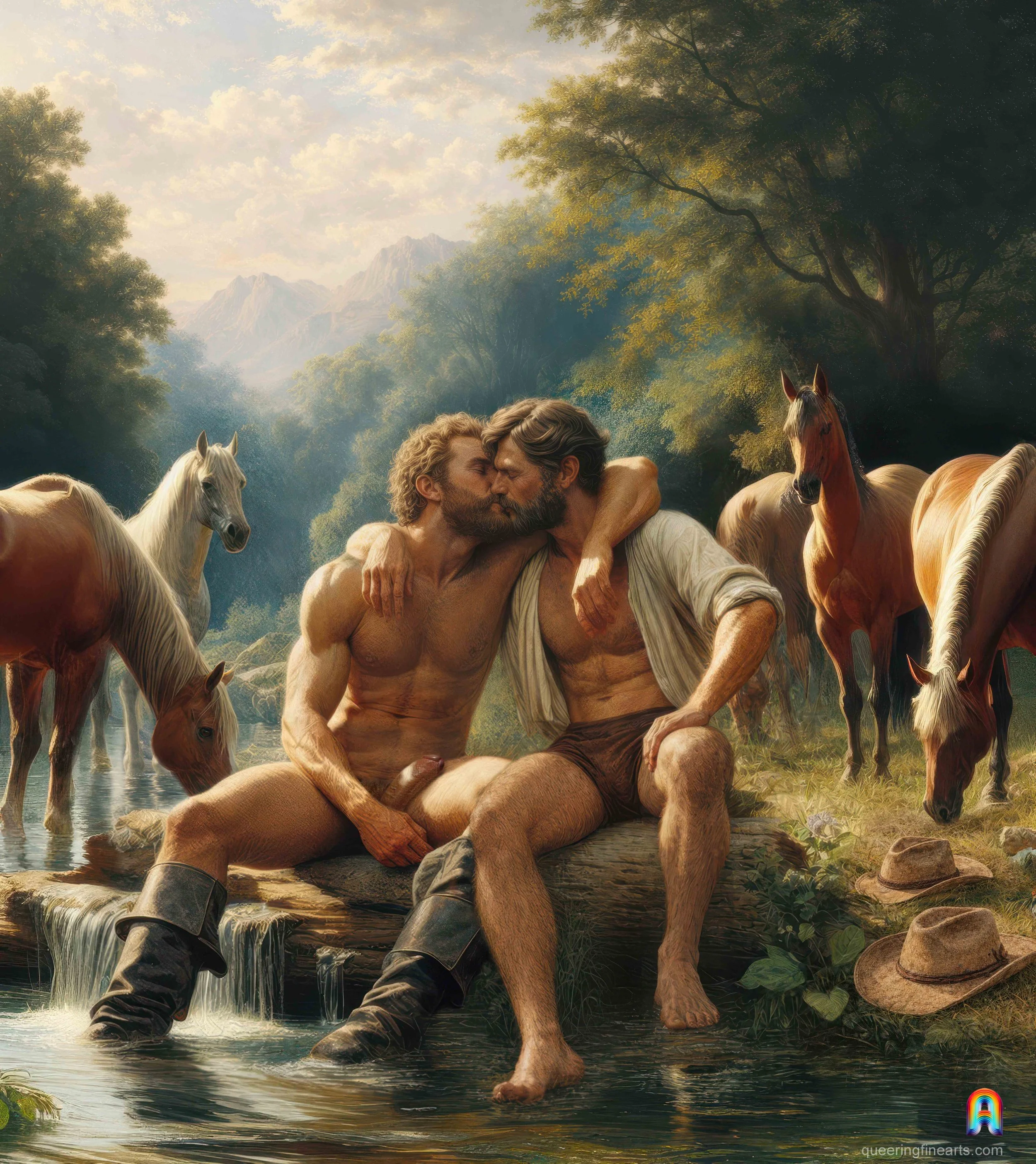
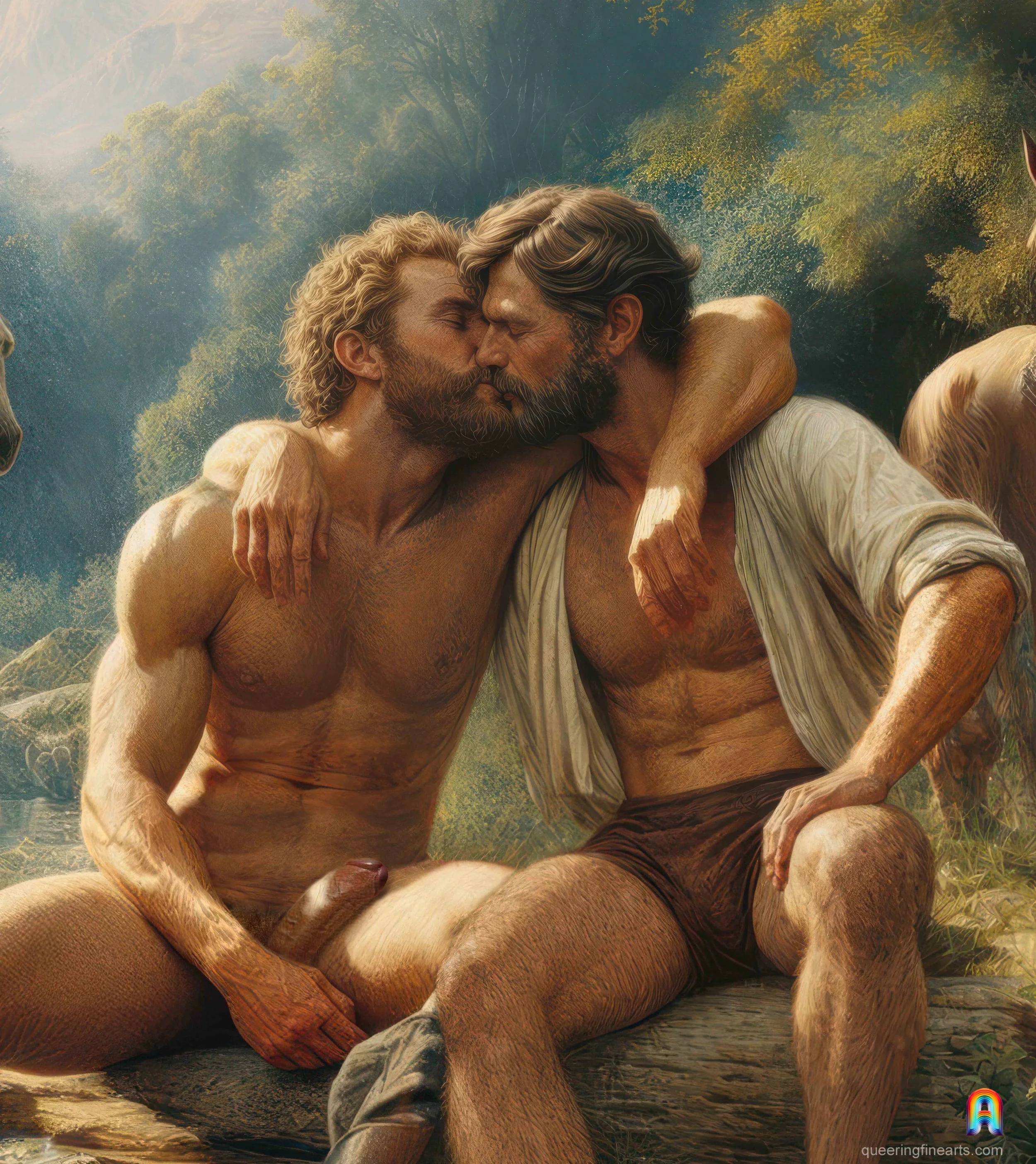
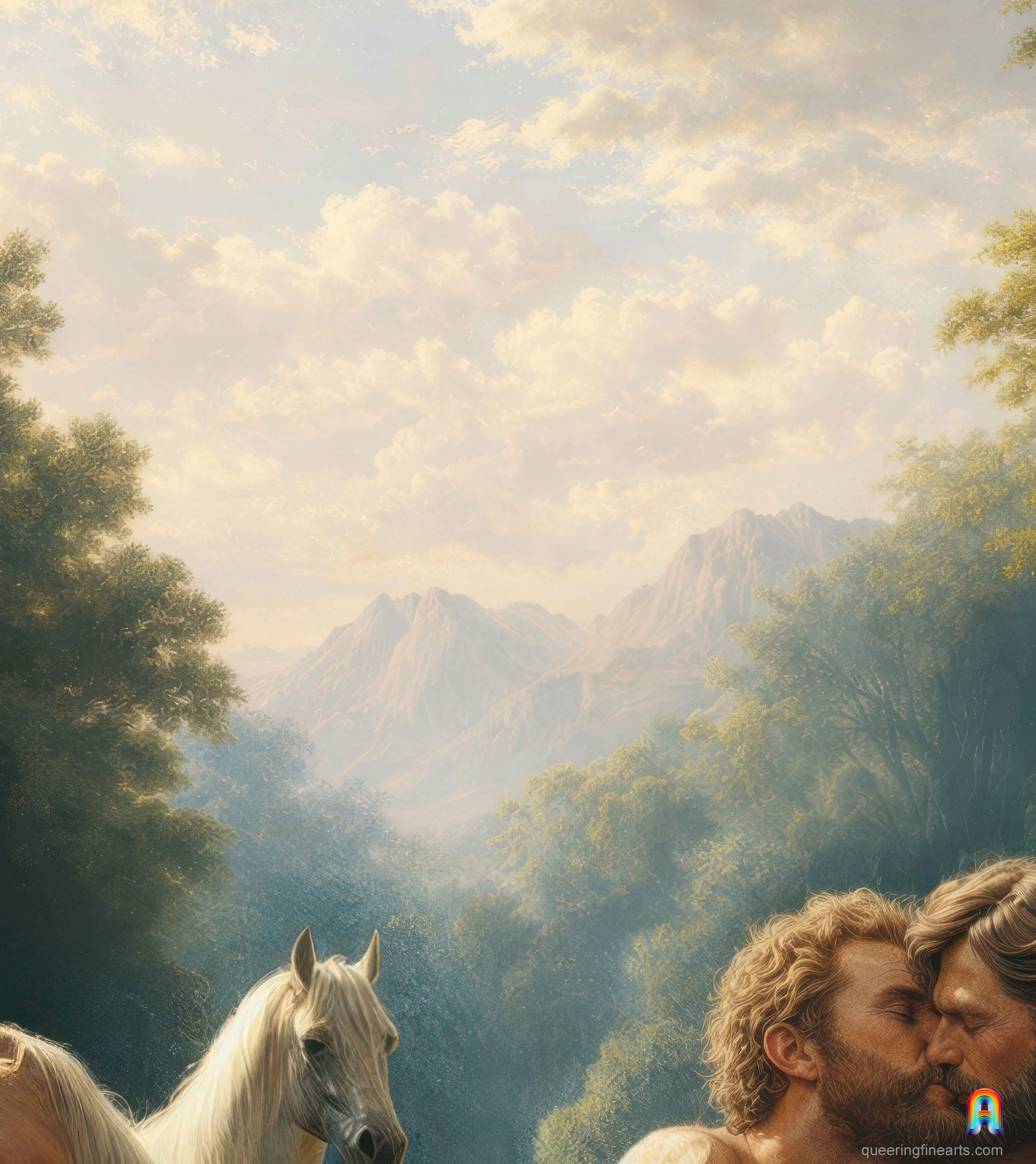
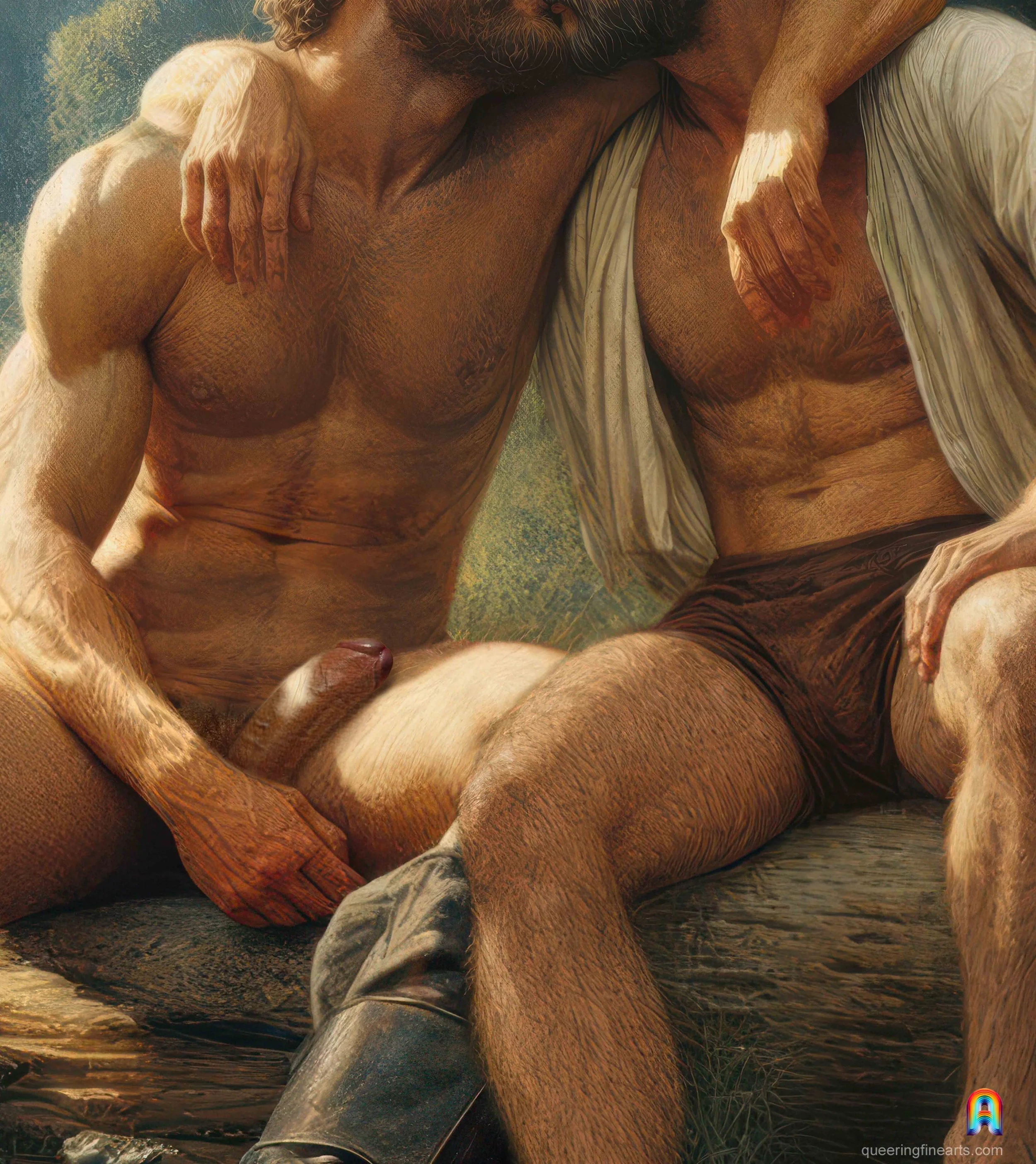
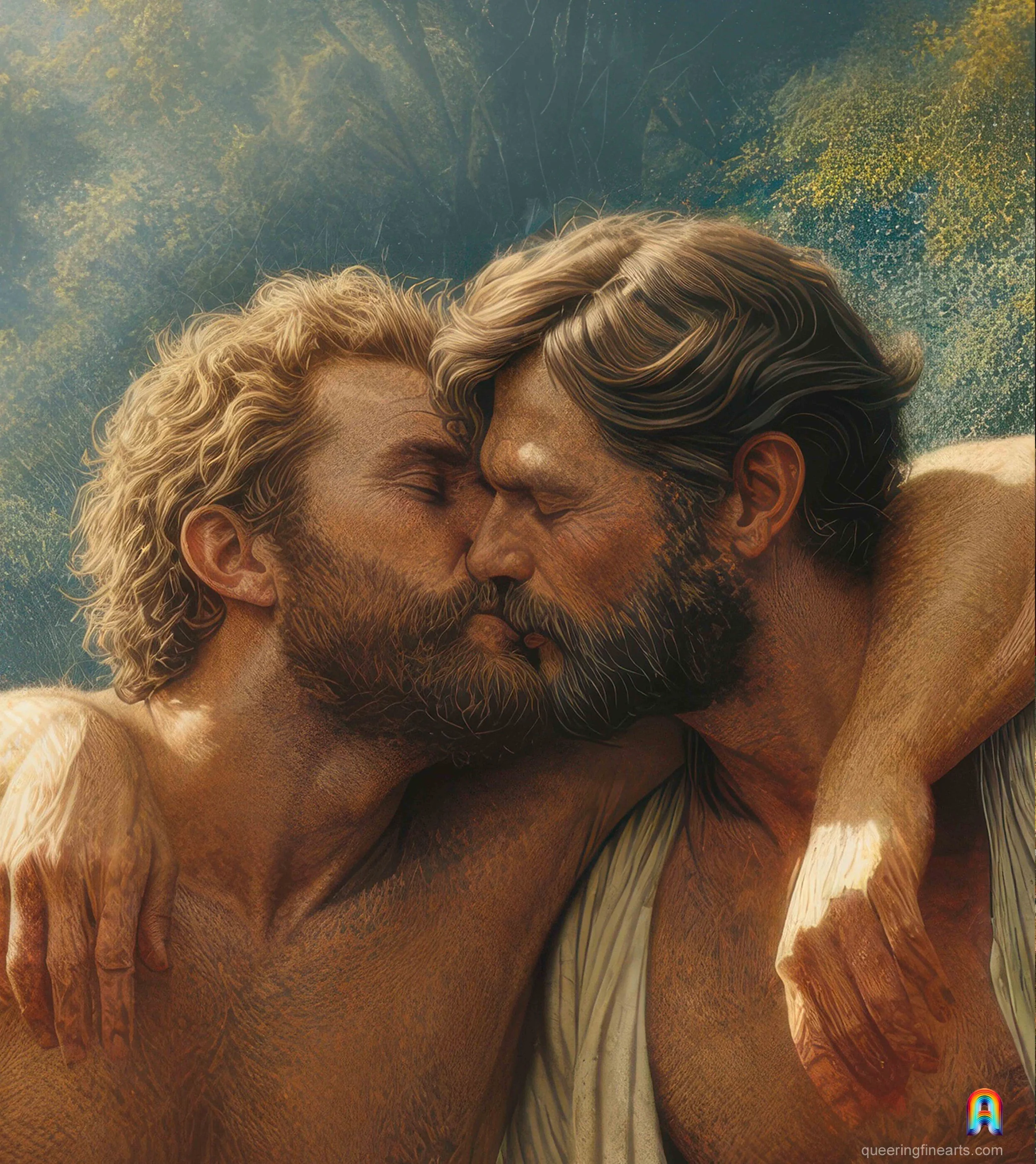
The scene depicts a pause beside a stream, set within a North American Western landscape constructed according to the codes of monumental nineteenth century landscape painting¹. Two cowboys sit side by side on a fallen tree trunk, their feet immersed in the water. Their bodies occupy the center of the composition and immediately draw the viewer’s eye. One of the men is entirely nude except for a pair of high shaft western boots. His body is muscular, openly exposed, and his erect sex is visible and unapologetically present². The other wears a light-colored shirt worn widely open and a rudimentary pair of shorts. He wraps his arm around his companion and kisses him on the mouth in a frontal, unambiguous gesture.
A Simple Life
The contact is intimate and direct. The arm draped across the shoulders, the closeness of the torsos, and the relaxed posture of the bodies suggest an established familiarity rather than a furtive impulse, a moment fully lived. Nudity and erection are integral to the scene³.
Complicit Stallions
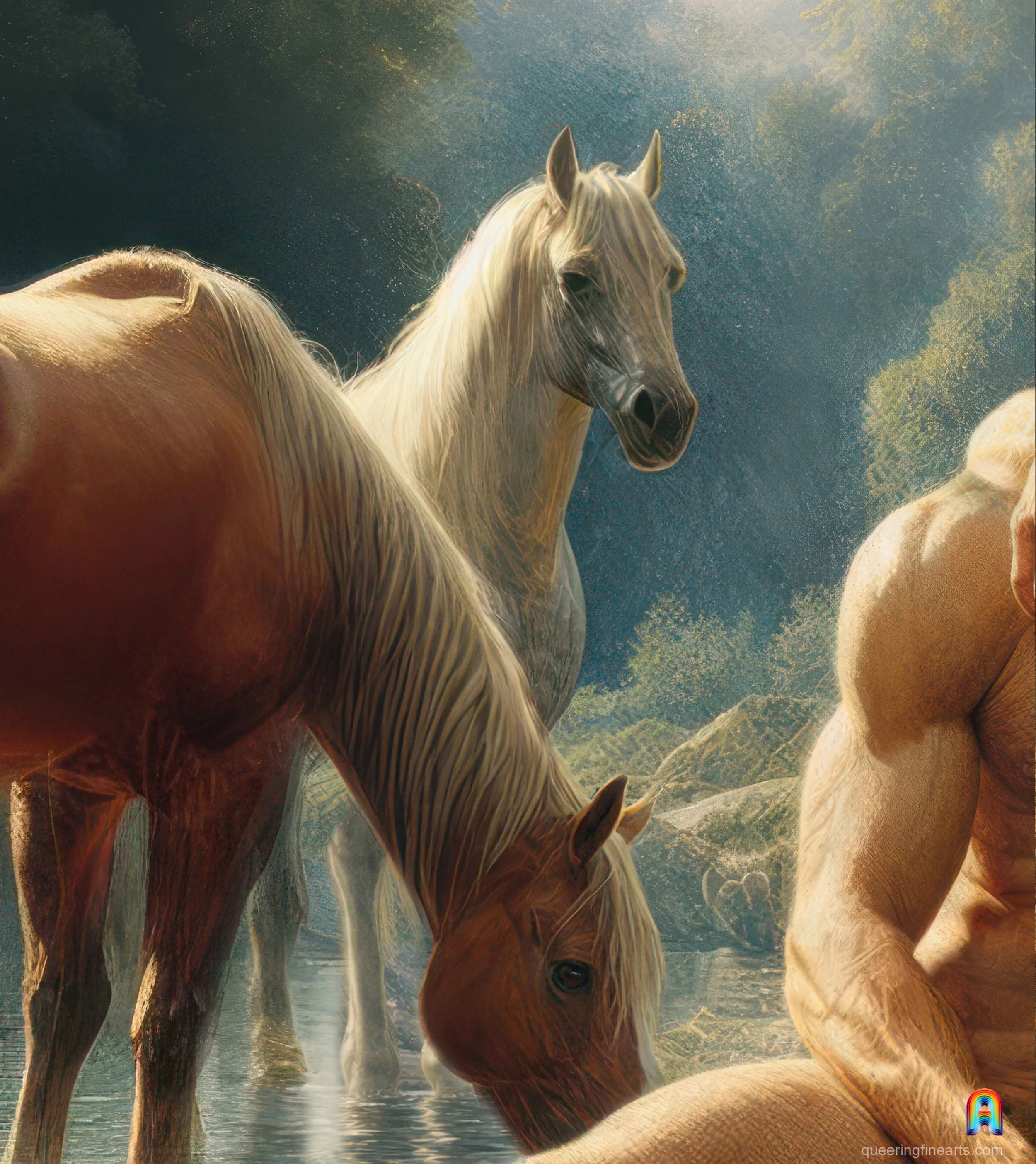
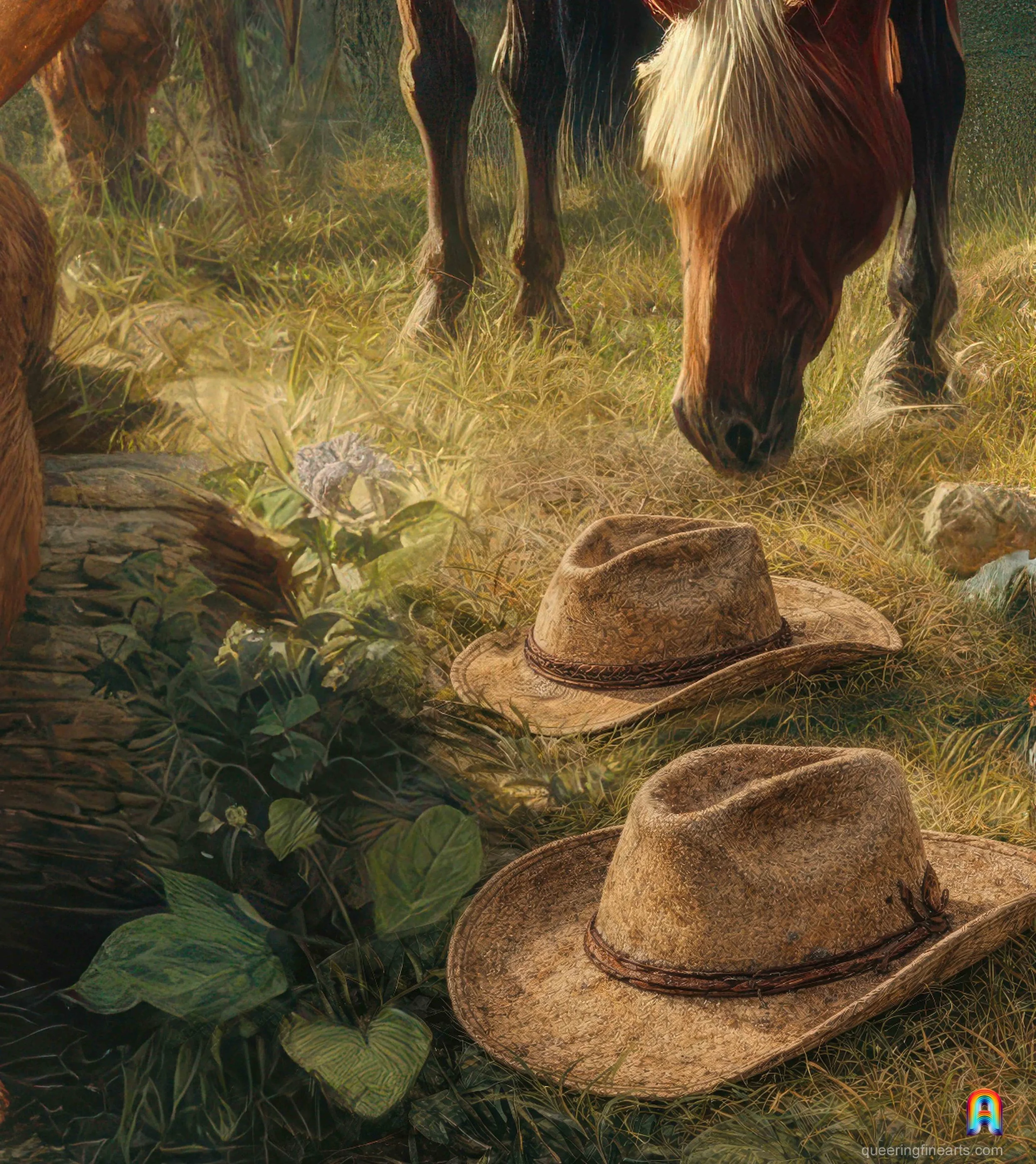
Around them, several unsaddled horses occupy the space. On the left, a white horse drinks calmly from the stream. On the right, another horse lowers its head toward a hat tossed into the grass, as if approaching it out of curiosity. A second hat lies nearby, partially absorbed by the vegetation. The remaining horses, tawny in color, stand in the tall grass, indifferent, almost protective in their calm presence⁴.
Harmony
In the background, bluish mountains are set within a carefully controlled atmospheric depth. The landscape opens broadly, placing the human scene within a vast and stable natural continuum⁵.
Monumental Tradition
The High Shaft Boots is formally inscribed within the tradition of monumental landscape painting associated with the circle and production environment of Albert Bierstadt (1830–1902). A German American painter trained in Düsseldorf, Bierstadt is known for his large-scale compositions of the American West, produced from travels and expeditions in the field. His practice relied on systematic preparatory studies and on a mode of production designed both for spectacular public exhibitions and for a private market eager for grand and idealized landscapes⁶. The composition, the scale of the setting, the spatial depth, and the atmospheric treatment clearly refer to this legacy. The light is constructed according to a logic typical of mid nineteenth century American landscape painting. It is a diffuse illumination that unifies the planes, softens contrasts, and grants the scene an idealized legibility. It seeks neither dramatic effect nor theatrical tension, but visual harmony, situating the human figures within a natural continuum rather than in opposition to the landscape.
Reclaiming the Myth
This traditional visual framework is, however, profoundly displaced by the central subject. Where Western painting long emphasized conquering virility, labor, and a strictly regulated masculine camaraderie, the work places an affective and sexual relationship between two men at the heart of the landscape⁷. The choice to depict one of the cowboys nude and erect is decisive. It forecloses any allusive or metaphorical reading and affirms without detour the sexual dimension of the relationship. Desire is shown as a bodily reality, fully embedded in the experience of the Far West, without pathos and without imposed clandestinity.
Hats Down
The abandonment of the hats functions as a legible visual metaphor. The hat, an emblematic element of the cowboy, a marker of social role and codified masculinity, is here casually cast onto the ground. This gesture materializes a voluntary suspension of norms and public identities⁸. The men shed what designates them in order to enter a space of intimacy where the social gaze no longer operates. The unsaddled horses extend this reading. Freed from all harness, they cease to be instruments of labor or domination and become figures of availability and freedom.
The Cowboy, a Reimagined Archetype
This rereading of the cowboy as a figure of desire and bodily freedom finds an extension in the twentieth century in certain popular visual constructions of masculinity, notably through the figure of the Marlboro Man. That character left a lasting mark through the world it crystallized. A world of men, of chosen solitude, of self-mastery and quiet authority, where virility was defined through restraint and physical presence rather than through speech. For many gay men, this figure could function as a symbolic territory to be reoccupied, its boundaries shifted to inscribe a fully legitimate queer presence⁹.
Queer Reconquering Its Ground
What is at stake here is not the adoption of a dominant code, but its transformation. The cowboy imaginary, originally conceived as a hetero formatted emblem, lends itself to a rereading in which strength, endurance, and camaraderie no longer exclude desire between men. From this perspective, virility is no longer opposed to homosexuality, but integrated into it as one of its possible expressions. The High Shaft Boots participates in the same gesture. The work seeks neither contrast nor provocation, but continuity. The same bodies, the same landscapes, the same signs of freedom can accommodate an affective and sexual relationship between men without losing their symbolic coherence.
Homosexuality Returned to the Everyday
This logic of reappropriation also finds explicit expression in twentieth century gay visual culture. In the work of Tom of Finland (1920–1991), male figures draw on archetypes of robustness, confidence, and belonging to strongly codified masculine worlds, while introducing a clear and unapologetic visibility of desire. This reinsertion takes on a different tone, more diffuse and more everyday, in the work of George Quaintance (1903–1957). In his paintings and drawings, the cowboy, the farmer, or the laborer appears as a pastoral and sensual ideal, rooted in the land, the body, and male camaraderie. Desire circulates there without emphasis, integrated into scenes of rest, work, and shared proximity. This is neither provocation nor spectacular reversal, but an extension: the return of homosexuality to the ordinary realm of gestures, affects, and human relationships, on equal footing with any other form of intimate life.
A Solid Historical Foundation
Historical research conducted over the past several decades has profoundly renewed our understanding of relationships between men in the context of the Far West. Far from the image of an exclusively heterosexual and silently normalized world, work in social history and gender studies has shown that affective and sexual relationships between cowboys were frequent, structural, and largely conditioned by the demographic and social realities of Western territories¹¹. In predominantly male environments marked by isolation, mobility, and the prolonged absence of women, relationships between men did not constitute a marginal exception, but an ordinary modality of intimate life.
Documentary Traces
Available sources letters, personal journals, travelers’ accounts, judicial testimonies, and administrative documents attest that such relationships could be known, tolerated, and sometimes even integrated into local forms of sociability, so long as they did not threaten the organization of labor or group cohesion¹².
Before Pseudo Science
Homosexuality was not necessarily named there as an identity, but lived as practice, attachment, and affective continuity among men sharing the same harsh daily life. What urban moral norms at the turn of the twentieth century would later seek to pathologize belonged then to a form of social pragmatism and an economy of bonds¹³.
Expanding the Horizons of the Far West
It is from this perspective that The High Shaft Boots offers a rigorous and historically plausible rereading of the American Western imaginary. The work does not project a contemporary reading onto the nineteenth century, but situates itself within a documented reality. The intimacy between the two cowboys does not stem from provocation, but from a coherent and possible restitution of inter masculine relationships as they existed in the Far West. By integrating explicit male homosexuality at the core of a pictorial framework inherited from the great landscape tradition, the work does not transgress history. It reveals a long-neglected perspective. It reminds us that these landscapes were also sites of desire and relationships between men, and that the freedom celebrated by Western painting could concern bodies and affects as much as territories.
QFA
A full text devoted to this reclamation of the cowboy imaginary, its circulation between dominant culture and queer cultures, and its historical and affective stakes will be published shortly in Chronicles on Queering Fine Arts.
QFA
Curiosity Piqued?
1. Angela Miller, Empire of the Eye: Landscape Representation and American Cultural Politics, 1825–1875, Ithaca, Cornell University Press, 1993.
2. Thomas Waugh, Hard to Imagine: Gay Male Eroticism in Photography and Film from Their Beginnings to Stonewall, New York, Columbia University Press, 1996; James M. Saslow, Pictures and Passions: A History of Homosexuality in the Visual Arts, New York, Viking, 1999.
3. David Halperin, How to Do the History of Homosexuality, Chicago, University of Chicago Press, 2002.
4. Nancy K. Anderson et al., Frederic Remington: The Color of Night, New York, Metropolitan Museum of Art, 2003.
5. Kevin J. Avery, Bierstadt: Art and Enterprise, New York, Hudson Hills Press, 1990.
6. Julie Schimmel, “The West as America: Reinterpreting Images of the Frontier”, in William H. Truettner ed., The West as America, Washington, Smithsonian Institution Press, 1991.
7. William W. Savage Jr., The Cowboy Hero: His Image in American History and Culture, Norman, University of Oklahoma Press, 1979.
8. Peter Boag, Re-Dressing America’s Frontier Past, Berkeley, University of California Press, 2011.
9. Gareth Longstaff, The Media and the Models of Masculinity, London, Routledge, 2013.
10. Jonathan D. Katz ed., Tom of Finland: The Art of Pleasure, New York, Abrams, 1998.
11. Peter Boag, Re-Dressing America’s Frontier Past, Berkeley, University of California Press, 2011.
12. John D’Emilio and Estelle B. Freedman, Intimate Matters: A History of Sexuality in America, Chicago, University of Chicago Press, 1997.
13. Michel Foucault, The History of Sexuality, Volume I: An Introduction, New York, Pantheon Books, 1978.