


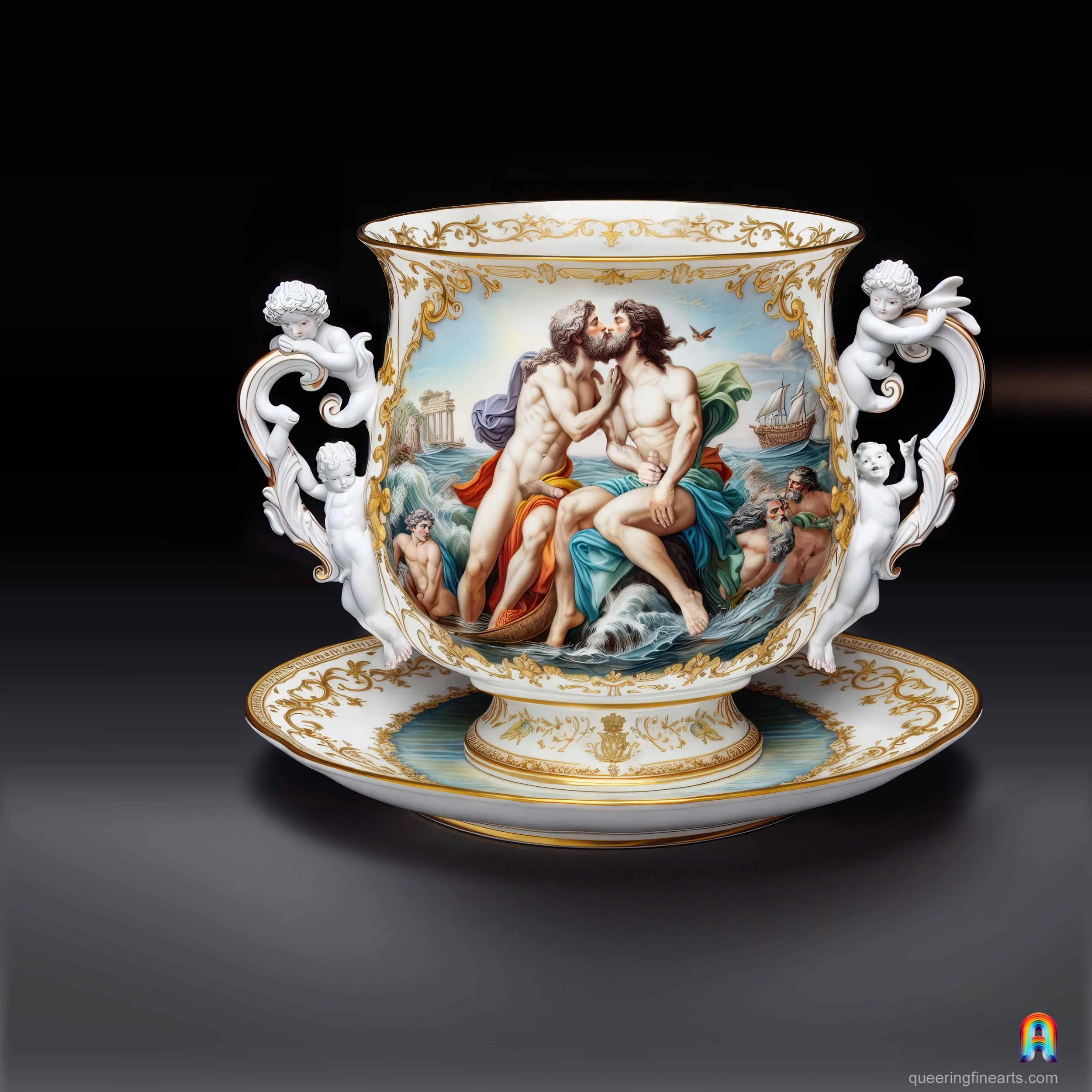
Game of Foam, or Nerites and Glaucus
A two-handled cup with its matching saucer, from the service of Prince Eugene of Savoy
Imperial Porcelain Manufactory of Vienna
Hard-paste porcelain, polychrome decoration and gilding, circa 1715-1720
Private collection
An Assertion in Porcelain
On the flaring body of this two-handled cup, encircled by a rich band of burnished gold and raised on a matching foot, the central scene asserts itself with a languid authority. Two nude men, their musculature idealized, stand at the water’s edge and meet in a frontal kiss, a gesture of fully assumed intimacy¹. The title of the work identifies them as Nerites and Glaucus, rare yet eloquent marine deities². Nerites, whose penis is shown in semi-erection, embodies masculine beauty exalted by divine love, a figure of perfection offered to the gaze. Glaucus, a former fisherman transformed into a prophetic god, boldly masturbating, incarnates the vital impulse born of metamorphosis³. Their union clearly articulates desirability and transformative energy in a direct and confident celebration of male love. Clear, even light glides across their bodies like a sovereign glaze, exalting flesh and gesture alike. Desire here asserts itself as a noble force, inscribed within mythological time.
A Complicit Marine Chorus
Around the central couple, several male figures rise from the waves. Together they form a complicit masculine entourage in which the couple’s intimacy appears neither exceptional nor isolated, but naturally embedded within a world where pleasure between men flourishes⁴.
A Language for Initiates
This iconography addresses its patron, whose identity will be revealed later, through a fully mastered humanist erotic language, bringing together Nerites and Glaucus for poetic and symbolic purposes. The choice of these secondary figures from the marine pantheon allows for the assertion of a clear and learned form of divine homosexuality. Metamorphosis, central to their myths, structures the scene as an active principle of desire. The technical mastery of Viennese porcelain, evident in the clarity of the flesh tones, the precision of the draperies, and the controlled stylization of the sea, supports this reading without excess⁵. Conceived for a select table setting, the cup transforms conviviality into a visible and sovereign assertion of love between men, inscribed within the mythological order and fully embraced as such. One can easily imagine that this beautiful object invited two people to drink from it together, complicit in a shared intimacy, where the contact of two lovers’ lips could silently extend the painted scene.


Theatricalities of the Masculine
In Viennese production of the first third of the eighteenth century, male figures often appear as antique heroes, warriors, or gods, invariably caught within narratives of power or victory. Here, that model is displaced. The bodies are heroic, yet their function is neither military nor triumphal. They exist for one another, in an assumed proximity that subtly diverts the academic lexicon of the male nude. Porcelain thus becomes a space of intimate theater. Virility is shown without attributes of domination. It is defined by reciprocity, by the concordance of gestures, and by the near-perfect symmetry of the poses. The putti sculpted on the handles, figures traditionally associated with love and play, do not comment on the scene through irony. They frame it like a discreet blazon, signaling that what unfolds at the center belongs to a legitimate affective register, though one rarely named⁶.
A Legible Scene
The composition leaves little room for ambiguity. Eyes are closed, hands rest without hesitation, bodies incline toward one another with quiet certainty. Nothing belongs to coded allusion or mere decorative innuendo. The cup embraces a direct representation of male intimacy, articulated through a visual vocabulary borrowed from an idealized Antiquity, yet transposed onto an object of daily use reserved for an extremely restricted circle. The marine landscape, with its distant architecture and sailing ship, reinforces the sense of a world apart, beyond the immediate constraints of court life. This is less a precise mythological narrative than a symbolic space in which desire may appear without further narrative justification⁷.

Imperial Legitimacy
In Vienna, under the reign of Charles VI, the imperial court cultivated a complex relationship to morality and intimacy. Profoundly Catholic in its institutions, it was also a place of extreme refinement, where art often served as a mediator for what could not be openly expressed. Porcelain, still a relatively young medium of prestige, offered an ideal terrain for such discreet displacements⁸.
A Chosen Object
Imagining that such a piece was conceived for a patron capable of grasping its implications is entirely plausible. It belongs to a culture of chosen objects, intended to be seen by a few peers, read with intelligence, and preserved away from indiscreet eyes⁹.
Prince Eugene of Savoy
The name of Prince Eugene of Savoy-Carignano (1663-1736) naturally emerges as that of a possible recipient, as his life and personality align closely with the audacity of the object. Born in Paris and raised at the court of Versailles, this prince of Savoyard origin was rejected by Louis XIV, who refused him a military command. He then turned to the imperial court of Vienna, where he became, paradoxically, the most celebrated general of the Habsburgs, a leading statesman, and an enlightened patron of the arts. This singular trajectory, from exile to pillar of the Empire, set him apart as a figure of exceptional independence and prestige.
Indifference to Conventions
Never married, he cultivated in his sumptuous Viennese residences, such as the Belvedere Palace, a life of great independence, surrounded almost exclusively by men. His circles, bringing together officers, secretaries, artists, and scholars, formed exclusively masculine microcosms in which homosociality assumed a strongly affective and intellectual dimension. The correspondence and memoirs of his contemporaries, in both Vienna and Versailles, evoke a man indifferent to marital conventions, sensitive to masculine beauty, and whose intimacy with his favorites provoked pointed commentary¹⁰.

Audacity Enabled by Status
In this context, a cup commissioned from the Imperial Porcelain Manufactory of Vienna, a prestigious institution of which he was a natural client, elegantly diverting the codes of heroic iconography toward a celebration of male love, would have suited his taste, status, and sensibility perfectly. Such an object embodied the very type of refined and coded presentation that could circulate within his restricted circle. For this prince with a singular path, victorious general, bibliophile, and builder, such a piece would have been far more than decoration, a discreet affirmation, a mirror of his inner world, and a testament to the intellectual audacity made possible by his extraordinary social position.
An Object of Truth
Between table display and silent affirmation, this Viennese cup opens a space of recognition. It reminds us that love between men has never been absent from court cultures, but has often found refuge in precious, discreet objects, destined to endure where official narratives fall silent.
In the controlled brilliance of its porcelain and the clarity of its central scene, this work restores a history long held in reserve.
QFA
Curiosity Piqued?
1. Alex Potts, Flesh and the Ideal. Winckelmann and the Origins of Art History, Yale University Press, 1994, pp. 135-160.
2. Karl Kerényi, The Gods of the Greeks, Thames and Hudson, 1951, pp. 64-66.
3. Ovid, Metamorphoses, Book XIII, translated and commented by Georges Lafaye, Les Belles Lettres, 2003.
4. Michael Rocke, Forbidden Friendships. Homosexuality and Male Culture in Renaissance Florence, Oxford University Press, 1996, pp. 1-38.
5. Ulrich Pietsch, Early Meissen Porcelain and Its European Contemporaries, Hirmer, 2011, chapters devoted to Vienna.
6. Thomas A. King, The Gendering of Men, 1600-1750, University of Wisconsin Press, 2004, pp. 3-32.
7. James M. Saslow, Ganymede in the Renaissance. Homosexuality in Art and Society, Yale University Press, 1986, pp. 213-245.
8. Thomas DaCosta Kaufmann, Court, Cloister, and City. The Art and Culture of Central Europe, 1450 to 1800, University of Chicago Press, 1995, pp. 312-340.
9. Randolph Trumbach, Sex and the Gender Revolution. Heterosexuality and the Third Gender in Enlightenment London, University of Chicago Press, 1998, pp. 87-112.
10. Louis de Rouvroy, duc de Saint-Simon, Memoirs, edited by Yves Coirault, Gallimard, Bibliothèque de la Pléiade, 1983, passages relating to Prince Eugene.