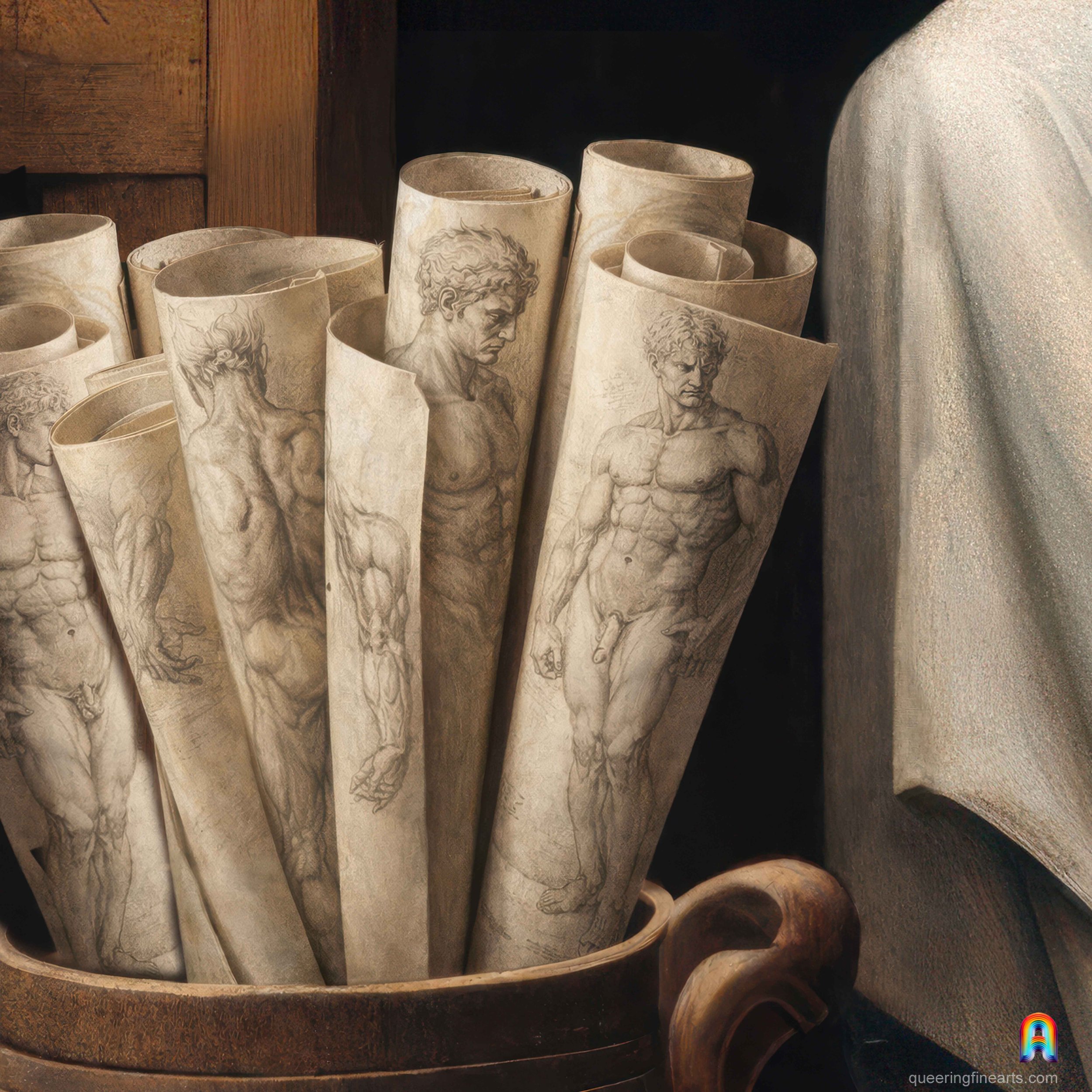
The Master and the Ideal Model
Workshop of Michelangelo (1475-1564)
Tempera on panel
Private collection
The Object of the Gaze
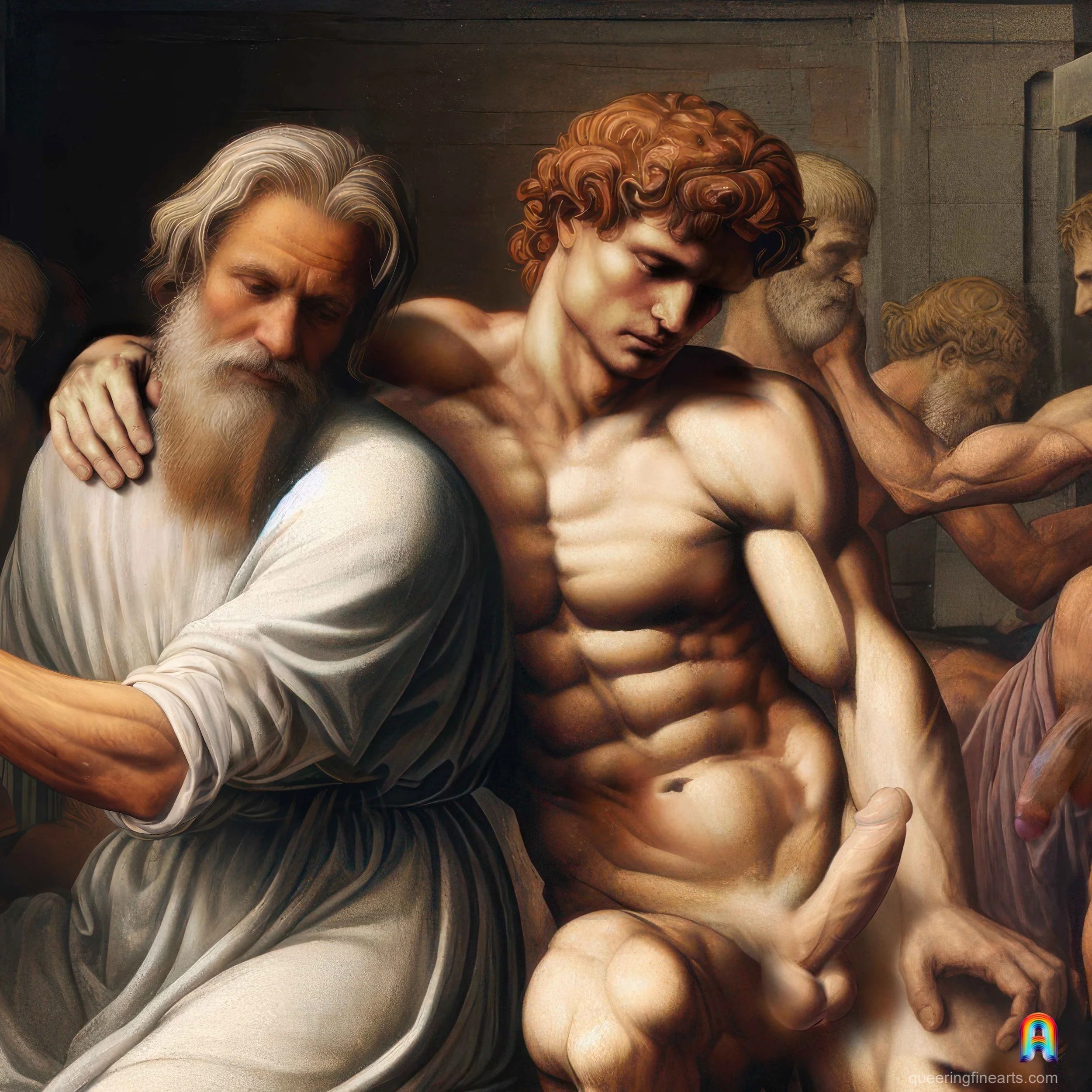
The scene unfolds in a Renaissance workshop structured by a deliberately restrained palette of stone tones, cool beiges, grays, and muted browns. A harsh, raking side-light carves out the forms and hollows out deep shadows, giving the male body an almost sculptural presence¹. The nude model sits in the foreground on a wooden bench, presented frontally, firmly anchored in space. His musculature is deliberately emphasized. The pectorals protrude, the abdominals are powerfully defined, the thighs thick and taut. The pale, cool flesh catches the light and isolates each muscular mass through a rigorous play of chiaroscuro. The model’s penis is fully visible, erect, voluminous, placed at the very center of the composition, treated as a major component of the body rather than as a secondary detail².
That Which One Burns
The master sits immediately beside the model, in an openly assumed physical proximity. His gaze is directed unflinchingly at the sexual organ, while his hand reproduces it on a large scale on the easel. The drawing enlarges the penis, renders it monumental, and asserts its power as a central fact of the male body. The gesture of drawing and the line of sight converge, binding observation, desire, and the making of the image³. The model slightly inclines his head toward the master and places his arm around his shoulders, establishing a clear relationship of familiarity and intimacy. In the background, other men are engaged in explicit amorous exchanges. Bodies touch, gestures are unambiguous, and these relations are neither concealed nor relegated. They are fully part of the represented space. The workshop thus appears as a place where the study of the male nude, the circulation of desire between men, and the creative act openly coexist, without moral partition or artificial separation between artistic labor and carnal experience⁴-⁵.


The Veiled Bias
A major and persistent tendency in Renaissance historiography, particularly in its most canonical production until the late twentieth century, has been to address male homosexuality through two intellectual postures that are both dominant and rarely questioned. The first rests on a heteronormative reading of the past that treats heterosexuality as self-evident and requiring no particular justification. The second applies to homosexuality an exceptionally demanding regime of proof, so high as to be virtually impossible to satisfy⁶. These two postures are not neutral. They structure how sources are read, hierarchized, accepted, or disqualified⁷.
An Inconvenient Obviousness
Within this framework, the role of workshop models in the Renaissance is almost always approached as a purely technical or pedagogical issue. The male model is described as an anatomical tool, a functional body necessary for learning to draw, for understanding proportion, movement, and contrapposto. This reading is entirely defensible, but it becomes problematic when it is used as a screen to neutralize any inquiry into desire⁸. The Renaissance workshop was nevertheless a closed, intensely homosocial space, where young and adult men interacted daily, often without female mediation, in situations of physical proximity and long duration⁹. Yet in classical historiography, this configuration is almost never questioned on the affective or sexual level, as if male desire for men were, by definition, improbable.
Asymmetrical Proof
This asymmetry appears clearly in the way historians treat evidence. When a Renaissance painter lives with a woman, shares his household, maintains a lasting relationship, or fathers children, these elements are generally sufficient to speak of a heterosexual relationship without requiring explicit declarations, erotic correspondence, or judicial testimony. Conversely, when an artist lives surrounded by young men, retains some of them for decades, repeatedly draws them, describes them with unusual affective intensity, or is publicly accused of sodomy, these elements are systematically deemed insufficient to advance the hypothesis of homosexual desire¹⁰. The same type of constellation of evidence thus does not produce the same interpretive effects depending on the presumed sexual orientation.
The Case of Leonardo
The case of Leonardo da Vinci is emblematic. Florentine archives attest that he was accused of sodomy in 1476 in an affair involving Jacopo Saltarelli. The charges were dismissed, a detail often cited to void the episode of all interpretive weight¹¹. Yet in other fields, a judicial accusation, even without conviction, is often mobilized as a meaningful indicator of social context and possible practices. Added to this is the prolonged relationship with Salaì, who entered Leonardo’s entourage at a very young age, was described by Leonardo himself as undisciplined and costly, yet was never durably dismissed, and was frequently identified as a model. Later literary sources, notably Lomazzo, explicitly evoke a sexual relationship between them. Here, dominant historiography invokes prudence, the lateness of the sources, and the risk of projection. But this prudence becomes asymmetrical when it transforms an accumulation of evidence into interpretive silence¹².
The Case of Il Sodoma
The same mechanism is at work in the reception of Il Sodoma. His very nickname, his public image in Vasari, the recurring anecdotes about his male entourage, and the persistence of this reputation in artistic literature all contribute to constructing a figure historically associated with homosexuality¹³. Yet a large part of scholarship strives to relegate these elements to the realm of moral caricature or defamation, without applying the same skepticism to hagiographic or heroicizing narratives concerning other artists. The suspicion of homosexuality is treated as an accusation that must be neutralized, rather than as a historical hypothesis to be evaluated with the same tools as others.
The Case of Michelangelo
The case of Michelangelo reveals another form of tension. The poems he addressed to Tommaso de’ Cavalieri, the affective intensity they express, and their language of desire are now widely acknowledged¹⁴. Yet as soon as one attempts to relate this dimension to the work on the male body, to the gifted drawings, to the sculptural gaze cast upon the flesh of men, a methodological boundary is immediately erected. Desire is accepted in the realm of text and sublimation, but hesitantly inscribed in the materiality of the workshop, as if the work of the model were required to remain pure of any erotic implication.



Methodological Censorship
These postures have a direct consequence for our understanding of the role of male models. By demanding for homosexuality a quasi-judicial level of proof, explicit and irrefutable, one mechanically produces invisibilization. The absence of explicit letters, confessions, or direct testimonies is interpreted as an absence of relationships, whereas it should be understood in light of the legal, moral, and religious repression that made such traces dangerous to produce and preserve¹⁵. To demand a written confession of sodomy in a context where it was a capital crime punishable by the stake is not a standard of historical rigor, but a logical impossibility. One thus demands proof that the social and juridical structure of the period actively sought to annihilate. This requirement of total proof becomes not a guarantee of rigor, but an instrument of methodological censorship.
Heterocentered Blindness
Going beyond reasonable historical caution does not mean asserting without nuance. It means recognizing that the standards of proof applied to male homosexuality are historically biased. In a context where the workshop is a place of training, hierarchical domination, bodily proximity, and the exchange of gazes, it is historically more fragile to assume the absence of desire than to envisage its presence.
History Caught in the Act
The question, then, is not whether all Renaissance painters desired their male models. The question is why, when faced with an evidentiary constellation comparable to that used for other aspects of private life, homosexuality continues to be treated as an exceptional and suspect hypothesis, almost always relegated outside the field of legitimate interpretation, thus reproducing, under the guise of scientific neutrality, the normative silence of the period.
QFA
Curiosity Piqued?
1. Baxandall, Michael. Painting and Experience in Fifteenth-Century Italy. Oxford, Oxford University Press, 1972.
2. Boswell, John. Christianity, Social Tolerance, and Homosexuality. Chicago, University of Chicago Press, 1980.
3. Bray, Alan. Homosexuality in Renaissance England. London, Gay Men’s Press, 1982.
4. Dinshaw, Carolyn. Getting Medieval: Sexualities and Communities, Pre- and Postmodern. Durham, Duke University Press, 1999.
5. Foucault, Michel. The History of Sexuality, Volume 1: An Introduction. New York, Pantheon Books, 1978.
6. Halperin, David. How to Do the History of Homosexuality. Chicago, University of Chicago Press, 2002.
7. Karras, Ruth Mazo. Sexuality in Medieval Europe: Doing Unto Others. New York, Routledge, 2005.
8. Kemp, Martin. Leonardo da Vinci: The Marvellous Works of Nature and Man. Oxford, Oxford University Press, 2006.
9. Rocke, Michael. Forbidden Friendships: Homosexuality and Male Culture in Renaissance Florence. Oxford, Oxford University Press, 1996.
10. Saslow, James. Ganymede in the Renaissance: Homosexuality in Art and Society. New Haven, Yale University Press, 1986.
11. Saslow, James. The Poetry of Michelangelo: An Annotated Translation. New Haven, Yale University Press, 1991.
12. Simons, Patricia. The Sex of Men in Premodern Europe. Cambridge, Cambridge University Press, 2011.
13. Steinberg, Leo. The Sexuality of Christ in Renaissance Art and in Modern Oblivion. Chicago, University of Chicago Press, 1996.
14. Turner, James Grantham. Schooling Sex: Libertine Literature and Erotic Education in Italy and England. Oxford, Oxford University Press, 2003.
15. Welch, Evelyn. Art and Society in Italy, 1350-1500. Oxford, Oxford University Press, 1997.