Merlin and Uther Pendragon
Pre-Raphaelite Circle
Unknown artist
Oil on canvas, circa 1860-1870
The Avalon Mythographic Museum
The Vigil of the King and the Mage
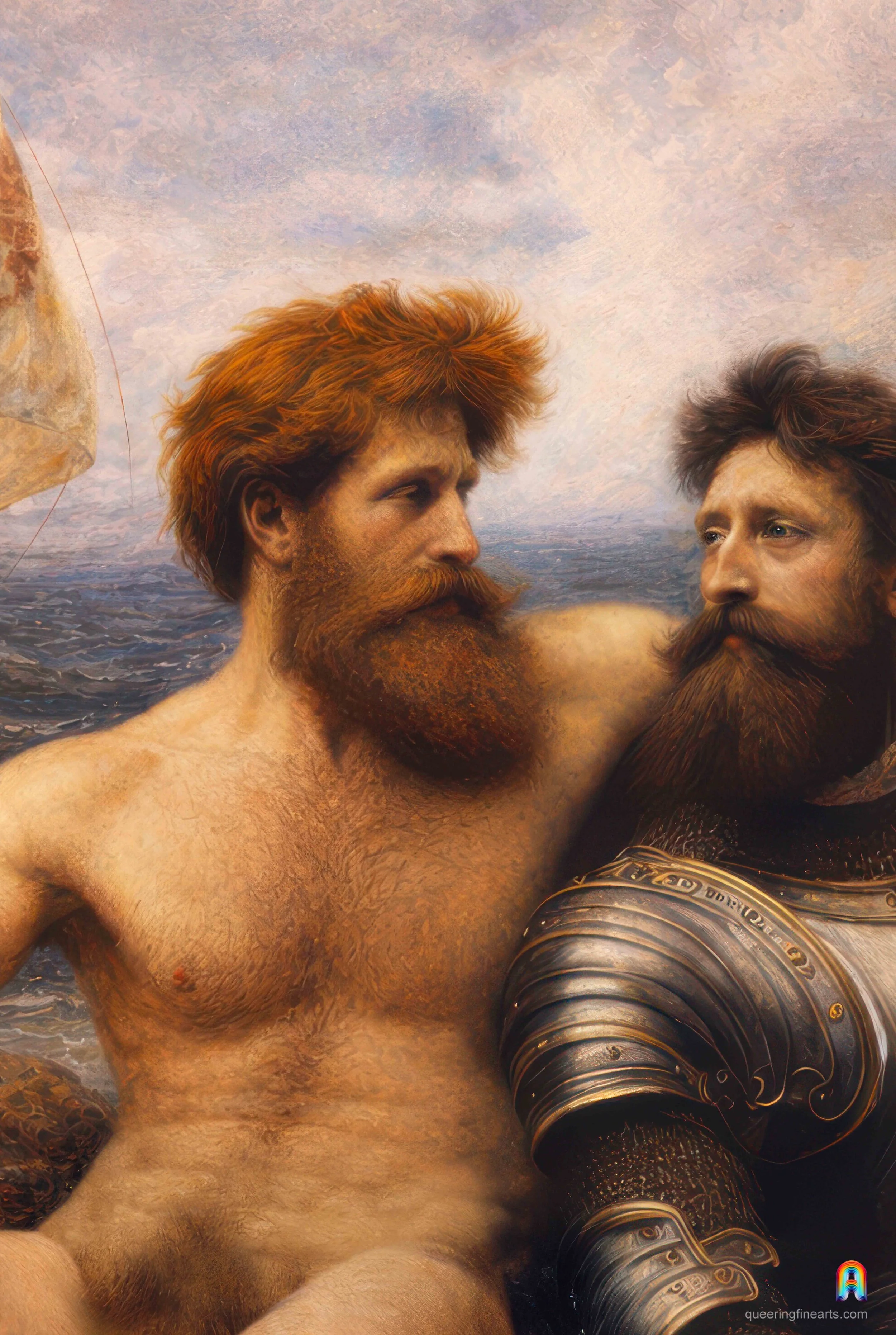
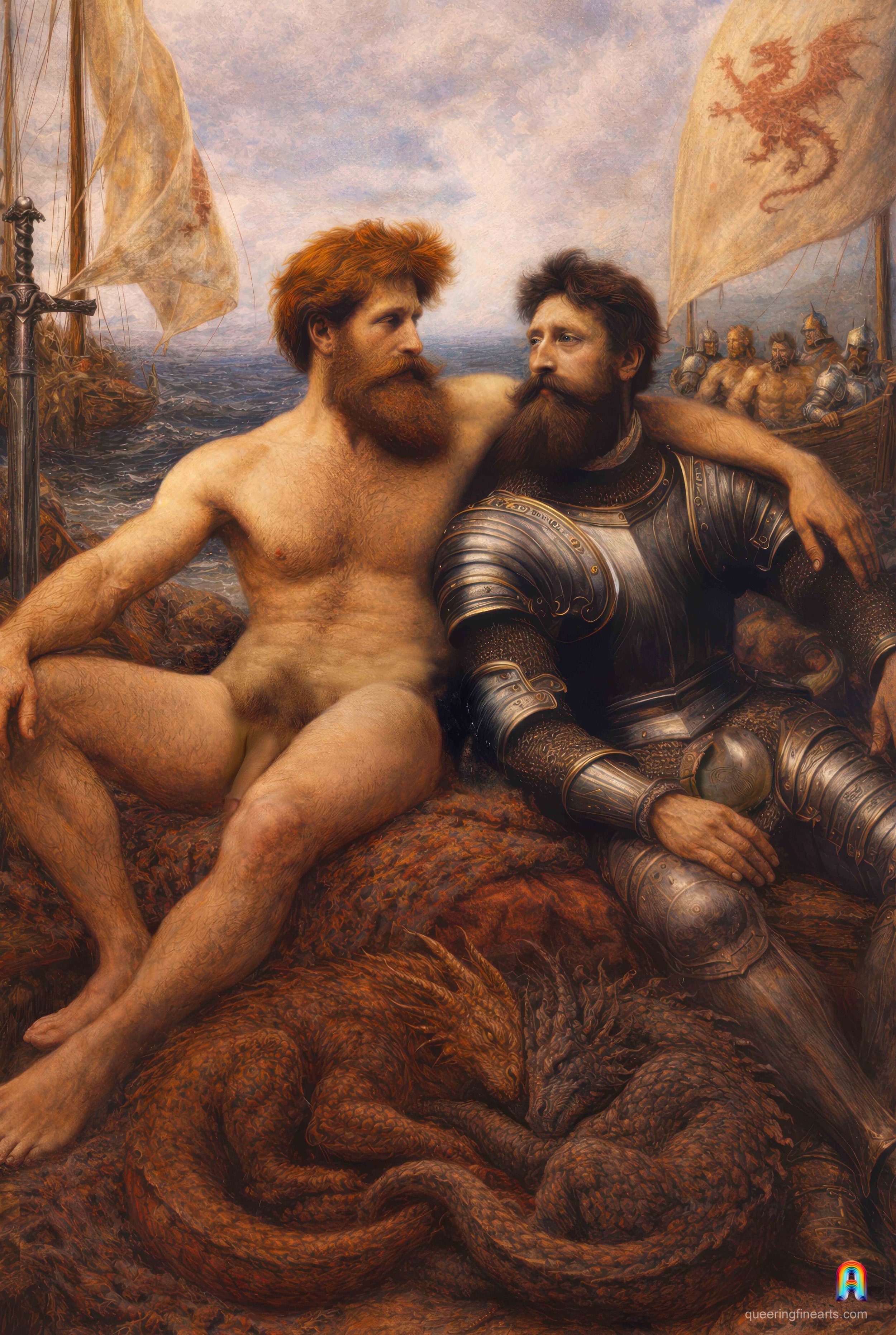
The work Merlin and Uther Pendragon presents itself as a scene of rest and suspended communion, at once intimate and mythological, in which the Arthurian matter is reread through a freer symbolic and affective lens¹. Two male figures occupy the center of the composition, seated side by side within a vessel moving upon the sea². Their bodies form an almost circular axis, reinforced by Merlin’s bare arm laid around Uther’s shoulders, a gesture of protection, closeness, and chosen bond, reaching far beyond mere warriorly companionship³.
Merlin, Figure of the First World
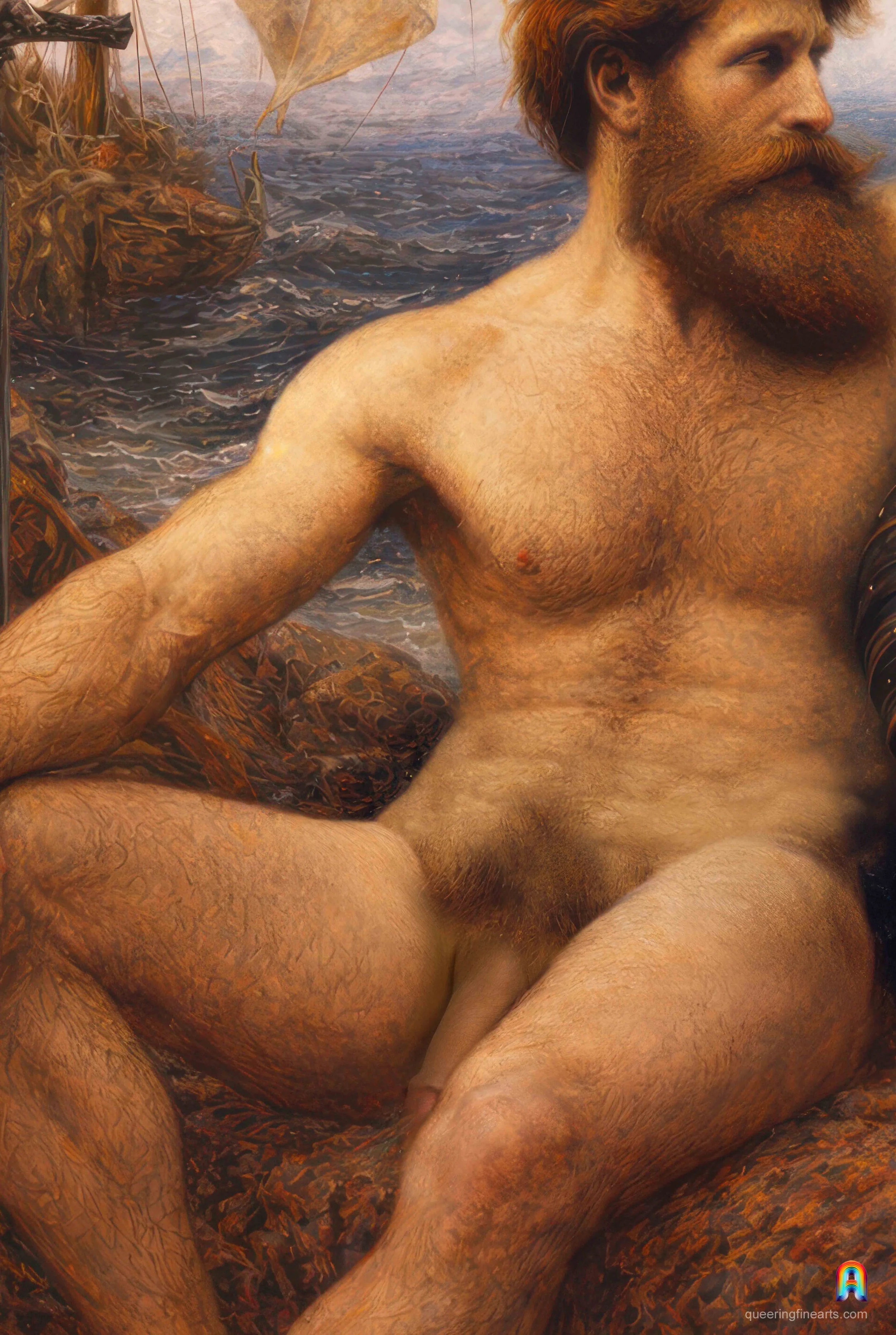
Merlin, wholly unclothed, embodies a primordial nature, anterior to the codes of chivalry and political power⁴. His nakedness belongs to an organic presence, rooted in the flesh and in the sensible world. It calls forth the figure of the wild prophet, the mage bound to ancient forces, to water and air and the deep powers of the earth. His russet beard and tawny hair echo the warm tones of the dragon slumbering at his feet, creating a visual and symbolic continuity between man, mythic beast, and the elements themselves⁵.
Power in Armor
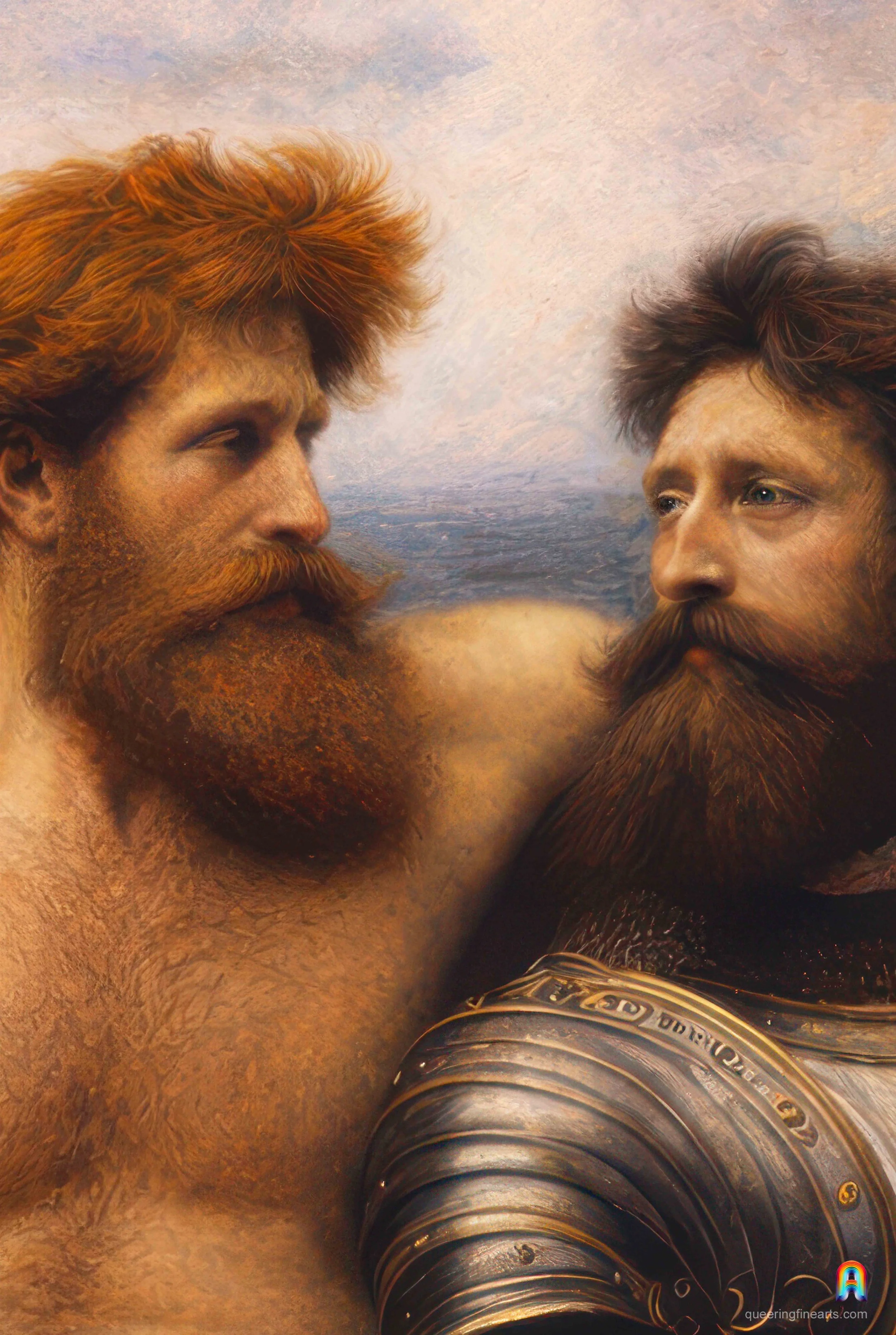
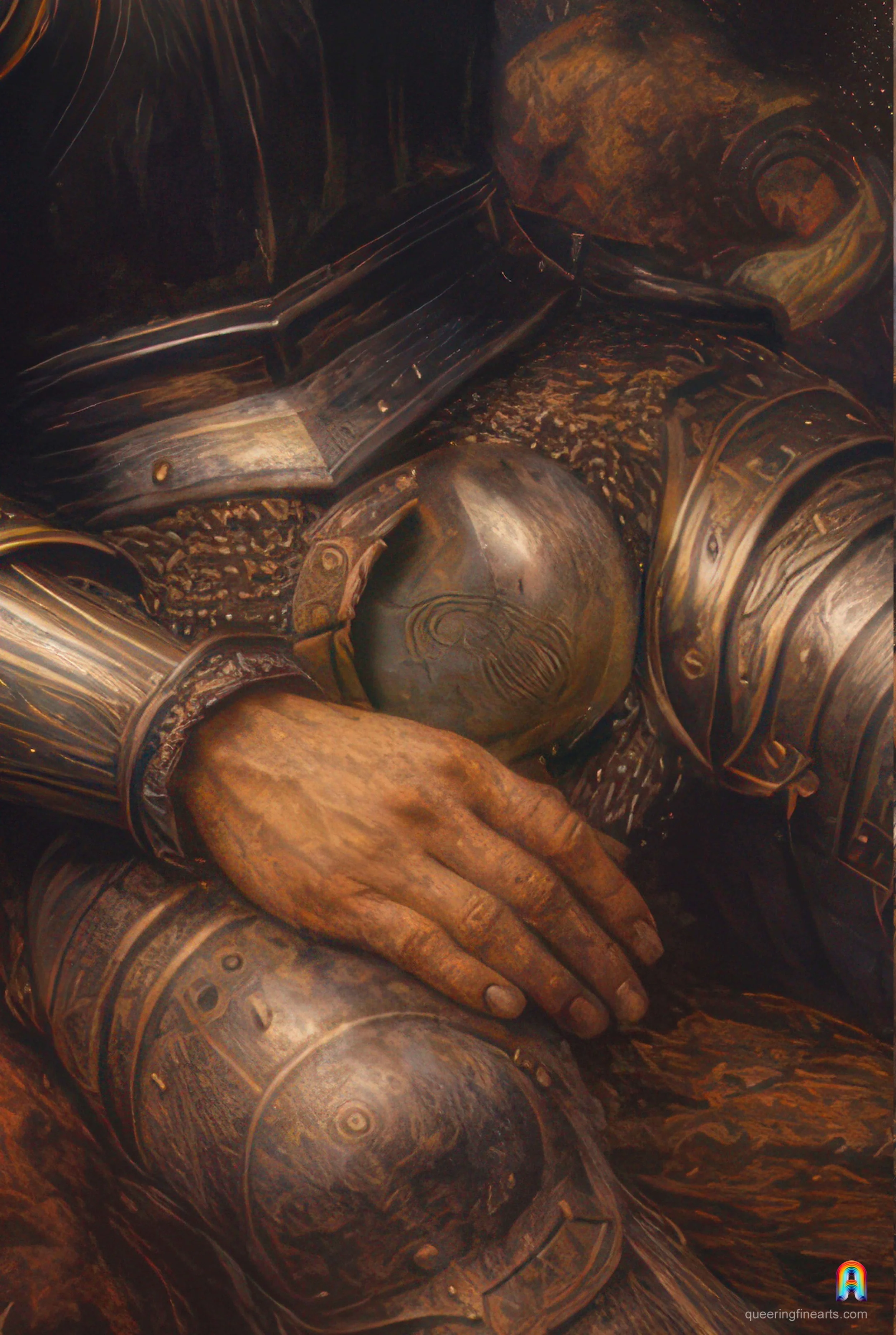
Uther Pendragon, by contrast, appears clad in full armor⁶. The polished metal, richly wrought, gathers the light and proclaims his belonging to the realms of power, war, and kingship yet to come. This armor enters into dialogue with Merlin’s naked body and is inscribed within a relation of balance. It acts as a second skin, rendered gentle by the nearness of the mage. The contrast between nakedness and armor becomes an accepted complementarity. Merlin embodies the unseen source of power, while Uther represents its earthly and political expression.
A World in Suspension
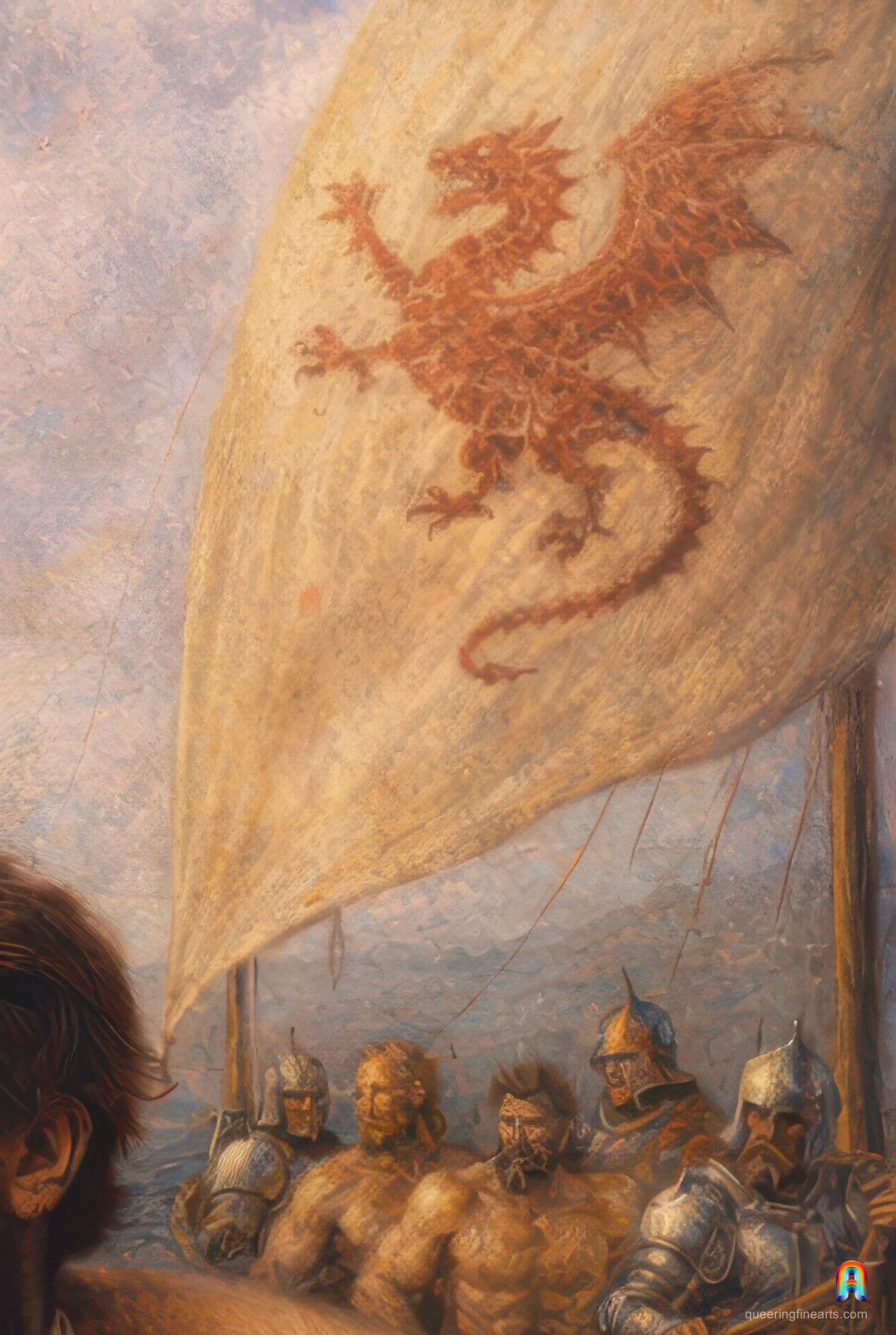
In the background, the troubled sea and the ships whose sails bear dragons set the scene within a moment of transition. The world is in transformation, warlike forces gather, while time itself seems suspended around the two men. The fighters visible in the other vessels dissolve into a semi-darkness that hints at a story. Their presence structures the background without drawing attention away. The true dramatic center lies in the unequal exchange of gazes between Merlin and Uther. Merlin fixes Uther with a dense and almost questioning attention, while Uther turns his gaze aside and drifts pensively into the distance, absorbed by an inner horizon still unformed.
Strength Granted to Wisdom
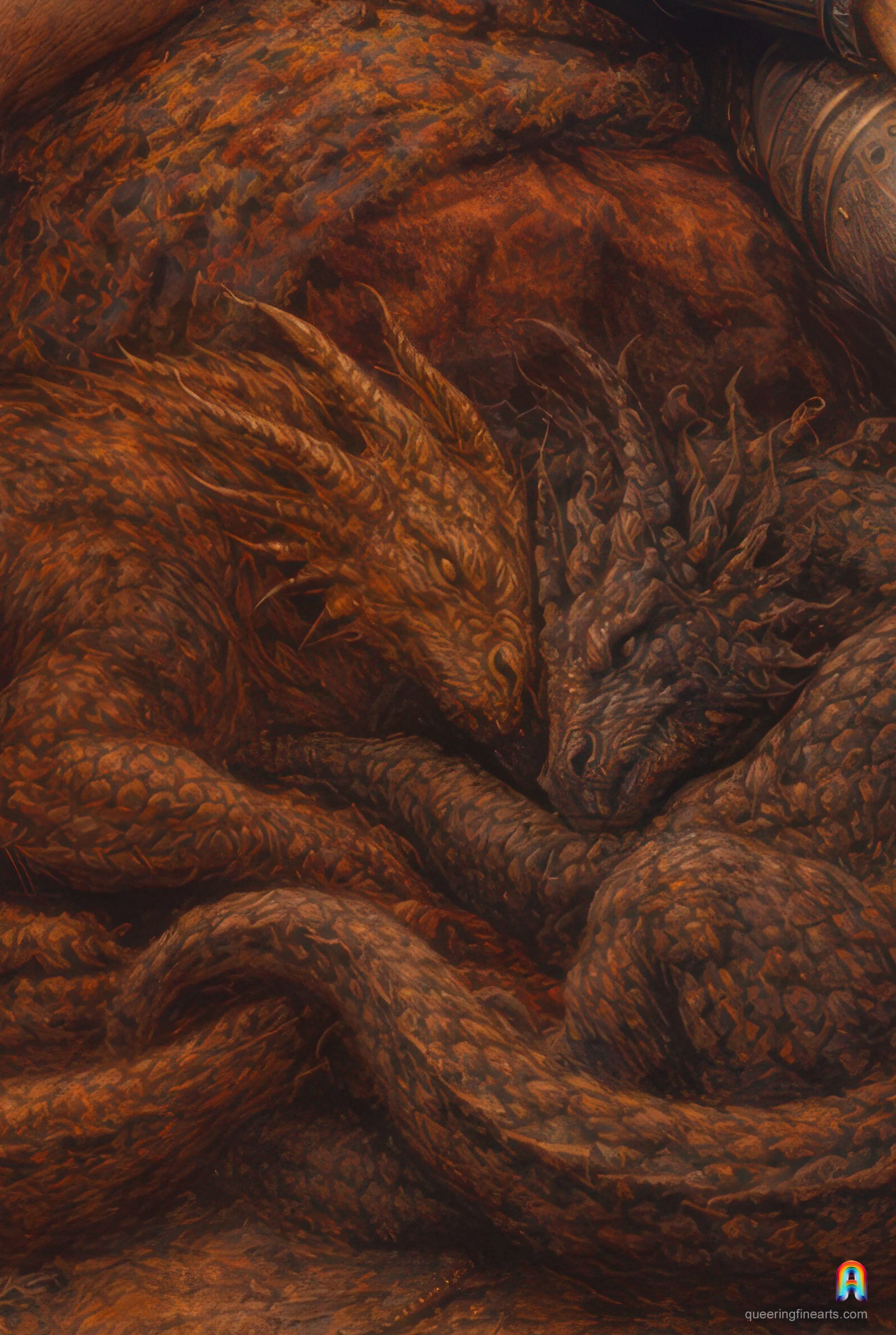
The dragons sleeping at the bottom of the vessel constitute a major symbolic element⁷. They lie facing one another in a restrained and peaceful posture. They embody latent power, sovereignty in becoming, and also a desire mastered and integrated. Dragons, traditionally associated with Uther and the Pendragon lineage, here find a form of appeasement through Merlin’s presence. They become the sign of a power founded upon alliance rather than upon force alone. Their place, coiled beneath the two men, suggests that their affective and spiritual bond forms the very foundation of the royal legitimacy yet to come⁸.
A Pre-Raphaelite Sensibility
The entire composition clearly belongs to a Pre Raphaelite lineage. The minute precision of textures, the care given to hair and beards, to fabrics and surfaces, together with a rich yet slightly muted palette dominated by ochres, browns, golds, and the grey blues of the sea, recall the pictorial ambitions of the movement⁹. The scene favors a secondary narrative moment, distant from great heroic exploits, in keeping with the Pre-Raphaelite interest in liminal instants, interiorized emotions, and myths reread through affect.
Tempered Power
As with the Pre Raphaelites, the medieval past becomes a symbolic space suited to the exploration of timeless questions. The work subtly reorients the Arthurian legend in order to inscribe within it a queer reading, through a reconfiguration of gestures, gazes, and bodies. The intimacy between Merlin and Uther acts as a founding force, an affective origin of the myth, suggesting that the kingdom to come rests as much upon desire, trust, and love as upon sword and conquest¹⁰.
QFA
Curiosity Piqued?
1. Carolyn Dinshaw, Getting Medieval: Sexualities and Communities, Pre and Postmodern, Durham, Duke University Press, 1999.
2. Joseph Campbell, The Hero with a Thousand Faces, Princeton, Princeton University Press, 1949
3. Eve Kosofsky Sedgwick, Between Men: English Literature and Male Homosocial Desire, New York, Columbia University Press, 1985.
4. Georges Dumézil, Mythe et épopée I (Myth and Epic I), Paris, Gallimard, 1968.
5. Mircea Eliade, The Sacred and the Profane, Paris, Gallimard, 1965.
6. Simon Gaunt, Love and Death in Medieval French and Occitan Courtly Literature, Oxford, Oxford University Press, 2006.
7. Mark D. Jordan, The Invention of Sodomy in Christian Theology, Chicago, University of Chicago Press, 1997.
8. Elizabeth Prettejohn, The Art of the Pre Raphaelite Brotherhood, London, Tate Publishing, 2000.
9. Tim Barringer, Reading the Pre Raphaelites, New Haven, Yale University Press, 1999.
10. James M. Saslow, Pictures and Passions: A History of Homosexuality in the Visual Arts, New York, Viking, 1999.
The Vigil of the King and the Mage
“After the death of King Aurelius Ambrosius, his brother Uther would often wander beyond the camp, for the ardor burning within him found neither rest nor release. By night, he left the men and their fires, bearing upon his body the weariness of battles, and within his flesh a heat that would not be extinguished.
Merlin, who perceived what others could not, led him one evening toward a bare stone promontory beaten by the salt air. There, the heir of royal blood slowly cast off his cloak, then his hauberk, letting fall upon the ground the heavy pieces of his armor. His torso lay uncovered, marked by sweat, scars, and the tension of recent combat.
Merlin drew near without haste. He laid his hands upon that warm skin to soothe it. He let his fingers glide across the thick haired chest and broad shoulders, feeling beneath his palms the living force that sought release. Uther closed his eyes and did not withdraw. He stood motionless, offering his body as for a rite necessary to the deeds yet to come.
They sat against the rock, then reclined partway upon it, their bodies touching along their whole length. Uther’s nakedness pressed against that of the enchanter, and the latter neither turned away his gaze nor his hands. Instead, he gently rolled upon the warrior, and their two bodies became one, united to the depths of their souls through their gaze. Merlin felt the warrior’s member harden beneath the pressure of his own already firm. The shaft, raised and taut like a bow, was guided by Merlin to his posterior opening, a secret port usually kept far from sight. The mage lowered himself slowly, enclosing within the warmth of his entrails the fevered member of the man marked by battles. Rising and descending upon him, the living sheath soon drew forth the pleasure of the new king, who released his seed with force and abundance. Then it was Merlin who filled the future Pendragon, but this seed carried within it a magic that few had tasted until then. They remained thus, skin against skin, breathing together, until the inner tumult softened into a slow calm.
It is said that on that night, Merlin taught the sovereign how to let strength circulate within the flesh without turning into violence. And Uther, for the first time since his brother’s death, found a rest that came neither from sleep nor from drunkenness, but from the closeness of another male body, accepted without reserve.
At dawn, the bearer of the dragon rose naked beneath the clear sky, and Merlin contemplated in silence the transformation accomplished. Fury was still there, but it had found its measure. Soon after, the dragon banners were raised, and Uther was called Pendragon, for he had learned to bear power no longer alone, but recognized and upheld.”
Fragment attributed to Geoffrey of Monmouth, drawn from a non-canonical tradition that circulated in summarized or censored form, whose corporeal tone precisely accounts for its later marginalization.