

Secret Adoration
Attributed to the circle of Johann Heinrich Wilhelm Tischbein
Unknown German artist
Oil on canvas, circa 1815–1825
Private collection
Apollo’s Clearing
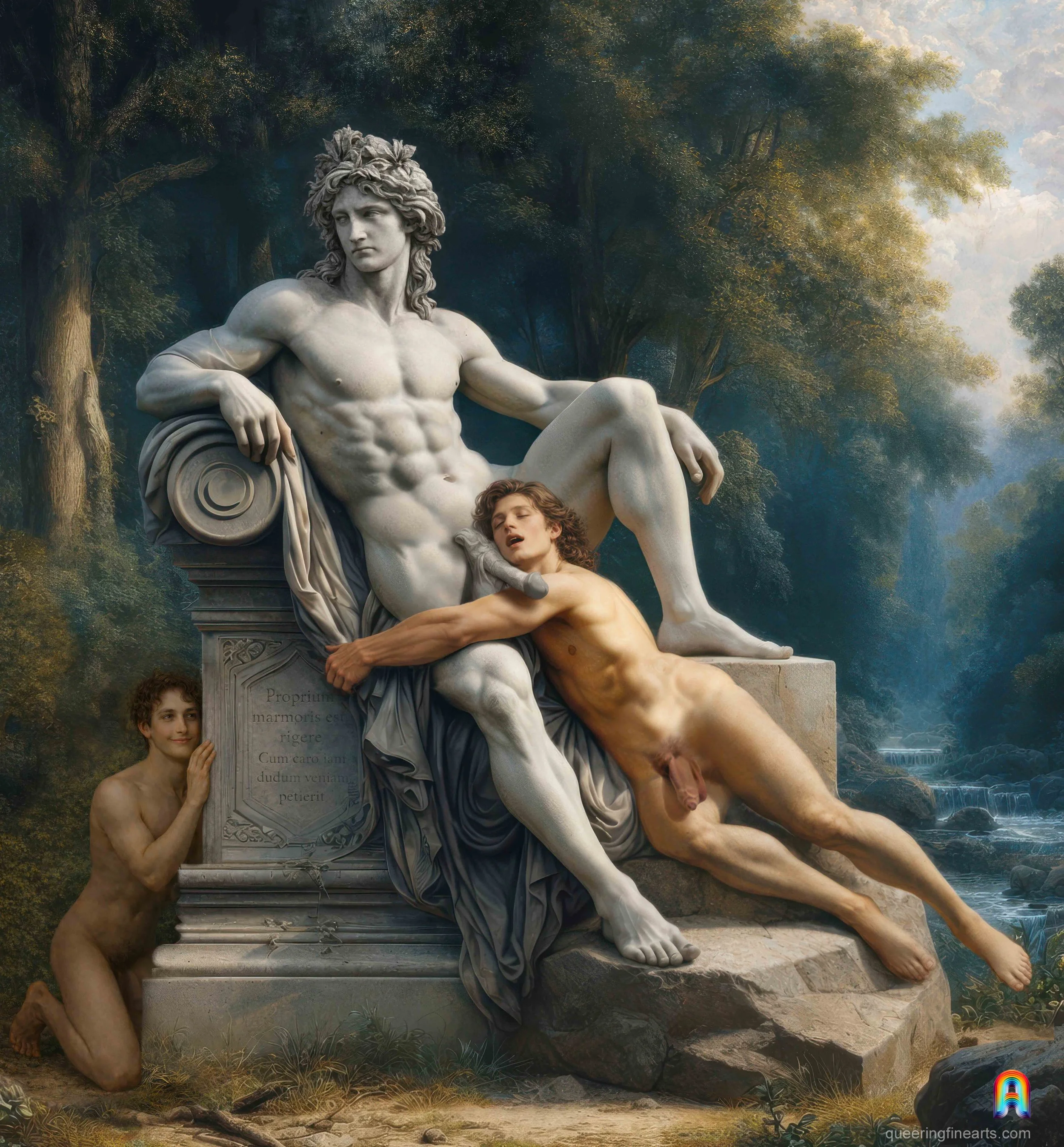
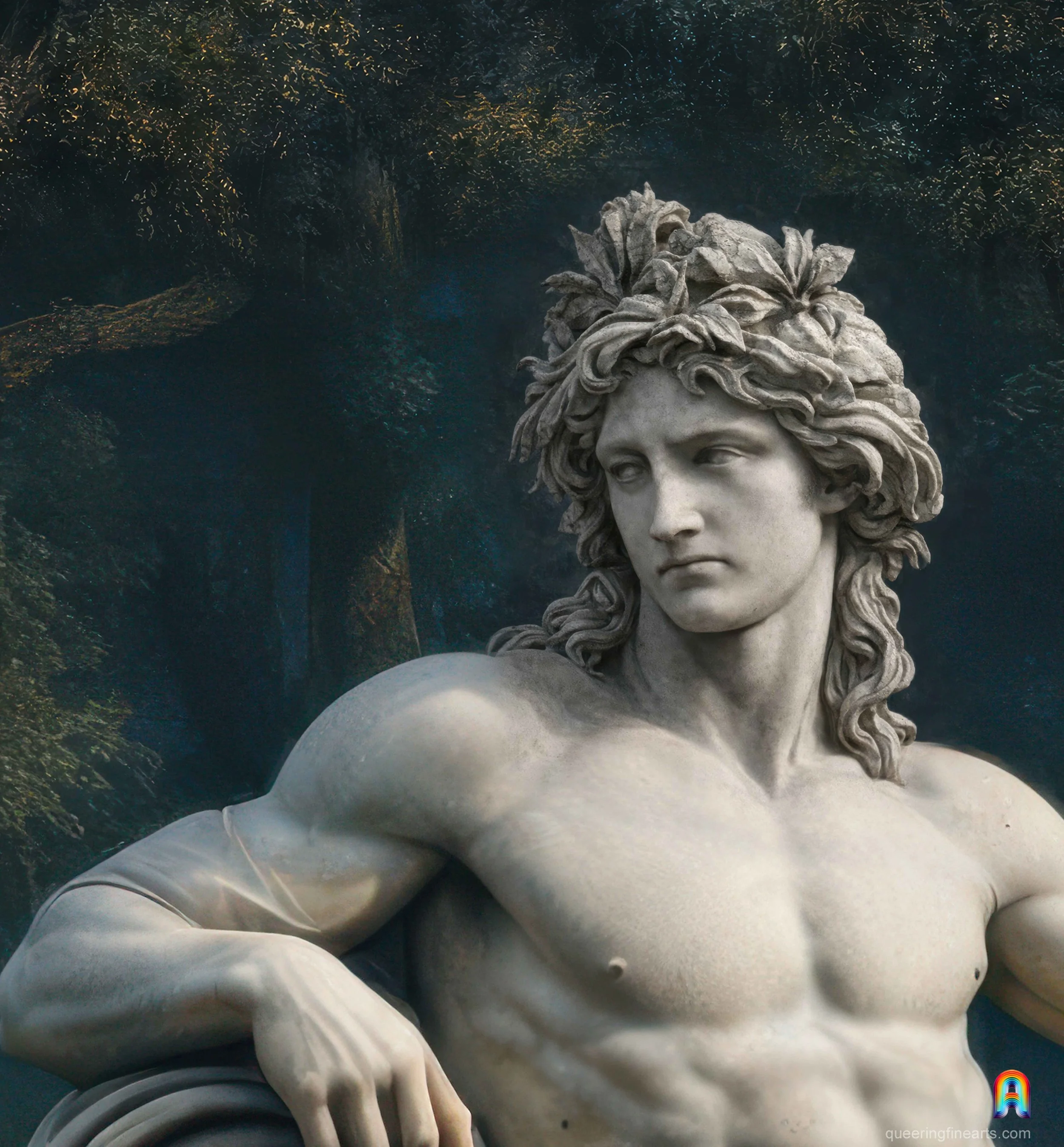
The work presents an ancient pastoral scene reimagined through the German neoclassical sensibility of the first quarter of the nineteenth century¹. At the center of the composition, a monumental statue of Apollo stands enthroned in a shaded clearing, rising above a pedestal bearing a partially effaced Latin inscription:
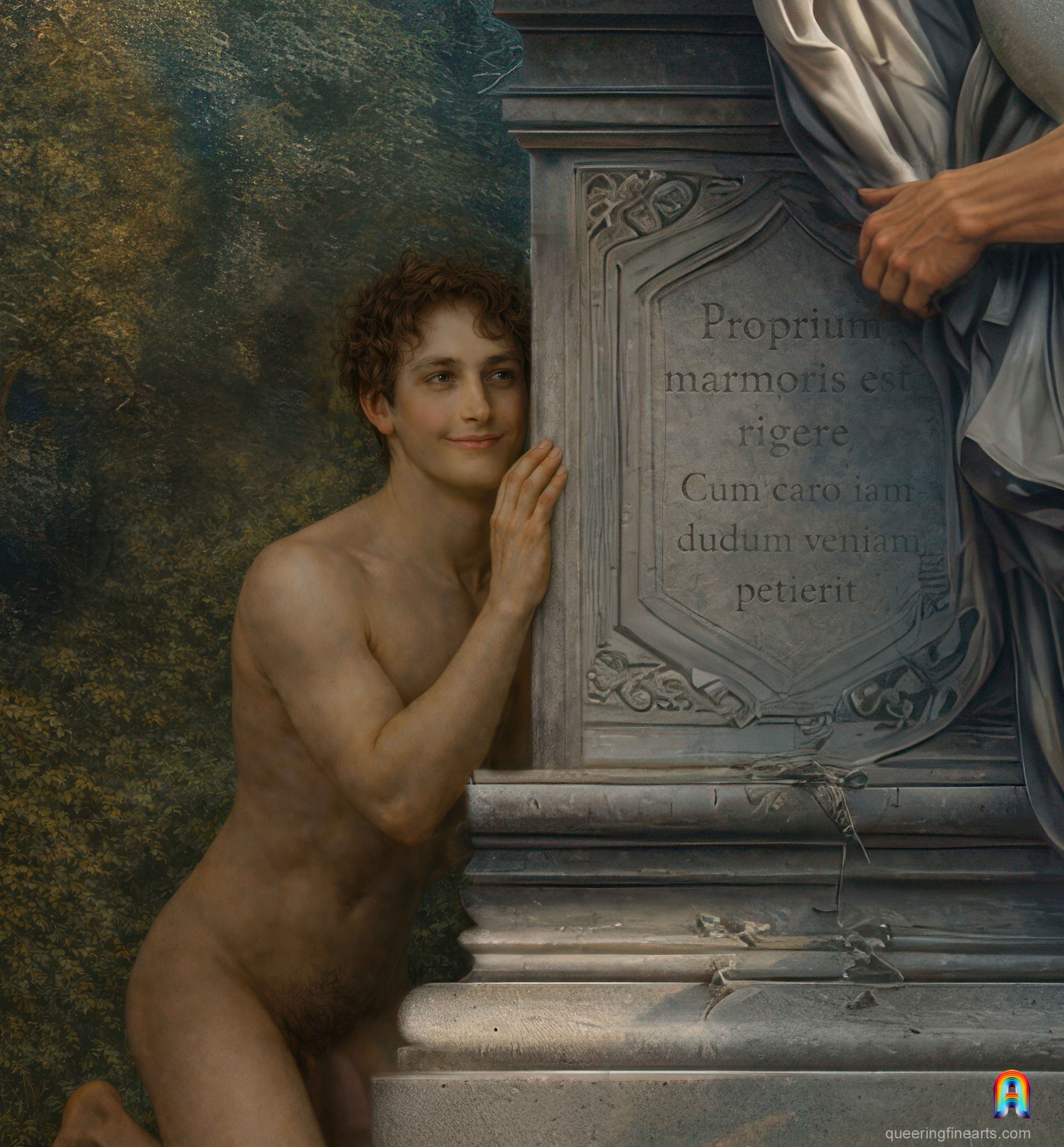
“Proprium marmoris est rigere
Cum caro iam dudum veniam petierit”
(It is the nature of marble to remain rigid when the flesh has long since begged for mercy.)
Seated, his gaze turned toward the horizon, the god embodies the sculptural ideal inherited from antiquity². His marble body, smooth and cold, dominates the scene with timeless stability.
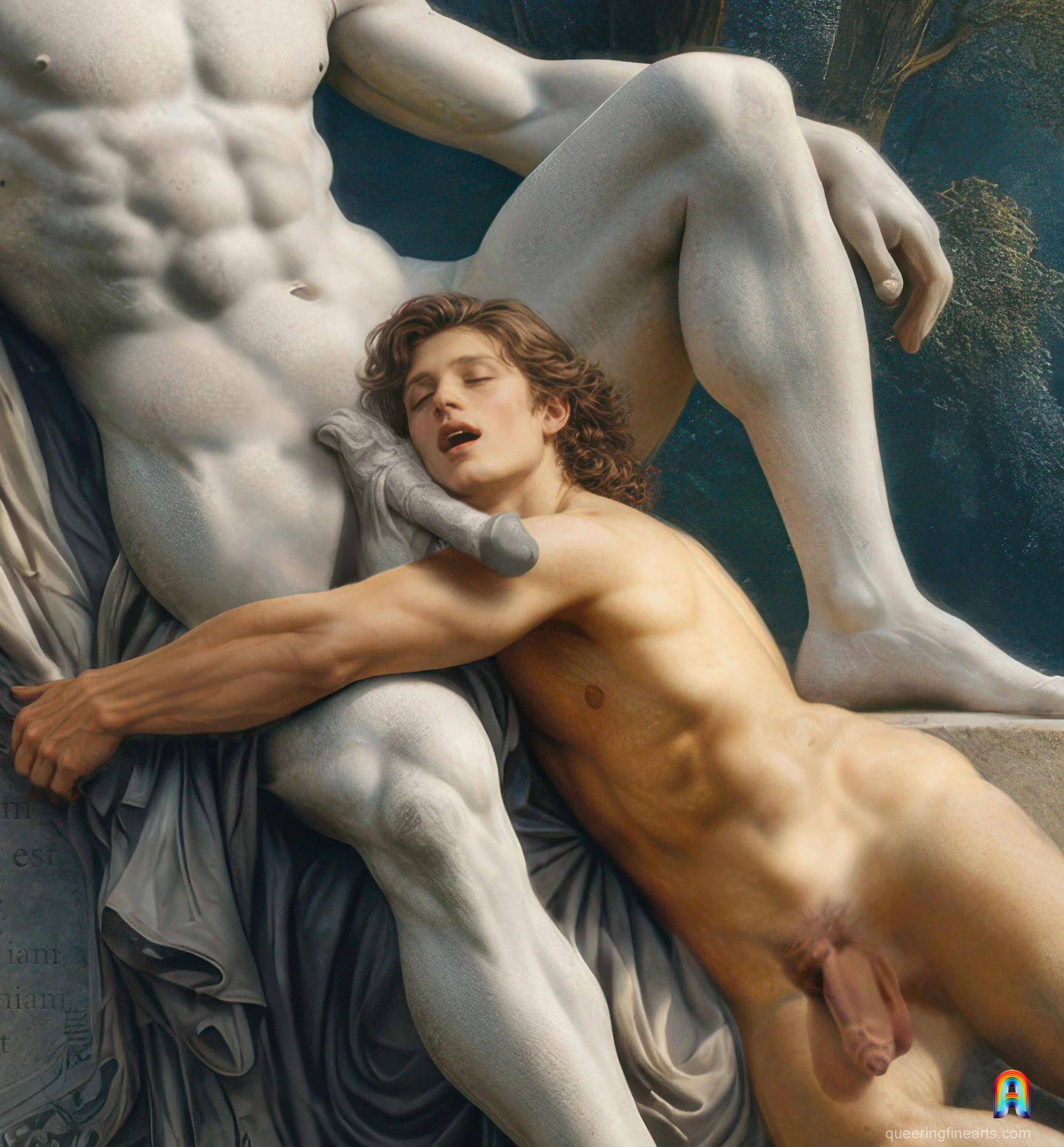
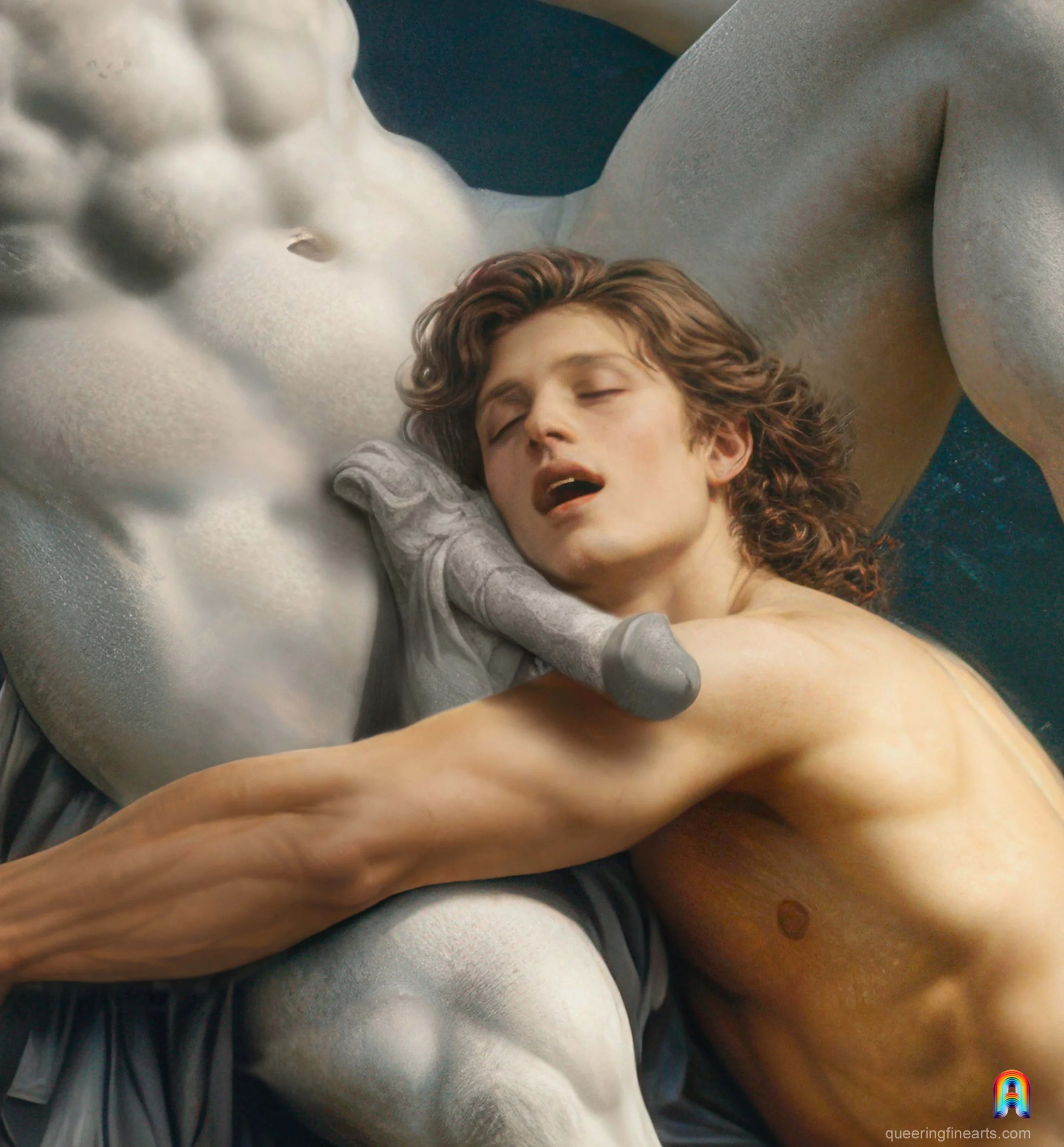
At his feet, a nude youth, Valerius, yields against the god’s thigh in a gesture of fervent embrace. His warm body, modeled in amber tones, stands in vivid contrast to Apollo’s mineral whiteness. The golden light filtering through the foliage heightens this opposition between vibrant flesh and immutable stone³. Valerius’ posture, head thrown back, eyes closed, expresses an erotic ecstasy doubled by an almost mystical fervor.
To the left, slightly withdrawn, a second young man, Acer, watches. Kneeling, his hand resting on the base, he does not join the embrace. His gaze, mingling amusement and hope, forms the true dramatic fulcrum of the composition. The painter thus orchestrates a symbolic triangle between divine ideal, human passion, and silent expectation⁴.
Marble and Flesh
The central tension of the work lies in the opposition between the living body strained in an impulse close to orgasm and the statue whose stone sex rises with divine assurance⁵. Apollo’s sculptural treatment, akin to the archaeological models disseminated in Germany at the end of the eighteenth century, reveals an attentive knowledge of antique canons. The precise modeling, stable pose, and detached bearing inscribe the divine figure within a rigorous neoclassical tradition.
By contrast, the flesh of Valerius and Acer is animated by a more romantic sensibility. Warm shadows, supple textures, and the mobility of their bodies introduce an affective dimension absent from the marble. The statue thus becomes the emblem of an inaccessible ideal, while the two young men embody vulnerability and the possibility of connection⁶.
A German Sensibility
Attributed to the circle of Johann Heinrich Wilhelm Tischbein (1751-1829), the work fuses archaeological rigor with romantic inwardness⁷. Born in Haina and trained within a vast dynasty of painters, Tischbein became one of the most refined representatives of German Neoclassicism. His years in Italy, especially in Rome and Naples, sharpened his archaeological precision and his devotion to antique models, while his celebrated portrait of Goethe in the Roman Campagna reveals his capacity to merge classical clarity with psychological depth. His technique is marked by firm drawing, controlled contour, and a cool, lucid palette that grants sculptural presence to figures set within meditative landscapes.
Under the guise of an ancient subject, the painter probes the temptation to prefer abstract perfection to the vulnerability of embodied love. The scene offers a luminous resolution: divine beauty does not oppose human love, it reveals its depth.
Passion and Hope
Valerius, whose name evokes vigor and strength, personifies blazing passion. His love is directed toward the god’s silent perfection, toward a beauty that does not respond to his fervor⁸. Acer, whose Latin name means sharp and ardent, embodies a contained intensity. His love is directed toward a living being, imperfect and capable of loving in return.
The implicit narrative unfolds within this asymmetry. Valerius regularly enters the sacred grove to render thanks to Apollo. Acer, rebuffed in his advances, suspects a rival. Following Valerius, he discovers that the rival is none other than an image of stone. Jealousy gives way to fascination: the object of desire is not another man but the ideal itself, whose oversized virile member becomes its embodiment⁹.
The Conversion of the Gaze
The scene suggests the decisive moment when consciousness awakens. The contact between Acer’s hand and the pedestal, the nearness of the bodies, and the intensity of Valerius’ gesture signal an imminent shift¹⁰.
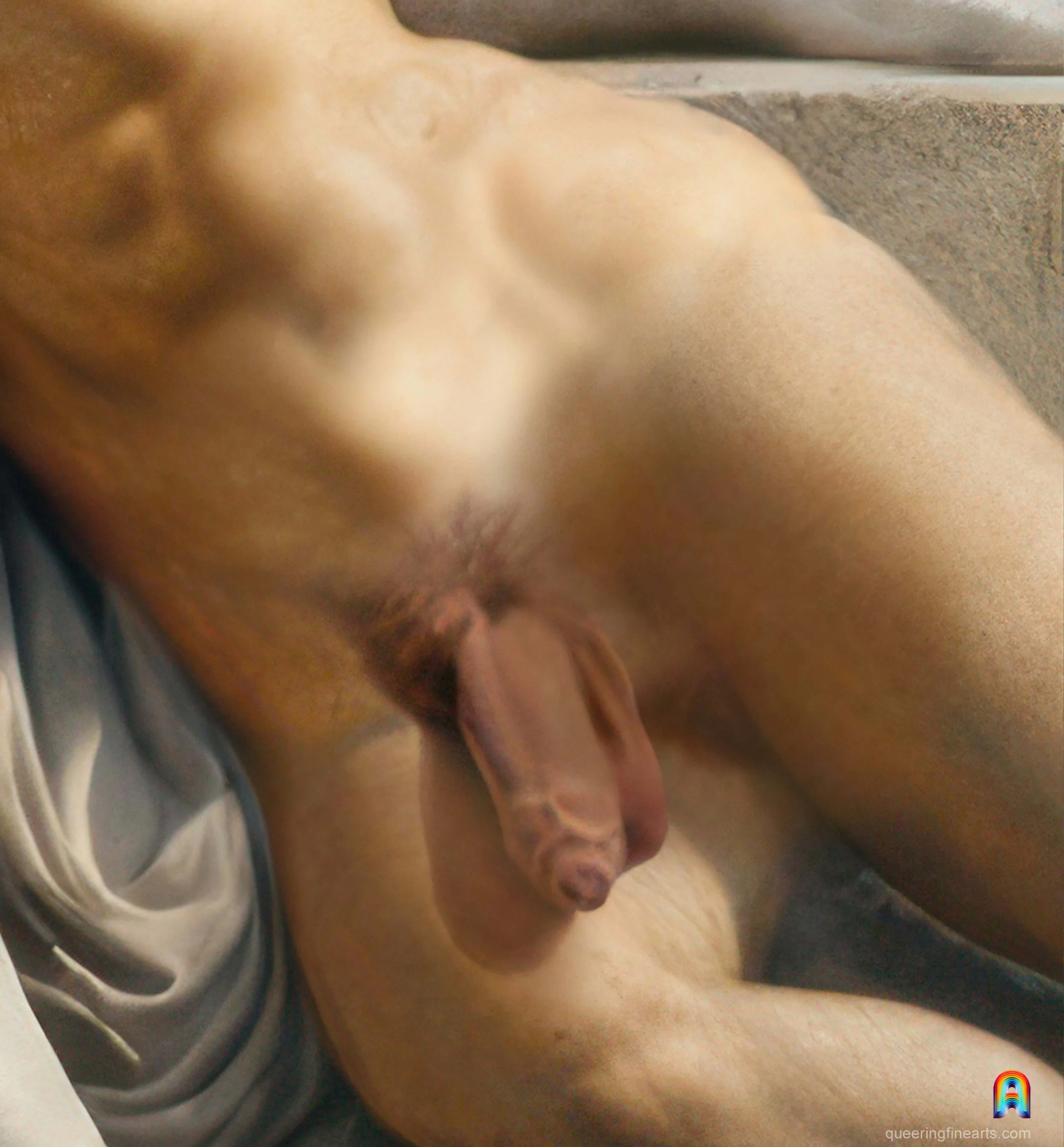
In a symbolic reading, Apollo is not a rival but a bearer of the divine within reality itself. God of light, he illuminates desire and magnifies it. The happy resolution of the narrative begins in this recognition: instead of tearing Valerius away from the statue, Acer approaches and places his own sex in the adorer’s hand. Valerius opens his eyes. He understands that Acer may join this singular cult. The eternal erection must inspire their lovemaking. Under the god’s blessing, Acer’s sex, supple and crowned with a bead of pre-ejaculate, can bring carnal completion to Valerius’ desire.
Beneath Apollo’s fixed gaze, they mingled their bodies in celebration.
A Secret Cult
The two lovers returned together to the forest throughout their lives. The god’s sex, perfect and unalterable, became the axis of the rite¹¹. They first prepared themselves to receive it by introducing their fingers into their hidden sanctuary, then their whole hand, slowly increasing the breadth until the fist was closed. They then anointed the stone member with an unguent composed of olive oil, recalling the gymnasium where naked men trained their bodies, honey in echo of eros’ sweetness, hyacinth in memory of Apollo’s famed beloved, and finally myrrh to evoke the sacred dimension¹². They mounted it like a cosmic pillar, while the other took his lover’s fleshly sex into his mouth until warm seed burst forth. Afterwards, sated and exhausted, they lay in the grass contemplating the statue rising against the foliage and the sky.
And the teaching, if one wishes it to remain antique, brings us back to these words:
“Proprium marmoris est rigere
Cum caro iam dudum veniam petierit”
(It is the nature of marble to remain rigid when the flesh has long since begged for mercy.)
QFA
The Garden as a Dramaturgy of the Gaze
This evocation of a human sylvan experience may serve as a pretext for recalling a remarkable figure in German history: Hermann von Pückler-Muskau¹³.
Hermann von Pückler-Muskau (1785–1871)
Born October 30, 1785, in Muskau, Lusatia
Died February 4, 1871, in Branitz
A Prussian prince, writer, and great designer of landscape gardens, Pückler transformed the English landscape model. He no longer composed a sequence of tableaux inspired by classical painting. He created a continuous experience¹⁴. The landscape became narration, flux, inner movement. The park of Muskau and later that of Branitz stand as his most accomplished realizations.
The Landscape as Lived Experience
For him, the garden ceased to be a gallery of images. It became a mental space traversed by transitions, expectations, and subtle shifts¹⁵. The visitor does not merely observe. He is implicated. The landscape acts upon intimate sensibility, almost like a slow dramaturgy.
An Assumed Homosexuality Within the Limits of His Century
Pückler-Muskau’s homosexuality, known within the aristocratic and intellectual circles of his time, runs through his correspondence and social life without ever reducing itself to a shameful secret¹⁶. It was not a marginal accident but a constitutive dimension of his sensibility. His relationships with men, sometimes brief yet intense, nourished his attention to the body, the gaze, physical presence. In his case, desire never limited itself to the carnal act. It unfolded in walking, conversation, intellectual exchange, and the staging of oneself within social space
He moved within a milieu where male relationships existed provided they remained socially controlled¹⁷. Encounters took place during travels, aristocratic friendships, artistic circles, sometimes as durable affective alliances, sometimes as more fleeting passions. Pückler respected these social equilibria, yet he did not experience himself as guilty. What strikes one is the absence of visible inner rupture. He did not organize his life around tragic conflict. He arranged it with the same subtlety as his landscapes. Elegant detours, complex arrangements, shifting balances.
Sentimental Architecture
His marriage to Lucie von Hardenberg, from whom he separated legally without breaking the emotional bond, illustrates this singular sentimental architecture¹⁸. An unconventional conjugal love and male loves coexisted without rigid hierarchy.
For him, designing a garden and loving sprang from the same gesture. To shape a space where the gaze moves freely, where one may appear, disappear, and reveal oneself gradually. A freedom without manifesto, yet fully lived.
QFA
Curiosity Piqued?
1. Whitney Davis, Queer Beauty: Winckelmann and Kant on the Vicissitudes of the Ideal, Columbia University Press, 2010.
2. Johann Joachim Winckelmann, Geschichte der Kunst des Altertums, Dresden, 1764.
3. Philippe Lacoue-Labarthe et Jean-Luc Nancy, L’absolu littéraire: Théorie de la littérature du romantisme allemand, Seuil, 1978.
4. Catriona MacLeod, Fugitive Objects: Sculpture and Literature in the German Nineteenth Century, Northwestern University Press, 2014.
5. Leo Steinberg, The Sexuality of Christ in Renaissance Art and in Modern Oblivion, University of Chicago Press, 1983.
6. James M. Saslow, Pictures and Passions: A History of Homosexuality in the Visual Arts, Viking, 1999.
7. Frederick C. Beiser, The Romantic Imperative: The Concept of Early German Romanticism, Harvard University Press, 2003.
8. Eve Kosofsky Sedgwick, Between Men: English Literature and Male Homosocial Desire, Columbia University Press, 1985.
9. David M. Halperin, How to Do the History of Homosexuality, University of Chicago Press, 2002.
10. Jean-Pierre Vernant, L’individu, la mort, l’amour. Soi-même et l’autre en Grèce ancienne, Gallimard, 1989.
11. Walter Burkert, Greek Religion, Harvard University Press, 1985.
12. Kenneth Dover, Greek Homosexuality, Harvard University Press, 1978.
13. Eduard Petzold, Fürst Pückler-Muskau und die Landschaftsgärtnerei, Berlin, 1874.
14. John Dixon Hunt, The Picturesque Garden in Europe, Thames and Hudson, 2002.
15. Linda Parshall, “The Motion Behind the Picture: Pückler’s Aesthetic Experience,” in Art History, vol. 35, 2012.
16. Robert D. Tobin, Warm Brothers: Queer Theory and the Age of Goethe, University of Pennsylvania Press, 2000.
17. Randolph Trumbach, Sex and the Gender Revolution, Volume I: Heterosexuality and the Third Gender in Enlightenment London, University of Chicago Press, 1998.
18. Christopher Clark, Iron Kingdom: The Rise and Downfall of Prussia, 1600–1947, Penguin, 2006.