James and George
Attributed to John de Critz the Elder
Oil on canvas, circa 1606
The Stuart Portrait Gallery
Portrait of a King and His Favorite
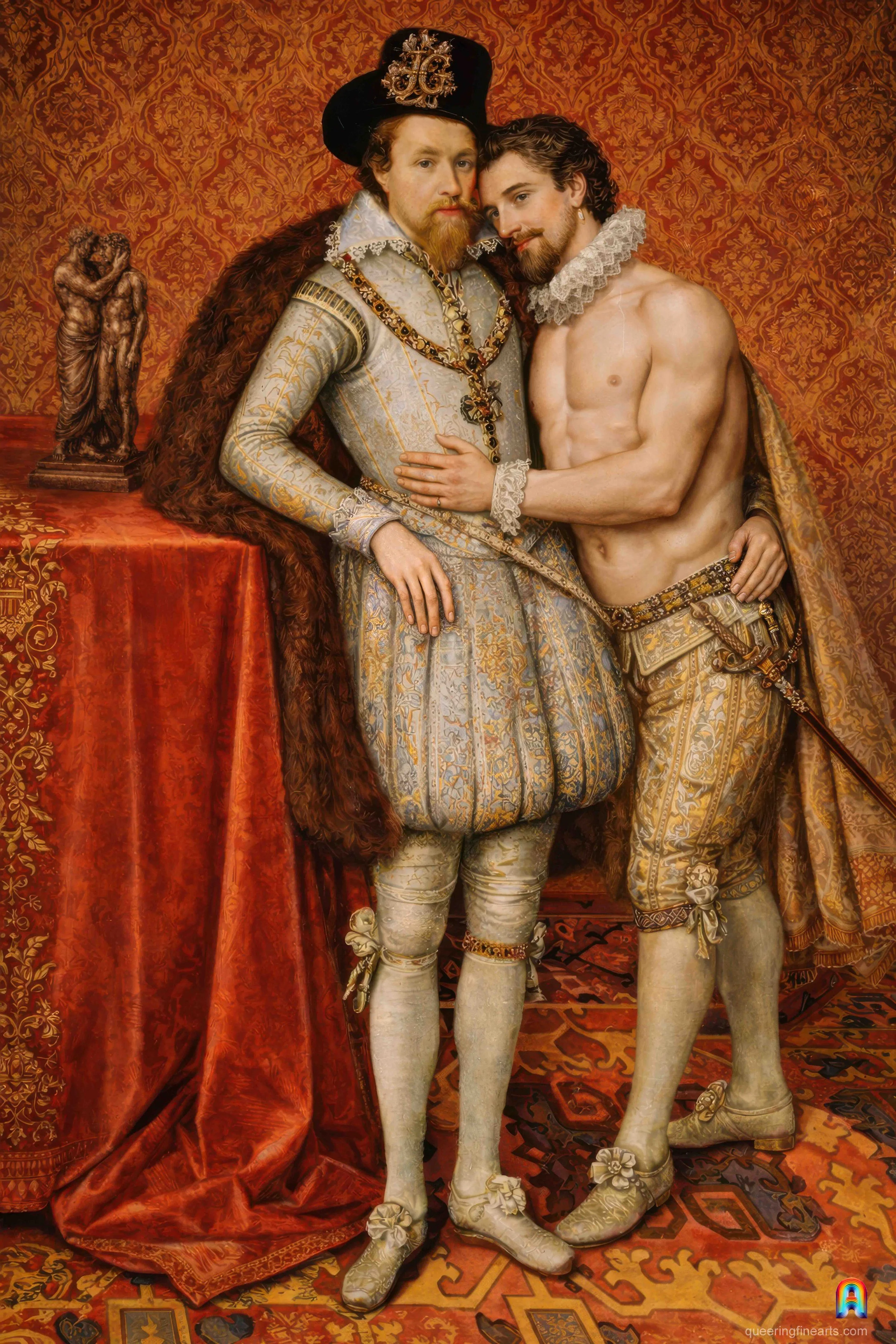
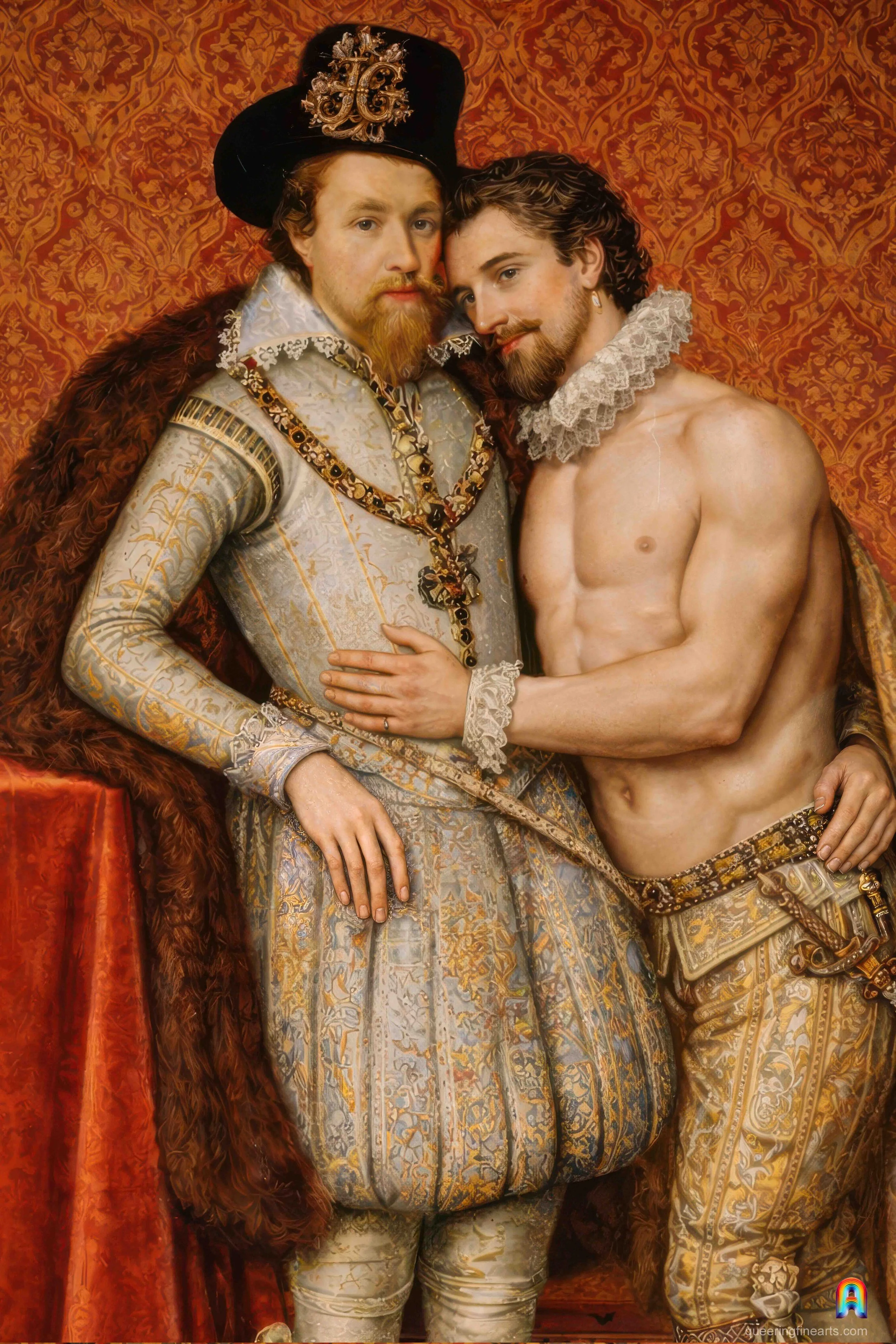
This double portrait depicts James VI and I and his favorite, George Villiers, within an interior lavishly hung in red damask. The king stands slightly inclined to the right, wrapped in a fur-lined mantle and clad in a richly embroidered doublet. These textiles do not merely serve as ornament. Within the economy of Jacobean luxury, imported silk, gold embroidery, and fur signaled access to international trade networks and to the regulated privileges of the court. To wear such materials was to proclaim proximity to the distributive center of power.
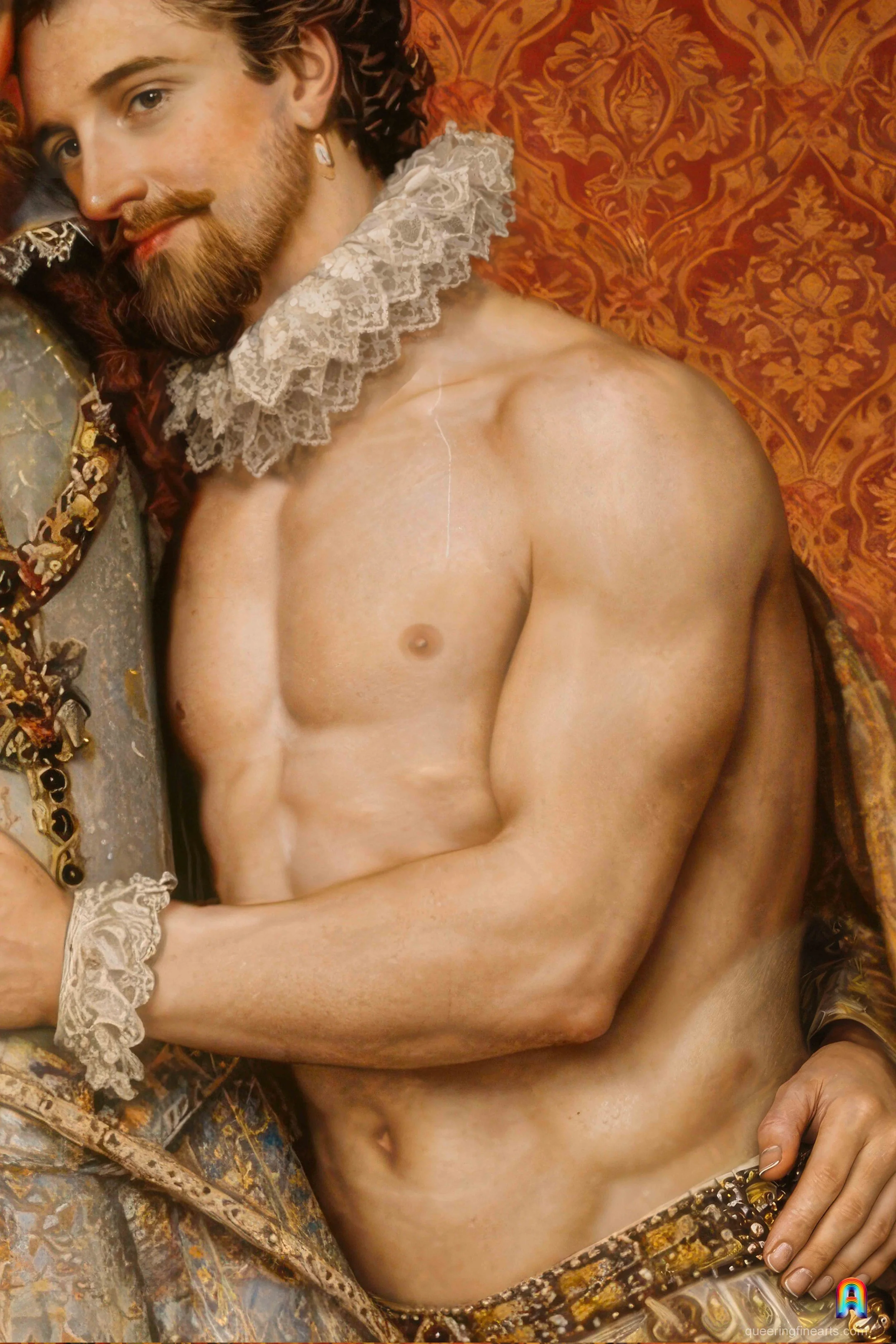
At his side, Villiers appears bare-chested, draped in a golden cloak slipping from his shoulder. His youthful, muscular body contrasts with the sovereign’s solemn display of fabric. One wears the regalia of authority, the other offers the presence of the body¹.
Affectionate Intimacy
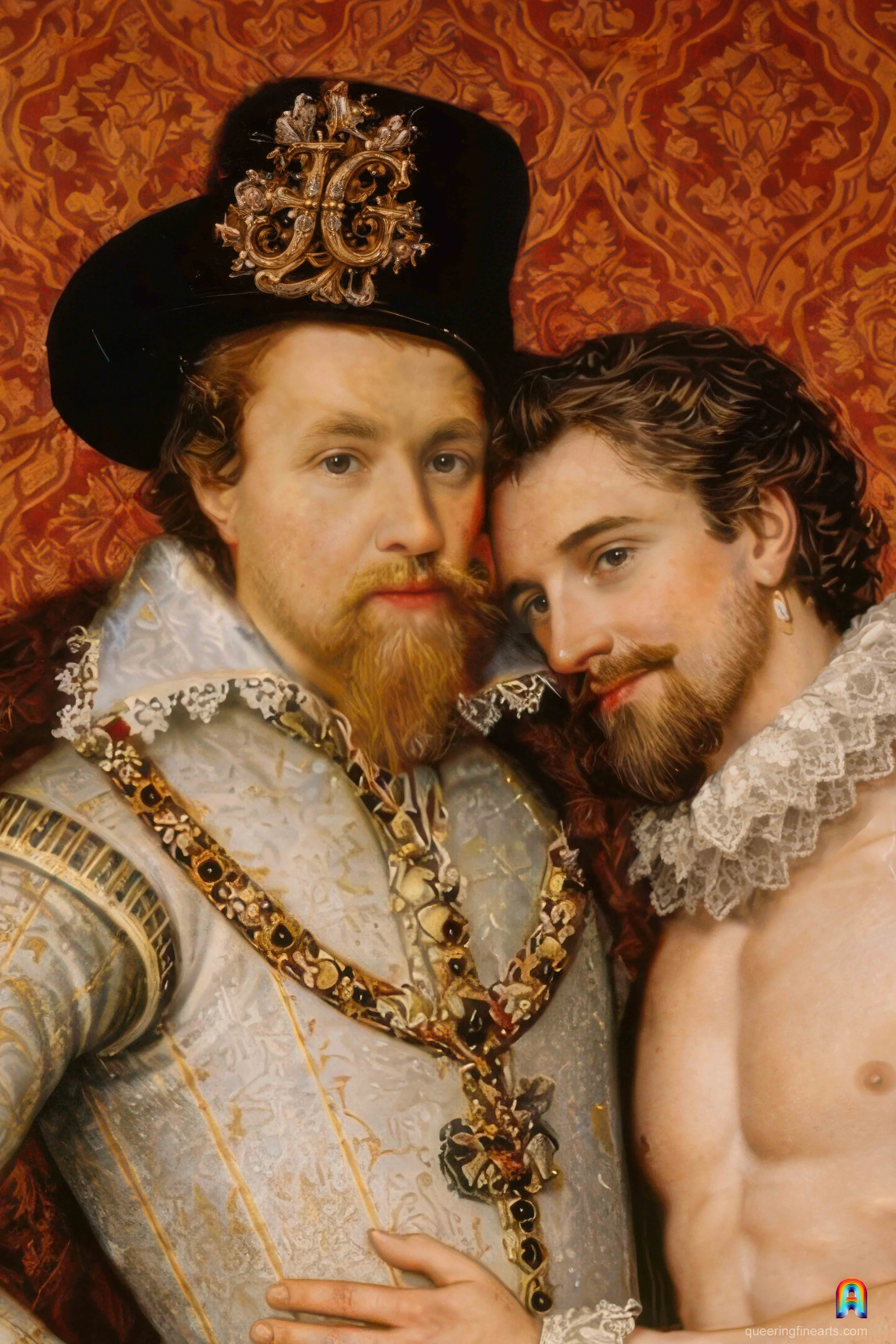
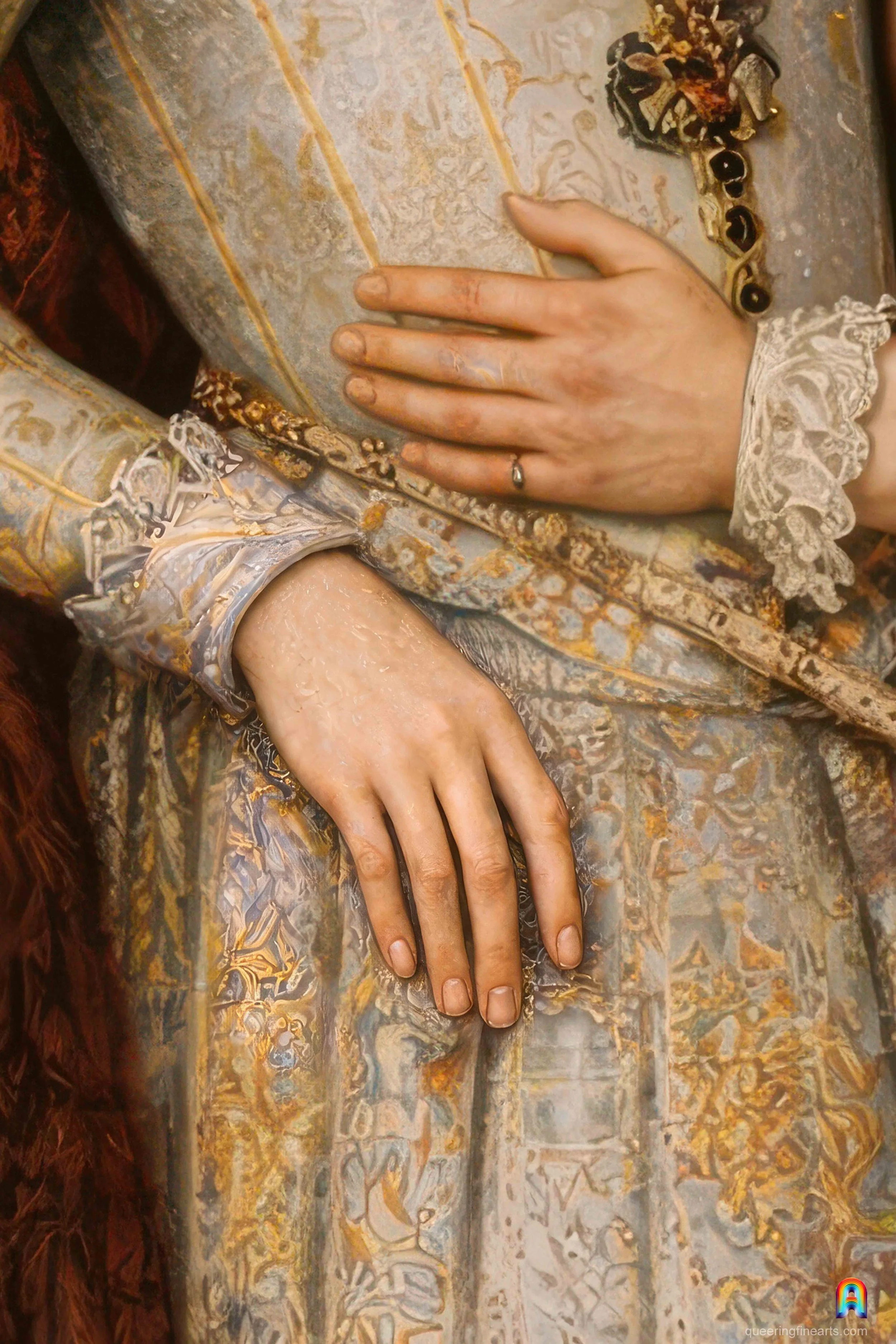
The closeness of the figures is striking. Villiers encircles the king’s waist with a confident arm, his hand resting upon the royal abdomen in a gesture of intimacy that exceeds mere courtly familiarity². Their faces nearly touch. James gazes directly outward, his expression grave yet softened by the nearness of his favorite. Villiers inclines his head toward the king, his oblique glance suggesting complicity and tenderness. The compositional balance rests upon this tension between public authority and private attachment.
The Intertwined Letters
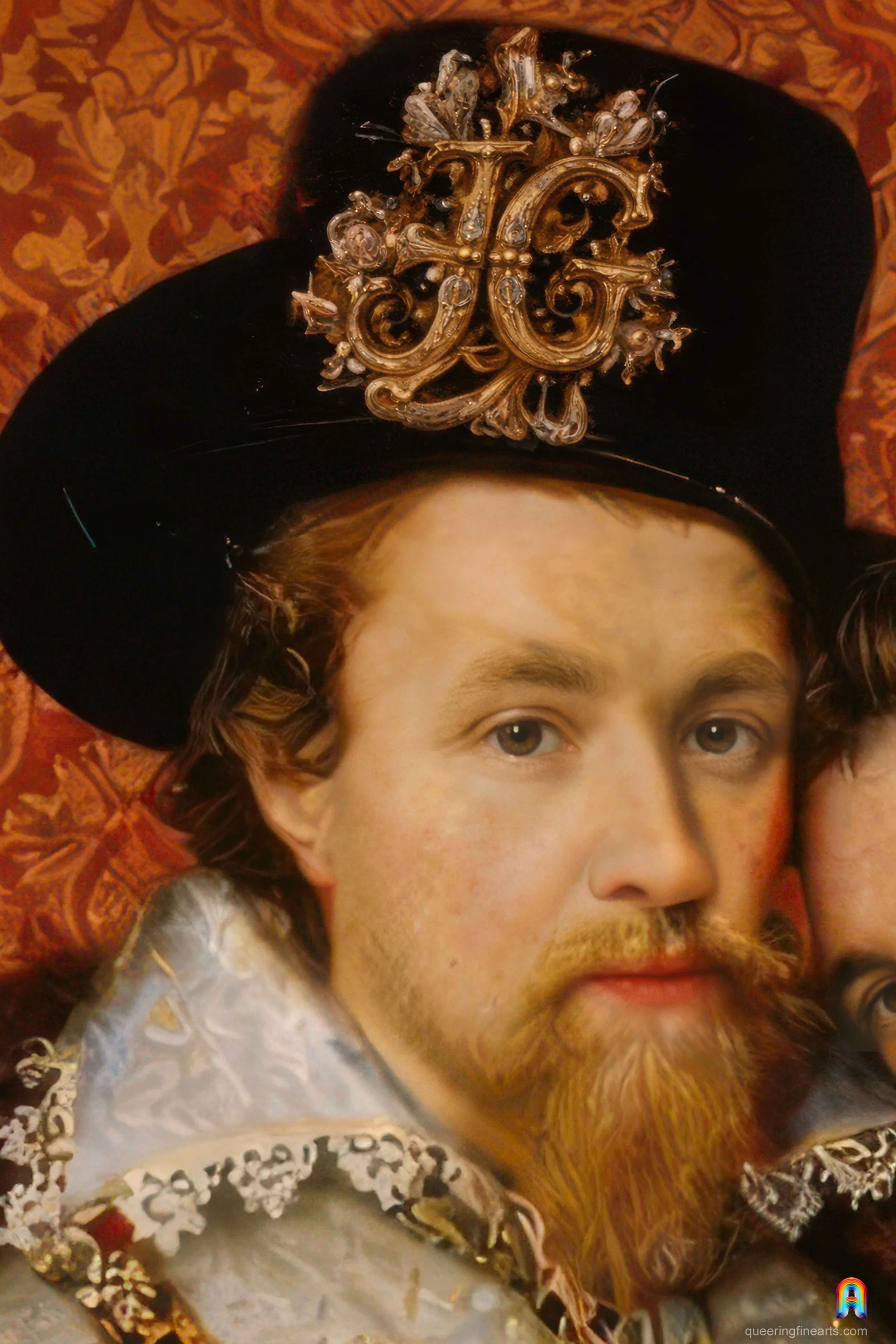
On the king’s hat, a brooch bearing the interlaced initials J and G draws the eye. The monogram functions as a discreet declaration. In heraldic and amorous traditions, the intertwining of letters signifies union, the symbolic fusion of two identities³. Placed upon the royal emblem, it inscribes affection at the very heart of power.
In Reflection
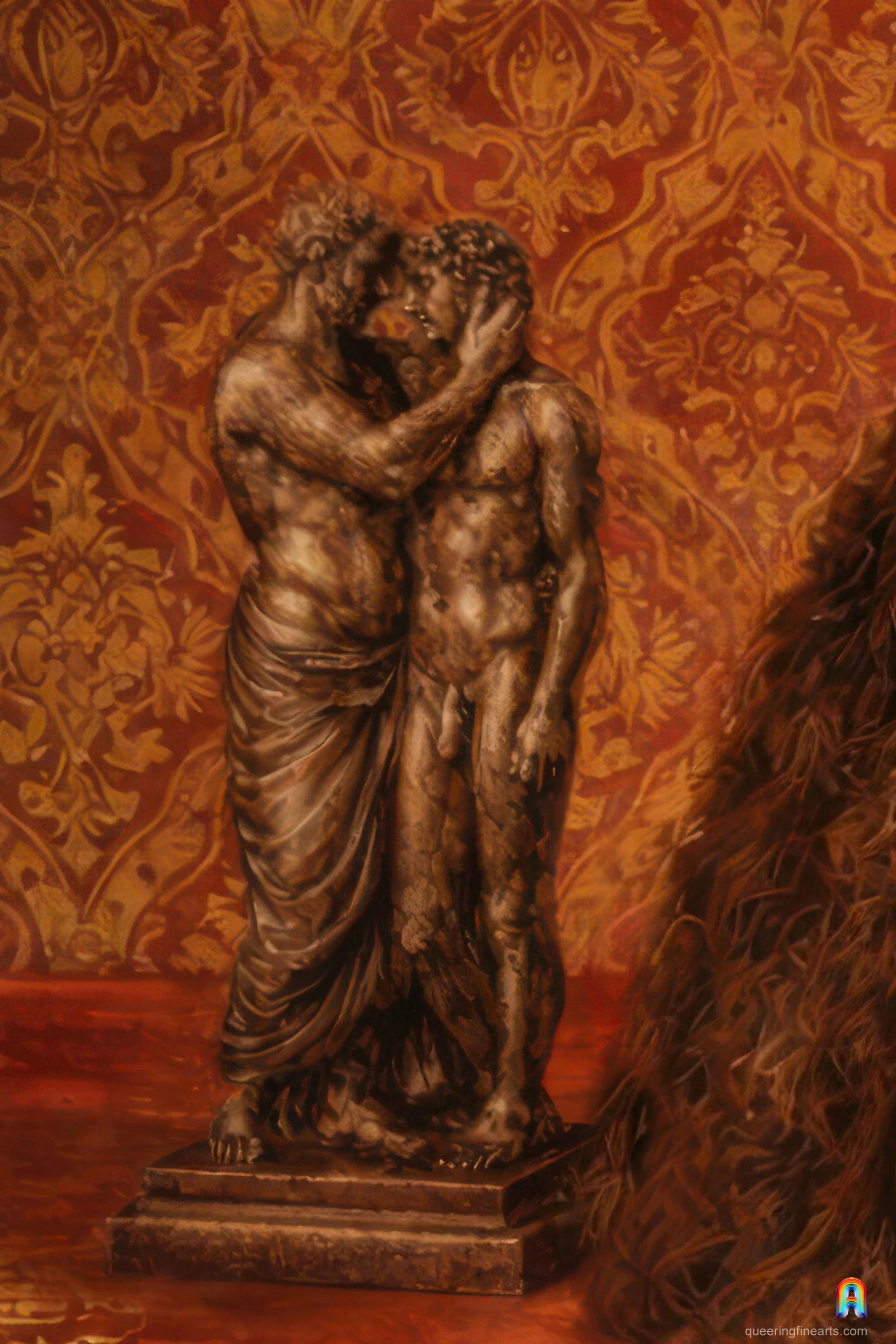
To the left, resting upon a table covered in red velvet, a statuette of Hadrian and Antinous locked in affectionate embrace represents the Roman emperor and his companion. In antiquity, their relationship was elevated to the status of political and sentimental myth⁴. After Antinous’s death, Hadrian deified him and multiplied his image throughout the Empire⁵. The sculpture’s presence establishes an explicit parallel between sovereignty and male love. It acts as a historical mirror, situating James and Villiers within an antique lineage in which imperial authority and attachment between men coexist.
The Voluptuousness of Touch
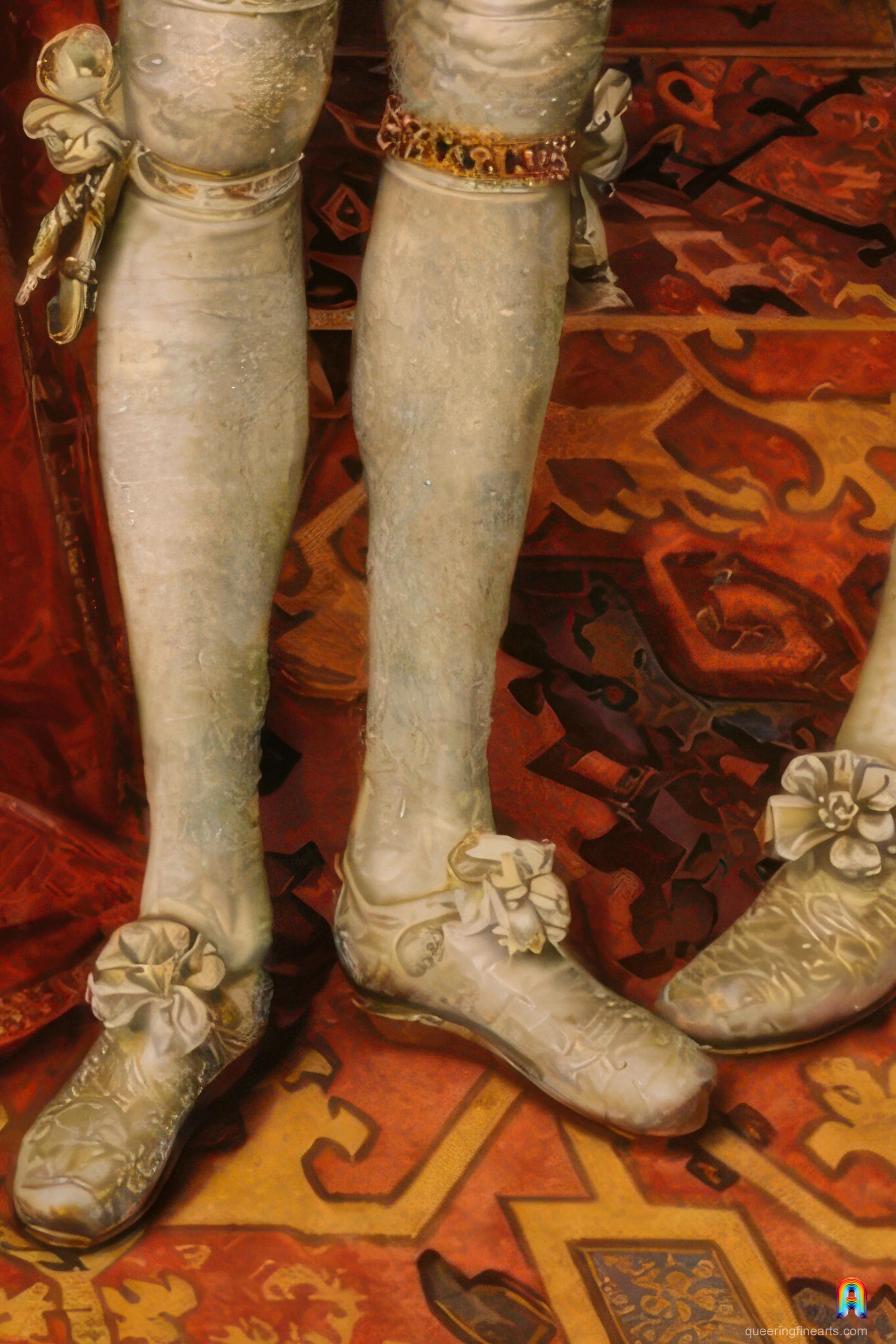
Heavy fabrics, the Oriental carpet, gold embroidery, and fur contribute to a theatrical staging of rule. The carpet from the East, a commodity of high symbolic value, inscribes the scene within a geography of prestige and global exchange. Metallic embroideries, costly and often executed by specialized workshops under royal supervision, literally materialize the wealth of the realm upon the sovereign’s body.
Yet the emotional center of the painting lies in the contact of bodies. The work transforms the state portrait into a scene of intimacy. It suggests that Jacobean power is exercised not solely from the throne, but within the shared space of gaze and touch⁶.
Authority, Desire, Memory
The painting articulates three interwoven levels of meaning: the official representation of the monarch, the visual assertion of a privileged attachment, and the learned reference to an antique precedent⁷. Together, these elements construct an image in which authority, desire, and historical memory are entwined with quiet audacity.
A Double Crown
James VI and I (1566 to 1625), one of the most consequential sovereigns in the history of the United Kingdom, belonged to the House of Stuart. Son of Mary, Queen of Scots and Henry Stuart, Lord Darnley, he became King of Scotland at the age of one following his mother’s forced abdication⁸. Raised amid religious and political tensions, he governed Scotland through the closing decades of the sixteenth century before ascending the English throne in 1603 upon the death of Elizabeth I⁹. He thereby united the crowns of Scotland and England in his person, inaugurating what is known as the Jacobean era.
James is also the monarch who authorized the 1611 English translation of the Bible, the king whose name would forever be attached to it. His reign marks a pivotal moment in British history, at the crossroads of confessional conflicts, dynastic ambitions, and the gradual construction of a shared monarchical identity between the two kingdoms. Married to Anne of Denmark, with whom he had several children, he ensured dynastic continuity while also developing male attachments that profoundly shaped the political culture of the period.
Passing Favors
Before Villiers’s rise, James had already extended favor to several courtiers of lesser stature, such as Esmé Stewart, Duke of Lennox, and Robert Carr, Earl of Somerset. Their influence, though real, proved briefer and politically more fragile¹⁰.
Meteoric Favor
When George Villiers appeared at court in 1614, he was a young gentleman of ambition, supported by factions hostile to the reigning favorite. James VI and I, already marked by previous attachments, quickly noticed this strikingly handsome young man, carefully trained in the codes of courtly conduct. Their encounter was strategic as well as emotional. Villiers was presented as an alternative to Robert Carr’s overbearing influence and he rose with vertiginous speed, advancing from courtier to Duke of Buckingham within a few years¹¹. This meteoric ascent was not merely political. It was intimately bound to the sovereign’s personal favor.
James and Steenie
Their relationship possessed remarkable intensity. James, aging and physically frail, found in Villiers an affective presence and vitality that animated him. Villiers, for his part, fully understood the political value of proximity. The king publicly called him “Steenie,” a reference to Saint Stephen whose beauty he praised¹². Gestures of affection were not concealed. Contemporaries spoke of embraces, physical familiarity, and constant access to the king. Some saw scandal. Others saw excess favoritism. Modern categories must be applied with caution. Jacobean court culture permitted passionate rhetoric between men, yet the tone of their bond often exceeds the register of political friendship.
At the Summit of the State
By 1616, Villiers had entered the Privy Council. In 1617 he became Lord High Admiral. In 1618 he was created Duke of Buckingham, a title of extreme rarity in England. He accumulated key offices, controlled access to the king, and distributed patronage and recommendations. Spanish ambassadors in London, particularly the Count of Gondomar, reported in their dispatches the extraordinary favor Buckingham enjoyed, describing a proximity so constant that it became a distinct factor in diplomatic analysis¹³. Their correspondence suggests that this visible affection, far from being ignored, was observed in Madrid as a decisive political element.
Under the Kingdom’s Gaze
Within England, contemporaries likewise commented upon the closeness between James VI and I and George Villiers. Memoirists and observers such as Sir Anthony Weldon noted the king’s physical familiarity with his favorites, speaking of public kisses and demonstrations of affection that startled certain courtiers¹⁴.
A Pen Without Evasion
The correspondence between James VI and I and George Villiers is particularly revealing. The king’s letters are charged with affective and even carnal language remarkable for its frankness. In several letters addressed to Villiers, the king signs himself “thy dear dad,” “your dear dad and husband,” and “your dear dad and gossip.” He calls Villiers “my sweet child and wife” and “my only sweet and dear child.” These formulations appear in early editions of the correspondence, notably The Letters of King James VI and I, as well as in nineteenth century collections devoted to Buckingham’s letters¹⁵.
The Throne and the Imagination
The favourite survived James’s death in 1625 and retained his central position under Charles I of England, and this continuity invites a more romantic reading: such a portrait of a couple ought to have existed, just as same-sex spouses ought to have been able to reign upon the thrones of the world, reminding us that one of the kings situated at the crossroads of the founding dynamics of the United Kingdom, whose attachments to men were notorious, belongs to a queer history long marginalized. James VI and I wore two crowns, and his life encompassed two realities of intimacy.
QFA
Curiosity Piqued?
1. Carolyn Dinshaw, Getting Medieval: Sexualities and Communities, Pre and Postmodern, Durham, Duke University Press, 1999.
2. Joseph Campbell, The Hero with a Thousand Faces, Princeton, Princeton University Press, 1949
3. Eve Kosofsky Sedgwick, Between Men: English Literature and Male Homosocial Desire, New York, Columbia University Press, 1985.
4. Georges Dumézil, Mythe et épopée I (Myth and Epic I), Paris, Gallimard, 1968.
5. Mircea Eliade, The Sacred and the Profane, Paris, Gallimard, 1965.
6. Simon Gaunt, Love and Death in Medieval French and Occitan Courtly Literature, Oxford, Oxford University Press, 2006.
7. Mark D. Jordan, The Invention of Sodomy in Christian Theology, Chicago, University of Chicago Press, 1997.
8. Elizabeth Prettejohn, The Art of the Pre Raphaelite Brotherhood, London, Tate Publishing, 2000.
9. Tim Barringer, Reading the Pre Raphaelites, New Haven, Yale University Press, 1999.
10. James M. Saslow, Pictures and Passions: A History of Homosexuality in the Visual Arts, New York, Viking, 1999.