

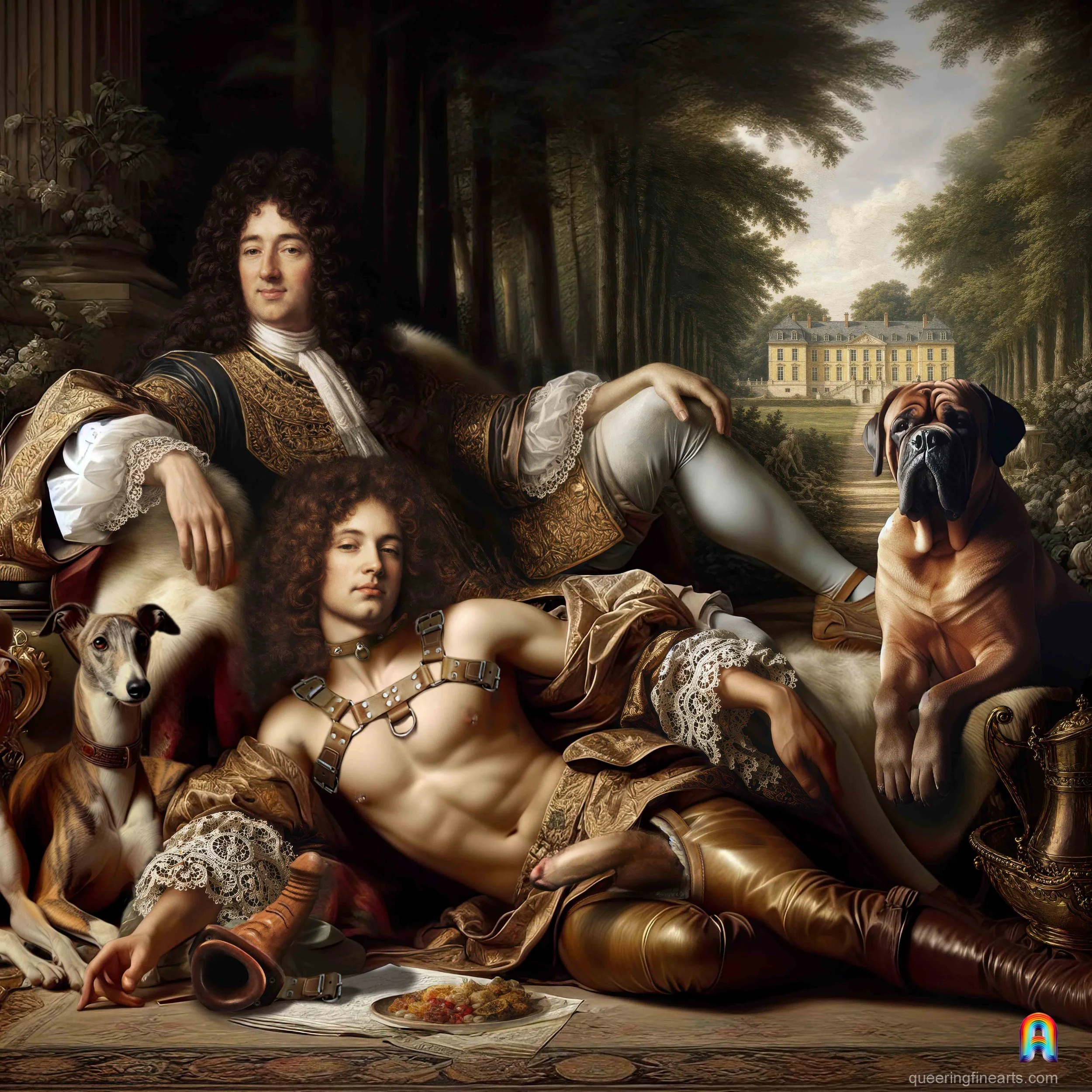
Monsieur
Philippe d’Orléans and the Chevalier de Lorraine in the Park of Saint-Cloud
Workshop of Pierre Mignard
Oil on canvas, late 17th century
Private collection
Prominent Queers in the France of the Grand Siècle
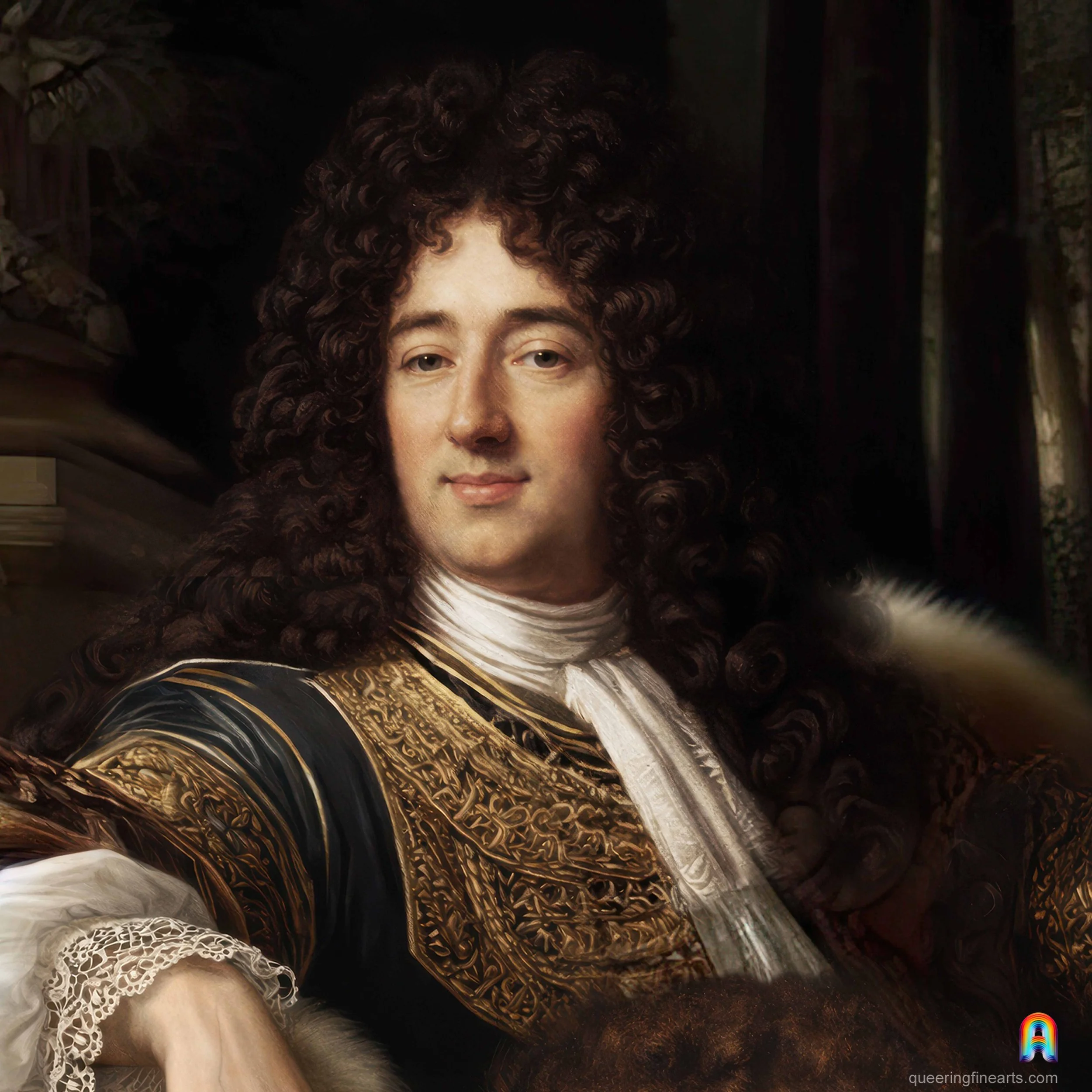
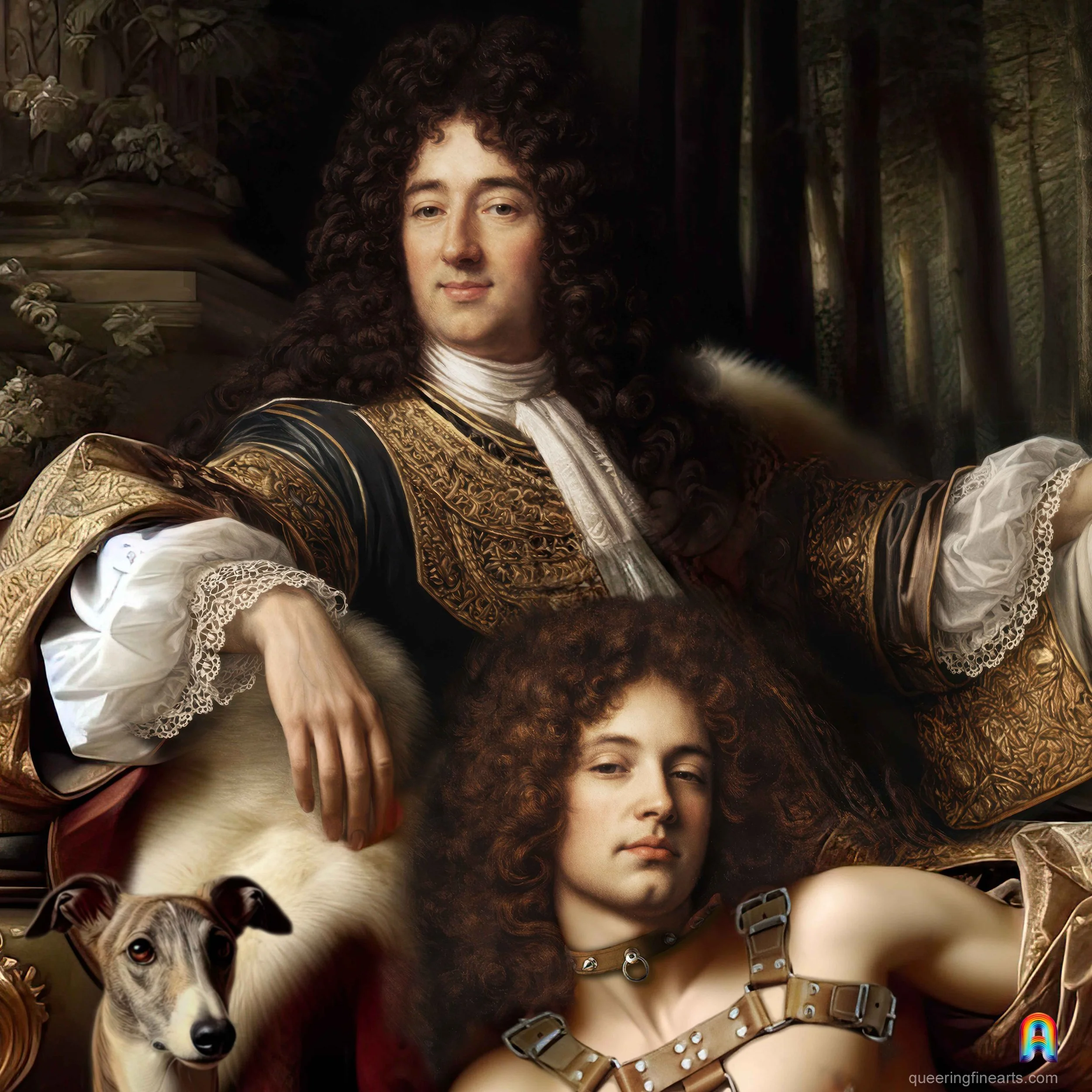
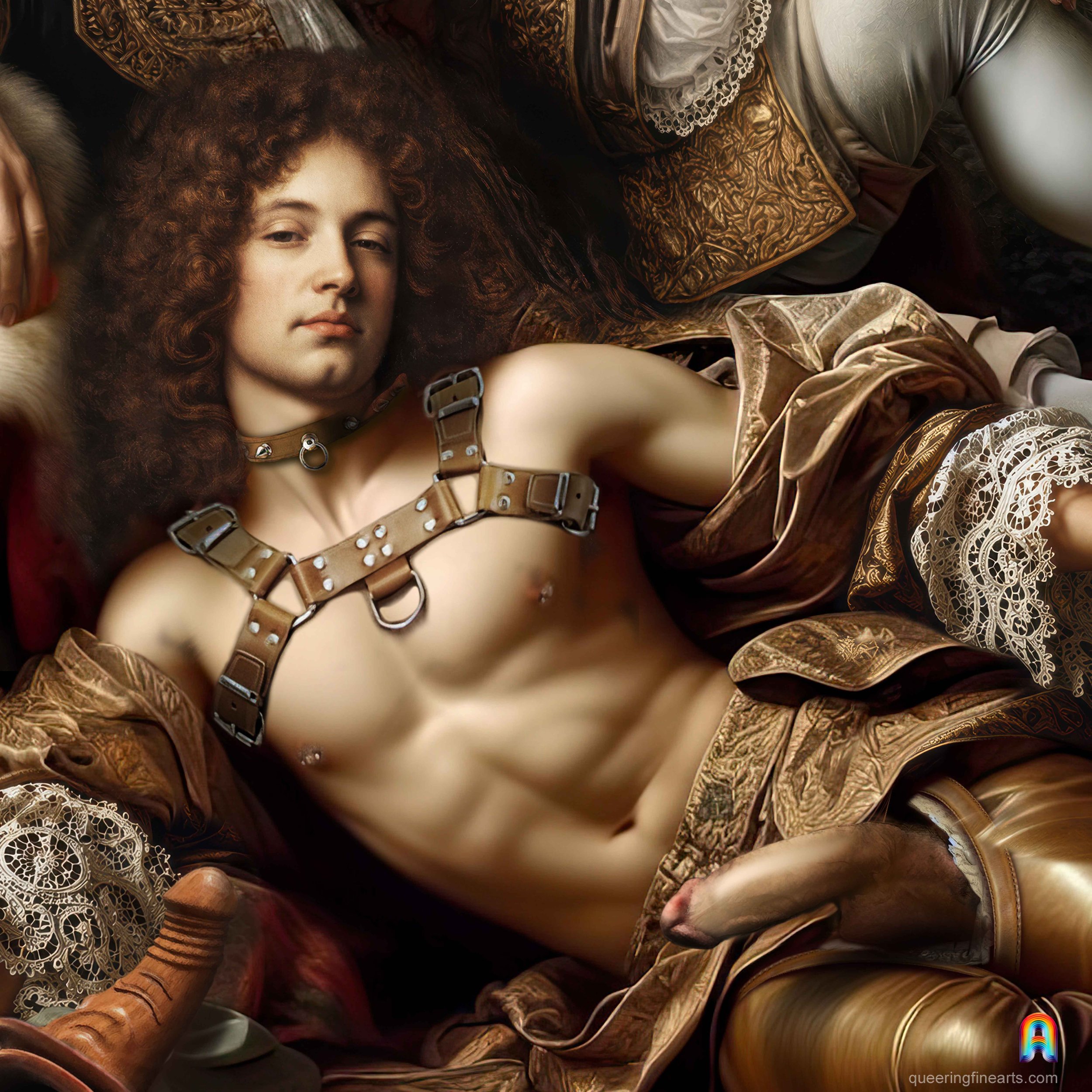
The composition is organized along a supple diagonal, in which the reclining body of the Chevalier de Lorraine (1643-1702)¹, half-undressed, leads the eye toward the taller and more sovereign figure of Philippe d’Orléans (1640-1701)², known as Monsieur. The latter, brother of King Louis XIV³, installed with studied nonchalance, dominates the scene while seeming to yield to it, in a posture where social mastery mingles with a form of intimate surrender. His gesture, resting gently on the silk-clad leg, affirms a discreet possession.
A Diagonal of Desire
The treatment of fabrics, the smooth and luminous flesh tones, and the attention paid to lace and the reflections of satin place the work within a Mignardesque sphere⁴. One recognizes here that enveloping softness, that polished sensuality characteristic of the stylistic circle of Pierre Mignard (1612-1695)⁵, in which flesh never imposes itself brutally, but instead reveals itself in a tempered light, almost caressing.
Nonchalance and Domination
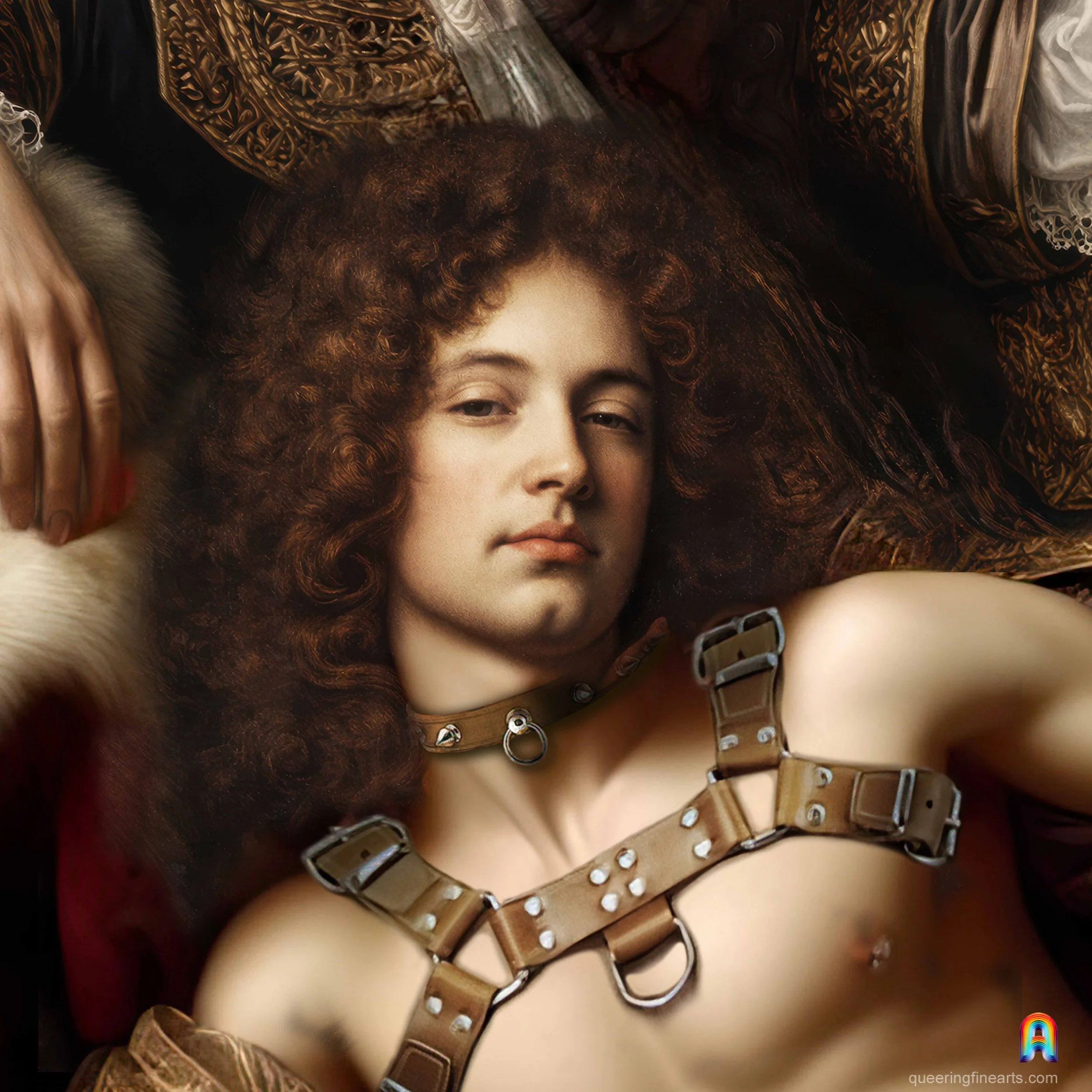
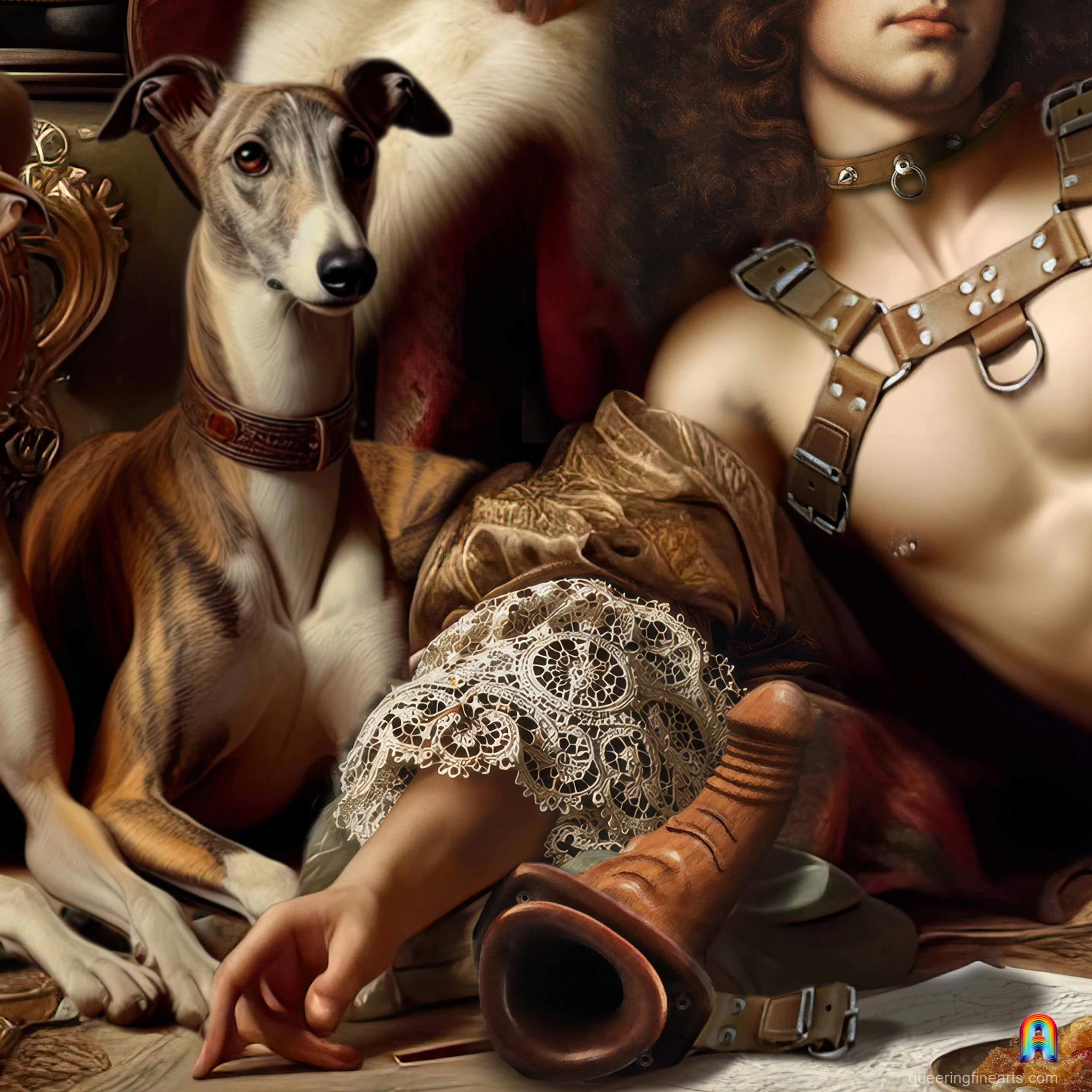
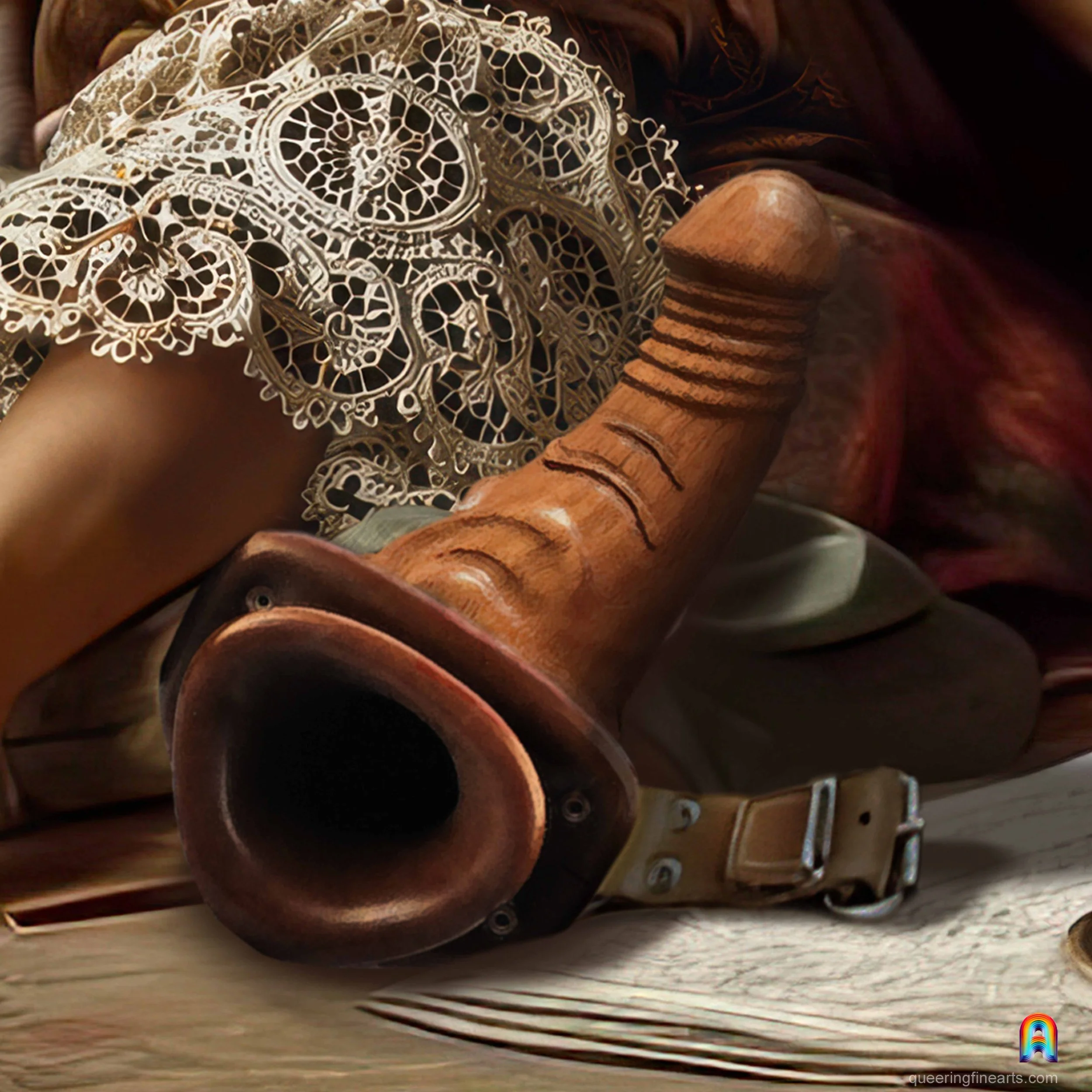
The Chevalier de Lorraine, placed in the foreground, his head slightly inclined and his gaze voluptuous, embodies an offered beauty. His partially exposed body, his erection displayed in a triumphant manner, is less that of a hero than that of an object of contemplation. The harness he wears, an element at once decorative and suggestive, introduces a tension between constraint and surrender. Around his neck, a collar recalling that of a dog suggests a playful submission to Monsieur. The presence of a hollow wooden dildo, matching the rest of the harness, nevertheless shows that the dynamics of power are less clear than hierarchy of rank might suggest. The games of the two men are freer and more inventive than appearances might lead one to believe⁶.
At Their Feet
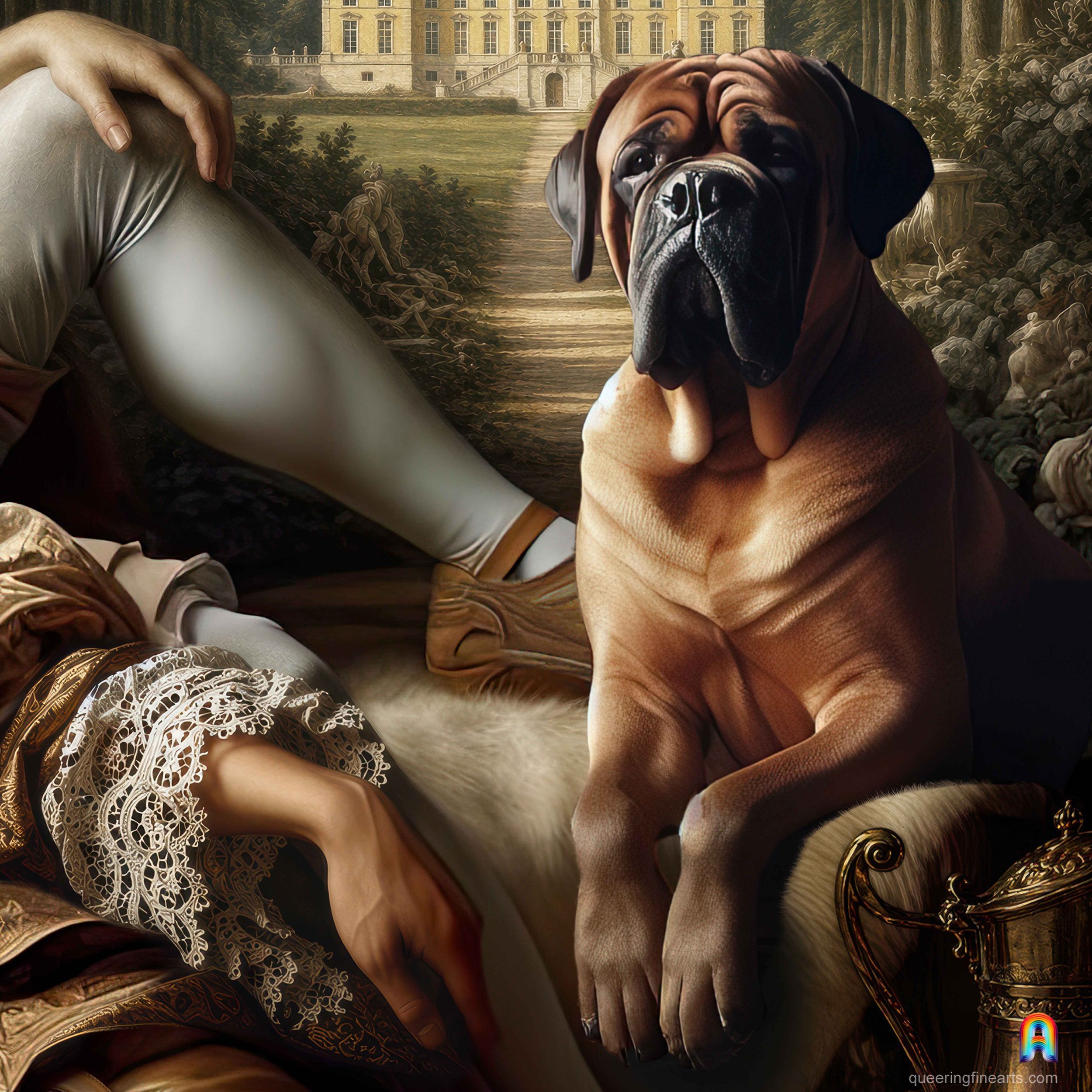
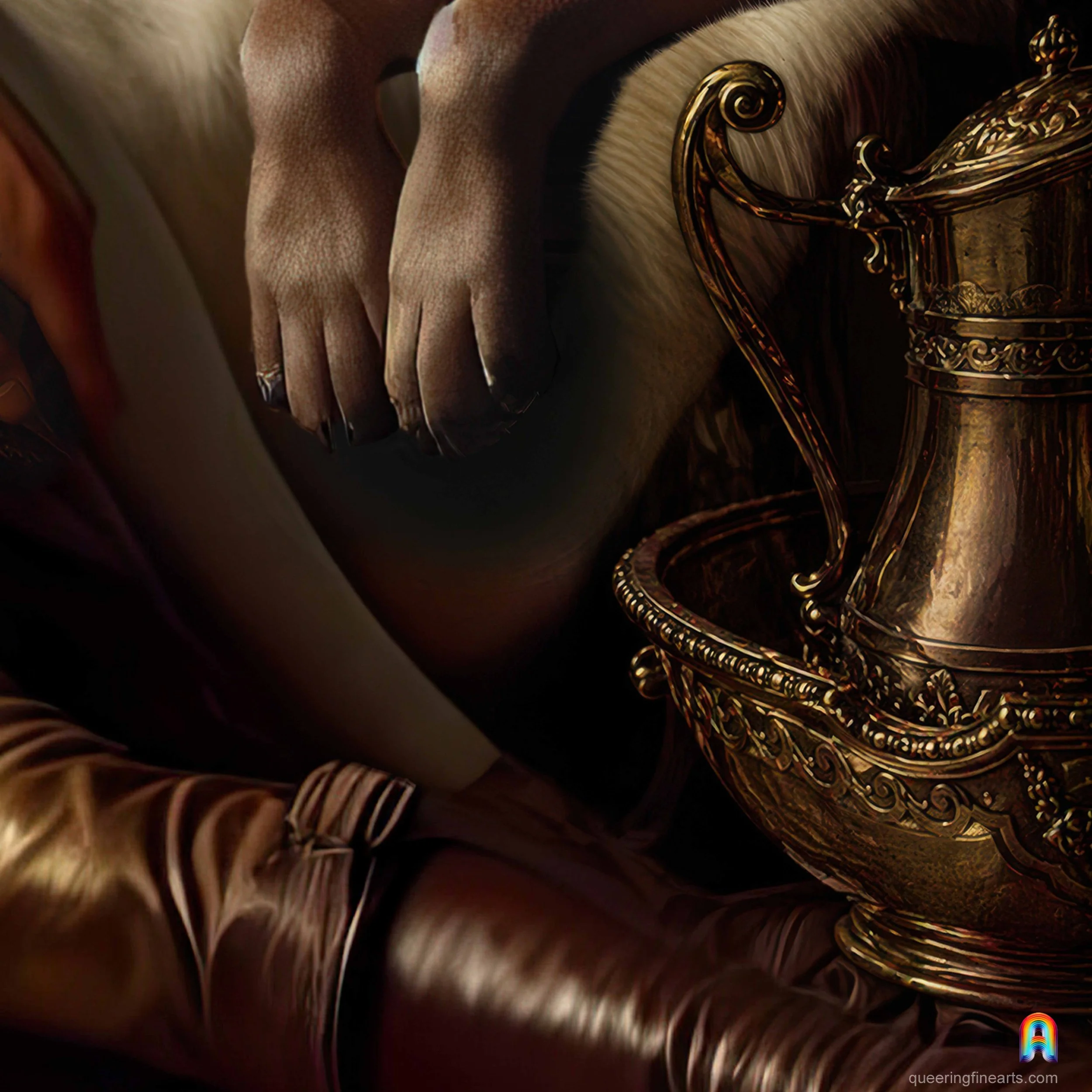
The two dogs introduce a clear symbolic system. The mastiff, massive and grounded, refers to Monsieur: stability, authority, contained power. The greyhound, more slender and more nervous, evokes the Chevalier: speed, grace, availability. These animal presences extend the characters of the two men and inscribe them within an allegorical reading of the couple, in which fidelity and desire are expressed through figures familiar to court painting⁷.
Delicacies
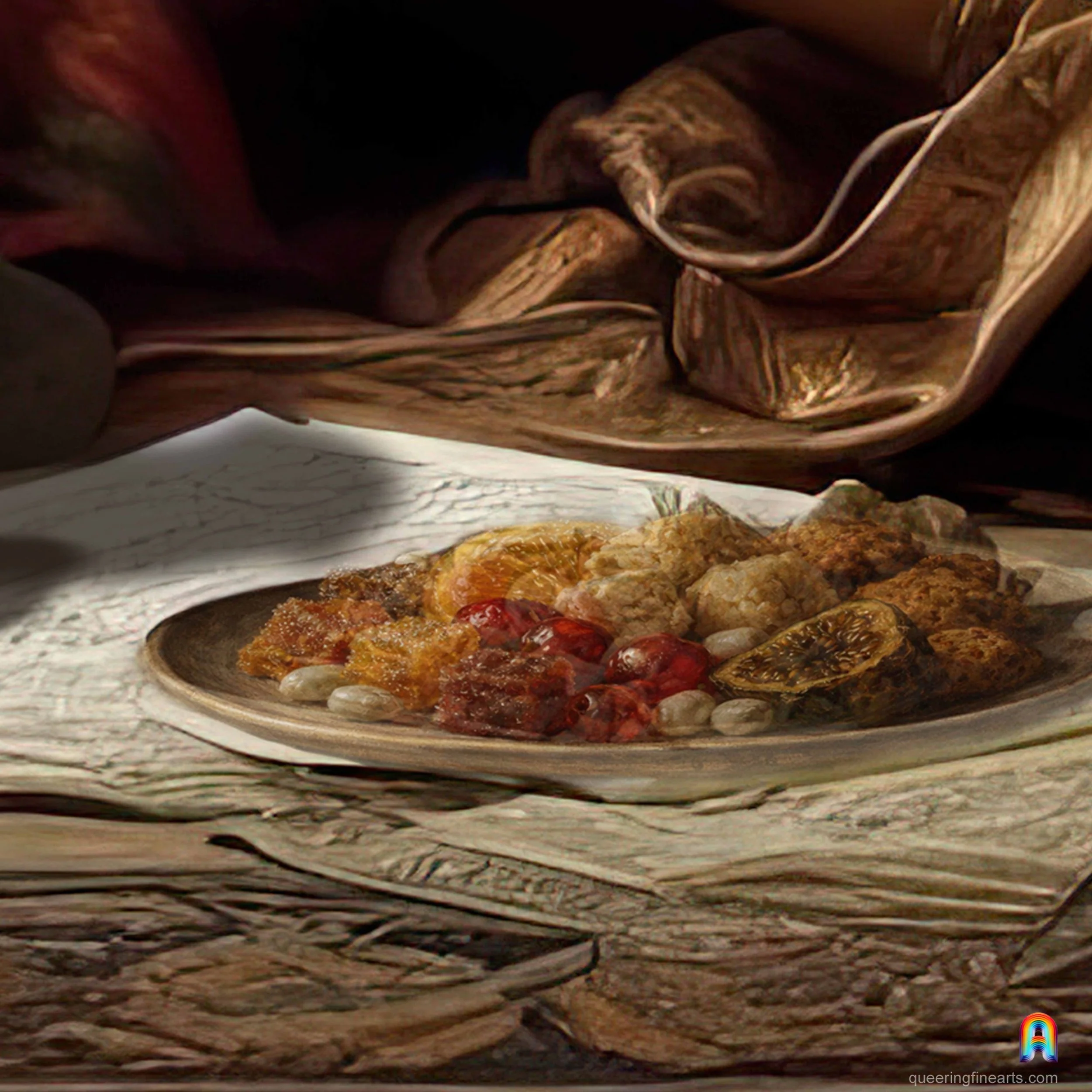
The plate set on the ground brings together a limited but highly luxurious selection of fine sweets, worthy of a refined aristocratic milieu: one recognizes candied fruits in amber and glowing red tones, probably citrus fruits or citron, a few delicate dragées with a satiny appearance, as well as small, dense and precious fruit jellies. It is a chosen, costly and elegant selection, belonging to that culture of sugar and daintiness which, in courtly circles, fully participated in the language of luxury, refinement and pleasure⁸.
An Object of Ritual
On the right side of the composition, the ewer and the golden basin go beyond mere luxurious décor. Their presence refers to gestures of washing and ablution proper to the aristocratic world of Monsieur, whose sumptuous goldsmith’s work is well documented⁹. In this scene, they thus take on a more intimate value, suggesting a shared ritual intertwined with erotic play and bodily care that precede or prolong a moment of amorous closeness, where the refinement of objects discreetly meets that of desire.
Monsieur’s Versailles
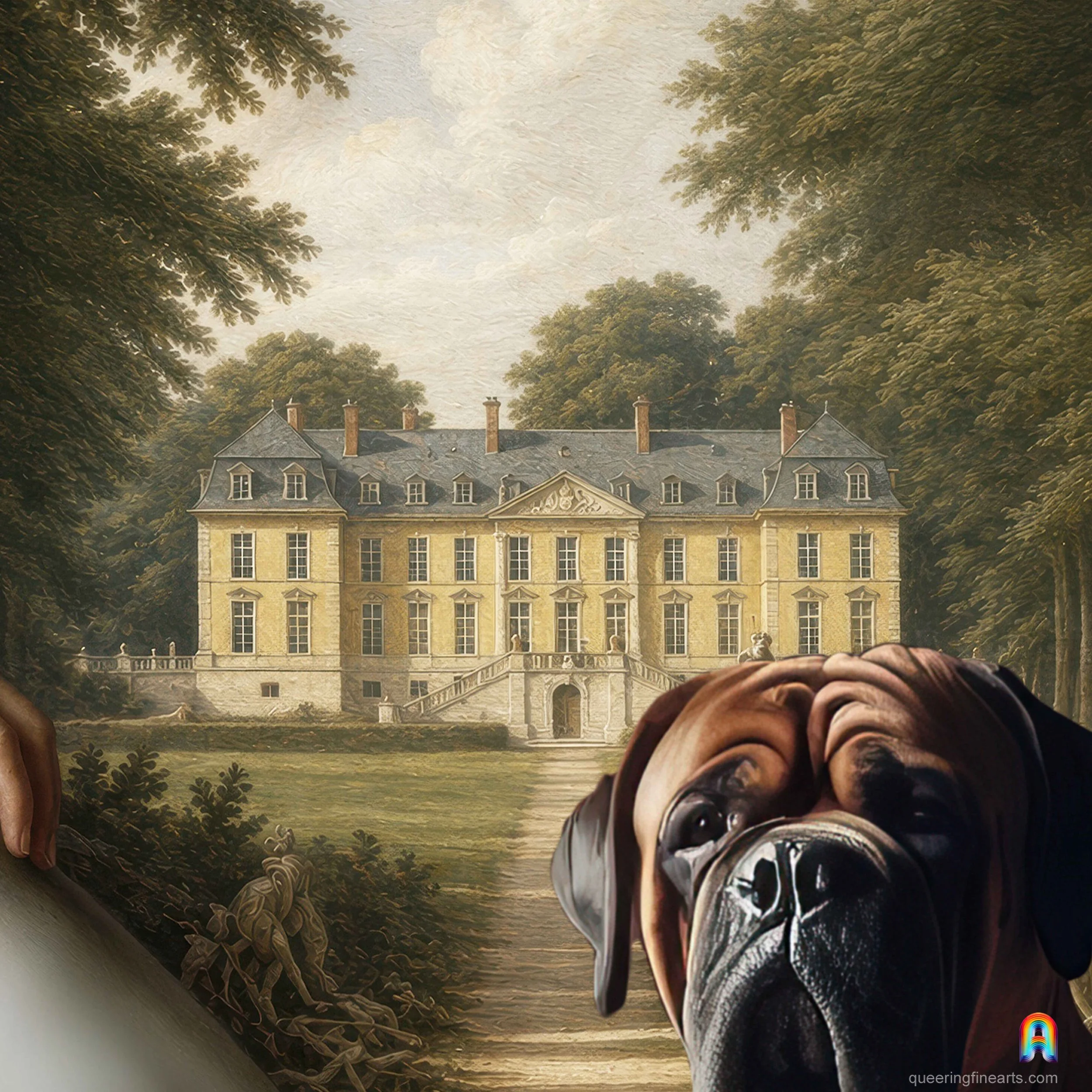
In the background, the Château de Saint-Cloud appears in softened light. It is not merely a backdrop, but an essential marker: Saint-Cloud, Monsieur’s residence, becomes here the implicit stage of this relationship¹⁰. The landscape, orderly and deep, opens the scene toward a space of representation in which the intimate and the political come together.
A Panoply of Desire
The whole painting rests on a subtle balance between convention and audacity. Every element - posture, gaze, sexual accessories, animals, architecture, goldwork - contributes to a coherent construction of desire. Within this economy of signs, the work offers less a narrative than an atmosphere, in which bodily proximity becomes a silent certainty¹¹.
Fluidity of Gender… of Genre
One might read this painting as a variation on the codes of aristocratic portraiture, diverted toward a scene of male complicity. Where tradition would have imposed distance and dignity, the artist introduces a continuity of bodies and gazes. This inflection, discreet yet constant, transforms the painting into a space of projection for a bond which, though unnamed, asserts itself powerfully¹².
An Ally of Taste
Thus, attributed to Mignard’s workshop, the work testifies less to a style than to a milieu: that of a court where appearances are mastered to the point that they can contain, beneath their smooth surface, forms of attachment that escape official frameworks. The presence of Pierre Mignard in the horizon of this work is not arbitrary. A court painter favored by Louis XIV, he was also an important artist in Monsieur’s orbit, particularly at Saint-Cloud, where his decorations helped make the residence of the king’s brother a place of magnificence capable of symbolically rivaling other centers of princely power¹³. His link with Monsieur therefore does not stem from some convenient retrospective association, but from a genuine historical, aesthetic and social proximity.
A Troubling Convergence
Nothing allows one to affirm solidly a homosexuality of Mignard on the model of the readings authorized by the sources concerning Monsieur. What appears instead is a subtler cluster of cultural indications: a painter associated with a prince whose tastes and attachments to men were notorious, a style perceived as graceful and caressing, and a later reception quick to associate this kind of softness with an old and nonetheless reductive vision of the “feminine”¹⁴.
A Caressing Brush
One might even say that this proximity sheds light on the very logic of the painting. If Monsieur chose artists capable of translating his world, it is not unreasonable to think that Pierre Mignard, or a painter from his workshop, could have given form to a scene in which splendor does not contradict intimacy, where the preciousness of objects only heightens the sensuality of bodies, and where masculine tenderness finds a way to express itself without breaking with the codes of aristocratic portraiture. In this perspective, the reference to Mignard serves not only to situate a manner, but to restore an entire milieu of taste.
Monsieur, Brother of the Sun King
The brother of Louis XIV, known by the title Monsieur, was named Philippe d’Orléans. One of the most singular figures of the 17th century court, he stands out through a complex relationship to gender, to self-representation and to his relationships with men, in a context where appearance, taste and social play fully participated in aristocratic identity.
The Magnificent Younger Brother
As the king’s younger brother, Philippe (1640-1701) was raised in an atmosphere shaped by Anne of Austria and Cardinal Mazarin, who directed his education away from direct political rivalries. Very early on, he developed a marked taste for splendor, precious fabrics, jewels and a self-staging that deliberately blurred the traditional codes of aristocratic virility, preferring to heroic austerity an aesthetic of grace, refinement and visual pleasure.
Philippe, My Love
His relationships with men constitute a central aspect of his life. Among his favorites, the most famous is Philippe de Lorraine, whose influence was such that it directly worried the king. Their relationship is generally interpreted as amorous and sexual, although contemporary sources resort to coded language. Around him gravitated a circle of male favorites forming a veritable “court within the court,” where emotional ties, political alliances and strategies of influence intertwined within a semi-official space¹⁵.
Favorite, Lover, Royal Headache
One may further specify that the Chevalier de Lorraine was not merely one favorite among others, but a man of very high birth whose influence was also exercised in the concrete organization of the Orléans household. Court testimonies show him associated with the management of Monsieur’s entourage, his residences and certain favors, which gave their bond a domestic and political reach as much as an affective one. The crisis of 1670 confirms this brilliantly: when Louis XIV had the Chevalier arrested and exiled, Monsieur reacted with such intensity that the affair became a genuine dynastic and diplomatic problem, before the favorite was finally allowed to return. Their relationship thus appears less as a simple gallant intrigue than as a lasting attachment.
Monsieur’s Two Wives
Despite this intimate life, Philippe contracted two dynastic marriages, with Henrietta of England and then Elizabeth Charlotte of the Palatinate, and ensured the continuation of his line, notably through the birth of the future Regent, Philippe II d’Orléans. The letters of his second wife moreover constitute a precious source, describing without restraint her husband’s relationships with his favorites¹⁶.
The Privilege of Rank
The very term “homosexuality” did not exist in the 17th century, when behaviors were first understood through moral, religious and legal categories such as sodomy, rather than through a personal identity in the modern sense¹⁷. In a contemporary reading, Philippe d’Orléans may nevertheless be understood as a man whose homosexual relationships were notorious. These did not merely stem from a precarious or marginal tolerance: his exceptional rank as the king’s brother granted him an extraordinary latitude, and the French court had already known, in other periods, sovereigns or princes whose attachments to men were visible. Monsieur’s case is therefore not that of an absolute exception, but of a visibility made possible by hierarchy itself, by proximity to power and by the logics proper to court society.
A Brother’s Affection
Far from mere tolerance, Louis XIV maintained with his brother a relationship made up of recognition and political balance. Philippe d’Orléans, by fully accepting his role as younger brother without ever contesting power, guaranteed a precious dynastic stability, and this positioning was in return honored by the king. His freedom of manners, though at times framed, thus formed part of an implicit pact, in which political loyalty and personal latitude answered one another, without preventing Philippe from retaining honors, wealth and prestige, nor from distinguishing himself militarily, notably at the Battle of Cassel in 1677.
A Key Queer Figure
As such, Philippe d’Orléans becomes a key figure for understanding the complexity of the 17th century: a world in which relationships between men were not inscribed within fixed identities, where tolerance depended on social hierarchies, and where appearance, self-theatricalization and refinement of gesture made it possible to express, under the cover of elegance, forms of desire that escaped explicit frameworks.
QFA
Curiosity piqued?
Jean-Christian Petitfils, Monsieur, frère du Roi Soleil, Paris, Fayard, 1986.
Alexandre Maral, Le roi, la cour et Versailles, Paris, Perrin, 2012.
Joël Cornette, Louis XIV, Paris, Gallimard, 2012.
Sylvain Bellenger, Pierre Mignard (1612-1695), Paris, Gallimard / Musée du Louvre, 2005.
Antoine Schnapper, Le métier de peintre au Grand Siècle, Paris, Gallimard, 2004.
Georges Vigarello, Le corps redressé, Paris, Delarge, 1978.
Michel Pastoureau, Une histoire symbolique du Moyen Âge occidental, Paris, Seuil, 2004.
Ken Albala, Eating Right in the Renaissance, Berkeley, University of California Press, 2002.
Natacha Coquery, Tenir boutique à Paris au XVIIIe siècle, Paris, EHESS, 2011.
Établissement public du musée et du domaine national de Versailles, “Philippe d’Orléans (1640-1701),” online resource, https://www.chateauversailles.fr/decouvrir/histoire/grands-personnages/philippe-orleans, accessed April 18, 2026.
Norbert Elias, La société de cour, Paris, Flammarion, 1974.
Diane Wolfthal, “Picturing Same-Sex Desire: The Falconer and His Lover in Images by Petrus Christus and the Housebook Master”, dans Troubled Vision: Gender, Sexuality, and Sight in Medieval Text and Image, New York, Palgrave Macmillan, 2003, p. 17-46.
Sylvain Bellenger, op. cit.
Jean-Marie Apostolidès, Le Roi-machine, Paris, Minuit, 1981.
Jean-Christian Petitfils, op. cit.
Élisabeth-Charlotte du Palatinat, Lettres, ed. Dirk Van der Cruysse, Paris, Mercure de France, 1989.
Didier Godard, Le Goût de Monsieur: l’homosexualité masculine au 17e siècle, Montblanc, H&O, 2002.