


Big Jack and the Three Bears
From the hand of an artist inspired by the art of Van Gogh
Oil on canvas, date unknown
Private collection
The Birth of Desire
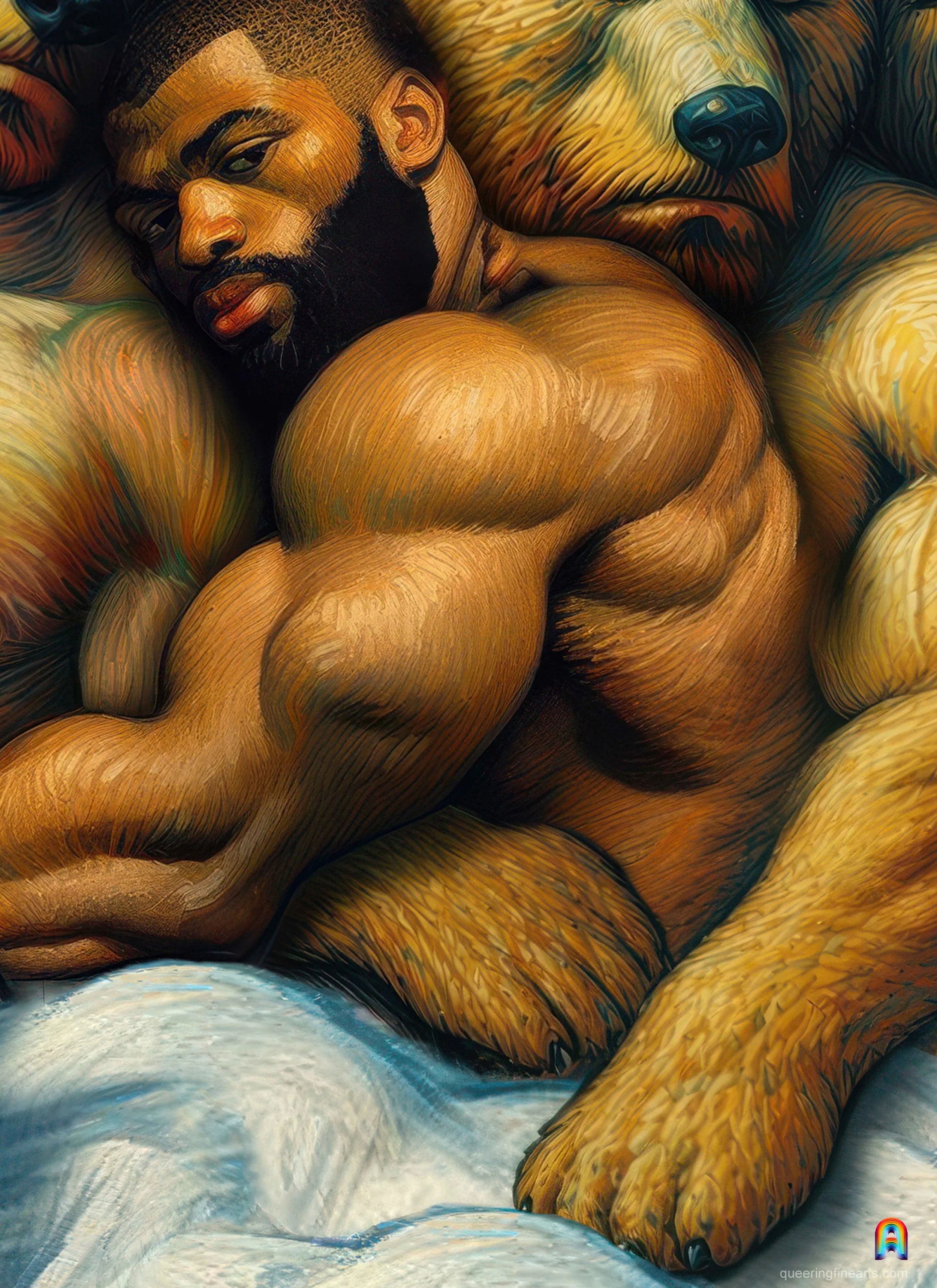
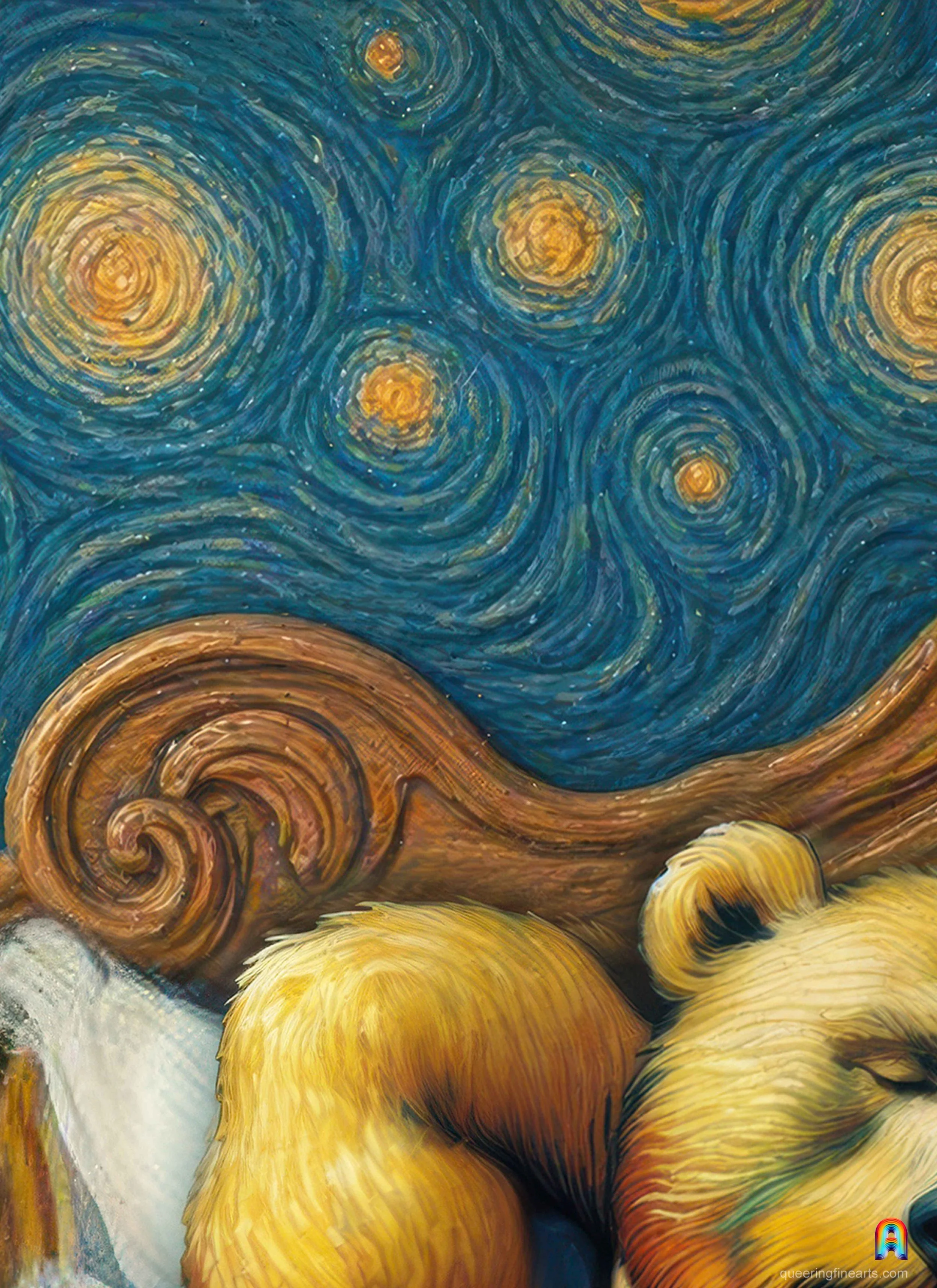
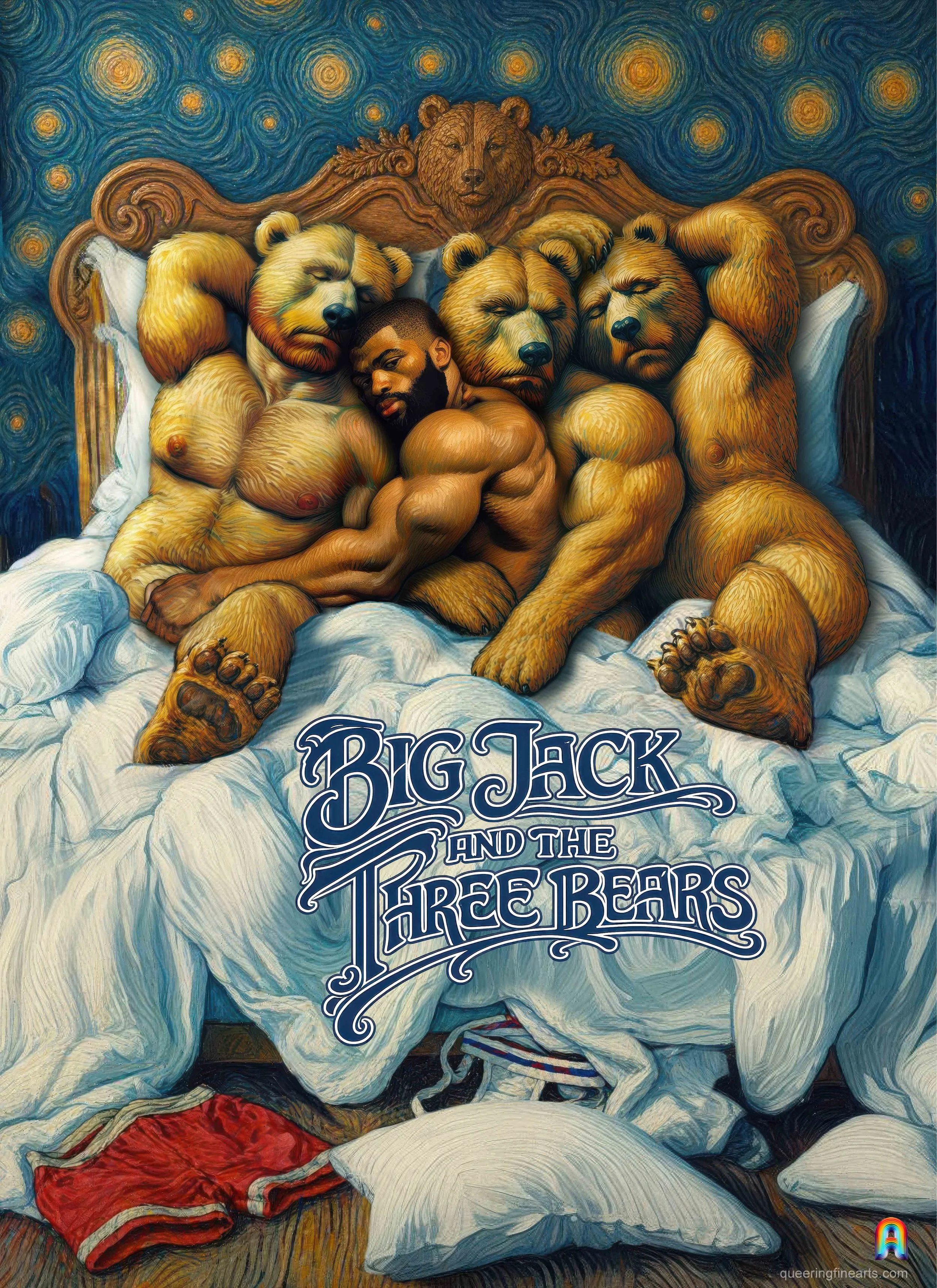
A warm room in the morning, still threaded with the spirals of a starry night¹, as though the sky itself had slipped indoors. An unmade bed. The wood of the headboard, carved with the face of a bear both gentle and watchful, presides over a scene suspended between ancient tale and the nostalgic memory of childhood. Here, the familiar world quietly slips out of alignment: the unexpected visitor has crossed the threshold, entered without a sound, tried each chair, tasted the bowls of porridge², then climbed to the bed where he surrendered himself.
Big Jack and the Three Bears
At the center, Big Jack lies at rest, held within three bodies of bears, shaggy, heavy-muscled, reassuring. They leave behind them a night of passion. What remains is this slow proximity, almost drowsy, where the boundaries between sleep and waking dissolve. One can still sense, in filigree, those stories told at night³, where a house lost in the woods reveals its mysteries and each humble gesture takes part in a broader quest. Perhaps the discovery of one’s own sexuality beyond imposed norms⁴? Yet here, the primary discovery carries the warmth of a chosen surrender and, above all, a quiet acceptance of self. Big Jack holds the member of the bear on the right in his hand, while the bear at the center, tightly embracing him, watches him calmly out of the corner of his eye.


Comforting Virility
Big Jack’s body, with its volumes inherited from Big Jim figurines, a toy universe marketed in 1972⁵, introduces another memory: that of childhood bedrooms, slightly uneasy about their own attractions and the path ahead, of handled toys, of stories replayed in secret. This presence, at once coded and carnal, enters into dialogue with the dense fur of the bears, plush and male presences of heightened virility⁶, older, more instinctive, yet reassuring. Together, they compose an image of refuge where strength becomes enveloping softness. Where the body of the man seeking refuge is played like a fleshly instrument by heavy paws and reaches zones of ecstatic pleasure.
The Van Gogh Enchantment
The painting itself breathes. The brushstrokes, vibrant and nervous, set a light in motion that seems to pulse beneath the surface. The blue of the background swirls, the yellows ignite like embers. This Van Gogh-like touch animates the material. It transforms the room into an inner landscape⁷, into an active dream, into moving substance.
Clues
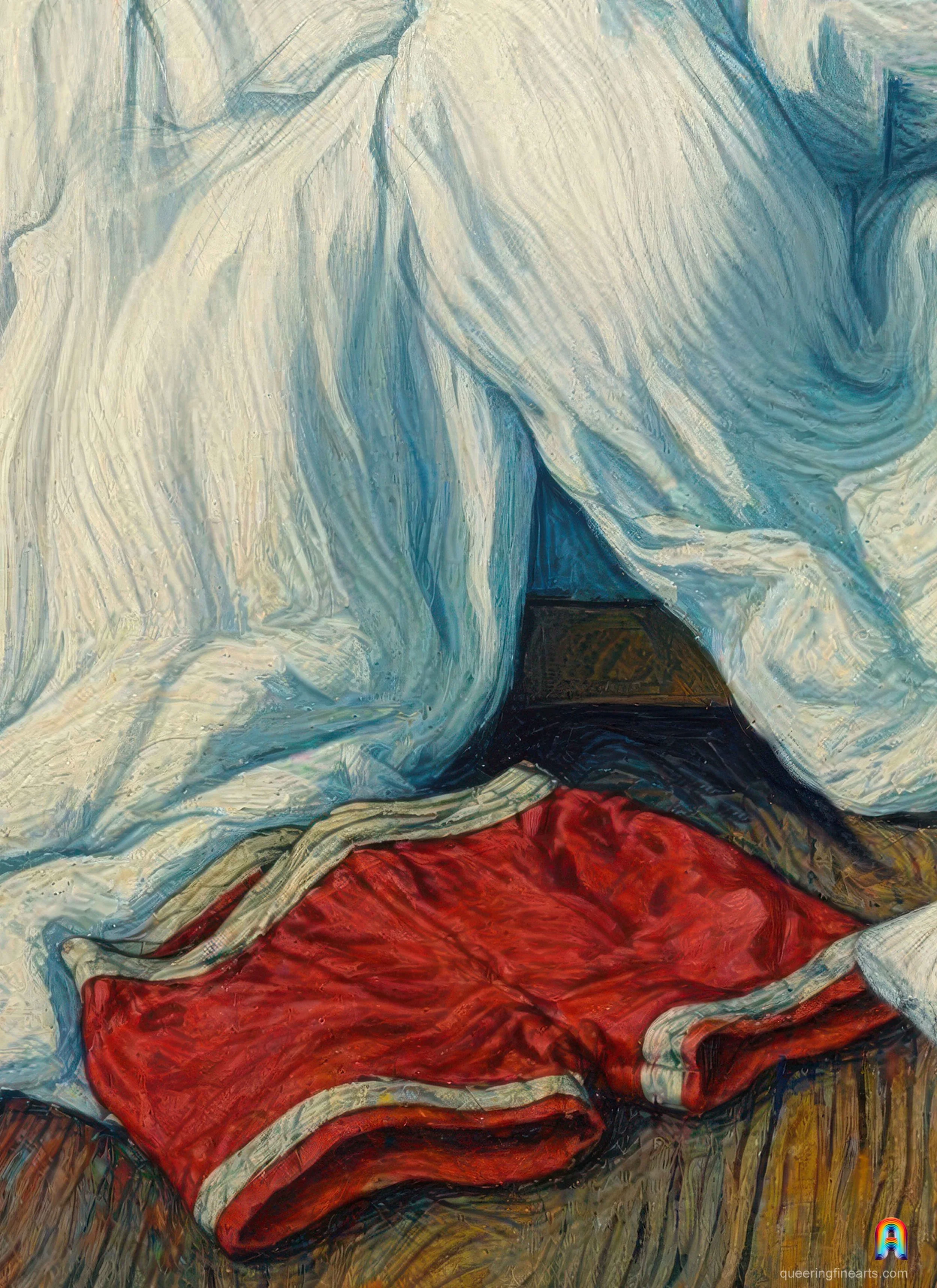
And then, at the foot of the bed, a wink slipped outside the tale: a red trunk, abandoned, a direct memory of Big Jim accessories⁸, and a jockstrap half hidden in the folds of the sheets. These objects say, without insisting, that the story has grown. That the game has shifted. That what was once a naive exploration, sometimes tinged with sensuality, has become an awareness of the body, of desire, of the presence of the other
Initiatory Exploration
Everything holds within this delicate balance: carved wood and living plush, toy and flesh, memory and moment. The scene tells more than one tale. It reawakens their deep sensation: that of entering somewhere, of touching, of discovering, then remaining a little longer than expected… until one no longer quite knows whether one is a guest or already at home.

The “Bachelor” Three Bears
The story now known as Goldilocks and the Three Bears was not, at first, the story of a little blonde girl. Its first printed version is English: Robert Southey publishes in 1837 The Story of the Three Bears in The Doctor⁹. In this version, the intruder is an ill-mannered old woman, a vagabond, who enters the home of three bachelor bears¹⁰, note this detail well, one might think of the old cliché of same-sex “roommates”, eats their porridge, tries their chairs, sleeps in their beds, then flees through the window when discovered. The tale is thus, at first, a story of domestic trespass, of the transgression of private space, and of disorder introduced into a perfectly ordered household.
At the Mill of Acceptability
The major transformation comes next: the old woman gradually becomes a child. Joseph Cundall, in the mid-19th century, helps replace this disagreeable figure¹¹ with a little girl with silver hair, then golden. This shift leads to Silver-Hair, then to Goldilocks. At the same time, the three bears cease to be three males living together and become a family legible for children: Papa Bear, Mama Bear, and Baby Bear. The tale thus moves from a somewhat harsh fable about an adult intruder to a childhood story about curiosity, limits, and the famous “just right”.
Scrapefoot or the Tailed Intrude
Yet there exists another fascinating path: that of Scrapefoot, an English tale where the intruder is neither a woman nor a child, but a fox¹². In this version, a fox enters the castle of three bears, drinks their milk, tries their chairs and their beds, then is discovered. Joseph Jacobs, a major English collector of the late 19th century, considered this version very important¹³, possibly older than Southey’s. Some commentators have even suggested that Southey’s old woman might stem from a confusion between a vixen, a shrew, or an old woman, as popular English allowed semantic shifts around the figure of the cunning or unpleasant female. This hypothesis is unproven, yet stimulating, because it restores the tale to an older animal cycle: the curious, thieving, intrusive fox entering a domain not its own.

Renart (a fox) and Brun (a bear)
This is where the comparison with the Roman de Renart becomes interesting, though one must remain cautious. The Roman de Renart is a vast cycle of animal tales composed in Old French in the 12th and 13th centuries¹⁴: animals speak, deceive, judge, and fight like humans, in a satirical universe where Renart, the cunning fox, notably confronts Brun the bear, a figure of strength but also of naivety. One cannot say that Goldilocks and the Three Bears descends directly from the Roman de Renart. However, the two can be brought together through their motifs: the fox as intruder, cunning, the penetration of a forbidden space, confrontation with the bear, and the logic of punishment or escape. In the Roman de Renart, Brun the bear is repeatedly tricked or humiliated by Renart, notably in the episode of the honey. The fox-bear relationship is thus already charged, in medieval Europe, with a comic and violent dynamic: the agile, transgressive animal confronting the powerful, heavy one, vulnerable to its own appetite.
Toward Consent
One may thus imagine a shift toward a more adult and more troubling reading: where earlier versions staged a male fox facing a bear, or three male bears living together, the intruder here becomes a bold young man who deliberately crosses the threshold of an intimate space. It is no longer merely naive curiosity but an intrusion charged with desire. By entering the house, touching, trying, appropriating objects and spaces, he first disturbs the trio’s balance, as in traditional versions. But instead of flight or punishment, the encounter bends: reception transforms, tension gives way to a form of acceptance, then to an implicit initiation, where the disorder introduced becomes passage, learning, even the accomplishment of initiating sexual acts. The question then reverses: was the intrusion mere chance, or did it respond to a long-held fantasy that finally found, in this forbidden space, its place of embodiment?

A Quest (whose aim is known only at its end)
The story of the intruder and the three bears stands at the crossroads of two traditions. On one hand, it belongs to the great world of fairy tales, even without fairies: a house in the forest, three repeated actions upon triple objects, a ritual progression, a fault, a discovery. On the other, it retains something of the older animal tale¹⁵: the fox, the bear, territory, food, cunning, and sanction. Its strength lies precisely there. Beneath the apparent simplicity of Goldilocks, one senses a much more archaic narrative core: someone enters where they should not, touches what is not theirs, seeks the right place, then discovers that the house of wonder is never without an owner.
Finding One’s Place
From this perspective, the tale can also be read as a subtle metaphor for the prohibitions weighing upon a child’s desire¹⁶, particularly when it diverges from expected norms. The crossed threshold, the tried objects, the body seeking “the right place” become gestures charged with a familiar tension: that of secret exploration, of pleasure mixed with fear, of feeling both drawn and guilty. For a young boy taught early what is permitted or not to be, the story resonates deeply. Everything is there: the call, the transgression, the fear of being discovered, but also the possibility, even fleeting, of a space where desire recognizes itself. The intrusion thus becomes not merely a fault but the sign of a vital impulse, of a search for self that, despite prohibitions, always finds a way to express itself.

Games of Male Proximity
In the 1970s, the world of Big Jim figurines produced by Mattel already offered a gallery of coded and intensified masculinities¹⁷. These characters, adventurers, spies, explorers, exist in a world of constant action where the male body is central, valued, displayed, and where male proximity is inherent to play. Accessories, staging, situations of danger or survival construct a theater of gesture and physical performance. The child spontaneously projects narratives onto it but is also confronted with an insistent presence of the male body as a site of heroism, tension, identification, and in many cases, desire.
Big Jack 1972: at last
Among these figures, Big Jack, introduced in the early 1970s, holds a singular place. The first major Black character in the line, he embodies a form of openness still rare in the toy industry of the time¹⁸. Yet beyond this dimension, he shares with the others an aesthetic of the sculpted body, visible muscle, contained power. His presence broadens the range of representations without breaking from the dominant model: that of strong, autonomous men ready for action. In his own way, he contributes to the construction of a plural yet intensely embodied masculine imaginary.
Diffuse Trouble
For a young boy attuned to other forms of desire, these toys could become far more than simple playthings. Muscled bodies, molded torsos, biceps capable of contracting to the point of bursting “iron” bands introduced an almost tactile dimension where strength became spectacle¹⁹. The proximity of the figurines, their handling, their arrangement in invented scenarios opened a discreet space of exploration. Between fascination, identification, and diffuse trouble, these objects could offer a first encounter, silent yet persistent, with a form of desire still without words, already intensely present.

Desire Without Word
In this continuity, childhood does not appear as a neutral space later shaped by an identity imposed from outside. It is already inhabited, traversed, oriented. Homosexuality does not emerge as a rupture or a late deviation but as an intimate given, already there, still without language, yet fully active²⁰. The child does not formulate, he feels. And faced with images, stories, objects that surround him, he makes his own shifts, his own correspondences. Where others see adventure, he perceives proximity. Where a story of curiosity is told, he feels attraction. The tale, the toy, the scene thus become surfaces of projection where something deeply personal finds a way to be expressed, even in silence.
Refuge Before Flight
Thus are born these parallel worlds, discreet yet powerful, that the child creates in response to what he carries within. He does not merely receive stories: he transforms them, bends them, inhabits them differently. He invents variations, proximities, intensities that escape prescribed frameworks. In this room, in these repeated gestures, in these bodies brought together through toys, one reads this capacity to create meaning from what is offered, but also despite what is imposed²¹. The work bears direct trace of it: that of an imaginary built from within, in response to a truth already present, which found, in the forms of tale and play, the means to take shape.

The Child Become Man
Become a man, the child no longer plays with action figures: he rediscovers, with real bodies, warm, musky, the forms, the strengths, and the promises that his figurines had first allowed him to sense. The “bears” are no longer plush, Big Jack is no longer a toy, and the bed is no longer a setting from a tale: everything is now embodied in the warmth of intimate encounters, in the real presence of bodies, in the finally lived possibility of what once could exist only in secret.
QFA
Curiosity piqued?
1. Ronald Pickvance, Van Gogh in Saint-Rémy and Auvers, New York, Metropolitan Museum of Art, 1986.
2. Maria Tatar, The Annotated Classic Fairy Tales, New York, W. W. Norton, 2002.
3. Jack Zipes, The Oxford Companion to Fairy Tales, Oxford, Oxford University Press, 2000.
4. Didier Eribon, Reflections on the Gay Question, Paris, Fayard, 1999.
5. Tim Walsh, Timeless Toys, Kansas City, Andrews McMeel, 2005.
6. Georges Vigarello, The Upright Body, Paris, Delarge, 1978.
7. Meyer Schapiro, Van Gogh, New York, Abrams, 1950.
8. Derrick Vanhoy, The Big Jim Book, Atglen, Schiffer Publishing, 2009.
9. Robert Southey, The Doctor, London, Longman, 1837.
10. Maria Tatar, The Annotated Classic Fairy Tales, New York, W. W. Norton, 2002.
11. Joseph Cundall, Treasury of Pleasure Books for Young Children, London, 1850.
12. Katharine Briggs, British Folk-Tales and Legends, London, Routledge, 1970.
13. Joseph Jacobs, English Fairy Tales, London, David Nutt, 1890.
14. Jean Dufournet, Le Roman de Renart, Paris, Flammarion, 1998.
15. Vladimir Propp, Morphology of the Folktale, Paris, Seuil, 1970.
16. Bruno Bettelheim, The Uses of Enchantment: The Meaning and Importance of Fairy Tales, Paris, Robert Laffont, 1976.
17. Gary Cross, Kids’ Stuff, Cambridge, Harvard University Press, 1997.
18. Patricia A. Turner, Ceramic Uncles and Celluloid Mammies, Charlottesville, University of Virginia Press, 1994.
19. Susan Stewart, On Longing, Durham, Duke University Press, 1993.
20. Sigmund Freud, Three Essays on the Theory of Sexuality, Paris, Gallimard, 1987.
21. Donald Winnicott, Playing and Reality, London, Tavistock, 1971.
