In Arcadia
Attributed to Anne-Louis Girodet
Oil on canvas, circa 1820–1830
From the collection of a lover of Virgil
Corydon and Alexis
“Formosum pastor Corydon ardebat Alexin,
delicias domini, nec quid speraret habebat.”¹
The shepherd Corydon burned with love for the beautiful Alexis, his master’s favorite, and no longer knew what hope he might hold.
Virgil, Eclogue II
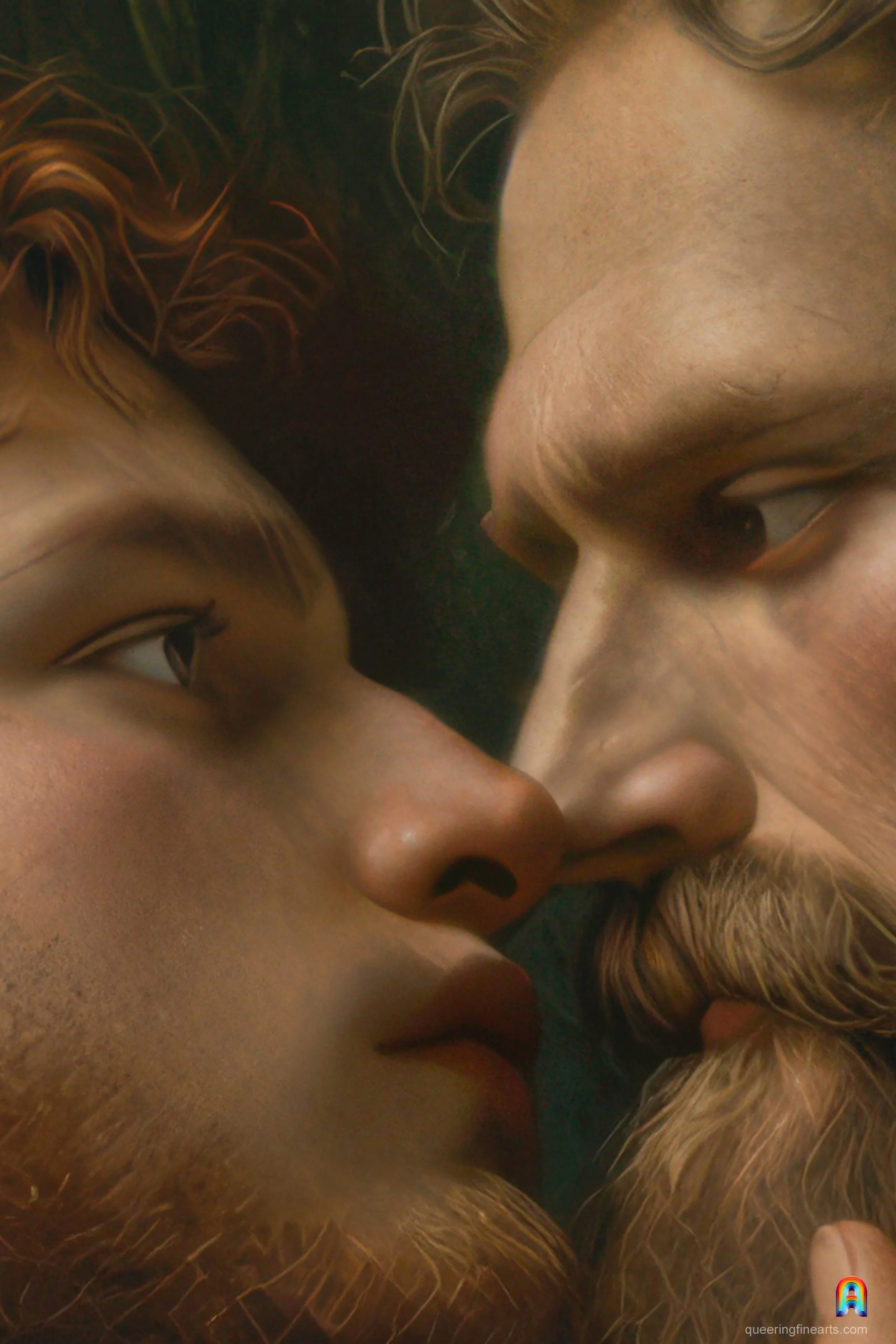
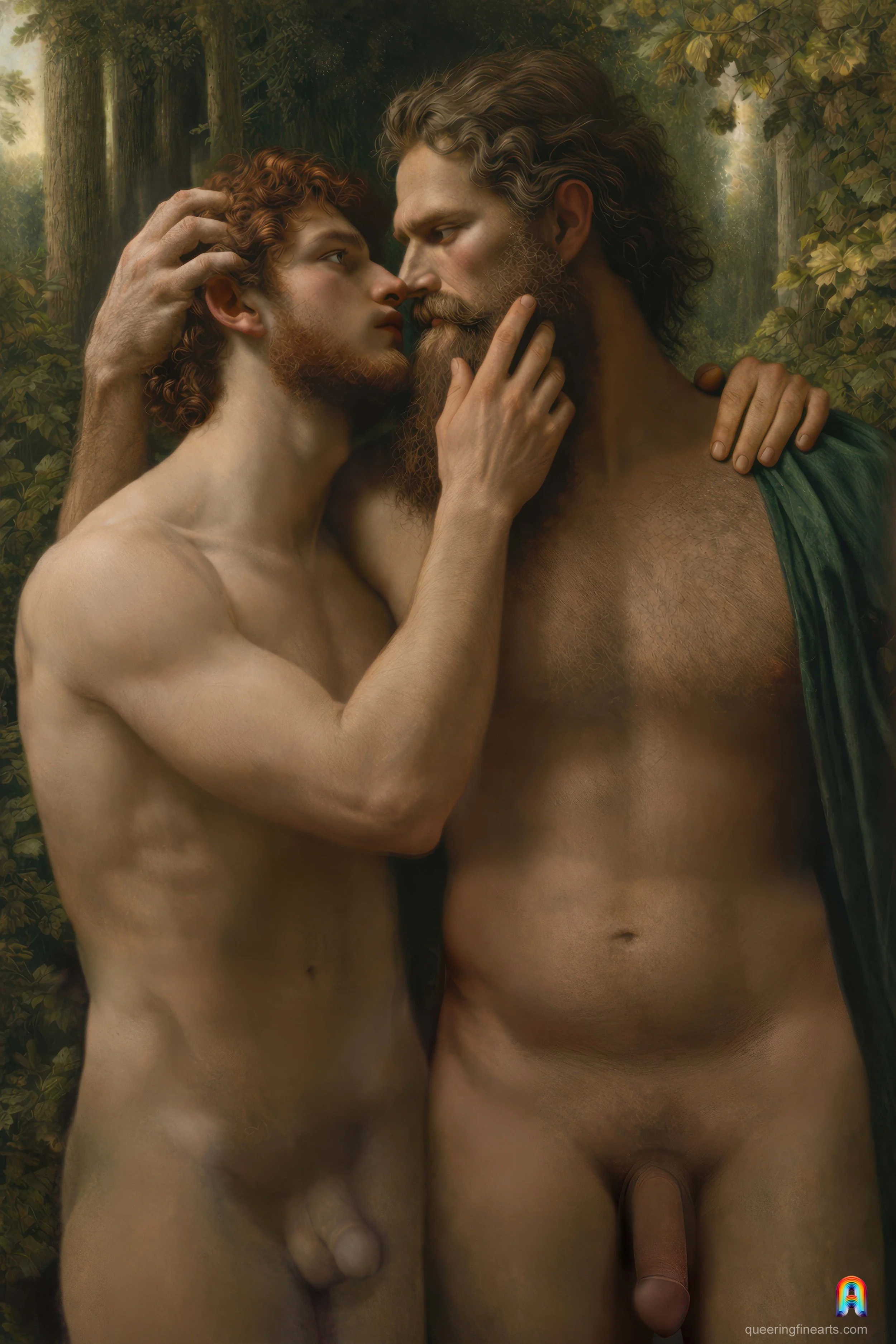
The artist chooses from the outset to depict Corydon and Alexis, figures drawn from Eclogue II by the Roman author Virgil². The shepherd and the beloved youth, known through ancient song, take on corporeal presence here in a face-to-face encounter of striking intensity. The poem becomes image. The pastoral voice is transformed into immediate presence, offered to the gaze.
A Romantic Arcadia
The forest setting transposes ancient Arcadia into the sensibility of the early 19th century. Romantic painters, following Girodet, reinterpret classical motifs through an expressive vision of nature³. The forest, dense and enveloping, becomes a space of emotion, a secluded place where inner impulses take form.
Light, filtered through the foliage, glides gently across the bodies and establishes a contemplative atmosphere. The landscape functions as an intimate setting. It draws the figures together, isolates them from the world, and intensifies their presence. This nature, inspired by Virgil’s Arcadia, becomes a site of sensory revelation, where desire inscribes itself with clarity within the order of living things⁴.
The Meeting of Bodies
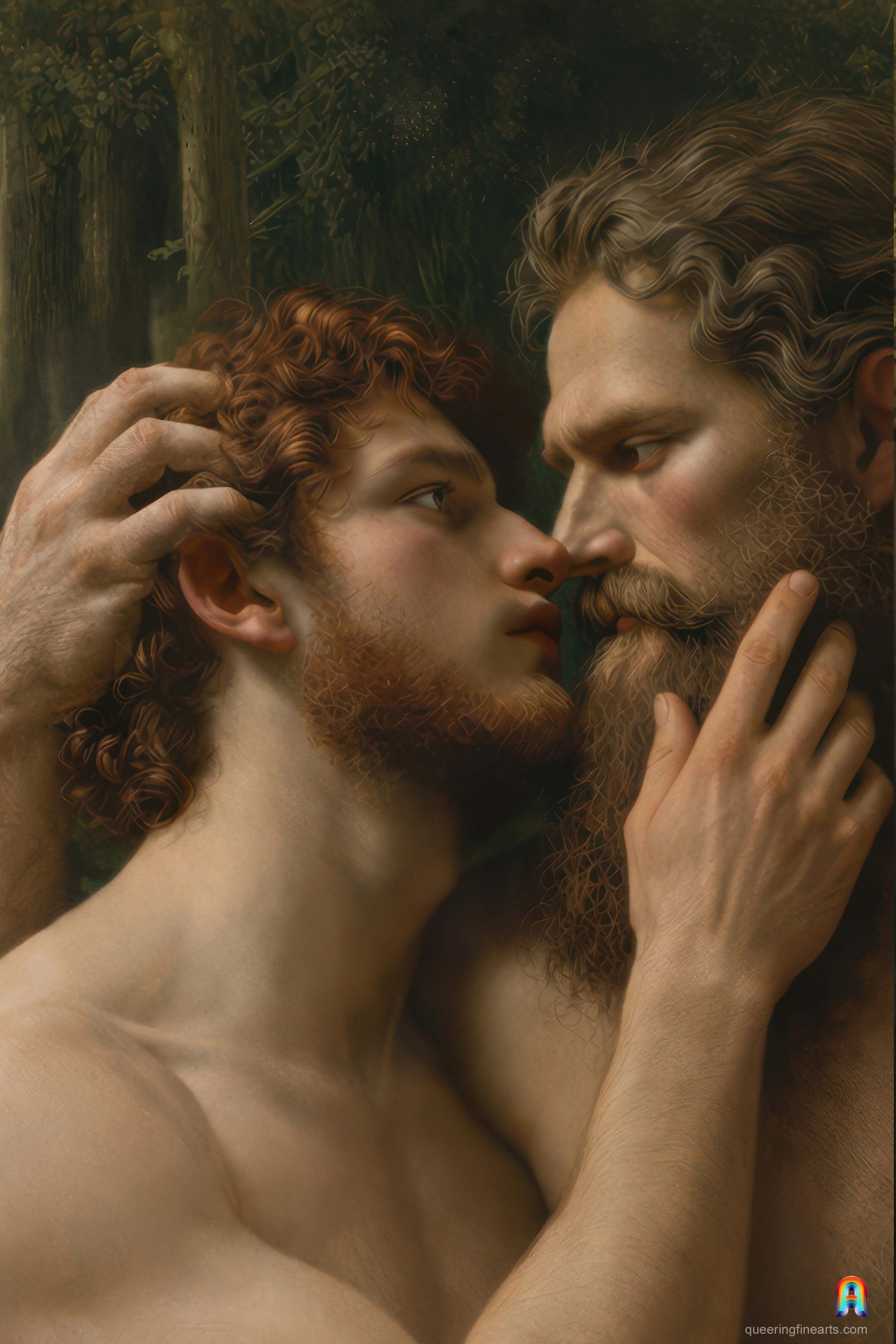
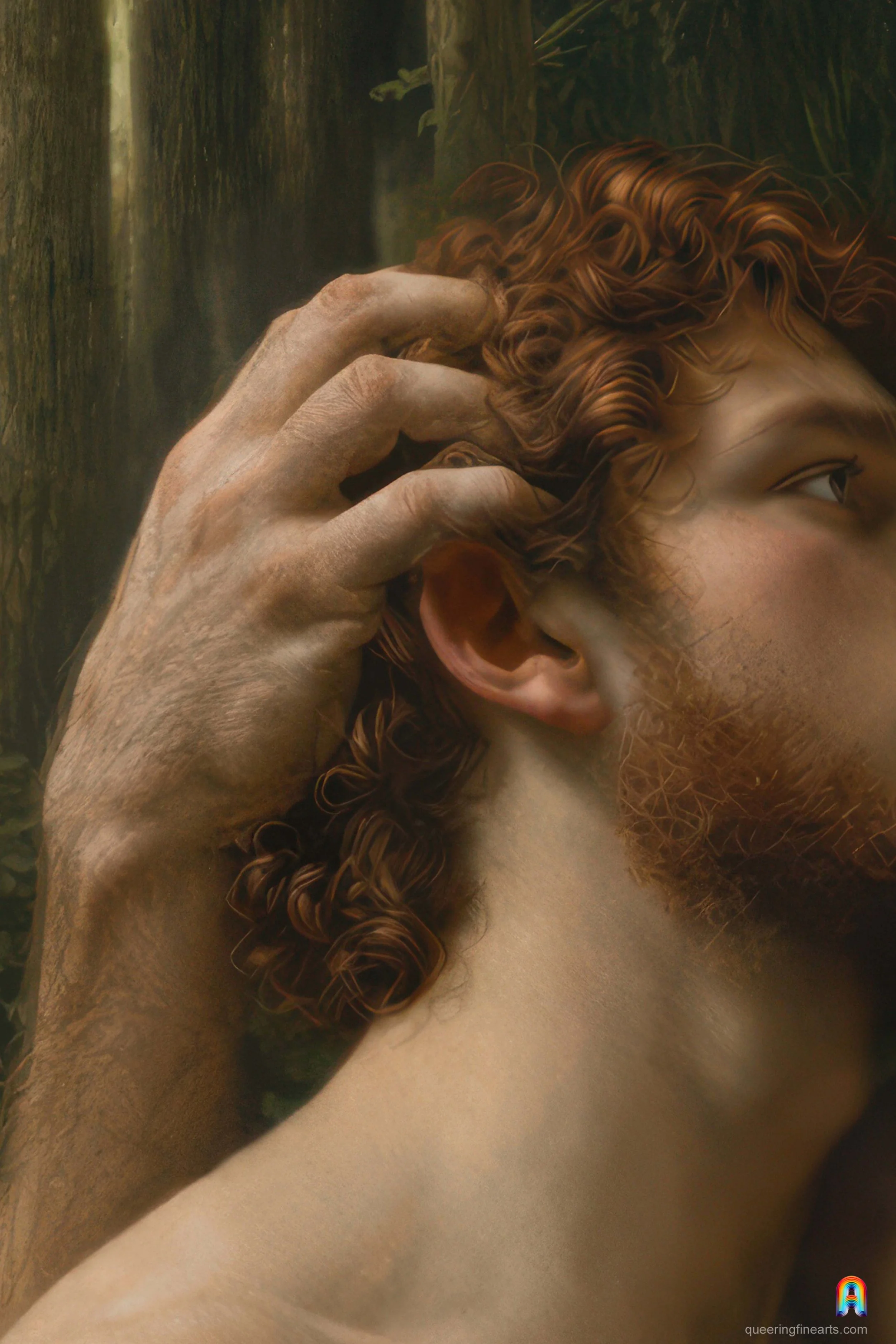
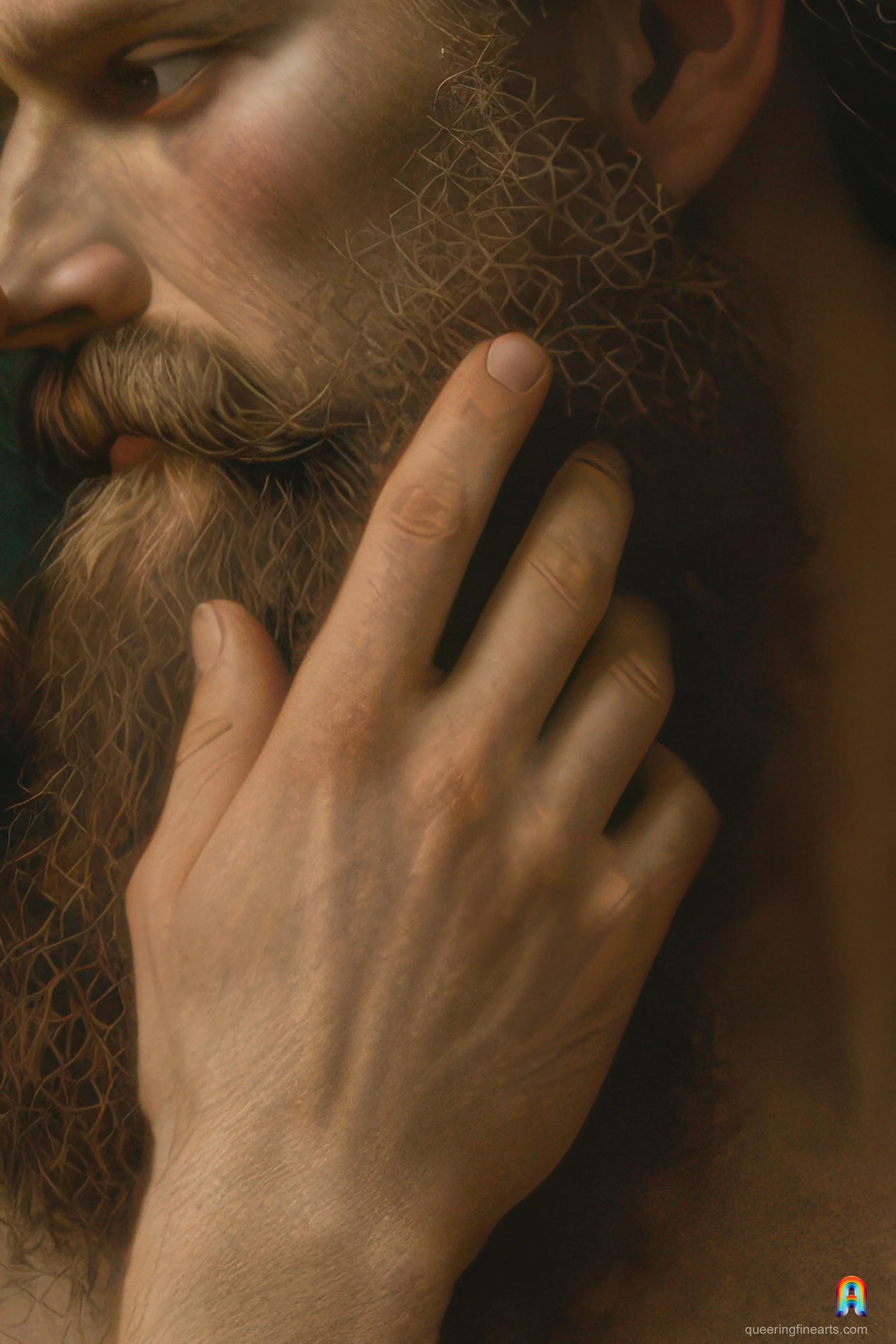
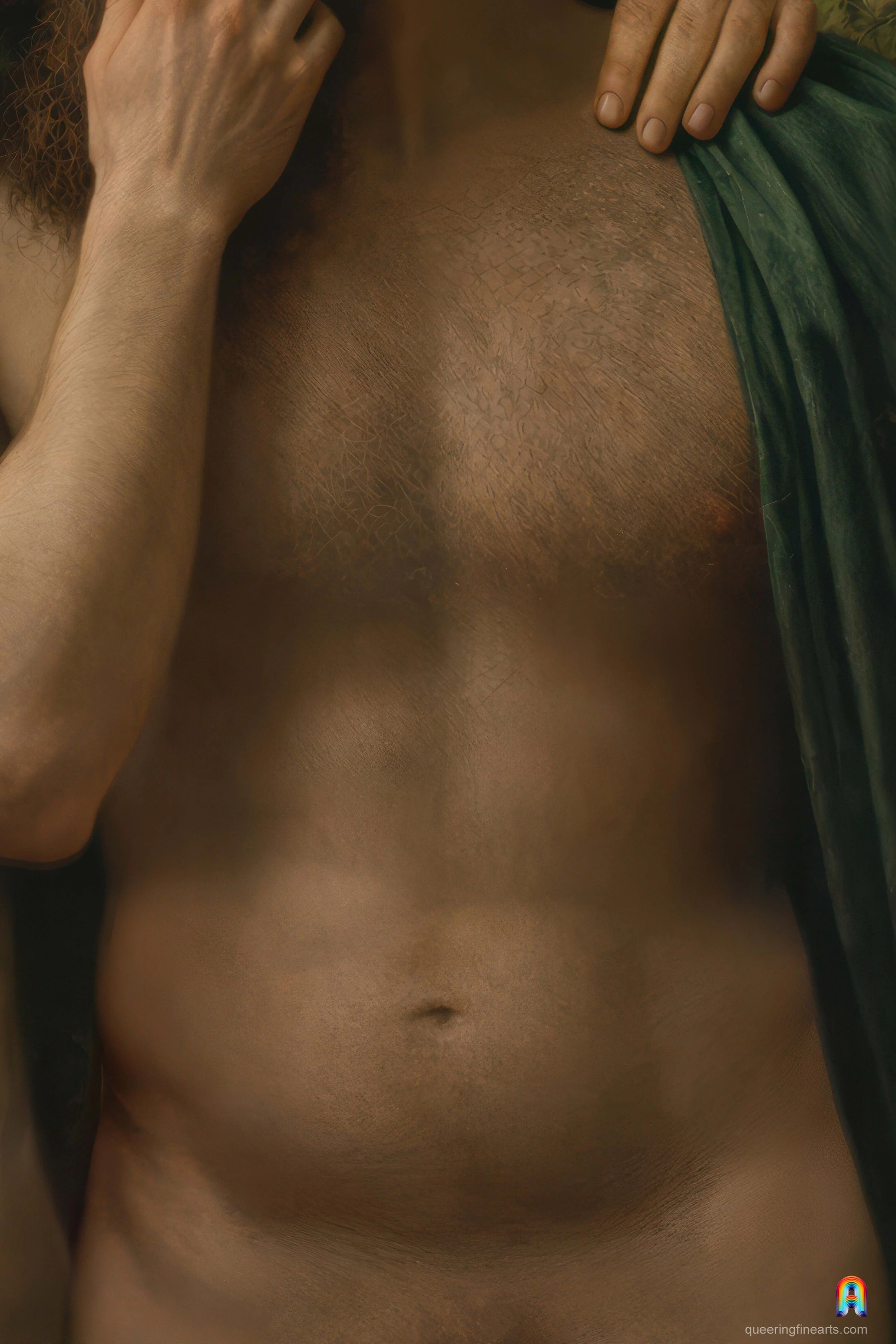
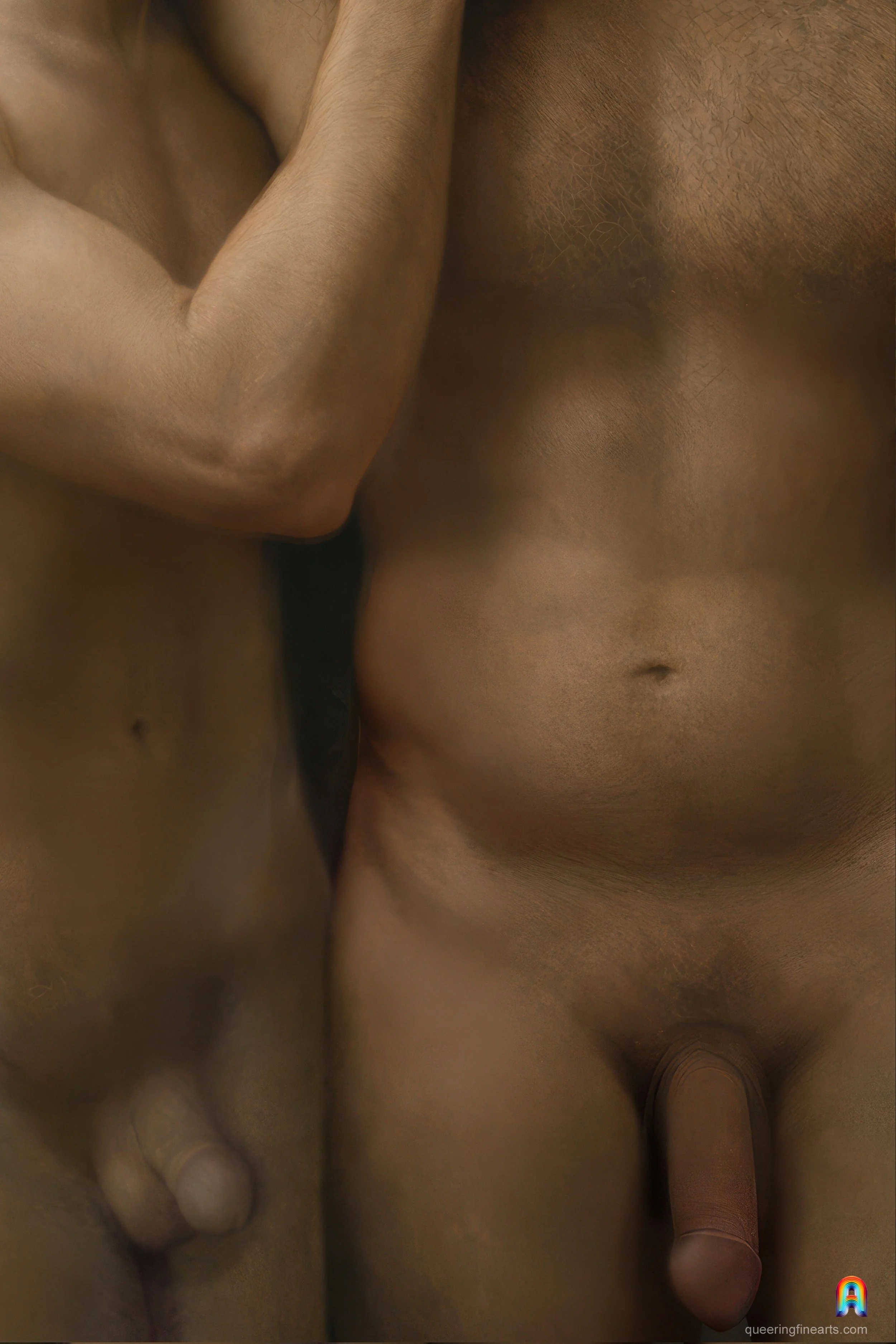
In the foreground, the two figures occupy the entire surface. Alexis, on the left, with his slender body and curly auburn hair, appears captivated by Corydon. The latter’s hand sinks into his companion’s hair, while the other gently takes hold of his beard with precise delicacy and places his other hand upon his shoulder, from which a green drapery falls.
Facing him, Corydon, bearded and more mature, broad in stature and powerful in torso, receives this closeness in full presence. His hand rests upon the young man’s shoulder. His gaze meets that of the one who approaches. Contact circulates between hands, faces, and shoulders. Alexis’s sex is in a state of semi-erection, while the shepherd’s remains at rest, as for him the erotic charge is directed toward a more diffuse, slower tension, one in which he has not yet gained the assurance that the one for whom he burns has yielded to his game of seduction.
The moment depicted gathers the full tension of the scene. Their faces nearly touch. Breath seems shared. The entire composition converges toward this point of encounter.
Ancient Inheritance and Romantic Vision
The painting belongs to a tradition in which ancient figures serve as a reservoir of emotion and form⁵. Virgil provides the subject. Romanticism lends it renewed intensity. Artists of the early 19th century seek in Antiquity a truth of feeling, a closeness to nature, and a simplicity of impulse.
Corydon and Alexis thus become more than literary figures. They embody a universal experience of desire. Their presence, inscribed within forest, light, and silence, resonates with the world around them. The work reveals a living Arcadia, where ancient song takes on visible form.
Anne-Louis Girodet and the Sensuality of the Gaze
Anne-Louis Girodet (1767–1824) occupies a singular position at the threshold between Neoclassicism and Romanticism⁶. Trained in the studio of Jacques-Louis David, he developed early a personal sensibility marked by a taste for dreamlike atmospheres, unreal lighting, and a particular attention to the male body, rendered with a softness and sensuality that departs from the heroic rigor of his master. Works such as Endymion reveal a fascination with youthful beauty and bodily abandon, set within a poetic universe where flesh appears bathed in light.
Biographical sources, discreet as often for this period, suggest emotional attachments directed toward young men, notably within the context of his studio, leading several historians to evoke a homosexual sensibility⁷. This dimension, never explicitly formulated in contemporary documents, emerges above all in his work, where the gaze directed toward the male body, delicate, attentive, and charged with restrained intensity, participates in an imaginary in which desire circulates with quiet freedom.

“O tantum libeat mecum tibi sordida rura
atque humilis habitare casas et figere cervos
haedorumque gregem viridi compellere hibisco!
mecum una in silvis imitabere Pana canendo.
Pan primum calamos cera coniungere pluris
instituit, Pan curat ovis oviumque magistros;
nec te paeniteat calamo trivisse labellum.”⁸
Ah, if only it might please you to live with me in these rustic fields, to dwell in humble cottages, to hunt the deer, and to drive the herd of goats with a green hibiscus rod! With me, in the woods, you would rival Pan in song. Pan was the first to join several reeds with wax. Pan watches over the sheep and their keepers. And you would not regret having worn your lips upon the reed pipe.
Virgil, Eclogue II
At the Sources of Pastoral Poetry
Virgil’s Eclogue II, written by a Latin poet of the 1st century BCE, belongs to a collection of short poems known as the Eclogues or Bucolics. In them, Virgil reworks a Greek tradition inaugurated notably by Theocritus⁹, transforming it for the Roman world. These texts present shepherds who sing, converse, or lament within an idealized pastoral universe that functions less as reality than as a poetic space.
A Simple and Luminous World
This space is known as Arcadia. Originally a mountainous region of Greece, it becomes in ancient and later literature an imagined place, a kind of mental landscape where life unfolds in harmony with nature, herds, and seasons. Removed from the city, from power, and from social constraint, this world allows emotions to be expressed freely, especially desires and attachments. Song becomes speech, and feeling finds a direct, almost unadorned form.
A Sung Love
Within this setting unfolds Eclogue II. The poem presents a shepherd, Corydon, in love with a young man of striking beauty, Alexis. Corydon loves, and he sings that love. Alexis remains silent, distant, almost unreal. The entire poetry arises from this imbalance: a voice raised in the face of absence.
The Natural Impulse of Beings
Virgil presents desire as a force embedded in the movement of life itself. At one point, Corydon observes that every being is drawn to what pleases it: animals pursue one another, plants attract creatures, and he himself is drawn toward Alexis.
The Dream of a Shared Life
Corydon’s song extends beyond abstract lament. He imagines a life with Alexis: sharing a dwelling, living among herds, hunting, singing together. He promises fruits, flowers, a simple and tangible existence. Love takes shape through gestures, proximity, and daily life.
A One-Sided Desir
At the same time, this projection heightens the silence of Alexis. The more Corydon describes what he might offer, the more palpable the absence of response becomes. The poem turns into a meditation on unreturned love, on the distance between desire and possibility. At its close, Corydon attempts to regain composure, to return to simple tasks, and to turn away. He tells himself he will find another Alexis. The resolution remains fragile. The song itself bears witness to the persistence of desire.
A Universal Emotion
This text retains a particular force today. It shows that desire between men stands present at the very foundations of Western literature, and that it may be expressed with disarming simplicity. In Virgil’s Arcadia, such love appears as an experience to be lived. Through Corydon’s voice, a profoundly human emotion traverses the centuries: to love, to desire, and to continue singing, even when the other remains silent.
Virgil, Poet of Rome
Virgil, whose full name was Publius Vergilius Maro, was born in 70 BCE near Mantua in northern Italy and died in 19 BCE in Brindisi. He belongs to the generation that witnessed the end of the Roman Republic and the establishment of Augustus’ rule. Protected by figures such as Maecenas, he became one of Rome’s greatest poets, author of the Eclogues, the Georgics, and the Aeneid. His poetry reveals a deeply personal sensibility, attentive to emotion, human fragility, and the tensions between desire and reality.


A Queer Voice
Accounts from antiquity, though discreet, suggest that Virgil formed attachments to young men. The grammarian Aelius Donatus reports that the poet lived with great reserve and maintained relationships with youths, including one named Alexis, whose name resonates with the figure in Eclogue II
The Ancient Gaze on Love
These elements remain difficult to verify with certainty, yet they testify to an early reception of Virgil as a poet attuned to male-male desire. What matters above all is that his work gives this form of desire a refined poetic expression, integrated within the pastoral landscape and human experience.
Greco-Roman Passions
In the Greco-Roman world, relationships between men, in certain forms, belonged to recognized social practices, structured by precise codes relating to age, status, and role¹⁰. Pastoral poetry, inherited from the Greek tradition, provides a space where these relations may be transposed, idealized, and freed from social constraint. In Virgil, this tradition continues in a language of great softness, where desire speaks with restraint and clarity.
Thus, even if the details of Virgil’s personal life remain beyond full reconstruction, his work stands as clear testimony to a world in which love between men could be sung, inscribed within nature, and transmitted as one form among others of human experience.
« Torva leaena lupum sequitur, lupus ipse capellam,
florentem cytisum sequitur lasciva capella,
te Corydon, o Alexi: trahit sua quemque voluptas. »¹¹
The fierce lioness follows the wolf, the wolf follows the goat, the lively goat follows the flowering cytisus, and Corydon follows you, Alexis: each is drawn by his own desire.
Virgil, Eclogue II
QFA
Curiosity Piqued?
1. Virgil, Eclogues, II, v. 1-2, ed. and trans. Jacques Perret, Paris, Les Belles Lettres, 1967.
2. Richard F. Thomas, Virgil’s Bucolics and the Art of Fiction, Cambridge, Cambridge University Press, 2017.
3. Thomas Crow, Emulation: Making Artists for Revolutionary France, New Haven, Yale University Press, 1995.
4. Paul Alpers, What Is Pastoral?, Chicago, University of Chicago Press, 1996.
5. Francis Haskell, History and its Images: Art and the Interpretation of the Past, New Haven, Yale University Press, 1993.
6. Sylvain Bellenger, Girodet (1767-1824), Paris, Gallimard / Musée du Louvre, 2005.
7. James Smalls, Making Trouble for Art History: The Queer Case of Girodet, Art Journal, vol. 55, no. 4, 1996, pp. 20-27.
8. Virgil, Eclogues, II, v. 28-30.
9. Theocritus, Idylls, I, ed. and trans. Pierre Waltz, Paris, Les Belles Lettres, 1968.
10. Craig A. Williams, Roman Homosexuality: Ideologies of Masculinity in Classical Antiquity, 2nd ed., Oxford, Oxford University Press, 2010.
11. Virgil, Eclogues, II, v. 63-65.