

Where the Crystal Mountains Rise
In the manner of a painter close to the circle of Thomas Eakins
Oil on canvas, circa 1903-1910
Private collection
Between Empire and Desire
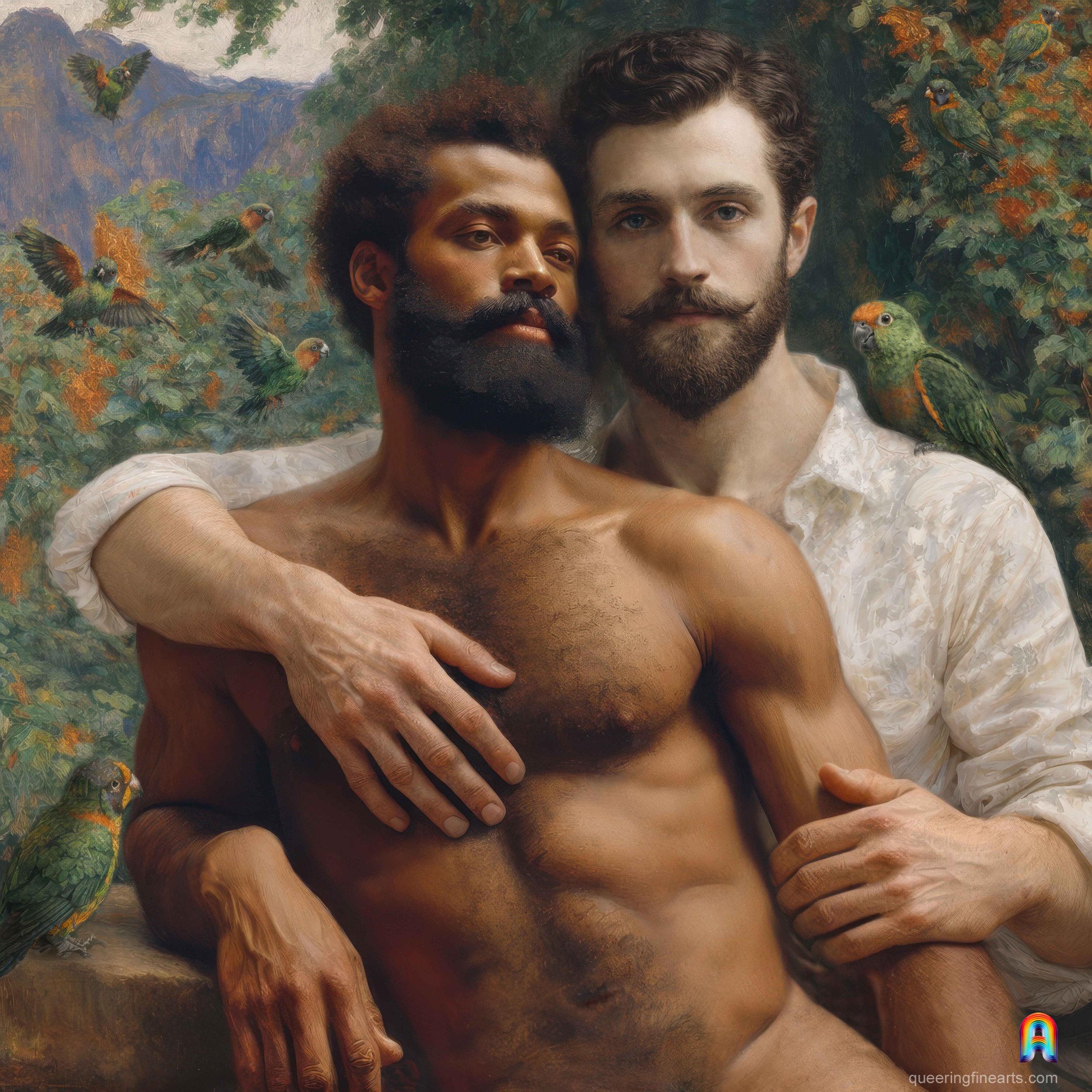
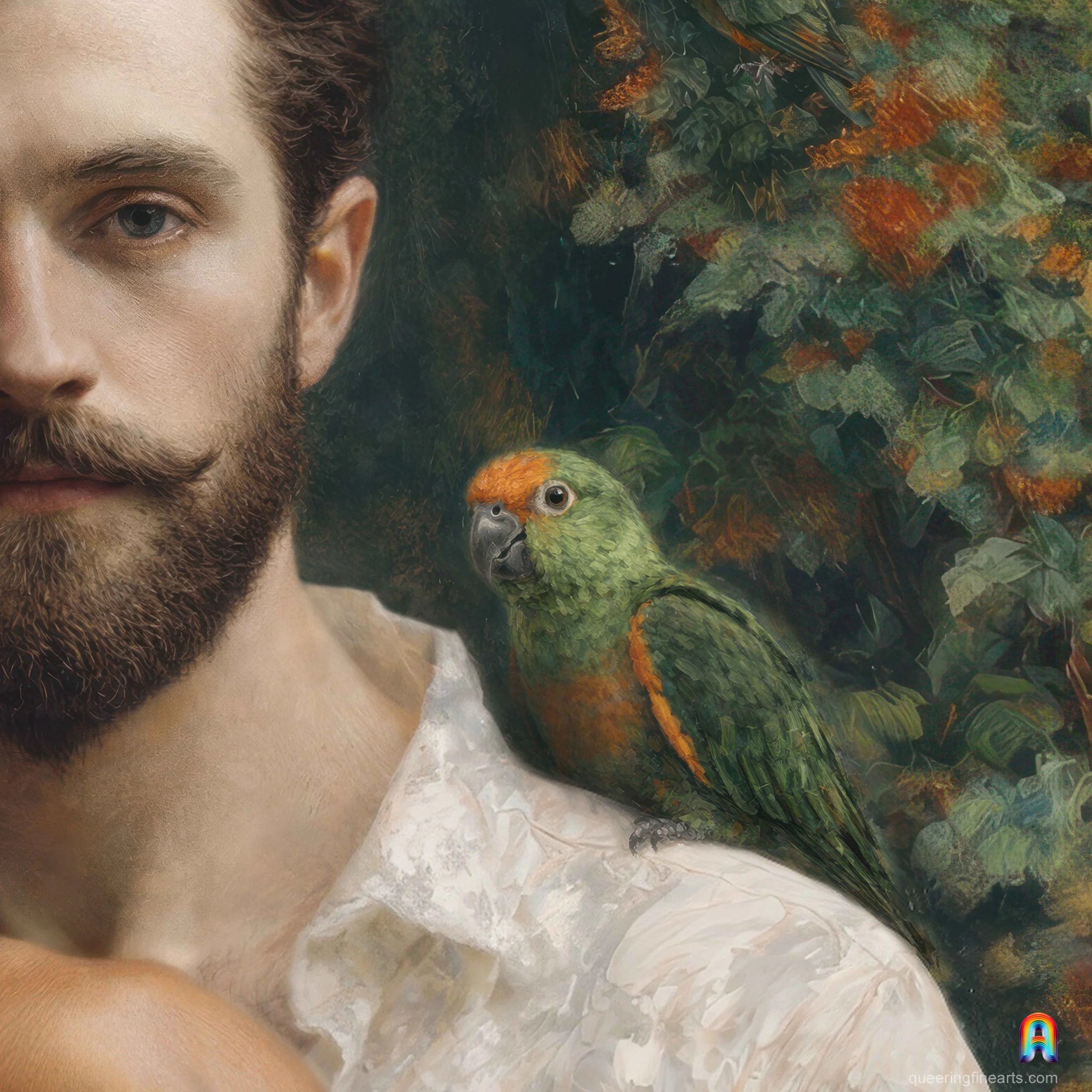
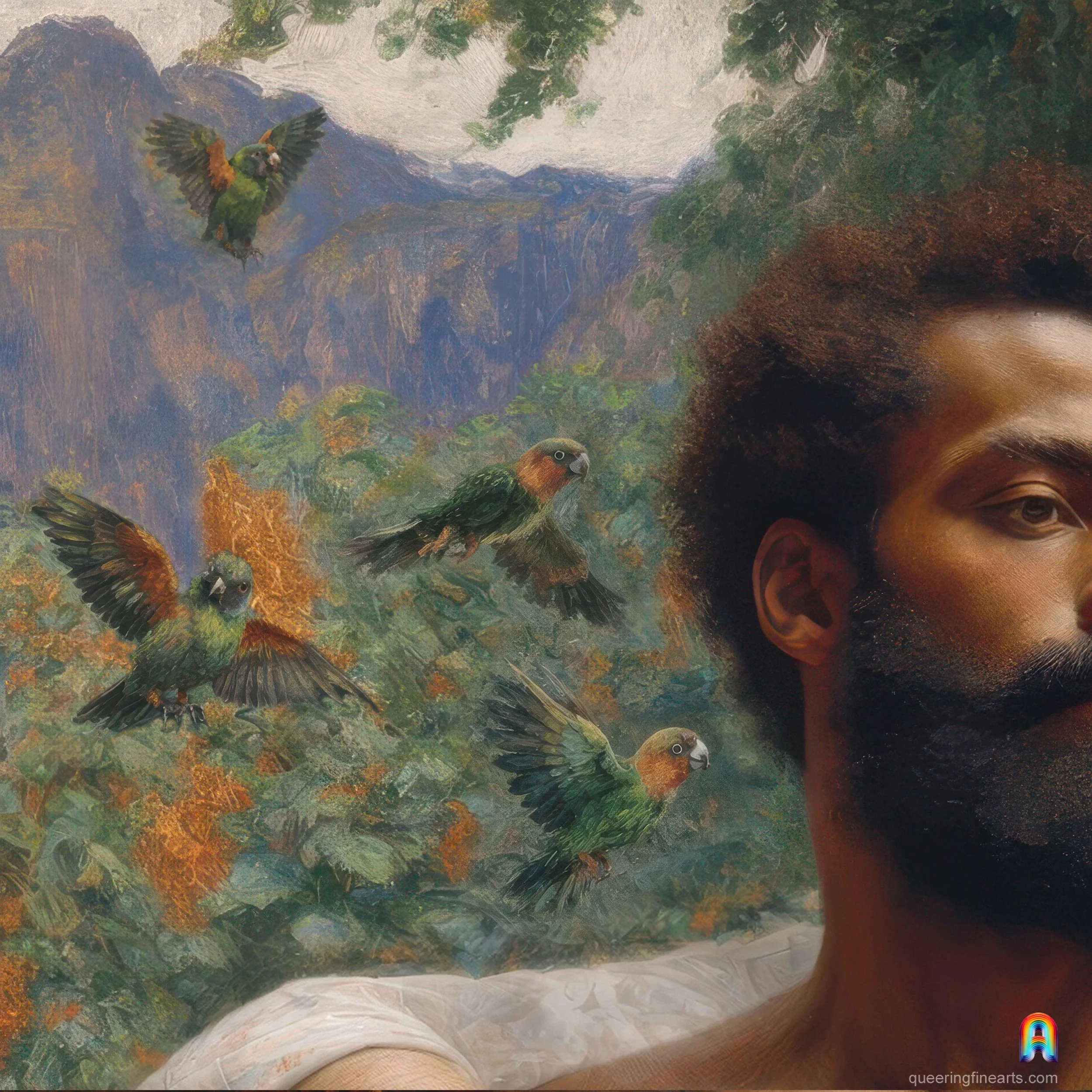
The scene unfolds in a dense clearing in the Congo, bathed in a soft light filtered through the foliage. In the background, the distant outline of the Crystal Mountains emerges through a bluish haze. Several Jardine’s parrots cross the space in flight or settle within the vegetation, their greens and oranges punctuating the canvas with vibrant accents in a world alive with movement. The whole is rendered in a manner that evokes a painter close to the circle of Thomas Eakins (1844-1916)¹, a major American realist known for his male nudes, his anatomical rigor, and his pioneering use of photography: a structured light, bodies treated with near-anatomical precision, and a tension between compositional discipline and the intimacy of gesture. Such an American inflection is not implausible, given the strong currents of sympathy for the Irish cause that made Casement a figure of interest in the United States well beyond the British Isles.
Two worlds meeting
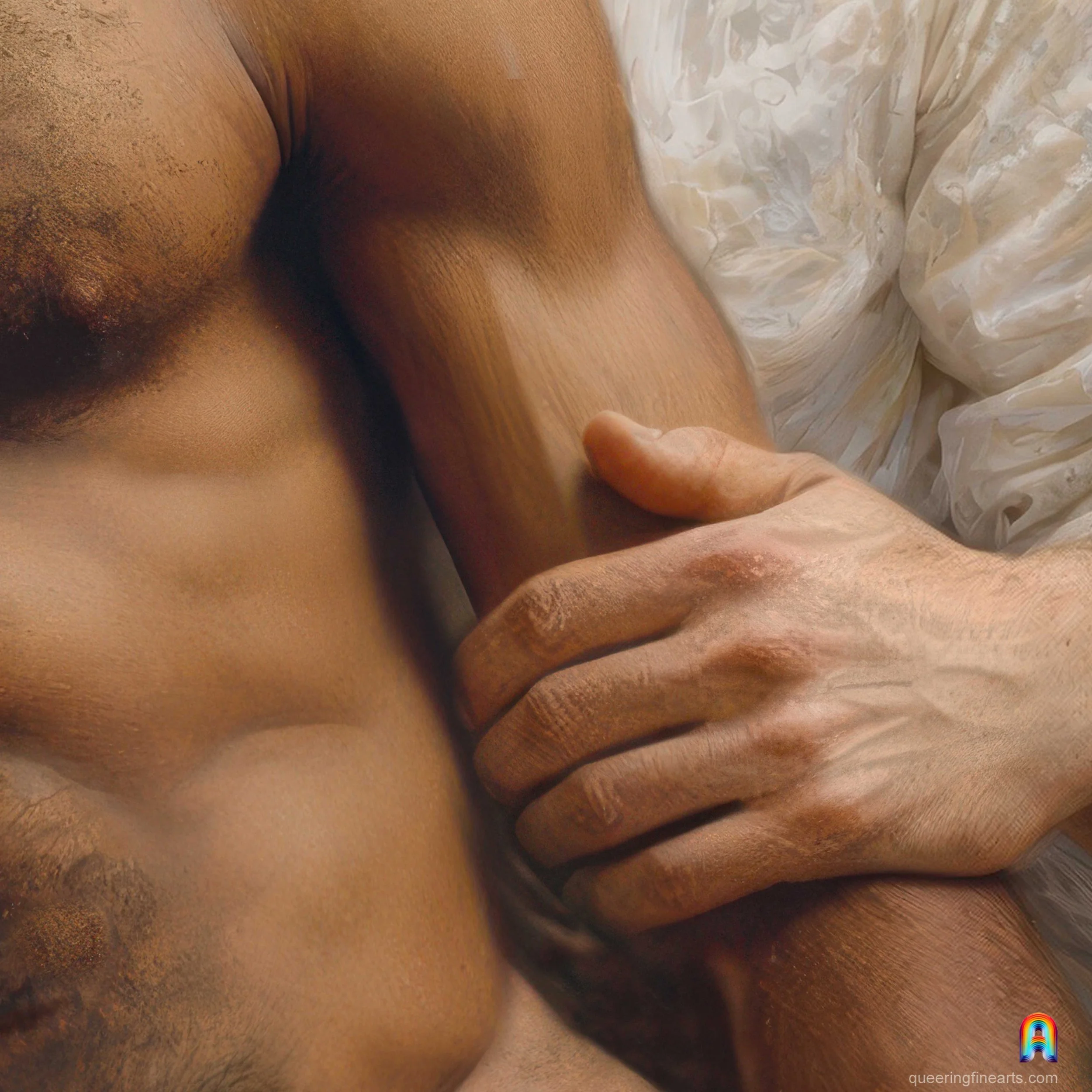
In the foreground, two men occupy almost the entire surface. One, bare-chested, with dark skin, sits in a posture that is at once grounded and fiercely assured, a quiet, unyielding strength radiating from his very stillness. His musculature is rendered with attentive precision. The other, positioned behind him, is a man in a light-colored detachable-collar shirt, whose hand rests sensually on his companion’s chest while the other encircles his arm.
An envoy of the Foreign Office
This man can be identified as Roger Casement, then a British consul in the Congo at the time of his humanitarian investigations². He is not depicted here in the exercise of his official duties, but in a suspended, almost clandestine moment, where administrative authority yields to an immediate human proximity. This presence gains further depth in light of Casement’s historical association with a keen awareness of the suffering inflicted upon Congolese populations. That gravity surfaces only faintly, like an inner shadow, in the restraint of the scene itself.
A scene that invites the gaze
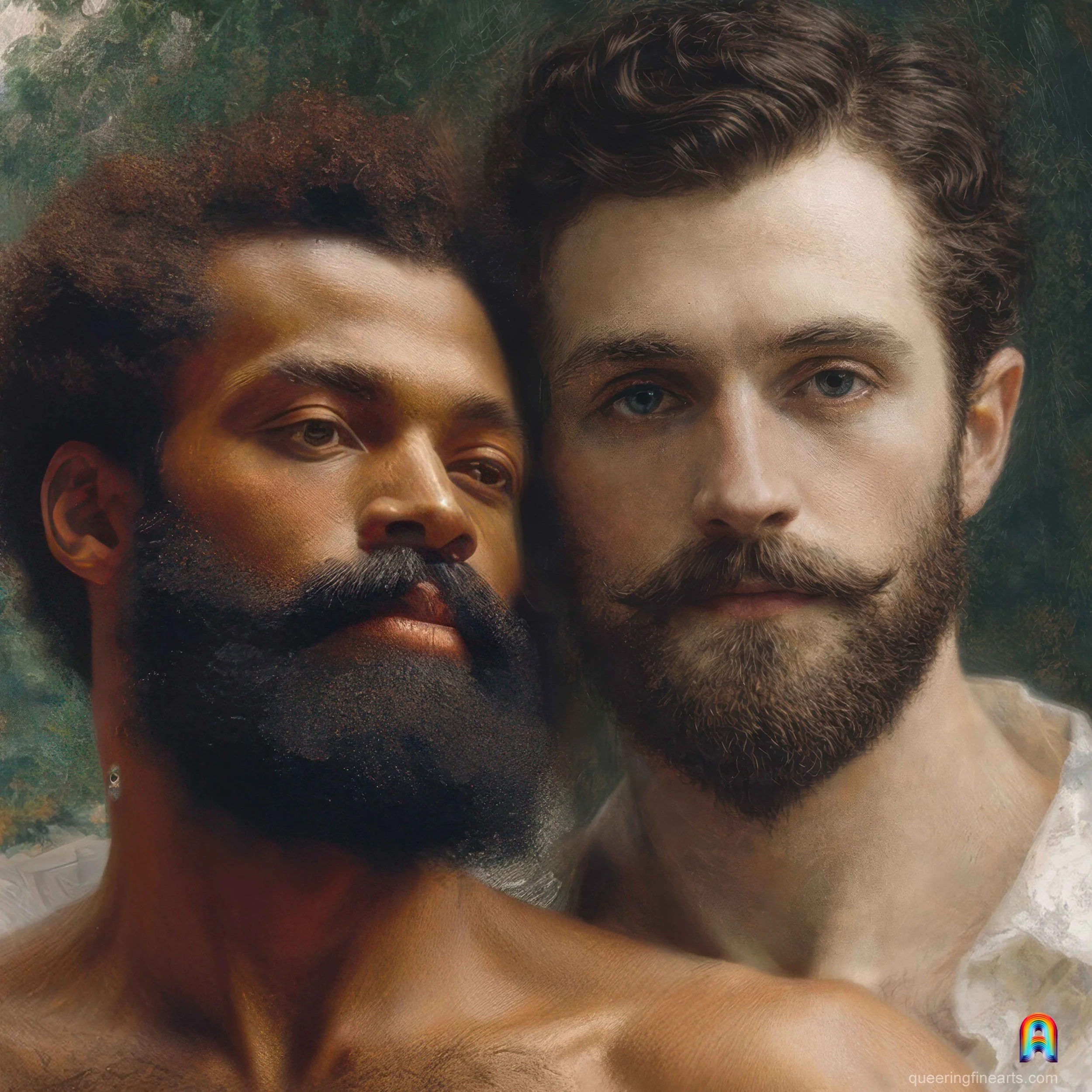
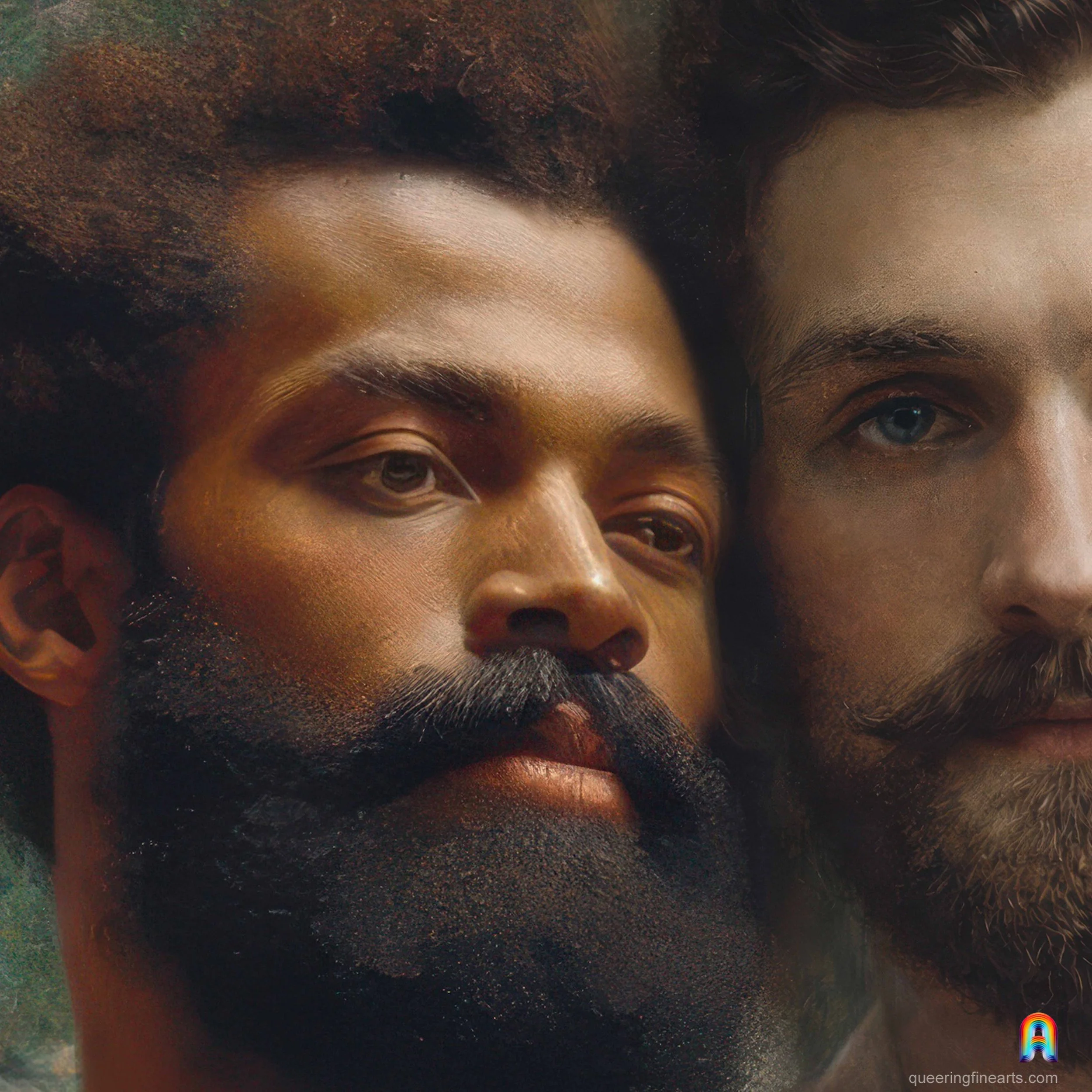
The exchange of gazes is central. The man in the foreground looks slightly beyond the frame, absorbed in an interior sensation or thought. Casement, by contrast, meets the viewer’s eyes. This direct gaze creates a particular tension: it draws the viewer into the scene while keeping them, discreetly, at a distance.
Another measure of human presence
The gestures remain simple, almost restrained. Yet the emotional charge is palpable. The contrast between the whiteness of the garment and the nakedness of the body, between light skin and dark skin, between colonial status and the embodied presence of the other man, produces multiple layers of reading. The scene does not operate as a rejection of imperial domination; rather, it allows a fleeting glimpse of a proximity that unsettles it without necessarily dissolving it. Tenderness introduces another measure of human relation.
A fragmented figure
Roger Casement (1864-1916) is a British diplomat of Irish origin who became, in turn, an investigator of colonial violence, an Irish nationalist activist, and a major figure in queer history³. Before the Congo, he had served in Angola and Mozambique, an early familiarity with colonial spaces that shaped his critical gaze. He remains known for exposing atrocities in the Congo Free State and later in the Putumayo, in the Amazon⁴, as well as for the scandal surrounding the publication of his private diaries. These diaries were deliberately used by the British state to discredit his defense during his trial for high treason⁵ - treason that consisted, in concrete terms, in seeking German military support for Ireland during the First World War. He was executed in 1916, after converting to Catholicism on the scaffold. He thus resists any singular interpretation.
From shadow to homage
Today, in 2026, Casement is generally understood less as a coherent figure than as a knot of contradictions. In Ireland, public memory has largely reintegrated him among the major figures of nationalism and anti-colonialism. Official commemorations have clearly honored him, and his presence in public space is visible, notably through the statue installed in Dún Laoghaire⁶ ⁷
The Empire’s rebel
In England, or more broadly within the traditional British narrative, he remains far less a national hero than a former servant of the Crown turned Irish rebel, executed for high treason. That said, even in contemporary British interpretations, his role in exposing colonial crimes is far more widely acknowledged than it once was. Among historians, the dominant tendency is no longer to decide simply between hero and victim. Casement is now read as both at once, without either term being sufficient. He appears as a decisive actor in the critique of empire, a precursor to modern humanitarian testimony, an Irish nationalist radicalized by colonial experience, and also as a figure partly destroyed by the British state through his trial, execution, and the circulation of his personal journals.

A man in the fracture of history
His most firmly recognized contributions begin with his work in the Congo. His 1903 investigation and the report published in 1904 played a major role in bringing international attention to the violence associated with the regime of Leopold II². Historians continue to acknowledge his importance within the Congo reform movement, often described as one of the first major human rights campaigns of the 20th century
A second front of truth
He is also credited with a comparable role in the Putumayo. His investigation into abuses within the rubber economy in the Amazon contributed to exposing the violence inflicted upon Indigenous populations and exploited workers⁴, and this aspect of his work remains central to any historical assessment of his significance.
Diaries of an intimate space
For queer history, Casement now holds a central place, precisely because his sexuality is no longer treated as a mere scandalous appendix to his biography. His private diaries are now often read both as fragments of intimacy, where moments of desire and fleeting encounters between men surface, and as objects caught within a political struggle that distorted their meaning⁵. Despite their ambiguities, they suggest the possibility of male relationships lived within the density of the colonial world, in direct contact with bodies, gazes, and presences⁸.
One must nevertheless avoid allowing an overly narrow reading of these notes to reduce such relationships to their purely transactional dimension. In societies where homosexuality is persecuted, criminalized, or exposed to social disgrace, anonymous, furtive, or paid encounters often provide forms of discretion that are less available to relationships requiring one to appear under one’s true identity, to engage with someone over time, or to exist within a more stable social visibility. This clandestine character does not in itself define the nature of desire or the possible depth of attachment; it speaks above all of a world of surveillance, risk, and constraint within which these men had to seek one another.
A scene that unsettles the world
This returns us to the work itself, which ultimately does not simply represent a moment of proximity between two men in a historically charged setting. Within the very structure of a colonial space, it reveals a relationship that escapes the logic of possession, classification, and distance upon which imperial order rests. There lies its most troubling force: not in anecdote, nor even in the identity of Casement, but in the fragile and fleeting possibility of a shared humanity that suspends the violent organization of the world surrounding it.
QFA
Further reflection - On the roots of Casement’s thought
At the roots of Casement’s thinking
Roger Casement did not become an investigator of colonial atrocities by chance. Three dimensions of his life, too often treated separately, converged to shape this singular figure: a servant of Empire who became one of its most penetrating critics, a man whose rebellion against oppressive authority was rooted in what he was.
An in-between position: the Protestant Irishman within the Empire
Born into an Anglican Protestant family, with a mother who converted to Catholicism on her deathbed, Casement belonged to that Protestant minority often associated with imperial administration. This background naturally opened the doors of the British consular system to him. Yet rather than functioning solely as a privilege, this in-between position gave him a decisive advantage: he was both inside the system and able to maintain a critical distance from it. He was not born a rebel - he was first a loyal servant of the Crown - but his condition as an integrated Irishman allowed him, more than an English officer by birth, to perceive the blind spots of the colonial order.
The living memory of the Great Famine
Casement did not experience the famine of 1845-1852, having been born in 1864. Yet its memory remained vivid within Irish society and within families. He knew that his compatriots had endured, only half a century earlier, a form of systemic exploitation: abusive rents, the forced export of food while the population starved. When he investigated in the Congo and later in the Putumayo, this memory shaped his interpretation. He seems to recognize in Congolese rubber what Irish peasants had once endured. His reports and personal writings are marked by implicit, and sometimes explicit, comparisons. The famine did not merely move him - it provided him with a framework, a conviction that exploitation was not an exotic anomaly but a mechanism he had already seen at work at home.
A marginal sexuality as a school of persecution⁹
Casement’s homosexuality was not simply a shameful burden to be endured in silence. Despite the personal suffering it caused him, it became a singular source of lucidity. In a Victorian world that criminalized his desires, he learned to recognize the weight of norms, the arbitrariness of moral condemnation, and the violence of a state capable of destroying a man by exposing his intimacy. His diaries suggest that he himself drew parallels between the disgust he felt in the face of colonial brutality and the disgust he felt toward his own sexuality - an internalized shame, certainly, but also a rare capacity to identify with those whose bodies were subjected, exploited, and wounded. Later, the British state would use these same diaries to discredit him and justify his execution. Proof, if any were needed, that sexual repression and political repression were deeply intertwined in the eyes of his persecutors. For Casement, this intimate experience of marginality likely sharpened his awareness of the mechanisms of domination.
Three forces, one trajectory
None of these dimensions alone explains the man. Yet their convergence clarifies the logic of his trajectory. In Casement’s case, the awakening to oppression did not occur all at once: it formed gradually, each stage feeding the next.
First, the intimate experience of a sexuality condemned by Victorian moral order exposed him early to the arbitrariness of norms and the violence of persecution. This was a first form of rebellion, lived in secrecy and shame, yet one that sharpened his sensitivity to all forms of domination.
Then, as an imperial investigator, he denounced colonial violence carried out by other powers - Leopold II in the Congo, the Arana company in the Putumayo. He could still see himself as a servant of the Crown correcting the excesses of other empires. Yet his gaze sharpened.
Finally, political radicalization led him to recognize in British domination over Ireland an oppression of the same order. He then turned his lucidity against the Empire he had served, leading to treason and the scaffold.
Thus, Casement did not denounce oppression despite what he was; he did so, in part, because he was all of these things at once. An Irish Protestant within the system, an heir to the famine, a homosexual in a world that criminalized him, each of these forces gave him an added lucidity and a driving force for rebellion. Far from being weaknesses or contradictions, these traits formed the very roots of his humanism and his courage. And it is by following their unfolding over time, from intimate revolt to political insurrection, that one best understands how a loyal servant of the Crown became one of its most penetrating critics.
QFA
Curiosity Piqued?
1. Michael Fried, Realism, Writing, Disfiguration: On Thomas Eakins and Stephen Crane, Chicago, University of Chicago Press, 1987.
2. Great Britain, Foreign Office, Further Correspondence Respecting the Independent State of the Congo. Presented to both Houses of Parliament by Command of His Majesty, February 1904, London, Harrison and Sons, 1904.
3. David Squires, “Roger Casement’s Queer Archive,” PMLA, vol. 132, no. 3, May 2017, pp. 596–612.
4. Jordan Goodman, The Devil and Mr. Casement: One Man’s Battle for Human Rights in South America’s Heart of Darkness, New York, Farrar, Straus and Giroux, 2010.
5. Jeffrey Dudgeon, Roger Casement: The Black Diaries – With a Study of His Background, Sexuality, and Irish Political Life, Belfast, Belfast Press, 2016.
6. Angus Mitchell (ed.), Roger Casement: The Amazon Journal, Dublin, Lilliput Press, 1997.
7. Dún Laoghaire-Rathdown County Council, “Roger Casement Statue Unveiled,” press release, April 30, 2021, URL: https://www.dlrcoco.ie/news/general-news-public-notices-press-releases/roger-casement-statue-unveiled (accessed April 3, 2026).
8. Alison Garden, The Literary Afterlives of Roger Casement, 1899–2016, Liverpool, Liverpool University Press, 2020.
Patrick R. Mullen, The Poor Bugger’s Tool: Irish Modernism, Queer Labor, and Postcolonial History, Oxford, Oxford