

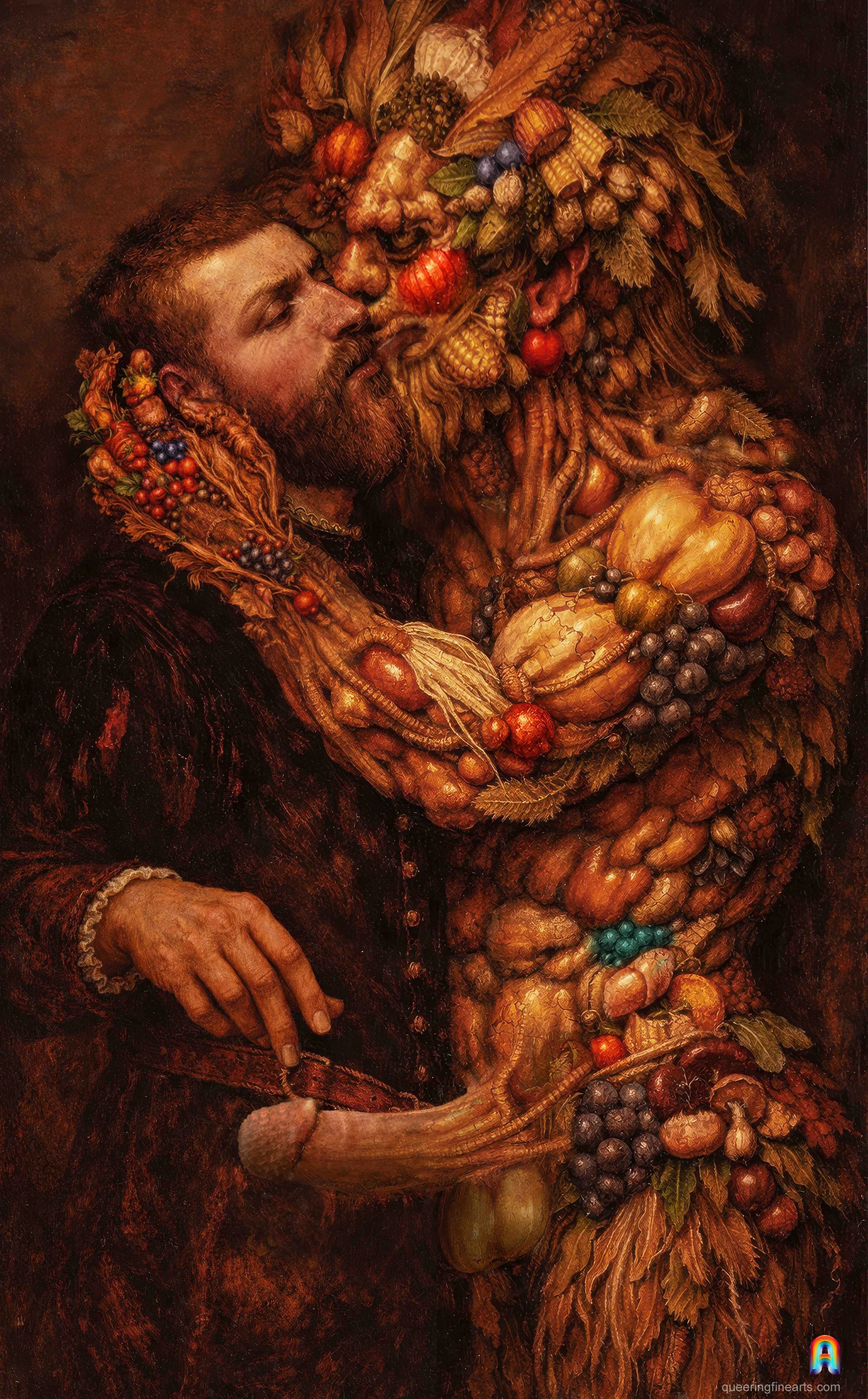
Amorous Vertumnus
In the manner of Giuseppe Arcimboldo
Oil on canvas, after 1590
Private collection
The Assemblage of Desire
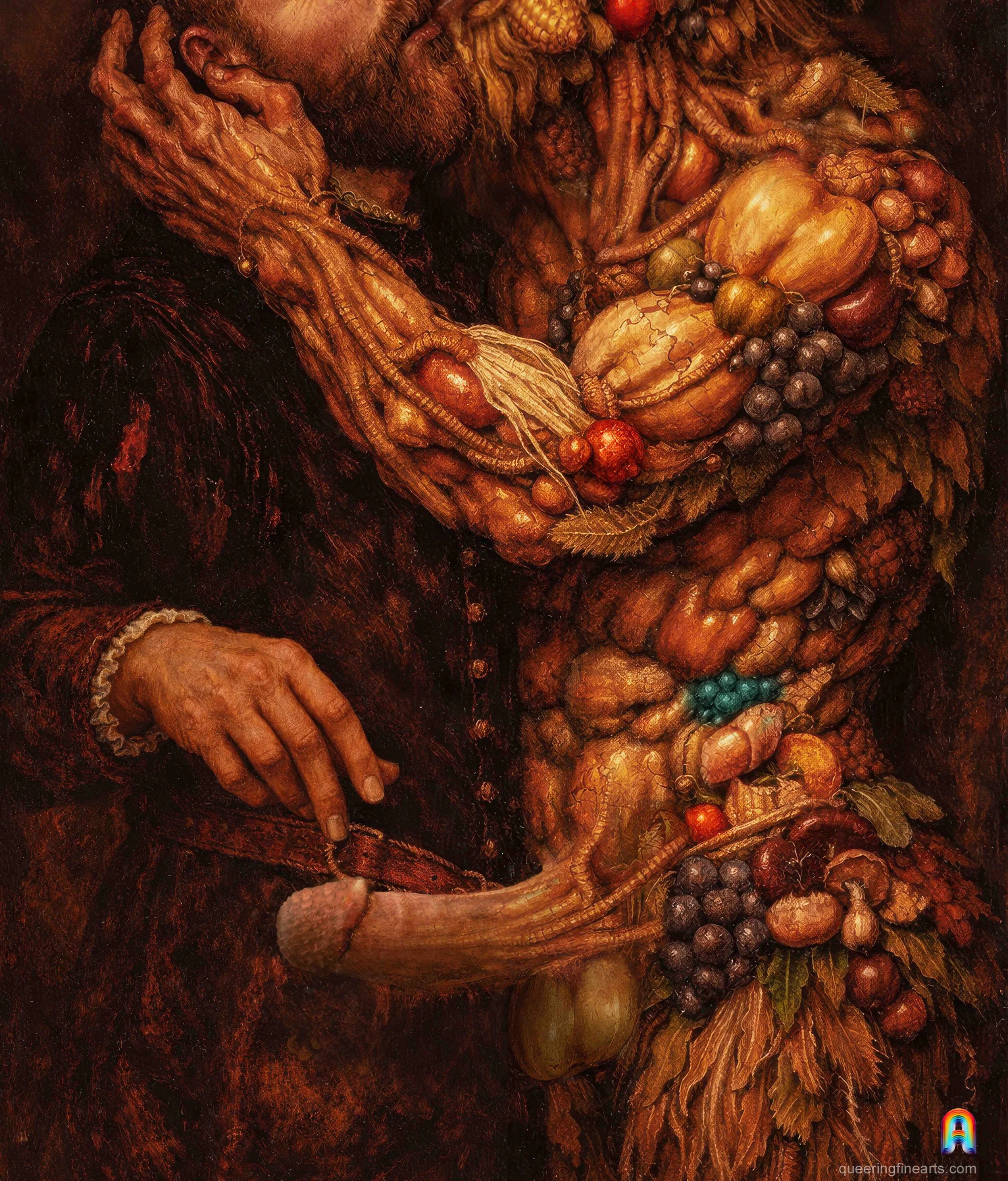
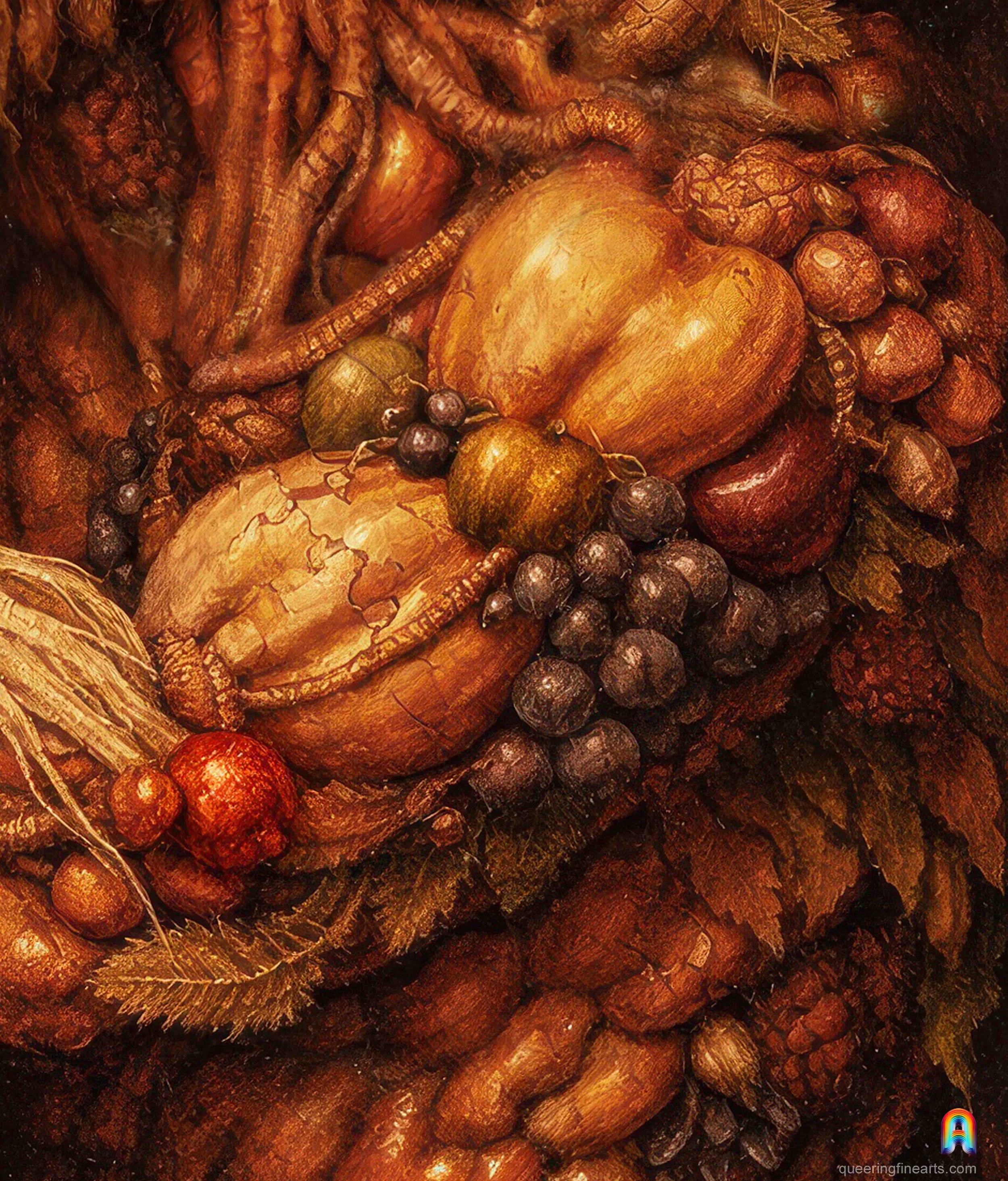
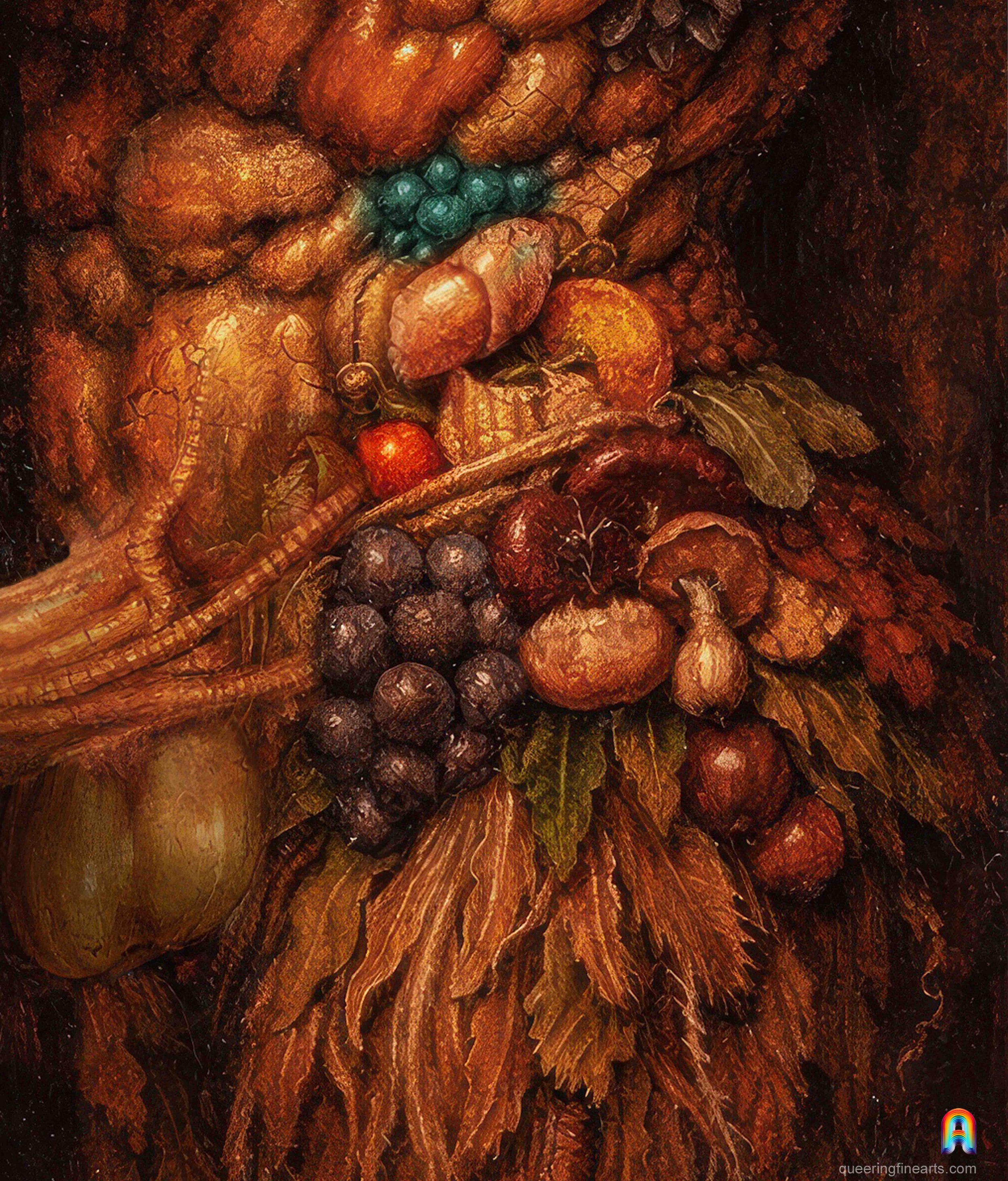
Vertumnus, the Roman god of the seasons and of metamorphosis, closely associated with autumn and the abundance of the harvest, appears here in the figure at right.¹ His face and most of his body are formed from a dense assemblage of fruits, vegetables, leaves, ears of grain, mushrooms, and vegetal matter that clearly evoke the season of harvest. The palette is dominated by ochres, browns, deep reds, oranges, and earthy golds, which give the whole a profound and sensual warmth tied to the maturity of the season.
The Offered Figure
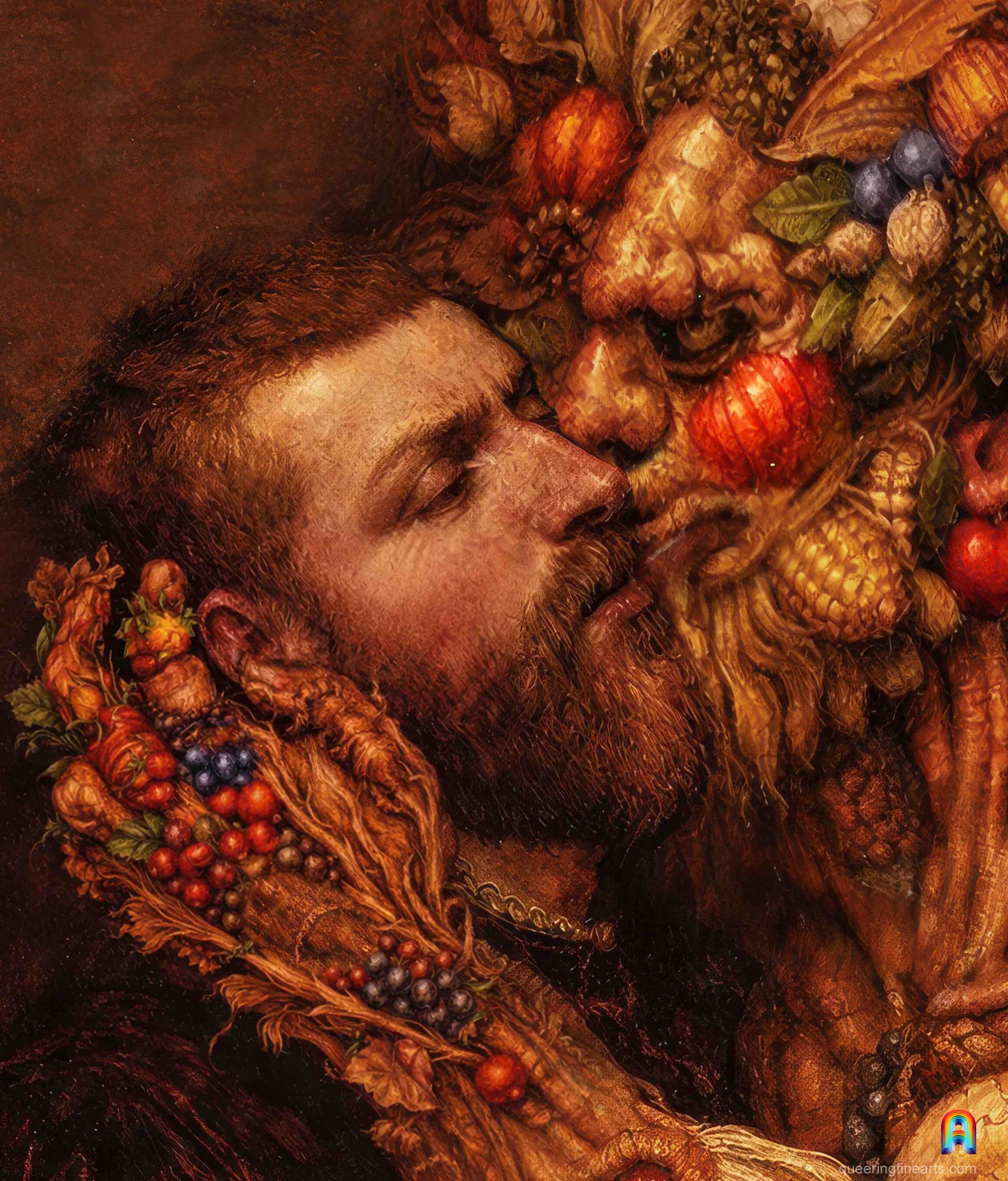
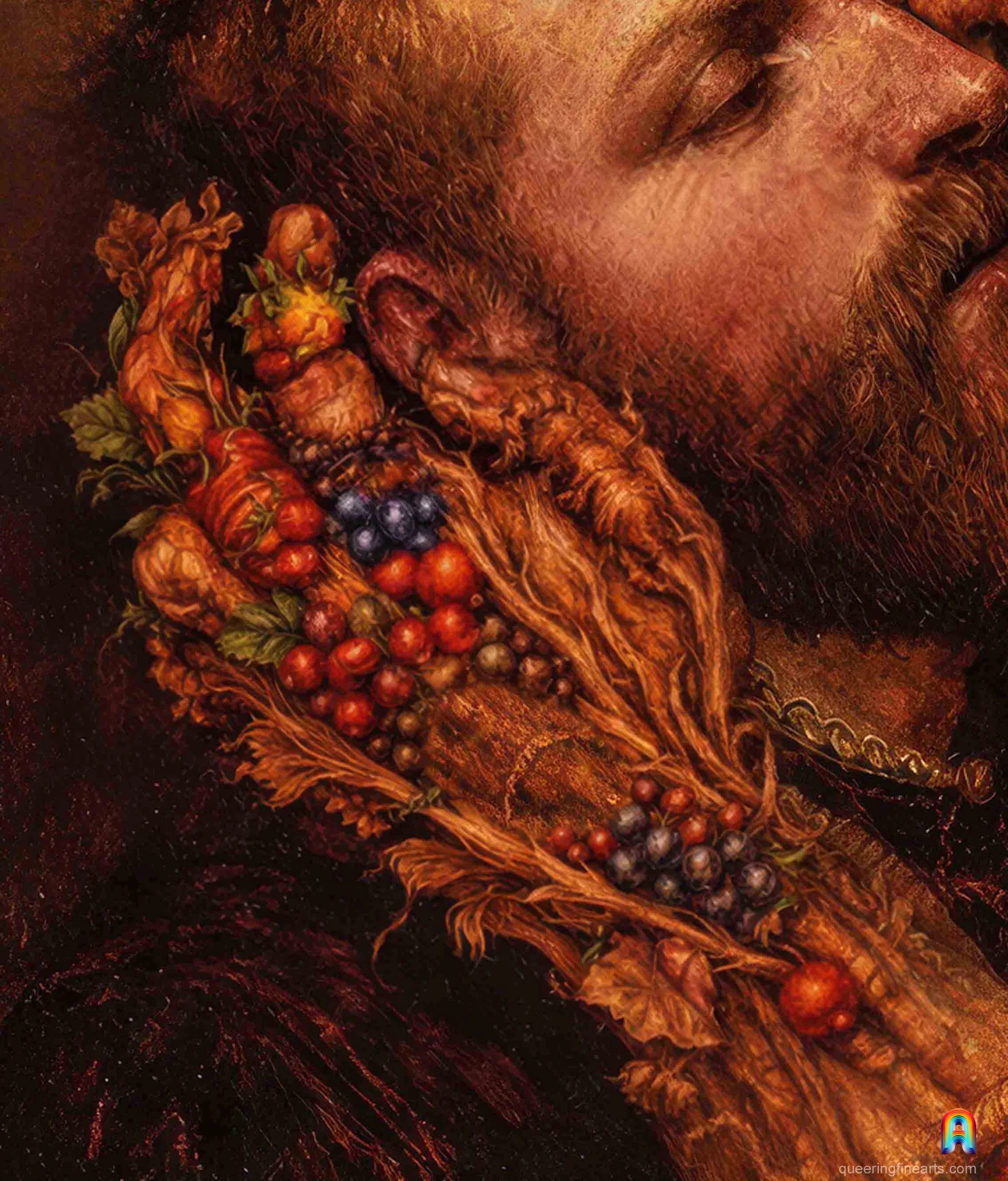
At left, a bearded courtier, dressed in a dark garment that appears to be velvet, receives the kiss with closed eyes. His body is treated naturalistically, with warm and substantial flesh that contrasts with Vertumnus’s composite exuberance. The encounter between these two presences, one human and the other made of vegetal elements, heightens the force of contact and gives the scene an intensity that is at once sensual, strange, and deeply embodied. The figure of this man is far from a mere foil. His individuation, the density of his presence, and the almost contemplative gravity of his surrender give him singular weight, even though no decisive clue allows one to identify him as a true portrait. He should likely be understood less as a specific individual than as a fully human figure wholly invested by desire, offered up to an encounter with the metamorphic god.
The God, the Man... and the Mushroom
Homosexuality is not merely hinted at here: it lies at the very core of the composition. Desire between the man and the god is shown openly, in the closeness of their faces, the pressure of Vertumnus’s hand upon his companion’s neck, the gesture of the latter, whose hand seems to seek the buckle of his belt in order to undo it, the surrender of his closed gaze, and above all the virile member of the fantastic figure, swollen with life. That member is represented, moreover, with a certain humor through the mushroom Phallus impudicus, known in English as the common stinkhorn. Perhaps it is precisely this generous offering that he seeks to grasp with his hand… The choice of Vertumnus further reinforces this reading: as a god of change and transition, he here becomes the very face of a masculine desire bound to transformation and fluidity.
Courtly Obscenity
In Mannerism, and particularly in the sophisticated courtly cultures with which Arcimboldo’s career was bound, obscenity and explicit eroticism could be fully acknowledged as components of an artificial and learned visual language. Arcimboldo entered Habsburg service in 1562 under Ferdinand I, continued under Maximilian II, and only later became associated with Rudolf II.² Within this broader late Mannerist world, artists such as Bartholomeus Spranger (1546-1611), who became one of the leading painters at Rudolf II’s court, produced works of unabashed eroticism, in which elongated bodies and complex poses served an aesthetic of sensual exuberance and refined grotesquerie.³
Erotic Art and Princely Danger
It is no coincidence that a painting such as Bronzino’s An Allegory with Venus and Cupid (Agnolo Bronzino, 1503-1572), contemporary with the first generations of Mannerism and probably made in Florence for transmission to Francis I of France, already embodied the dangerous prestige of erotic art in a princely setting.⁴ It was judged so obscene that Louis XIV had Venus partially veiled, and that in 1855 the director of the National Gallery in London had some parts repainted.⁵ Mannerist obscenity thus rests upon a paradox: celebrated for its virtuosity within learned and princely circles, it became, outside those spaces, or in later moral climates, a transgression to be censored. Within this tradition, the choice of Phallus impudicus to figure Vertumnus’s virile member appears less as an isolated provocation than as the inheritance of a Mannerism that had already lodged desire in the play of forms and the humor of detail.
Arcimboldesque Recasting
By its principle of construction, the work very clearly evokes Arcimboldo’s universe, whether as reference or as hypothetical authorship. Yet it significantly shifts his language. Where traditional composite heads primarily revolve around enigma, allegory, and virtuosity, this image pushes that vocabulary toward a scene of love between men, more carnal, more explicit, and affectively more immediate.
Artifice and Metamorphosis
Giuseppe Arcimboldo (c. 1526-1593) was an Italian painter of the second half of the 16th century best known for his composite portraits, in which human faces are formed out of fruits, flowers, animals, and objects.⁶ Active at the Habsburg court, notably under Rudolf II in Prague, he developed a unique visual language, at once learned and playful, at the intersection of art, science, and courtly entertainment. His work, emblematic of Mannerism, is marked by a taste for artifice, ambiguity, and transformation: it challenges the notion of a stable identity by presenting figures that are constructed, hybrid, and in constant recomposition. Long marginalized after his death, Arcimboldo is now recognized as a major figure in the history of art, whose visual invention continues to nourish contemporary readings. His rediscovery in the 20th century, particularly in connection with Surrealism, played a decisive role in this renewed appreciation: artists and critics were newly drawn to the dreamlike strangeness, visual wit, and metamorphic logic of his composite images.
Composite Identity
Arcimboldo creates bodies that never correspond to a simple identity. The face is no longer something fixed or self-evident: it is constructed. The human being takes shape there through an assemblage of fruits, flowers, animals, objects, and elements radically different from one another. This way of composing the image shatters the idea of a natural, stable, and unified subject. That is precisely one of the major contributions of the queer gaze: to show that identity is not given once and for all, but is constructed, performed, and transformed. The American art historian Thomas DaCosta Kaufmann, author of major studies on Arcimboldo, indeed emphasizes the composite, artificial, learned, and deliberately fabricated character of the painter’s universe.⁷
The Mask and Identity
From this perspective, Arcimboldo is queer because he challenges the very idea of portraiture as a natural image of the person. Classical Western portraiture generally promises a clear link between appearance, identity, and the truth of the subject. In Arcimboldo, that link ceases to be self-evident. The face becomes a mask, but a mask that reveals precisely that every identity is already in part constructed, coded, and staged. His figures do not simply say, “this is who I am”; rather, they show how a subject may be fabricated through assemblage, artifice, and style. In that sense, his work is profoundly queer, because it replaces the idea of a fixed nature with that of an identity in motion. It also compels the viewer to accept instability, to renounce any simple reading, and to see in being not a given truth but a form always in the process of composition.
Hybrid Subject
One must go further still: Arcimboldo blurs the very boundaries between categories. In his work, the human and the non-human continually intermingle. The masculinity of the learned or princely portrait is no longer closed in upon itself, self-assured, and perfectly controlled; it becomes traversed by the vegetal, the animal, the object, and the ornamental. The subject ceases to be a stable unity. It becomes open, hybrid, multiple. This openness has immediate queer force because it contradicts the normative ideal of a clear, disciplined body perfectly coherent with its social place. When Kaufmann discusses these visual games based on the assemblage of natural elements into heads and faces, it strongly supports this reading of a subject produced by combination, displacement, and transformation.
A Camp Aesthetic
One may also discern in Arcimboldo a sensibility akin to what would much later be called camp, that taste for artifice and détourning which turns the learned into the playful and tips the noble into irony. This is not to claim that he belonged to a modern culture already named as such, but rather to recognize in him a delight in artifice, in excess of invention, in intellectual brilliance, and in the diversion of noble codes through play and theatricality. His composite figures are serious and ironic at once, prestigious and playful, learned and almost insolent. They welcome stylization, wit, and displayed virtuosity. Here again, one touches something very close to the queer: a taste for the fabricated, for the overly constructed to be naïve, for the visible as stage and as performance.
Cultivating Instability
And above all, Arcimboldo is queer because he creates disturbance without seeking to dispel it. His images fix nothing once and for all. They cause hesitation. They force the gaze to move from one reading to another, from one order to another, from one identity to another. They cultivate instability. Queer is not concerned only with represented subjects; it is also a way of making the visible less stable, of refusing a closed interpretation, and of setting desire, artifice, metamorphosis, and uncertainty to work together. Recent approaches to queerness in the art of the early modern period, notably in Carla Freccero’s work⁸ and in the volume Queerness in der Kunst der Frühen Neuzeit?⁹, provide a solid framework for this kind of reading.
Silence and Speculation
Can one then argue that Arcimboldo himself was queer? The answer can only remain open, but nothing in the current state of the sources authorizes us to close the question. He evolved at the Habsburg court, in a world where artifice, disguise, theatricality, and games of appearance occupied a central place, and his work itself never ceases to trouble the stable categories of identity, the body, and representation. It must also be recalled that, for the 16th century, the absence of explicit proof can hardly be invoked as a decisive argument against a queer reading. The archives of the period record repression, scandal, or accusation far more readily than they do the lived and openly assumed experience of such desires. In a world marked by religious condemnation and judicial risk, it was structurally difficult to leave clear traces. The absence of direct testimony therefore does not prove non-existence; it measures first of all the violence of imposed silence.¹⁰
The Freedom to Define Oneself
Uncertainty may therefore remain regarding Arcimboldo’s sexual orientation. His work, however, may be read without hesitation as profoundly queer. It dismantles the idea of a natural identity, transforms the body into assemblage, turns appearance into staging, blurs the boundaries between realms, and replaces the fixity of the subject with a logic of metamorphosis, mask, and composition. In Arcimboldo, being is never simply given: it is always in the process of composing itself, and this constant mutation grants it a complexity that removes it from all banality.
QFA
Curiosity piqued?
1. Ovid, Metamorphoses, vol. II, Books IX-XV, translated by Frank Justus Miller, revised by G. P. Goold, Cambridge (Mass.), Harvard University Press, coll. “Loeb Classical Library”, 1916, p. 280-291; Ovide, Les Métamorphoses, t. III, livres XI-XV, texte établi et traduit par Georges Lafaye, Paris, Les Belles Lettres, 1930, p. 156-161.
2. Thomas DaCosta Kaufmann, Arcimboldo: Visual Jokes, Natural History, and Still-Life Painting, Chicago, University of Chicago Press, 2009; Encyclopaedia Britannica, “Giuseppe Arcimboldo”, en ligne, URL : https://www.britannica.com/biography/Giuseppe-Arcimboldo, consulté le 21 mars 2026.
3. Elizabeth J. Petcu et Jeffrey Chipps Smith (dir.), Bartholomeus Spranger: Splendor and Eroticism in Imperial Prague, New York, The Metropolitan Museum of Art et New Haven, Yale University Press, 2014; The Metropolitan Museum of Art, “Bartholomeus Spranger”, dans The Met Collection, en ligne, URL : https://www.metmuseum.org/art/collection/search/343312, consulté le 21 mars 2026.
4. Janet Cox-Rearick, “Sacred to Profane: Diplomatic Gifts of the Medici to Francis I,” Journal of Medieval and Renaissance Studies, vol. 24, 1994, p. 239-258.
5. Jaynie Anderson, “A ‘Most Improper Picture’: Transformations of Bronzino’s Erotic Allegory in the National Gallery”, Apollo, vol. 140, no 390, 1994, p. 31-39; National Gallery, “Bronzino, An Allegory with Venus and Cupid”, en ligne, URL : https://www.nationalgallery.org.uk/paintings/bronzino-an-allegory-with-venus-and-cupid, consulté le 21 mars 2026.
6. Sylvia Ferino-Pagden (dir.), Arcimboldo, 1526-1593, Milan, Skira, 2007.
7. Thomas DaCosta Kaufmann, Arcimboldo: Visual Jokes, Natural History, and Still-Life Painting, Chicago, University of Chicago Press, 2009.
8. Carla Freccero, Queer/Early/Modern, Durham, Duke University Press, 2006.
9. Lisa Hecht et Hendrik Ziegler (dir.), Queerness in der Kunst der Frühen Neuzeit?, Cologne, Böhlau Verlag, coll. “Studien zur Kunst”, vol. 50, 2023.
10. Valerie Traub, Thinking Sex with the Early Moderns, Philadelphia, University of Pennsylvania Press, 2015.