Poseidon and Pelops
In the manner of Alfons Mucha (1860-1939)
Gouache, ink and graphite pencil on paper, circa 1900-1910
Private collection
Marine Idyll
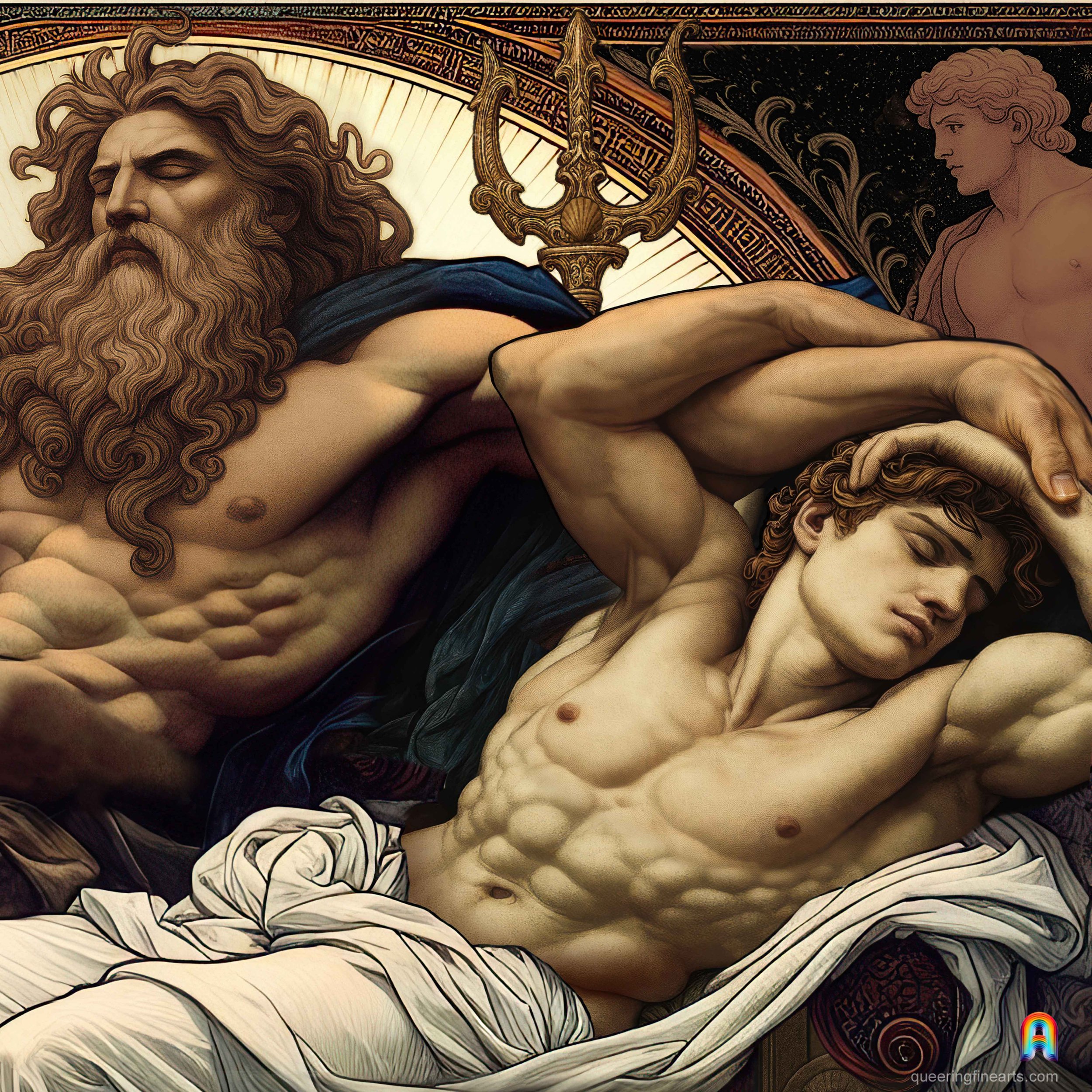
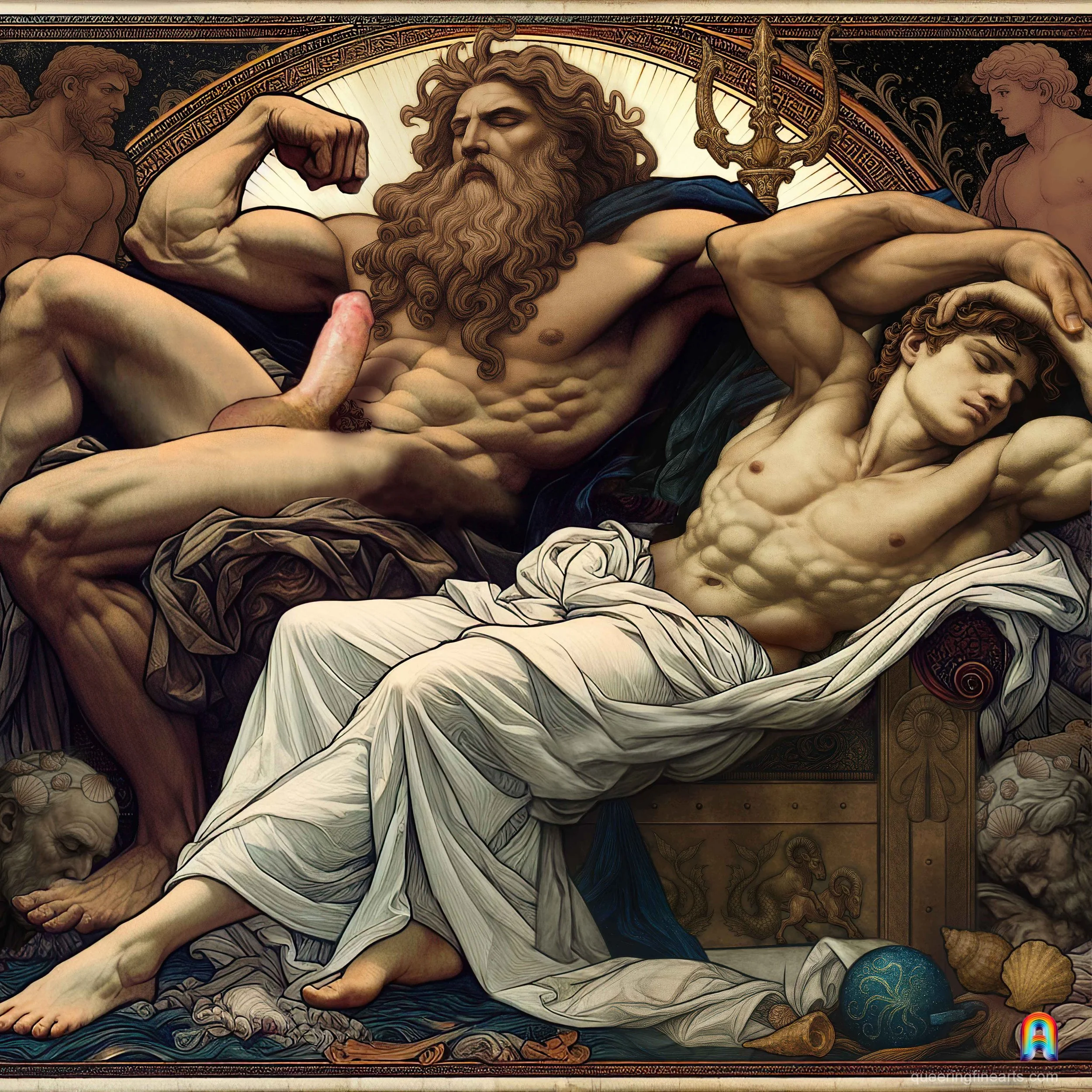
The work transposes the myth of Poseidon and Pelops from Greek mythology into a visual language shaped by Art Nouveau,¹ particularly evident in its use of a decorative stylization close to poster art,² with its dark outlines, soft palette and taste for legible ornament. The comparison with Alfons Mucha, a major figure of this European movement and an artist now inseparable from the aesthetic of the Belle Époque,³ helps situate this alliance of sensuality, compositional clarity and abundant decor. Even the god’s power is tempered, softened, made almost fluid by his sinuous pose and by the serpentine lines of the hair, beard and draperies. The setting forms a kind of ornamental frame in which the intimate scene unfolds like a sensual dream rather than a mere mythological episode.
The Sovereignty of Desire
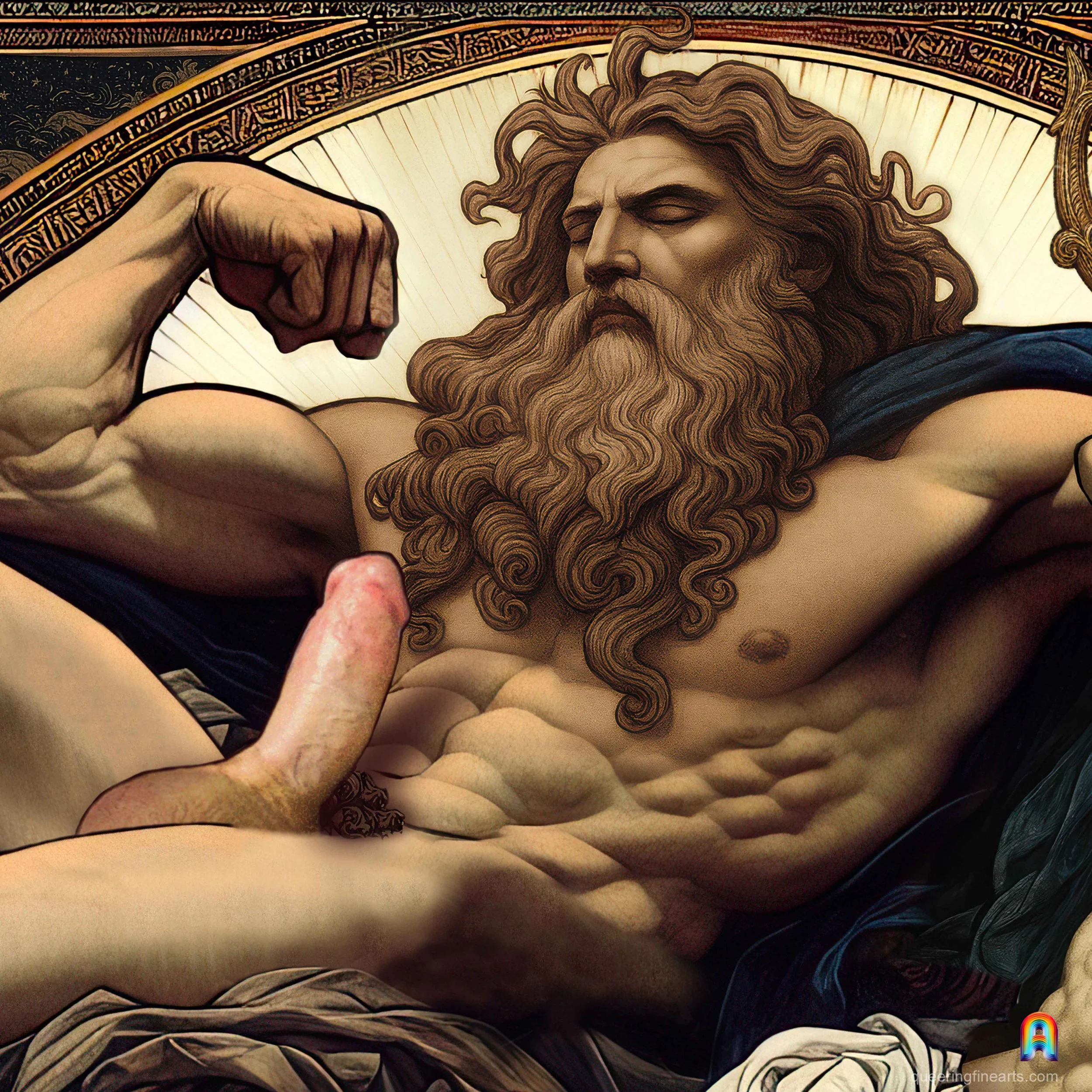
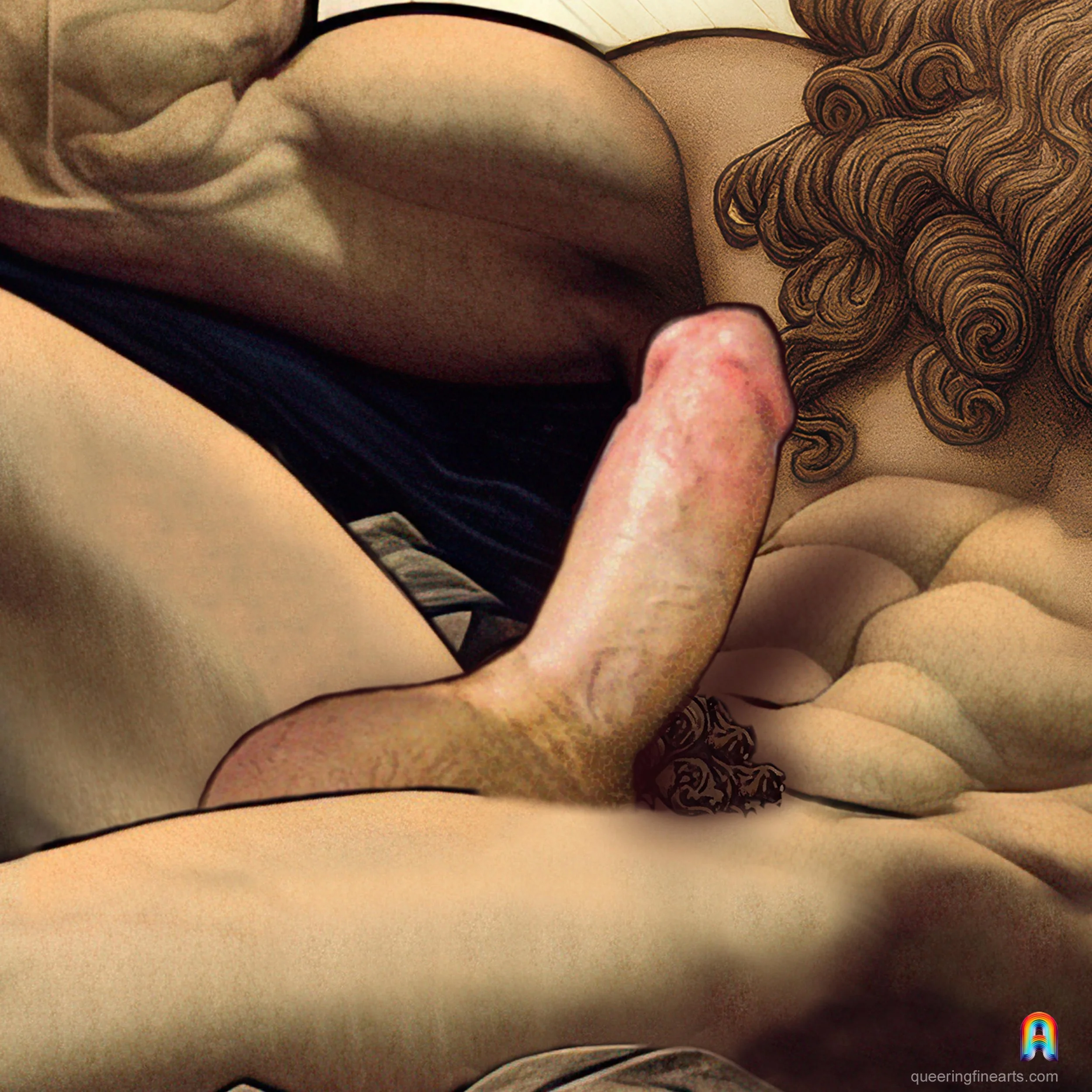
At the center of the composition, Poseidon appears in all the majesty of a sovereign divine virility. His monumental body occupies the space with an imperious, almost crushing assurance, yet this physical domination does not reduce itself to menace. It is eroticized. His splendid erection is one of the focal points of the composition, almost luminous in its delicate flesh tones. The god does not merely enthrone himself. He attracts, envelops and holds. His arm extended above Pelops acts as a gesture of possession that is at once tender and powerful. It is the emotional pivot of the image. The young man, far from recoiling, clasps that arm in return, welcoming its hold with voluptuousness. The entire scene rests on this circulation of contact.
Consenting Abandon
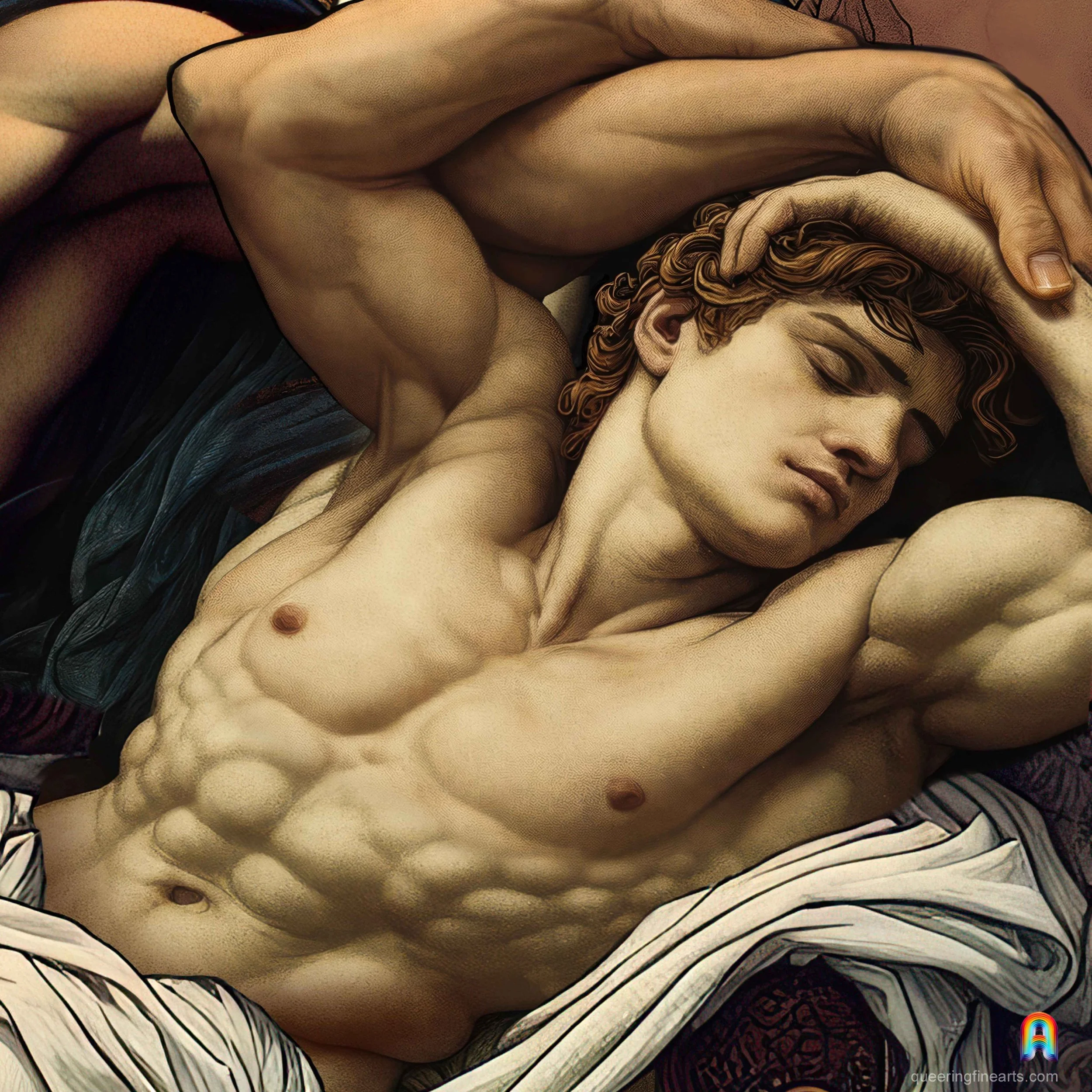
Pelops is shown in a posture of remarkable abandon. His torso unfolds with an almost sculptural beauty, yet this idealized nudity is far from innocent. His slanting body, his arms thrown back, his head tilted and his closed eyes all suggest relaxation, trust and openness to desire. He does not look at the god, and that is precisely what heightens the erotic charge. He seems already absorbed in sensation. In the pleasure of receiving. He does not resist, but lets himself be steeped in the moment before being steeped in the god. This apparent passivity does not erase his role in the scene, for the hand encircling Poseidon’s arm is enough to show that there is a response, symbolic consent and a returning gesture.
The Upright Trident
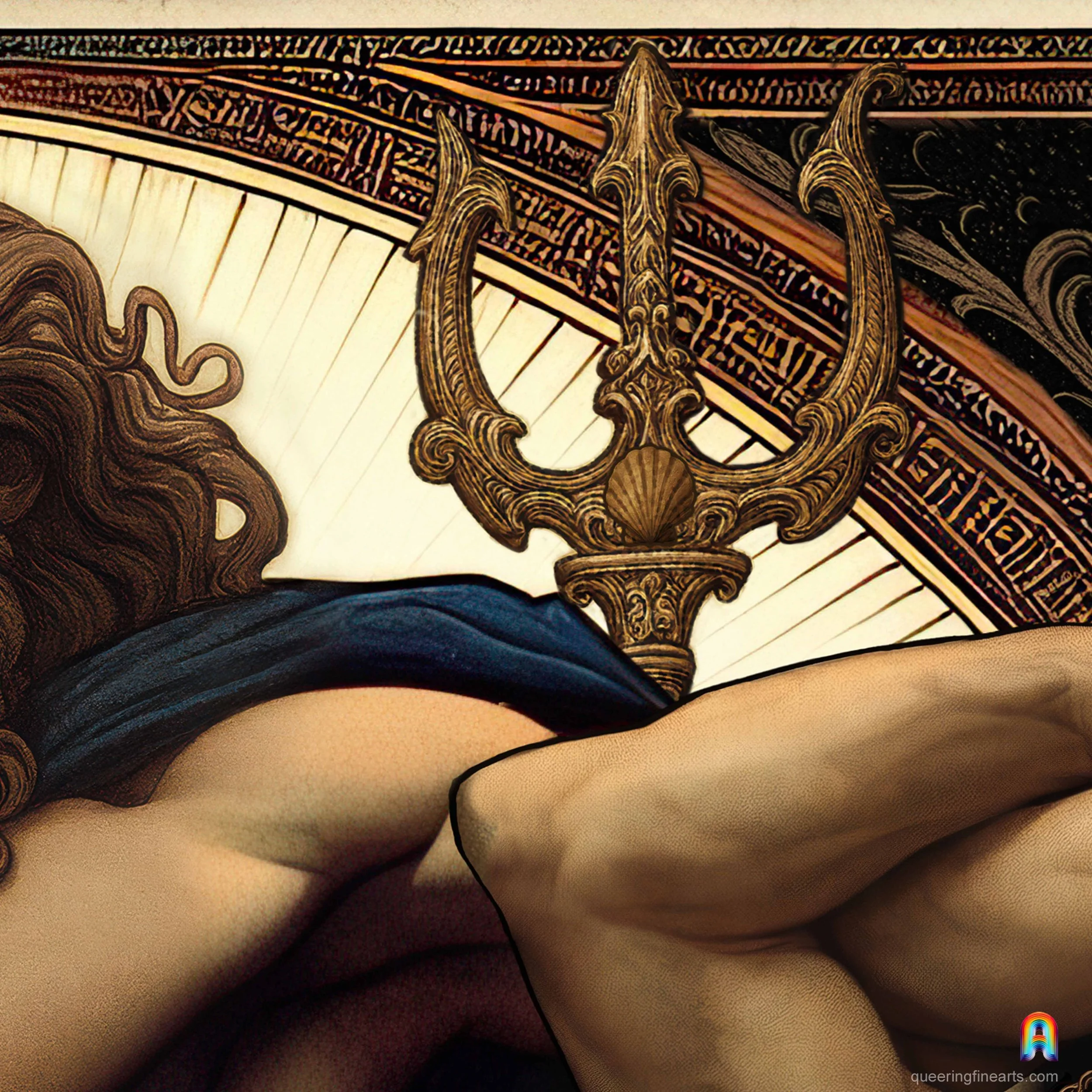
The trident raised behind Poseidon obviously recalls his identity, yet it does more than name the god. It acts as a sign of sexual and cosmic power. Vertical, ornamental and almost sacralized by the composition, it prolongs the sovereignty of the figure. In such a visual context, it becomes impossible not to see it also as a phallic assertion. The work does not conceal that the god’s desire is immense and even triumphant. Poseidon is not here merely the lord of the sea. He is a force of desire that claims, surrounds and marks the entire space with its presence.
Ornamental Symbolism
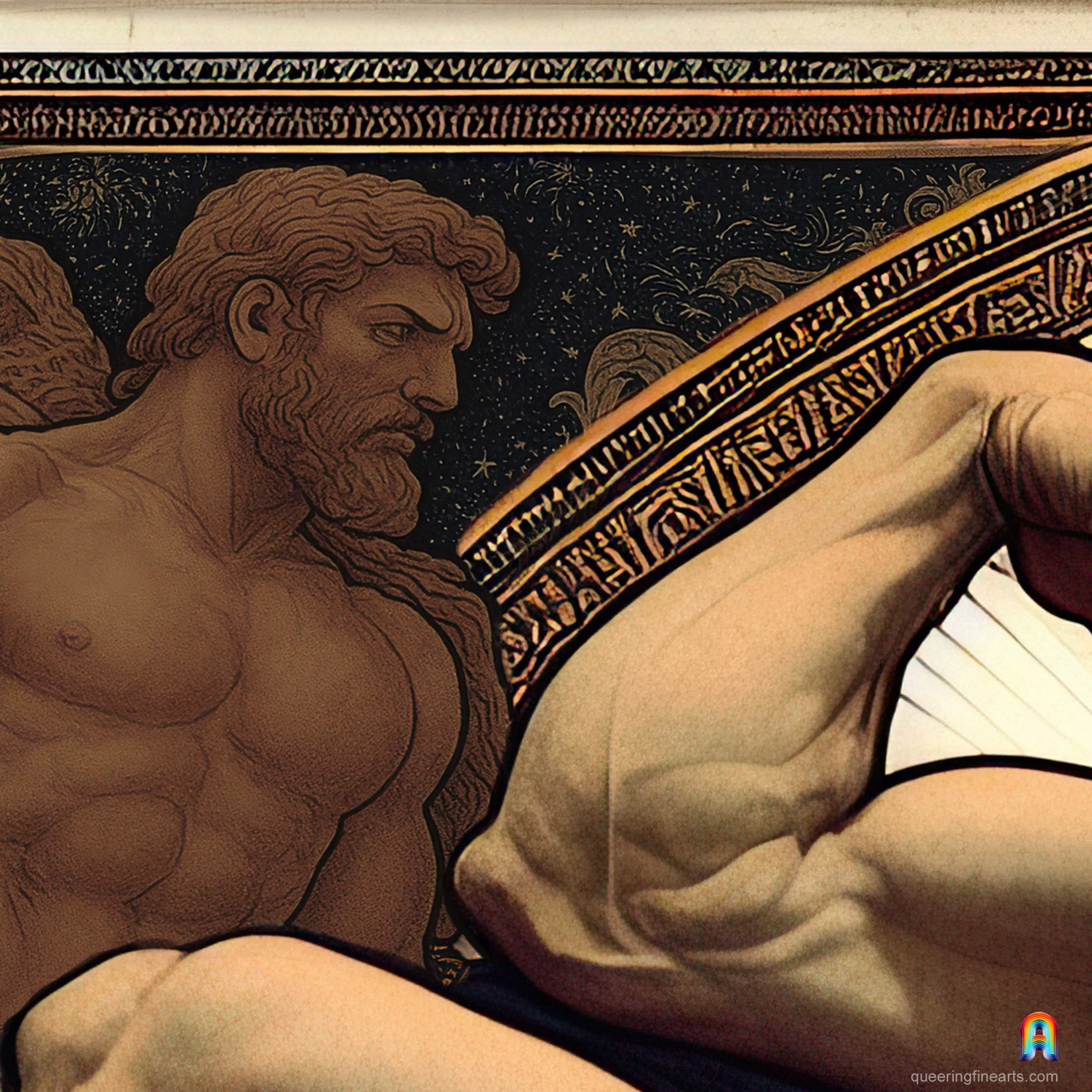
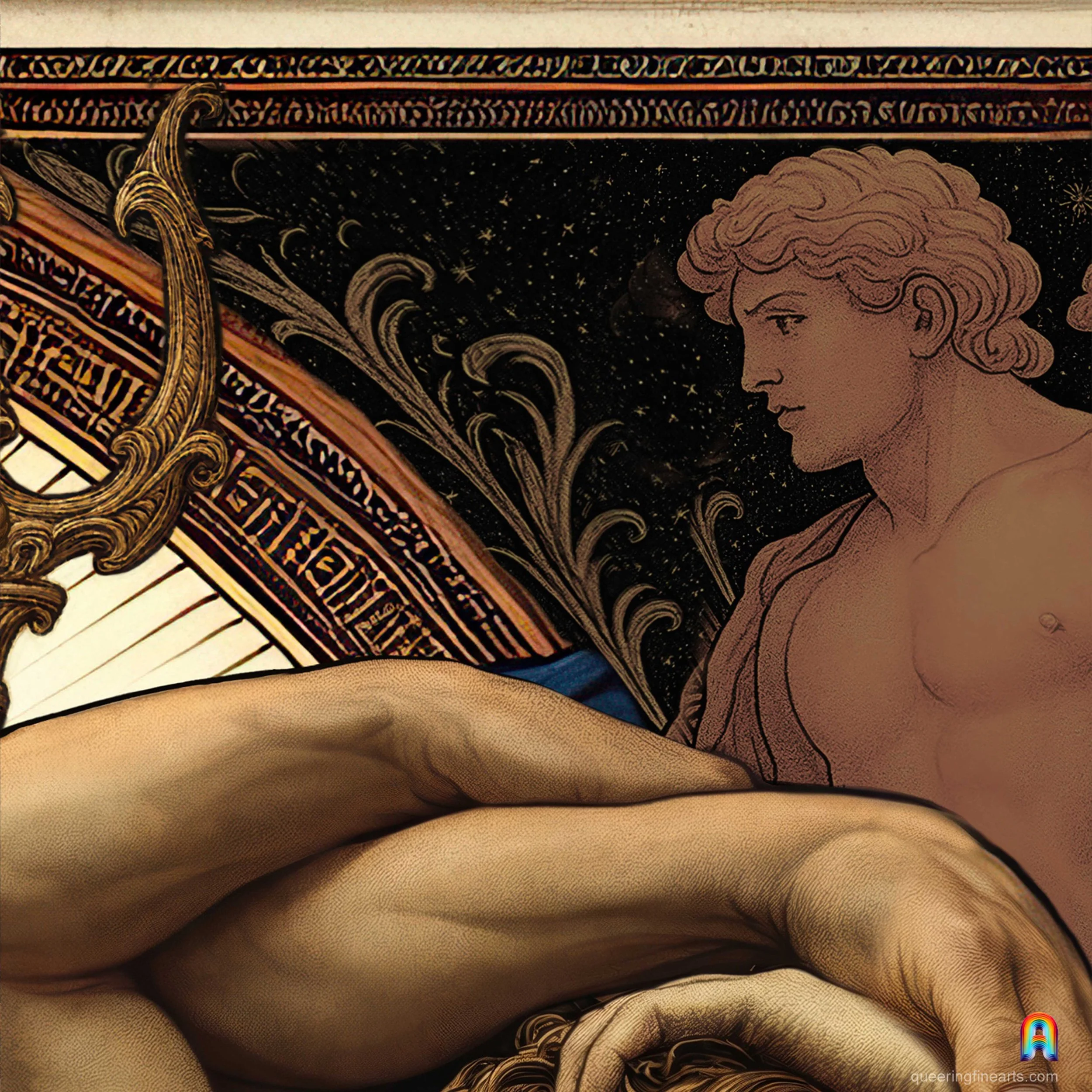
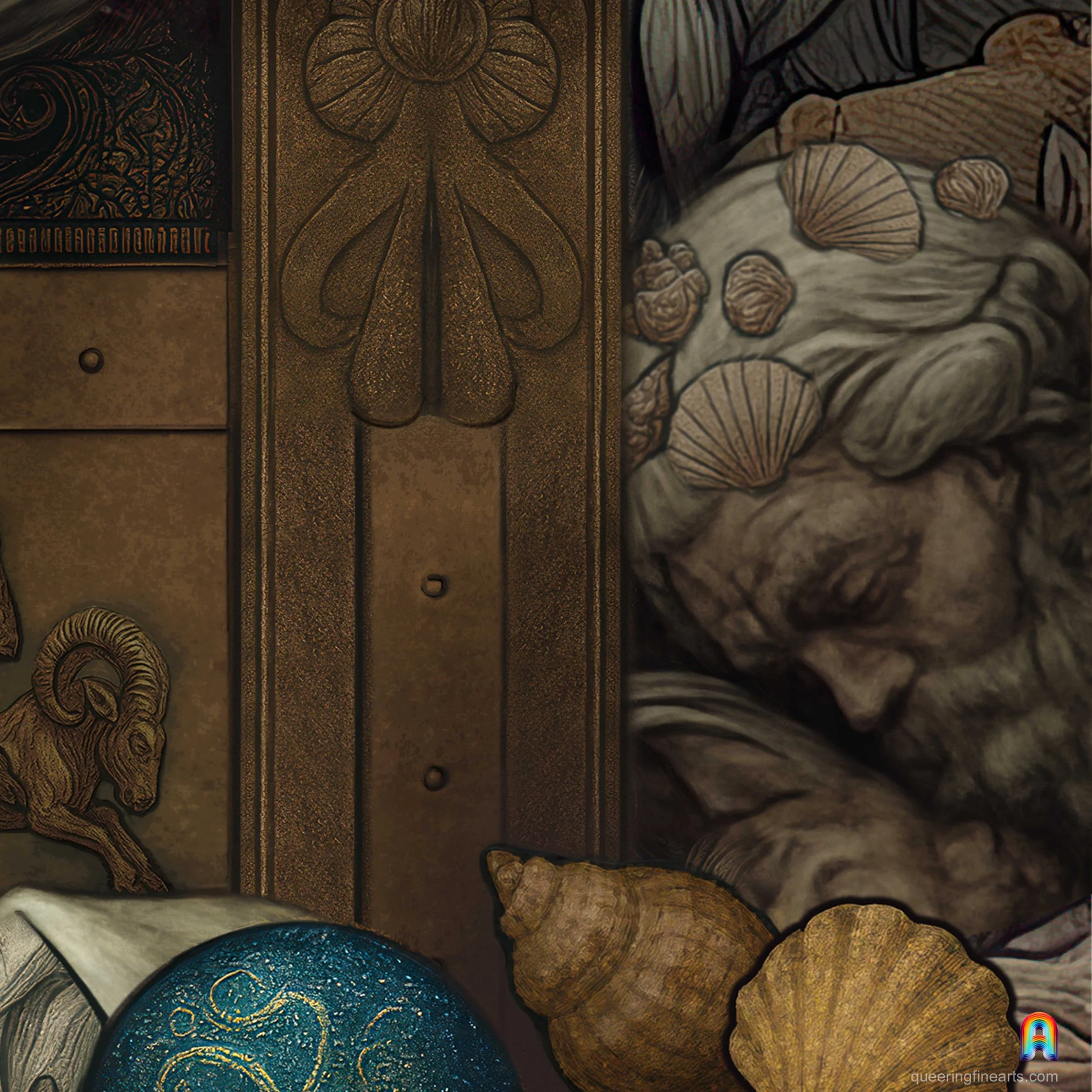
The architectural frame suggests a chamber in a marine palace where frescoes evoking Hercules and Apollo subtly enrich the scene. Hercules, the embodiment of virile strength, and Apollo, the ideal of youth, beauty and harmony,⁴ form two symbolic poles between which the relationship uniting Poseidon and Pelops is inscribed. They serve to deepen the meaning. On one side, physical power. On the other, youthful perfection. At the center, their erotic condensation in the embrace between the god and the young man.
Court of the Abysses
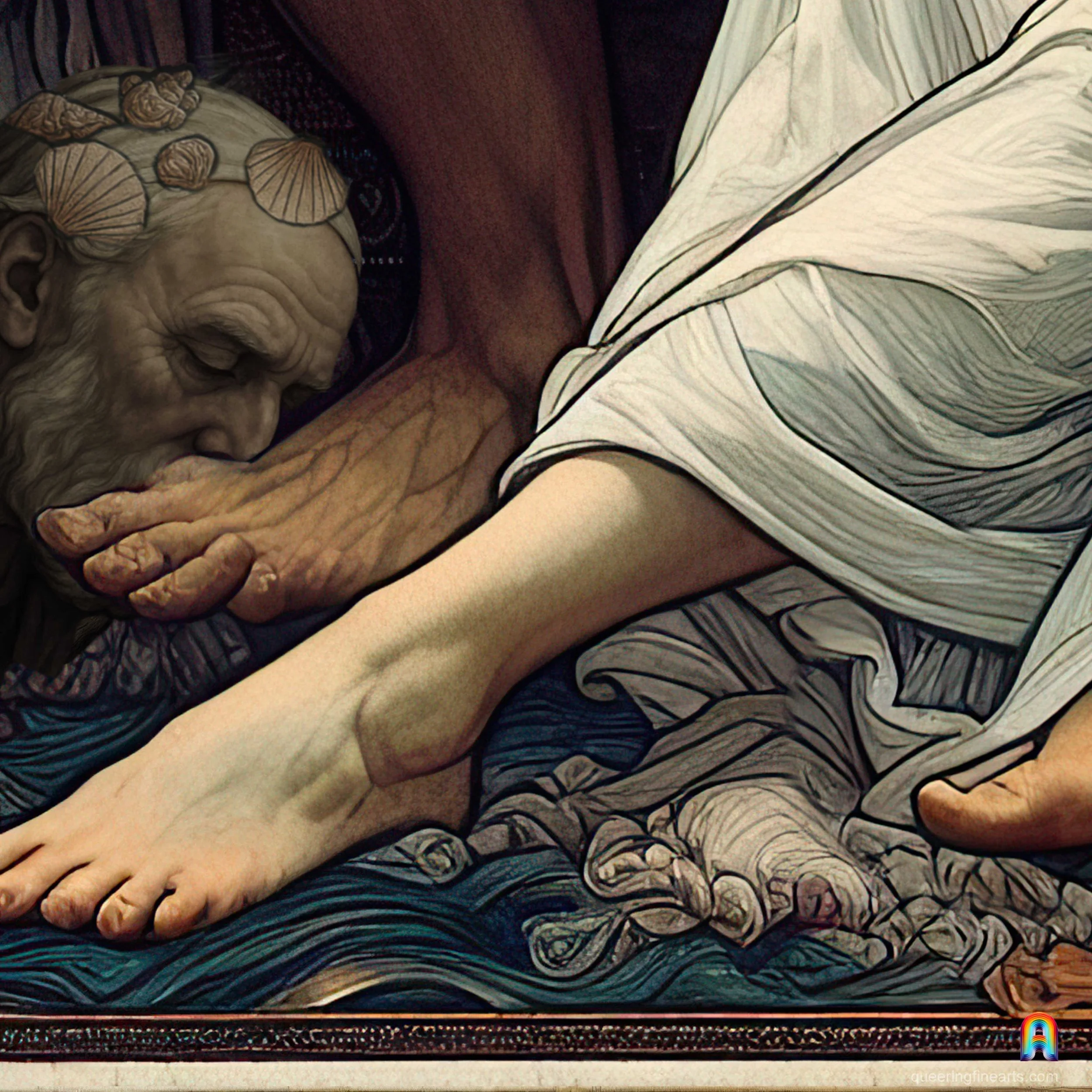
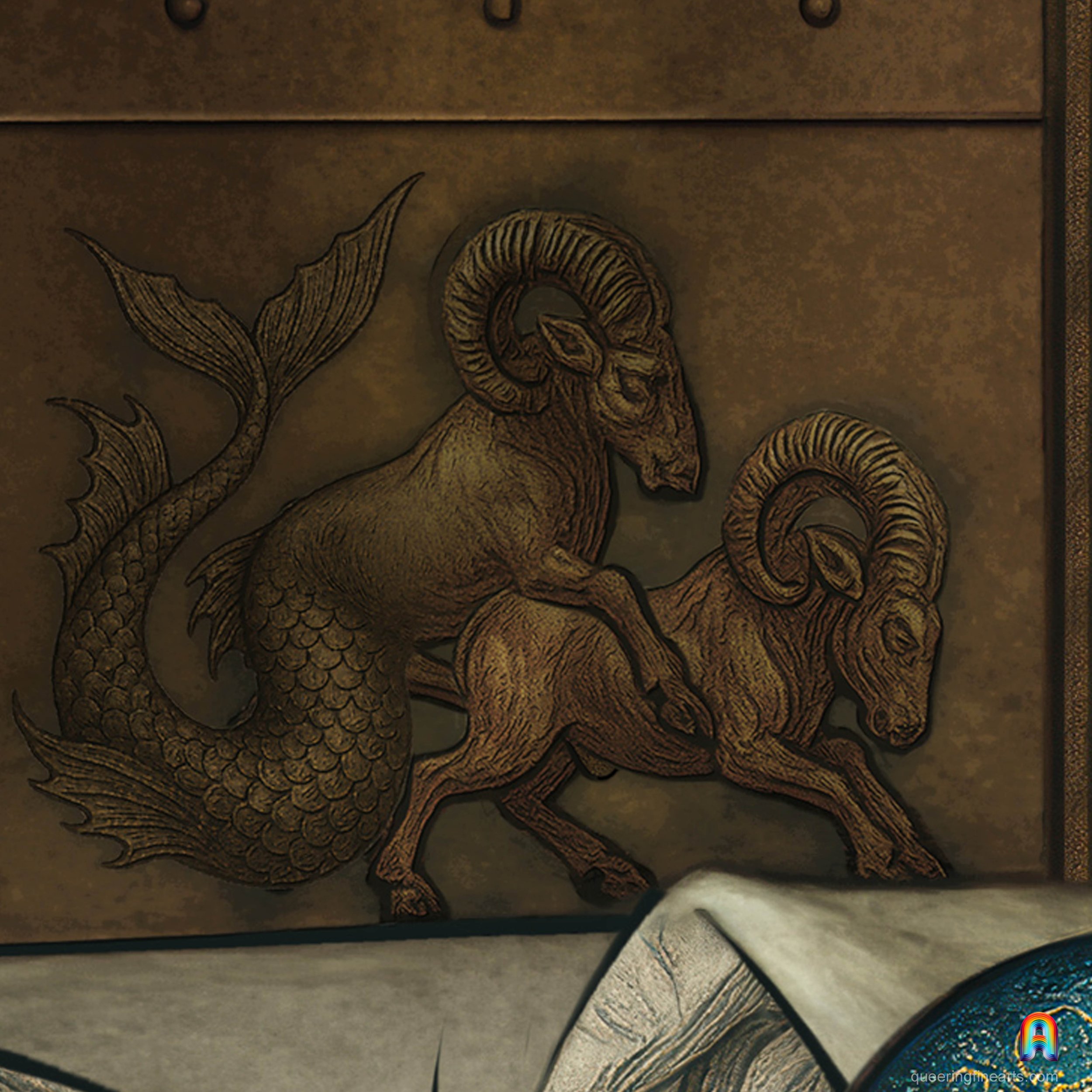
The marine elements scattered throughout the composition - shells, watery textures, deep hues and undulating motifs - remind us that this scene belongs to Poseidon’s world. The sea insinuates itself everywhere with its enveloping sensuality. The heads glimpsed below, marine courtiers half-hidden in the decor, contribute to the impression of a universe populated by aquatic presences who witness, or at least belong to, the god’s sphere. This gives the whole an atmosphere of an underwater court, strange and sumptuous, where the sovereign’s desire becomes almost a fact of nature. The throne itself deserves particular attention. Sculptures upon it show a sea-ram with a fish tail penetrating a terrestrial ram, an explicit illustration of the coupling of the two protagonists of the principal scene.
Theater of Desire
What finally strikes the viewer is that the painting’s sensuality does not proceed only from nudity or anatomical beauty. It also comes from the staging of contrast. Poseidon is vast, dark, bearded and sovereign, almost telluric despite his marine dominion. Pelops is fair, smooth and young, almost languid like a living offering. The dialogue of flesh, scale, textures and attitudes constructs a very powerful tension between active strength and lascivious abandon. That is what gives the image its real intensity. The myth is no longer a distant anecdote here. It becomes a theater of male desire in which a god’s love for a mortal takes the form of caressing domination and reciprocal fascination.
In One Voice
In that sense, the work offers a highly coherent reading of the myth of Poseidon and Pelops. It insists less on the narrative in the strict sense than on the affective and carnal state that makes it possible. The beloved youth is not merely beautiful. He is already caught in a moment of voluptuous surrender. And the god is not merely powerful. He is a being of desire, possession and gift. The whole composition seems to say that mythic favor is born here from an initial sensual impulse, within the enclosed, ornamental and marine space of a divine intimacy. This way of turning embrace into architecture and desire into a total decor is very typical of Art Nouveau,¹ never far removed from Symbolism⁵ and the other styles of the turn of the 19th and 20th centuries.
Prague in Filigree
The comparison with the work of Alfons Mucha opens another path as well. Born in Moravia, formed within the Czech cultural sphere and later returning to settle in Prague at the beginning of the 20th century⁶ in order to pursue the most monumental and most nationally invested part of his work, the artist makes it possible to build a bridge between a broadly European fin-de-siècle sensibility and the particular context of the Czech capital. From that point of anchorage, the image can lead toward another aspect of Prague around 1900: no longer only its artistic refinement, but also the more discreet presence of a homosexual life perceptible in certain meeting places, in literary circles, in the press and even in police archives.⁷
Homosexuality in a Minor Key
This history did not leave Prague with emblems as dazzling as those of Paris or Berlin. It appears instead in fragments, through male sociabilities, cultural circles, codes of desire and traces that are often scattered. In Prague as elsewhere, homosexuality also had the singular privilege of being denounced on all sides in the name of principles that contradicted one another perfectly well. For some socialists or communists, it was treated as a bourgeois mania, a suspect refinement of privileged people. For certain conservative milieus, it became instead a symptom of moral laxity, or even a seedbed of social disorder. This opening may be extended by reading the article “Prague around 1900: Outline of a Homosexual History” in the website’s Chronicles of Absent Works section.
A Lesser-Known Story
It is to Greek mythology that we return for the queer narrative that inspired this work, a story less well known than the great myths, yet still a beautiful example of a legend in which tenderness between men has its place and in which the story ends happily. In this vast universe populated by gods, heroes and passions intertwined with fate, Pelops is an ancient hero, a king’s son, and his name would later remain attached to the Peloponnese itself.⁸ Among the poets of antiquity who sang these tales, Pindar,⁹ the Greek lyric poet of the 5th century BCE, left a particularly beautiful evocation of him in which the radiance of the young man draws the love of a god itself.
The Divine Abduction
In these verses, Pelops is presented as a mortal of exceptional beauty. That beauty touches Poseidon, the great god of the sea, lord of the trident and of horses.¹⁰ The poet then recounts that “the god of the splendid trident,” “his mind overcome by desire,” seized him and “carried him off”¹¹ in his chariot of golden horses. Pelops thereafter lived under Poseidon’s favor. Beloved of the master of the sea, he is kept near him among the immortals. Pindar even explicitly compares his fate to that of Ganymede.¹² The story therefore clearly places Pelops among those beautiful young mortals whom a god’s desire carries off from the human world.
Return among Mortals
Then comes the time when Pelops returns among men. Having become a young man in “the flower of his beautiful youth,” he turns his heart toward marriage and wishes to unite himself with Hippodameia, daughter of King Oenomaus, ruler of Pisa in Elis. But the princess can be won only at the cost of a terrible ordeal: a chariot race in which the suitors risk their lives.¹³
Supplication to the Sea
Then, alone in the night, Pelops approaches the gray sea and calls upon Poseidon, “the god of the deep roar, lord of the trident.” When the god appears to him, Pelops reminds him of their former bond and implores him in these terms: “if the pleasures of love count for anything, Poseidon...,” stop the bronze spear of Oenomaus, carry me in the swiftest chariot, and grant me victory. Poseidon hears this prayer. Pindar says that in honoring him the god gave him “a golden chariot” and horses with “untiring wings.”¹⁴ Thanks to this aid, Pelops defeated the might of Oenomaus and took Hippodameia as his wife. The god’s former love for the young mortal therefore remains alive in the decisive help he grants him when his life is at stake.
Immortal Favor
Another ancient author, Apollodorus, summarizes the same tradition by saying that Pelops, because of his exceptional beauty, became Poseidon’s favorite and that the god gave him a winged chariot whose axles did not even grow wet upon the sea.¹⁵ Yet it is truly in Pindar that this legend takes its clearest and most beautiful form: that of a young man loved by a god, carried off through desire and then still sustained by that love when the ordeal arrives.
QFA
Curiosity Piqued?
1. Tomoko Sato, Alphonse Mucha, London, Tate Publishing, 2015, p. 10-37; Jackie Wullschläger, “Alphonse Mucha review - decorative dishes delight,” Financial Times, June 12, 2025; Mucha Museum, Alfons Mucha and His Life, Prague, official website, consulted March 13, 2026.
2. Musée d’Orsay, Art Is in the Street, Paris, Musée d’Orsay, online exhibition presentation, section on Mucha’s posters for Sarah Bernhardt; The Metropolitan Museum of Art, Two Girls Reading, New York, The Metropolitan Museum of Art, online object entry, consulted March 13, 2026.
3. Mucha Foundation, Alfons Mucha: Czech Master of the Belle Epoque, Prague, online exhibition presentation; Tomoko Sato, Alphonse Mucha, London, Tate Publishing, 2015, p. 39-85.
4. Pierre Grimal, The Dictionary of Classical Mythology, Oxford, Basil Blackwell, 1986, entries “Heracles” and “Apollo”; The Oxford Classical Dictionary, 4th ed., Oxford, Oxford University Press, 2012, entries “Heracles” and “Apollo.”
5. Jean-David Jumeau-Lafond, Les peintres de l’âme. Le symbolisme idéaliste en France, Ghent, Snoeck, 1999, p. 11-28; Michel Draguet, Le Symbolisme en Belgique, Brussels, Fonds Mercator, 2010, p. 9-22.
6. Mucha Museum, Biography, Prague, official website, biographical chronology; Jiří Mucha, Alphonse Mucha: His Life and Art, London, Heinemann, 1966, p. 194-233. Consulted March 13, 2026.
7. Jonathan Bolton, “Russian and Czech Decadence,” in Jane Desmarais and David Weir, eds., Decadence, Cambridge, Cambridge University Press, 2019, p. 179-196, here p. 189-193; Manfred Macmillan, “Introduction,” Ann Arbor, University of Michigan Press, 2024, p. 3-8, 24-27; Jan Seidl et al., Queer Prague: A Guide to the LGBT History of the Czech Capital, 1380-2000, Brno, Černá Pole, 2014.
8. Encyclopaedia Britannica, “Pelops,” online entry, consulted March 13, 2026; Pierre Grimal, The Dictionary of Classical Mythology, Oxford, Basil Blackwell, 1986, entry “Pelops.”
9. Pindar, Olympian Odes, I, in Aimé Puech, trans., Pindare. Tome I : Olympiques, Paris, Les Belles Lettres, 1949, p. 14-19; William H. Race, trans., Pindar. Olympian Odes, Pythian Odes, Cambridge, Harvard University Press, 1997, p. 46-57.
10. Pierre Grimal, The Dictionary of Classical Mythology, Oxford, Basil Blackwell, 1986, entry “Poseidon”; The Oxford Classical Dictionary, 4th ed., Oxford, Oxford University Press, 2012, entry “Poseidon.”
11. Pindar, Olympian Odes, I, lines 37-44, in Aimé Puech, trans., Pindare. Tome I : Olympiques, Paris, Les Belles Lettres, 1949, p. 16-17; William H. Race, trans., Pindar. Olympian Odes, Pythian Odes, Cambridge, Harvard University Press, 1997, p. 50-51.
12. Pindar, Olympian Odes, I, lines 40-44, in Aimé Puech, trans., Pindare. Tome I : Olympiques, Paris, Les Belles Lettres, 1949, p. 16-17; Karl Kerényi, The Heroes of the Greeks, London, Thames and Hudson, 1959, p. 230-233.
13. Pindar, Olympian Odes, I, lines 67-74, in Aimé Puech, trans., Pindare. Tome I : Olympiques, Paris, Les Belles Lettres, 1949, p. 18; Pseudo-Apollodorus, The Library, Epitome, II, 3-9, in Jean-Claude Carrière and Bertrand Massonie, trans., Apollodore. Bibliothèque, Paris, Gallimard, 1991, p. 194-199.
14. Pindar, Olympian Odes, I, lines 75-87, in Aimé Puech, trans., Pindare. Tome I : Olympiques, Paris, Les Belles Lettres, 1949, p. 18-19; William H. Race, trans., Pindar. Olympian Odes, Pythian Odes, Cambridge, Harvard University Press, 1997, p. 54-57.
15. Pseudo-Apollodorus, The Library, Epitome, II, 3, in Sir James George Frazer, trans., Apollodorus. The Library, vol. 2, Cambridge, Harvard University Press, 1921, p. 144-147; Jean-Claude Carrière and Bertrand Massonie, trans., Apollodore. Bibliothèque, Paris, Gallimard, 1991, p. 194-195.