Vault Panel, Two Men Kissing
In the Caravaggesque tradition of 17th-century Sicilian painting
Oil on marouflaged canvas, after 1608
Sicilian vault decoration, aristocratic interior in Palermo
More than a Kiss
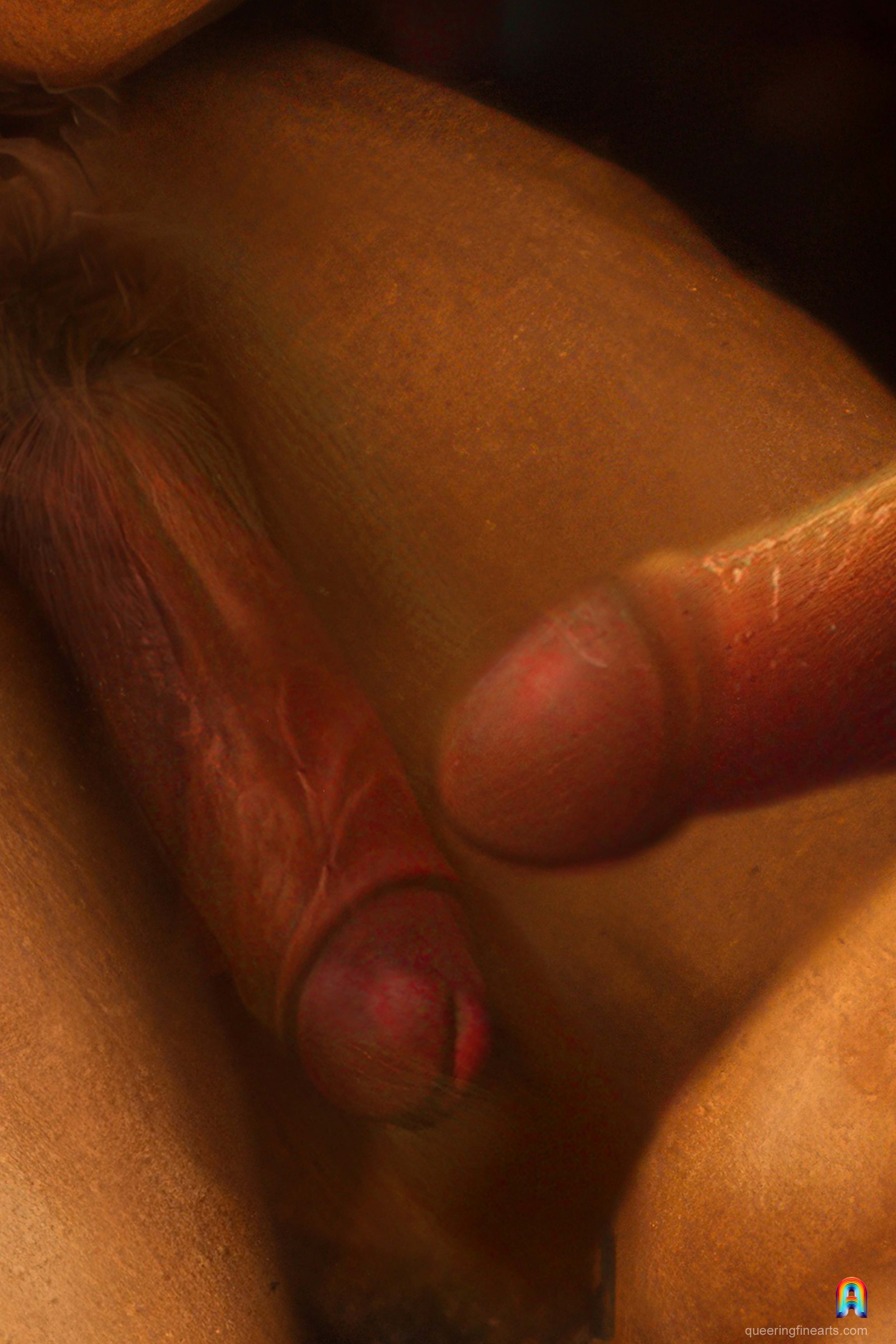
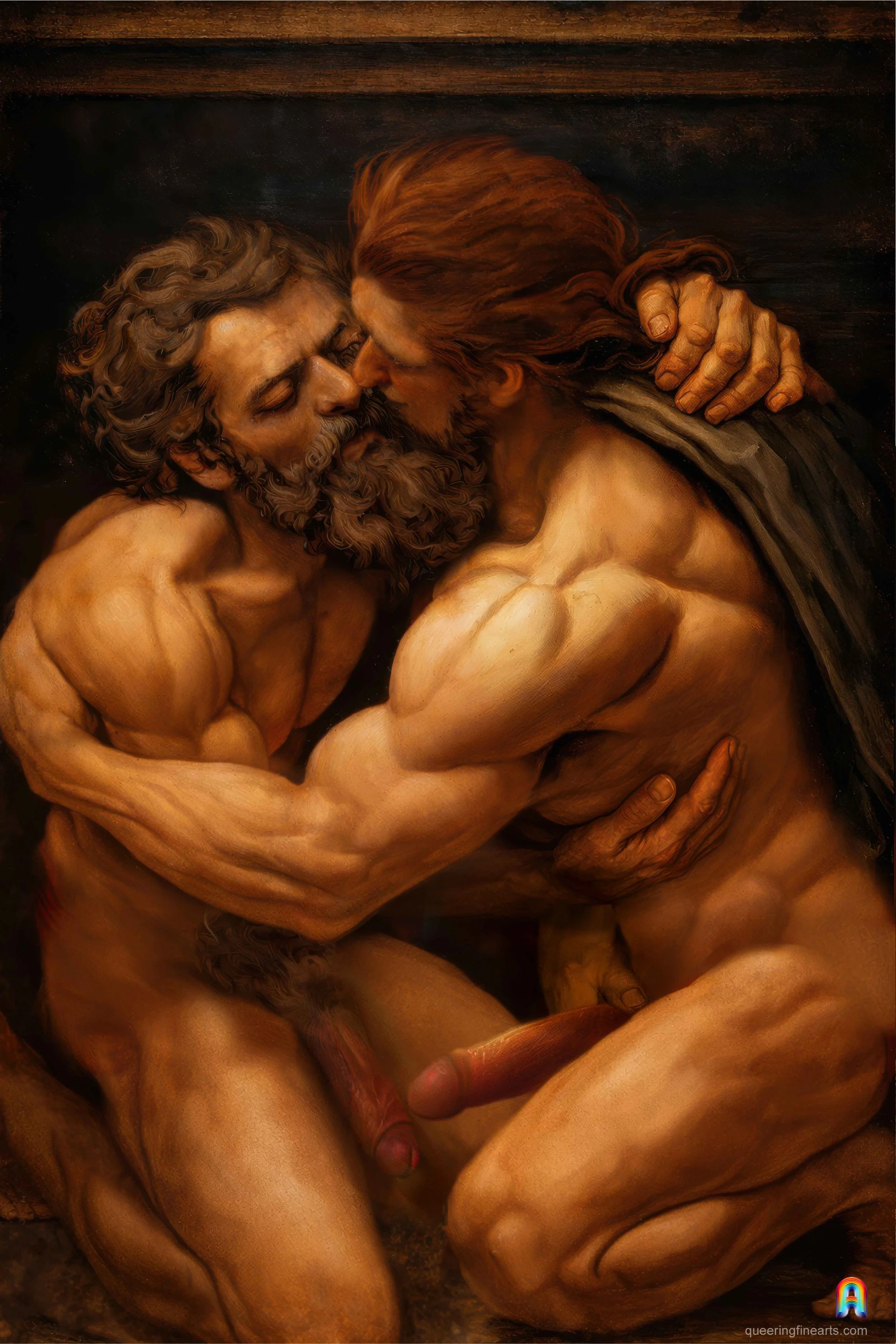
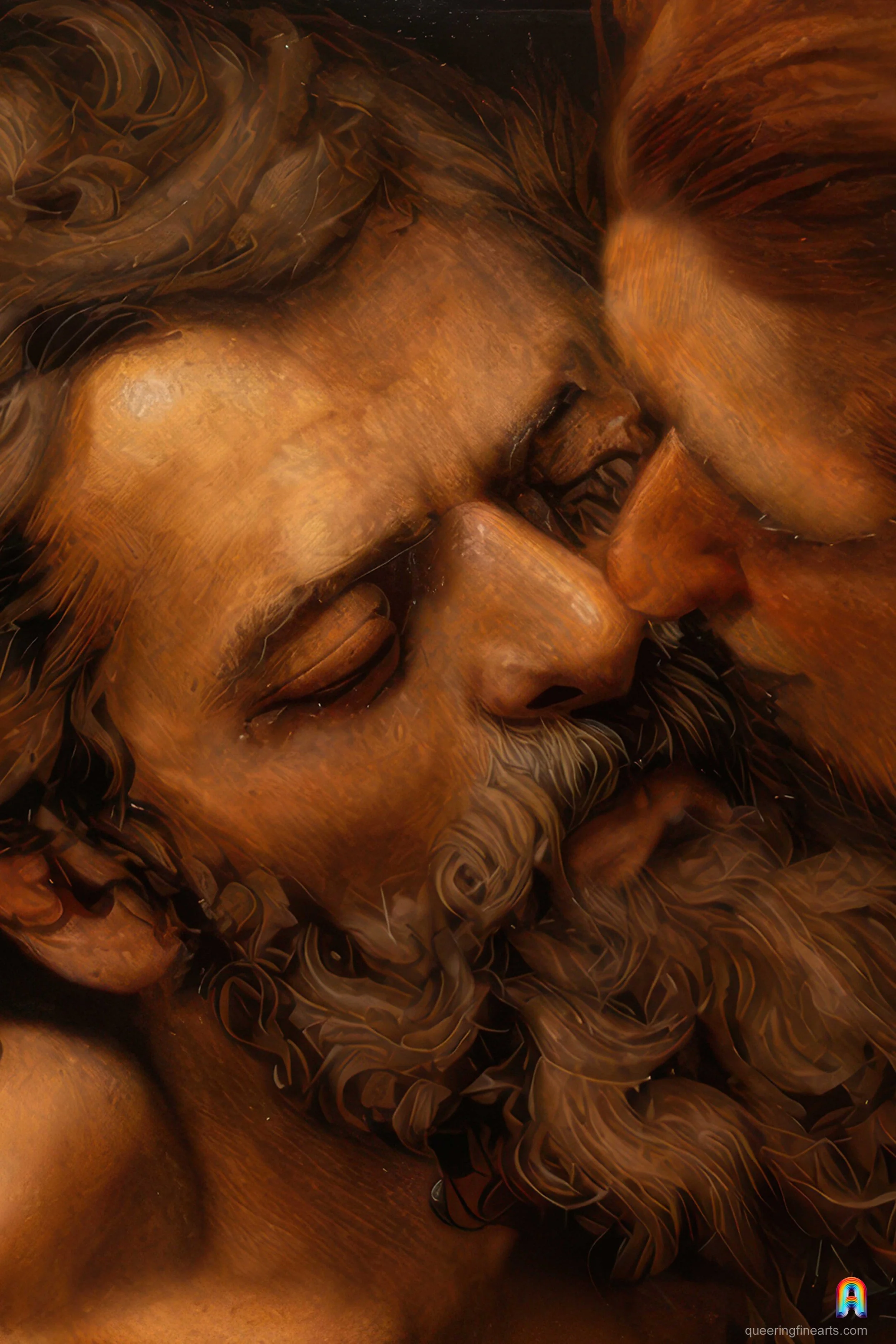
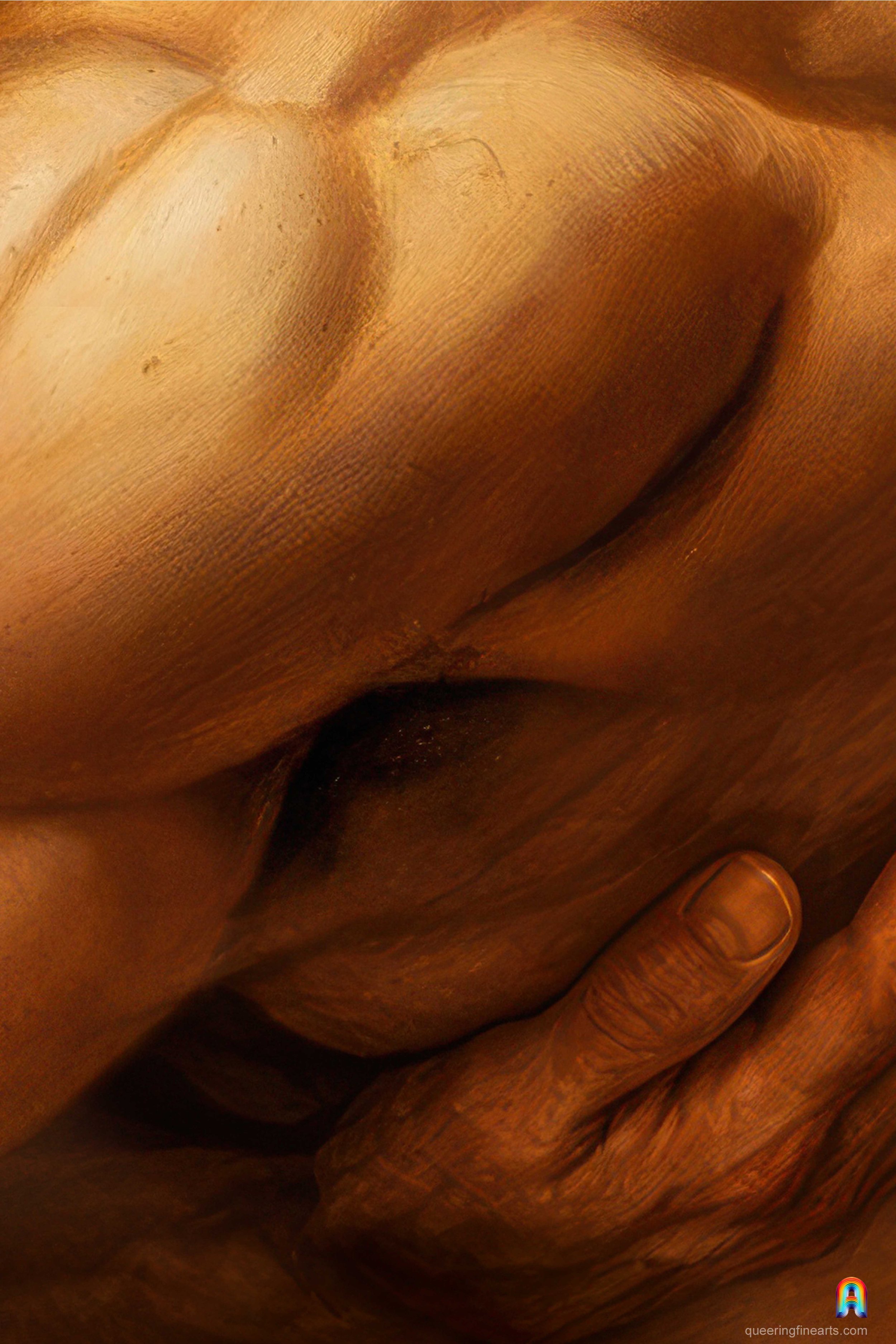
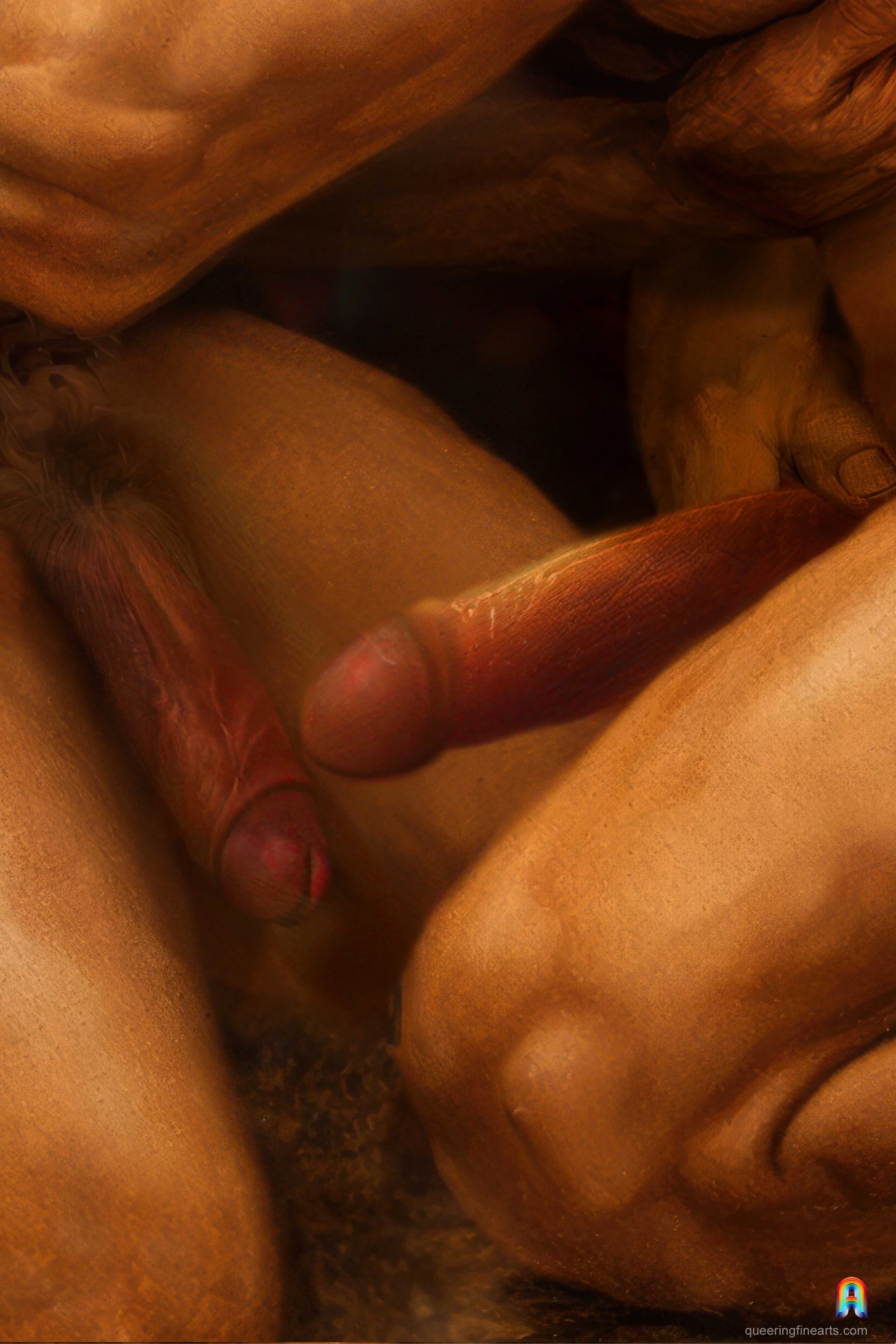
This panel is designed for a viewer standing within a room reserved for the intimates of the masters of the house, which calls for a simple and forceful visual impact, typical of the spirit of painted vaults in Palermo¹. The artist strips away nearly everything that might distract, so that the vault declares only one thing: a kiss between men, a deeply intimate scene in which the sexual organs are handled with skill and ardour. Two nudes cling to one another, chest against chest, arms locked in an embrace of mutual force. The face of the bearded man, his eyes closed, receives the kiss with evident serenity. His red-haired companion presses his lips to his while firmly holding his penis and drawing it toward his own, in a combination of actions that suggests a practiced familiarity with homoerotic play. The whole is arranged so that, from the floor, the viewer grasps at once the form, the gesture, and the passionate nature of the lovemaking.
Workshop and Palermitan Culture
This panel belongs to the legacy of Caravaggesque naturalism that left a profound mark on painting in southern Italy and Sicily in the early 17th century². Caravaggio’s stay on the island between 1608 and 1609, followed by the rapid spread of his pictorial solutions, introduced a new way of representing the male body, brought close to the viewer, shaped by dense light, and charged with immediate carnal presence³. In this artistic context, an image directly devoted to the embrace of two men does not appear as an anomaly. It fits within an already established pictorial language in which physical closeness, the sensuality of flesh, and the intensity of gazes become means of constructing the image. Within the private space of a palermitan palace, a painted ceiling could thus provide a privileged setting for this direct celebration of male beauty and desire⁴.
Caravaggio and Male Desire
Michelangelo Merisi da Caravaggio (1571-1610) occupies a singular place in this development of European painting. Several art historians have pointed out that the painter’s homosexuality sheds light on the central place occupied in his work by young male bodies and the sensual intensity of their presence⁵. Paintings such as Bacchus, Young Saint John the Baptist, and Boy Bitten by a Lizard present male figures offered to the gaze with manifest erotic charge, in which the beauty of the male body becomes a subject in its own right. From this perspective, Caravaggesque painting helped to assert a visual language in which attraction between men can be suggested or expressed through the proximity of bodies, the contact of gazes, and the sensuality of light.
Heteronormativity as Method
The case of Caravaggio is especially revealing and makes it possible to address the question of how queer subject matter has been treated by art historians. Despite abundant documentation concerning his relationships with young men, whether models, workshop companions, or presumed lovers, despite the manifest homoerotic charge of many works, and despite a network of patrons with well-known homosexual mores such as Cardinal del Monte, dominant historiography long maintained a systematic resistance to any queer reading of his work.
The Double Standard of Proof
In Caravaggio’s case, this resistance takes the form of a double movement: the overinvestment in the rare mentions of female relationships, only one, Lena, described as a “concubine” in a judicial document, as proof of exclusive heterosexuality, and the systematic minimization of everything that might attest to attraction toward men. Models become mere “collaborators,” patrons become disembodied “mecenases,” and the eroticism of male bodies becomes pure aesthetic research. This methodological asymmetry is not trivial: it perpetuates the idea that heterosexuality goes without saying and needs no proof, whereas homosexuality would require explicit documents that the context of criminalization made impossible to produce.
For Knowing Eyes
Learned homoeroticism, whether expressed through classicizing codes or through heroicized nudity, was one of the languages that European elites knew how to mobilize in private decor⁶. It made it possible to affirm desire as beauty without weighing it down with a justificatory narrative. Here, the frontal nature of the kiss and the sexual activity suggests a patron who seeks neither allusion nor mythological disguise, but a direct celebration, in a Palermo where the nobility used its palaces to assert its taste, rank, and identity.
Southern Light, the Presence of the Body
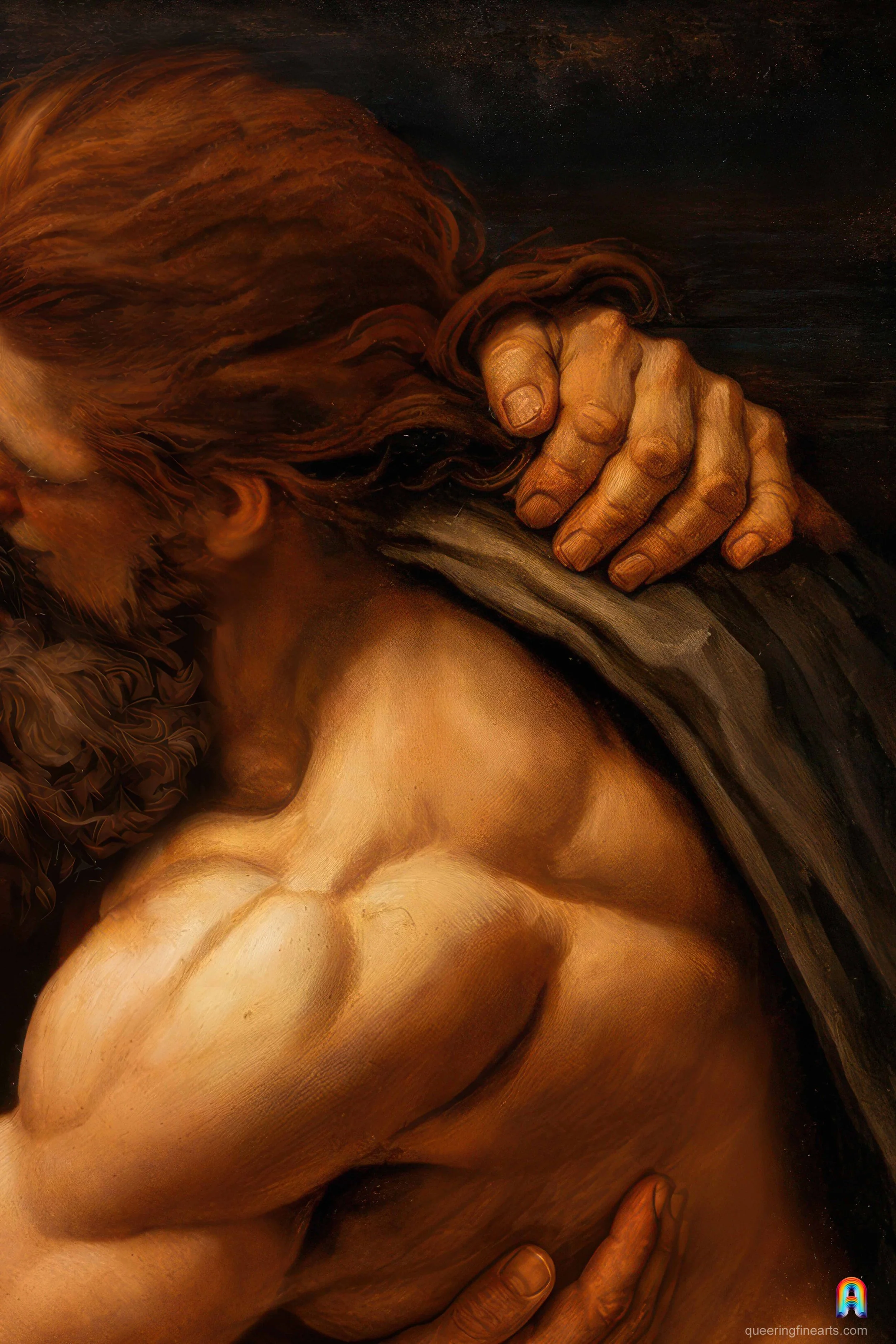
The light here constructs the very legibility of the embrace. It first catches the broad planes of the body, shoulders, pectorals, forearms, then allows other areas to dissolve into a warm dimness, so that the figures stand out with force and seem to advance toward the viewer. This treatment belongs to a Sicilian pictorial culture deeply marked by the reception of Caravaggism, in which light does not merely illuminate but grants bodies a dense, immediate, almost tangible presence³. In this panel, it does more than model the flesh. It concentrates attention on contact, stabilizes the composition, and gives the kiss its full visual authority.
Curiosity piqued?
1. Chiara Bonanno, Il cielo barocco di Palermo. Volte e cupole affrescate nella Sicilia del Seicento, doctoral dissertation, Università degli Studi di Palermo, 2018.
2. Sebastian Schütze, Caravaggio. The Complete Works, Cologne, Taschen, 2017.
3. Danielle Carrabino, Caravaggio in Early Modern Sicily, London, Routledge, 2026.
4. Luisa Chifari and Ciro D’Arpa, Vivere e abitare da nobili a Palermo tra Seicento e Ottocento. Gli inventari ereditari dei Branciforti principi di Scordia, Palermo, Palermo University Press, 2019.
5. Giorgio Fichera, Caravage queer : l’histoire de l’art face aux sexualités, doctoral dissertation in Arts: history and theory, EHESS, under the supervision of Giovanni Careri, defended on 16 December 2023.
6. Natacha Aprile, “La légende Caravage. Vie et œuvre de l’artiste, entre fantasmes et réalités,” Les Cahiers de Framespa, no. 35, 2020.