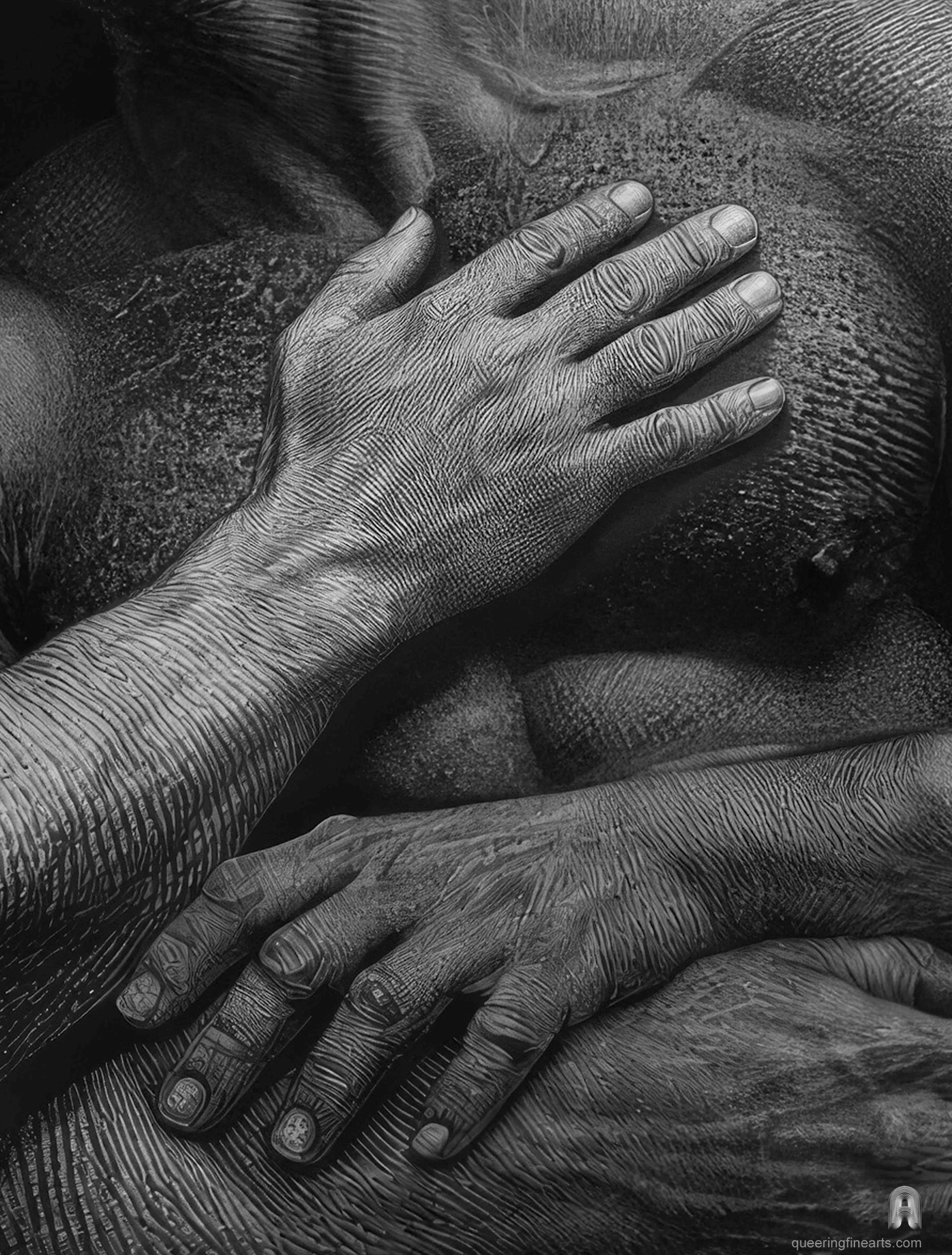
Encounter
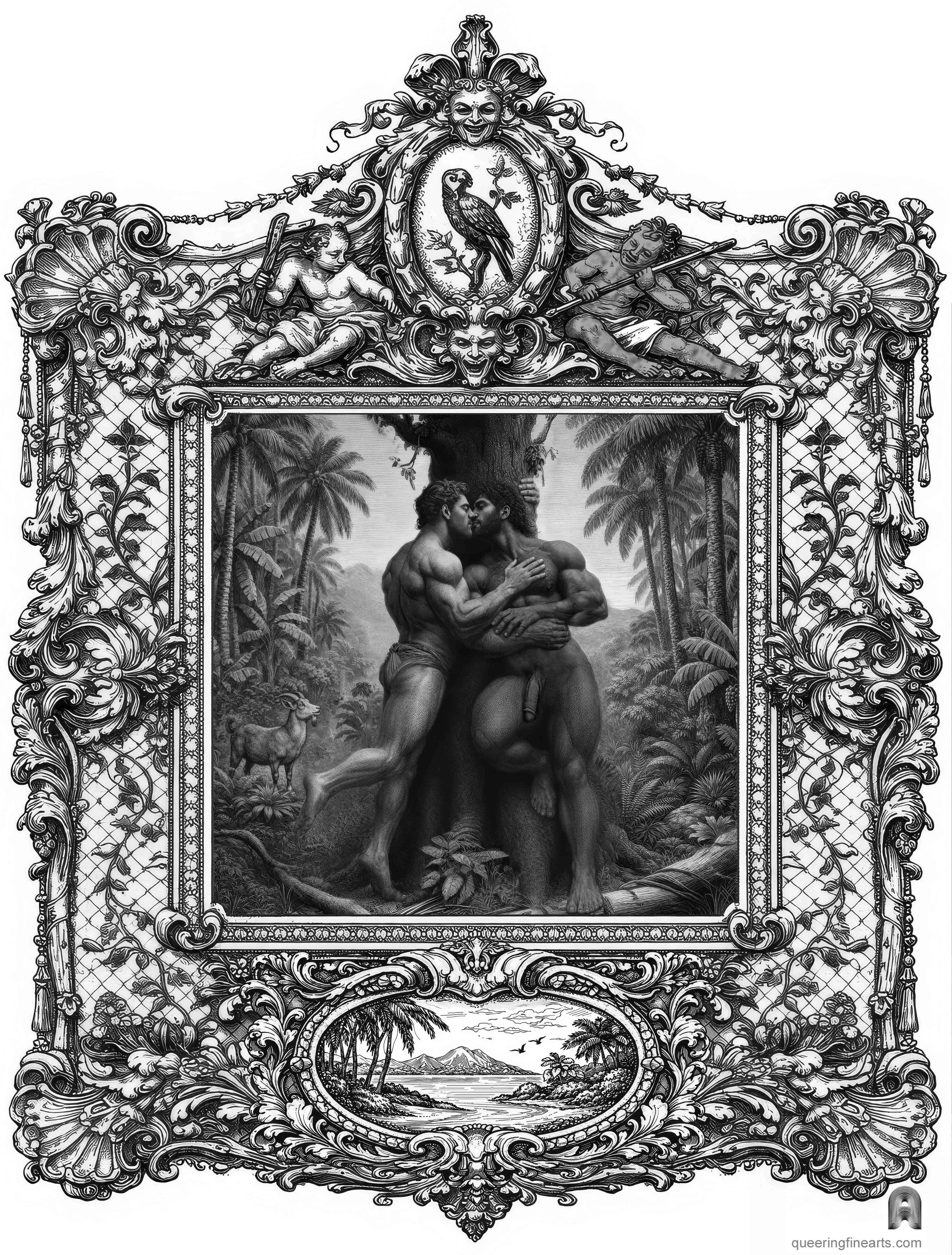
After the ornamental vocabulary of wood engravings attributed to Napoléon Thomas and to the engravers of the edition, notably Lacoste jeune, Chevauchet, Adolphe Best. Borel et Varenne edition of 1836 of Robinson Crusoe, translated by Pétrus Borel.
Copy held at the Bibliothèque nationale de France, Gallica
Sensual Utopia Where Encounter Replaces Conquest
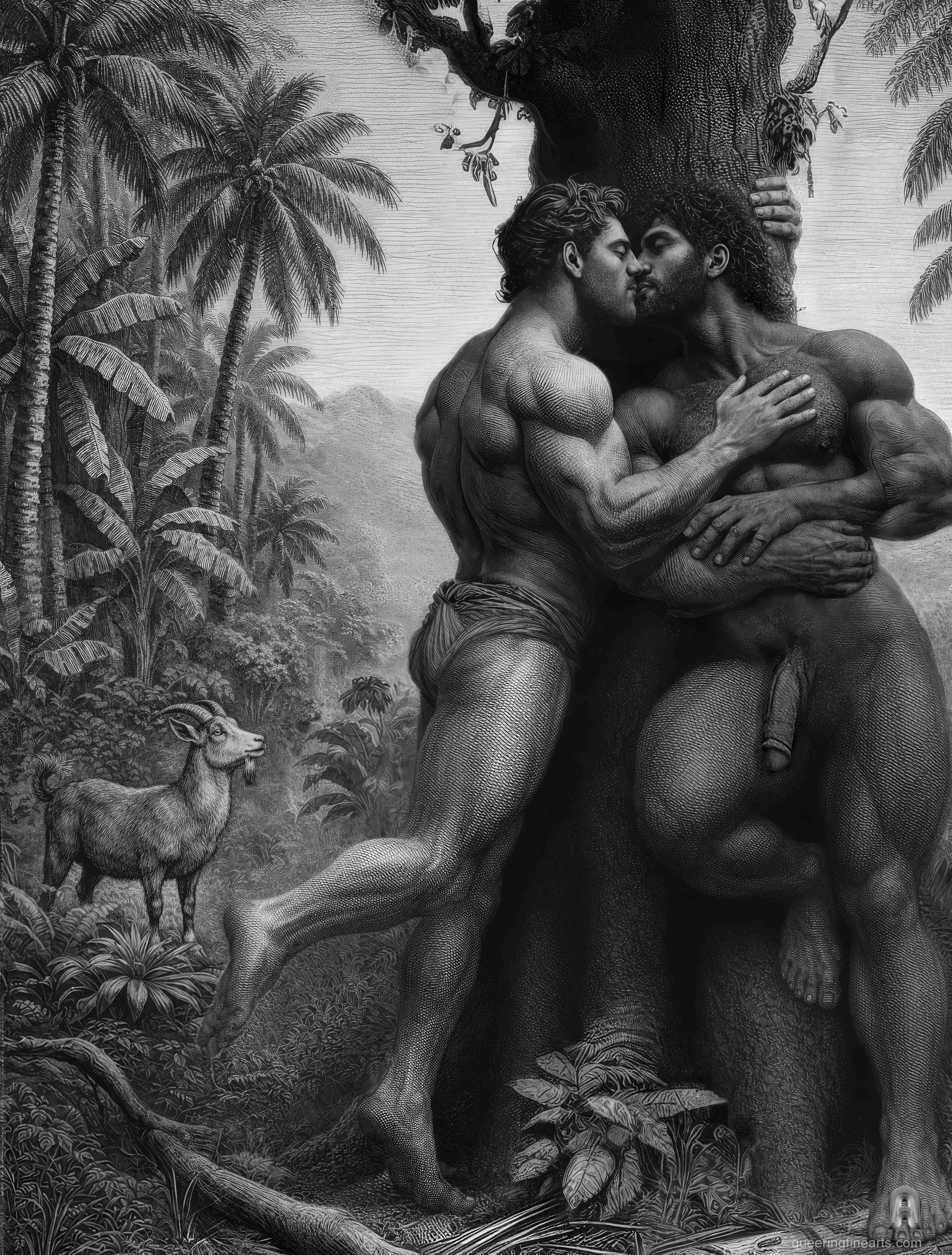
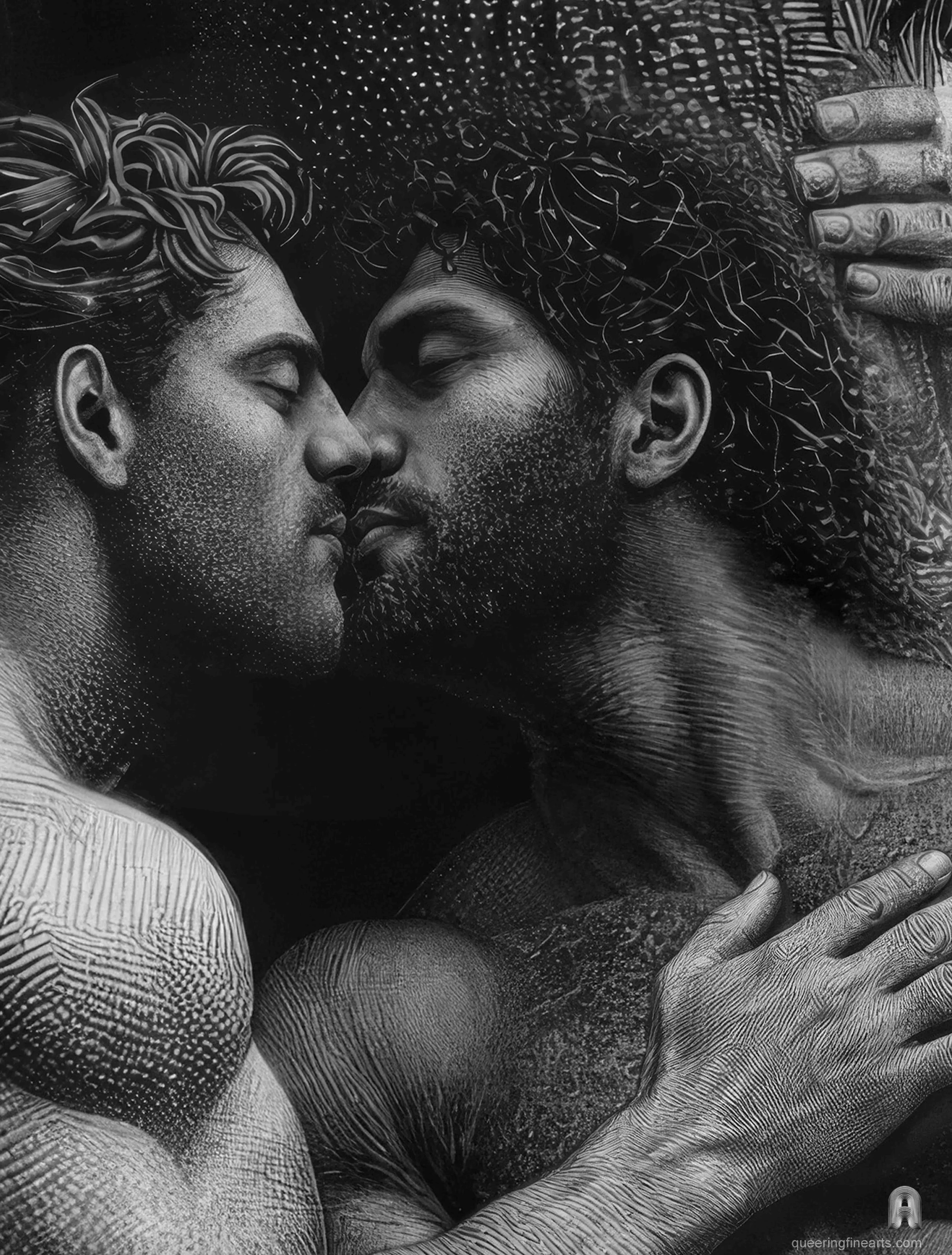
This work presents itself as a nineteenth century engraving. It adopts the visual language of Romantic illustration to produce an image that could have existed in another editorial world, one in which two major figures of eighteenth-century literature would meet on the same island, in a sensual utopia. On one side, Paul, taken from Paul et Virginie by Jacques Henri Bernardin de Saint-Pierre. On the other, the figure known as Friday in Robinson Crusoe by Daniel Defoe. This catalogue entry offers a queer rereading of these works, doubled by a learned play with the codes of the illustrated book, colonial fiction, and the sentimental narrative.¹
On the Threshold
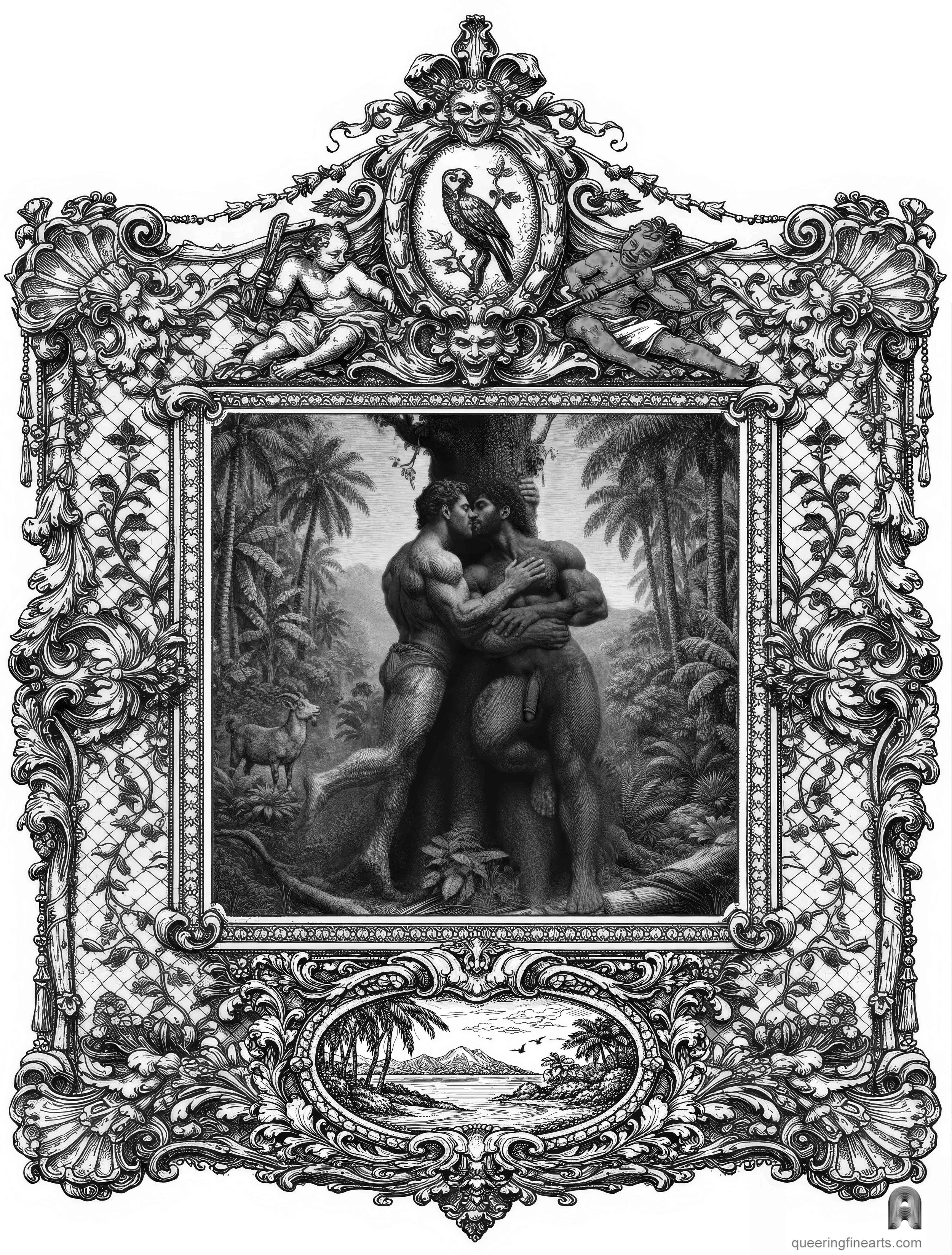
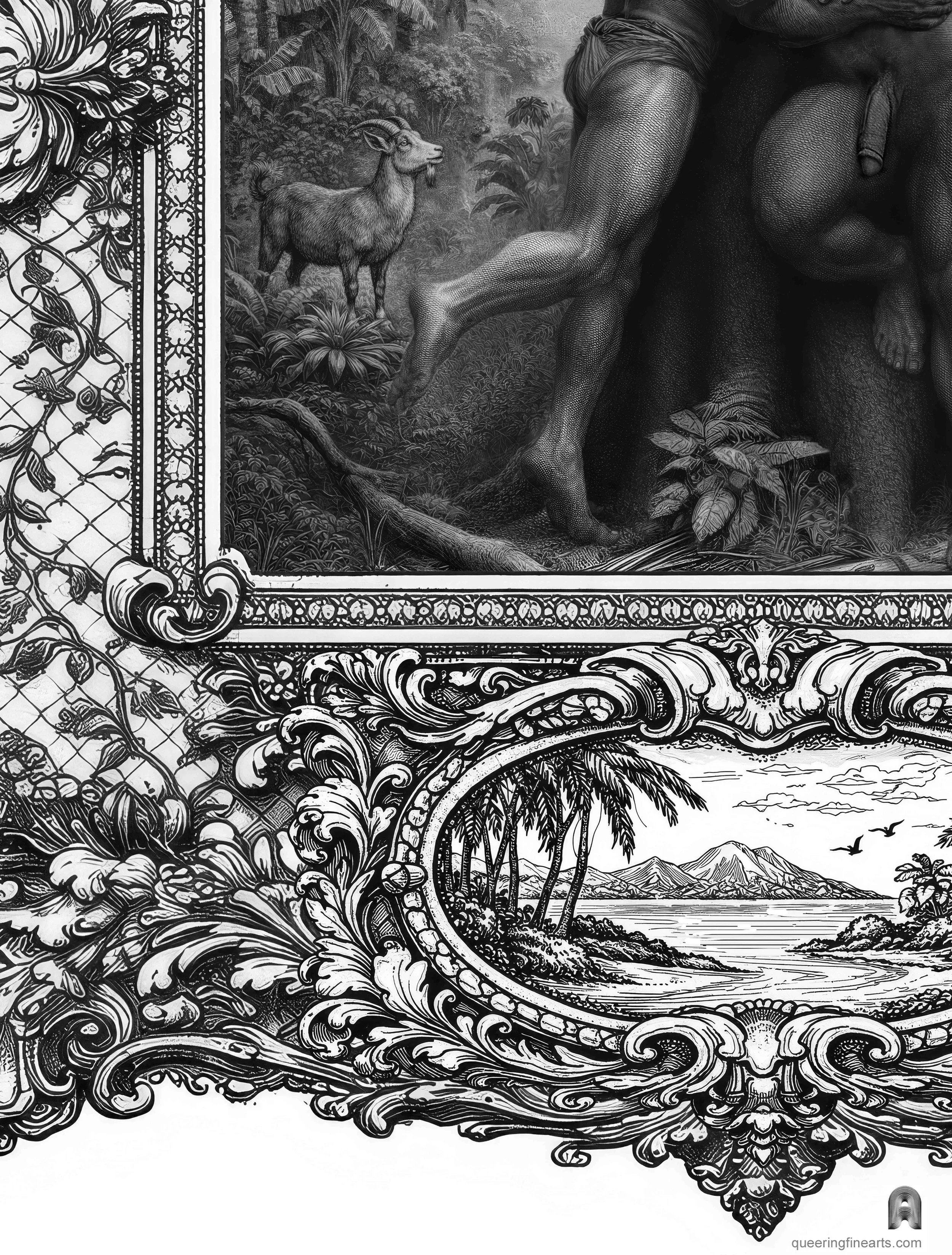
The first element to look at is the frame, which draws directly on a model associated with the Borel et Varenne edition of Robinson Crusoe published in 1836, in the translation by the writer Pétrus Borel, 1809 to 1859. Its ornamental exuberance, its symmetry, its masks, its scrollwork, its cartouches, and its allegorical figures evoke the great visual culture of illustrated editions in the nineteenth century, when each part of a narrative could be introduced by an image conceived as a narrative threshold. Here, the frame plays that threshold role in spectacular fashion. It frames, but above all, it announces. The upper cartouche with the parrot functions as a tropical and colonial emblem, almost like an exotic coat of arms. The lower cartouche with an insular landscape already condenses the idea of travel, of the island, and of distance.²
A Program Announced
The two reclining figures at the top, on either side, recall the allegories of frontispieces, while perhaps also embodying the different ethnic origins of Paul and Friday. In principle, the frame comes from a model associated with the Borel et Varenne edition of Robinson Crusoe published in 1836, in the translation by the writer Pétrus Borel, 1809 to 1859. This translation of Defoe’s novel is so famous, and so accomplished, that it is still published today. The viewer therefore enters the image as one would enter an illustrated chapter of a novel from past centuries.³
In the Same Surge
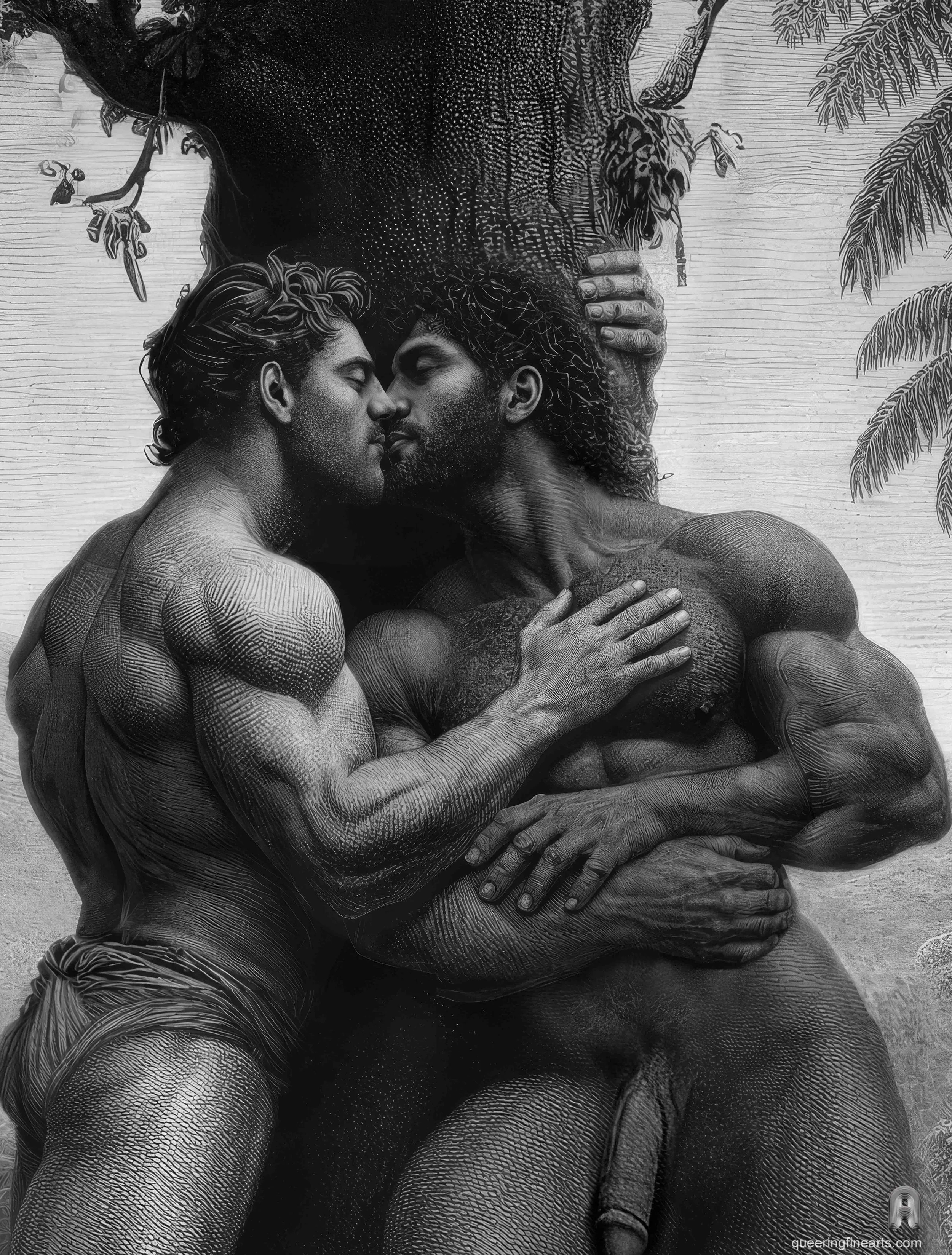
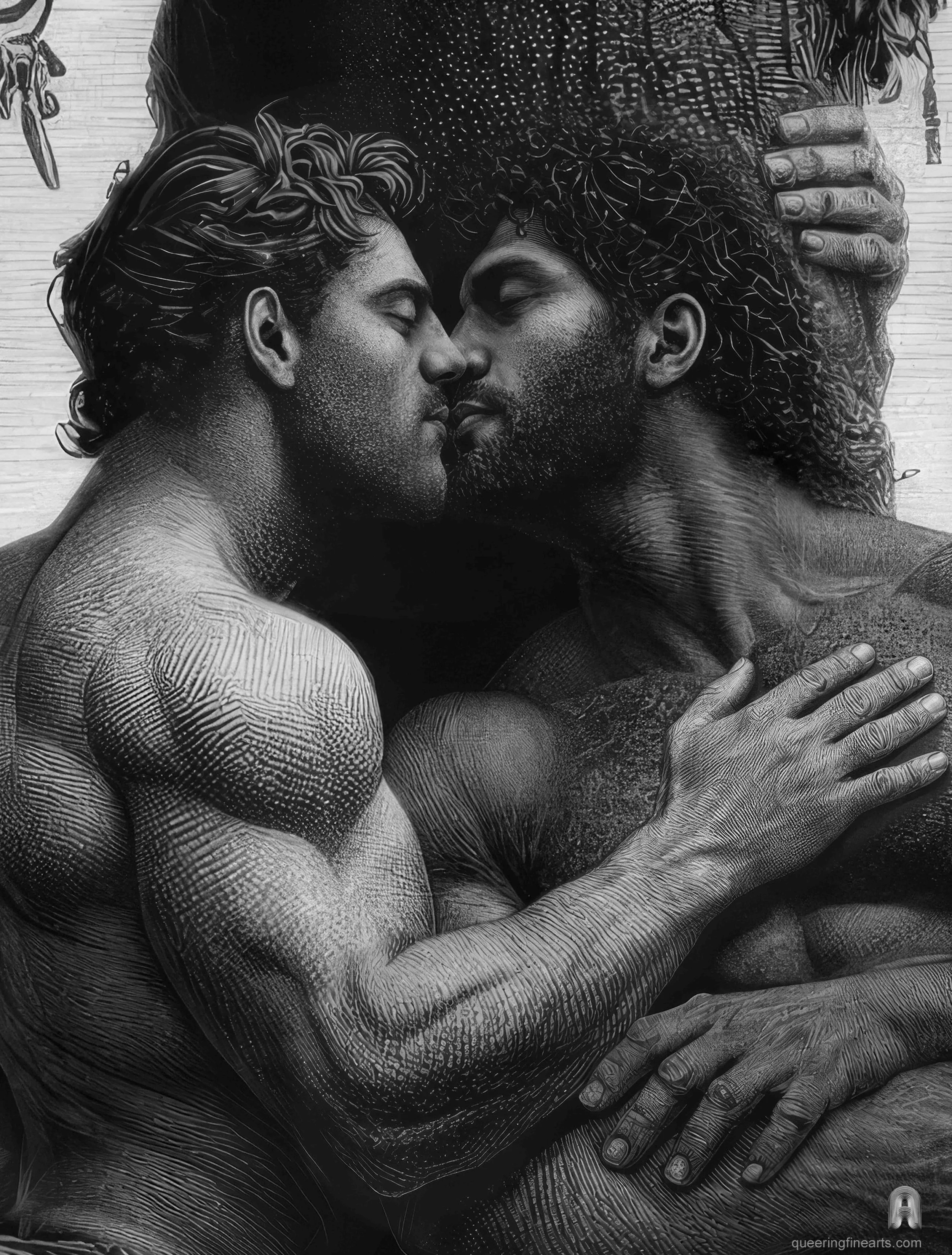
The central scene immediately shifts this historical frame toward a new moment for these literary works. Paul and the one Defoe names Friday, whom this utopia renames Amanari, are seen entwined against a trunk, in a passionate, carnal closeness. The composition draws the bodies together, almost fusing them, and organizes their contact as a reciprocal accord, revealed by the frank exchange of their gaze, rather than as a seizure. The kiss and the embrace are not simple signs of affection. They are the very substance of the image. The engraver emphasizes Paul’s candid eagerness, the torsions, the points of support, the crossed arms, Amanari’s body at rest, with an unabashed eroticism. The rendering is sculptural, almost academic, giving the scene the visual dignity of a grand literary illustration.⁴
The Island of Encounter
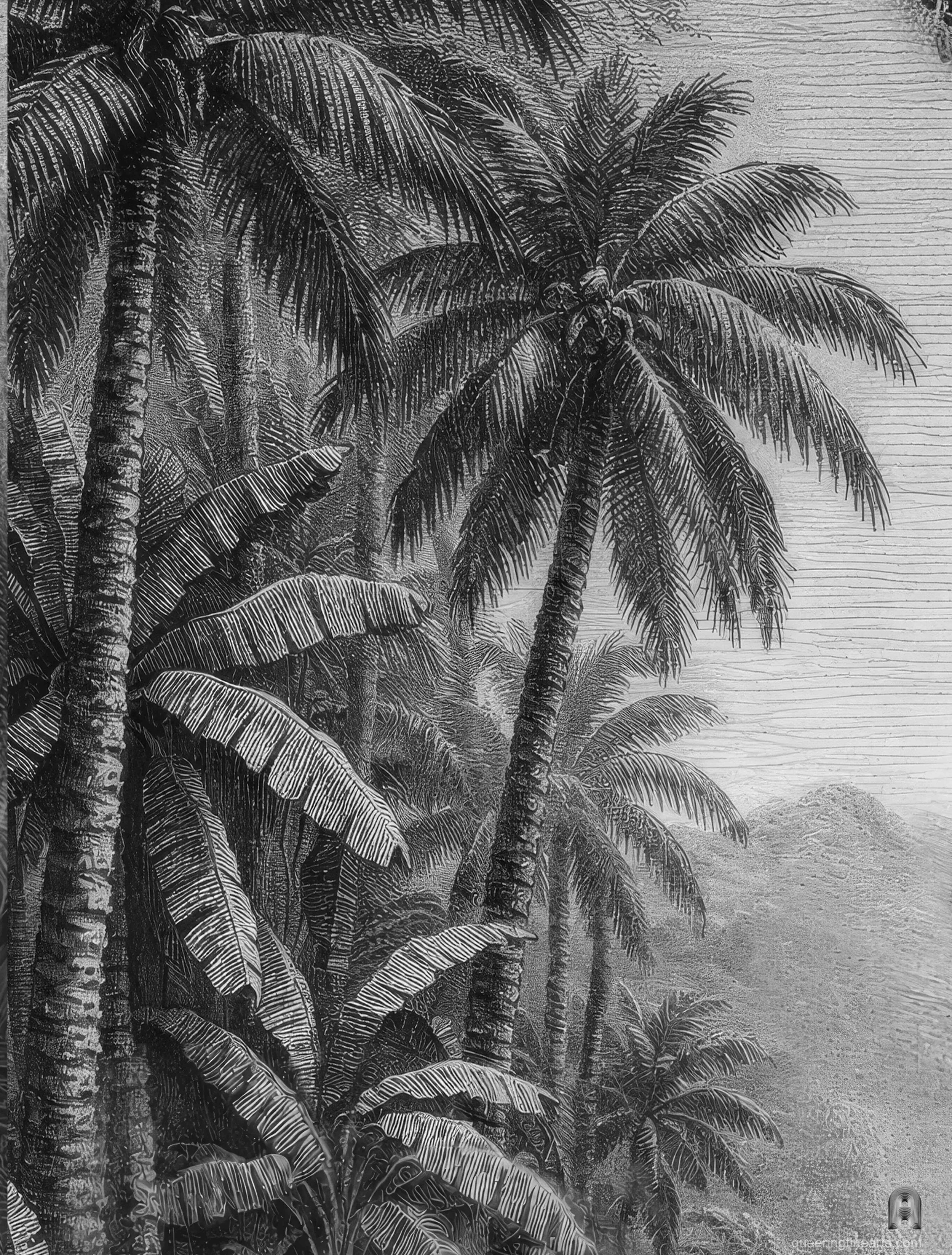
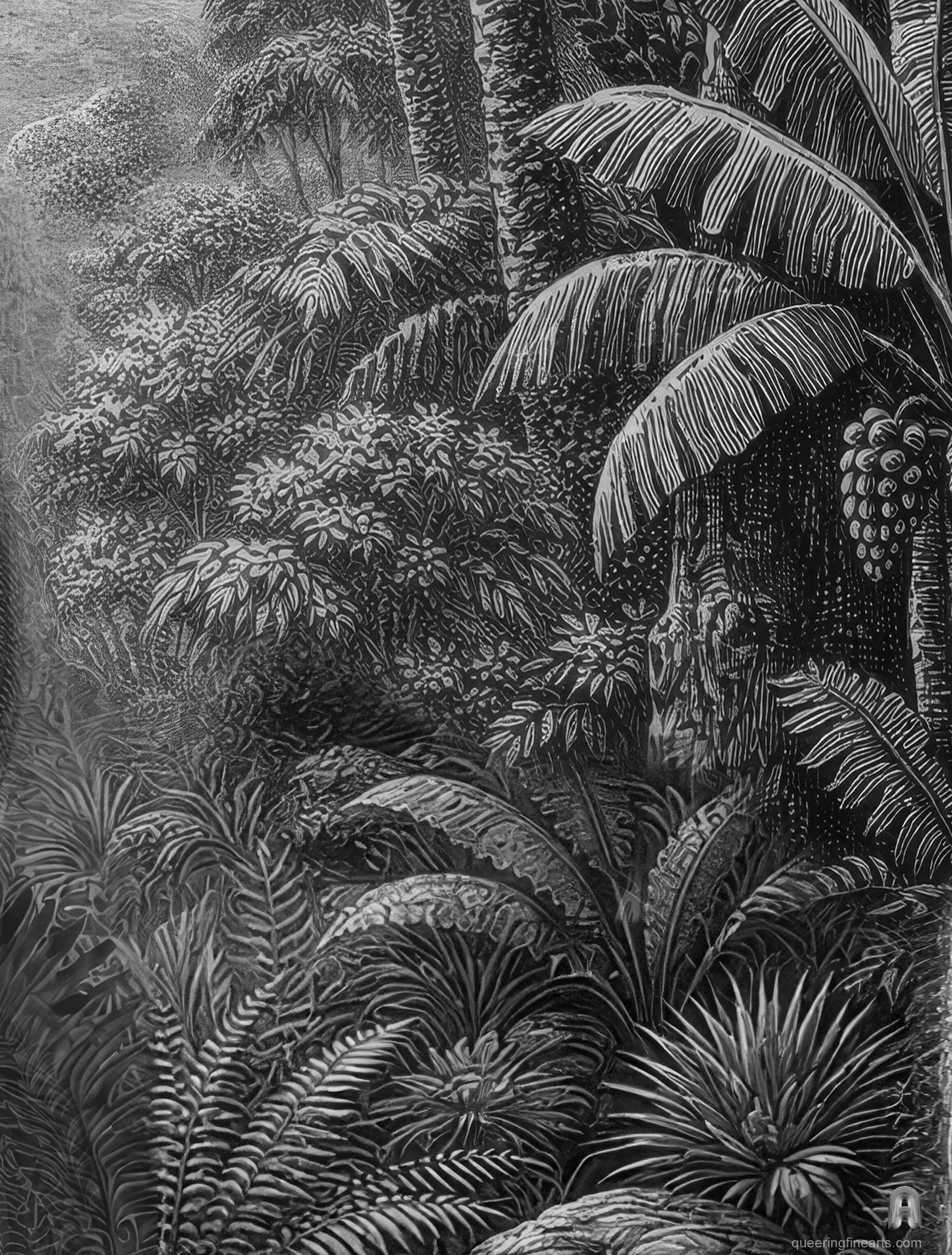
According to the authors of the two source novels, the islands on which the protagonists move lie in distinct spaces of the European colonial world, one in the Indian Ocean, Saint-Pierre, the other off the northern coast of South America, within the Caribbean orbit, Defoe. These two worlds were separated by more than 11,000 kilometers of ocean. In this engraving, are we on Paul’s island, or on Amanari’s. The image refuses to decide, because it fabricates an island of encounter. The tropical landscape is lush, but not strictly locatable. It borrows from the visual vocabulary of Paul et Virginie, with its palms, its dense undergrowth, and its imagined harmony with nature, while also summoning the insular theatre of Robinson Crusoe, a place of survival, technical invention, and colonial hierarchy. The island becomes here a third island, a utopian island, made of literary memory and critical displacement.⁵
Crossed Trajectories
The two characters come from very different novelistic traditions. Paul, in Paul et Virginie by Jacques Henri Bernardin de Saint-Pierre, 1737 to 1814, belongs to a tale of sensibility in which nature serves as a moral counter model to the European social world. He embodies a form of affective simplicity, a youth shaped by an idealized vision of life close to nature. The figure known as Friday, in Robinson Crusoe by Daniel Defoe, 1659 or 1660 to 1731, appears in a narrative of survival, organization, and domination, in which his entry into the story passes through his meeting with Crusoe, who names him, instructs him, and inscribes him within an imposed order. In the engraving, these two novelistic trajectories are torn from their original frames and placed on equal footing. This visual gesture is crucial. It removes from Friday the structure of subordination that marks his source narrative, and it removes from Paul his sentimental isolation, making him a partner in exchange.⁶
A Pivot of Meaning
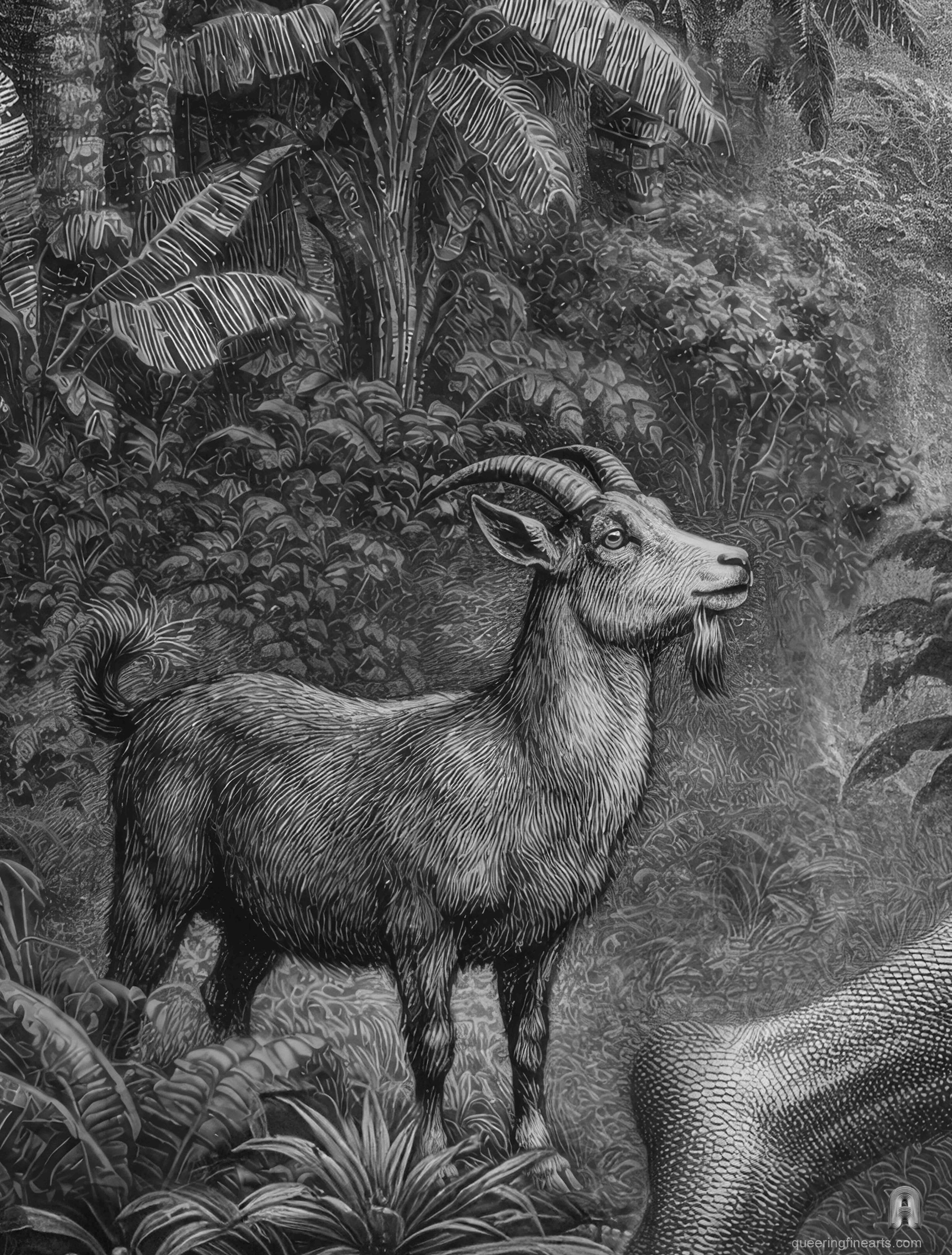
A goat appears on the left, in the undergrowth. If the engraver placed it there, it is first because it belongs to both novelistic worlds. But this double belonging, for anyone who knows the texts, also says something else. In one case, Defoe, the goat is captured, raised, counted. In the other, Saint-Pierre, it is part of a shared, sensitive world. Present in both places, it signals that these two books, despite their encounter in the image, do not tell the same relationship to the living.⁷
Crossover
The implicit narrative proposed here can then be read clearly. We are in a utopian crossover. After the loss of Virginie, Paul leaves his world, drifts, then is shipwrecked on another island. There, he meets Amanari. Solitude, desire, curiosity, and the necessity of surviving together do the rest. The two men draw closer, learn one another, transform. The image suggests a love story, but it also implies a much broader mutual apprenticeship. The narrative text can go further into the erotic, but the engraving already does the essential work visually. It replaces the colonial schema with reciprocal intimacy, and it replaces abstract innocence with embodied sensuality.⁸
Setting Out to Explore
For a reflection on the sexual practices Paul and Amanari may have explored together, follow this link to the article A Free Sexuality in the Chronicles section of the site. The article evokes the sexuality of Indigenous peoples as it existed, integrated into social life, represented in sacred art, lived without guilt or a repressive apparatus. This vision corresponds strangely to what a Rousseauist thought would readily call natural, not bestial or unbridled, but simply not denatured by artificial moral constructions
Imposed Morality
Opposed to this vision is the European morality imposed through conquest. It is the product of centuries of theological, legal, and social elaboration. It is concocted in the literal sense, fabricated, complexified until it drifts away from any immediate relation to the body. It is not self evident. It is taught, preached, codified, and it calls for punishment when one deviates.¹⁰
The Unsurrendered Body
In Amanari’s world, before colonization, sexuality was neither a sin nor a shameful topic. It belonged to a worldview in which gender fluidity was recognized, in which homosexual practices could be represented in sacred art, and in which the body was not subjected to the repressive morality that would come to characterize the colonial order.¹¹
An Artificial Morality
In this opposition, it is not civilization that triumphs over savagery. It is a highly artificial moral construction, carried by force, that crushes another way, simpler and older, of inhabiting one’s body. The natural here is not a naive ideal. It is simply what comes before the normative edifice, what has not yet been covered over by the accumulation of rules and prohibitions.¹²

Defoe Versus Saint-Pierre
Daniel Defoe writes at the beginning of the English eighteenth century, in a moment of maritime and commercial expansion. Published in 1719, Robinson Crusoe reflects a culture of navigation, property, and organization. Coming from a dissenting Protestant background, Defoe lived as an entrepreneur, journalist, and polemicist, in direct contact with trade and credit. His novel bears that trace, with a very concrete writing made of inventories, practical decisions, and an island gradually ordered.¹³
Bernardin de Saint-Pierre writes at the end of the French eighteenth century, in the climate of the late Enlightenment. Published in 1788, Paul et Virginie proceeds from another gaze. Trained as an engineer, traveler, and observer of environments, notably in the Indian Ocean, Bernardin de Saint-Pierre makes the island a moral and affective space. The landscape becomes a language, and insularity less a worksite than a place of possible accord, or of loss.¹⁴
Two Ethics of Narrative
Both novels belong to the European colonial world, but they do not narrate it in the same way. In Daniel Defoe, nature is first a milieu to be mastered, and the relationship to Friday is structured by an explicit hierarchy. In Bernardin de Saint-Pierre, the colonial frame remains, but the narrative impulse shifts toward a critique of social artifices and the idealization of a simple life, where nature serves as moral measure more than resource.¹⁵
The crossover staged by this engraving is fertile, and it prepares a more philosophical and political reading. Before the text even develops its critique of domination, property, and the colonial gaze, the image has already begun the work of displacement. It makes the homosexual embrace the very place where the logic of conquest comes undone, and where, concretely, the oppression that accompanies it is outwitted. It places bodies on equal footing, it suspends hierarchy, it strips encounter of any idea of possession. It makes possible another island, not as a territory to be ordered, but as a space of reciprocity, where desire ceases to be a motive for shame or control. And the gesture takes on a magnificent irony, because the very aesthetics of the old conquest narratives are used here to figure their reversal.
QFA
Curiosity Piqued?
1. Eve Kosofsky Sedgwick, Epistemology of the Closet, University of California Press, 1990, searchable via WorldCat and university catalogues. Judith Butler, Gender Trouble, Routledge, 1990, searchable via WorldCat and university catalogues.
2. Gérard Genette, Seuils, Éditions du Seuil, 1987, searchable via SUDOC, WorldCat, and library catalogues.
3. Bibliothèque nationale de France, Gallica, Borel et Varenne 1836 edition of Robinson Crusoé, translation by Pétrus Borel, notice and digitized copies.
4. J. Paul Hunter, The Reluctant Pilgrim: Defoe’s Emblematic Method and Quest for Form in Robinson Crusoe, Johns Hopkins University Press, 1966, searchable via WorldCat.
5. Peter Hulme, Robinson Crusoe and Colonialism, in The Cambridge Companion to Robinson Crusoe, Cambridge University Press, 2018, searchable via university catalogues and academic platforms.
6. John Richetti, ed., The Cambridge Companion to Daniel Defoe, Cambridge University Press, 2009, searchable via university catalogues.
7. Daniel Defoe, Robinson Crusoe, 1719, texts and editions searchable via digital libraries and catalogues, and Jacques Henri Bernardin de Saint-Pierre, Paul et Virginie, 1788, texts and editions searchable via digital libraries and catalogues.
8. Linda Hutcheon, A Theory of Adaptation, Routledge, 2006, searchable via WorldCat and university catalogues.
9. Gregory D. Smithers, Reclaiming Two Spirits: Sexuality, Spiritual Renewal, and Sovereignty in Native America, Beacon Press, 2022, searchable via WorldCat and university catalogues.
10. Michel Foucault, The History of Sexuality, Volume 1, The Will to Knowledge, Gallimard, 1976, searchable via SUDOC and library catalogues.
11. Will Roscoe, The Zuni Man Woman, University of New Mexico Press, 1991, searchable via WorldCat and university catalogues.
Paul and Amarani
“Paul came ashore on the island at the end of an afternoon, exhausted, salt crusted, his lips cracked. After hauling his makeshift boat up onto the bank, he first walked along the strand, because he knew, out of plain prudence, that the heart of a forest must be studied before one ventures into it. At last he decided to enter. The heat was heavy but kind. The palms filtered the light and broke it into bright patches. Underfoot, the earth was black, damp, and full of blunt smells, leaves, fruit, sap. A nearby stream made itself heard before it showed itself. When Paul found it, he knelt, drank at length, and lingered a moment, watching the water run.
A little farther on, he found a few berries with a pleasant taste, which he ate without haste. Suddenly he sensed a presence. A subtle shift in the birdsong, a rustle of foliage cut short by the will to become silent. Paul stood still. He waited and he searched the layers of green.
He made out the silhouette of a man between two trunks. The man kept his distance but he was not hidden. He watched, simply, like someone who does not apologize for being there. Paul took a few steps toward him. He noticed first the man’s eyes, because they held his gaze without provocation. Then he noticed the quiet strength of his shoulders. He watched the dark skin revealed unevenly by the play of light in the undergrowth. He moved closer still, until he could perceive the other’s way of breathing, slow and peaceful. A warmth rose in Paul, clear, physical, immediate. He had not seen a man for far too long and this one had a beauty that unsettled him.
Paul raised his hand, palm open. The other answered with a similar gesture, then brought his hand to his chest and spoke a word. Paul repeated it as best he could. The word came back, clearer. They began again. It was long, awkward, but without tension. Little by little Paul understood that the word was a name, the name of the magnificent stranger. Amanari. Paul finally pronounced it correctly and he was surprised to feel an emotion at the music of this new word. In turn he managed to make his own understood, which Amanari pronounced successfully. Paul thought that, if he had felt no respect for this man, he could have invented a name for him with nonchalance, dressed him up in a name from his own world, or baptized him after the day of the week it was, since he had kept count, a Friday.
Now Amanari was the one who came closer. He stopped very near, near enough for Paul to make out his long lashes and the moisture of his skin. Amanari’s eyes rested for a second on Paul’s mouth, then returned to the newcomer’s eyes. Paul felt himself blush and he blamed himself for it, because that reflex came from a world where too many things are concealed. Here, no one asked him to hide anything.
Amanari offered him a small lime. Paul took it. Their fingers touched. Amanari did not withdraw his hand at once. He let the contact last a little, just long enough for Paul to understand it was not an accident. Paul could have pretended it was nothing. He did not. He let time pass and in that time there was already a form of accord. He brought the fruit to his mouth and was surprised to find very little bitterness in it.
Amanari’s hand came to rest on his forearm, then slowly moved upward. Paul shivered. He placed his hand on Amanari’s shoulder and Amanari felt that this gesture carried the force of an answer and an encouragement. The first kiss came without pretense. It was light, the second more assured and Paul felt, very simply, that he had no reason to fight the desire to go further. Amanari then led him toward a shelter of palms and a fire already prepared.
Night fell. They ate a dish made from breadfruit. They continued to make themselves understood through gestures and looks, each keeping a constant care not to rush the other.
Later, in the dark warmth, they undressed with simplicity. They drew close. Their mouths found each other and they kissed with a mounting urgency. The sounds of the woods had shifted into the song of night creatures, crickets and small tree frogs.
Paul had no hesitation in moving from Amanari's mouth to his engorged penis. With one hand he held the solid shaft, and with the other he cupped the generous scrotum. Amanari had placed his hands behind Paul's head and, while twirling strands of hair between his fingers, rocked it back and forth rhythmically. Sometimes he pressed it down hard until his lips met his lower abdomen and the head touched the back of his throat. Paul would then suppress a gag reflex while enjoying these new sensations he had never experienced before. He was surprised to find himself enjoying even the burst of semen that flooded his mouth when Amanari could no longer contain his pleasure. Then, before continuing the passionate lovemaking already well underway after this initial climax, the two men burst into laughter, thus sealing a mutually satisfying complicity.
Paul uttered the name Amanari again, allowing it to coexist in his mouth with the delicate taste of seminal fluid. He understood, without needing to express it, that this island would host another beautiful chapter of his life.”
After an anonymous nineteenth century author, who would have made the character Paul from Bernardin de Saint-Pierre meet the character known as Friday from Daniel Defoe, in an unofficial supplement, in a sensual utopia.