

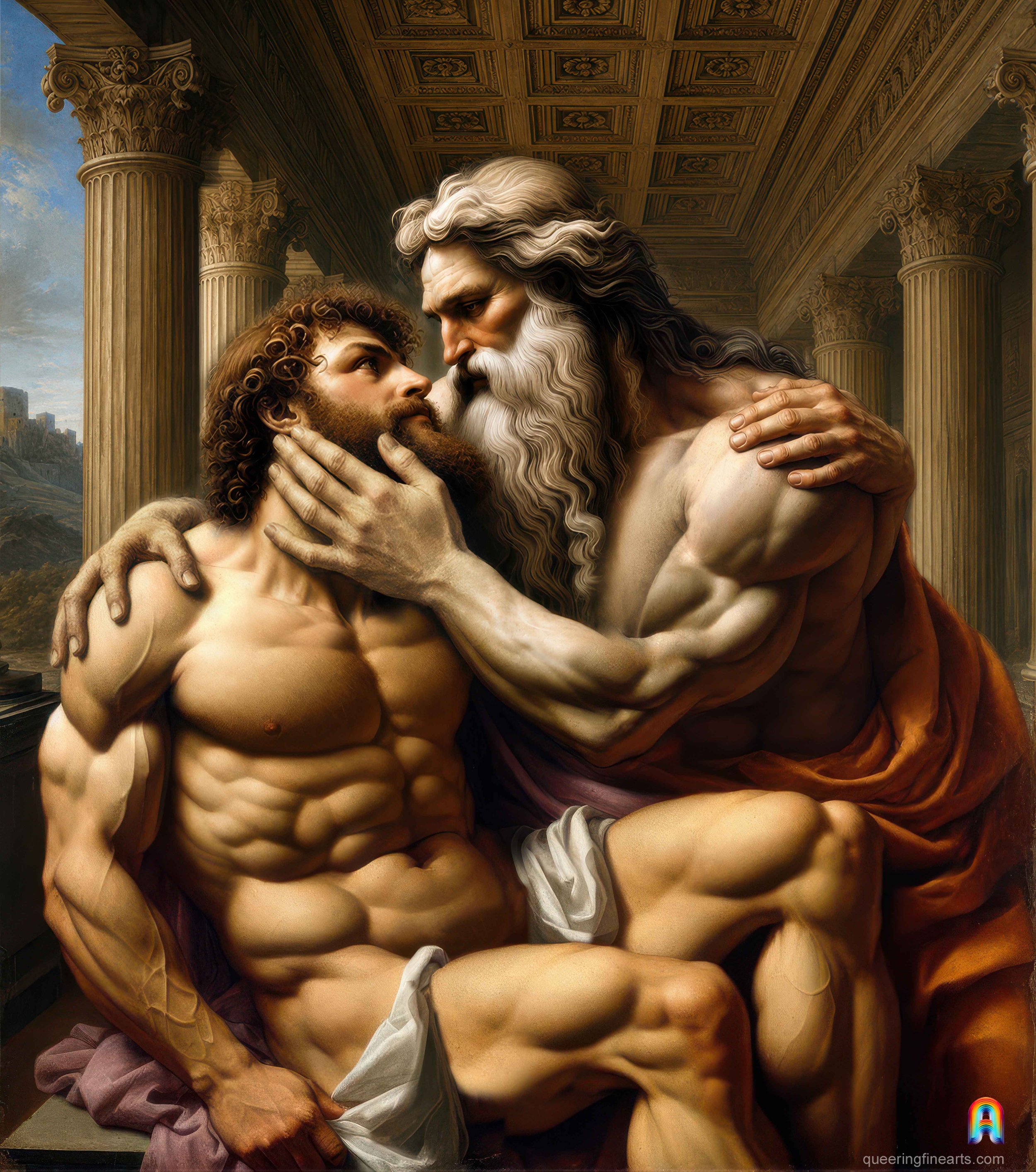
Attic Loves
Attributed to a Late Renaissance Italian Master
Oil on canvas, c. 1540-1560
Private collection
Between Classical Ideal and Forbidden Desire
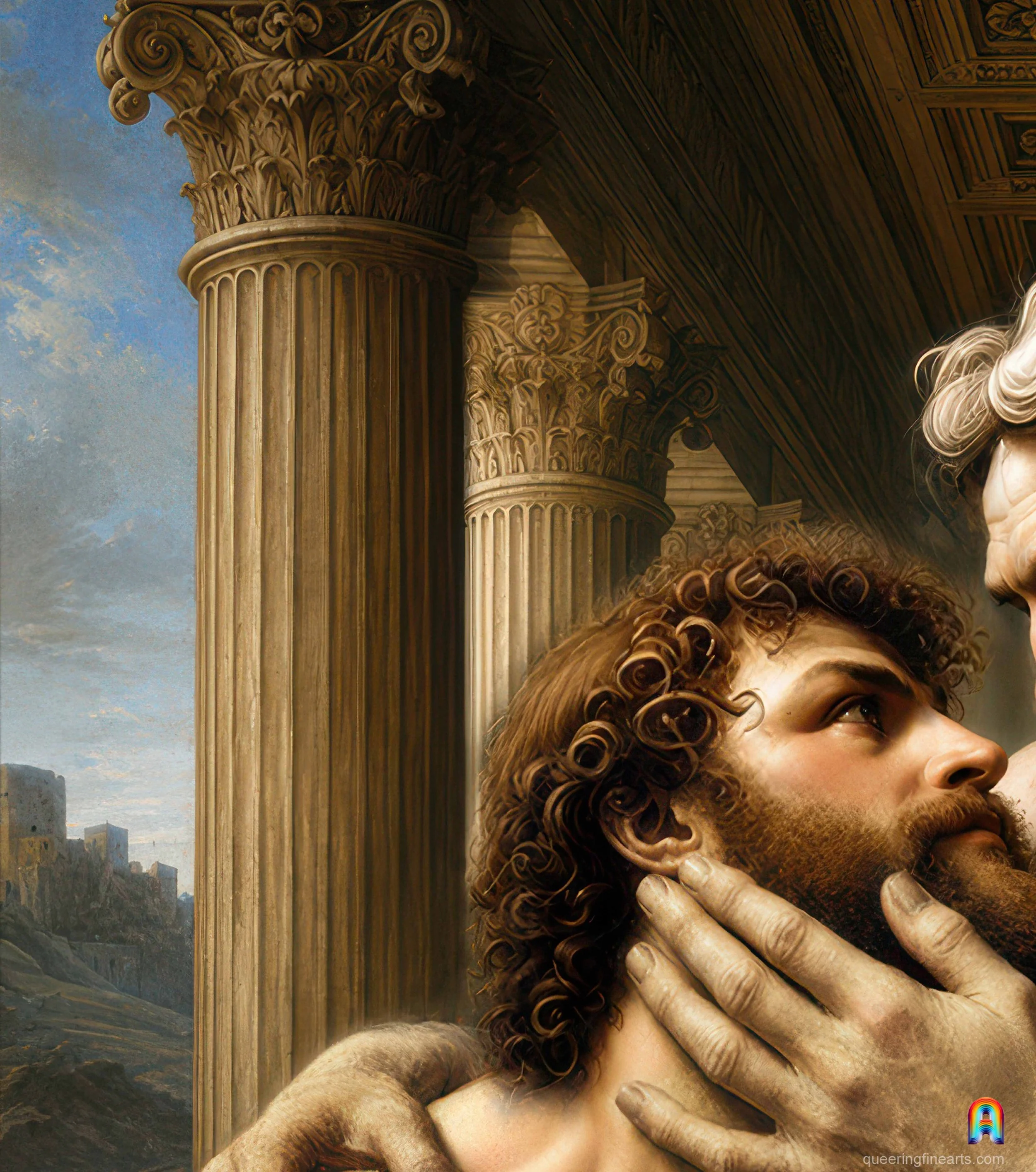
Two men stand within a loggia opening onto an Italian landscape. On the left, an older figure with a flowing beard, wrapped in a voluminous drapery of warm orange tones, places his hand upon the cheek of his companion. On the right, a nearly nude young man meets his gaze without hesitation. Their exchange seems to suspend time itself. Behind them, rolling hills rise toward a distant fortress, while Corinthian columns and a coffered ceiling situate the scene within the idealized world of the Renaissance.
Sculptural Presence
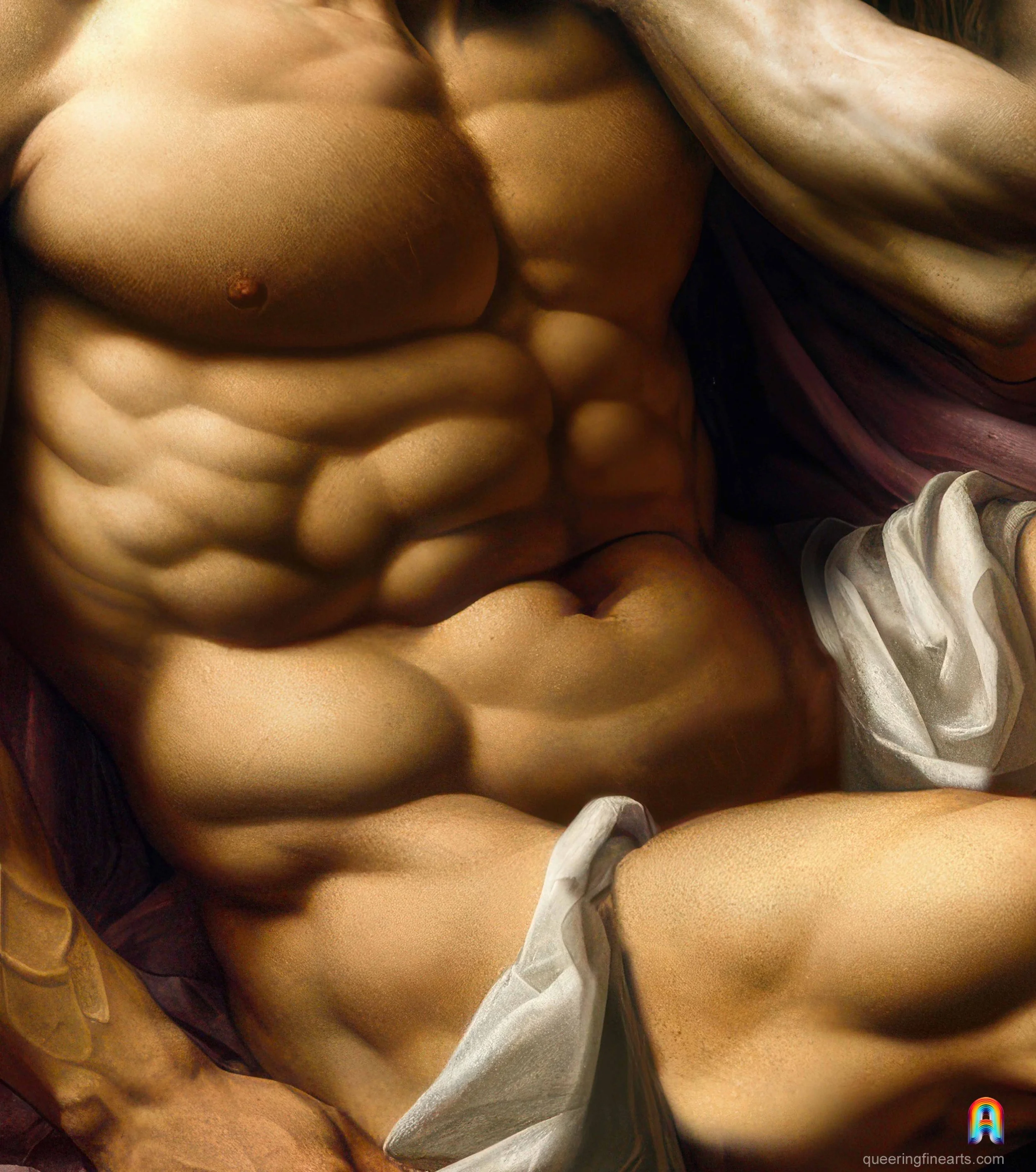
The two figures dominate the composition with an almost monumental presence. Their powerful physiques reveal the profound influence Michelangelo exerted upon generations of Italian artists. The younger man embodies the masculine ideal celebrated in Renaissance workshops: a broad chest, heroic musculature, wide shoulders, and flesh modeled with the firmness of antique sculpture. His companion, despite his advanced age, retains a remarkable physical strength of his own. One bears the marks of experience, the other those of youth. One is clothed, the other nearly naked. Their closeness gathers these contrasts into a single harmony.
Antiquity Reimagined
The architecture plays a central role in this staging. The columns, classical order, and harmonious proportions all evoke the ancient world rediscovered by humanist scholars. Renaissance artists admired Greece and Rome with passion and sought to restore them to life. The fortress appearing on the horizon discreetly reminds us that this scene also belongs to 16th-century Italy. As in so many paintings of the period, antiquity and the painter's present merge into a shared imaginary space.
An Open Interpretation
At first glance, the work might depict a god and a mortal, a philosopher and his disciple, a humanist and his protégé, or simply two men united by a privileged bond. The painter leaves the viewer free to determine the nature of their relationship. This openness nourishes the richness of the work and grants it a depth that extends far beyond a simple narrative.
Philosophers
At the same time, humanist scholars rediscovered ancient texts devoted to friendship, virtue, and mutual admiration between men. Plato, Cicero, and many other classical authors occupied a central place in the intellectual formation of Renaissance elites. Relationships between a mature man and a younger companion could therefore be presented as models of moral elevation, intellectual transmission, and mutual refinement.
Contradictions
Yet this celebration of masculine beauty coexisted with a far less comfortable reality. In several Italian cities, sexual relations between men were subject to constant surveillance and could result in severe penalties.² The same society that publicly exalted male beauty imposed strict limits upon certain forms of desire. The contradiction ran deep. It permeated laws, mentalities, and systems of representation. The entire scene unfolds within the heart of that tension.
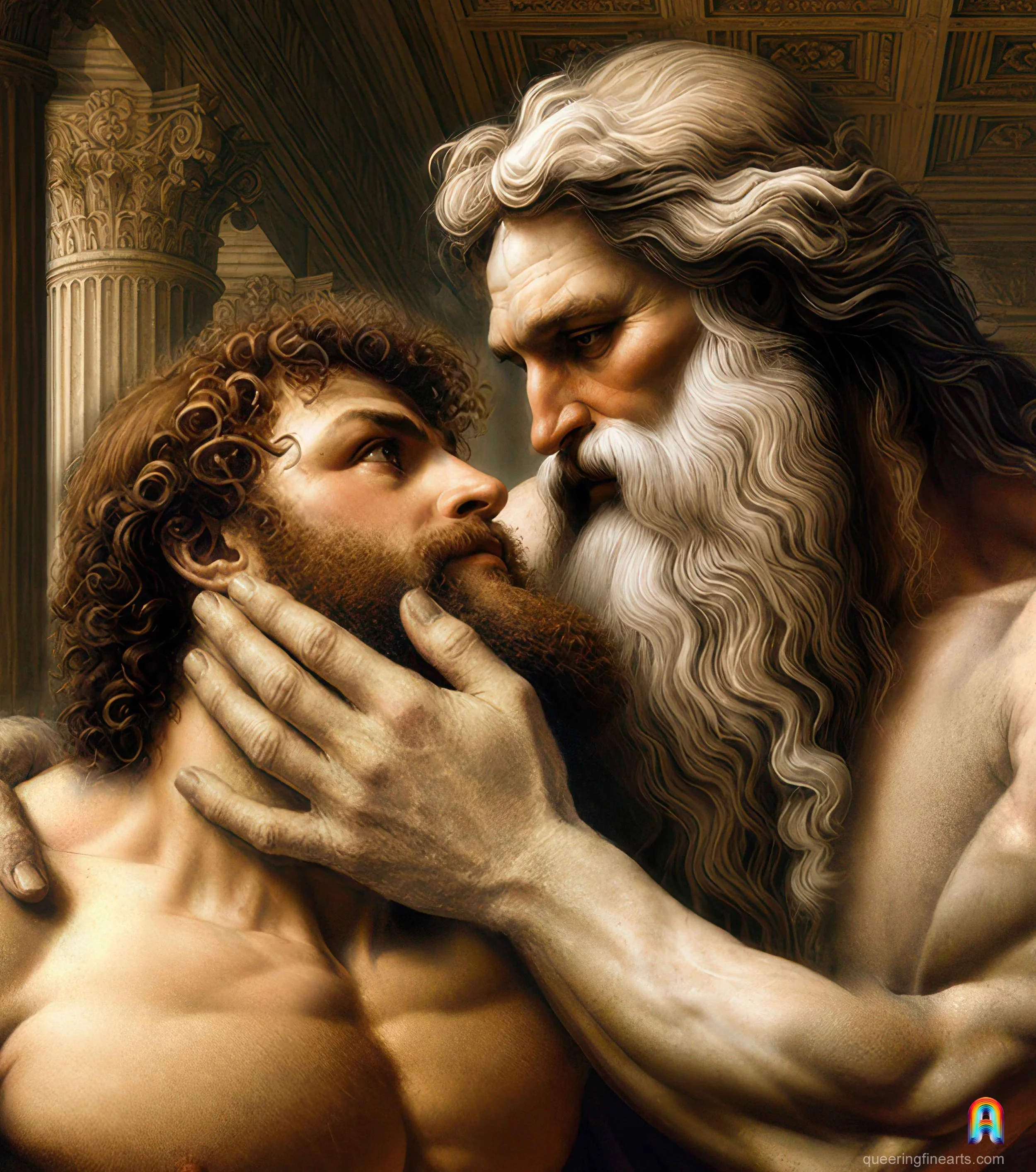
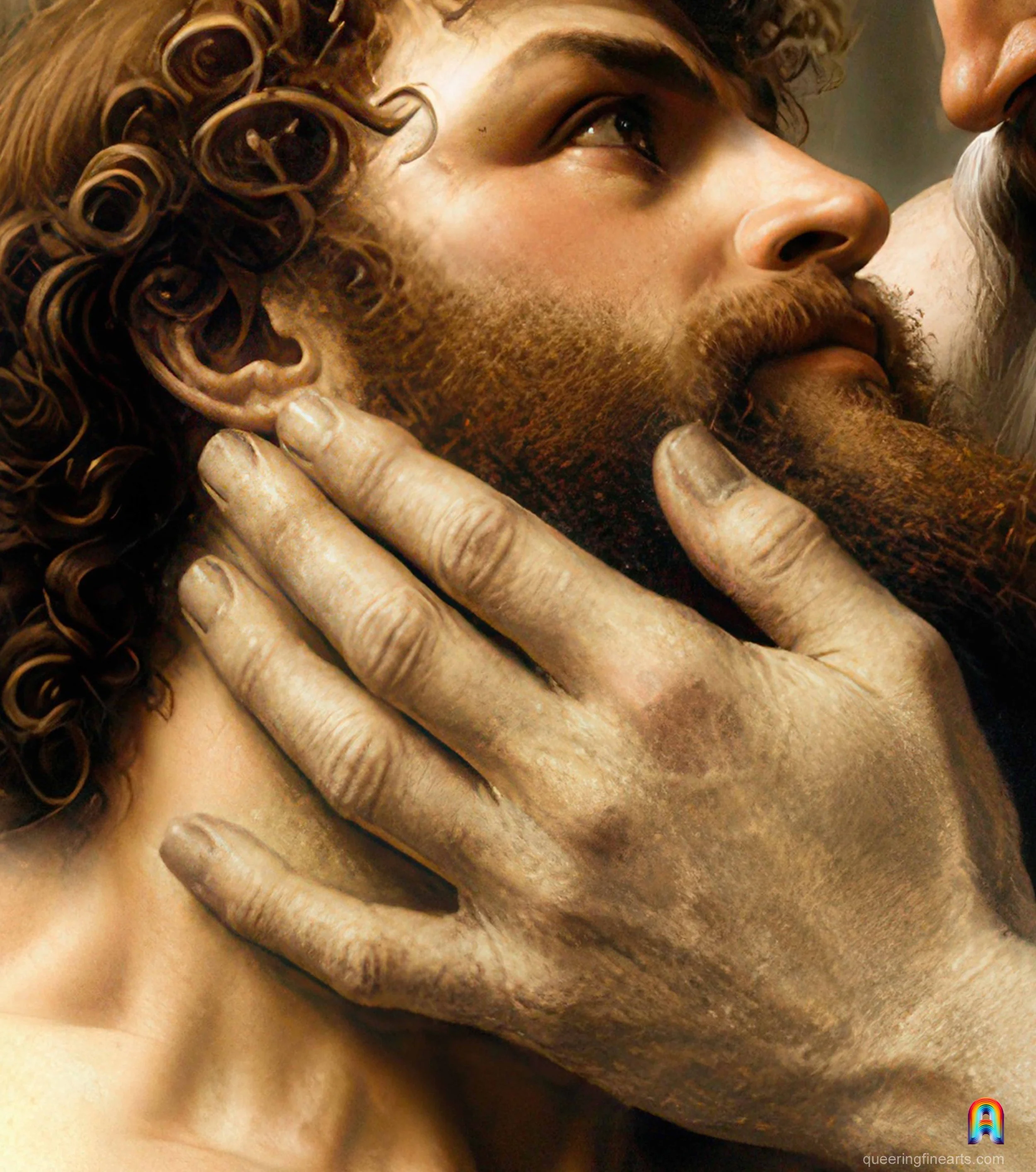
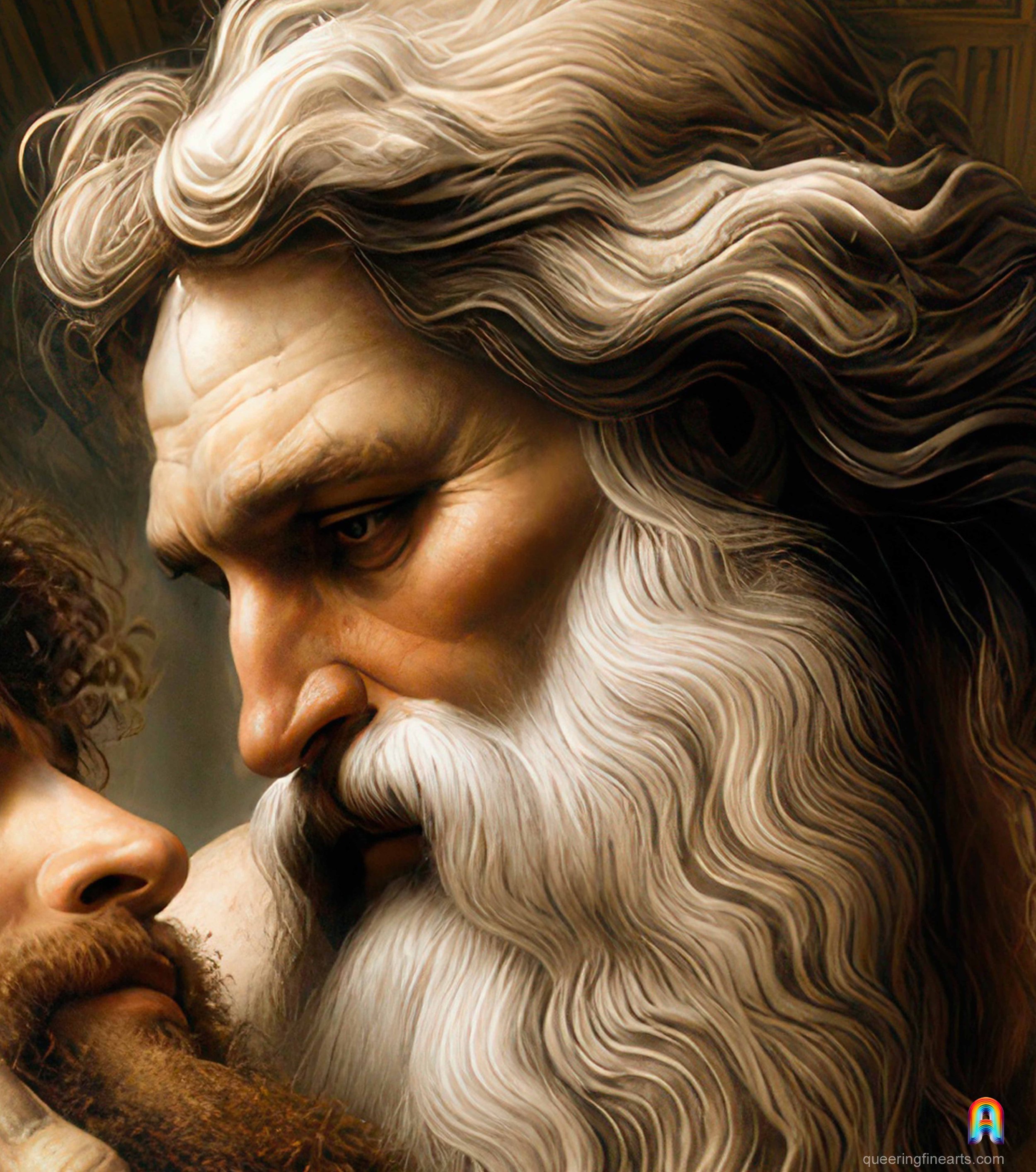
The older man's hand rests upon the young man's cheek with unmistakable tenderness. The gesture concentrates attention upon the bond connecting the two figures. The younger man receives this touch with calm assurance. Their eyes meet in an intense exchange, as though the outside world had momentarily receded around them.
A Renaissance Model
Should every form of hierarchy therefore be erased? Probably not. The difference in age, the contrast between the elder figure's ample drapery and the younger man's near-complete nudity, together with their respective postures, all evoke a model deeply familiar within Renaissance culture: that of the relationship between an experienced man and a young adult.³ The painting transforms this asymmetry into an affective relationship. The experience of one encounters the youth of the other within a proximity where gesture, gaze, and physical presence acquire greater importance than social distinctions.
The Painting's True Subject
The Renaissance possessed an extraordinarily rich vocabulary for celebrating masculine beauty, male friendship, wisdom, virtue, and the transmission of knowledge. It possessed far fewer means for openly acknowledging certain forms of romantic attachment between men. Art consequently became a privileged territory of ambiguity, suggestion, and allusion. Painting offered a subtle language through which gazes, gestures, and symbols conveyed meanings that words could express only imperfectly.
A Humanist Horizon
The title itself participates in this logic. Attic Loves evokes a cultural horizon more than a specific narrative. For Renaissance humanists, Attica and Athens represented the birthplace of philosophy, beauty, rhetoric, and a particular conception of relationships between men. The title therefore situates the scene within an intellectual as much as an emotional space: that of an imagined antiquity, reconstructed and reinterpreted by Italian artists.
Suspension
The work carefully cultivates its ambiguities. It inhabits that fragile equilibrium where admiration for masculine beauty gradually acquires an emotional intensity that exceeds mere contemplation. Between wisdom and attachment, between transmission and desire, between classical inheritance and the moral constraints of its age, it imagines a suspended moment that the Renaissance could contemplate without always finding the language to name it.
Modernity
Behind the classical architecture, the humanist references, and the idealized bodies, the painting confronts a question that has echoed across centuries: how can love between men be represented within a culture that deeply admires masculine beauty while hesitating to acknowledge fully what that beauty may inspire?
Within this silence charged with meaning, within this lingering gaze and this hand that gently remains, Attic Loves offers a discreet yet eloquent response. It reminds us that the history of love between men cannot be reduced to the prohibitions that surrounded it. It also belongs to the history of beauty, admiration, and the images that, century after century, sought to give it a face.
QFA
Curiosity piqued?
1. James M. Saslow, Pictures and Passions: A History of Homosexuality in the Visual Arts, New York, Viking, 1999.
2. Guido Ruggiero, The Boundaries of Eros: Sex Crime and Sexuality in Renaissance Venice, New York, Oxford University Press, 1985.
3. Michael Rocke, Forbidden Friendships: Homosexuality and Male Culture in Renaissance Florence, New York, Oxford University Press, 1996.