A Matter of Perfect Respectability
Attributed to an artist in the London circle of James Tissot (1836-1902)
Inspired by the play A Matter of Perfect Respectability, attributed to Oscar Wilde
Gouache, watercolour and ink on illustration board, c. 1900
Cover illustration for a limited edition intended for a select circle of discerning readers
Private collection
What If Oscar Wilde Had Been Allowed to Go Further?
The Raw Material of Comedy
The attribution of this illustration to James Tissot remains uncertain, yet its fashionable world provides a tempting point of comparison. The elegant interiors, the characters caught in a moment of social tension, and the art of telling a story through gestures, glances and sartorial details all recall several of his London works. Whether executed by Tissot himself or by an anonymous illustrator, the image clearly belongs to that refined culture of the late 19th century¹ in which appearances, propriety and concealed passions formed the raw material of comedy.
The Image Worth a Thousand Words
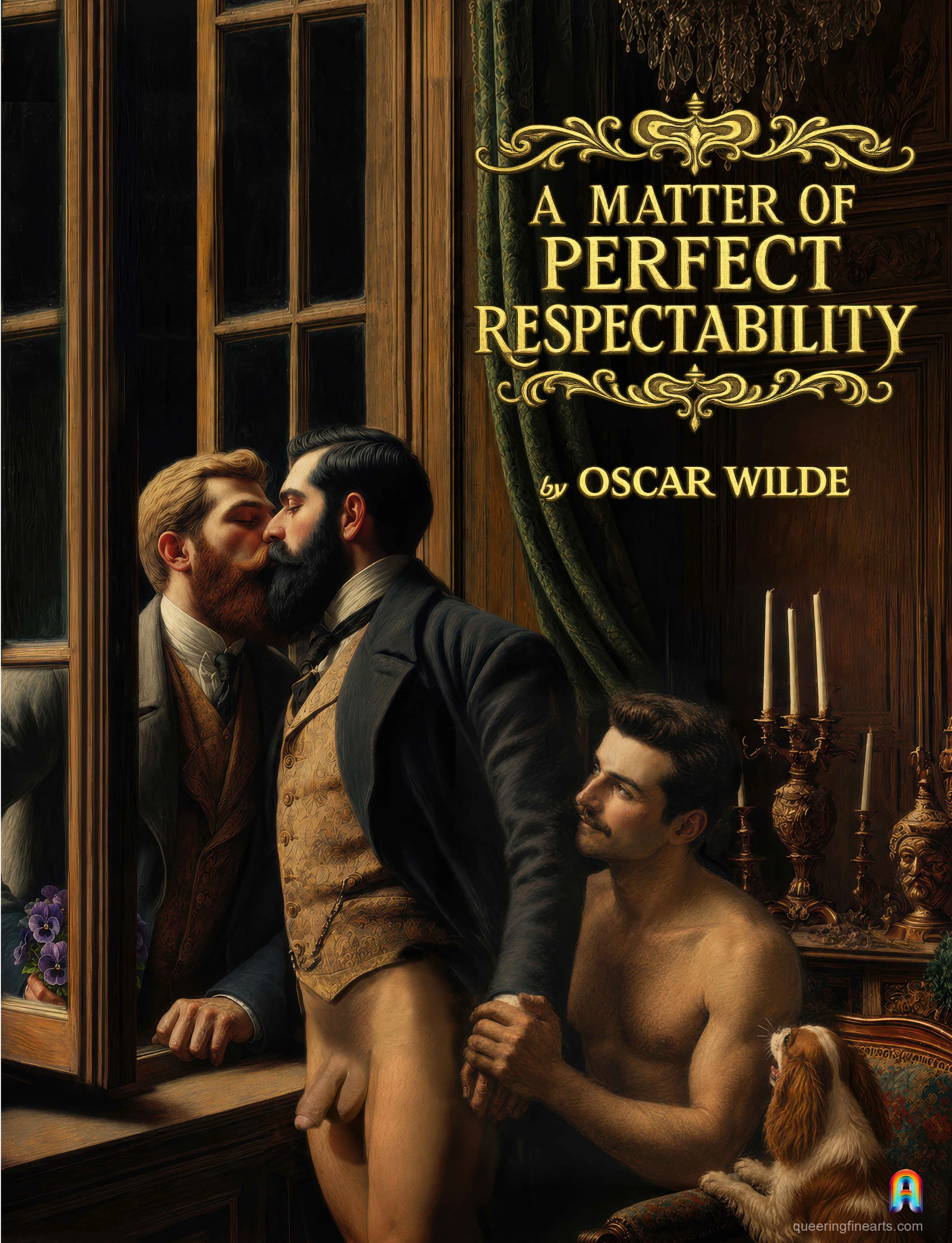
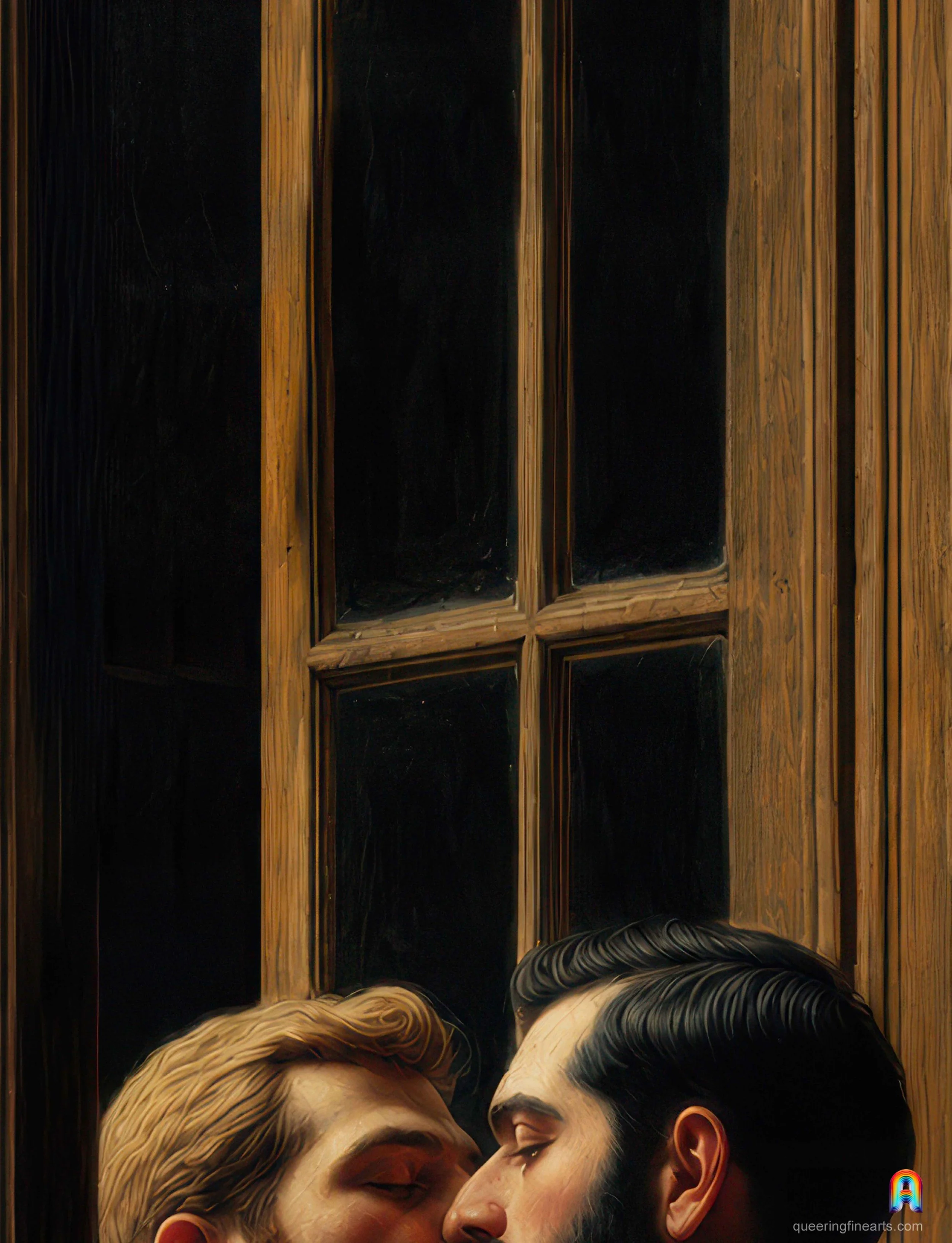
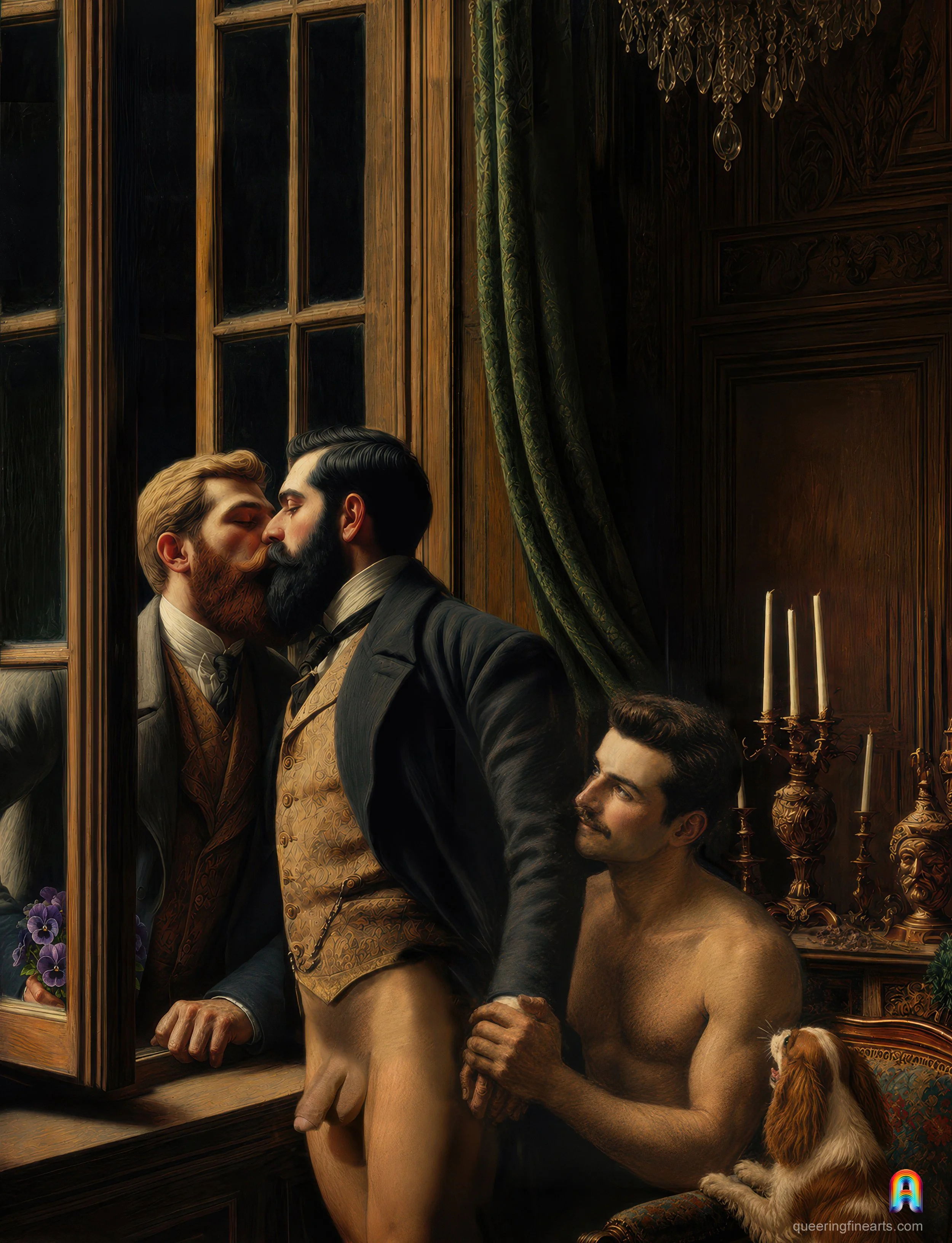
This illustration most likely adorned the cover of a limited edition of A Matter of Perfect Respectability, a three-act comedy attributed to Oscar Wilde.² The choice of image is revealing: far from concealing the play's romantic premise, the cover announces it with delightful insolence. The kiss at the window, the second lover hidden in the room, the bouquets of fresh and withered pansies, and the jealous dog all introduce the reader to the machinery of vaudeville before a single line of dialogue has been spoken.
A Lord Caught Out
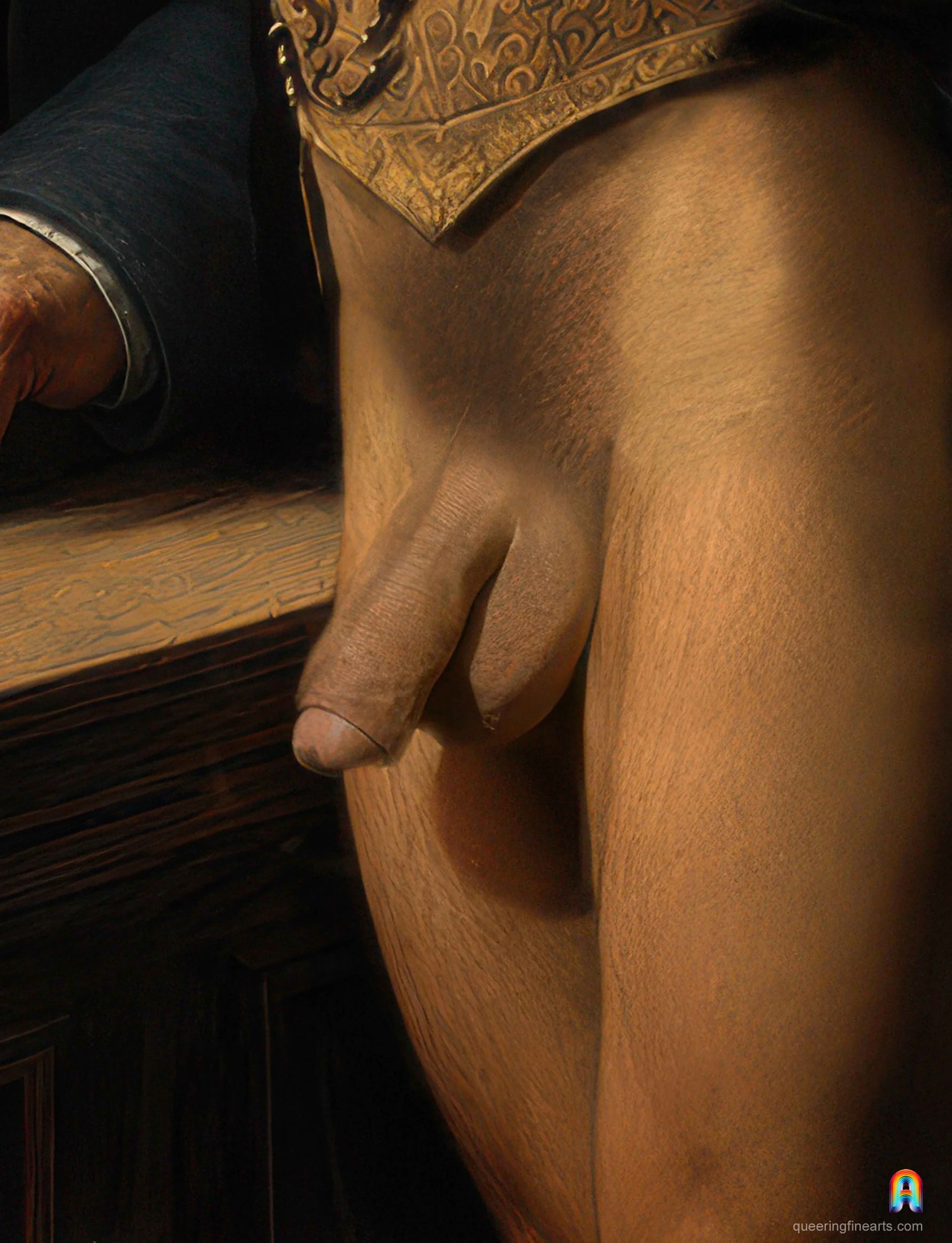
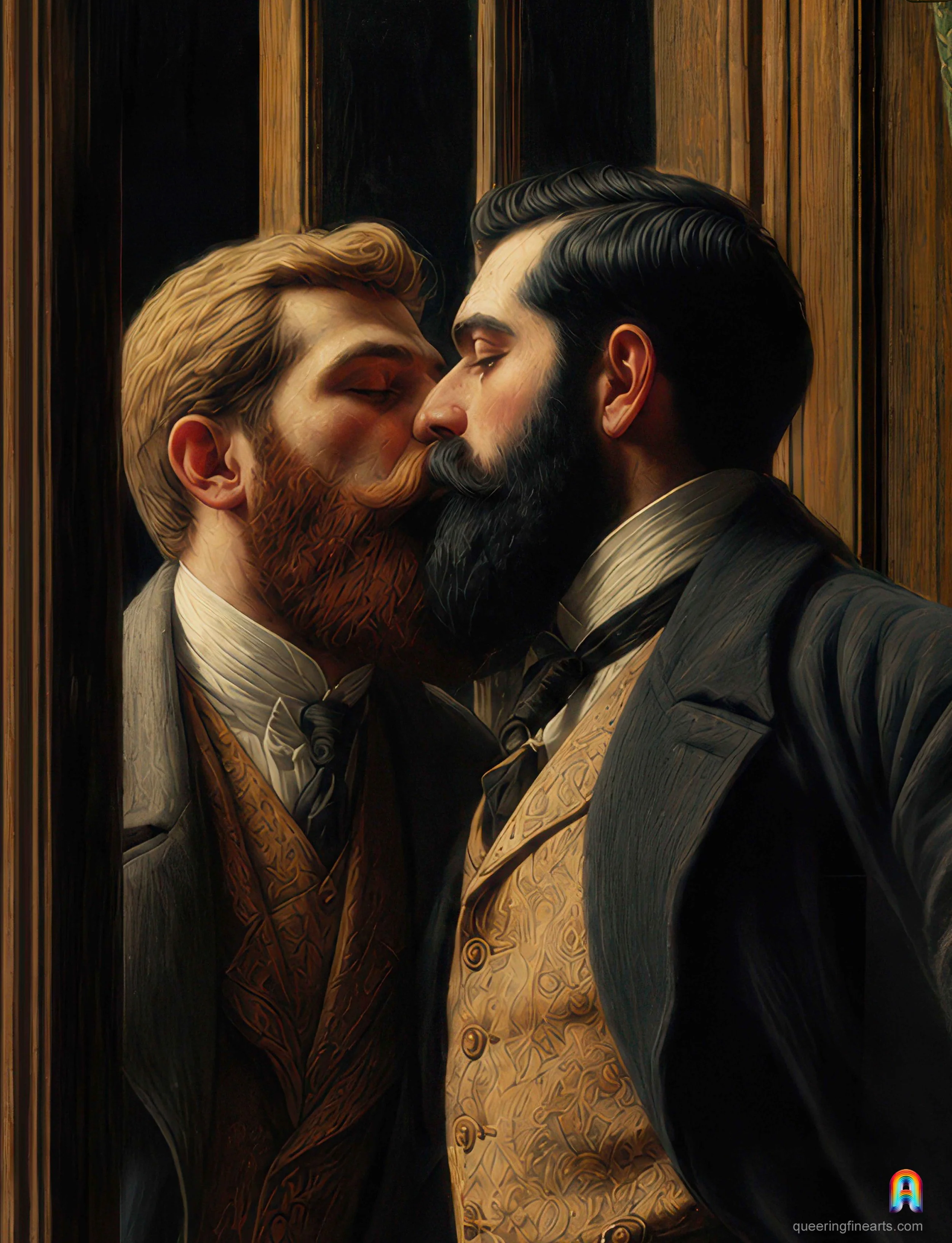
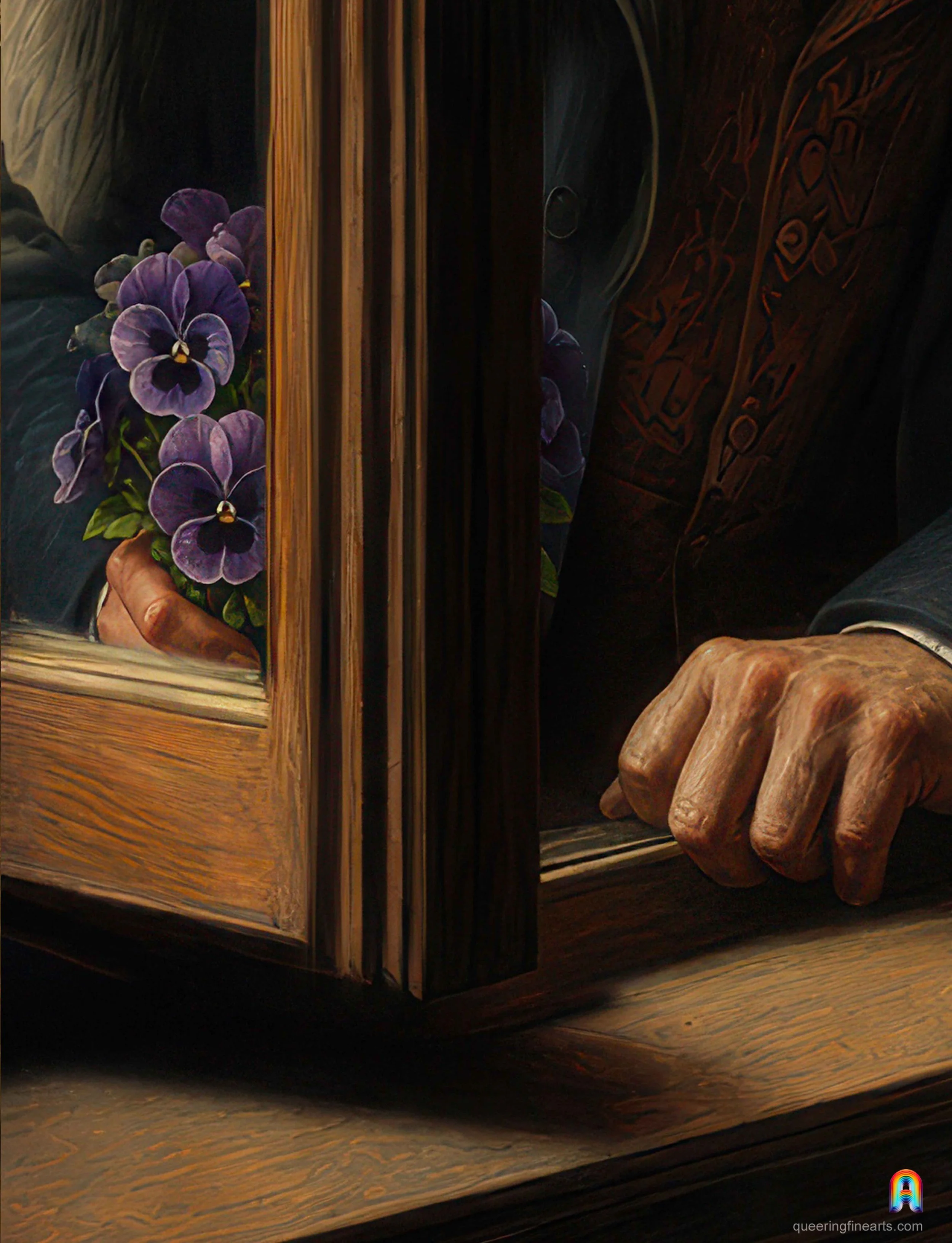
At the centre of the composition stands Lord Basil Ashcombe, a refined aristocrat whose reputation rests as much upon his elegance as upon his ability to maintain appearances. Leaning from his window, he exchanges a kiss with Mr. Adrian Vale, a romantic young aesthete who has come bearing a bouquet of freshly gathered pansies. The scene would already be compromising enough were it not for one detail that the illustrator discreetly yet unmistakably emphasises: Lord Basil appears in a remarkably incomplete state of dress. His jacket, waistcoat and cravat testify to a commendable devotion to social convention. His lack of trousers testifies to an equally evident devotion to more private pursuits. The contrast between the impeccable correctness of his upper attire and the complete absence of correctness in his lower attire constitutes one of the image's most successful comic effects. The viewer immediately understands that Adrian's arrival has occurred at a singularly inconvenient moment.
An Officer at the Ready
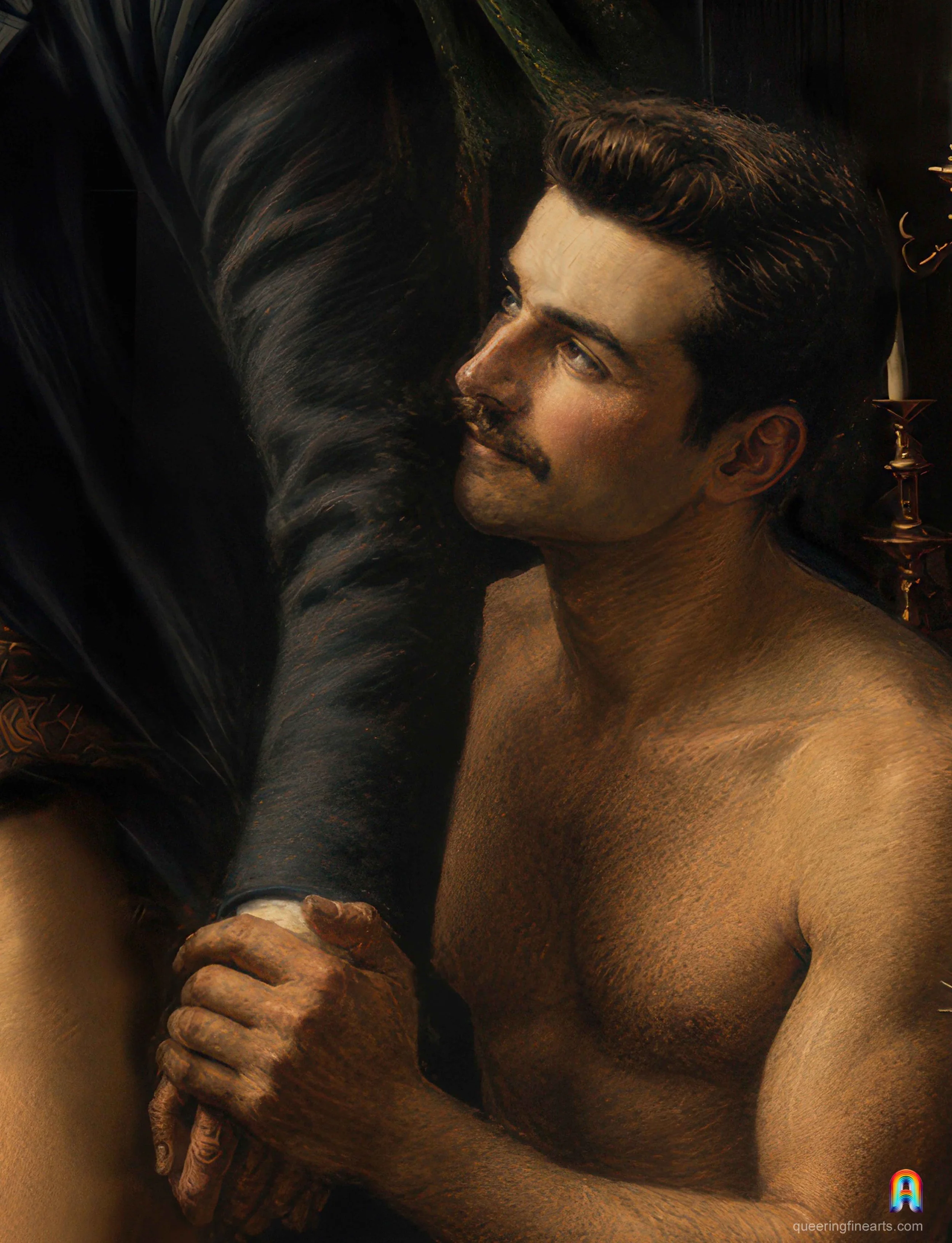
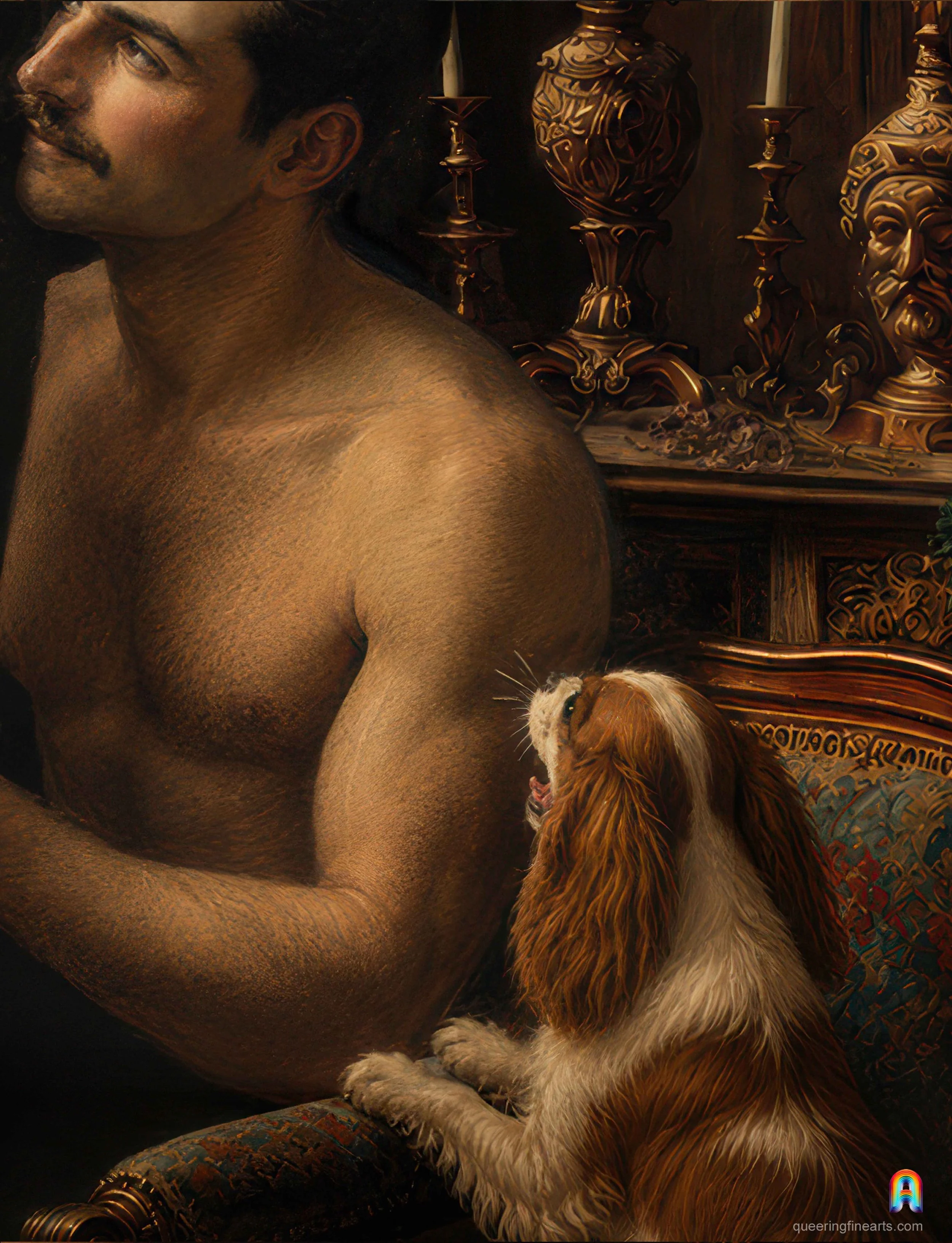
Inside the room stands Mr. Felix March, a young officer as handsome as he is imprudent. Every indication suggests that he was already occupying Lord Basil's apartments when Adrian Vale appeared at the window. The two gentlemen seem to have been engaged in activities quite remote from military concerns when an unexpected visitor obliged them to interrupt their amusements. Faithful to the finest traditions of vaudeville, Felix has slipped behind Lord Basil, where he remains astonishingly out of sight. From this precarious position he watches Adrian's advances with amusement, observing his host's efforts to manage two suitors simultaneously without provoking immediate disaster. His mischievous smile suggests that he is enjoying Basil's embarrassment every bit as much as the visitor's innocence.
A Four-Legged Witness
On a nearby armchair, a small King Charles Spaniel named Bunbury noisily expresses his jealousy. Every visitor is a potential rival in his eyes, and Felix March appears to be the unfortunate object of his displeasure today.
The Language of Flowers
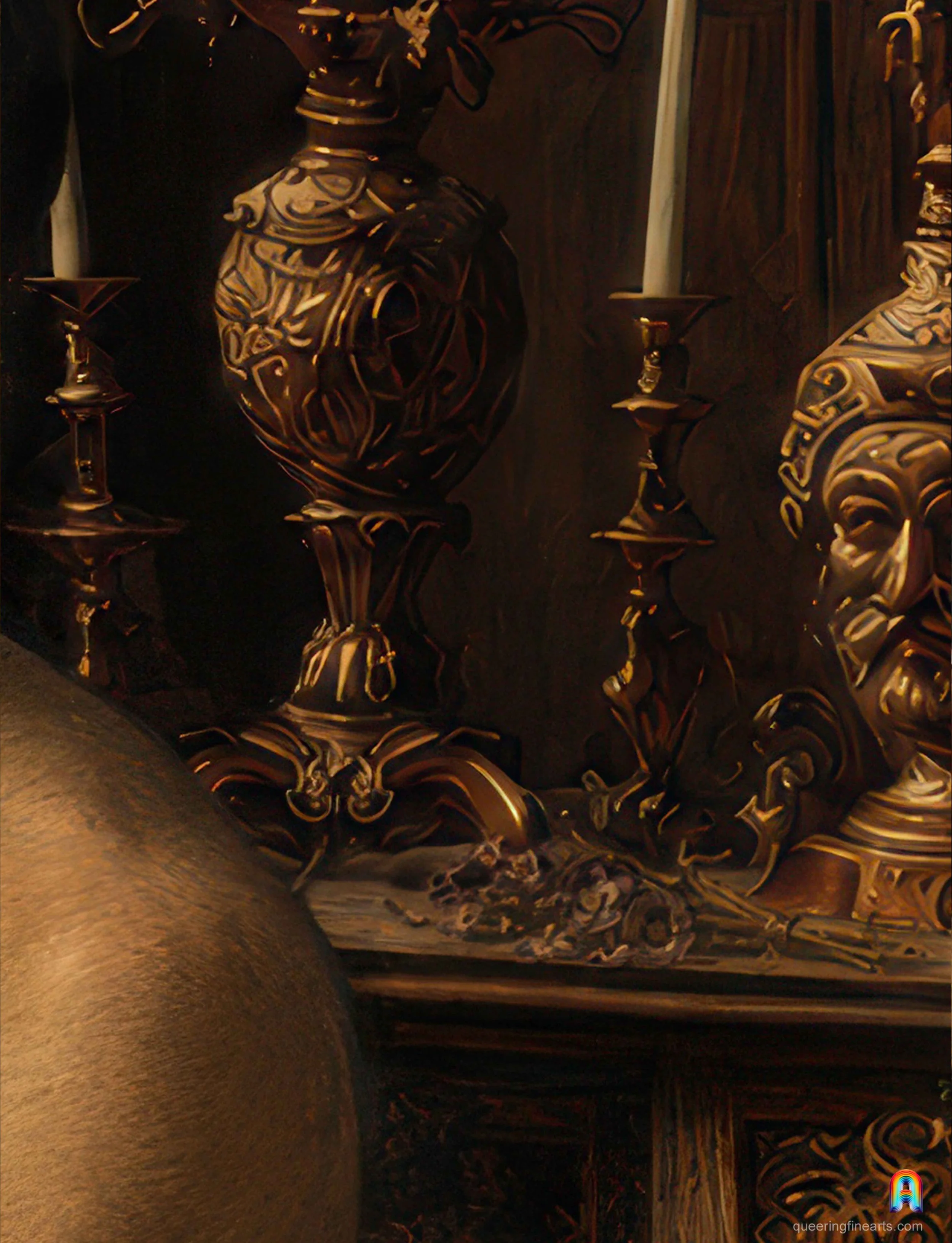
Behind the characters, a small bouquet of dried pansies rests upon the chest of drawers. Its visual echo of the fresh flowers brought by Adrian Vale can hardly be accidental. The neglected bouquet, carelessly discarded rather than placed in a vase, seems to suggest a relationship less ardent than it once was. The scene thus contrasts the promises of a new love with an attachment that is quietly fading away.
Homosexuality Kept Behind the Curtain for Lack of Freedom
Emerging from the Night, or from the Wings
The setting itself sustains a significant ambiguity. The window opens onto complete darkness that might equally represent the London night or the wings of a theatre stage. This hesitation between real space and theatrical scenery appears entirely deliberate. It recalls one of Wilde's most deeply characteristic ideas⁴: that society itself is merely a performance in which everyone plays a carefully constructed role.
The Central Question
The scene answers a very simple question: what might a late 19th-century comedy of manners have looked like if homosexual characters had been allowed to appear openly on stage?
Criminalisation and Literary Detours
In Oscar Wilde's day, reality was very different. Male homosexuality remained criminalised in Britain³ and could lead to scandal, social exclusion, loss of status and even imprisonment. Even the boldest writers were obliged to work within these constraints. Desire therefore circulated through innuendo, double meanings, secret identities and countless literary detours. Yet all the ingredients were already present. Wilde's comedies abound in romantic misunderstandings, false identities, unexpected visits, improvised lies and doors opening at precisely the wrong moment. This work merely imagines that some of these characters can finally be themselves.
A Comic Mechanism Finally Unleashed
Here there is no need for elaborate pretexts or excessively enthusiastic friendships. Romantic rivalries, jealousy, misunderstandings and strategies of seduction belong fully to the world of vaudeville. Only the protagonists have changed.
Far from being provocative, the image reminds us how ready theatrical conventions already were to accommodate such stories. What was lacking was neither dramatic talent nor effective comic machinery, but simply the freedom required to place these stories on stage.
Raising the Curtain on a Different Theatrical Genre
One may therefore view this work as the imaginary expression of a repertoire that never had the opportunity to exist: the great homosexual comedies of the Belle Époque.
The Wilde Affair, or Tragic Vaudeville
An Expressive Summary
The visual style of the work belongs firmly to the tradition of late 19th-century British theatrical illustration. The artist has chosen to depict the single most extravagantly compromising moment in the play. At a glance, the reader understands exactly what is at stake: one lover at the window, another concealed within the room, an aristocrat caught between them, and a small dog liable at any moment to bring crashing down the elaborate edifice of lies and improvisations laboriously constructed by its master.
The poses are deliberately expressive, and the accessories participate directly in the action. The freshly presented bouquet, the forgotten pansies upon the chest of drawers, Bunbury's barking and the darkness beyond the window are not decorative details but elements of the plot itself. As in the finest theatrical illustrations of the period, the entire story suddenly seems capable of existing within a single image.
The Constellation Around Wilde
This imaginary edition also invites us to situate the work within the broader network of artists and writers who gravitated around Wilde.
Charles Ricketts, Friend and Collaborator
The edition for which this illustration might have been intended naturally calls to mind another important figure within Wilde's artistic world: Charles Ricketts.⁵ A close friend of Oscar Wilde, collaborator on several of his publishing ventures and a prominent figure within the British Aesthetic Movement, Ricketts remains one of the artists most closely associated with the material culture of Wilde's publications. His name immediately evokes finely produced editions, limited print runs and collectors' libraries, all hallmarks of fin-de-siècle London.
A Remarkable Homosexual Couple
This association acquires particular resonance when one considers Ricketts's long relationship with the painter Charles Shannon.⁶ The two men shared their lives, their studio and their artistic ambitions for nearly half a century. Historians now recognise them as one of the most remarkable male homosexual couples in the British art world of their time. This personal experience lends a particular flavour to any connection between Ricketts and a work depicting the emotional realities of relationships between men, realities that Victorian society generally preferred to leave unspoken.
Discretion as a Passport
Unlike Oscar Wilde, whose private life was brutally exposed to public scrutiny with consequences that require no retelling, Ricketts and Shannon passed through their era with a discretion that enabled them to preserve both reputation and career. They moved within the same aesthetic circles, knew many of the same individuals and shared a culture in which male attachments, passionate friendships and subtle codes of mutual recognition occupied an important place. For an informed reader in 1902, the mere mention of Charles Ricketts's name in connection with a private edition attributed to Wilde would doubtless have constituted a knowing wink whose significance extended far beyond purely artistic concerns.
A Thin Line Between Comedy and Tragedy
The Oscar Wilde affair itself demonstrates how narrow the boundary between comedy of manners and drama could be at the close of the 19th century.⁷ Certainly, male homosexuality was criminalised, and the law allowed the prosecution of men suspected of relationships with other men. Yet Wilde's downfall was not the result of a systematic police campaign. Rather, the writer found himself at the centre of a conflict involving love, reputation, social class and power. His relationship with Lord Alfred Douglas involved the son of one of the most famous and combative aristocrats in the kingdom, the Marquess of Queensberry.
Writer Versus Aristocrat: An Assault on the Social Order
In Victorian England, this was not merely a matter of sexual morality. It was also a matter of rank. That a writer, however brilliant and celebrated, should maintain a relationship with the son of a peer of the realm was viewed by some as an affront to the social order itself. What followed were public insults, provocations, threats, challenges and lawsuits in a sequence of events that would not have seemed out of place in a boulevard comedy. When Wilde brought a libel action against Queensberry, he believed he could silence his opponent. The reverse occurred. The defence examined his private life with relentless zeal, the prosecution collapsed, and the state stepped in.
The Triumph of Convention
The law already existed, yet it required the explosive convergence of a flamboyant writer, an aristocratic young lover, an enraged father and a society obsessed with hierarchy before it descended with such force. In certain respects, the Wilde affair resembles a tragic vaudeville in which social conventions ultimately triumph over every character.
QFA
(An excerpt from the play's "risky" pastiche is waiting for you after the Curiosity piqued? "Works to Explore" section. Finally, discover the lines that lead right up to the moment shown in the illustration!)
Curiosity piqued?
1. Nicholas Frankel, Oscar Wilde's Decorated Books, Ann Arbor, University of Michigan Press, 2000.
2. Richard Ellmann, Oscar Wilde, New York, Alfred A. Knopf, 1988.
3. Alan Sinfield, The Wilde Century: Effeminacy, Oscar Wilde and the Queer Moment, New York, Columbia University Press, 1994.
4. Neil McKenna, The Secret Life of Oscar Wilde: An Intimate Biography, New York, Basic Books, 2005.
5. J. G. P. Delaney, Charles Ricketts: A Biography, Oxford, Clarendon Press, 1990.
6. Matt Cook, « Domestic Passions: Unpacking the Homes of Charles Shannon and Charles Ricketts », Journal of British Studies, vol. 51, no 3, juillet 2012, p. 618-640.
7. Morris B. Kaplan, Sodom on the Thames: Sex, Love and Scandal in Wilde Times, Ithaca, Cornell University Press, 2005.
8. Philippe Jullian, Jean Lorrain, Paris, Fayard, 1974.
9. Christopher Maurer, « Jacinto Benavente », dans David T. Gies (dir.), The Cambridge History of Spanish Literature, Cambridge, Cambridge University Press, 2004, p. 417-420.
10. Paul Vincent, Louis Couperus: A Reader, Amsterdam, Amsterdam University Press, 1992.
11. Michael Rosenfeld, « Gay Taboos in 1900 Brussels: The Literary, Journalistic and Private Debate Surrounding Georges Eekhoud's Novel Escal-Vigor », Dix-Neuf, vol. 22, no 1-2, 2018, p. 98-114.
12. Dag Heede, Herman Bang: Mærkværdige Læsninger, Odense, Syddansk Universitetsforlag, 2003.
Caught with His Trousers Down...
ACT II, Scene 3. — Lord Basil Ashcombe's study. An elegant reception room. A window opens onto an exterior balcony. Upon a chest of drawers rests a small bouquet of faded pansies. A King Charles spaniel named Bunbury occupies an armchair.
Lord Basil's frock coat is impeccably buttoned. Lord Basil himself is, however, remarkably devoid of trousers, which he has only just allowed to fall during a passionate exchange of kisses with Felix March, a young officer who is already entirely undressed.
Suddenly, three measured taps are heard at the window.
BASIL and FELIX, then ADRIAN.
FELIX
Have you ordered a second officer?
BASIL
I never order officers. They invariably arrive of their own accord.
(More knocking, this time a playful drumming upon the glass.)
FELIX
That sounds much more like a poet.
BASIL (growing slightly pale).
Good Lord.
FELIX
What is it?
BASIL
Adrian.
FELIX
The man with the pansies?
BASIL
The very one. (Glancing downward at a certain part of himself which is rapidly losing confidence.) There goes my magnificence.
FELIX
That is unfortunate.
BASIL
That is catastrophic.
FELIX
You mean this unexpected arrival?
BASIL
I mean the loss of my erection!
(A third series of knocks.)
FELIX
What am I to do?
BASIL
Hide behind me.
FELIX (with a glance at both the situation and Basil's anatomy).
I find that arrangement extremely attractive.
BASIL
It is a method that has preserved more English reputations than the Church of England.
(Felix positions himself behind him. Bunbury, who had been sleeping in the armchair, awakens and immediately begins to growl.)
FELIX
Your dog disapproves.
BASIL
My dog is jealous.
FELIX (to Bunbury).
You shall have to accustom yourself to seeing me sniffing around your master's rear quarters.
(Basil opens the window. Adrian appears holding a small bouquet of fresh pansies.)
ADRIAN
Basil!
BASIL
Adrian!
ADRIAN
I hope I am not disturbing you.
BASIL
I should dearly like to answer that question, but you have chosen precisely the most difficult possible moment at which to ask it.
ADRIAN (noticing the absence of trousers).
Would that difficulty stem from the fact that you are impeccably dressed above the waist and remarkably neglected below it?
BASIL
If only it were as simple as that!
ADRIAN
I happened to be passing the house and thought of you.
BASIL
The consequences of thought are habitually underestimated.
ADRIAN (offering the flowers).
For you.
BASIL
More pansies?
ADRIAN
I believe you owe me something.
BASIL
Whenever a man makes such a statement, he ought always to specify whether he means money or affection.
ADRIAN
Affection.
BASIL
In that case I am concerned. It is a kind of debt I do not always succeed in repaying.
(Adrian leans toward him. Basil hesitates for a moment. Behind him, Felix smiles. Bunbury begins to growl.
ADRIAN
Then allow me at least to collect the interest.
(They kiss. Felix seizes one of Basil's buttocks, causing him to emit a brief sound not entirely unlike the whinny of a startled horse.)
I see it pleases you as well.
(Bunbury bursts into furious barking.)
But Bunbury seems rather upset.
BASIL
Bunbury regards every visitor as an attempted territorial invasion.
(Behind Basil, Felix suppresses a laugh.)
ADRIAN
I beg your pardon?
BASIL
I am conducting several conversations simultaneously.
ADRIAN
With whom?
BASIL
With you and my conscience.
ADRIAN
And what does it tell you?
BASIL
That I should probably close this window.
(Bunbury barks louder than ever. Felix is visibly struggling to remain invisible.)
ADRIAN
I cannot help thinking there is someone behind you.
BASIL (with heroic composure).
My dear fellow, whenever a man finds himself in a truly difficult situation, he always avoids turning round with the greatest heroism.
(It is at this precise moment that the illustration is set. As a cover image, the work therefore announces its subject with perfect clarity: not merely a comedy of compromised respectability, but a farce of competing affections in which scandal is never very far away. Between Adrian Vale's older passion, the new attachment embodied by Felix March, and Lord Basil's increasingly desperate efforts to maintain an impossible equilibrium, every ingredient is already in place for a comedy in which doors slam less often than epigrams.)
QFA