

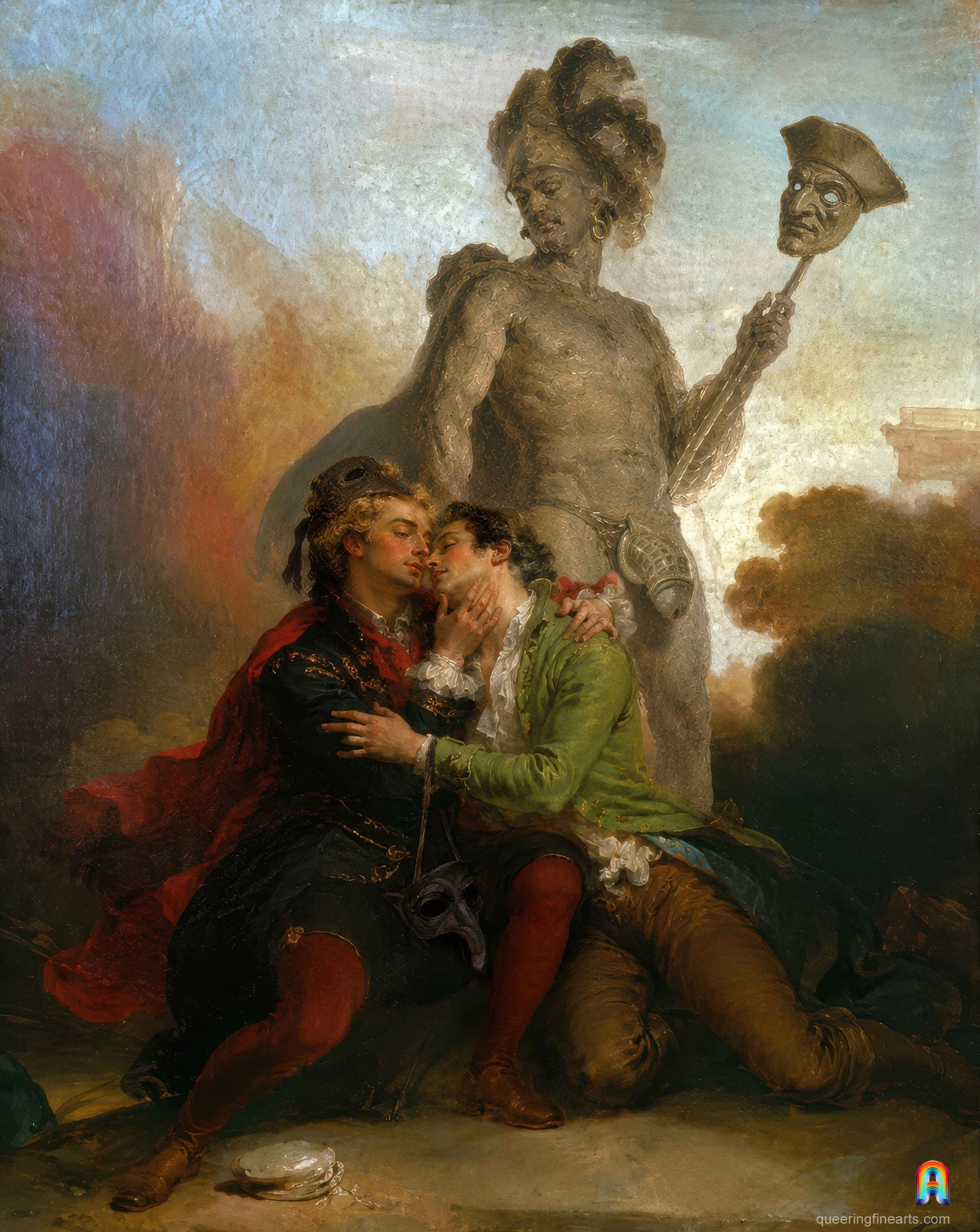
Away with the Masks
In the manner of Alexandre-Évariste Fragonard (1780-1850)
Inspired by Don Juan and the Statue of the Commander
Oil on canvas, circa 1830-1835
Private collection
Densifying the Myth
Like Don Juan himself, that compulsive seducer whose insatiable appetite for conquest ultimately led him to the supper that proved fatal, you are invited into a game of rewriting in which one of the great classics of Western culture is wholly transfigured. This queer fantasia, at once playful and profoundly serious, does not seek to correct the original work, but to open it toward other possibilities, to explore what its tensions, ambiguities, and theatricalities may still reveal when viewed from another horizon of desire.
Fragonard the Son
This imagined work, conceived in the manner of the French painter Alexandre-Évariste Fragonard (1780-1850)¹, son of the celebrated Rococo painter, trained under David and more Romantic in temperament than his father, offers a spectacular rereading of a myth born in 17th-century Spain with El burlador de Sevilla y convidado de piedra, attributed to Tirso de Molina², before undergoing its great European metamorphoses in Molière’s Dom Juan ou le Festin de pierre³, and later in the operatic adaptation Da Ponte wrote for Mozart⁴. But here, the myth is upended in its very foundations.
The Tradition
Traditional Don Juan rests upon a familiar mechanism⁵: seduction, deceit, domination, flight, blasphemy, defiance of the moral order, then the terrible return of justice embodied by the Commander. Molière makes him a libertine nobleman, fascinating in his intelligence and insolence, yet morally devastating. His valet Sganarelle, theatrical ancestor to Leporello, observes, comments, suffers, and serves all at once. The Commander becomes the inexorable figure of the return of the Real: death, law, punishment.
Three Poles
This image preserves these three poles, but profoundly inverts their meaning.
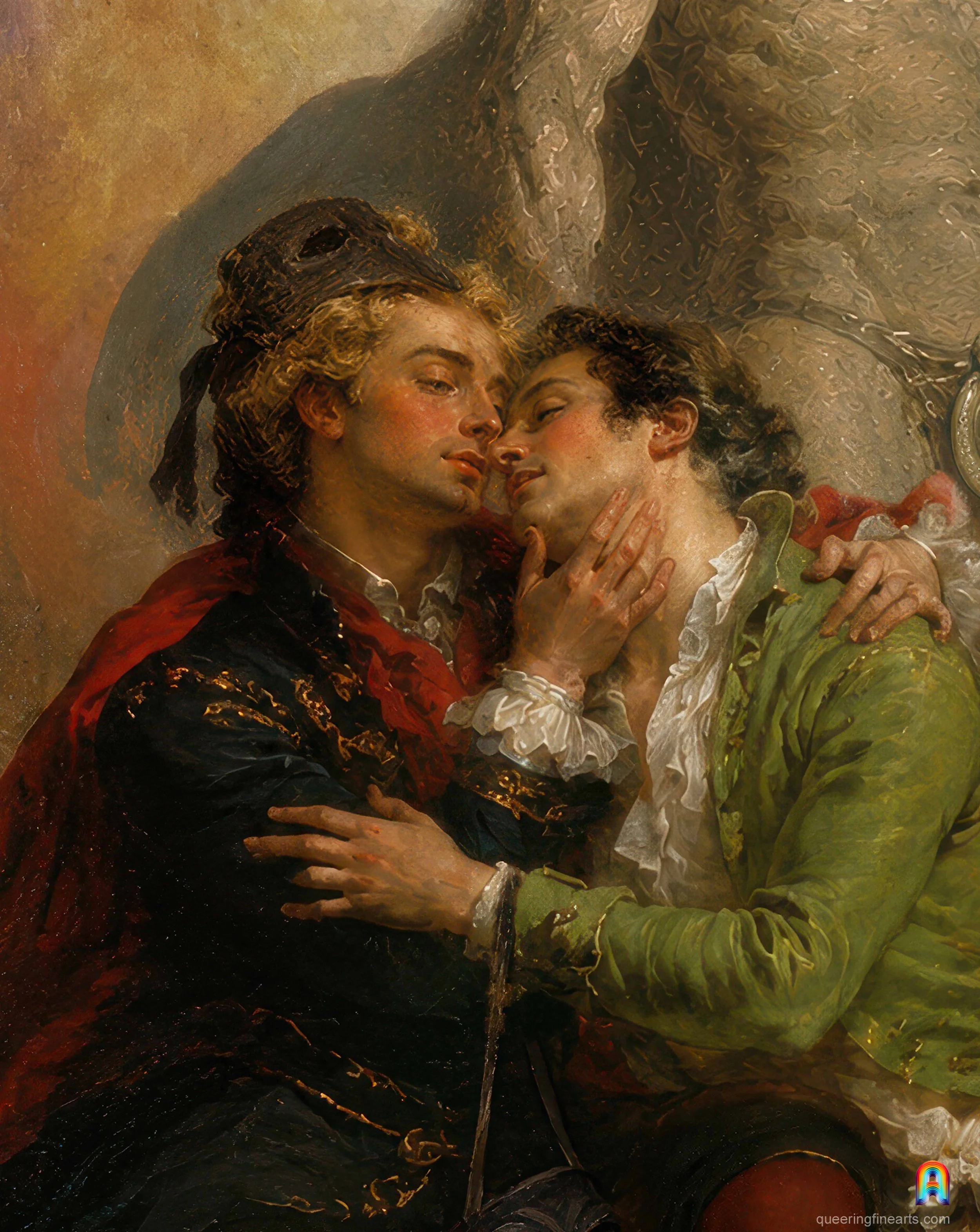
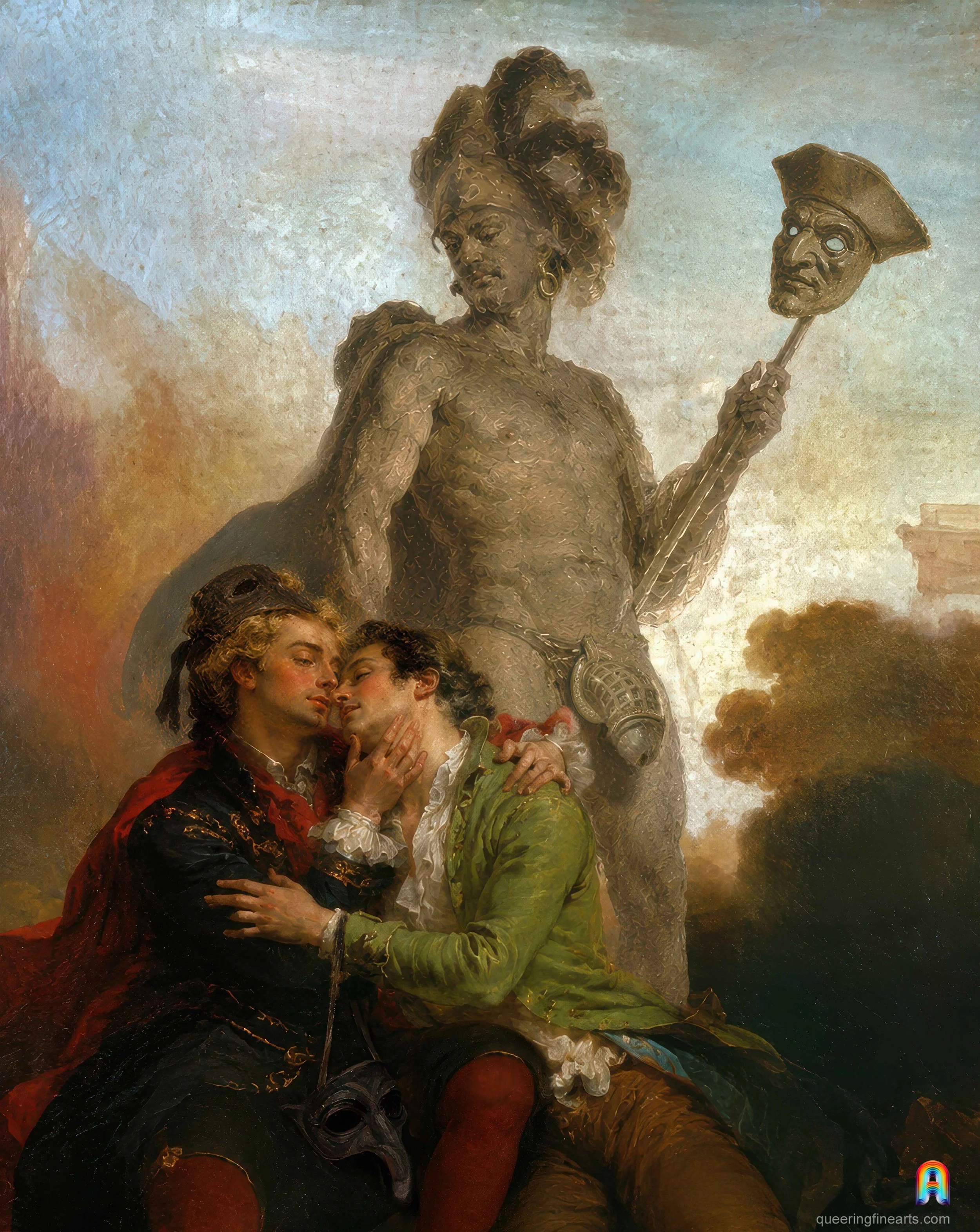
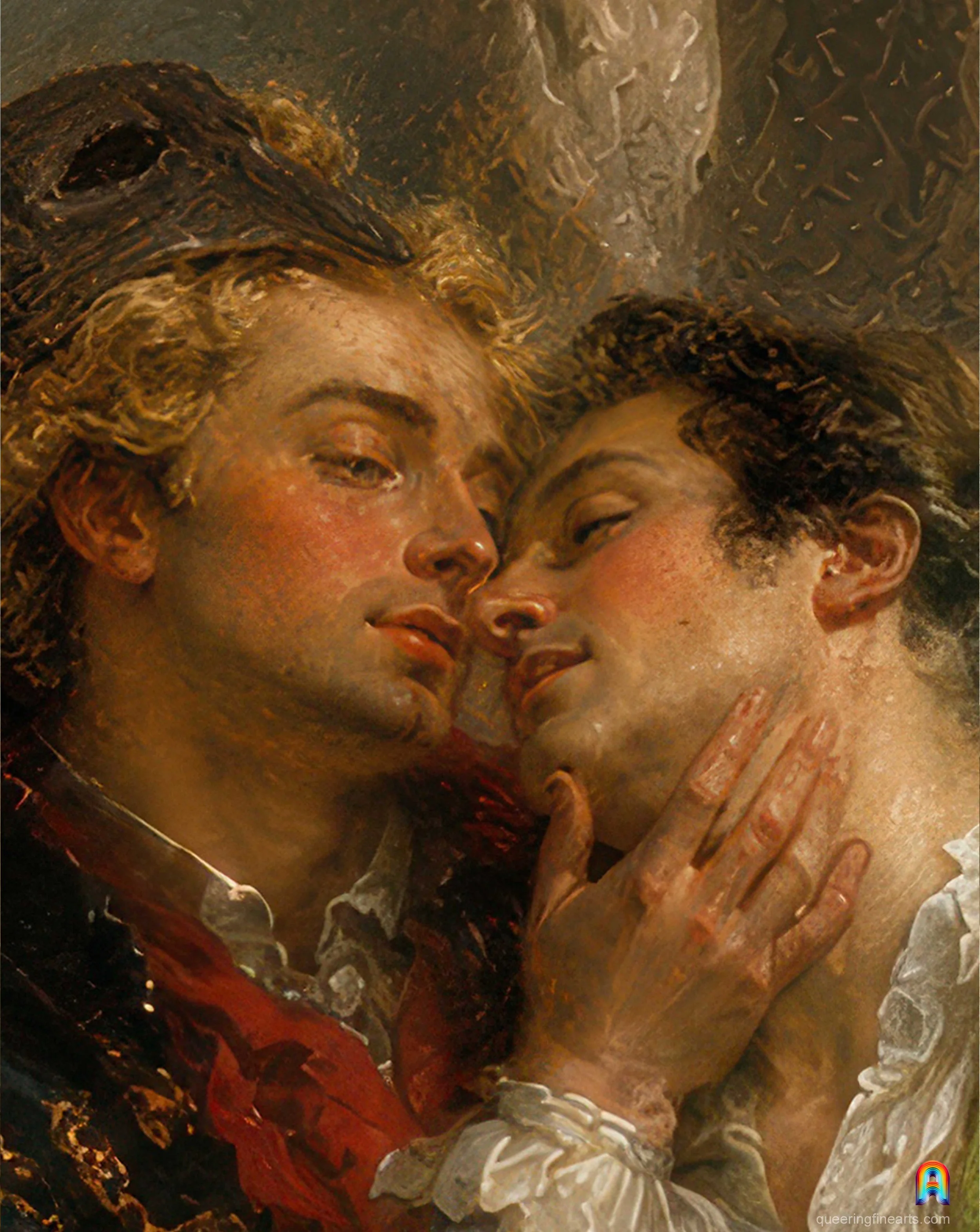
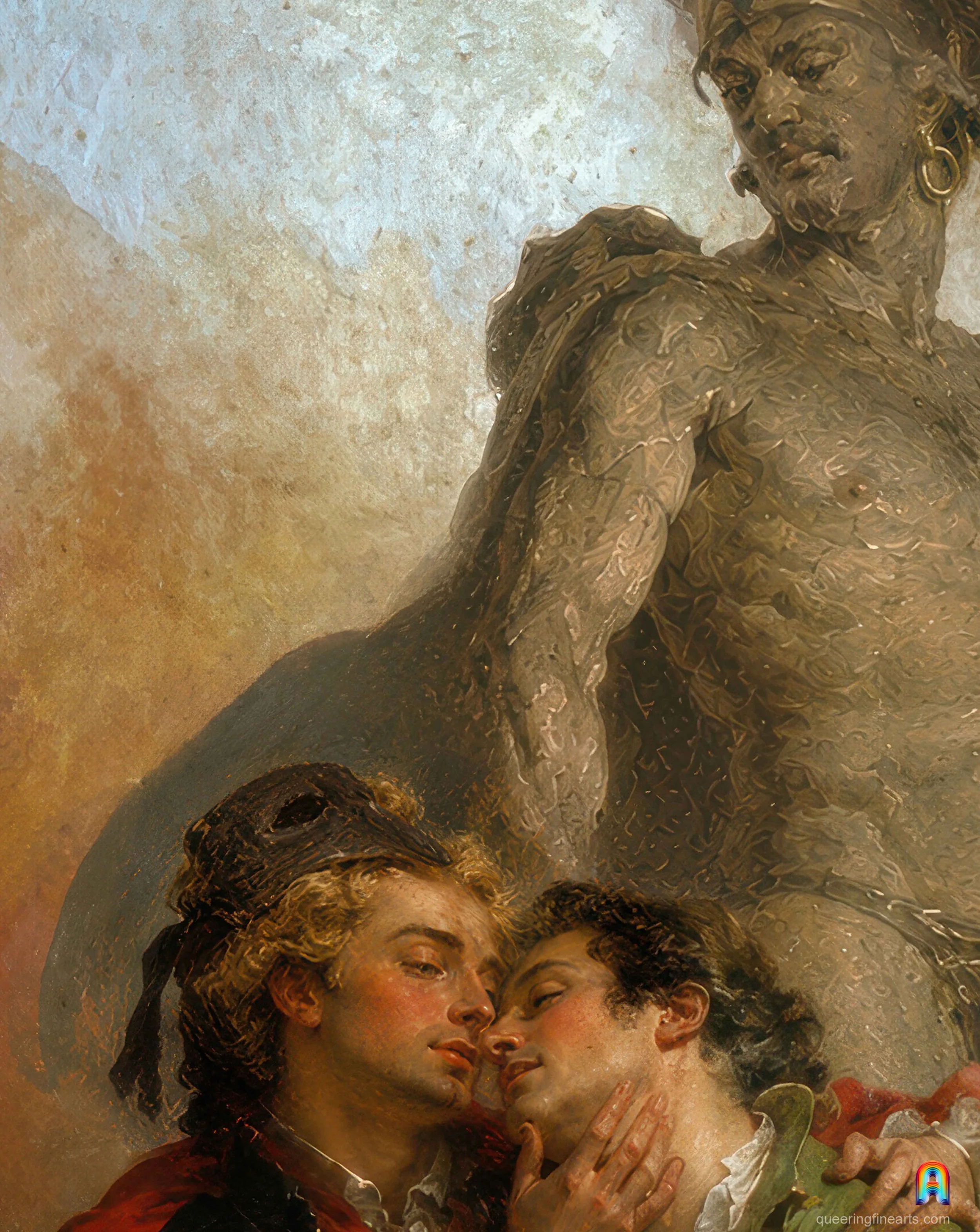
In the foreground, two men kiss with a clarity that leaves no room for ambiguity. Don Juan, recognizable by his sumptuous attire, grasps the face of his servant and lover with intensity, while their bodies press against one another in a posture of mutual surrender. This detail immediately transforms the entire reading of the myth: we are confronted with a scene of romantic passion between men. The work performs here a gesture of rare symbolic audacity.
Faithful Servant
In Molière, Sganarelle is the privileged witness to his master’s hypocrisy. He knows his tricks, his successive seductions, his abandonments, his reversals. He serves as confidant as much as whipping boy. Their relationship already carries a structural intimacy: that of the servant who knows everything, sees everything, accompanies everything. Da Ponte, Mozart’s librettist, amplifies this dynamic through Leporello, notably in the cruel humor of the famous Catalogue Aria (Madamina, il catalogo è questo)⁶, in which the valet recites with almost bureaucratic detachment the innumerable female conquests of his master, turning Don Giovanni’s romantic predation into grotesque inventory.
Conquests as Display
This work proposes a fascinating reversal. Don Juan’s actions, his innumerable female conquests, cease to appear solely as expressions of compulsive libertinism. They may also be read as carefully staged displays designed to conceal a desire directed toward men.
Heterosexual Excess and Unspoken Des
This hypothesis of a Don Juan whose female conquests serve merely as decoy is not without precedent in queer readings of the myth. Wayne Koestenbaum (The Queen’s Throat, 1993) suggested, regarding Mozart’s Don Giovanni, that the seducer’s frenzied energy may be read as a form of “heterosexual excess” intended to conceal repressed homosexual desire⁷. Terry Castle (The Apparitional Lesbian, 1993) showed how figures of compulsive seduction in 18th-century opera and theatre often bear traces of an “unspeakable” desire the myth endlessly seeks to exhume, then repress anew⁸. This canvas renders that dynamic visible, no longer as subtext, but as the unmistakable truth of the foreground.
Victims and Diversion
The famous catalogue then shifts into another dimension: no longer merely a register of victims, but an apparatus of camouflage. Each conquest becomes fabricated proof. Each anecdote, a diversion. Each number, a mask meant to reinforce the expected public persona.
A Game of Masks
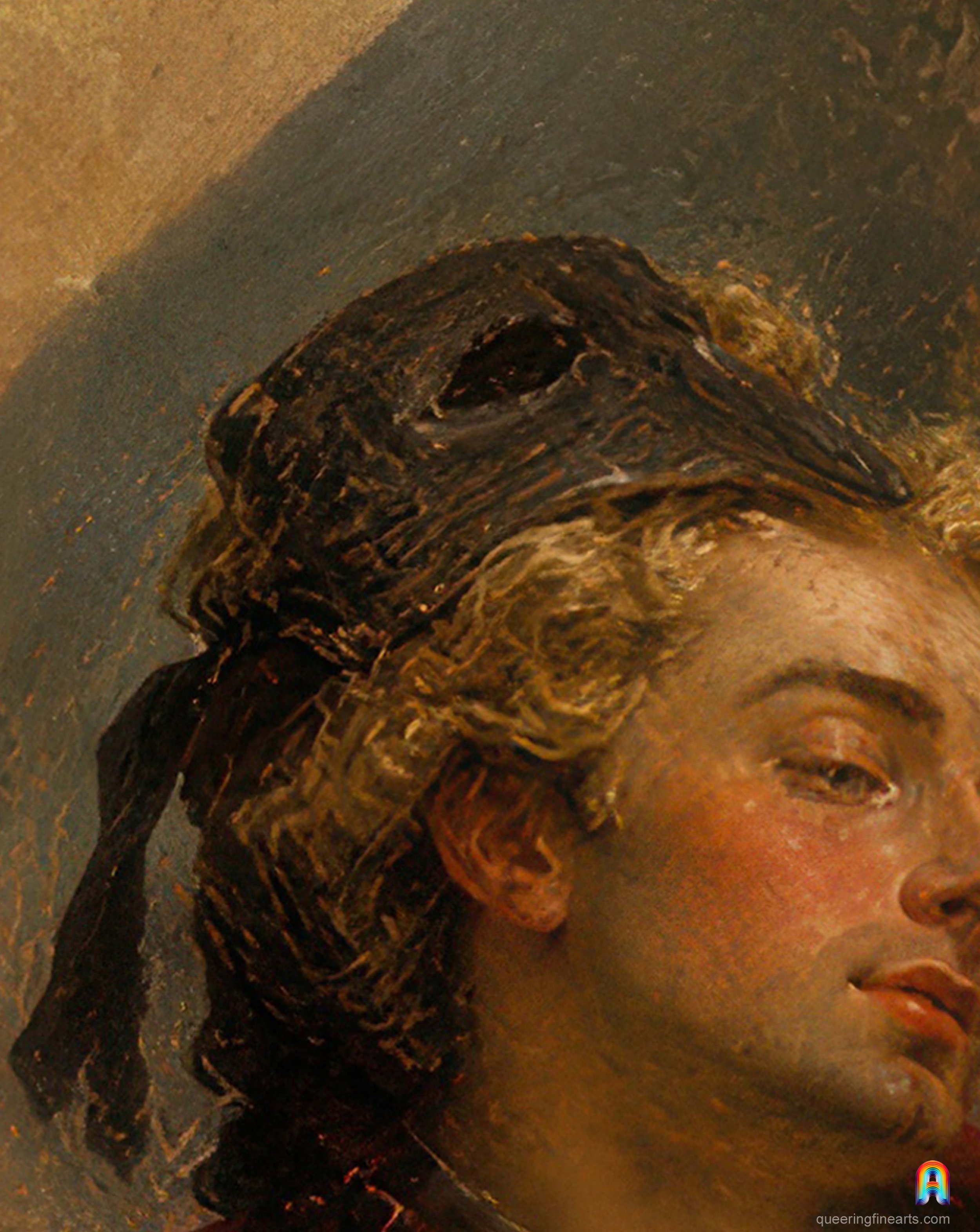
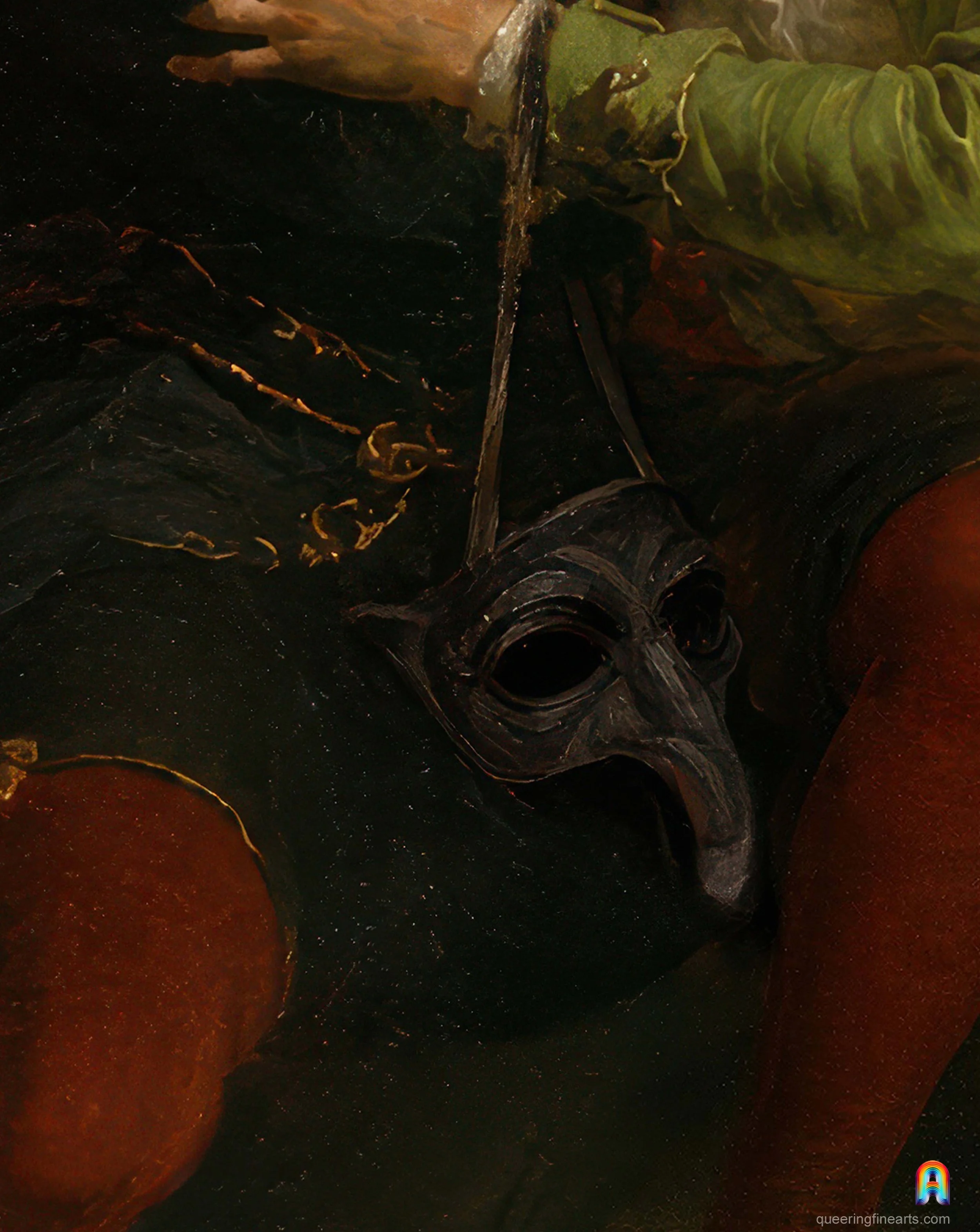
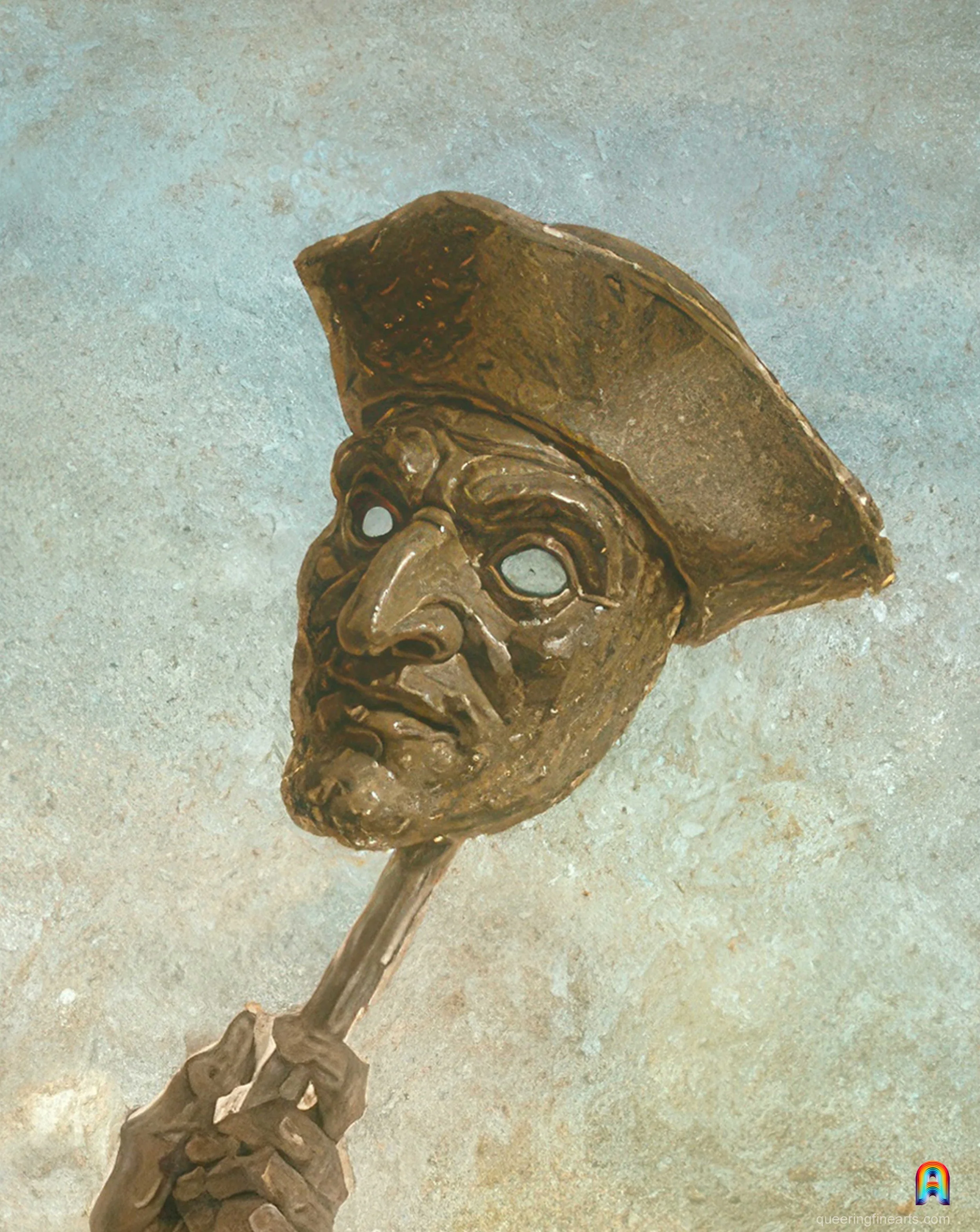
And indeed, each character abandons his mask here. Don Juan has cast his behind him, like a role now discarded. Sganarelle-Leporello lets his dangle from his hand. The Commander holds his aloft at the end of an upright staff, like the very emblem of theatrical authority. These borrowed faces seem drawn from the traditions of Italian commedia dell’arte⁹ and Venetian carnival¹⁰: for Don Juan, a bauta, associated with anonymity, transgression, and games of seduction; for Sganarelle-Leporello, a grotesque mask with an overtly phallic nose, pushing farce toward sexual ambiguity; for the Commander, a Capitano mask, that swaggering figure of martial authority and performative virility¹¹. Here, appearances no longer conceal. They reveal.
A Liberating Kiss
Sganarelle-Leporello’s intimate knowledge ceases, then, to be merely practical. The servant is no longer simply the one who knows his master’s affairs: he becomes the one who protects the lie, his secret partner. This reading powerfully illuminates the kiss in the foreground, which carries something almost tragically liberating, as though a truth long contained were finally erupting. Don Juan, draped in a dark red cloak, holds the other’s face with possessive intensity, yet not coercively. The other visibly yields to the exchange. Everything here speaks of consent.
A Man Imprisoned, Women Sacrificed
And this is precisely what constitutes one of the myth’s deepest upheavals. Don Juan remains a profoundly problematic figure here, as in his traditional incarnations, insofar as his relationship to consent remains corrupted by false identities, deceitful promises, manipulation, and abandonment. This work does not seek in the slightest to absolve him. It proposes a more troubled reading: that of a man incapable of recognizing or assuming his true desire in the world he inhabits, and who instrumentalizes women to construct the public illusion of a heterosexuality conforming to the expectations of his time. The fault remains entire. These women are still deceived, used, sacrificed to a masquerade not of their making. But the libertine changes in nature: less a predator driven solely by appetite than a man imprisoned within a social and sexual role he himself helps sustain, brutally so.
A Man Imprisoned, Women Sacrificed
And this is precisely what constitutes one of the myth’s deepest upheavals. Don Juan remains a profoundly problematic figure here, as in his traditional incarnations, insofar as his relationship to consent remains corrupted by false identities, deceitful promises, manipulation, and abandonment. This work does not seek in the slightest to absolve him. It proposes a more troubled reading: that of a man incapable of recognizing or assuming his true desire in the world he inhabits, and who instrumentalizes women to construct the public illusion of a heterosexuality conforming to the expectations of his time. The fault remains entire. These women are still deceived, used, sacrificed to a masquerade not of their making. But the libertine changes in nature: less a predator driven solely by appetite than a man imprisoned within a social and sexual role he himself helps sustain, brutally so.
Nothing Is Pardoned
This reinterpretation removes nothing from Don Juan’s violence. It merely displaces its meaning. But it does not stop with Don Juan, nor with his bond to Sganarelle-Leporello. It summons the myth’s third great figure: the Commander.
The Third Man
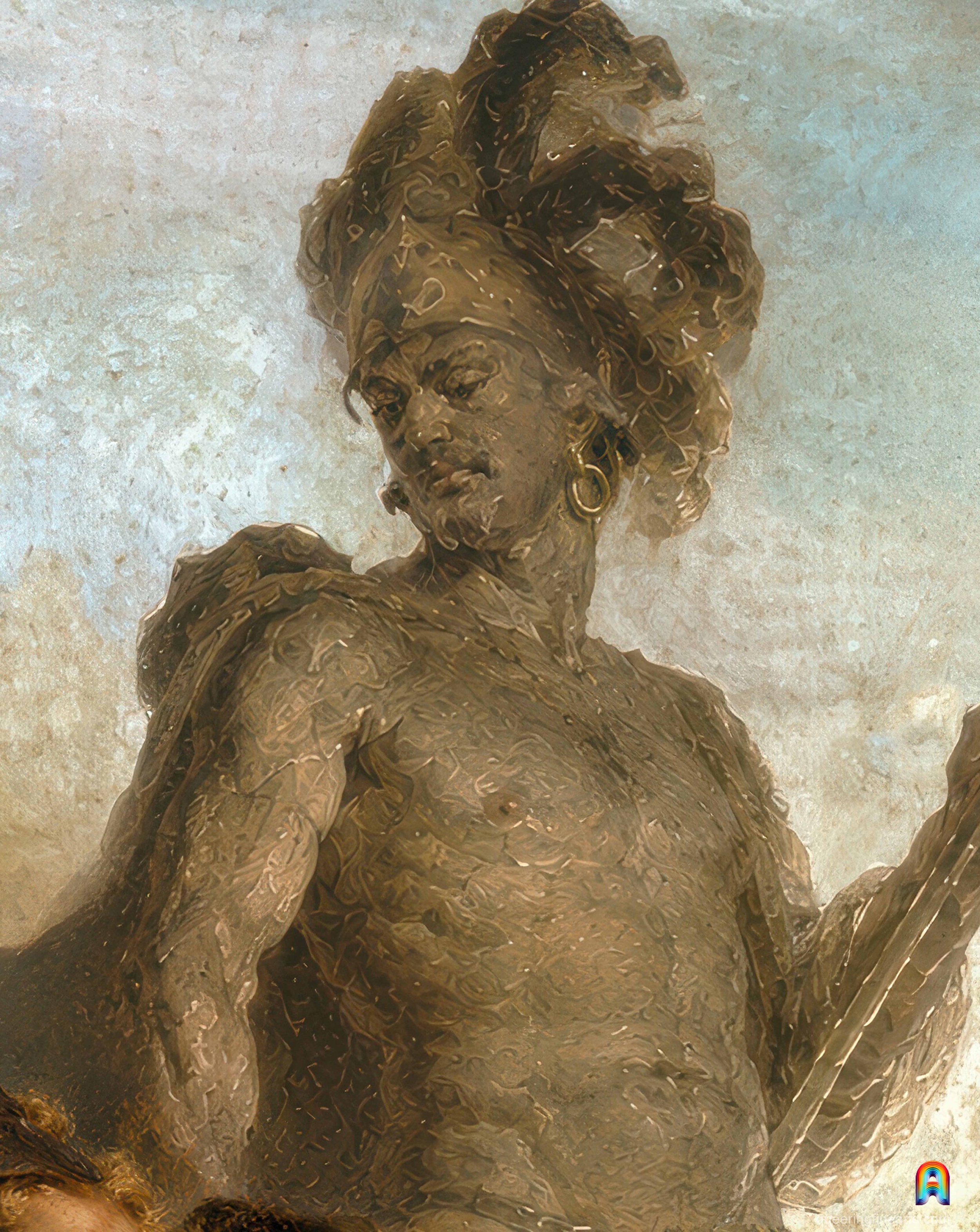
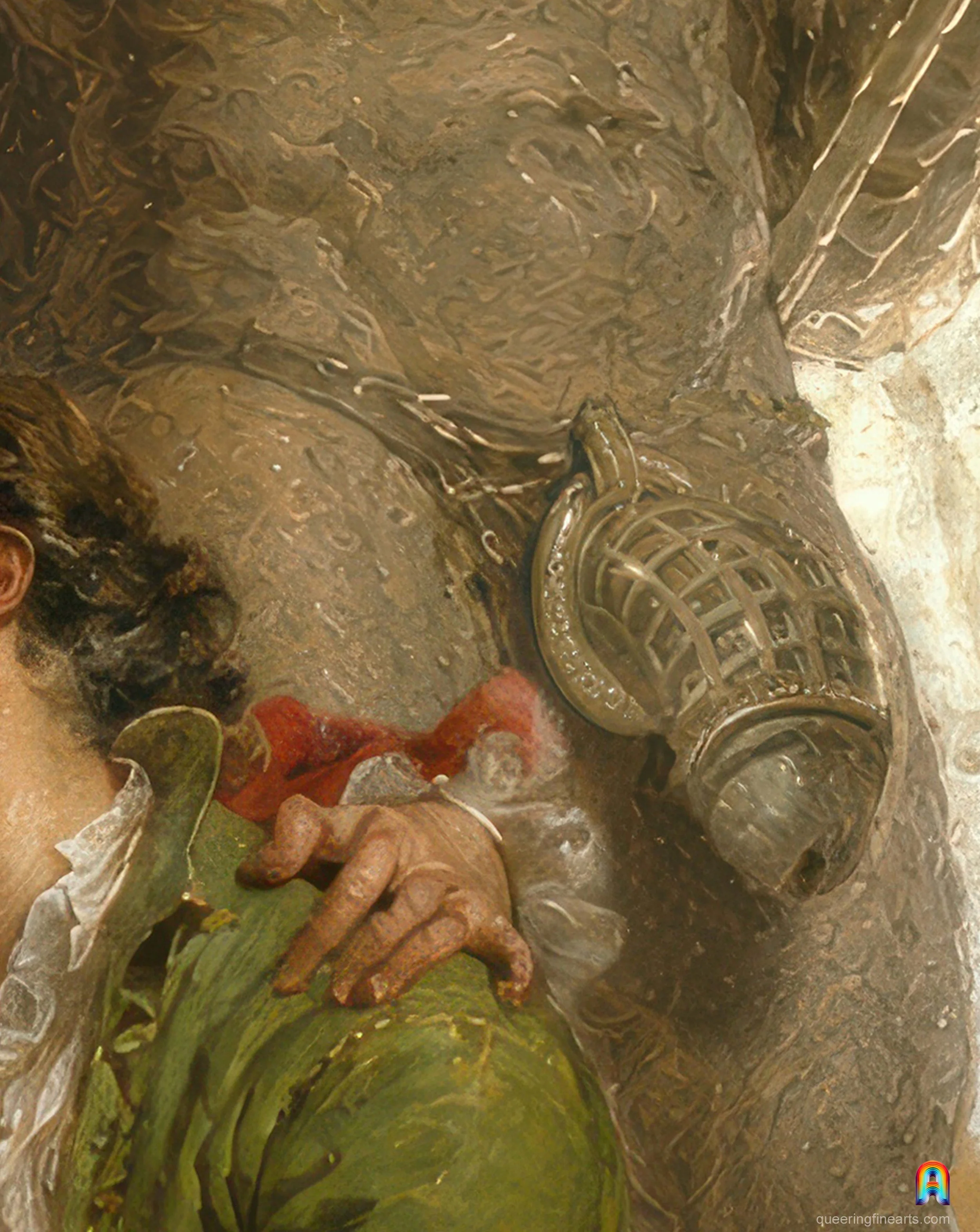
Behind the lovers rises a monumental figure, nearly naked, eroticized by his adornments, his monumental sex enclosed within a cage that neutralizes it. A helmeted, heroic statue whose presence dominates the entire composition. The reference to Le Festin de pierre is crucial here.
Moral Debt
In Molière, as already in the Spanish tradition inaugurated by Tirso de Molina, the Commander is first a man of flesh, an offended father and figure of authority whom Don Juan kills in a duel after attempting to seduce his daughter. But this death is never a mere narrative episode: it constitutes the central knot of the myth. The Commander later returns in spectral, then statuary form, embodiment of a past that refuses burial, of the moral debt Don Juan obstinately denies to the end. The work proposed here shifts that dynamic without diminishing its tragic force.
Corneillean Drama
The daughter ceases to be the sole apparent object of seduction: she becomes also the means by which Don Juan reaches the father, a father whom this reading imagines as himself touched, traversed by a desire he cannot name. The duel then no longer opposes merely an offended father and a libertine. It pits against one another a man devastated by multiple wounds: that of his betrayed daughter, but also that of a father burdened by remorse for having, through his own weakness or desire, contributed to his child’s suffering.
A Restless Conscience
This hypothesis intensifies the drama to vertigo. The Commander’s anger ceases to have a simple cause. To wounded honor are added guilt, shameful desire, the awareness of having failed as a father, perhaps even the impossibility of naming what he himself once felt. His return no longer belongs solely to divine justice or moral reckoning. It becomes also that of a torn conscience incapable of rest.
A Tormented Figure
Da Ponte preserves this structure while transfiguring it musically in one of the most arresting scenes in the operatic repertoire¹², the supper scene in which the statue of the Commander comes to dine and drags Don Juan to hell. But here too, the image performs a displacement. This Commander does not first appear as pure punishment. His body is too intensely incarnated. He is not buried beneath morality. He is exposed as a powerful, magnetic, desirable physical presence. This is no accident.
The Commander is not only the law. He is also desire.
Such a figuration, a monumental male body, eroticized, exposed, yet with its sex enclosed in a neutralizing cage, recalls James Saslow’s analyses (Pictures and Passions, 1999) of male desire in Old Master painting. Saslow shows that heroic nude male bodies often function as “screens” upon which homosociality may unfold safely, provided the sexual organ is softened or displaced¹³. Here, the metal cage draws the eye toward what it conceals; it eroticizes through negation. Whitney Davis (Queer Beauty, 2010) would add that such “queer beauty” depends precisely on this simultaneous play of subtraction and exposure. The Commander-statue embodies this aesthetic regime at its most extreme¹⁴.
Carnal Complicity or Tragic Passion
The original duel thus ceases to be merely a moral confrontation or a question of offended honor. It also bears traces of a more intimate bond, now ruptured, in which desire, guilt, and violence became tragically entangled. Don Juan would no longer be torn simply between pleasure and punishment, but between two forms of male love: Sganarelle-Leporello, earthly, daily, carnal, human complicity; the Commander, tragic grandeur, authority, impossible passion, monumental past. The Commander ceases to be a mere judge. He becomes a third loving term.
A World Incapable of Truth
This reading profoundly transforms the myth’s moral meaning. In the Christian tradition, Don Juan is punished for vice, arrogance, and refusal to repent. But here, the true drama is no longer desire.
It is its social impossibility.
The scandal is not that Don Juan loves men.
The scandal is that a world incapable of receiving such truth could drive a man to construct a false identity, at the cost of lives drawn into that fiction.
Victim and Executioner
For the women he seduces are no less harmed. They become collateral victims of a social order demanding the performance of conquering virility, even as Don Juan remains fully responsible for choosing to play that role to the point of cruelty.
The great strength of the work, then, is not that it adds a simple homosexual inflection to a famous myth. It alters its symbolic structure. It radicalizes even further the subversive charge of the character. The libertine is no longer a collector of bodies. He becomes a man imprisoned by a role. The valet is no longer a mere commentator. He becomes the hidden love. The Commander is no longer solely divine punishment. He becomes also the return of impossible desire, guilt, and unresolved past.
The True Question
Curiously, Away with the Masks may find its truest musical echo perhaps not in Mozart, but in Richard Strauss’s Don Juan. Inspired by Nikolaus Lenau’s darker, more introspective poetic vision, Strauss paints a Don Juan propelled by feverish desire, dazzling masculine bravado, and an almost compulsive search for something forever out of reach. For a queer reading built around performance, concealment and repressed desire, the fit feels almost uncanny.
Thus, the myth ceases to be a tale of vice punished. It becomes a queer drama of thwarted truth. The Commander’s return no longer belongs to simple punitive justice: it compels Don Juan at last to stand before the truth of his own desire.
The Commander no longer says:
“You shall be punished.”
He says instead:
“Who are you, truly?”
QFA
Curiosity piqued?
1. Rébecca Duffeix, Alexandre-Évariste Fragonard, le fils prodige (catalogue d’exposition), Angoulême, Musée d’Angoulême, 2020. [Citation : 1, 3, 6]
2. Tirso de Molina, El burlador de Sevilla y convidado de piedra, éd. Joaquín Casalduero, Madrid, Cátedra, 1977.
3. Molière, Dom Juan ou le Festin de pierre, dans Œuvres complètes, éd. Georges Forestier et Claude Bourqui, Paris, Gallimard, Bibliothèque de la Pléiade, 2010.
4. Lorenzo Da Ponte, Il dissoluto punito ossia il Don Giovanni, livret pour Wolfgang Amadeus Mozart, Prague, 1787.
5. Jean Rousset, Le Mythe de Don Juan, Paris, Armand Colin, 1978.
6. Julian Rushton, W. A. Mozart: Don Giovanni, Cambridge, Cambridge University Press, 1981.
7. Wayne Koestenbaum, The Queen’s Throat: Opera, Homosexuality, and the Mystery of Desire, New York, Poseidon Press, 1993.
8. Terry Castle, The Apparitional Lesbian: Female Homosexuality and Modern Culture, New York, Columbia University Press, 1993.
9. John Rudlin, Commedia dell’arte: An Actor’s Handbook, Londres, Routledge, 1994.
10. James H. Johnson, Venice Incognito: Masks in the Serene Republic, Berkeley, University of California Press, 2011.
11. Pierre Louis Duchartre, The Italian Comedy, trad. Randolph T. Weaver, New York, Dover Publications, 1966.
12. Mary Hunter, The Culture of Opera Buffa in Mozart’s Vienna: A Poetics of Entertainment, Princeton, Princeton University Press, 1999.
13. James Saslow, Pictures and Passions: A History of Homosexuality in the Visual Arts, New York, Viking, 1999.
14. Whitney Davis, Queer Beauty: Sexuality and Aesthetics from Winckelmann to Freud and Beyond, New York, Columbia University Press, 2010.