

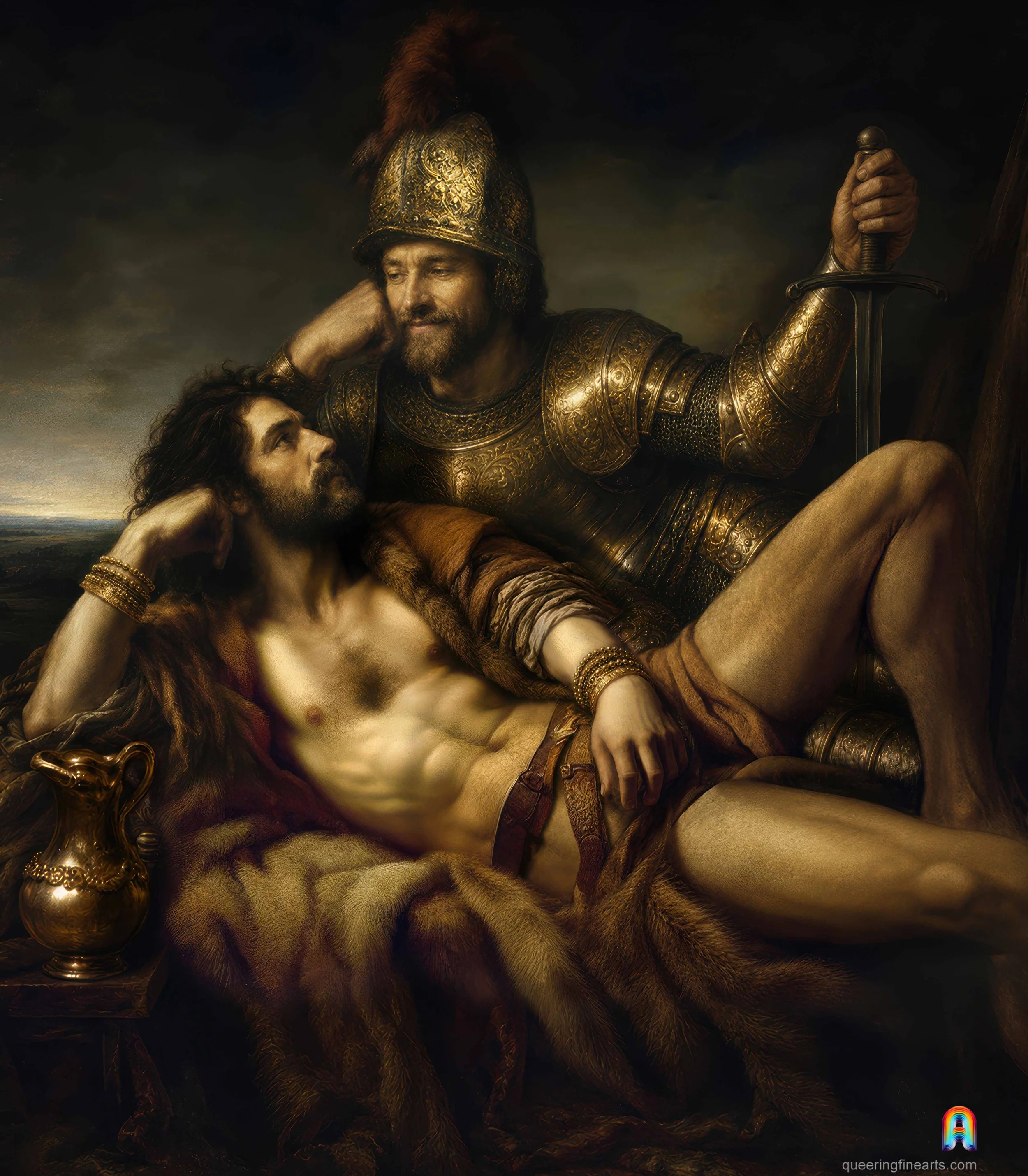
Shadow and Amber Light
Attributed to the circle of Rembrandt
Oil on canvas, after 1661
Private collection, Amsterdam
While Amsterdam Slept
Under the amber glow of Dutch Golden Age painting, masculinity was on display everywhere: in civic militias, officers’ portraits, guild culture, taverns, ships, and the entire visual language of public honor.¹ The Amsterdam of Rembrandt celebrated male camaraderie, hierarchy, theatricality, and embodied prestige. Historians of queer history invite us to look beneath this visible architecture of masculinity to discover richer human realities shaped by male intimacy, desire, discretion, emotional complexity, and enduring bonds.²
Beneath the Armour
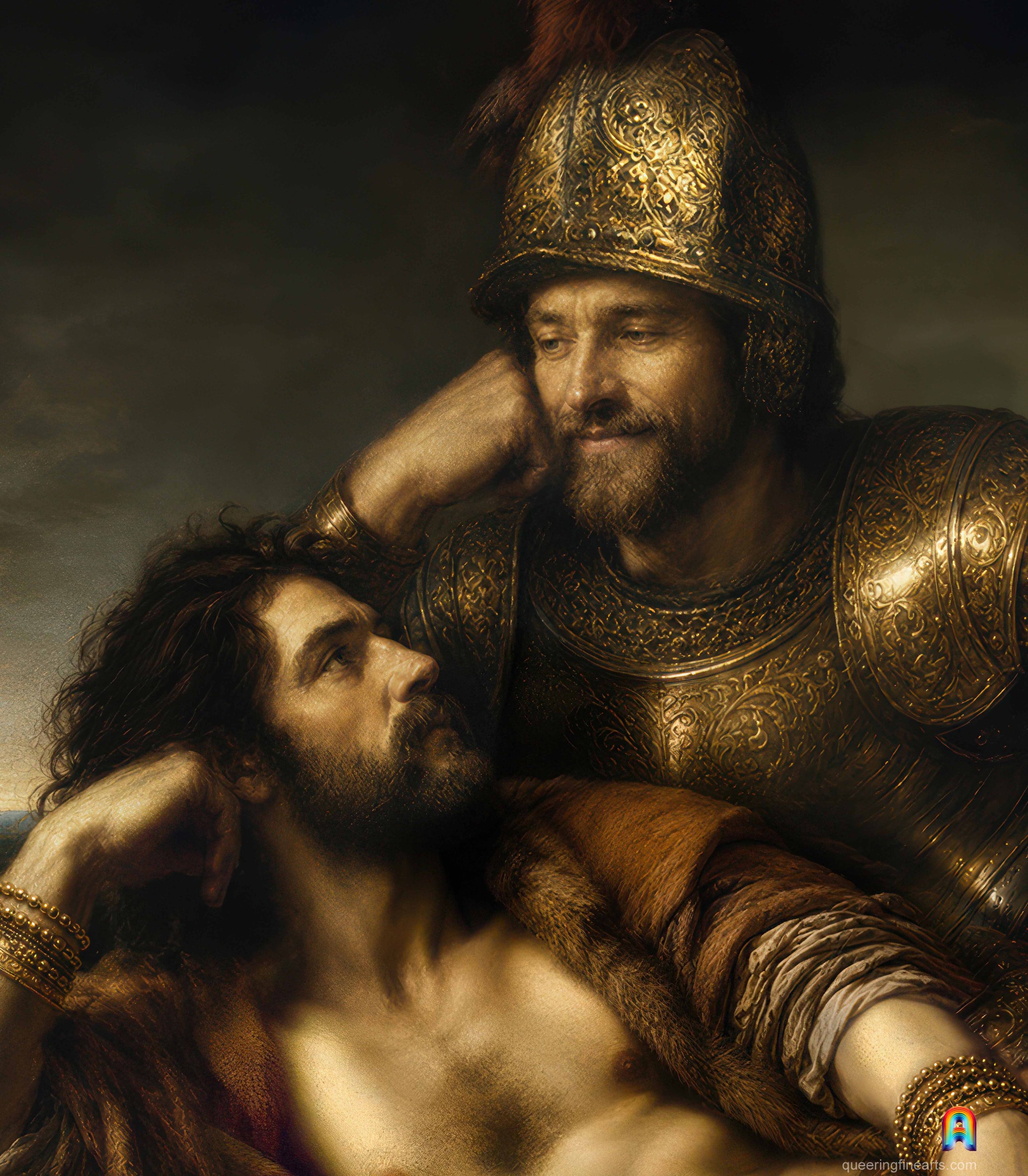
This composition, attributed to the circle of Rembrandt, deploys with intensity several visual themes dear to the Rembrandtesque world. It should have existed at the very time we imagine its creation. To see it is to taste a reparative dystopia that invites us to lift the veil on a fascinating and vibrant chapter of queer history. Nothing embodies this better than the very materiality of the work: a taste for historical costume as psychological theatre, a fascination with metallic surfaces bathed in liquid gold, a pleasure in identities consciously staged, and that emotional ambiguity which, in Rembrandt and his circle, sometimes allows intensities to emerge that resist confinement within a strictly moral or biblical narrative.³
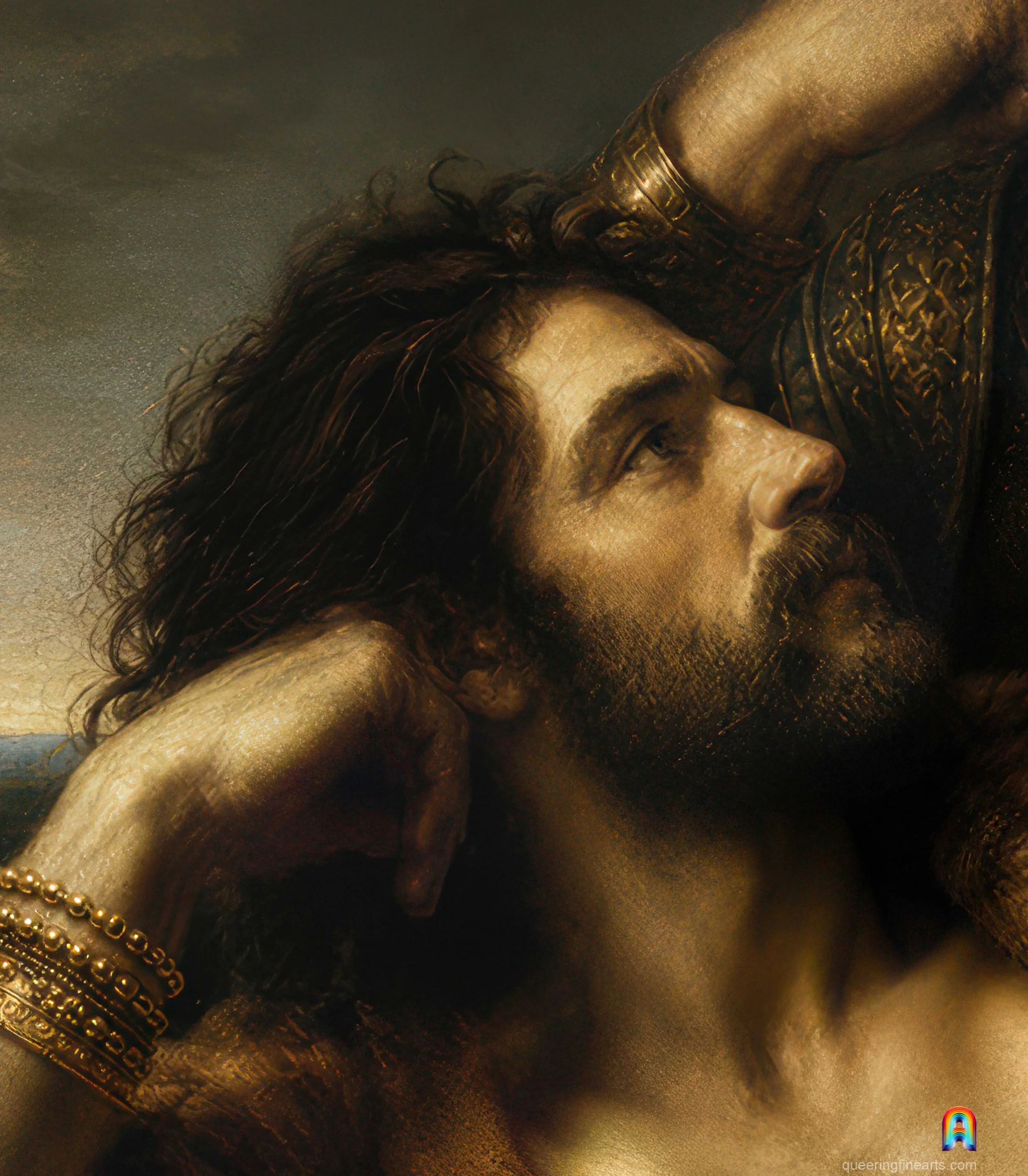
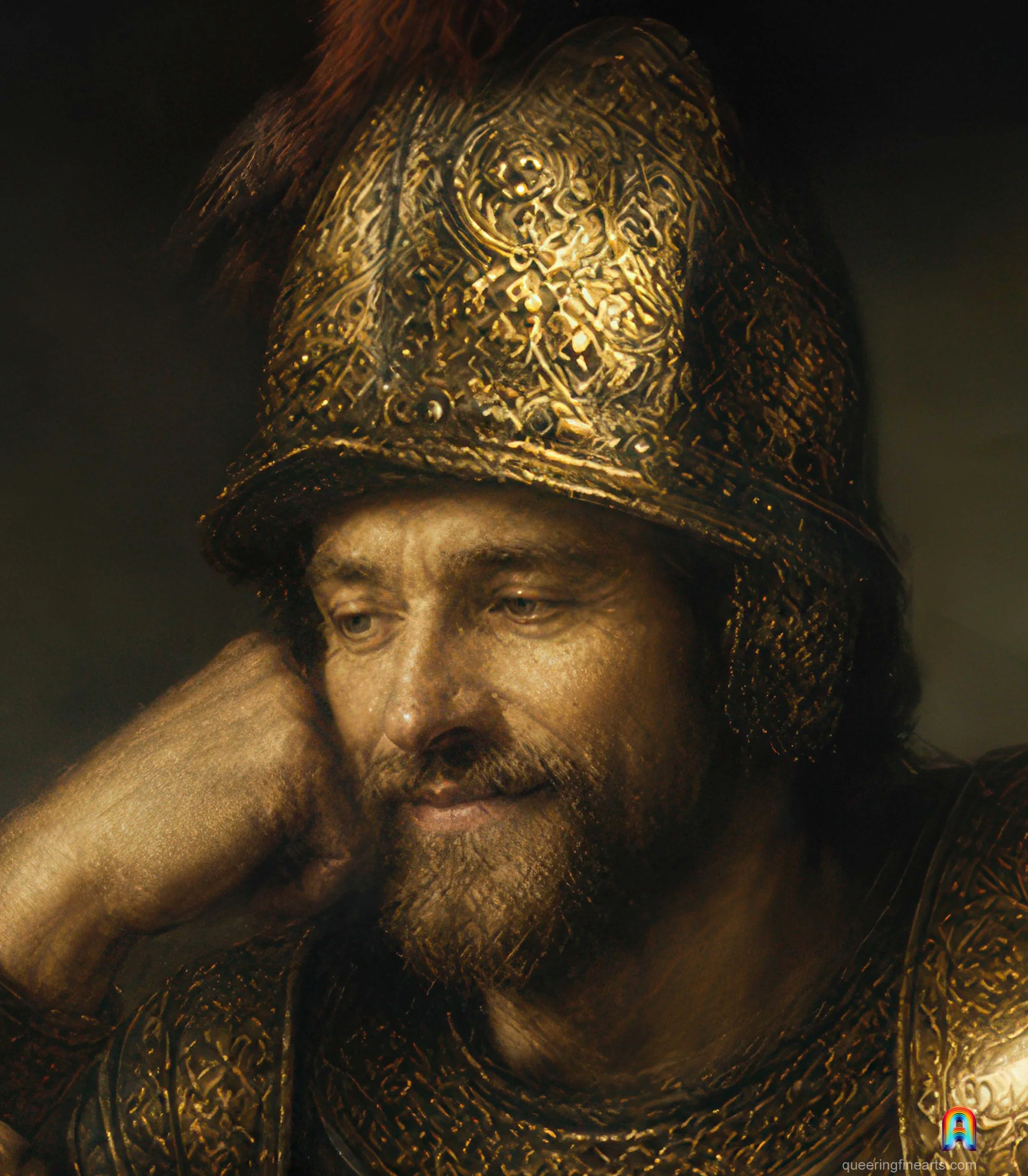
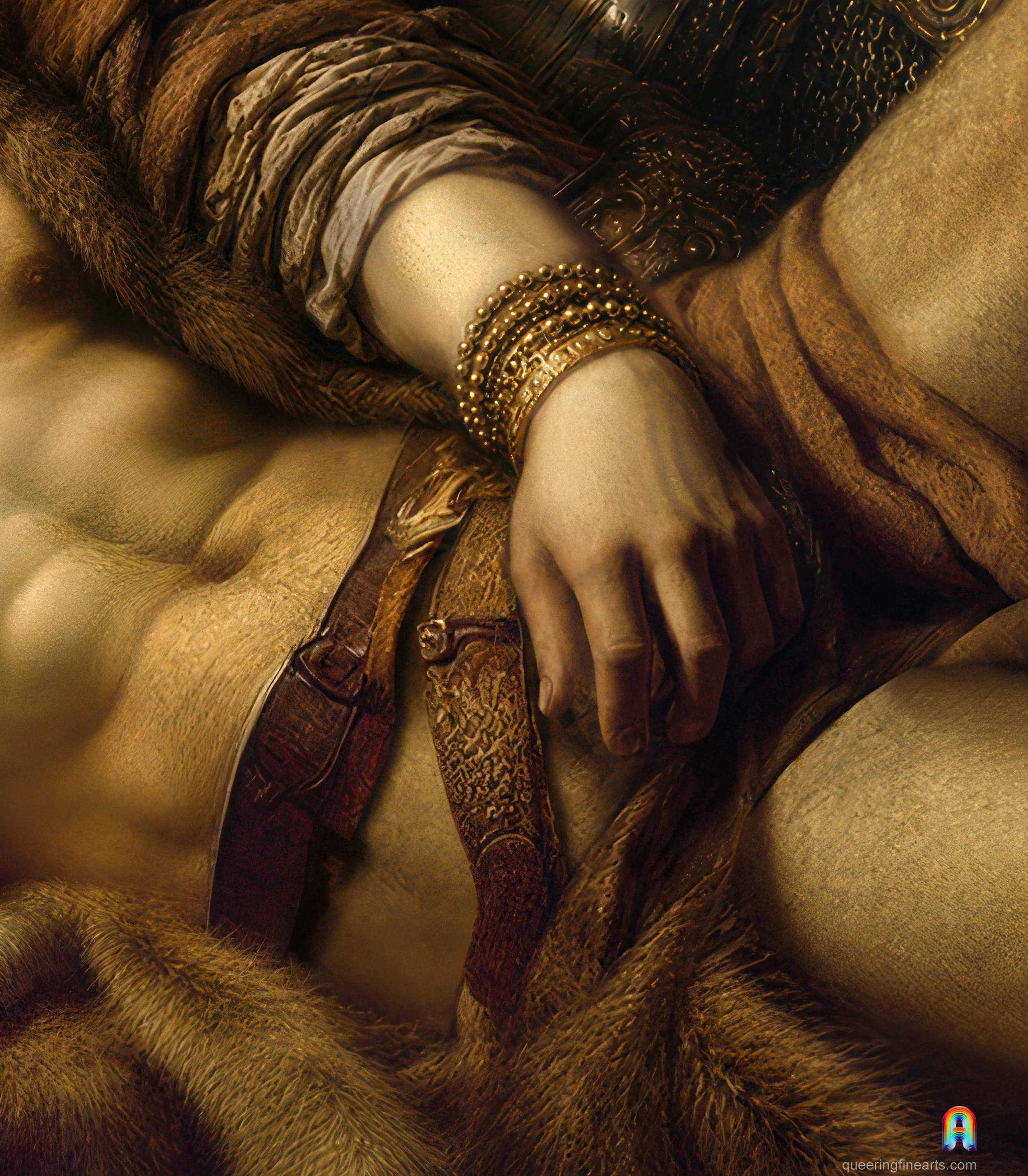
Two men occupy the entire dramatic space. One, nearly naked, reclines in a posture of carefully composed surrender, exposing his torso, thighs, and a vulnerability that is far from innocent. The other, armoured, helmeted, armed, at first appears to embody authority, control, and martial power. Yet the image subtly reverses these roles. The warrior leans forward with meditative gentleness. His smile is restrained, intimate, almost tender. His gaze is not directed toward the viewer, but toward the man lying beside him. It is there that the true subject of the painting takes shape.


Dramaturgy of Male Desire
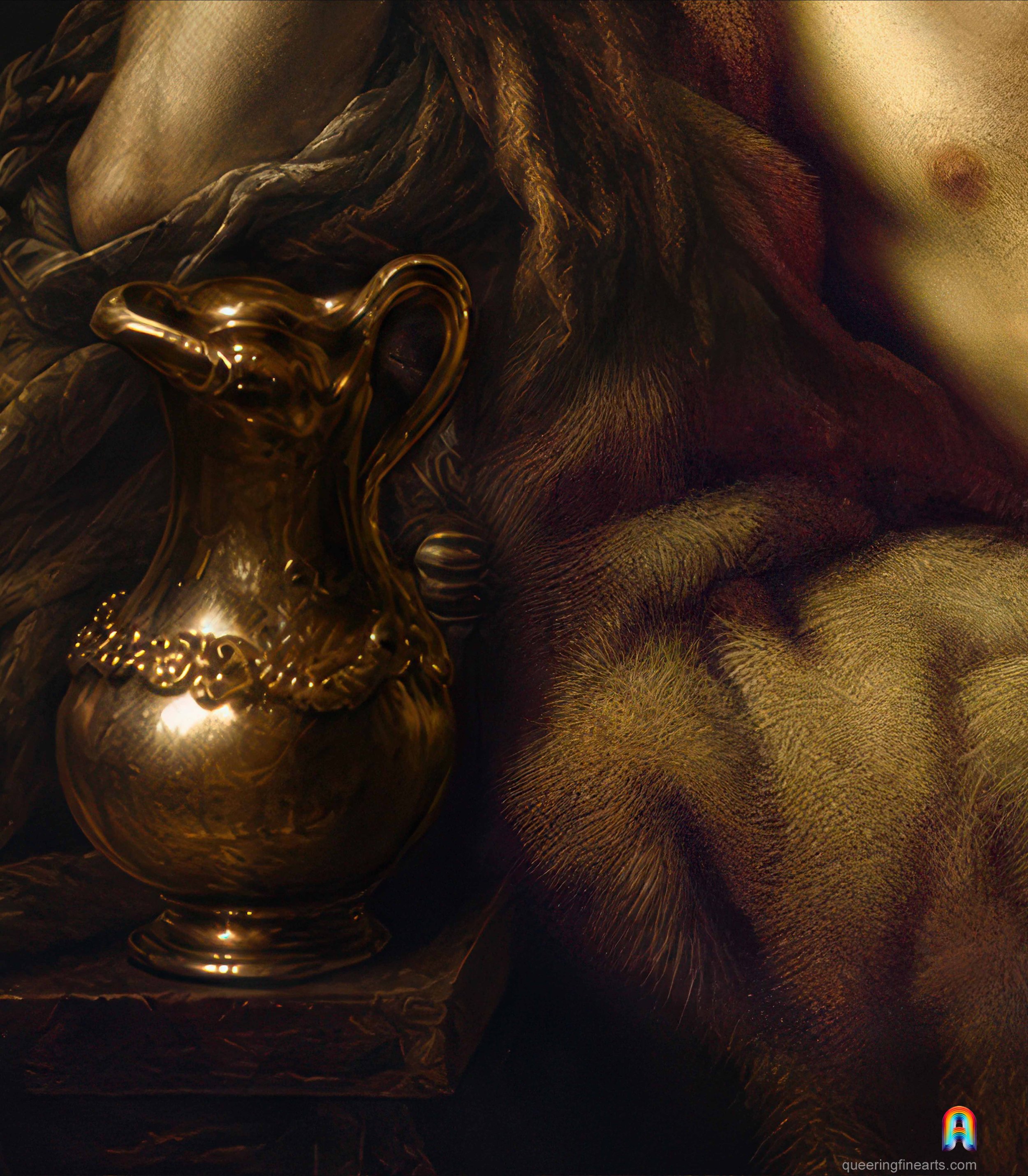
The reclining figure’s body is not treated as that of a prisoner, a suffering saint, or a wounded hero. It is offered to the gaze with calculated slowness. The twist of the pelvis, the raised leg, the studied relaxation of the arm, the skin warmed by amber light, the sensual contact between naked flesh and the sumptuous thickness of the fur upon which the body surrenders itself: everything belongs to the vocabulary of male pictorial eroticism.⁴ The fur adds an essential tactile dimension here. Its animal texture enters into a discreet dialogue with the figure’s beard, hairy torso, and masculine body hair, creating a sensual interplay between human warmth and living matter brought under refinement. But here desire does not circulate according to the familiar conventions of European high art. The desiring gaze is male, so too is the object of that desire, and the image itself seems to take pleasure in celebrating the beauty of that attraction.
The work also reveals a marked taste for borrowing, assemblage, and citation, processes entirely consistent with the visual culture of 17th-century workshops, where motifs, costumes, and accessories circulated from one composition to another.⁵
Vocabulary of Theatre
The monumental helmet immediately evokes The Man with the Golden Helmet, that work long attributed to Rembrandt before being more cautiously reassigned to the Rembrandtesque circle.⁶ But the quotation extends far beyond that isolated borrowing: the entire cuirass, with its sculpted plates, warm reflections, and almost ceremonial splendour, composes a figure of striking presence. We are confronted less with precise military equipment than with a visual construction designed to magnify the male body. Polished steel does not merely protect; it exalts. Opposite the naked flesh of the reclining man, this metallic second skin becomes a counterpoint charged with singular tension.
The accumulated bracelets on the reclining figure’s arms reprise the ornamental vocabulary of the Portrait of Saskia van Uylenburgh in sumptuous costume.⁷ The displacement is especially suggestive. Jewels associated with an opulent feminine representation become here instruments of male eroticisation. This shift unsettles gender assignments with remarkable freedom. The male body is not merely heroic or anatomical; it becomes precious, sensual, joyfully offered to the gaze.
In the foreground, the goldsmith’s object unfolding its golden reflections recalls the sumptuous accessories of Zacharias Writing the Name of His Son, Rembrandt’s great late work, bathed in the golden light characteristic of his final manner.⁸ As so often in this pictorial universe, such accessories are never incidental. They establish an atmosphere of luxury and ambiguous sacrality.
This accumulation of quotations contributes greatly to the eloquence of the work.
Homoeroticism as the Engine of the Composition
The work assembles fragments from the Rembrandtesque world only to profoundly redirect their meaning. The warrior’s helmet becomes an accessory of fantasy. The bracelets become homoerotic adornment. The goldsmith’s object intensifies the sensuality of the setting. Even chiaroscuro itself ceases merely to dramatise the scene: it becomes a complicit light, soft and carnal, made to protect the intimacy of embraces.⁹ The tenderness and complicity of the exchanged gaze, the physical proximity, the symbolic hierarchy between offered nudity and martial armour, along with the unsheathed sword held upright, an unmistakable phallic projection at the centre of the composition, all construct a scene of desire between men. A desire cultivated through the codes of history painting, fantasy portraiture, and Baroque visual theatre.
Attributed to the circle of Rembrandt, this work seems to reveal what 17th-century Dutch painting could sometimes contain in latent form: a troubling masculine sensuality, coded, sometimes displaced into other narratives, yet always ready to resurface once one agrees, at last, to look differently.
A Queer History Before Identity
As Dutch historian Theo van der Meer has shown, early modern Dutch society organised matters of sexual pleasure between men through moral, legal and religious frameworks, particularly that of sodomy, categories that described acts rather than identities.¹⁰ This distinction opens a fascinating historical perspective while leaving the human reality of desire fully present.
The Dutch Republic has often been imagined as exceptionally tolerant, and in many respects it was. Compared with other regions of Europe, Dutch urban culture allowed a remarkable degree of social experimentation, religious plurality, and personal latitude. This atmosphere shaped a society of unusual openness for its time, even if its limits remained defined by dominant moral and legal structures. Unlike England, where the Buggery Act of 1533 imposed the death penalty throughout the early modern period, the Dutch Republic saw only sporadic executions for sodomy before 1730, generally following public scandals rather than systematic prosecution.¹¹
This relative tolerance is part of a larger picture, that of a Dutch history where relationships between men have crossed the centuries, discreet at times but never extinguished, as vibrant as an underground spring. The work of historian D. J. Noordam makes clear that traces of these lives survive unevenly in the archives, sometimes as whispers, sometimes in judicial records, always reminding us of a human continuity far older than modern terminology.¹²
This creates a familiar historical paradox: what survives in the archives often reflects moments of exposure, while vast territories of ordinary life, affection, attachment, and private experience remain gently beyond their reach.
Fluid Affective Worlds
Queer historians have therefore learned to read beyond accusation in order to recover the broader textures of lived experience. Gert Hekma, one of the foundational scholars of queer history in the Netherlands, has emphasised that desire between people of the same sex appears not only in judicial cases, but through broader structures of sociability, friendship, gender performance, and cultural codes. Male intimacy in the Dutch Golden Age could inhabit magnificent zones of ambiguity that resist rigid modern categorisation. Passionate friendship, emotional dependency, admiration, patronage, and erotic possibility could coexist within affective worlds richer and more fluid than those later centuries sometimes allowed.

Private Life Within Institutions
One particularly fascinating and rarely discussed dimension concerns the role of domestic and institutional spaces. Much of male life in the Dutch Republic unfolded not only in public space, but also in environments where men lived in prolonged proximity: boarding houses, apprenticeships, ships, merchant lodgings, military quarters, university settings, and commercial residences. The household itself operated according to social structures far more varied than the compact family model familiar to many modern readers. Young men often entered systems of dependency, training, service, and patronage that placed them in emotionally charged relationships with older men, masters, employers, mentors, or companions. Queer historians increasingly remind us that intimacy often springs from daily familiarity, shared trust, common habits, and the simple joy of a presence that has become essential.
Port of Every Possibility
The Dutch Republic was also profoundly shaped by maritime life, a particularly evocative factor in any history of male intimacy. A sea-oriented empire created prolonged all-male environments, very different from most domestic settings on land. Months or years at sea gave rise to worlds of hierarchy, discipline, bodily proximity, ritual, emotional interdependence, and shared endurance. Historians of relations between men in early modern Europe have repeatedly identified ships, ports, and maritime cultures as spaces where other forms of life became imaginable.¹³ Amsterdam, one of the greatest ports in Europe, fully belonged to this geography of movement and possibility. Sometimes freedom took on a very concrete face there: men could cross paths, recognise each other, love each other.
Words for Saying It
Another illuminating perspective emerges from the language of friendship itself. Correspondence between men in the early modern period can strike contemporary readers by its intensity, affection, and at times almost devotional character. This was part of the emotional vocabulary of the age. Men wrote of longing, fidelity, admiration, absence, and attachment in registers that later centuries often narrowed. Queer scholarship rightly resists simplistic equivalences between emotional language and erotic relationships, while preserving space for the affective richness such language reveals. Consider the correspondence between the Amsterdam merchant Pieter de la Court and the statesman Johan de Witt. Their letters, preserved in the National Archives in The Hague, have attracted attention for their striking emotional intensity within the conventions of early modern friendship.¹⁴ Whatever the exact nature of that attachment, this affective warmth continues to cross the centuries with remarkable force.
A Dutch Institutional Patchwork
This phenomenon formed part of a broader European landscape. In 17th-century England, comparable networks existed, later taking institutional form in the specialised molly houses of the 18th century.¹⁵ What distinguishes the Dutch case lies less in the existence of same-sex desire, a profoundly human constant, than in the particular institutional frameworks through which society interpreted and managed it: a patchwork of Calvinist consistories, maritime tribunals, and civic authorities with overlapping jurisdictions.
There is also the illuminating question of archival visibility and social privilege. Judicial records preserve certain lives in extraordinary detail, particularly those of servants, soldiers, labourers, sailors, drifters, and socially vulnerable men. Elites often moved within more discreet circuits, shaped by reputation, wealth, patronage, and private life. Queer historiography has taught us to recognise that visibility itself follows social logics, and that the silence of the archives can sometimes speak with as much eloquence as the testimonies that survive.
Networks Beneath the Surface
Amsterdam itself was a city of thresholds: prosperous, cosmopolitan, maritime, crowded with merchants, sailors, soldiers, servants, apprentices, foreigners, and passersby. Such cities have historically created remarkable possibilities for encounters escaping the immediate gaze of the social structures of their time.
In a context of religious, social, and political anxiety, men accused of sodomy became an ideal target: minorities, already morally condemned, easily cast as symbolic agents of collective disorder.
The great moral panic of 1730-1731, when Dutch authorities prosecuted hundreds of men, condemning approximately seventy-five to one hundred of them to death while many others were banished or imprisoned, revealed networks, meeting places, and forms of male sociability that had long existed beneath the surface.¹⁶ Even this difficult chapter ultimately confirms continuity: these human bonds had long formed part of urban life.
Looking Differently at Paintings of Men
Dutch art itself belonged to a broader European visual culture that celebrated admiration for the male body through classical, biblical, martial, and allegorical imagery. Even in a Protestant mercantile republic often associated with sobriety, the visual language of masculine beauty remained fully legible. The erotic sometimes appeared explicitly, sometimes more subtly, while aesthetic appreciation of the male form, costume, gesture, and presence already formed part of that culture’s visual literacy. As art historian Eric Jan Sluijter has shown, Dutch Golden Age painting invested deeply in the representation of male bodies, not only in explicitly martial or biblical scenes, but also in the more relaxed display of muscular workers and graceful young men in studio and genre scenes.¹⁷ H. Perry Chapman has further demonstrated how Rembrandt’s constant staging of masculine persona belonged to a complex performance of identity.¹⁸
And so we look differently at Dutch paintings of men.
As traces of a culture deeply invested in the staging of masculinity itself.

Presence Beneath Velvet and Steel
Rembrandt’s militia portraits, with their bodies pressed against one another, velvet, steel, gloved hands, ceremonial command, and theatrical light, offer something profoundly captivating: a world in which masculine presence, admiration, hierarchy, beauty, and intimacy were already richly choreographed.
Queer history leads us toward a truer reading of the past; it restores to human history some of its lost warmth. It reminds us that desire between men has not only endured across the centuries, but has also given rise to tenderness, beauty, attachment, pleasure, and deeply real forms of happiness.
QFA
Curiosity piqued?
1. Simon Schama, The Embarrassment of Riches: An Interpretation of Dutch Culture in the Golden Age, New York, Alfred A. Knopf, 1987.
2. Gert Hekma and Kent Gerard (eds.), The Pursuit of Sodomy: Male Homosexuality in Renaissance and Enlightenment Europe, New York, Harrington Park Press, 1989; Gert Hekma, “Same-Sex Relations among Men in Europe, 1600-1900,” in George E. Haggerty and Molly McGarry (eds.), A Companion to Lesbian, Gay, Bisexual, Transgender, and Queer Studies, Oxford, Blackwell, 2007, pp. 173-191.
3. Ernst van de Wetering, Rembrandt: The Painter at Work, Amsterdam, Amsterdam University Press, 1997.
4. James M. Saslow, Pictures and Passions: A History of Homosexuality in the Visual Arts, New York, Viking, 1999.
5. Svetlana Alpers, Rembrandt’s Enterprise: The Studio and the Market, Chicago, University of Chicago Press, 1988.
6. Ernst van de Wetering et al., A Corpus of Rembrandt Paintings, vol. 6, Dordrecht, Springer, 2015.
7. Gary Schwartz, Rembrandt: His Life, His Paintings, New York, Viking, 1985.
8. Christian Tümpel, Rembrandt: Myth and Method, London, Haus Publishing, 1986.
9. Mieke Bal, Reading Rembrandt: Beyond the Word-Image Opposition, Cambridge, Cambridge University Press, 1991.
10. Theo van der Meer, “Are Those People Like Us? Early Modern Homosexuality in Holland,” in Katherine O'Donnell and Michael O'Rourke (eds.), Queer Masculinities, 1550-1800, London, Palgrave Macmillan, 2006, pp. 53-70; Jonas Roelens, Citizens and Sodomites in the Eighteenth-Century Dutch Republic, Leiden, Brill, 2020.
11. Theo van der Meer, Sodoms zaad in Nederland: Het ontstaan van homoseksualiteit in de vroegmoderne tijd, Nijmegen, SUN, 1995; Alan Bray, Homosexuality in Renaissance England, New York, Columbia University Press, 1995.
12. D. J. Noordam, Riskante relaties: vijf eeuwen homoseksualiteit in Nederland, 1233-1733, Hilversum, Verloren, 1995.
13. Randolph Trumbach, “The Birth of the Queen: Sodomy and the Emergence of Gender Equality in Modern Culture, 1660-1750,” in Martin Duberman, Martha Vicinus and George Chauncey Jr. (eds.), Hidden from History: Reclaiming the Gay and Lesbian Past, New York, New American Library, 1989, pp. 129-140.
14. Herbert H. Rowen, John de Witt: Grand Pensionary of Holland, 1625-1672, Princeton, Princeton University Press, 1978.
15. Alan Bray, Homosexuality in Renaissance England, New York, Columbia University Press, 1995; Randolph Trumbach, Sex and the Gender Revolution, vol. 1, Heterosexuality and the Third Gender in Enlightenment London, Chicago, University of Chicago Press, 1998.
16. Theo van der Meer, Sodoms zaad in Nederland: Het ontstaan van homoseksualiteit in de vroegmoderne tijd, Nijmegen, SUN, 1995; D. J. Noordam, Riskante relaties: vijf eeuwen homoseksualiteit in Nederland, 1233-1733, Hilversum, Verloren, 1995.
17. Eric Jan Sluijter, Seductress of Sight: Studies in Dutch Art of the Golden Age, Zwolle, Waanders, 1999.
18. H. Perry Chapman, Rembrandt’s Self-Portraits: A Study in Seventeenth-Century Identity, Princeton, Princeton University Press, 1990.