


He Returneth unto Him That Loveth Him
After Die Toteninsel (Isle of the Dead) by Arnold Böcklin (1827-1901)
A possible sixth version of the work, long unknown, surfacing from a private European collection at a most opportune moment, in these light-starved times.
Oil on canvas, date unknown
Private collection
At Eternity’s Threshold, Love
Long before Böcklin, the idea of an Isle of the Dead already haunted the European imagination. Beyond the western seas, ancient traditions envisioned mysterious islands toward which souls continued their journey after death. Classical authors preserved accounts associated with the Celtic world in which ferrymen bore the dead toward those unseen shores, while certain Germanic traditions likewise placed the realm of the dead upon distant island lands, somewhere in the fading light of the west.
This reinterpretation of Isle of the Dead immediately adopts Böcklin’s iconic composition¹. Yet beneath this apparent fidelity, a subtle variation decisively shifts the work’s emotional horizon.
Above the island, the sky unfolds a restless architecture of heavy clouds, remnants of a storm whose turbulence seems to hesitate before dispersing. Violet, brown, and ash-grey masses drift and collide in slow celestial agitation, while a weakened light still searches for passage through their folds. The entire atmosphere appears suspended in that uncertain moment when turmoil begins to subside, though calm has not yet fully returned.
The sea, nearly motionless, spreads its dark waters with grave stillness. The surf fades into the slow breathing of deep waters, a shadowed mirror reflecting the mass that rises before us.
The island asserts itself with monumental force
A rocky monolith rising from the waters, it appears as an archaic presence, torn from the depths like a fragment wrested from the earliest ages of the world. Its sheer cliffs, abrupt faces, and inhospitable masses of stone proclaim a fierce sovereignty. Yet warm light catches certain surfaces of the rock, awakening golden ochres that soften this monumental austerity and subtly disturb its original severity. The island retains all its funerary power, but this radiance introduces a singular ambiguity, as though this fortress apart from the world might nonetheless harbour, at its heart, the possibility of welcome. Tall black cypresses, clustered like a funerary guard, thrust their silhouettes toward the troubled sky, heightening still further the solemn and sepulchral character of the whole.
And yet, at the heart of this stone citadel, an opening irresistibly draws the eye. A waterside façade, framed by pale pillars, marks the point of passage into this enclosed realm. Behind it, an architecture partially carved into the rock suggests a sanctuary, a funerary dwelling, or some ancient city of silence. Around this threshold, sunlight animates the water’s surface with shimmering reflections that stand in contrast to the mineral gravity of the whole, as though life itself still persisted in trembling at the foot of this kingdom of silence. The entire composition converges toward this almost sacred breach.
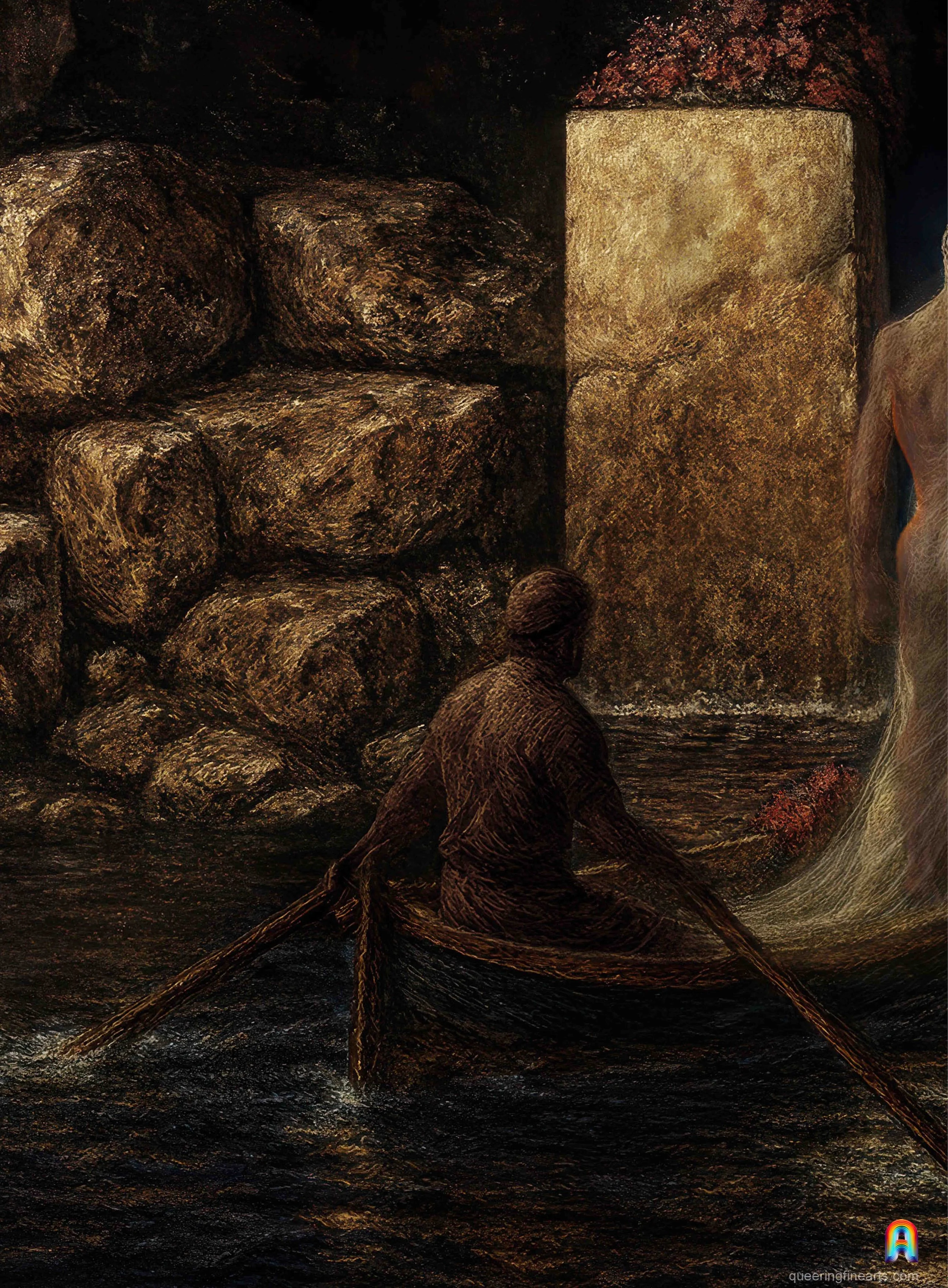
In the foreground, a ferryman, dark silhouette seen from behind, handles the oars with the ritual slowness of an immemorial gesture. Before him stands a figure wrapped in a light shroud, motionless, suspended between human presence and apparition. Through the translucent fabric, one senses the solid frame of a man whose full attention is fixed upon his eternal destination.

A fidelity that is only apparent
But this apparent fidelity conceals a profound metamorphosis.
The most significant intervention occurs at the island’s entrance. Where the original painting leaves the architectural space silent and uninhabited, a figure now waits in the shadow of the central portal. Standing at the top of a few steps, touched by discreet light, he appears as a welcoming presence. His calm, upright posture contrasts with the slow advance of the boat.
The architecture itself has been enriched and transformed. The island is no longer merely an abstract funerary mass pierced with sepulchral niches. It now more clearly resembles a sanctuary of beatitude carved into stone, with a monumental gateway framed by columns, terraces, and built elements evoking a funerary city or forgotten temple. The composition no longer rests solely on the notion of arrival at death. The presence of the waiting figure transforms the reading entirely: the destination becomes a place of encounter.
The work profoundly alters the emotional charge of the final voyage. Where Böcklin suggested a form of stoic resignation before the mystery of death, this version makes room for anticipation, fidelity, and the promise of reunion. The crossing leads toward a beloved presence.

The Creator of Die Toteninsel (Isle of the Dead)
Part of this evocative power also lies in the vision of its creator. Arnold Böcklin was a 19th-century Swiss painter, born in Basel in 1827 and deceased in Florence in 1901². He belongs to that constellation of artists commonly described as Symbolists, though his world does not fit neatly within any single school³. In his work, landscape becomes a mental stage. Nature is always charged with meanings that exceed the visible.
Haunting Images
Böcklin spent much of his life in Italy⁴, something deeply felt in both his palette and his compositional sensibility. His paintings breathe antiquity, ruins, myth, and Mediterranean gardens suffused with muted strangeness. His ambition was not to paint reality, but the soul of things. He is said to have wished to create visions rather than scenes.
Isle of the Dead
His most famous work, Isle of the Dead, exists in five painted versions produced between 1880 and 1886⁵. In each, a boat approaches a rocky island enclosed by towering cliffs and crowned with cypresses resembling funerary columns. In the boat, a white-draped figure stands beside a coffin. Is this a mourner accompanying the dead, or the soul of the deceased confronting its own passage? Böcklin never decides. The action is minimal, and yet everything is there. The painting operates like a dream laid bare, a mental image of threshold, passage, and separation. It explains nothing. It leaves everything to the viewer.
A Worldview
Böcklin rejects realism. His landscapes are interior states. Isle of the Dead may be read as the ultimate crossing toward a place of memory or oblivion. This way of painting myth without illustrating a specific narrative anticipates part of Symbolist art⁶ and even certain avant-gardes of the 20th century. Böcklin seeks pure allegory, freed from narrative detail.
Five Variations on the Same Dream
Rather than repeating a single image, Böcklin allowed Isle of the Dead to evolve across its five versions, subtly altering light, atmosphere, and emotional intensity. Taken together, they trace a progression from restrained funerary meditation toward darker, more oppressive imaginings, before softening again in their later incarnations
The first version possesses a deeply moving awkwardness. Nothing is yet entirely settled, whether in style or proportion. The sea is paler, the cypresses less theatrical. One senses Böcklin still searching for the exact form of his idea. Certain perspectival awkwardnesses reinforce that impression: the volumes at times seem simplified almost to the point of strange frontality, as though the space itself hesitated between landscape, mental architecture, and inner vision. This simplification of mass lends the whole a curiously modern presence, almost prophetic of the painting of the century to come.
That sincerity may stem from the fact that this first painting was not yet burdened by its future reception. It was not yet trying to be Isle of the Dead: it was becoming it. The later versions are more controlled, more dramatic, more compressed, but they also carry an awareness of their own image-power. The first proceeds by touch, and that is precisely what makes it so intimate and so true.

Legacy
Even today, Böcklin exerts a lasting fascination. He occupies a singular place: too visionary to be classified among academic painters, too solitary to belong fully to any movement. Isle of the Dead remains one of the most recognisable images in the history of art, a concentrated dream of melancholy and mystery.
An Image That Became Music
Isle of the Dead has exerted a powerful fascination on composers. The most famous example remains Sergei Rachmaninoff’s Isle of the Dead, op. 29 (1909), a symphonic poem inspired by a black-and-white reproduction of the painting⁷, whose obsessive rhythm evokes the ferryman’s slow crossing toward the funerary island. But he was not alone. Heinrich Schulz-Beuthen (1890)⁸ and Andreas Hallén (1898)⁹ had already composed symphonic poems titled Die Toteninsel in the late 19th century, while Max Reger devoted one movement of his Vier Tondichtungen nach A. Böcklin(1913)¹⁰ to this spectral vision. Other composers, into the contemporary era, have continued to extend this musical imaginary.
An Endlessly Revisited Icon
Beyond classical music, the work has permeated a broader visual and sonic imagination. Its iconography has appeared on album covers, been cited or evoked by contemporary artists ranging from darkwave to atmospheric metal, while its melancholic climate has inspired songs and more experimental creations. More broadly still, Isle of the Dead has become an archetypal image of passage into the beyond, continually revisited in cinema, fantastic literature, and the visual arts, far beyond the Symbolist circle that first gave it life.

He Returneth unto Him That Loveth Him
Arnold Böcklin did not paint a queer work. And yet Isle of the Dead offers an almost ideal framework for a queer reinterpretation, precisely because it is built upon silence, threshold, mystery, and inward projection. Nothing in it is explicitly narrated, and it is precisely that openness that makes the image available to other stories.
Böcklin himself is not entirely disconnected from figures now revisited through queer history: he notably painted Sappho¹¹, a foundational figure in modern lesbian cultural memory¹². But it is above all the Symbolism with which his work is associated that opens fertile ground here. This movement privileges inner worlds, veiled desires, allegorical visions, and deliberately incomplete narratives¹³. It suggests more than it declares, allowing the image to evoke the unspeakable.
Isle of the Dead pushes that logic to a rare degree. The work provides neither precise narrative, nor clearly defined identities, nor any single explanatory key. Who is the standing figure in the boat? A deceased soul? A living mourner accompanying a coffin? A spirit in passage? Böcklin refuses to decide. This suspension of meaning makes the image less a closed narrative than a mental space offered to interpretation.
It is precisely there that the queer reinterpretation finds its legitimacy. Western history has so often consigned love between men to silence, coding, or erasure¹⁴ that returning to an image itself constructed around the unsaid is anything but incidental. He Returneth unto Him That Loveth Him does not claim to reveal some hidden meaning in Böcklin. It chooses instead to inhabit the space he left open.


Silence Finally Receives a Story
The title provides the emotional key. It does not present death as definitive separation, but as movement toward the one who still loves. No longer an abstract passage into the afterlife, it becomes a journey directed by love. There is something profoundly moving in this idea, because it inverts one of our most universal experiences of grief: irreversible severance. Here, the lost being is not condemned to absence. Death itself becomes the path toward reunion.
The man covered by the shroud, brought by the ferryman, is no longer simply an anonymous figure travelling toward death. He becomes a man being led toward one final encounter. At the top of the gateway steps, another man waits, hand extended. These are two lovers separated by death, finally reunited.
A Narrative Reversal That Transforms Everything
The island appears as a place of reunion. The gesture of the welcoming figure, arm raised in an immediately legible movement, fills the scene with a deeply human emotion: that of a long-awaited reunion finally fulfilled. As the gaze tightens on this portion of the composition, details that were less perceptible at first begin to emerge, notably the flowers crowning the pillars of the gateway. Suddenly, this area of the image becomes charged with life and joy, transforming the threshold into a place of welcome, warmth, and love. Everything leads toward that suspended moment when separation comes to an end: the slow approach of the boat, the silent call of the one who waits, the imminent promise of an embrace, joyful effusions, and tenderness rediscovered.
This transformation remains strikingly faithful to Böcklin’s deeper logic. His image has always spoken of passage, threshold, the unknown, an inaccessible elsewhere. But where the painter’s versions suggest a crossing toward silence or erasure, this reinterpretation offers something else: continuity of attachment.

A Queer Perspective
Western history has abundantly produced narratives in which love between men is obstructed, silenced, condemned, or destroyed. Even where such bonds existed, they were often denied explicit representation or relegated to subtext. To imagine Isle of the Dead as the place where two men, finally freed from those old constraints, are reunited is to overturn that logic.
Death No Longer Becomes Separation, but Restoration
The island is no longer a destination of mourning, but a form of utopia. A place outside the world where what was denied by societies, unjust laws, or oppressive moral systems may at last exist without threat, in a sanctuary of peace bathed in light, where love waits at the threshold. The image no longer speaks of an ending. It speaks of fulfilment, eternal felicity, joyful conversations beside clear springs, and nights of limitless rapture.
Across religions and mythologies, human beings have often imagined that death does not wholly undo the bonds of love. The Greeks dreamed of the Elysian Fields and the Isles of the Blessed; the Egyptians conceived of the Field of Reeds as a luminous afterlife where the dead might recover a world made peaceful, familiar, and habitable; certain Eastern traditions have envisioned, through cycles of rebirth or continuities of the soul, forms of attachment enduring beyond a single lifetime; many Indigenous or animist cosmologies have imagined the dead as remaining present in other ways, within a continuity between the visible and invisible worlds; Christianity placed at the heart of its hope the resurrection and the promise of a communion that triumphs over separation; myth itself sent Orpheus down in search of Eurydice, as though love might demand passage even into the realm of the dead. None of this proves anything, of course. But it does show that such an intuition has been seriously imagined, longed for, and articulated by entire civilizations.
If so many human imaginations have glimpsed, each in their own way, a bond stronger than death, why not leave that profoundly human possibility open, if only for a moment? Why should love, so often defeated across the centuries, not find, in one of those beautiful stories we set against silence, somewhere beyond the visible world what it was so often denied?
After so many crossings toward absence, the boat finally leads toward Love.
QFA

Inside the Making of a Reimagined Böcklin
How and why I drew from different versions of Isle of the Dead to create a new emotional destination
When reimagining Arnold Böcklin’s Isle of the Dead, I was never interested in simply reproducing a single existing version. What fascinated me instead was the possibility of entering into dialogue with the full visual evolution of the motif, borrowing deliberately from different iterations in order to construct something emotionally new.
Böcklin returned repeatedly to this haunting composition, refining and transforming it across the five generally recognized versions, though the idea of a possible sixth has occasionally surfaced. Each possesses its own emotional logic, atmospheric weight, and pictorial solutions. Rather than treating one as definitive, I approached them as a visual vocabulary from which to compose a new narrative.
The strongest architectural influence came from the third version (III) (Berlin, 1883) and the fifth version (V) (Leipzig, 1886). From Berlin, I was drawn to the severe verticality of the cypresses and the monumental compression of the island itself. In that version, the island ceases to feel like landscape and becomes something closer to an inevitable threshold. That emotional gravity mattered deeply to me, because the reinterpretation needed first to feel recognizably Böcklinian. The viewer had to enter familiar territory of solemn passage before discovering that the emotional logic had changed.
From Leipzig, I borrowed much of the pictorial richness. Its rocky formations possess greater material complexity, with warmer tones, richer textures, and a more elaborate interplay between architecture and stone. I wanted the island not merely to suggest nature, but a constructed realm of memory, ritual, and symbolic permanence.
The sea also owes much to the fifth version (V). I deliberately chose a darker, more physically present body of water, one that could preserve Böcklin’s atmosphere of stillness while creating a deeper sense of emotional immersion. Water here is not decorative. It is the psychological distance that must be crossed.
The sky emerged from a synthesis between the emotional severity of the third version (III) and the more painterly chromatic complexity of the fifth version (V). I wanted clouds that retained the symbolic weight of Böcklin’s universe without flattening the composition into pure despair. The atmosphere needed to remain solemn, but not hopeless.
The standing figure in the boat naturally derives from the second version (II) (New York, 1880), where Böcklin introduced the now-iconic upright passenger beside the coffin. That silhouette is indispensable to the motif’s recognizability. Retaining it preserves the viewer’s initial assumptions. But preserving the symbol does not mean preserving its meaning.
I chose, however, not to retain the coffin itself, even though its presence would not necessarily have contradicted the emotional logic of the reinterpretation. A posthumous reunion could certainly have accommodated it. But visually, the coffin anchors the image too firmly in literal death. Removing it allowed the scene to remain more open, less about the material fact of death than about passage, longing, and arrival.
The most important transformation lies elsewhere.
Böcklin’s original conception offers arrival without reunion. His island receives, but does not welcome. Silence is the destination.
My reinterpretation required the opposite.
This shift was not simply narrative. It was also tied to a broader queer artistic concern. Representation matters, certainly, but so does the emotional nature of that representation. Queer imagery has so often been shaped by loss, secrecy, punishment, coded desire, or historical erasure. While those realities remain part of our cultural memory, I am equally interested in creating images that make room for light, beauty, tenderness, hope, and emotional repair. It was not enough for me simply to place queer presence within Böcklin’s world. I wanted to imagine a queer emotional horizon shaped not only by longing, but by the possibility of joy.
The floral elements atop the gateway pillars were introduced for that very reason. In Böcklin, the architectural threshold remains austere, severe, almost forbidding. Here, I wanted subtle visual signals that, upon closer inspection, would begin to alter the emotional reading. From afar, the scene remains recognizably somber. But as the eye approaches the threshold, traces of life emerge.
Texture mattered enormously in achieving this transformation. I was especially drawn to the pictorial surface of the fifth version (V), whose richly veined, almost organic rock formations possess a tactile vitality absent from some of the more austere treatments. That material sensuality helped support the conceptual shift. Even within a funerary landscape, life had to remain perceptible.
The palette was equally deliberate. The warmer ochres, muted golds, and mineral browns owe much to Leipzig, while the uncompromising dark verticality of the cypresses recalls Berlin. This balance allowed me to preserve Böcklin’s solemn symbolic language while gently opening it toward something emotionally more complex.
What interested me most was not rejecting Böcklin’s visual world, but redirecting its emotional destination.
At first glance, the image still appears to belong entirely to his familiar symbolic universe: death, silence, passage, monumental stillness. But that familiarity becomes a kind of visual misdirection. Slowly, the emotional grammar changes. The flowers. The softened threshold. The subtle suggestion of welcome.
What begins as an image of death becomes an image of reunion.
This was never intended as pastiche, nor merely as homage. It was an attempt to preserve Böcklin’s extraordinary visual language while asking whether one of Western art’s most haunting journeys might, just once, lead somewhere else.
QFA

Curiosity piqued?
1. Rolf Andree, Arnold Böcklin: Die Gemälde, Basel and Munich, Friedrich Reinhardt Verlag / Bruckmann, 1977, catalogue raisonné, entries nos. 366, 371, 375, 378, 380.
2. Ibid.
3. Michelle Facos, Symbolist Art in Context, Berkeley, University of California Press, 2009, pp. 67-69.
4. Rolf Andree, Arnold Böcklin: Die Gemälde, Basel and Munich, Friedrich Reinhardt Verlag / Bruckmann, 1977.
5. Ibid.
6. Michael Gibson, Symbolism, Cologne, Taschen, 1995, pp. 92-95.
7. Max Harrison, Rachmaninoff: Life, Works, Recordings, London and New York, Continuum, 2005, pp. 148-152.
8. Christoph Hust, Heinrich Schulz-Beuthen (1838-1915): Ein deutscher Wagnerianer in Zürich, Berlin, Kuhn, 1999.
9. Folke Lindberg, Andreas Hallén: En biografi, Gothenburg, 1955.
10. Christopher Anderson, Max Reger and Karl Straube: Perspectives on an Organ Performing Tradition, Aldershot, Ashgate, 2003.
11. Rolf Andree, Arnold Böcklin: Die Gemälde, Basel and Munich, Friedrich Reinhardt Verlag / Bruckmann, 1977.
12. Joan DeJean, Fictions of Sappho, 1546-1937, Chicago, University of Chicago Press, 1989.
13. Michelle Facos, Symbolist Art in Context, pp. 23-25; Whitney Davis, “Homoerotic Art Collection from 1750 to 1920,” Art History, vol. 24, no. 2, 2001.
14. Eve Kosofsky Sedgwick, Epistemology of the Closet, Berkeley, University of California Press, 1990; John Boswell, Christianity, Social Tolerance, and Homosexuality, Chicago, University of Chicago Press, 1980; Guido Ruggiero, Machiavelli in Love, Baltimore, Johns Hopkins University Press, 2007; Randolph Trumbach, Sex and the Gender Revolution, Chicago, University of Chicago Press, 1998.