

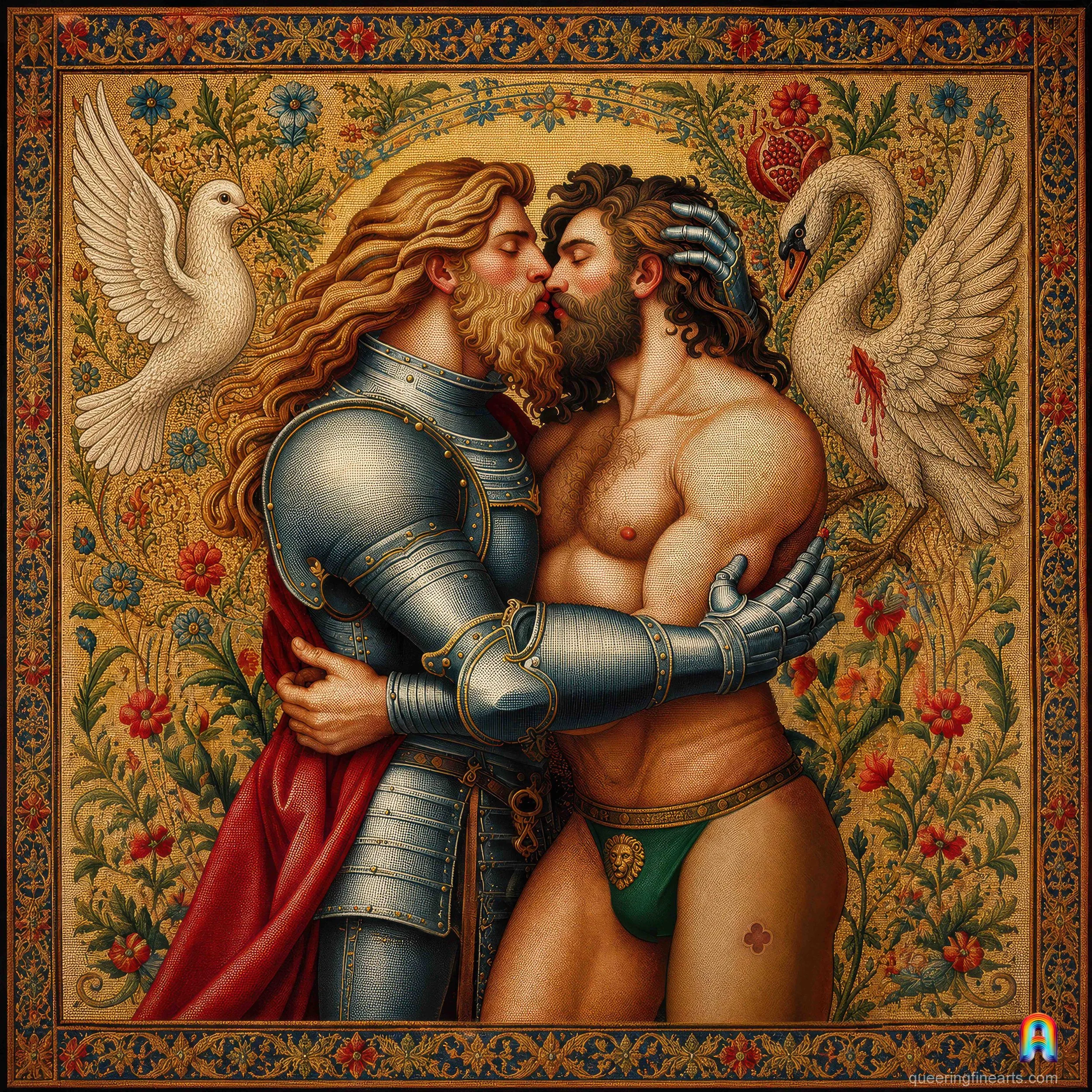
Never to Be Parted
Ami and Amile
Petit point tapestry
Wool and silk, late 19th century
Private collection
Love and Miracle
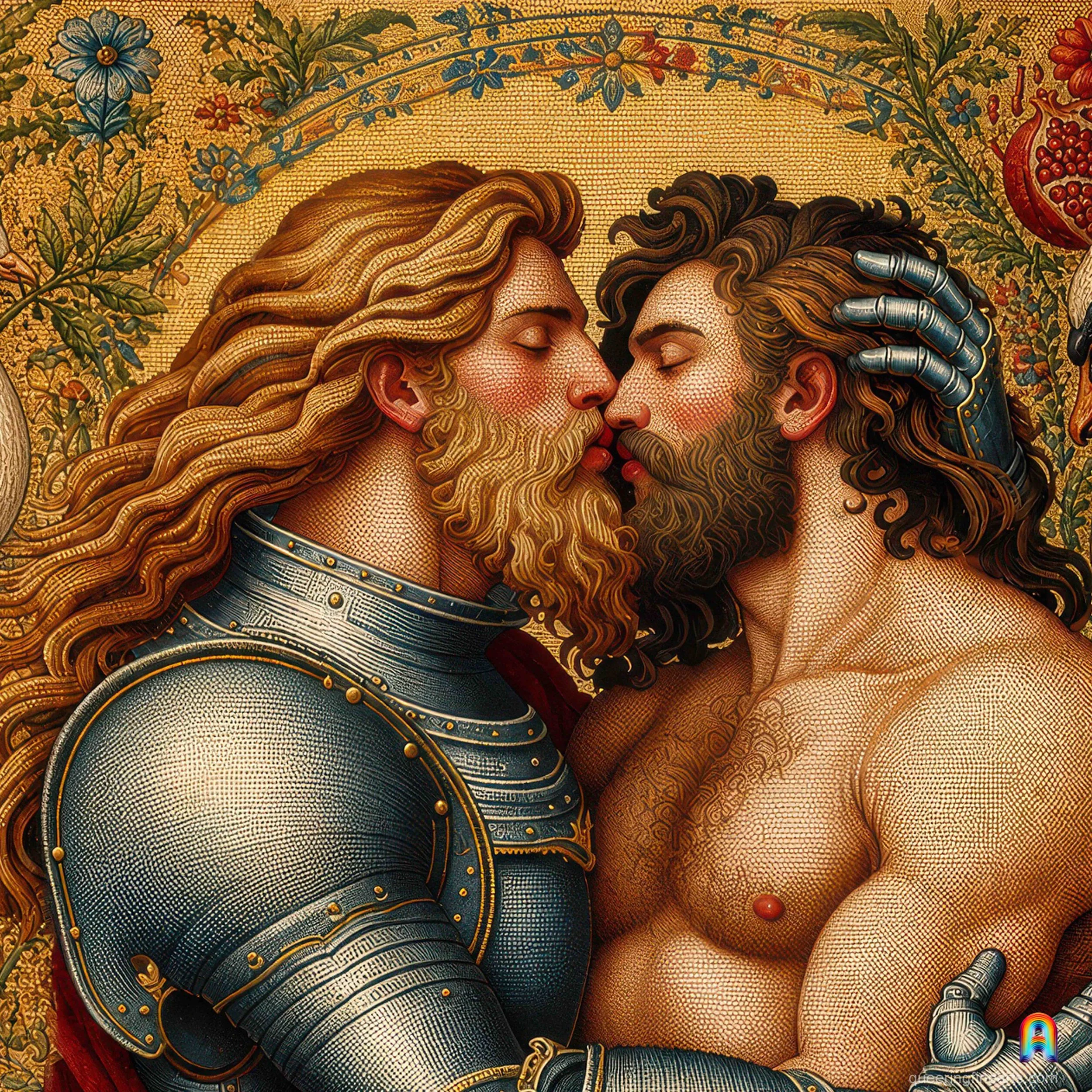
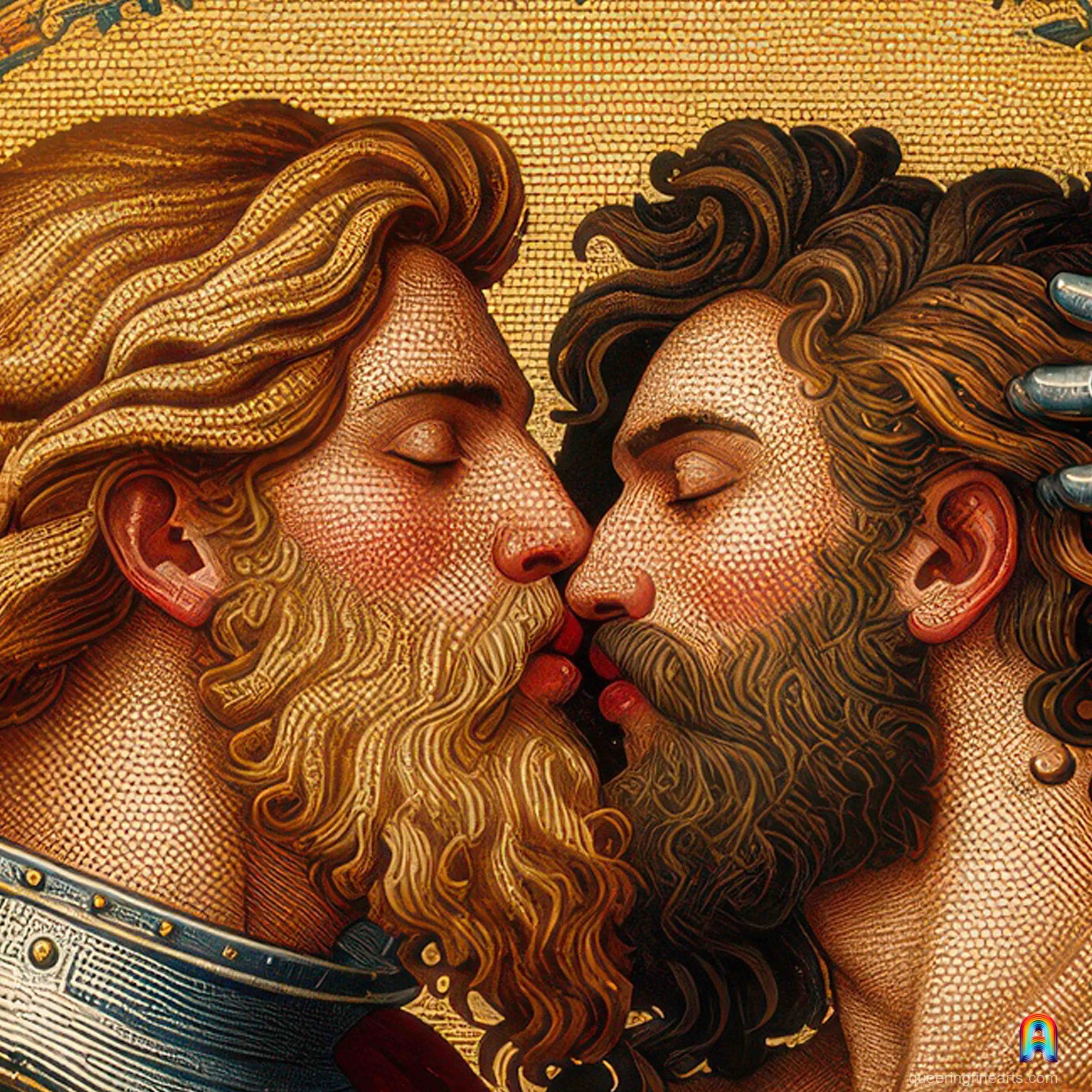
The composition draws on a medieval legend and is structured around the two figures of Ami and Amile¹, who occupy the central axis in immediate proximity. The armored knight on the left is Amile. He inclines his face toward his companion, Ami, whose half-naked body unfolds in an offered suppleness. The kiss, placed at the point where gazes and gestures converge, is not a mere episode: it structures the image and immediately defines the nature of the bond between the two knights.
Saturated Space
Around this nucleus, the vegetal décor unfolds into a dense field of scrolling foliage, stylized flowers, and open fruits, set against a golden ground that abolishes all illusionistic depth. This treatment situates the work within the Arts and Crafts tradition², where the textile surface is not a neutral support but an active space, saturated with signs. The eye does not travel toward a background: it remains caught within the very weave of the image, compelled to read its symbolic correspondences.
Transposed Twinship
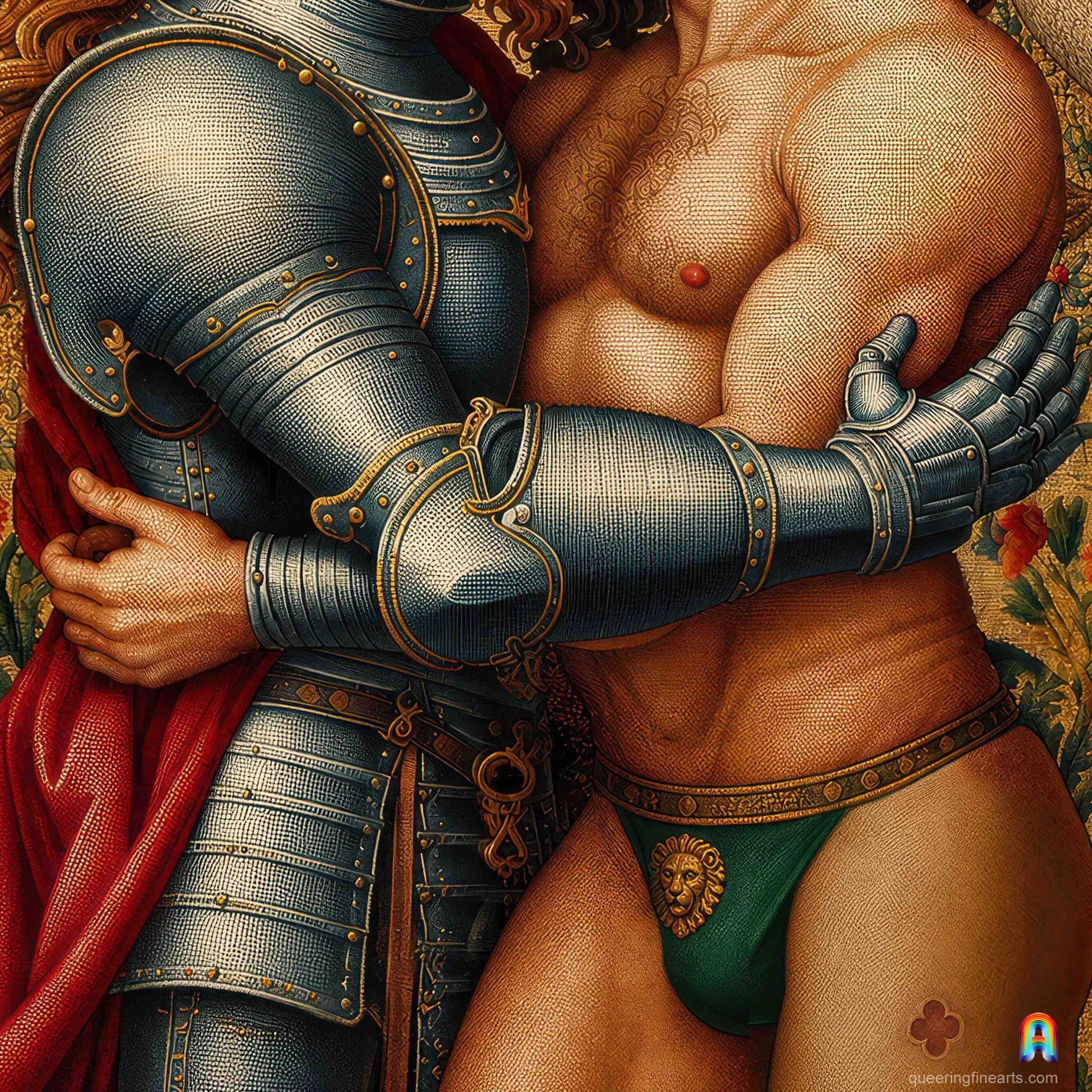
The legend insists on the perfect resemblance of Ami and Amile³, often described as indistinguishable. The tapestry does not reproduce this indistinction literally, but transposes it into a more subtle logic: that of complementary duality. One belongs to the social order, marked by armor, function, verticality. The other belongs to the realm of the body, of availability, of light. This apparent asymmetry reconstructs twinship as an inner correspondence.
The image thus suggests that the identity of the two men does not rest on repetition, but on relation. They are not alike merely because they resemble one another, but because they belong to one another.
The Wound
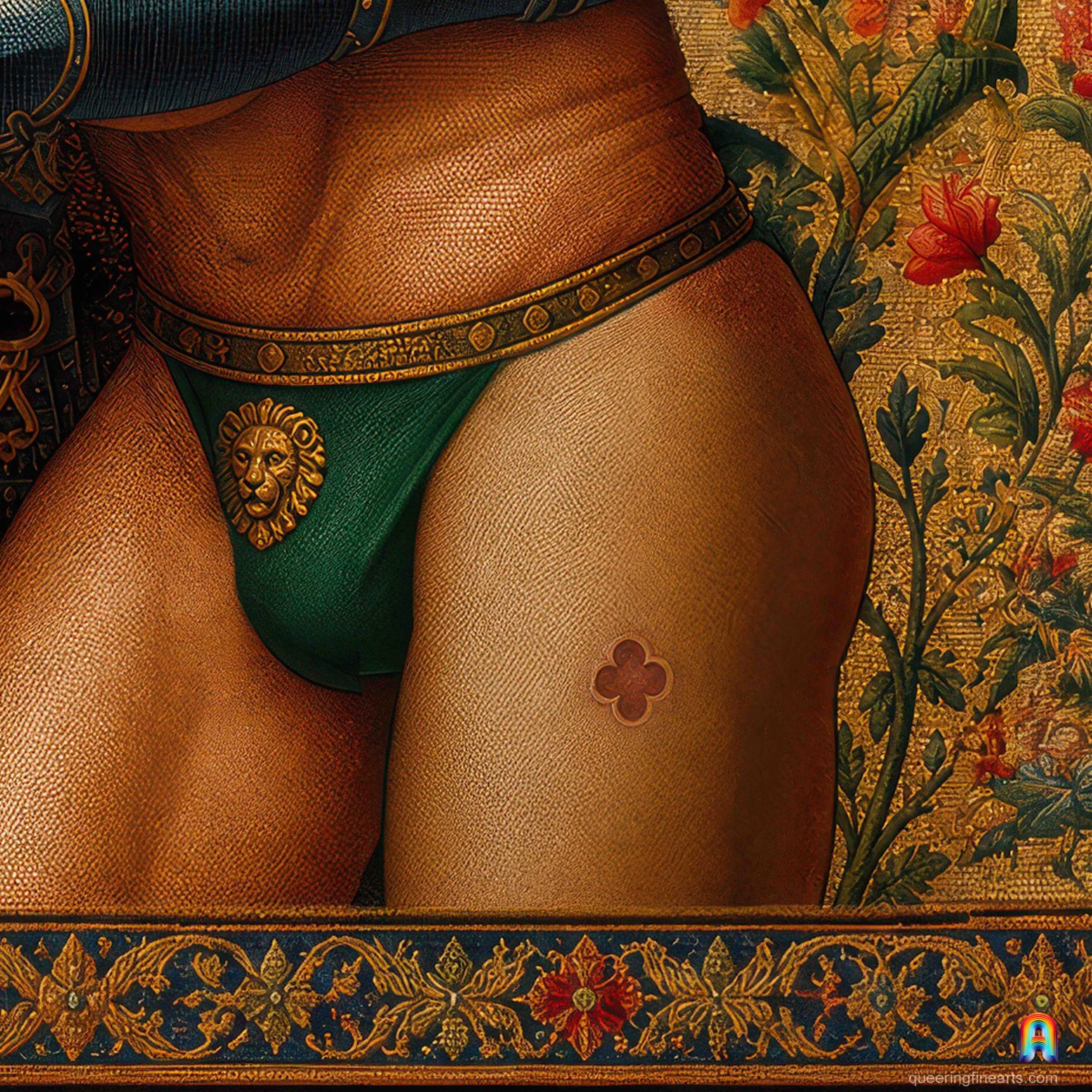
On Ami’s thigh appears a small stylized wound. It identifies this figure as Ami, struck by leprosy after saving Amile by taking his place in judicial combat and swearing falsely⁴. It also evokes, through its discretion and placement, the iconography of Saint Roch, whose plague is traditionally indicated by a wound on the thigh that he reveals by lifting his garment. This gesture, at once demonstrative and charged with bodily vulnerability, has made him, after Saint Sebastian, one of the saintly figures most invested with a homoerotic reading in the history of art. In Ami, the wound reprises and shifts this iconographic logic.
The wound recalls the bodily cost of an act of extreme friendship, in which fidelity passes through perjury. It condenses the full moral ambiguity of the narrative. Ami acts to save Amile, yet his gesture remains a fault before God. Leprosy renders this tension visible: love saves, yet it does not immediately abolish sin. Opposite him, Amile becomes the one who must respond through an even more terrible sacrifice, that of his own children, before God closes the cycle through Ami’s healing and the miraculous resurrection of the children. The description moves a bit quickly to present the story, but we will return to it in greater detail and with a more developed narrative structure later on.
The Wounded Swan
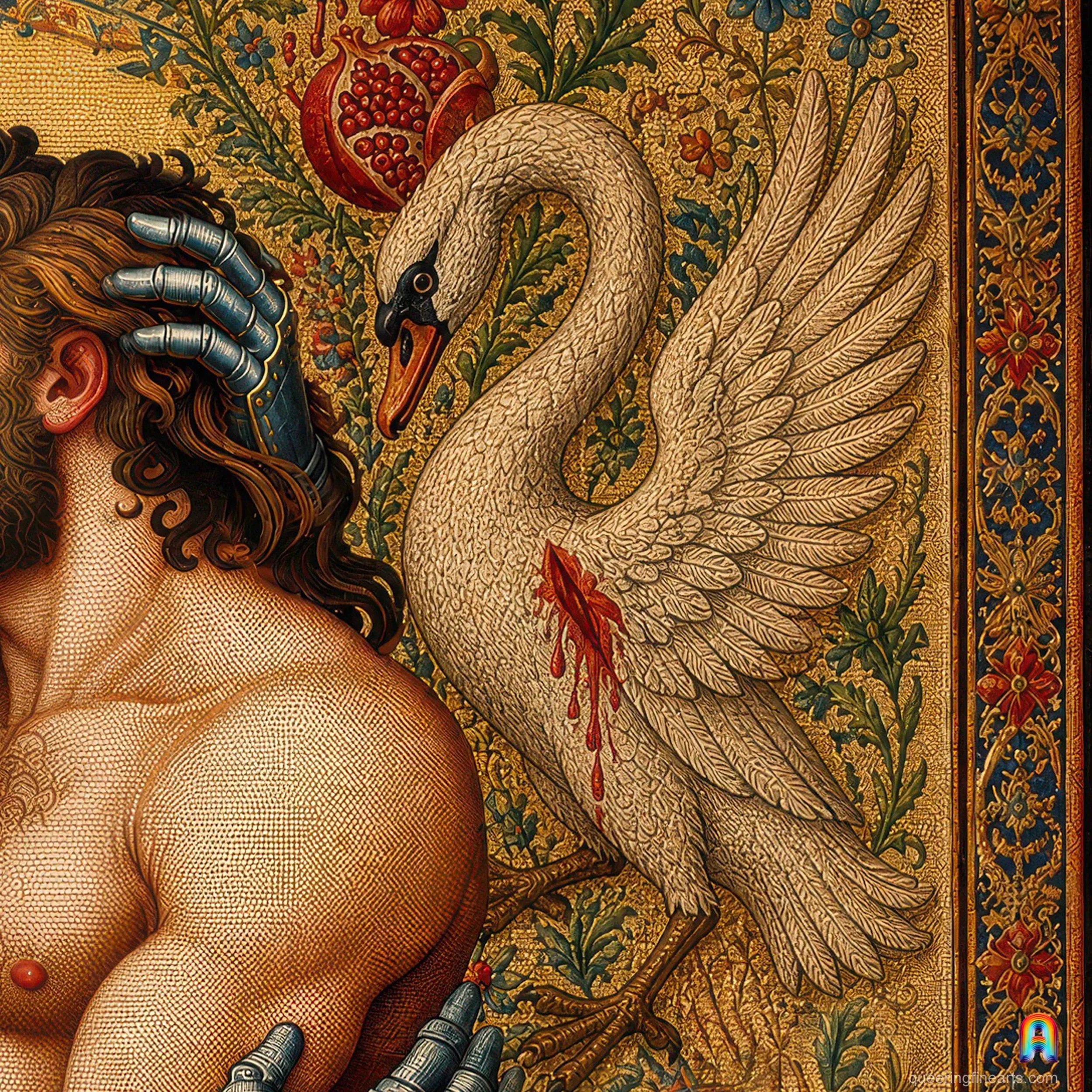
To the right, a swan occupies a lateral yet essential space. Its whiteness, its extended posture, its incised wing from which stylized blood flows make it immediately legible. In symbolic tradition, the swan evokes nobility, fidelity⁵, and a form of melancholic purity. Wounded, it becomes something else: an image of beauty struck yet not destroyed. The connection with Ami is evident. The animal wound doubles the human wound. Yet the swan does not merely reflect: it elevates.
The Dove of Forgiveness
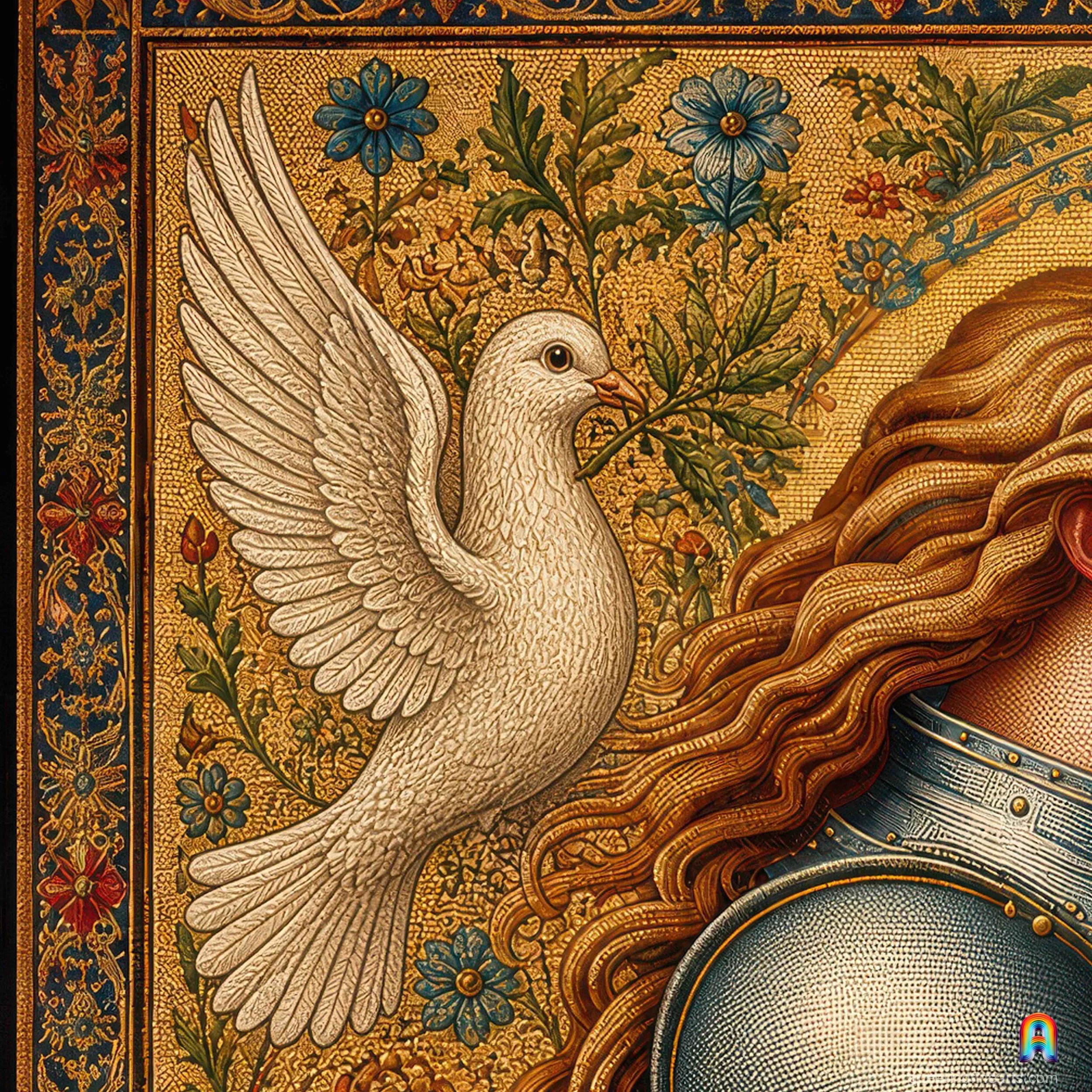
To the left, the dove intervenes at a later stage in the drama. In the legend, after Ami’s perjury, the leprosy that strikes him, and the sacrifice of Amile’s two children, the narrative does not end with the violence of the act, but with its surpassing: God heals Ami and resurrects the children. It is this moment of resolution that gives meaning to the whole. The dove belongs to this final phase. The branch it carries evokes an accomplished appeasement, like that of the biblical episode of Noah⁶. It marks the end of the ordeal, the return to a restored order in which fault, sacrifice, and suffering have been absorbed into divine forgiveness.
At the Center, the Kiss
Within the composition, the central kiss embodies the bond between Ami and Amile, a bond that is not only moral or spiritual, but physical, immediate, irreducible. The kiss unites what the narrative separates: illness, sacrifice, miracle. It constitutes a silent response to the ordeal. Where the text unfolds in stages, the image proposes simultaneity
Arts and Crafts
The Arts and Crafts movement’s interest in the Middle Ages is fundamental⁷. It does not stem from a simple taste for the past, but from a rejection of the industrial model and a desire to recover a direct relationship between labor, material, and form. The Middle Ages then appear as a period in which the object is still fully conceived, made, and meaningful. In this perspective, tapestry, embroidery, and textile arts occupy a privileged place. They embody a mode of production in which ornament is not added, but constitutive of the object. Medieval décor, with its stylized and repeated forms, provides a rich visual vocabulary.
Medieval Imagination
Medieval narratives partake of the same appeal and belong to the narrative structures of the chansons de geste⁸. They offer simple and powerful frameworks, in which actions carry immediate moral weight. For Arts and Crafts artists, these narratives provide an ideal material: legible, dense, directly translatable into form.
Where One Becomes the Other
The legend of Ami and Amile, as it appears in French literature at the end of the 12th century⁹, belongs to the world of the chansons de geste, yet immediately distinguishes itself by its center: not war or conquest, but the relationship between two men whose bond organizes the entire narrative. Their names themselves contribute to this: “Ami” derives from the Latin amicus (friend), while “Amile” constitutes a related and closely aligned form, creating an effect of near-sonic twinship. Ami and Amile are raised together, resemble one another to the point of indistinction, and live in such proximity that one can literally take the place of the other. This indistinction is not merely a narrative device: it establishes a relationship in which individual identity dissolves into a deeper union, which can today be read as a form of homosexuality inscribed in the very structure of the story.
Choosing the Beloved Against the World
When Amile is accused of adultery and threatened with death through trial by combat, Ami intervenes by taking his place¹⁰. He does not merely defend him: he becomes him, to the point of swearing under oath that he is Amile and that he is innocent. This perjury is a decisive act. It signifies that social and religious truth may be transgressed in the name of the bond that unites the two men. Ami chooses Amile against the order of the world. In this logic, reciprocal love does not appear as a simple inclination, but as an absolute priority granted to the other man, at the expense of norms.
Love Put to the Test
The leprosy that subsequently strikes him inscribes this transgression in his body. It is less a punishment than a trial. Ami’s body becomes the visible site of what he has done for the other. It is marked, altered, excluded, yet the relationship does not break. Amile does not withdraw. He remains. The bond persists through degradation, and this transforms its nature: it is no longer merely heroic, it becomes intimate, embodied, enduring. The loving nature of the bond manifests itself here in its capacity to survive bodily decay and social exclusion.
Absolute Sacrifice
The divine revelation that follows pushes this logic to its extreme. Amile learns, through a messenger sent by God, that the only way to heal Ami is to wash him in the blood of his own children. He accepts. He kills his two sons. The family is sacrificed in a demand that proceeds directly from God himself, and that is not without recalling the biblical episode of Abraham’s sacrifice¹¹, in which obedience to a divine command also entails crossing the threshold of filial sacrifice.
The Recognition of the Bond
Here, homosexuality no longer belongs merely to suggestion: it manifests as an attachment that structures all choices and hierarchizes human relationships. The healing of Ami and the resurrection of the children mark the culmination of this trajectory. God does not condemn what has unfolded between the two men. He puts this bond to the test, then recognizes it. Perjury, leprosy, sacrifice, and blood do not lead to rupture, but to confirmation of the bond. It has endured. It is validated.
Their story does not end with this recognition. In several medieval traditions, Ami and Amile are said to die within a short interval of one another, as if the bond that united them could not be prolonged in separation. They are often buried together, or brought to rest side by side after death, their bodies reunited where life might have divided them. This final gesture extends the logic of the narrative: the union that structured their actions is not dissolved by death, but affirmed beyond it, inscribed in memory, in devotion, and in the very space of the tomb.
Veneration
The veneration of Ami and Amile, attested in several regions of medieval Europe¹² and not confined to a single center, gives this reading an additional scope. While Mortara, in Lombardy, constitutes a well-documented site of their cult, their memory is also transmitted through local liturgical calendars, hagiographical compilations, and regional traditions, notably in northern France and in areas where the chansons de geste circulated.
The Grace of the Bond
Traces of this can be found in martyrologies and collections of saints’ lives¹³, where their story is included as an example. Their relationship was not only told: it was honored, inscribed within devotional practices, and proposed as a model. What is sanctified is not an individual exploit, but a bond between two men.
In this context, homosexuality is not named as such in medieval sources, yet it is in fact elevated to the rank of an exemplary relationship, tested through ordeal and confirmed by miracle. Modern historiography has emphasized that this type of narrative is not an isolated exception, but belongs to a broader set of intense attachments between persons of the same sex, recognized and at times valued within medieval Christian culture, without being immediately assimilated to moral or legal transgression.
As John Boswell, an American historian of medieval Christianity and sexuality whose work brought to light forms of tolerance and recognition of same-sex relationships in the Christian West, has shown, societies of the early and high Middle Ages developed varied modes of acknowledging affective bonds between persons of the same sex, ranging from spiritual friendship to forms of ritualized companionship, some of which could be invested with a quasi-sacramental value¹⁴. In this perspective, the legend of Ami and Amile appears less as an anomaly than as an extreme and narrative formulation of this possibility: that of a bond between two men engaging the body, the word, salvation, and grace.
Thus, the legend of Ami and Amile stages a form of love between men that structures the narrative from beginning to end, never named as such, yet never reducible to mere abstraction. It renders visible, in a symbolic and theological language, a relationship whose intensity is recognized, tested, and ultimately validated through divine intervention.
QFA
Curiosity Piqued?
1. Jean Rychner, La chanson de geste: essai sur l’art épique des jongleurs [The Chanson de geste: Essay on the Epic Art of the Jongleurs], Geneva, Droz, 1955.
2. Gillian Naylor, The Arts and Crafts Movement: A Study of Its Sources, Ideals and Influence on Design Theory, London, Studio Vista, 1971.
3. Jacques Ribard, Le Moyen Âge: littérature et symbolisme [The Middle Ages: Literature and Symbolism], Paris, Champion, 1984.
4. Philippe Walter, Christian Mythology: Revelations of Pagan Origins, trans. Jon E. Graham, Rochester, Inner Traditions, 2014.
5. Michel Pastoureau, Une histoire symbolique du Moyen Âge occidental [A Symbolic History of the Western Middle Ages], Paris, Seuil, 2004.
6. The Bible, Genesis 8:11, trans. Louis Segond, Bible Society, 1910.
7. E. P. Thompson, William Morris: Romantic to Revolutionary, London, Merlin Press, 1955.
8. Paul Zumthor, Toward a Medieval Poetics, trans. Philip Bennett, Minneapolis, University of Minnesota Press, 1992.
9. Ami and Amile: A Medieval Tale of Friendship Translated from the Old French, trans. Samuel N. Rosenberg and Samuel Danon, Ann Arbor, University of Michigan Press, 1996.
10. Ibid.
11. Søren Kierkegaard, Fear and Trembling, trans. (French edition), Paris, Gallimard, 1946 (ref. to Genesis 22).
12. Hippolyte Delehaye, The Legends of the Saints: An Introduction to Hagiography, trans. V. M. Crawford, London, Longmans, Green, 1907.
13. Acta Sanctorum, Société des Bollandistes, Brussels, ongoing publication.
14. John Boswell, Christianity, Social Tolerance, and Homosexuality: Gay People in Western Europe from the Beginning of the Christian Era to the Fourteenth Century, Chicago, University of Chicago Press, 1980.