

Belle Époque Vienna
Painter influenced by Egon Schiele, working in the wake of the Viennese Secession
Oil on canvas, circa 1900
Unknown collection
At the Threshold of Queer Modernity
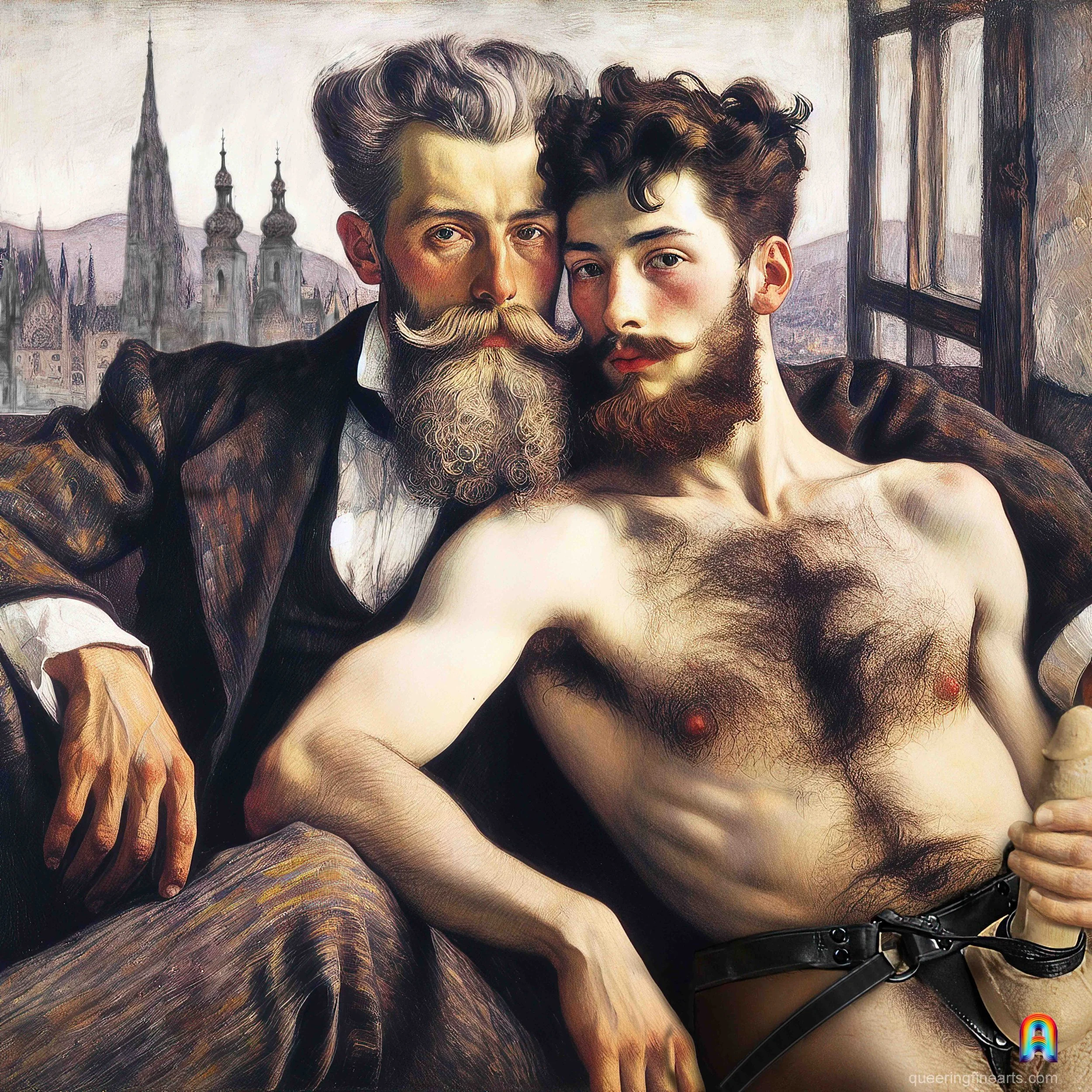
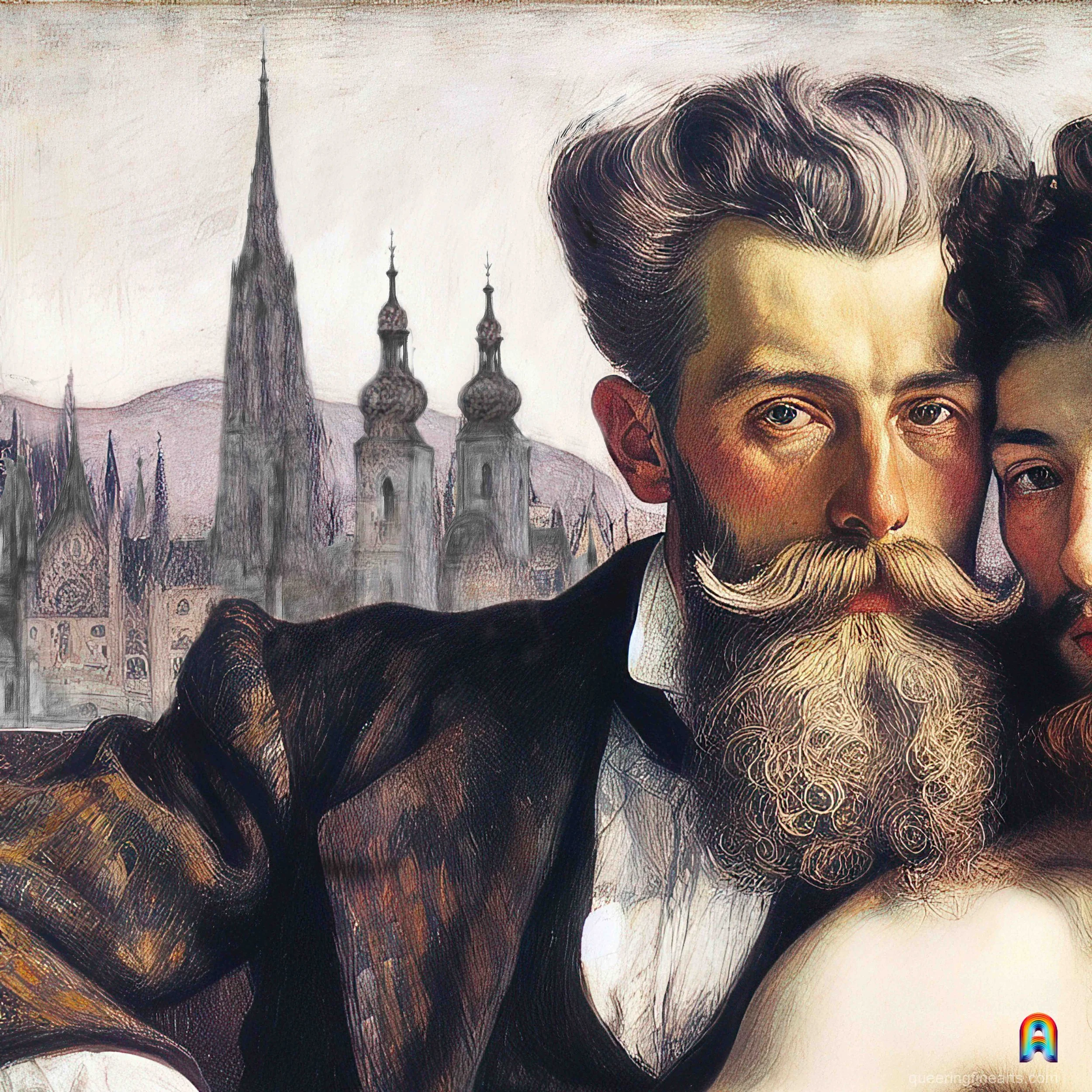
The painting depicts a male couple seated near an open window overlooking a city bristling with church spires, identifiable as Vienna around 1900¹. A mature man, impeccably dressed according to bourgeois codes, wraps his arm around a naked young man whose body, bathed in a cold, precise light, is rendered with an almost sculptural care². The latter holds a sexual object in his hand, presenting it to the viewer with confidence³. The tight framing, the diagonal formed by the bare arm, the proximity of the faces, and the chromatic harmony of browns fuse the two figures into a single volume, while the urban background remains deliberately less defined⁴. The handling combines a very smooth rendering of flesh with a more visible, nervous touch in the fabrics and the sky, evoking the psychological tension and corporeal intensity characteristic of Egon Schiele’s Viennese modernism⁵.
Modern Intimacy
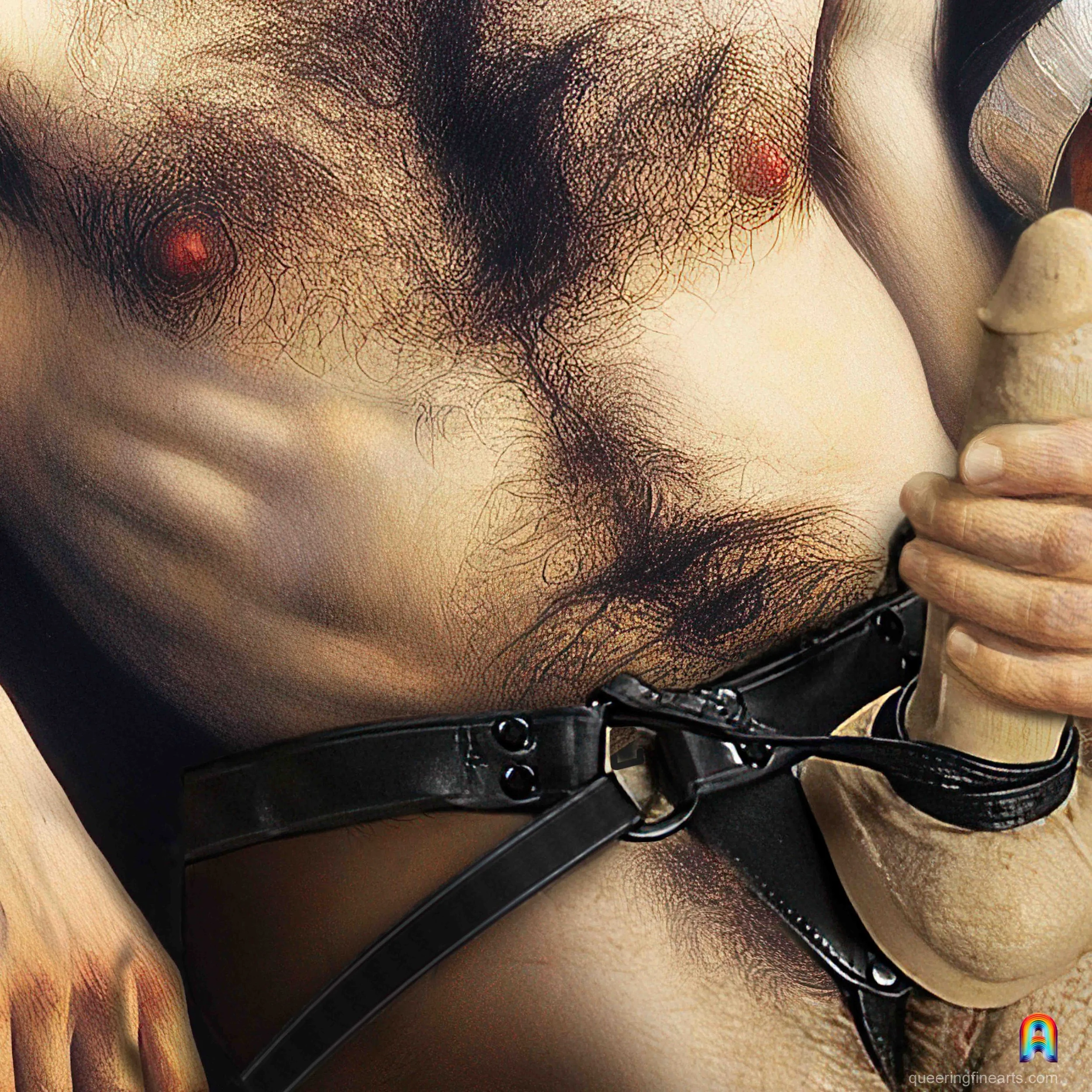
Beyond formal description, the scene centers on an openly assumed masculine intimacy⁶. The contrast between the clothed man and the young man’s exposed body, offered to the light, suggests an opposition between public role and the truth of desire. It seems clear that the dildo mounted on a strap-on harness has been used or will soon be⁷. Within this context, various scenarios can be imagined to explain its presence, whether as a simple sex toy or as a supporting instrument within a treatment associated with psychoanalysis⁸. The church spires visible in the background silently recall the weight of the moral norms of the period, while the open window marks a threshold between the private interior and the city. Through its balance between symbolism and sensitive observation of bodies, the work may plausibly be attributed to a painter associated with the Viennese Secession, within the orbit of artists who, around 1900, explored tensions between desire, modernity, and social order without naming them directly⁹.
A City at the Threshold
Around 1900, Vienna stands at a fascinating intellectual and social turning point with regard to homosexuality. Nothing is straightforward. Mentalities remain shaped by bourgeois morality and by the criminalization inherited from Austro Hungarian imperial law. Yet at the same time, the city becomes a laboratory in which the very languages are forged that will make it possible to think desire between men beyond the prism of vice¹⁰.
Psychoanalysis and the Reframing of Desire
First, the emerging field of psychoanalysis plays a decisive role. Freud opens a breach by asserting that sexuality cannot be reduced either to reproduction or to a moral ideal. He maintains that homosexualityis not a degenerative illness but a variation of psychic development. His private correspondence reveals that he considers social repression more dangerous than sexuality itself. This quiet shift does not abolish stigma but provides a key to de pathologization¹¹.
An Aesthetic of Ambiguity
At the same time, homosexuality becomes inscribed within Viennese aesthetics. The Viennese circle around Karl Kraus (1874–1936) and the Viennese Secession led by Gustav Klimt (1862–1918), together with the theatricality of the fin de siècle, create a visual space in which masculine sensuality can be explored obliquely¹². Ambiguity becomes a language. Erotic charge circulates through portraits, through intense friendships among writers, and through the expression of a stylized virility.
Lives Given Form
Within this culture of allusion and indirection, certain individual trajectories give a more embodied form to this homosexual sensibility. Egon Schiele (1890–1918) makes the male body a site of tension and desire exposed without disguise¹³. Robert Musil (1880–1942) interrogates in his fiction and journals the desires that fracture established moral frameworks¹⁴. Hugo von Hofmannsthal (1874–1929) translates deep male attachments into a writing shaped by sublimation and melancholy¹⁵.
From Naming to Advocacy
Austria also witnesses the emergence of genuine activists. Karl Maria Kertbeny (1824–1882) had already coined the word homosexual in previous decades. Shortly thereafter, Magnus Hirschfeld (1868–1935) establishes bridges with Viennese circles, contributing to the documentation of homosexual sociability and to the emergence of a community discourse¹⁶.
The Body as Mediation
From the earliest days of Viennese psychoanalysis, the treatment of sexual inhibitions is grounded primarily in speech, dream analysis, and transference, while leading some practitioners to consider more bodily approaches when verbalization reaches its limits¹⁷. Within a symbolic and controlled framework, erotic objects could serve as mediators rather than instruments of immediate pleasure, allowing desire to be approached indirectly¹⁸. In this perspective, one may imagine that the dildo represented in the work might have been used in this way, as a tool of therapeutic mediation as much as a sign of assumed intimacy¹⁹.
A Lasting Turning Point
All of this unfolds within a state of constant tension. Laws and policing maintain opprobrium. Yet salons, literature, psychoanalysis, and the artistic scene provide gray zones in which a homosexual sensibility circulates and reflects upon itself²⁰. Thus, Vienna around 1900 embodies both the weight of social judgment and the dawn of a new gaze. Desire between men ceases to be merely an affront to moral order and becomes a psychic phenomenon to be understood, represented, and even sublimated. It is one of this city’s most decisive contributions to the history of queer culture²¹, shaping durably the imaginaries and modes of thought of the Western world.
(To explore Belle Époque Vienna and understand its importance in gay and queer history, read the article in Chronicles, which examines how this period shaped new forms of male intimacy, visibility, and cultural expression. Click here to explore the work.)

Curiosity Piqued?
Carl E. Schorske, Fin-de-Siècle Vienna: Politics and Culture. New York: Vintage, 1981.
Georges Didi-Huberman, Le Corps, ce battement du monde. Paris: Éditions de Minuit, 2013.
Michel Foucault, The History of Sexuality, Volume I: An Introduction. New York: Pantheon Books, 1978.
Werner Hofmann, Vienna 1900: Art and Culture. London: Thames and Hudson, 1985.
Jill Lloyd, The Viennese Secession. London: Phaidon, 1991.
Whitney Davis, Queer Beauty: Sexuality and Aesthetics from Winckelmann to Freud. New York: Columbia University Press, 2010.
Thomas Laqueur, Solitary Sex: A Cultural History of Masturbation. New York: Zone Books, 2003.
Elisabeth Roudinesco, Freud: In His Time and Ours. Cambridge: Harvard University Press, 2016.
Peter Vergo, Art in Vienna 1898–1918. London: Phaidon, 1993.
Harry Oosterhuis, Stepchildren of Nature: Krafft-Ebing, Psychiatry, and the Making of Sexual Identity. Chicago: University of Chicago Press, 2000.
Sigmund Freud, Three Essays on the Theory of Sexuality. London: Hogarth Press, 1953.
Allan Janik and Stephen Toulmin, Wittgenstein’s Vienna. New York: Simon and Schuster, 1973.
Jane Kallir, Egon Schiele: The Complete Works. New York: Abrams, 1998.
Robert Musil, Diaries. London: Picador, 1996.
Hugo von Hofmannsthal, Selected Prose. New York: Pantheon Books, 1952.
Robert Beachy, Gay Berlin: Birthplace of a Modern Identity. New York: Knopf, 2014.
Wilhelm Reich, The Function of the Orgasm. New York: Farrar, Straus and Giroux, 1973.
Mark S. Micale, Approaching Hysteria: Disease and Its Interpretations. Princeton: Princeton University Press, 1995.
George Makari, Revolution in Mind: The Creation of Psychoanalysis. New York: HarperCollins, 2008.
Laurent Fabre, Regards sur le nu masculin. Lyon: Presses Universitaires de Lyon, 2008.
David Gleeson, Queer Aesthetics in Nineteenth-Century Visual Culture. London: Routledge, 2021.