

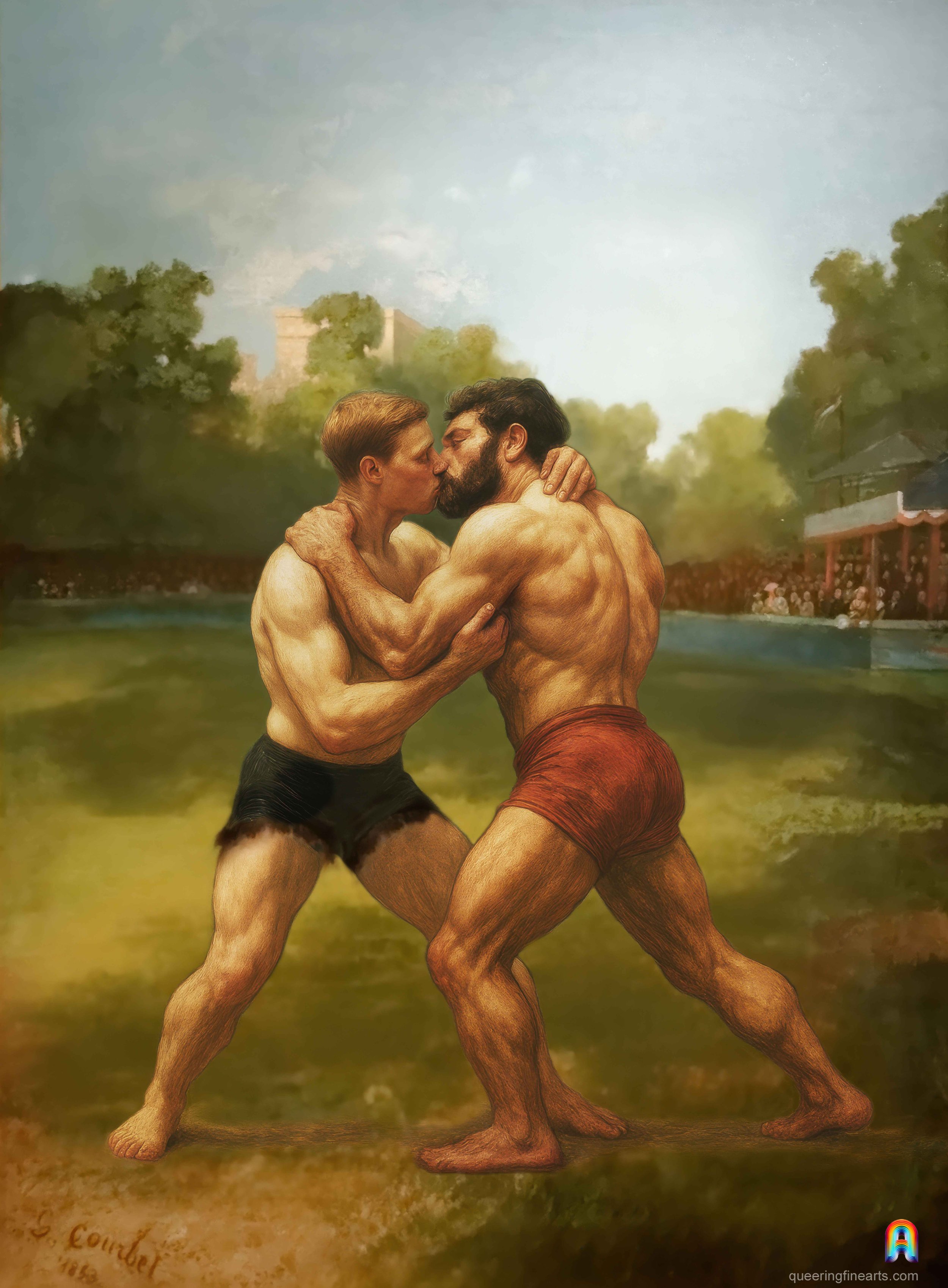
The Loving Wrestlers
In the manner of Gustave Courbet (1819 to 1877)
Oil on canvas, circa 1853
Unknown collection
Scandal upon scandal
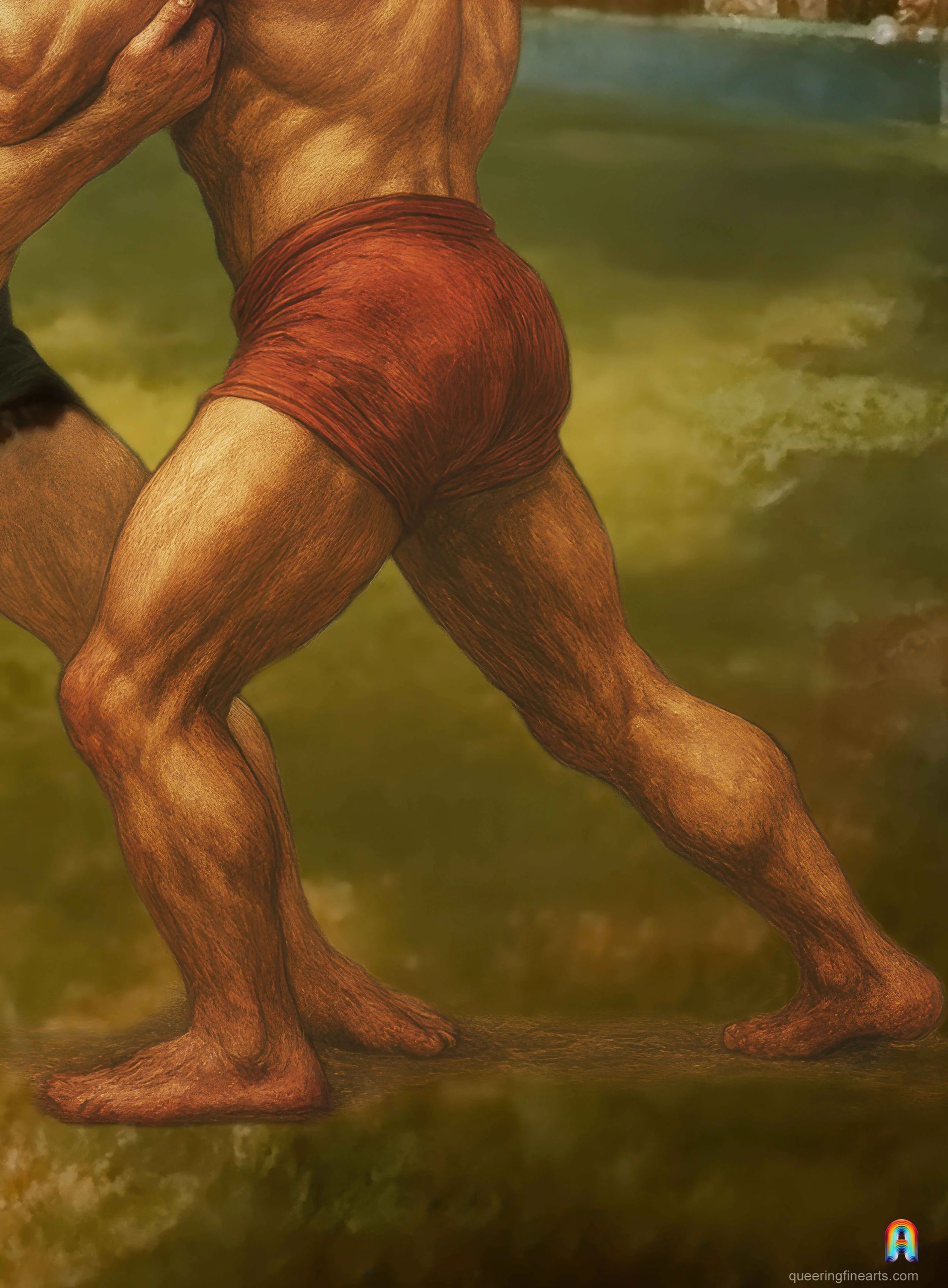
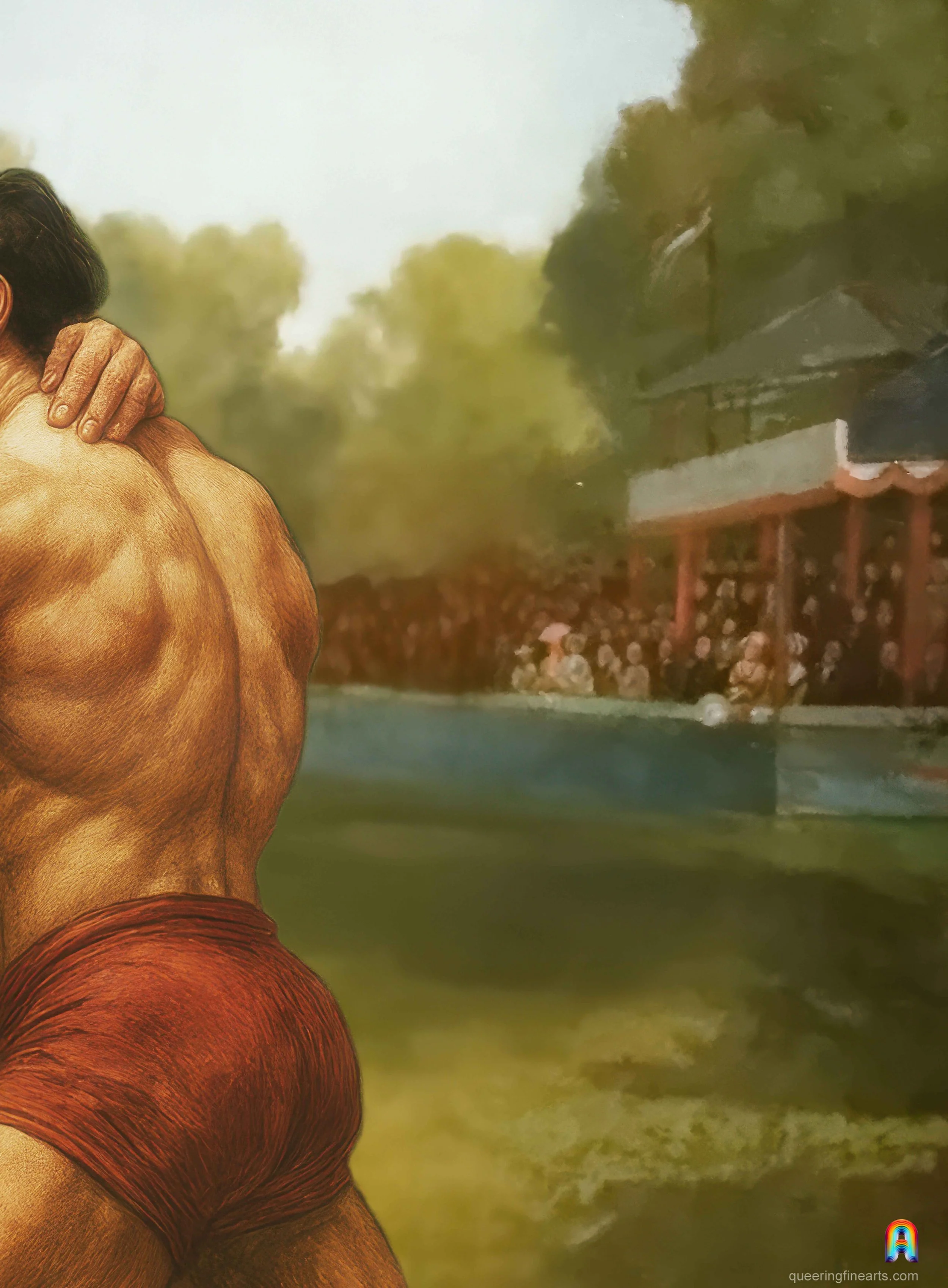
In this scene two powerful wrestlers stand at the center of a grassy arena, framed by the warm light of a summer afternoon. The stadium, the stands and the indistinct mass of spectators clearly echo the staging of The Wrestlers by the French painter Gustave Courbet (1819 to 1877) as does the frontal presence of the strongly modeled bodies and the relatively tight framing. Yet the moment depicted shifts into territory forbidden to the nineteenth century. The two athletes do not throw themselves against one another in exertion. Instead they draw close and kiss openly. Hands that should seek a sporting grip rest gently on neck or shoulder, torsos press together, mouths meet with ardor. What was supposed to be combat turns into a gesture of intimacy, and the sports field becomes a space of tenderness between men, assumed before the crowd and offered to our contemporary gaze.
The Courbet shock of the 1853 Salon
To grasp the impact of this reimagining we must return to Courbet’s The Wrestlers, shown at the 1853 Salon and now in the Museum of Fine Arts in Budapest. The monumental canvas shows two athletes in shorts clashing in a Paris hippodrome on Rue Montesquieu, within a setting of greenery and stands that closely recalls the atmosphere of the present work. Courbet chose a very large format usually reserved for history or religious painting, and insisted on the materiality of bodies, swollen veins, taut muscles, rough hands. This elevation of a popular spectacle to the status of grand painting was one of the key sources of scandal in an era when the Academy expected noble subjects and idealized forms.
Reality takes the place of gods
At the Salon The Wrestlers conversed with The Bathers, another canvas by Courbet on an equally imposing scale where he replaced the goddess or nymph with a plump bourgeois woman whose bare feet were dirty and whose stockings sagged. The double display asserted an aesthetic program that shocked critics: granting contemporary reality, unidealized flesh and the ordinary spectacle of leisure and sport the same dignity as lofty allegory. Reviews railed against “the vulgarity of forms” and even, as Delacroix muttered in his journal, “the abominable uselessness of the thought.” Yet collectors such as Alfred Bruyas perceived in the paintings a manifesto of artistic liberty. Standing before The Bathers, he famously declared, “Here is free art — this canvas belongs to me.” This tension between public outrage and the advocacy of progressive patrons came to define Courbet’s trajectory as a central figure of Realism and a companion to emerging social movements.

From Greek gymnasia to modern training halls
A broader nineteenth century context reinforces the charge of these athletic images. Wrestling schools, gymnastics clubs and later the revival of the modern Olympic Games emerged at the same moment. Coupled with illustrated press and nascent photography this sports culture created a true market for depictions of muscular male bodies. Courbet’s painting participates in this movement that brings the contemporary athlete, whether fairground champion or gym hall hero, into art in competition with idealized antique bodies.
Virile beauty as spectacle and desire
A few decades later the fascination with strongmen and bodybuilders gave some athletes an almost mythic aura. The Frenchman Louis Uni (1862 to 1928), called Apollon, was celebrated as the emperor of athletes and displayed his body in circuses and music halls, often photographed like a living statue reminiscent of Antiquity. The Prussian then British subject Eugen Sandow (1867 to 1925) became an international star whose loin cloth images before antique columns circulated widely. Presented as models of health and virile beauty, these bodies were nonetheless utterly available to an admiring, desirous gaze. Their heightened visibility created an athletic ideal that was both sculptural and spectacular, open to sensual reception. Athletic silhouettes became surfaces of projection, objects of fascination for a public that looked not only for strength or performance but also for carnal beauty.
The coded spectacle of male desire
Artists, illustrators and photographers exploited these sculptural physiques. They served as anatomical demonstration, advertising for training methods and a repertoire of poses charged with barely veiled homoeroticism. Sandow, spectacular embodiment of this imaginary, was described by some commentators as a gift for homosexual men since his poses, anatomical plates and carefully lit photographs seemed to offer unprecedented access to a male body exhibited to be admired, possibly desired. Around him an aesthetics of staged virility emerged, a theater of muscle where one can discern, even without definitive biographical proof, a link between athletic beauty and male fantasies. This dynamic was not marginal or clandestine, it circulated within public visual culture under the guise of hygiene, science or physical education.
Muscle aesthetics and fantasy
Yet this circulation, which appeared morally neutral, also helped normalize attention to the muscular body. It offered queer artists or those interested in the male nude a repertoire of models, postures and justifications that made their work possible. In this context some homosexual painters explicitly claimed the athlete as privileged subject. Gustave Courtois (1852 to 1923), whose relationship with the German painter living in Paris Carl Ernst von Stetten (1852 to 1942) is well documented, painted athletes and bare chested men several times. Among them the Swiss strongman Maurice Deriaz became one of his favored models, depicted with a sensual intensity that has deeply shaped modern interpretations of his work. This bond between artist and model was not an anomaly but part of a long and socially sanctioned lineage in which intense male contemplation could take shelter: Canova and his studio wrestlers, David and the idealized youth Bara, and countless academic ateliers where bodies were framed as noble material for study. These portraits reveal how the contemporary male nude, made acceptable through sports culture, became substance for an homoerotic aesthetics that did not name itself yet employed all of its codes.
Queer presence in visual culture
For artists and for part of the public this world of athletes ceased to be a simple celebration of strength. It became a realm where the gaze could contemplate, admire, analyze and openly desire a shaped male body. The male nude left myth or religious symbol and became incarnate in a man of flesh, identifiable, modern, sometimes recognizable. The staged display of muscles, studio photography before classical backdrops and the codified repetition of poses created a circulation of images of virility that flirted with eroticism while remaining ostensibly pedagogical. This fertile ambiguity became a terrain where homosexuality, even silenced or effaced by society, inscribed a durable, if often coded, visual presence.
Assumed inheritance
The canvas shown here fully embraces this legacy yet pushes it one step further. In Courbet the scandal did not arise from intimacy between men but from granting contemporary athletic bodies a monumental realism and carnal presence previously reserved for saints, antique heroes or feminine allegories. The Budapest wrestlers touch, grip, lean toward one another, yet everything remains inscribed in the register of virile combat and sports spectacle. Physical closeness already allows an ambiguous reading yet the scene remains justifiable through its subject. In The Loving Wrestlers that bodily grammar is reused to abolish this justification. The frontal kiss, the visible abandonment of holds and the explicit softness of gestures shift these male bodies from rivalry to affectionate tenderness.
Taking the affirmation further
By bringing together Courbet’s décor and aesthetic with an expression of love the nineteenth century would have censored, the work updates and deepens the original scandal. It shows what the visual culture of the time made unthinkable for a Realist painter already confronting resistance: not only an athlete presented with the codes of grand painting but two athletes whose mutual desire is no longer concealed by the fiction of combat or the mask of heroic antiquity. We must not forget that Courbet had already crossed a frontier almost no artist of his era dared to approach. By granting real, imperfect, powerful contemporary bodies a monumental pictorial treatment he defied academic canons. His audacity in bringing living flesh, muscular weight, swollen veins and popular gestures into the domain of high art was a historical shock from which we still inherit. The Loving Wrestlers does not erase that shock, it extends it.
Male affection as subject of art
In this assumed lineage the work opens an even wider breach in the history of images. It envisions the place that might have been granted, at the heart of European pictorial tradition, to gestures of affection between men that are neither myth, allegory nor caricature but simply an open air scene of love. It reveals what Courbet had already begun to crack open: the possibility of an art in which male bodies exist first in their material truth, then in their emotional truth, until intimacy itself becomes representable.
Curiosity Piqued?
1. Castagnary, Jules Antoine. Salons (1857 to 1879). Paris: Charpentier, 1892; Nochlin, Linda. Realism. London: Penguin Books, 1971.
2. Musée Fabre. Work dossier: Les Baigneuses. Montpellier; Delacroix, Eugène. Journal. Edited by André Joubin. Paris: Plon, 1933.
3. Guttmann, Allen. From Ritual to Record: The Nature of Modern Sports. New York: Columbia University Press, 1978.
4. Gaillard, Marc. Les Hommes forts de la Belle Époque. Paris: Éditions Atlantica, 2006.
5. Chapman, David. Sandow the Magnificent: Eugen Sandow and the Beginnings of Bodybuilding. Urbana: University of Illinois Press, 1994.
6. Chadwick, Whitney. Women, Art and Society. London: Thames and Hudson, 1990; Bundrick, Sheramy. Music and Image in Classical Athens. Cambridge: Cambridge University Press, 2005.
7. Sichel, Pierre. Gustave Courtois, peintre de la Belle Époque. Paris: Arthème Fayard, 1988.
8. Didi-Huberman, Georges. Le Corps, ce battement du monde. Paris: Éditions de Minuit, 2013.
9. Fabre, Laurent. Regards sur le nu masculin: du XIXe siècle à aujourd’hui. Lyon: Presses Universitaires de Lyon, 2008.