


A Cheerfully Naughty Christmas Carol
An Original Tale in the Manner of Charles Dickens.
Stave Four and a half. The Spirit of Amatory Christmases
On the stroke of Christmas Eve, when the candles had learned to burn with a steadier courage and the hearth whispered its contentment to the room, there appeared to me a Spirit I had not yet encountered, though I confess I ought to have known him all my life. He called himself, with a bow both gallant and mischievous, The Spirit of Amatory Christmases.
He was a being of handsome contradiction. His chest was bare as honesty itself, yet crowned with wreaths and ribbons as if decorum had lost a wager. His beard curled in festive abundance, his eyes sparkled with the benevolent conspiracy of one who knows more than he will immediately tell, and he bore four gilded frames, as if memories themselves had been polished and hung for exhibition. He smelled faintly of fir needles, spiced wine, warm skin, and mischief forgiven long ago.
Come, said the Spirit, for Christmas is not merely the season of remembrance, but of encounters that dared to continue long after the last carol had been sung, and did not trouble themselves with early nights.

Of a Guest Who Required More Than Pudding
First, with scarcely a pause for breath, we were shown a modest parlour where an invited friend lingered after supper, the pudding conquered and the chairs drawn closer by some innocent excuse. A shared glass became a shared smile, a smile became a confession, and the fire blushed at what it overheard. The frock-coats were divested, the collars undone, the breeches’ buttons more rent asunder than unloosed, and it was upon the table itself—a solid, unyielding witness—that the amatory libations first commenced. Time lost its authority, and when morning threatened the curtains, it found two men who had learned far more of one another than conversation alone could teach. It was nothing outrageous, the Spirit assured me, except for the audacity of bodies agreeing, repeatedly, that Christmas night was an excellent moment to forget restraint altogether.
Of a Ride That Did Not Spare the Rider
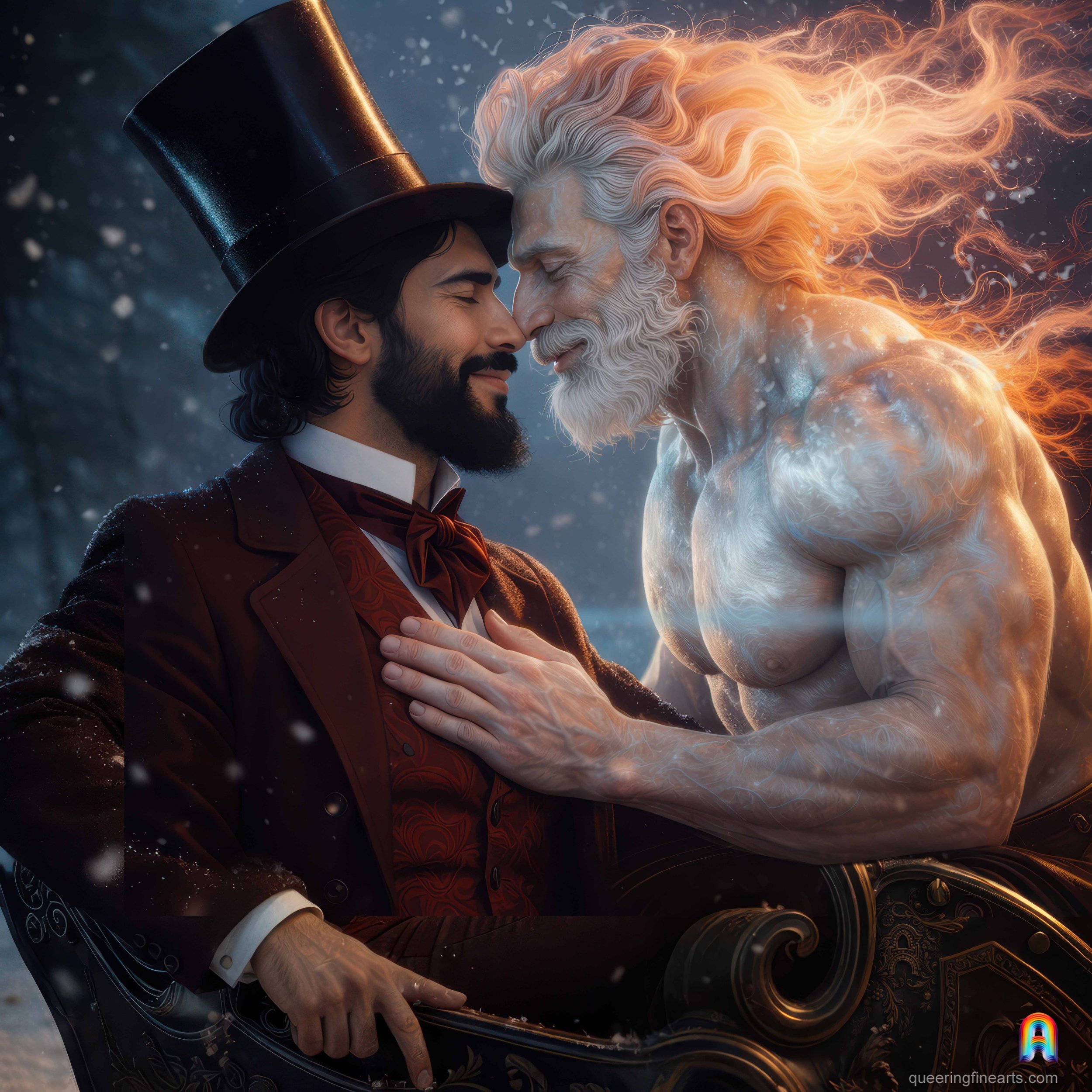
Next, the scene whisked us outdoors, into a moonlit ride by sleigh, bells chiming with suspicious enthusiasm. A stranger appeared alongside the runners, pale and luminous, his laughter carried on frost. What had commenced as but a kiss from the wintry blast grew into fond caresses, and then into a rhythm of such potent and regular undulation—a cadence born of the powerful drive of his haunches. This rhythm joined with, and was in no wise diminished by, the jolts and pitches of the sleigh as it was harried hither and thither over the uneven snows; it ended in warmth quite unaccountable to the temperature, and when the sleigh finally halted, there were breathless pauses, discarded gloves, and a silence that spoke eloquently of limbs entwined and rhythms discovered beneath borrowed blankets. The rider returned home at dawn, sore, satisfied, and smiling, having learned that some Christmas Spirits prefer repeated touch to testimony.
Of a Transaction Concluded in the Back Parlour
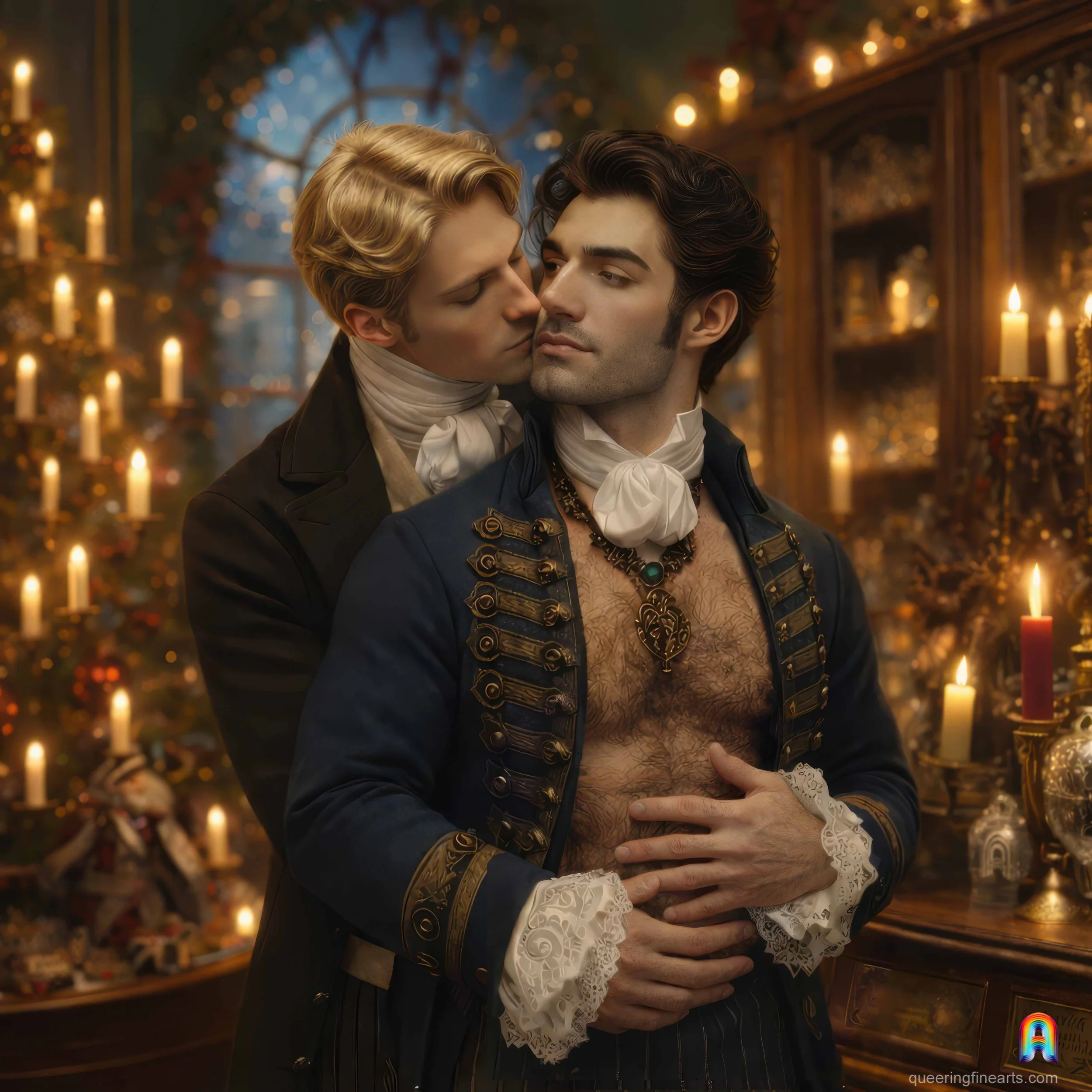
We scarcely had time to gather ourselves before we stood inside a well appointed shop of precious objects, where polished wood, glass cabinets, and carefully arranged marvels caught the candlelight with practiced elegance. The visitor had entered with the honest intention of choosing a Christmas gift, lingering over fine instruments, small sculptures, engraved boxes, and things whose value lay as much in craftsmanship as in cost. In reaching for one such object, his hand met that of the proprietor, who smiled as one accustomed to discerning more than taste. The conversation lengthened, the door was discreetly locked against the cold—and the back parlour, as fortune would have it, contained a sofa of velvet whose generous tuffs proved most commodious. Garments were set aside among the displays; the shopkeeper produced toys from the four corners of the world, destined for uses which few have even dreamt of; and the gift was forgotten entirely. By the time the lamps were lowered, it was clear that what had been selected that night could not be wrapped, priced, or returned, though it was explored with thoroughness and enjoyed until morning with a professional dedication on both sides. Rarely did a Christmas present yield such a paroxysm of joy, as much to he who gave as to he who received.

Of Men Who Knew How to Handle Hard Things
Lastly, and with a twinkle that betrayed his fondness for the unexpected, the Spirit showed a logging camp, where the scent of pine was not decorative but honest. Muscles ached with good labour, supper was plain, and the cold pressed close for invitation. There, among stacked timber and shared blankets, restraint surrendered without argument or ceremony. That which commenced with the most valiant and audacious of the lumberjacks soon drew in the entire company of the camp, men of exceptional frame and brawn, whose calloused hands administered caresses that were everywhere a little rough. Those so skilled in wielding axes proved perfectly adept at handling other shafts, of a hardness surpassing even that of wood! Strength met strength, and the long night was warmed by bodies as much as by the fire of the woodstove, loaded to capacity and regularly stoked with goodly-sized logs, from which the sap escaped under the effect of the heat, until the dawn rose gently upon an exhaustion that was well-earned and entirely mutual.
The Spirit Carried Persuasion to Great Lengths
Then the Spirit of Amatory Christmases laughed, and this time the sound lingered, low, deliberate, and unmistakably promising, as though it had decided not to leave at all. He drew nearer, the frames slipping from his hands and the wreath upon his brow shedding its leaves like permissions enthusiastically renewed. The room seemed to close its eyes. What followed was not instruction but confident participation, not spectacle but repeated surrender. Time loosened, furniture was repurposed without apology, candles burned themselves shorter without complaint, and the Spirit did most emphatically prove that memory is not a mere phantom of the mind, but possesses a body of most tangible substance, a member of supernatural proportion and vigour, a formidable endurance, and an imagination of most prodigious and inventive faculty.
When at last the first pale light crept between the curtains, the Spirit rose with the dawn, restored and smiling, already less solid than he had been hours before. He pressed a final, lingering touch upon his companion, a benediction felt everywhere rather than heard, and reminded him softly that Christmas has always been most remarkable when it dares to give more than expected and take its time doing so. Then he was gone. The room was quiet, the hearth reduced to embers, and the man lay spent in every sense, pleasantly undone, emptied and yet strangely full, carrying within him not only the certainty that Christmas was a wonderful feast, but the deeper knowledge that it had known him intimately, thoroughly, and without shame, and would remember him in return.
QFA
