

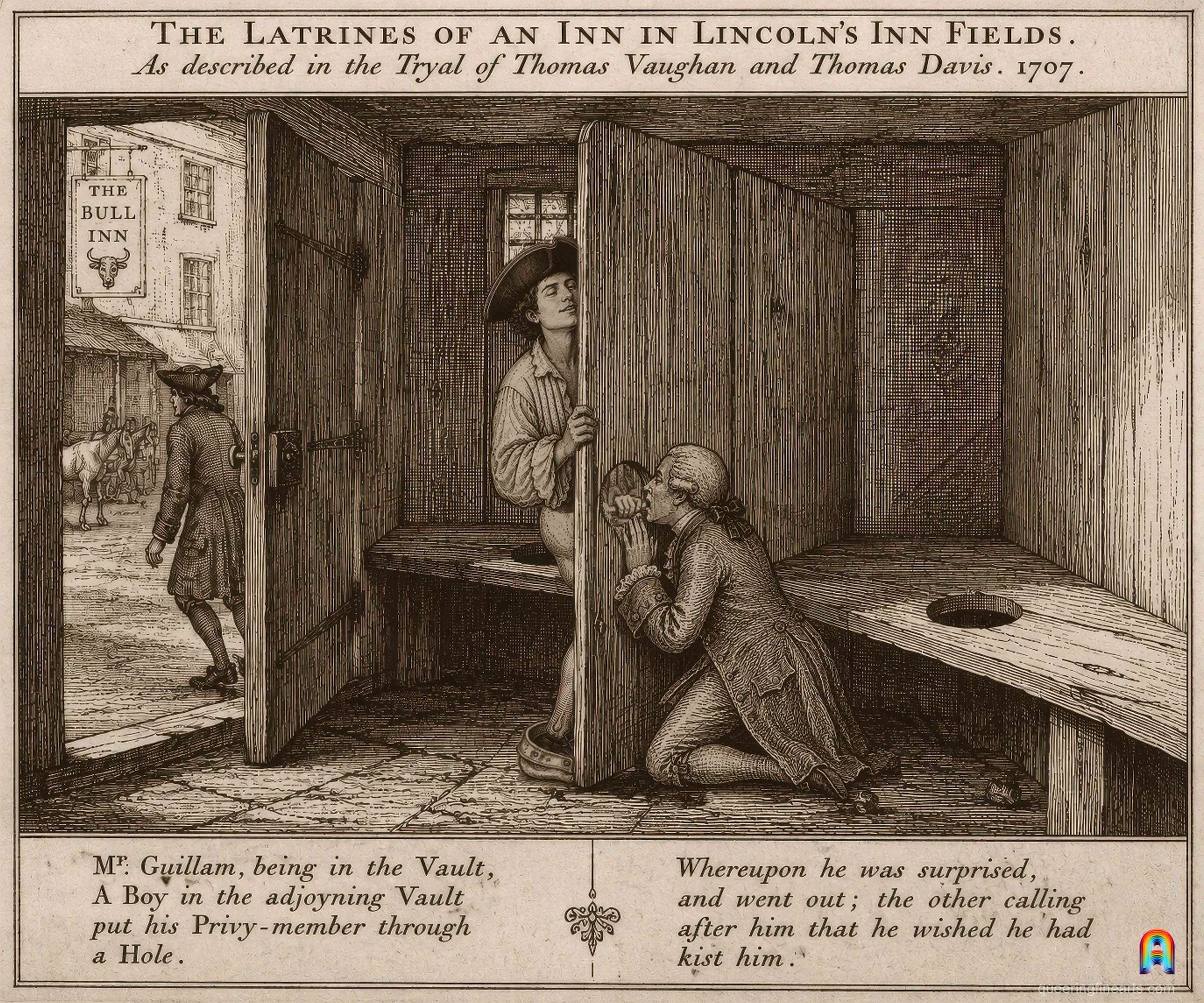
An Extraordinary Passage
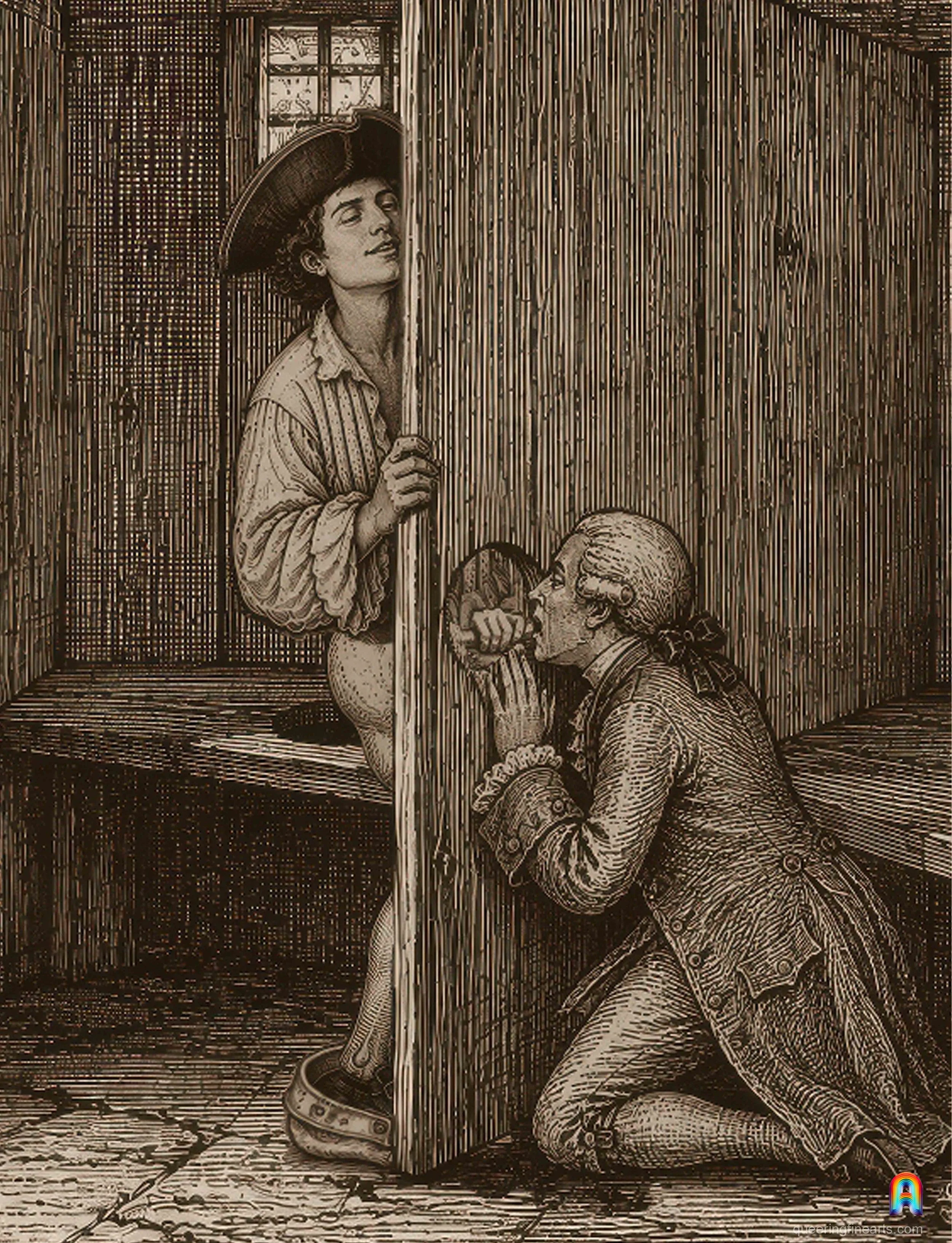
Anonymous English engraver
Engraving, 1707
Published in The Tryals of Thomas Vaughan and Thomas Davis
London, 1707
Private collection
A Hole with a Much Longer History
The glory hole is a deceptively simple device: a hole made in a partition separating two people, allowing sexual contact while preserving a degree of physical separation and, often, anonymity. Precisely because it is so simple, it has no identifiable inventor and no documented place of origin. Its history belongs less to the history of inventions than to the history of sexual practices and of the spaces in which they became possible. The expression glory hole itself is misleading when looking backwards. It existed in English by the 18th century, but with entirely different meanings, including a small room, cupboard or untidy storage space. Its sexual meaning appears much later, documented in American homosexual slang by 1949.¹ The practice, however, is demonstrably much older.
It is tempting to begin in Antiquity. Roman baths and latrines provided environments in which nudity and bodily functions were far less secluded than they would become in later European societies. Yet there is an important architectural problem with imagining an ancient glory hole: many Roman public latrines consisted of rows of seats without permanent partitions between users. The very thing that makes a glory hole possible, a wall separating two individuals, was therefore often absent. No known Roman text, object or archaeological installation securely documents a hole in a partition used for sexual contact. Even the famously erotic paintings of Pompeii's Suburban Baths tell us about the presence of sexual imagery in a bathing environment, not about glory holes.
There is nevertheless an intriguing Roman antecedent, although it belongs more properly to the history of voyeurism. In the House of the Centenary at Pompeii, room 43 contained erotic paintings and an unusually positioned small opening that could apparently be closed. John Pollini has proposed that it allowed someone to observe sexual activity taking place inside the room, perhaps by climbing onto a stool. The interpretation remains disputed, and other scholars have rejected the more adventurous reconstruction of the room as a private camera d'amore. What Pompeii offers us, then, is not an ancient glory hole but something subtler: a possible example of architecture being deliberately manipulated so that a wall could conceal bodies while an opening allowed erotic access to what lay on the other side.²
The evidence becomes dramatically clearer in London in 1707. During the proceedings against Thomas Vaughan and Thomas Davis for conspiracy and extortion, Mr Guillam described entering the Temple Bog-House and finding himself beside a remarkably enterprising neighbour. In the wonderfully restrained language of the record, “a Boy in the adjoyning Vault put his Privy-member through a Hole.”³ Guillam was surprised and withdrew, while the other man called after him with a further invitation. Whatever name contemporaries gave such an arrangement, all the essential elements of the later glory hole were already present: neighbouring compartments, a partition, a hole through it, the deliberate presentation of a sexual organ through the opening and the possibility of an encounter in which the partition limited the participants' exposure to one another.
This 1707 episode is particularly valuable because it appears almost accidentally in the historical record. The hole itself was not the subject of the prosecution. Vaughan and Davis were accused of participating in a scheme that used accusations of sodomy to extort money from men. Guillam was a victim and witness, not someone prosecuted for what happened in the latrines. His brief description survives because it formed part of the circumstances surrounding the attempted blackmail. The simplicity of the device also makes it perfectly reasonable to suspect that 1707 was not its beginning. A hole through a wooden partition required neither specialized equipment nor technological innovation. Earlier examples may simply have left no documentary trace.
A curious French legal case from 1857 provides a different kind of intermediate chapter. Young men engaged in what the courts called acts of libertinage inside a closed room were convicted of outrage public à la pudeur because an observer had been able to watch them through the keyhole. This was not a glory hole: the opening had not been made for sexual contact and was used only by a voyeur. Its significance lies elsewhere. It demonstrates how much could depend legally upon a tiny opening in a wall. An activity performed behind a closed door could nevertheless become “public” because it remained visible through a keyhole.⁴
By the 1860s and 1870s, Paris provides something much closer to an established culture of glory holes rather than the isolated glimpse preserved in the London proceedings. Public urinals had become important meeting places for men seeking other men. A police report from 1862 concerning a public convenience near the Pont de la Concorde records an opening in a partition that had been stopped with plaster and cement. Other reports reveal that the phenomenon was anything but easily suppressed.
At Les Halles the contest between users and authorities became almost absurdly persistent. François Carlier, a former senior Paris police official, later described how the men whom contemporary authorities called pédérastes bored “petits trous” through the partitions separating the individual compartments, allowing neighbours to commit what he termed outrages à la pudeur through the wall. Municipal workmen filled the holes during the day. They were opened again at night. The authorities eventually replaced the wooden partitions with iron plates. Even these were reportedly pierced, and the facilities ultimately had to be closed.⁵ Similar urinals and public conveniences associated with male sexual encounters could be found around Les Halles, railway stations, Montmartre and other busy parts of Paris.
The architecture helps explain their usefulness. Two men could occupy neighbouring compartments without standing openly together. The wall concealed much of each participant while the opening provided a point of contact. In places subjected to police observation, this arrangement offered discretion, partial anonymity and some protection from immediate visual exposure. It is tempting to describe this as a deliberate strategy for defeating the police, but the surviving evidence does not allow us to go quite that far. What can be said is that users repeatedly adapted the architecture around them and that municipal authorities repeatedly attempted to undo those adaptations.
A most singular object of veneration
The image presents itself as an English engraving from the early 18th century, conceived in the manner of an illustration accompanying the printed account of a judicial affair. Fine, descriptive lines and dense cross-hatching model the clothing, wooden partitions and shadowy interior of the latrines. The slightly theatrical perspective turns the place into a small stage: the open doorway onto the street situates the episode in the ordinary bustle of London, while the wooden partitions draw the eye towards considerably less ordinary proceedings.
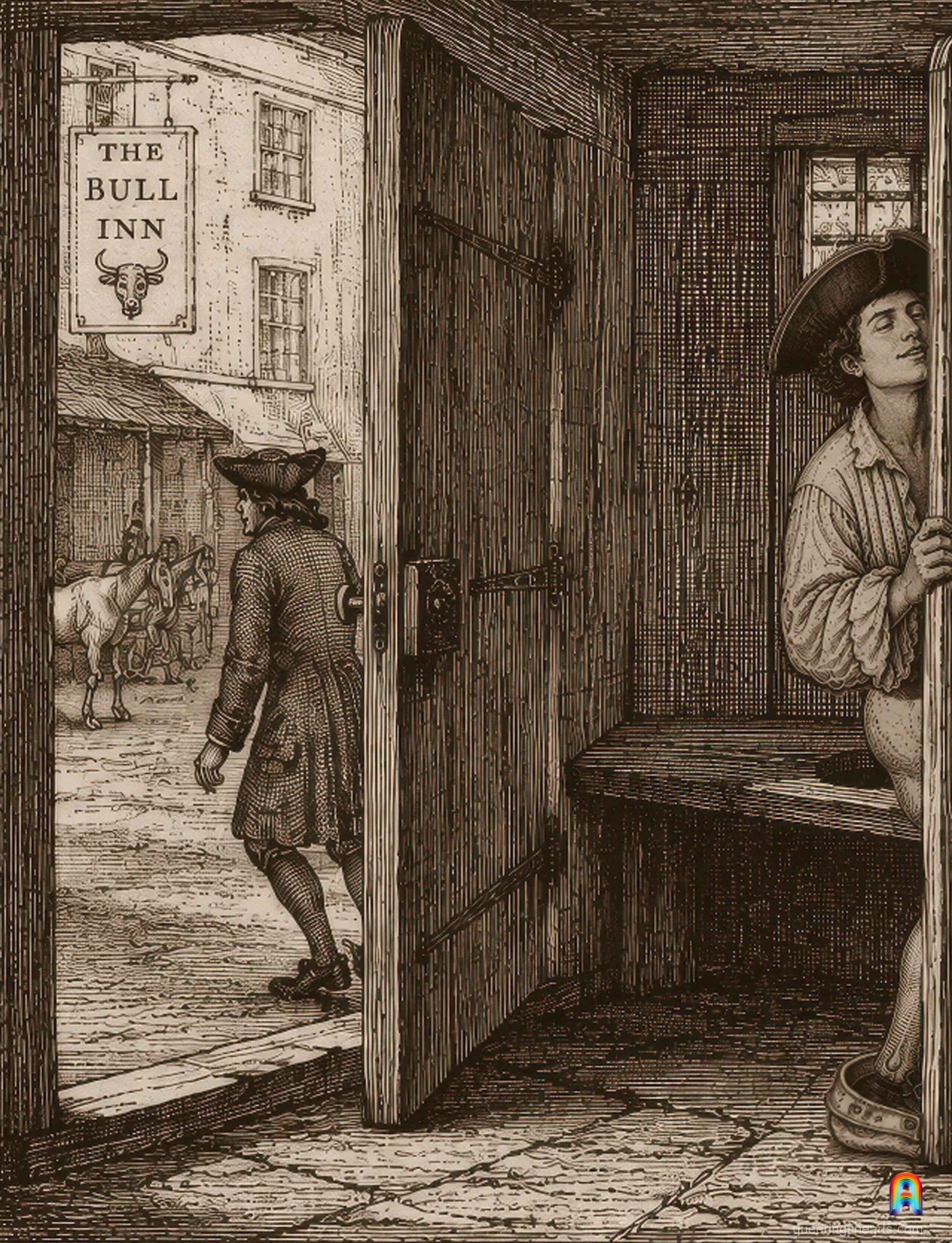
The setting is the Temple Bog-House, the public latrine where Mr Guillam’s extraordinary encounter was recorded as having taken place in 1707. A long wooden bench pierced with openings runs through the privies, while tall plank partitions provide their occupants with a rudimentary degree of seclusion. Through the open door, passers-by and horses remain visible outside, creating a striking contrast between the perfectly respectable activity of the street and the liberties afforded by the relative privacy within. Rough boards, an uneven floor, narrow compartments and scant light give the place an almost palpable material presence.
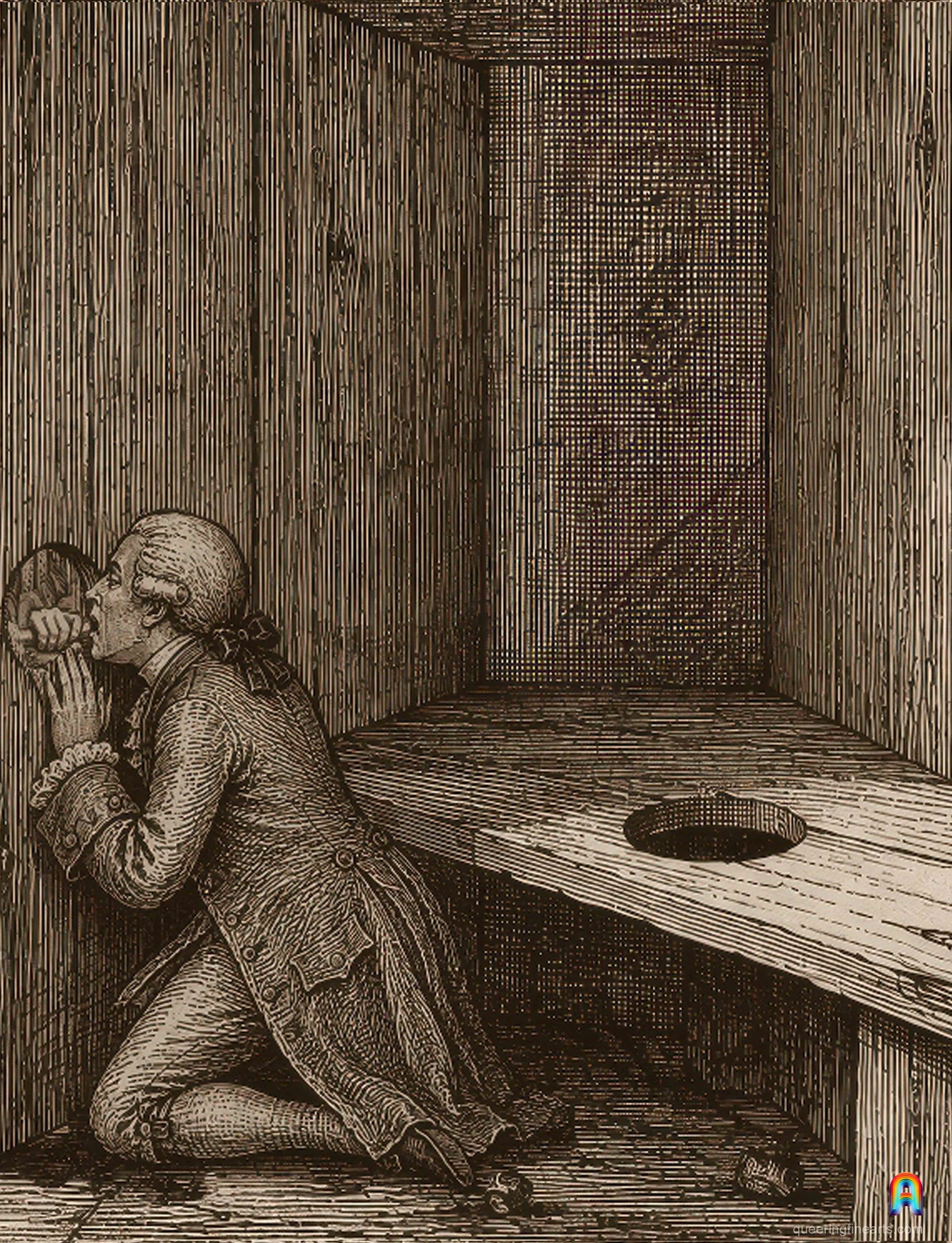
At the centre of the composition, the partition itself becomes the principal actor. A young man stands in one compartment while a gentleman kneels in the next. An opening cut through the boards allows the former to present what the testimony of 1707 describes with admirable judicial delicacy as his “Privy-member.” The engraver proves somewhat less reserved than the clerk of the court. The gentleman’s raised face and kneeling posture lend the unexpected apparition something of the character of a most singular object of veneration.
The engraver, however, has clearly allowed himself a certain liberty in reconstructing the encounter. According to the testimony, Mr Guillam was a considerably less active participant: surprised when a boy in the adjoining vault put his “Privy-member through a Hole,” he promptly withdrew. Here, our gentleman proves rather more receptive to the unexpected offering and greedily sucks the pizzle that appears through the hole. The departure from the recorded testimony is perhaps easily forgiven. If Mr Guillam resisted the bait, among the many gentlemen who frequented such conveniences there must surely have been others who allowed themselves to be more completely seduced by it.
Much of the visual effectiveness of the engraving lies in the relationship between concealment and revelation. The partition simultaneously separates the two men and makes their encounter possible. Faces and bodies remain largely divided while a tiny architectural opening becomes the point around which the entire composition revolves. What would ordinarily guarantee privacy has been ingeniously transformed into a means of overcoming it.
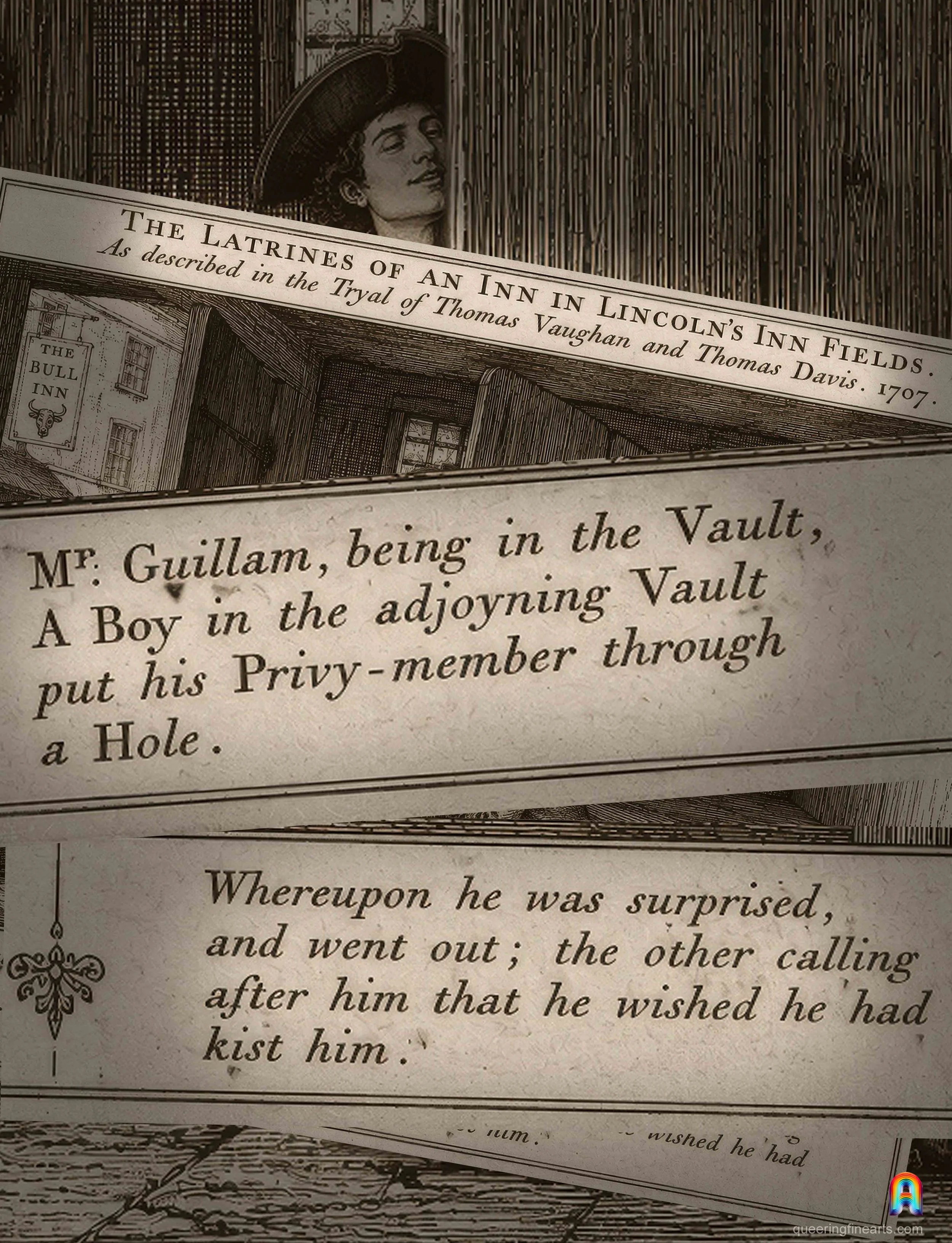
Beneath the image, the engraved caption reproduces the picturesque language of Mr Guillam’s testimony: “A Boy in the adjoyning Vault put his Privy-member through a Hole,” followed by his surprise and departure. The retention of such expressions as “Vault,” “adjoyning” and “Privy-member” reinforces the documentary character of the print and connects this unusually vivid scene directly with the Vaughan and Davis affair of 1707.
Into the Modern Glory Hole
By the middle of the 20th century, the practice had acquired the name by which we know it today. The earliest printed sexual use so far identified appears in the United States in 1949, in the clandestinely published Gay Girl’s Guide, which defines a “glory-hole” as a phallic-sized opening in the partition between toilet booths, sometimes serving merely as a peephole. The definition is revealing: by the late 1940s the object was sufficiently familiar within American homosexual slang to require no explanation of how or why it was used. Two decades later, linguist Julia P. Stanley included glory holein her 1970 study of American homosexual slang, describing it explicitly as an opening made between public toilet stalls for oral intercourse. By then, the term had clearly moved beyond a private euphemism and into an identifiable vocabulary of gay male sexual culture.⁶
The setting was changing as well. Public toilets remained important, but during the sexual transformations of the 1960s and especially the 1970s, glory holes migrated into a new commercial geography of gay life: adult bookstores, pornographic cinemas, peep-show booths, bathhouses and purpose-built sex clubs. Laud Humphreys’s controversial Tearoom Trade of 1970 documented the elaborate codes governing anonymous encounters between men in public lavatories,⁷ while the increasingly visible gay sexual culture that followed Stonewall allowed practices once improvised in municipal toilets to be incorporated deliberately into commercial spaces. In San Francisco the transformation became particularly conspicuous. By the late 1970s, establishments existed in which rows of plywood cubicles were constructed specifically so that customers could have sex through openings in the partitions. A contemporary account of gay San Francisco later recalled eight establishments devoted to glory-hole encounters alongside nine bathhouses, a remarkable indication of how far an improvised hole in a toilet wall had evolved into an architectural feature of an openly commercial sexual culture.⁸
The glory hole also answered needs that survived gay liberation. It offered speed, discretion and above all anonymity. The wall removed many of the rituals ordinarily preceding sex: names could remain unknown, faces unseen and differences of age, class, appearance or even publicly assumed heterosexuality could momentarily become irrelevant. This helps explain why glory holes continued to flourish not only in explicitly gay establishments but in adult bookstores and porn cinemas frequented by men who did not necessarily identify themselves publicly as gay. Later accounts of these environments repeatedly emphasize precisely this attraction: the encounter could be reduced almost entirely to desire itself, stripped of biography and social negotiation.⁹
From the Shadows and Back Again
The AIDS crisis profoundly altered this landscape. During the 1980s, bathhouses, sex clubs and adult bookstores came under intense scrutiny as authorities sought to contain HIV transmission. Some establishments closed while others modified their interiors and practices. Yet the glory hole never disappeared. It survived in adult cinemas, clubs, saunas and private settings and eventually moved from the margins of gay slang into pornography, popular culture and a sexual vocabulary now understood far beyond the gay communities in which its modern meaning first developed.
Perhaps the most striking sign of how much has changed comes from New York itself. In August 2026, New York State lawmakers introduced legislation aimed at overturning regulations dating from the AIDS crisis that have effectively prevented the return of gay bathhouses to New York City for more than forty years. State Senator Erik Bottcher and Assembly member Tony Simone argue that rules adopted during the emergency of 1985 no longer reflect contemporary HIV science, citing advances in testing, treatment and prevention, including PrEP and PEP. The proposal would replace prohibition with a modern system for licensing and regulating adult bathhouses. Public-health specialists have also pointed out that regulated venues can provide opportunities for testing, prevention and health outreach rather than simply driving sexual activity out of sight.¹⁰
Should the legislation succeed, New York could therefore witness the return of a form of gay communal life that once played a celebrated role in the city. And with the bathhouses would very likely return some of the architecture long associated with them, glory holes included. What makes the prospect particularly delightful from a historical point of view is that New York would not be inventing anything new. It would simply be rejoining a culture that never disappeared elsewhere. Glory holes themselves remain widespread, surviving in gay saunas, sex clubs, adult cinemas and other venues around the world. More broadly, the bathhouse culture with which they have long been associated remains very much alive across Europe, North America, Latin America, Australia and Asia, from Paris, London and Berlin to Toronto, Chicago, Berkeley, Hong Kong and Melbourne.
Nor is the glory hole any longer confined to the furtive geography that created it. It can be purpose-built rather than secretly drilled, found in commercial venues rather than municipal toilets and encountered in places where its existence is neither clandestine nor particularly mysterious. What began, as far as the surviving record allows us to see, as an ingenious exploitation of a partition has become one of the most recognizable pieces of sexual architecture in the world. Its essential attraction has nevertheless remained remarkably constant: curiosity, anonymity, anticipation and the peculiar excitement produced by a wall that conceals almost everything while revealing precisely enough.
That makes the long history of the glory hole rather more cheerful than a simple story of repression might suggest. Authorities filled the holes with plaster. Men opened them again. Paris installed iron partitions. Those were pierced too. Police watched public conveniences. The practice migrated elsewhere. Bathhouses closed. New venues appeared. The principle has proved astonishingly durable. Technologies changed, laws changed and attitudes towards homosexuality changed almost beyond recognition. Yet somewhere in the world, there always seems to have been another wall and someone willing to put a hole in it.
QFA
Curiosity Piqued?
1. Swasarnt Nerf [pseud.], Gay Girl’s Guide, États-Unis, 1949, cité dans Tom Dalzell (dir.), The Routledge Dictionary of Modern American Slang and Unconventional English, New York, Routledge, 2009, entrée « glory hole ».
2. John Pollini, « Lovemaking and Voyeurism in Roman Art and Culture: The House of the Centenary at Pompeii », Mitteilungen des Deutschen Archäologischen Instituts, Römische Abteilung, vol. 116, 2010, p. 289-319.
3. Rictor Norton (dir.), « Trials of Thomas Vaughan and Thomas Davis, 1707 », Homosexuality in Eighteenth-Century England: A Sourcebook, 29 avril 2007, mise à jour le 15 juin 2008, d'après A Compleat Collection Of Remarkable Tryals Of the most Notorious Malefactors, at the Sessions-House in the Old Baily, for near Fifty Years past, Londres, J. Phillips, J. Brotherton, W. Meadows et J. Roberts, 1718, vol. 2, p. 120-126.
4. Marcela Iacub, Par le trou de la serrure. Histoire de la pudeur publique, XIXe-XXe siècles, Paris, Fayard, 2008.
5. Régis Revenin, Homosexualité et prostitution masculines à Paris, 1870-1918, Paris, L’Harmattan, 2005.
6. Julia P. Stanley, « Homosexual Slang », American Speech, vol. 45, nos 1-2, printemps-été 1970, p. 45-59.
7. Laud Humphreys, Tearoom Trade: Impersonal Sex in Public Places, Chicago, Aldine Publishing Company, 1970.
8. George W. S. Trow, « The Castro », The New Yorker, New York, 21 juillet 1986. Le reportage décrit notamment le South of Market Club, ses cubicules munis d'ouvertures ainsi que les huit établissements à glory holes et neuf bathhouses alors recensés à San Francisco.
9. Don Bapst, « Glory Holes and the Men Who Use Them », Journal of Homosexuality, vol. 41, no 1, 2001, p. 89-102.
10. Craig McCarthy et Natalie O’Neill, « NY lawmakers want to bring back sex-fueled bathhouses - 40 years after ban during AIDS crisis », New York Post, New York, 5 août 2026.