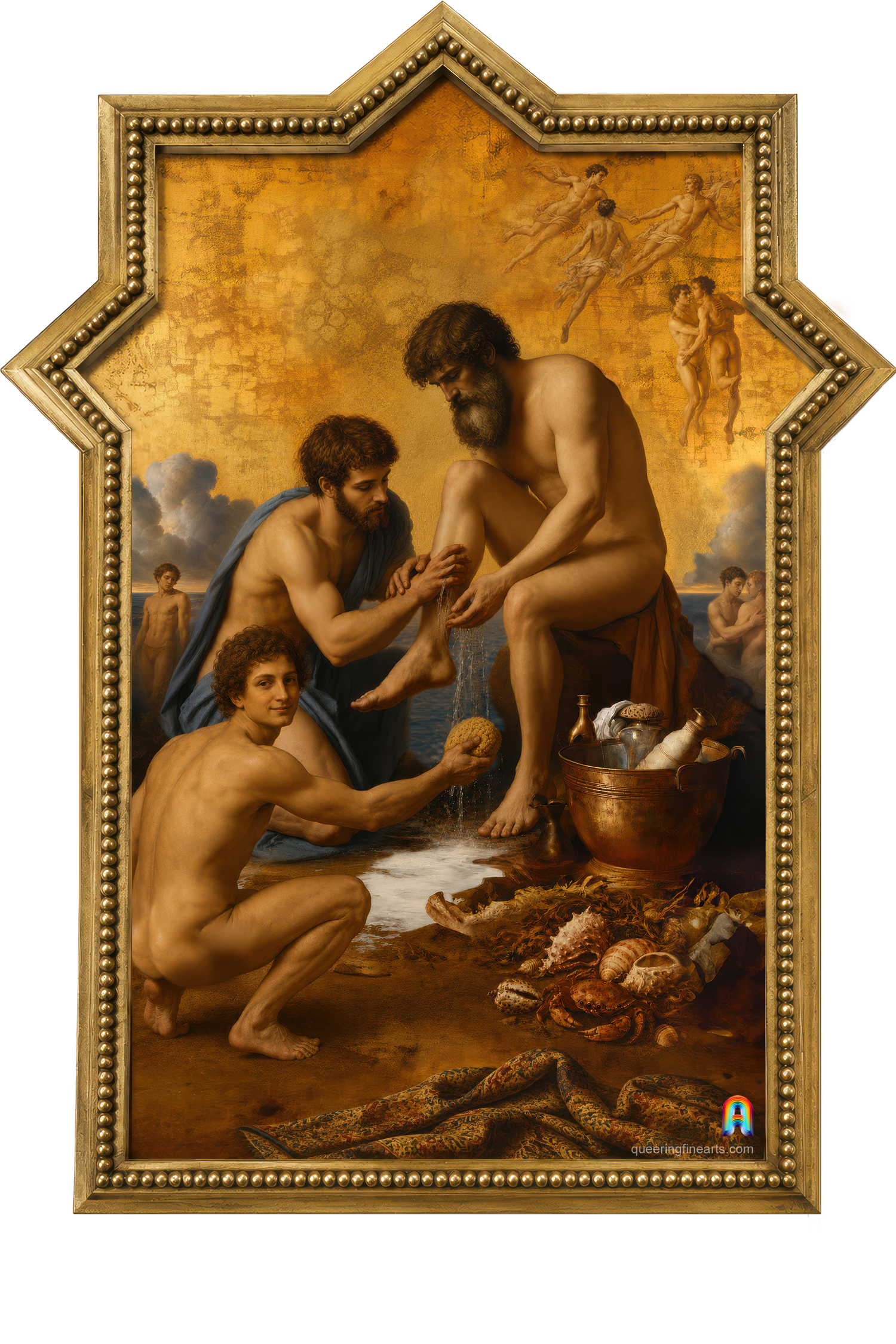
Sea Rituals
Attributed to Károly Lotz (1833-1904)
Oil on canvas, c. 1880
Probably commissioned for the salon of the Rudas Thermal Baths, Budapest
Private collection
The Discreet Life of the Rudas Baths
Ritual
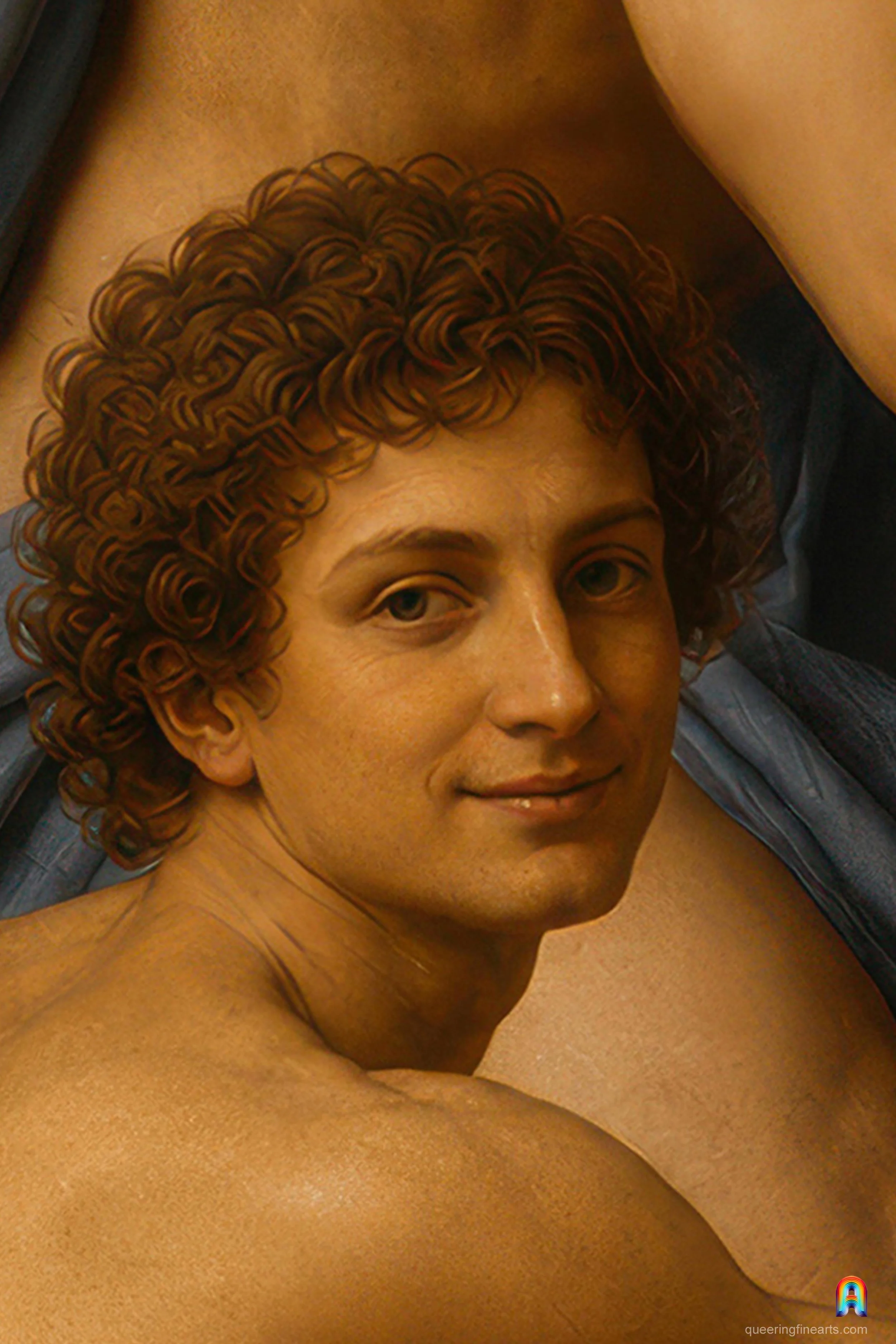
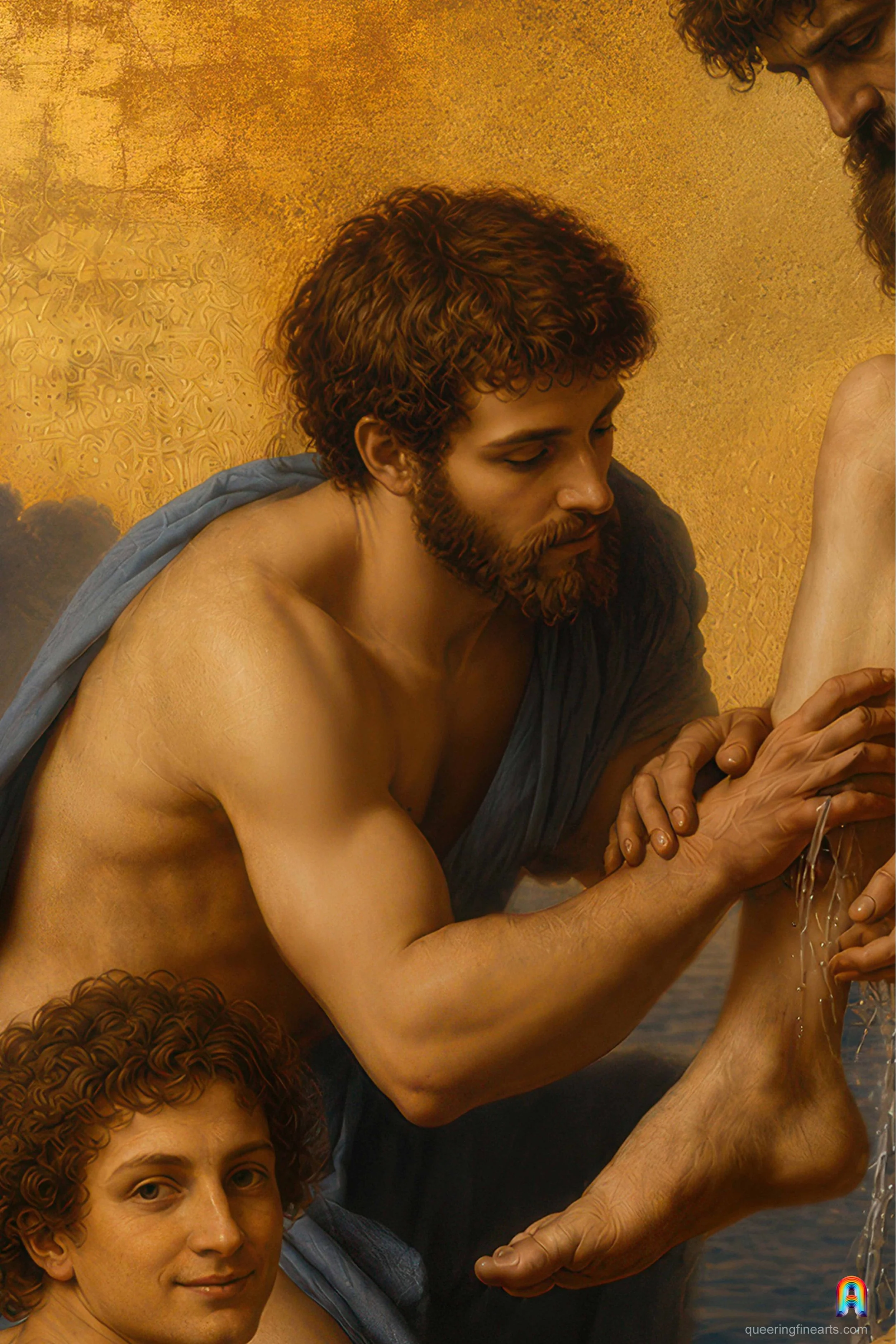
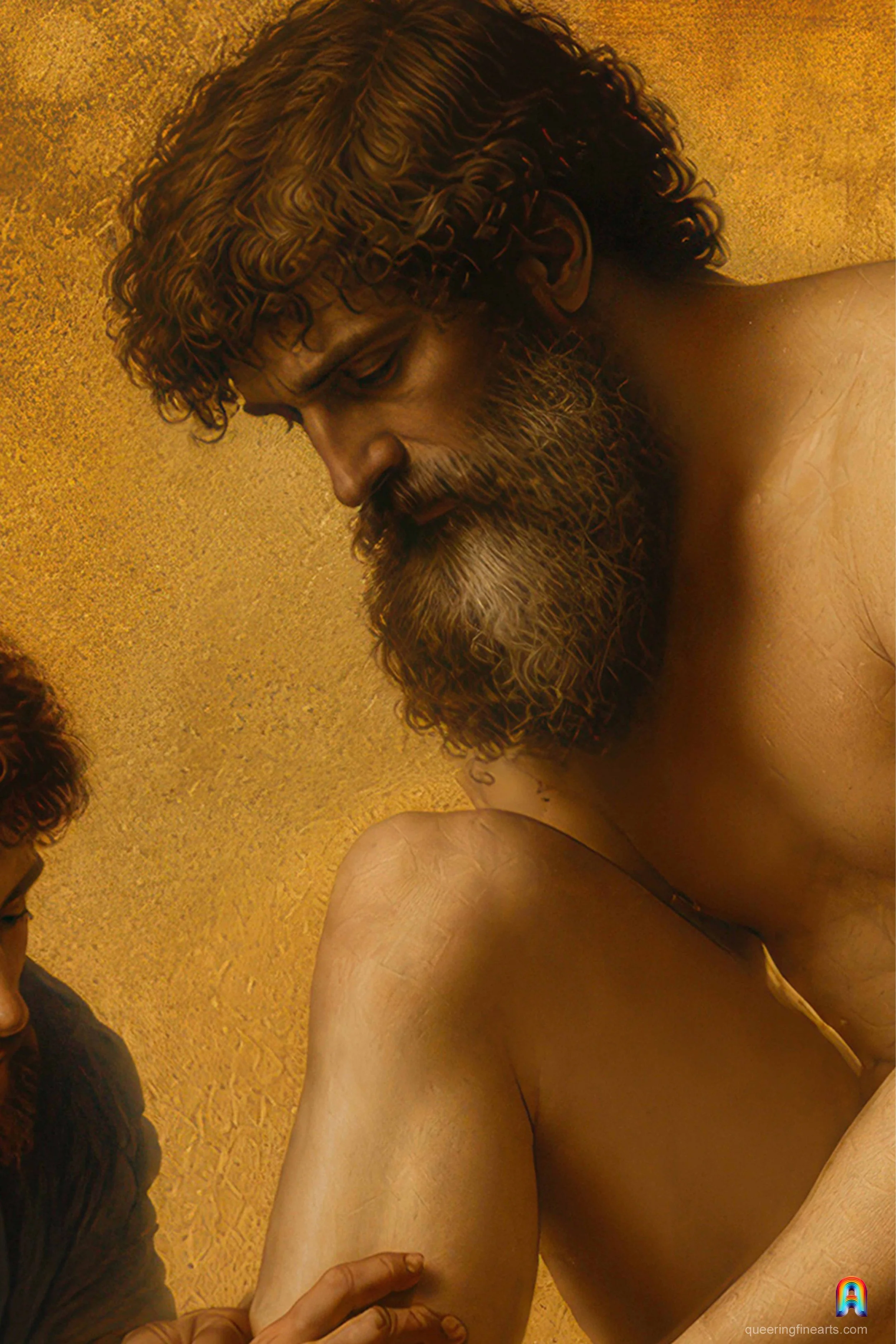
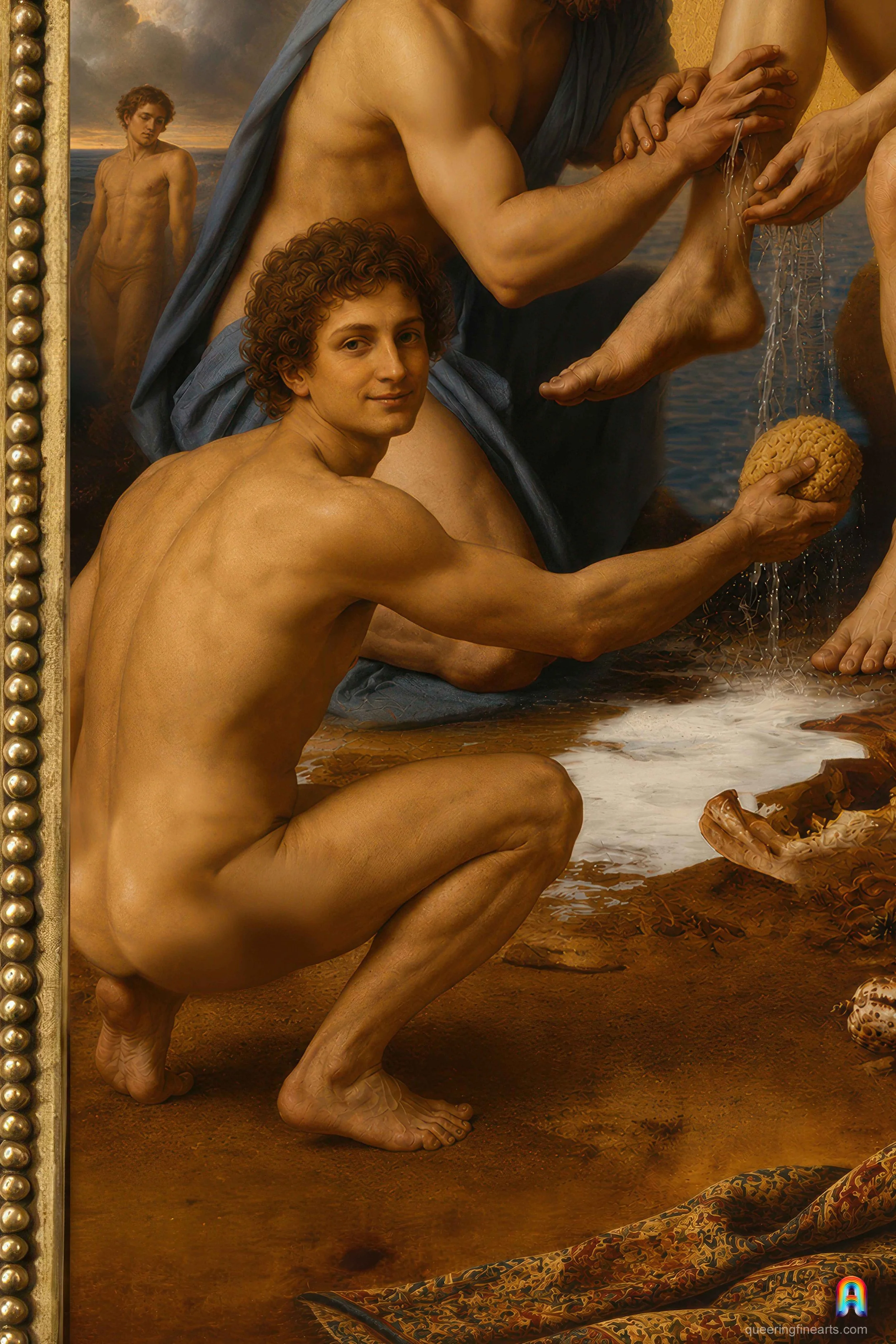
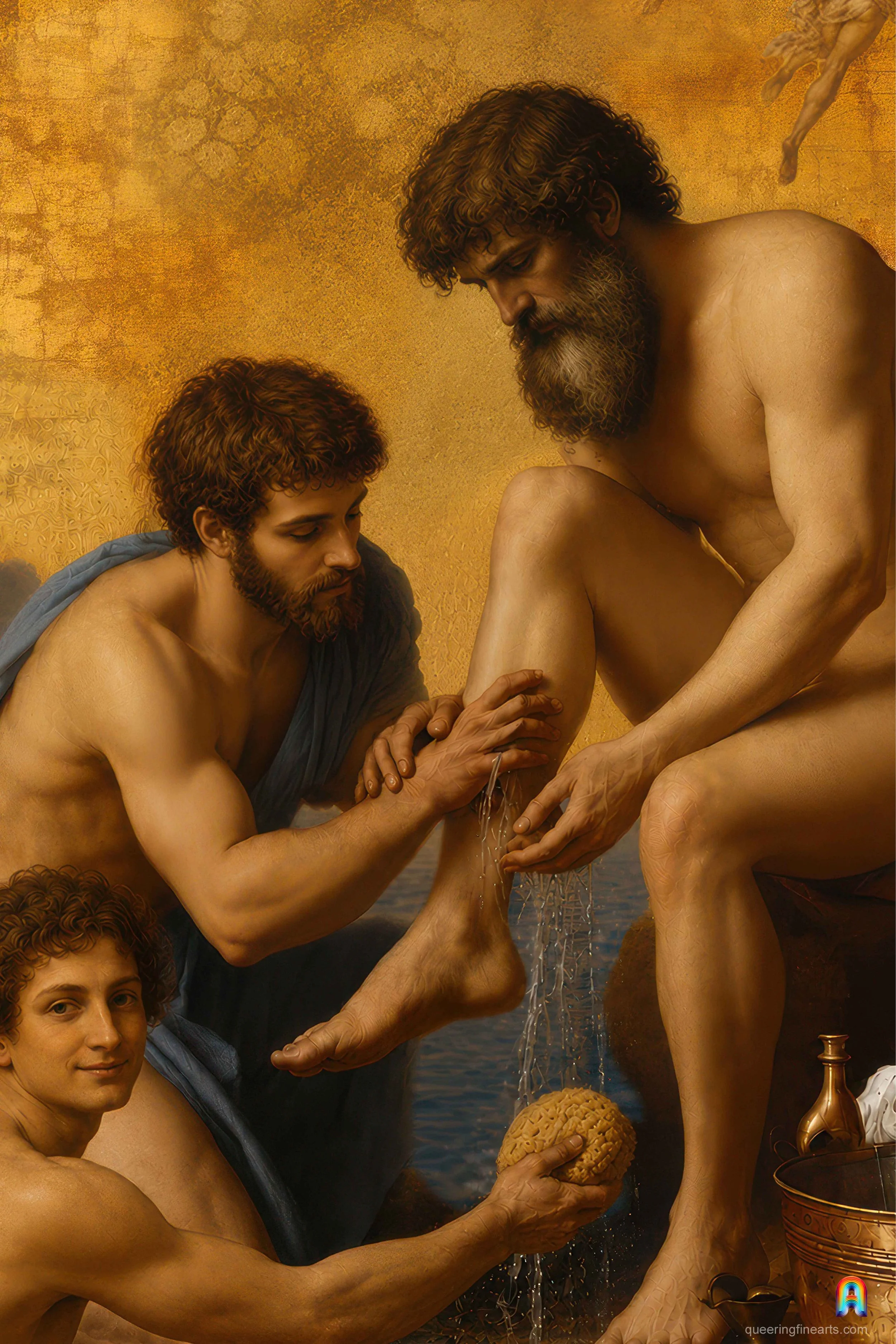
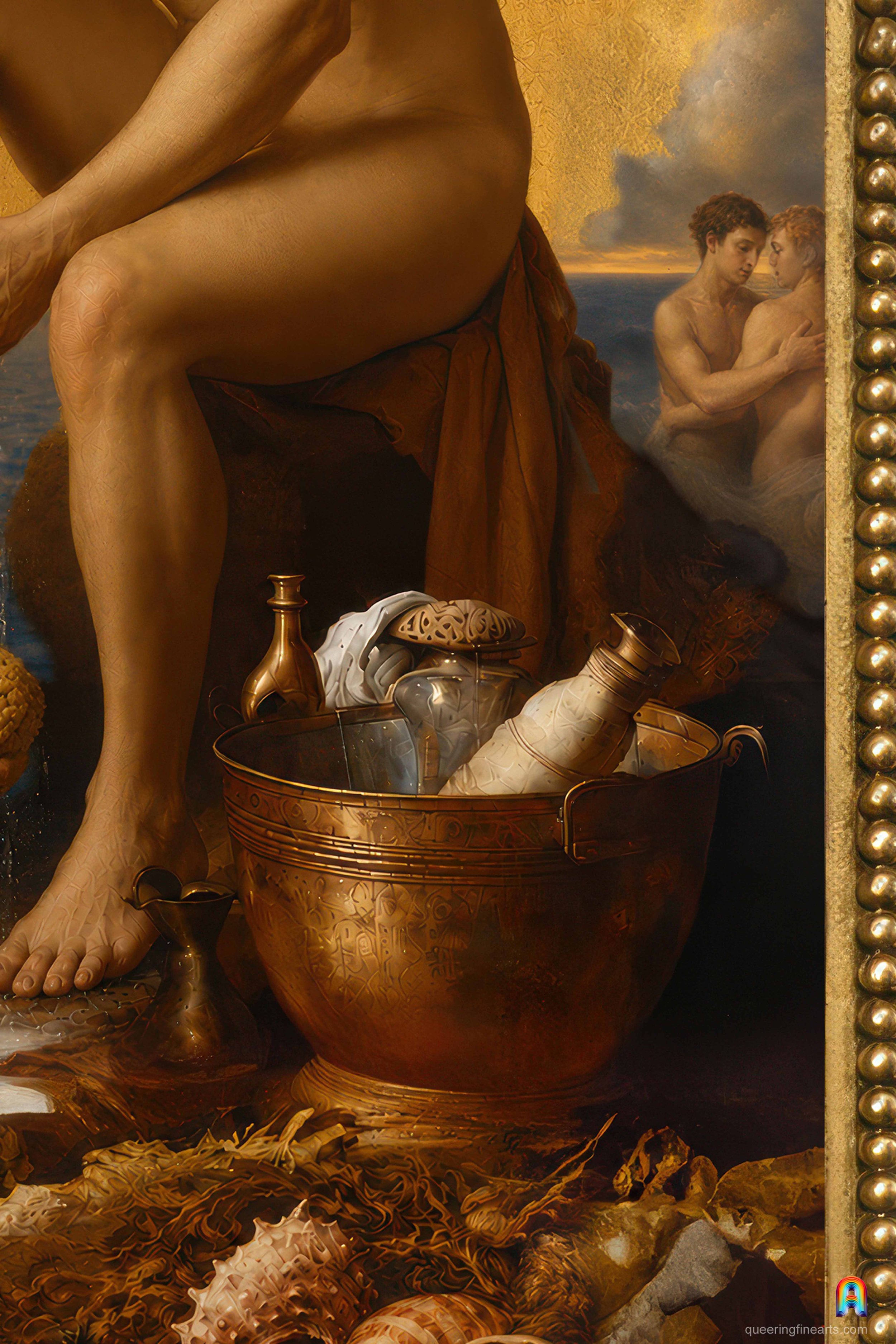
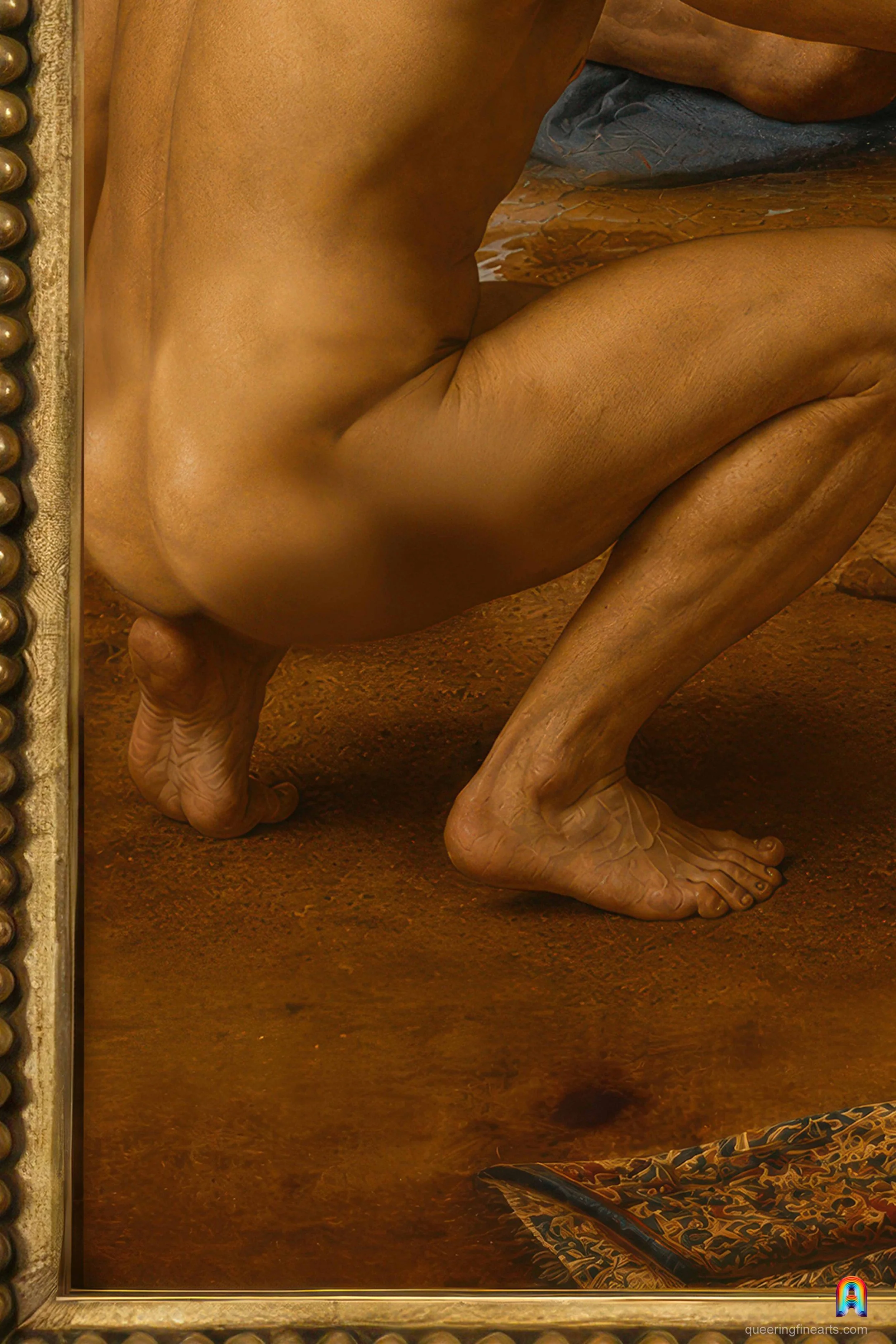
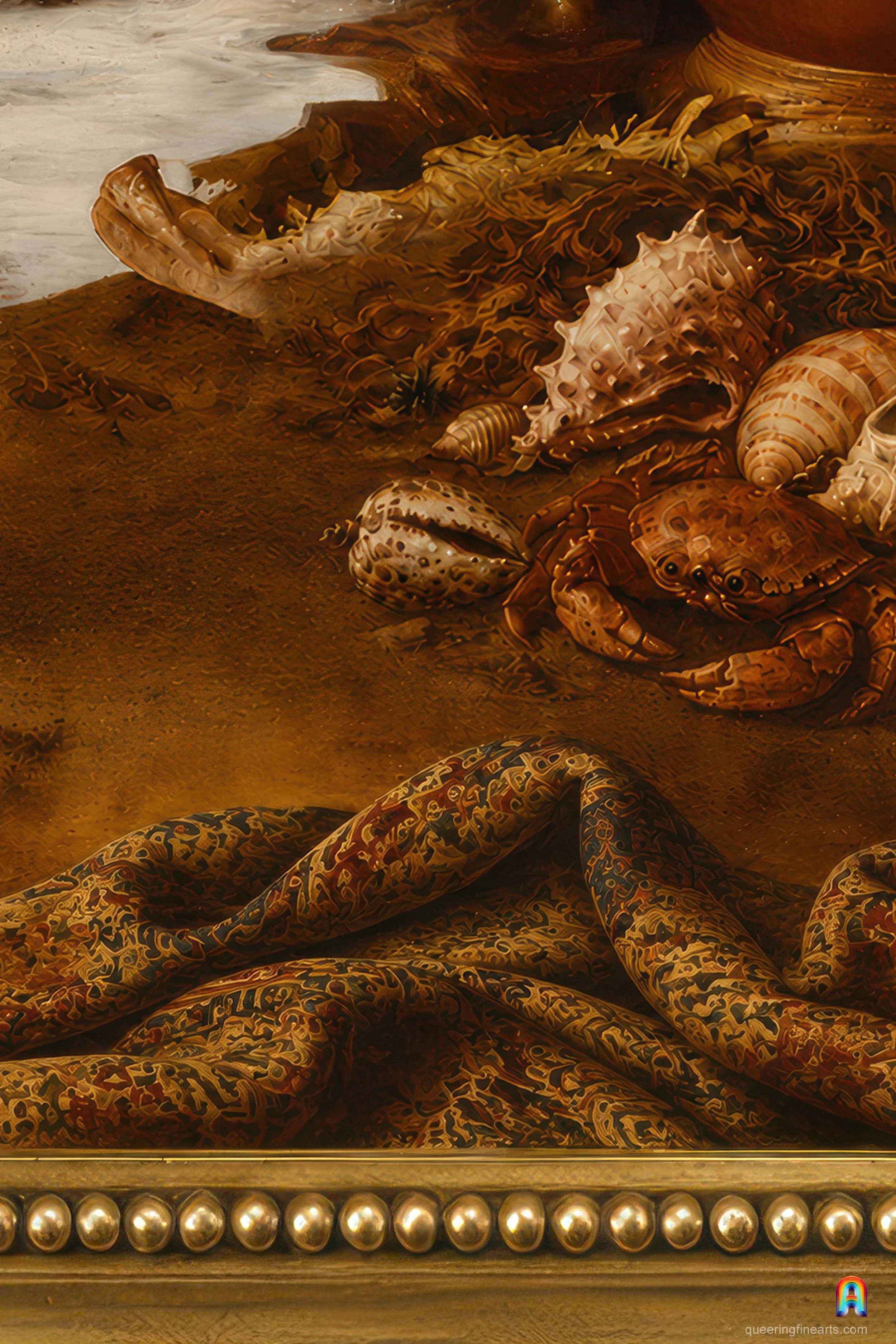
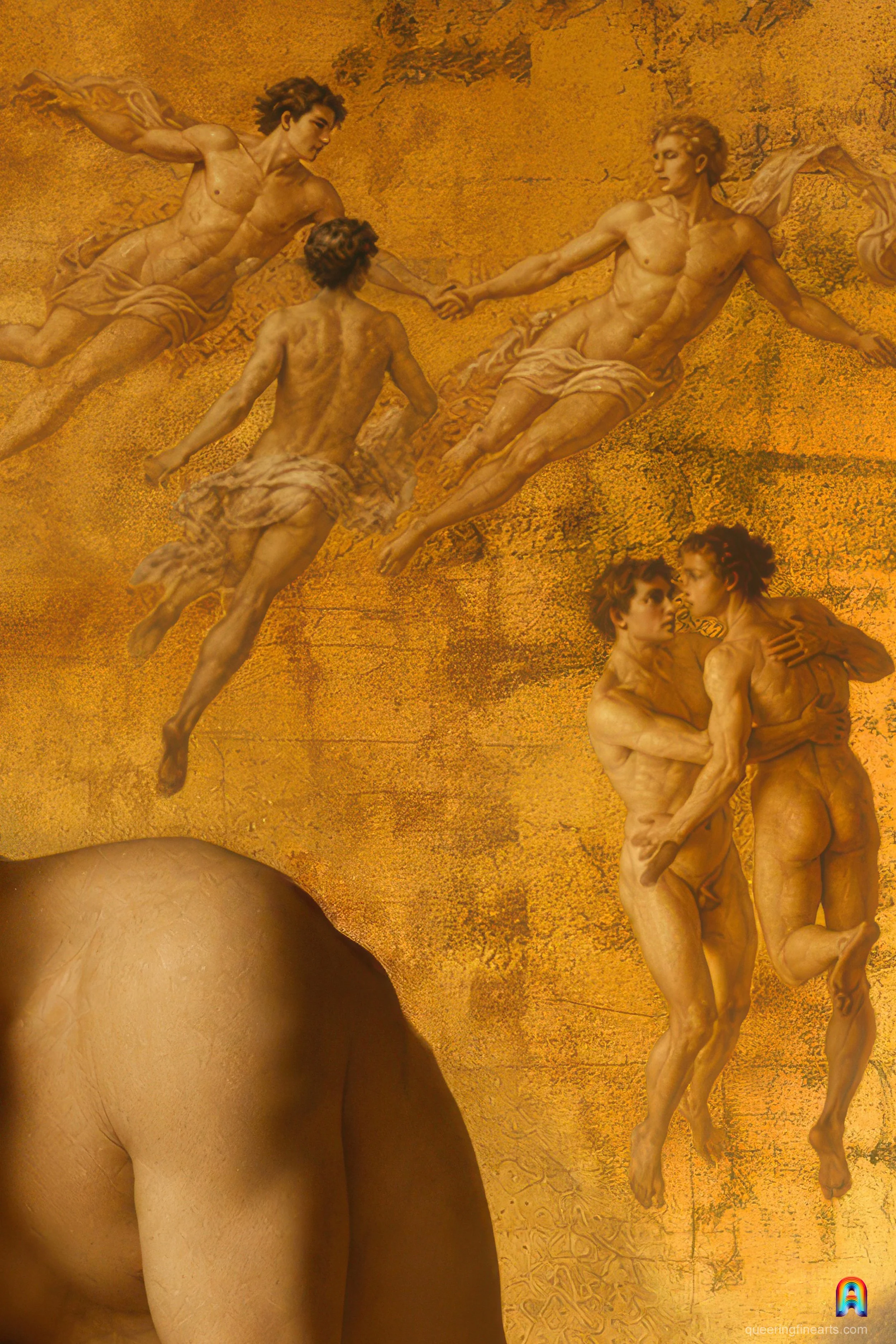
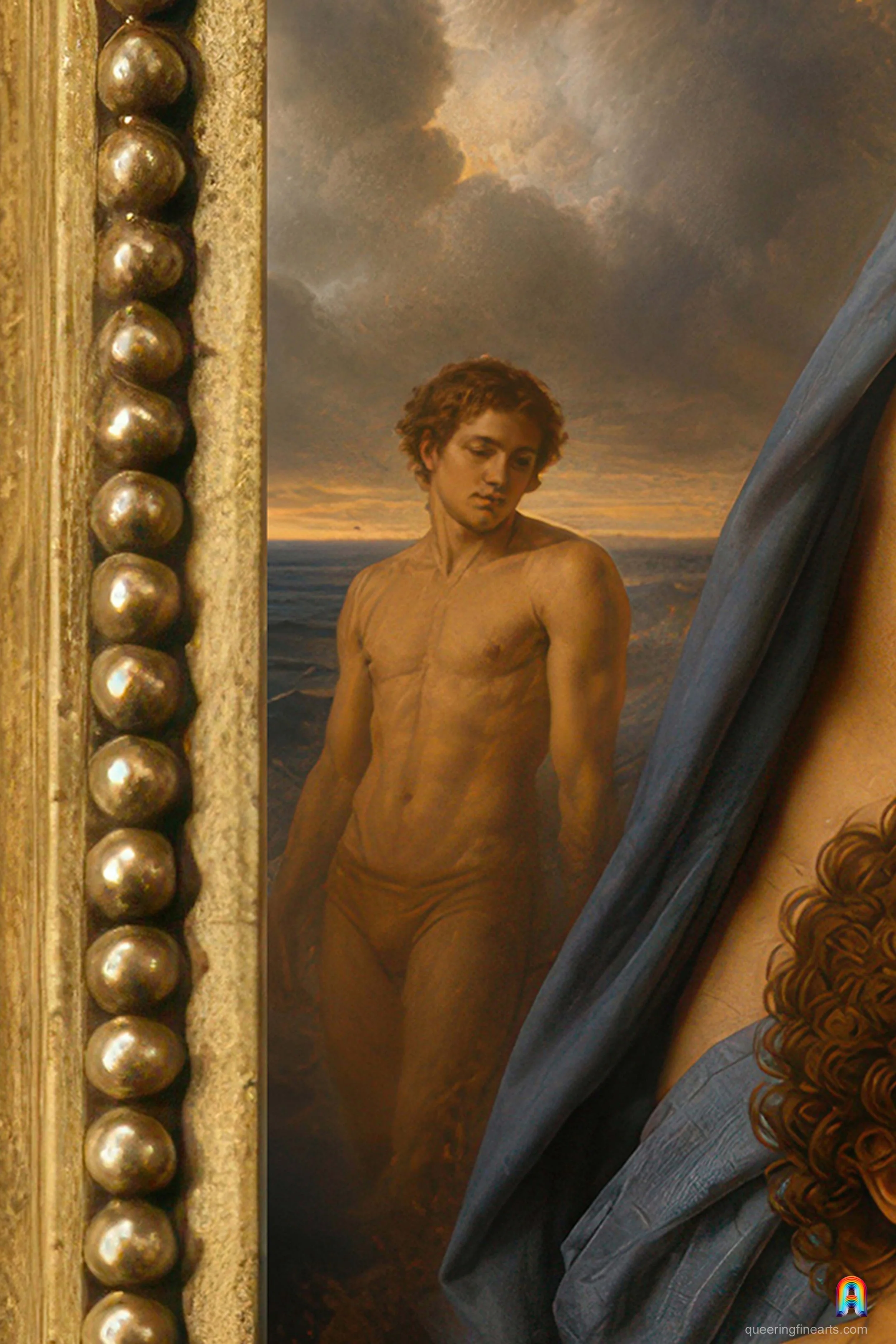
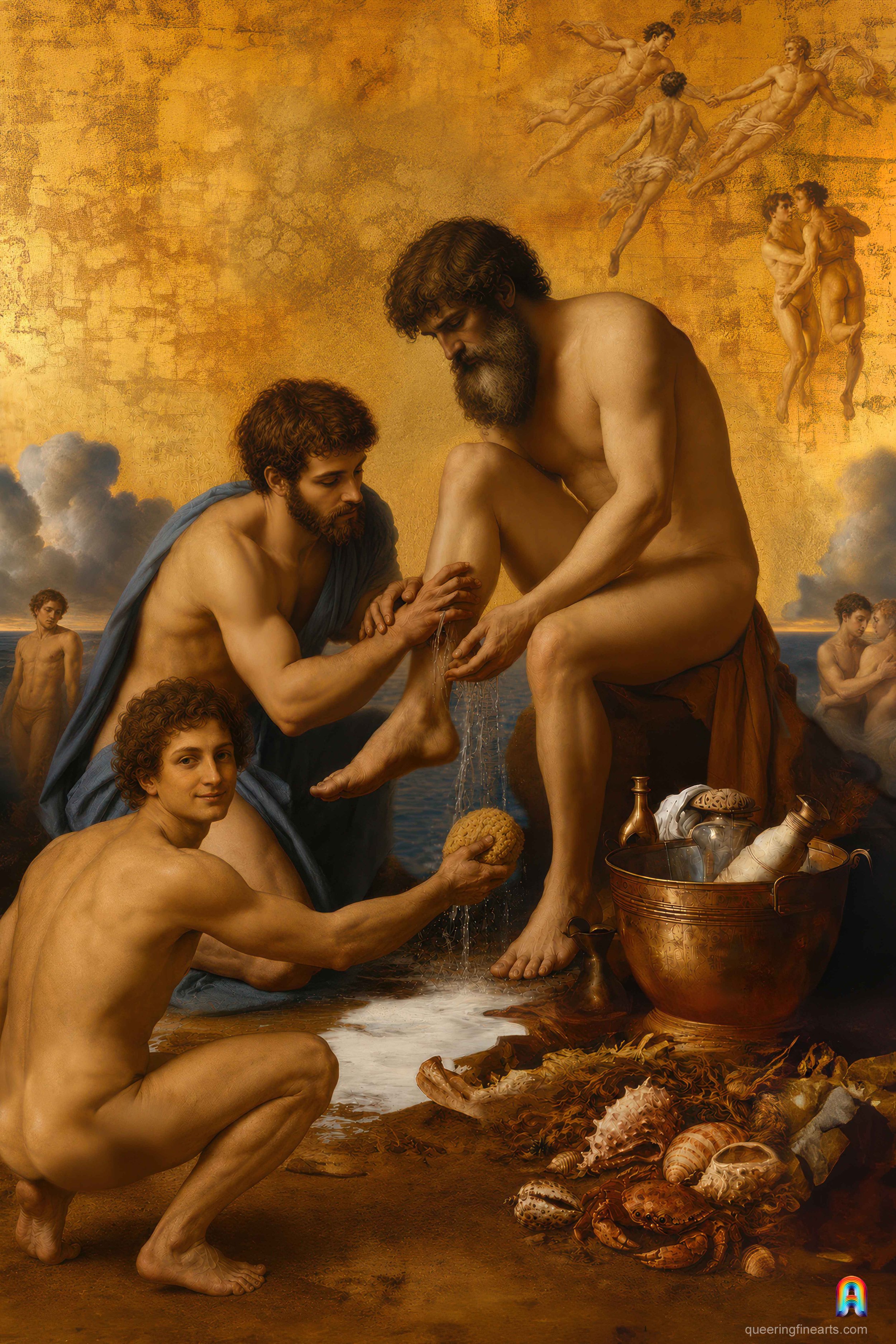
Three men stand by the sea. One offers his foot into the care of a younger companion, who washes it with an almost loving tenderness. A third looks directly at us with quiet complicity, a sponge in his hand, as though inviting us to join the company of other men. Around them are gathered every accessory of the bath and of the sea: ewers, linens, a bronze basin, shells, fish, seaweed and precious textiles. In the background, other bathers quietly enjoy the water. Above the scene, two embracing pairs of young men drift slowly across a golden sky like winged divinities watching over the ritual unfolding beneath their gaze. The entire composition is devoted to the male body: the body that is cared for, the body that is contemplated and the body that is idealized.
Hungarian Academic Painting
Attributed to Károly Lotz¹ (1833-1904), one of the leading academic painters of late 19th-century Hungary, this large oil on canvas was most probably painted around 1880 for the salon of the Rudas Baths in Budapest. The author of the great decorative schemes of the Hungarian National Museum, the Budapest Opera House and numerous palaces throughout the capital, Lotz became a master at transforming decorative commissions into vast allegories inspired by classical Antiquity. The style of Sea Rituals, its classical vocabulary, the monumentality of its figures and its mythological imagery all belong fully within that tradition.
Between Two Baths
The painting's presumed destination corresponds perfectly to its iconography. Following its expansion in 1831², the Rudas Baths no longer consisted solely of their celebrated Ottoman hammam. The establishment now included a hotel, salons, a dining room, a billiard room and several rest areas intended for visitors spending several days there or undergoing a thermal cure. Sea Rituals most likely adorned one of these rooms, accompanying visitors between two baths in an elegant environment that disappeared with the destruction of the hotel's wing in 1944.³
Reflection of a Masculine World
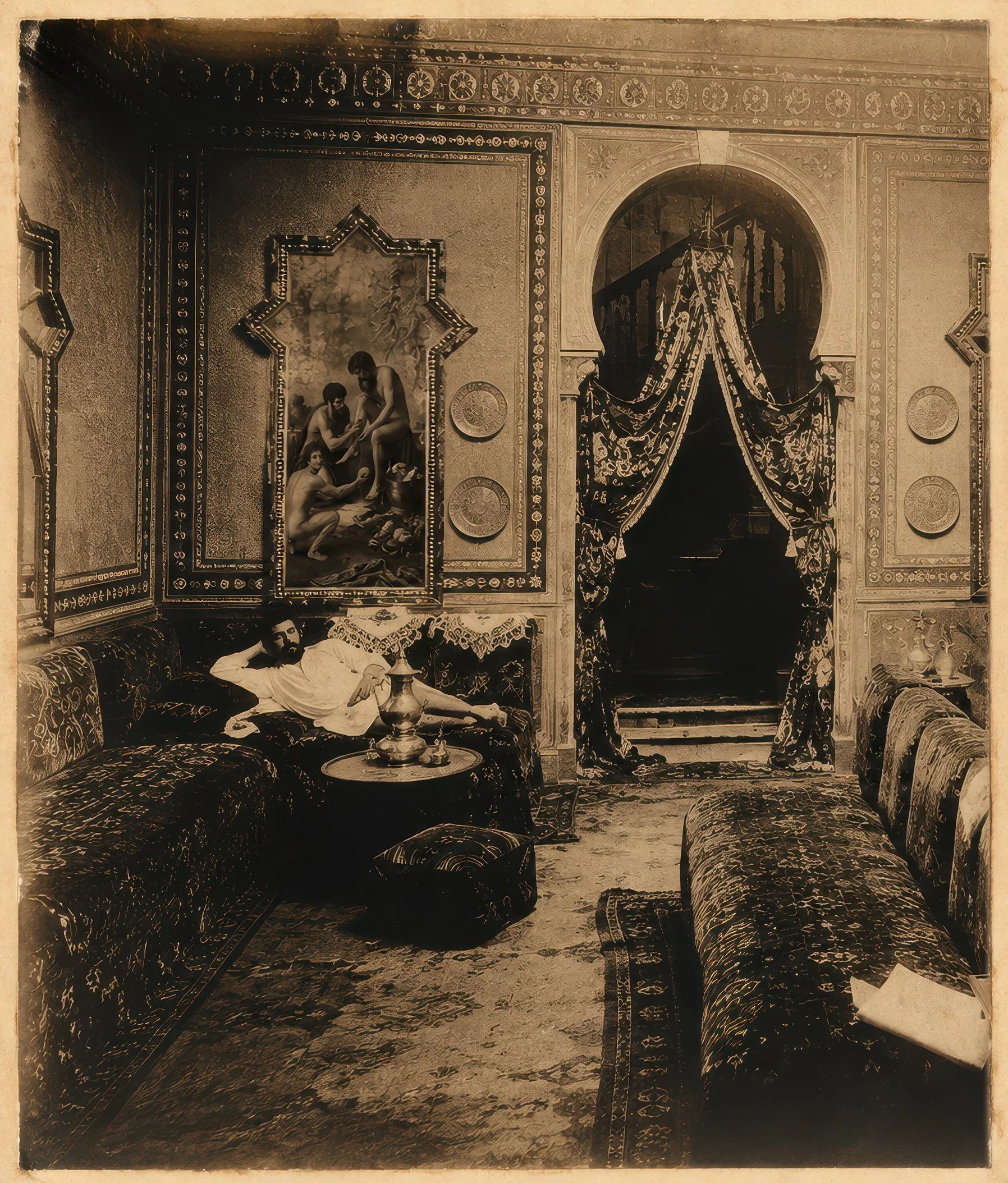
A photograph, most likely taken in the salon of the Rudas Baths around 1890,⁴ shows Sea Rituals in its original location, displayed above a visitor reclining comfortably in the establishment's rest area. It was in this very room that conversations, reading, encounters and the long hours between two baths unfolded. Only a few years later, the baths would become one of the principal centres of homosexual sociability in Budapest,⁵ frequented by men drawn as much by the reputed virtues of the waters as by the opportunity to enjoy the company of other men. Hanging above this clientele, Sea Rituals did more than celebrate bathing. It silently accompanied a masculine world whose codes, gestures and ideals it already reflected.
The Classical Ideal
Like many monumental decorative schemes of its period, the painting transposes the world of the baths into an idealized Antiquity. The bathers become classical heroes, the attendants become officiants performing an ancestral rite, and the most ordinary gestures of washing, massage and ablution acquire the solemnity of a sacred ceremony. At the same time, the pervasive nudity renders the figures almost timeless. Only the blue drapery evokes the ancient world, while the rest of the scene could belong to almost any period in history when men came together to bathe. Rather than reconstructing a specific historical setting, the artist creates an imagined classical world where everyday life is elevated to the dignity of myth.
Small Gestures, a Larger Story
Despite the number of figures, the composition remains remarkably calm. There is no dramatic action, no narrative climax. The eye moves slowly from one figure to another, yet beneath this apparent serenity runs an unmistakable current of erotic tension. Lingering touches, knowing glances, parted thighs, supple torsos and the unashamed display of youthful male bodies transform ordinary acts of care into a choreography of desire. Nothing overtly transgressive occurs, yet almost every gesture seems to hover on the threshold between innocent attention and erotic invitation. The deliberate rhythm of the composition invites the viewer to contemplate not only the ritual of bathing but also the sensual beauty and unmistakable homoerotic charge of the male body.
The Baths: Precursors of Modern Gay Saunas
Spaces of Intimacy
Long before the appearance of modern gay bars, clubs or saunas, bathing establishments already constituted one of the principal meeting places for men. Their primary function remained entirely respectable: people went there to wash, undergo a cure, receive a massage, enjoy the mineral waters or simply spend a few hours at rest. Yet wherever communal baths reserved for men existed, these establishments gradually came to fulfil a second, more discreet function.⁶
Then and Now
This continuity often comes as a surprise to the modern reader. We tend to associate places of homosexual sociability with the great metropolises of the 20th century. Yet for centuries public baths had already created the very conditions that many modern gay saunas still offer today: socially accepted nudity, body care administered between men, spaces for relaxation where one could remain for hours, and a succession of rooms allowing visitors to pass naturally from the steam to the pools, then on to the salons and rest areas.
Baths, Politics and Philosophy
The roots of this reality reach back well before the 19th century. Greek and later Roman thermae had already made bathing an essential institution of civic life.⁶ Men exercised there, received massages, discussed politics, literature and philosophy, concluded business and cultivated social relationships that could sometimes become very close. Although these establishments cannot be equated with modern homosexual venues, they had already made the male body an object of care, admiration and intimacy, providing a model to which European thermal establishments would repeatedly refer.
The Golden Age of the Spa
During the 19th century, with the spectacular development of spa towns, hydrotherapeutic establishments and public baths, this tradition experienced a genuine renaissance. Throughout Europe, physicians prescribed mineral waters, steam baths, massages and prolonged cures. Bathing establishments quickly developed into vast complexes where visitors no longer came merely for a few ablutions but stayed for several days, sometimes several weeks. Hotels, restaurants, reading rooms, music salons and rest areas extended the experience far beyond the pools themselves.
Legitimate Proximity
For homosexual men, these establishments offered a considerable advantage: they rendered nudity, physical contact and close proximity between men entirely legitimate. They also represented a marked improvement over the discomfort of the public latrines where such encounters had so often been confined, although some men nevertheless found a very particular pleasure there. What distinguished the baths was therefore everything that could take place without ever disturbing the appearance of perfect respectability.
Ah, Paris!
Paris provides one of the earliest documented demonstrations of this phenomenon. During the closing decades of the 19th century, several private bathing establishments, including the Bains de Penthièvre and the Bains du Gymnase, acquired a reputation well known both to their regular clientele and to the police. Behind the perfectly respectable façade of bathhouses frequented by a bourgeois clientele developed a network of habitués attracting not only men seeking the company of other men but also those engaged in prostitution. Police archives show that these establishments were by no means isolated exceptions, but formed part of a much broader homosexual geography linking cafés, hotels, public promenades and meeting houses.
The Russian Bani
The same phenomenon appears even more clearly in the Russian Empire. Dan Healey's research shows that the bani of Saint Petersburg and Moscow occupied an essential place within the homosexual subculture of the late 19th century.⁷ The attendants responsible for washing and body care enjoyed with their clients an intimacy that very few other places made possible. Some also offered sexual services, while the baths became privileged meeting places for men who possessed very few opportunities to live their desire openly. The boundaries between care, pleasure, prostitution and affection often remained blurred, precisely because the bath itself already authorized an exceptional degree of physical proximity.
The Baltic and Scandinavia
The cities of the Baltic region and Scandinavia underwent comparable developments. In Stockholm, baths, swimming establishments and certain beaches reserved for men gradually became privileged places for observing the male body and for discreet encounters. Riga, then part of the Russian Empire, most probably belonged to the same network of sociability, although the surviving documentation is less abundant. Everywhere, the bath offered a setting in which closeness between men temporarily ceased to appear suspicious and instead became a natural consequence of bodily care.
Budapest
It was in Budapest, however, that this evolution reached one of its fullest expressions. Drawing upon the legacy of classical thermae, the Ottoman hammam and the spectacular development of Austro-Hungarian thermal establishments, the Hungarian capital transformed bathing into a genuine urban institution. Anita Kurimay's research demonstrates that by the turn of the 20th century⁸ several establishments, among them the Rudas, Császár, Lukács and Hungária Baths, already ranked among the city's principal centres of homosexual sociability.
An Ottoman Legacy
The Rudas Baths alone embody this long history. Descended from an Ottoman hammam reserved exclusively for male patrons for centuries, they combined communal bathing, steam, massage, long hours spent in the rest rooms and a culture of the body deeply rooted in the daily life of Budapest. A few years before their homosexual reputation was explicitly documented, they had already welcomed Károly Mária Kertbeny, the man who coined the words "homosexual" and "heterosexual." This convergence of place, vocabulary and community gives the Rudas Baths a singular place in the European history of homosexuality.
The Universal Meaning of Sea Rituals
Seen in the light of this history, thermal establishments appear in an entirely new light. They were not merely places of healing or leisure. For generations of men attracted to other men, they also became the true predecessors of today's gay saunas. The forms of desire have changed. Legal frameworks, customs and identities have changed as well. Yet the fundamental idea remains strikingly familiar. It is within this long European tradition that Sea Rituals now fully reveals its meaning.
The Man Who Gave Homosexuality Its Name
Károly Mária Kertbeny
When Sea Rituals was probably installed in the salon of the Rudas Baths around 1880, one man had already been living in the establishment for several years. Visitors encountered him in the corridors, the rest rooms and on the terraces overlooking the Danube. His name was Károly Mária Kertbeny.
The Writer Who Changed Everything
At first glance, nothing distinguished him from the many writers, journalists and men of letters then active in Budapest. Yet his work would profoundly transform the history of homosexuality. In 1868 and 1869, in two anonymous memoranda opposing Prussia's proposed anti-sodomy legislation, Kertbeny coined the terms Homosexualität and Heterosexualität.⁹ For the first time, attraction between persons of the same sex received a term that would eventually become the modern standard, referring neither to sin, nor to crime, nor to disease.
Naming in Order to Exist
The importance of this innovation extends far beyond the invention of a single word. Until then, legal and medical texts spoke of "sodomites," "sexual inversion," "pederasty" and other categories that designated acts, offences or crimes. Kertbeny introduced a fundamental shift. He no longer described a behaviour. He designated a person. Homosexuality gradually ceased to be understood merely as an act and became instead a human condition capable of being understood, defended and, later, openly affirmed.
A Fundamental Shift
Even more remarkable, his reasoning remains strikingly modern. Unlike many of his contemporaries, Kertbeny did not seek to demonstrate that homosexuals deserved tolerance because they had been born that way. He defended a far more radical principle: whatever the origin of desire, the State has no right to interfere in freely consenting relationships between adults when they cause no harm to others. More than a century before the great legal reforms of the Western world, he was already defining private life as a sphere beyond the reach of criminal law.
The Hermit of the Baths
This reflection takes on a particular resonance at the Rudas Baths. Beginning in 1875, Kertbeny was provided with an apartment there in the hope that the thermal waters would contribute to his recovery. He settled there permanently and remained until his death in 1882. In his correspondence, he described himself as "the old hermit of the Rudas Baths."¹⁰ What drew Kertbeny there remains an open question. He may well have been attracted by the opportunity to meet other men. Whatever the answer, history has left us with a remarkable coincidence: the man who gave homosexuality its modern name spent his final years in the very place that would later become one of the principal centres of homosexual life in Budapest.
Several Layers of Encounters
The coincidence extends beyond mere anecdote. Kertbeny, who himself experienced desire for men and had relationships with several male lovers, spent the last years of his life in one of the places that would become most important for intimacy between men in Budapest. Under the same roof thus converged a man directly concerned with homosexual desire, the new vocabulary he forged to describe it, a culture centred upon the male body and an environment in which that desire could circulate with uncommon freedom.
An Ancient Gaze, Yet a Modern One
Read in the light of Kertbeny's thought, Sea Rituals acquires an unexpected depth. The men who wash, support or contemplate other men are no longer merely the actors in an elegant classical allegory. They now belong to a period in which love between persons of the same sex was itself beginning to acquire a new language. The painting continues to speak the language of Antiquity. The world surrounding it, however, is already beginning to invent that of modern homosexuality.
Evocative Literature
The Soul of the Baths in Literature
While archives and photographs allow us to reconstruct the physical appearance of thermal establishments, literature restores their atmosphere. It reveals what administrative documents never tell us: the long hours spent in the steam, the conversations, the silences, the closeness of bodies and that strange sensation of living, if only for a moment, in a world composed almost entirely of one's own kind.
Writers in the Steam
Many Hungarian writers were regular patrons of the baths of Budapest. Sándor Bródy (1863-1924) lived for several years at the Rudas Baths, where each morning he descended to take his steam bath before returning upstairs to write in his room. Gyula Krúdy (1878-1933), for his part, captures the physical abandonment peculiar to the thermal cure. In Szent Margit, he recounts that he awaited "the hour of the bath with happiness," as though no other concern remained.¹¹ He lies motionless, "his arms relaxed, his legs outstretched," while the hot, constantly renewed water envelops him. Under his pen, the bath becomes a sensual suspension of everyday life, a moment when the body ceases to resist and allows itself to be entirely entrusted to the water.
The Intimacy of Massage
It is, however, Sándor Márai (1900-1989) who leaves us the most physical description. When he returns to the Rudas Baths after the Siege of Budapest, he finds the staff welcoming him like a prodigal son. He immerses himself in the hot water and recalls the twenty-five years he spent there. The masseurs, he writes, "knew my body better than my mother, my wife or my mistresses."¹² The phrase is not metaphorical. It describes a familiarity acquired through years of baths, massages and repeated appointments, within that singular relationship in which one man regularly entrusts his naked body into the hands of another.
Viktor
Márai continues by describing Viktor, his masseur, standing before him "with his hands on his hips," while the writer lies naked upon a damp bench. The masseur examines him before vigorously setting to work on his abdomen. "Let us begin again from the beginning," he says, as though the body of his regular client were a familiar work rediscovered after a long interruption. The heat, the nudity, the masseur's lingering gaze and the energetic pressure of his hands lend the passage a sensuality that Márai makes no attempt to soften. Above all, it conveys what no medical treatise could ever express: the baths created between visitors and the men responsible for their care a degree of physical intimacy almost impossible to find within bourgeois society.
The Memory of Homosexual Desire
Homosexual fiction offers another perspective upon this intimacy. Published in 1906 under the pseudonym Xavier Mayne, Edward Prime-Stevenson's Imre: A Memorandum (1858-1942)¹³ unfolds in a Budapest that is only thinly disguised. There, Oswald, a British aristocrat, meets Imre, a young Hungarian officer. Their cautious friendship gradually becomes a love story in which both men learn to recognize one another beneath the outward appearances of military virility and conventional friendship.
Purification
The bath appears at the very moment when Imre returns from a military camp. Before joining Oswald, he stops at the officers' baths, washes himself and changes his clothes. After dinner, exhausted by marching through the summer heat, he falls asleep upon the long green sofa in his friend's room. His sabre and fitted jacket have been thrown onto a chair. His shirt is open at the throat and his sleeves rolled above the shoulders, emphasizing the deep tan of his skin. Oswald then contemplates the young man's "physical abandonment" and his deep, silent breathing. The loving gaze may at last rest freely upon a body that the bath has stripped of dust, uniform and military discipline.
The Beauty of the Male Body
Here the bath functions as a threshold. Before entering it, Imre belongs to the army, to hierarchy and to the public gaze. Afterwards, he once again becomes a vulnerable man, asleep before the one who loves him. His body is no longer that of an officer on display. It may now be contemplated for the beauty of its skin, its shoulders, its breathing and that masculine beauty which the novel describes without reserve.
The Aesthete's Pleasure
Prime-Stevenson likewise grants constant importance to the male body. Imre possesses a supple yet powerful physique whose strength becomes fully apparent only in nudity, when muscles and tendons emerge beneath smooth, hairless skin. One of his companions, Karvaly, bears the nickname "Hermes" because he resembles a statue by Praxiteles.¹⁴ Antiquity thus provides the novel with an immediately intelligible vocabulary for celebrating masculine beauty. It allows desire to be expressed through the figure of the statue, the hero and the god, exactly as in Sea Rituals, where contemporary bathers assume the appearance of figures from classical Antiquity.
Impossible Love
But Imre does not stop at aesthetic contemplation. The young officer eventually recounts the desperate love he once felt for Karvaly. He describes the mask he constantly wears before other men and the risk of losing his career, his friendships and even his life should his desire ever become known. His affection for his companion had become a "fierce and desperate homosexual love,"¹⁵ impossible to confess to the very man who inspired it. The language of comradeship thus becomes the refuge of a feeling that must both be lived and concealed.
Precursors of Modern Gay Saunas
Literature thus reveals what photographs and archives only allow us to glimpse. Thermal establishments were not merely places where bodies were cared for. They were also places where men learned to look at other men, to touch them, to know them, to have sexual intercourse and sometimes to love them. In this respect, they truly appear as the precursors of today's gay saunas¹⁶, not because they fulfilled exactly the same function, but because they already offered that distinctive combination of nudity, bodily care, sociability and desire that continues to characterize these masculine spaces.
Nudity and Physical Contact in the Humid Heat
Read in the light of this literature, Sea Rituals ceases to be merely an allegory of the pleasures of bathing. It now belongs to a continuous history of places shaped by homosexual life. Throughout the 19th century, spa towns, thermal establishments and public baths long fulfilled the role later assumed by seaside destinations such as Provincetown, Mykonos and Sitges¹⁷, and later still by the gay saunas of the great metropolises¹⁸: they offered men attracted to other men places in which to travel, spend time, rest, make contact and recognize one another. The settings have changed. So have social customs. Yet the underlying logic of these destinations remains strikingly constant. Sea Rituals reminds us that this history began long before the 20th century.
QFA
Curiosity piqued?
1. Éva Bicskei (dir.), Károly Lotz (1833-1904), Budapest, Magyar Nemzeti Galéria, 1991.
2. Gábor Cséby, A Rudas fürdő története, Budapest, Budapest Gyógyfürdői és Hévizei Zrt., 2005, p. 29-38.
3. Gábor Cséby, A Rudas fürdő története, p. 92-96.
4. Mór Erdélyi, Salon des bains Rudas, photographie, vers 1890, Bibliothèque métropolitaine Ervin Szabó, Budapest, Collection iconographique.
5. Anita Kurimay, Queer Budapest, 1873-1961, Chicago, University of Chicago Press, 2020, p. 42-63.
6. Garrett G. Fagan, Bathing in Public in the Roman World, Ann Arbor, University of Michigan Press, 1999, p. 9-47.
7. Dan Healey, Homosexual Desire in Revolutionary Russia: The Regulation of Sexual and Gender Dissent, Chicago, University of Chicago Press, 2001, première partie, « Same-Sex Eros in Modernizing Russia ».
8. Andrea Kurimay, Queer Budapest, 1873-1961, Chicago, University of Chicago Press, 2020, p. 45-61.
9. Hubert Kennedy, Karl Heinrich Ulrichs: First Theorist of Homosexuality, Boston, Alyson Publications, 1988, p. 175-183; voir aussi Manfred Herzer, Kertbeny: Leben und Werk des Erfinders des Wortes Homosexualität, Hambourg, MännerschwarmSkript, 2001.
10. Manfred Herzer, Kertbeny: Leben und Werk des Erfinders des Wortes Homosexualität, Hambourg, MännerschwarmSkript, 2001, p. 221-230.
11. Gyula Krúdy, Szent Margit, dans Krúdy Gyula összes művei, Budapest, Szépirodalmi Könyvkiadó, éd. critique.
12. Sándor Márai, Föld, föld!..., Budapest, Helikon, 1991 (1re éd. 1972), passages consacrés aux bains Rudas.
13. Edward Prime-Stevenson (Xavier Mayne), Imre: A Memorandum, Naples, The English Book-Press, 1906; rééd. Peter Owen Publishers, Londres, 2003.
14. Edward Prime-Stevenson (Xavier Mayne), Imre: A Memorandum, éd. James J. Gifford, Peterborough (Ontario), Broadview Press, 2003, partie « Faces - Hearts - Souls », passage consacré à Karvaly.
15. Prime-Stevenson, Imre: A Memorandum, partie « Faces - Hearts - Souls », confession d’Imre sur son amour pour Karvaly.
16. Florence Tamagne, Histoire de l'homosexualité en Europe. Berlin, Londres, Paris, 1919-1939, Paris, Seuil, 2000, introduction; George Chauncey, Gay New York, New York, Basic Books, 1994, introduction.
17. Gordon Waitt et Kevin Markwell, Gay Tourism: Culture and Context, New York, Haworth Hospitality Press, 2006.
18. Allan Bérubé, « The History of Gay Bathhouses », Journal of Homosexuality, vol. 44, nos 3-4, 2003, p. 33-53.