


A Guide to a Most Delightfully Gay Rose Garden
Being Practical Instructions for the Selection, Arrangement and Proper Enjoyment of Roses by the Discerning Gentleman
Anonymous
England, c. 1885
Chromolithograph, frontispiece to an illustrated horticultural manual
From the library of an unidentified gentleman horticulturist
Full Bloomed
A particularly flourishing rose garden provides the setting for this instructive scene, in which two young gardeners demonstrate the considerable attention required by well-established climbing roses. One, equipped with pruning shears and raised upon a small wooden step, attends to the higher growth, while his companion assists him rather closely from below.
Around them, roses have been trained over a succession of iron arches to create a luxuriant flowering passage. Large specimens occupy the foreground, while climbing varieties rise overhead and mingle with the surrounding foliage. The abundance is almost excessive, suggesting a gardener who has understood that restraint, though occasionally useful in pruning, need not govern every aspect of horticultural life.
The anonymous author appears to have intended his volume for the experienced gentleman gardener rather than the complete novice. Matters of selection, placement, hardiness and cultivation are treated seriously, but so too is the less easily codified question of what sort of company a garden ought to keep.
Among the roses available to his imaginary 19th-century gardener is William III, an old Rosa spinosissima whose dark crimson flowers and formidable thorns provide a suitably historical beginning. The remaining inhabitants of the garden present a more curious problem. Several varieties described in the pages that follow would not, according to conventional horticultural chronology, exist for another century.
The identity of the author remains unknown. Whoever he was, his knowledge of roses appears to have extended considerably beyond the horticulture of his own time.
In more ways than one.
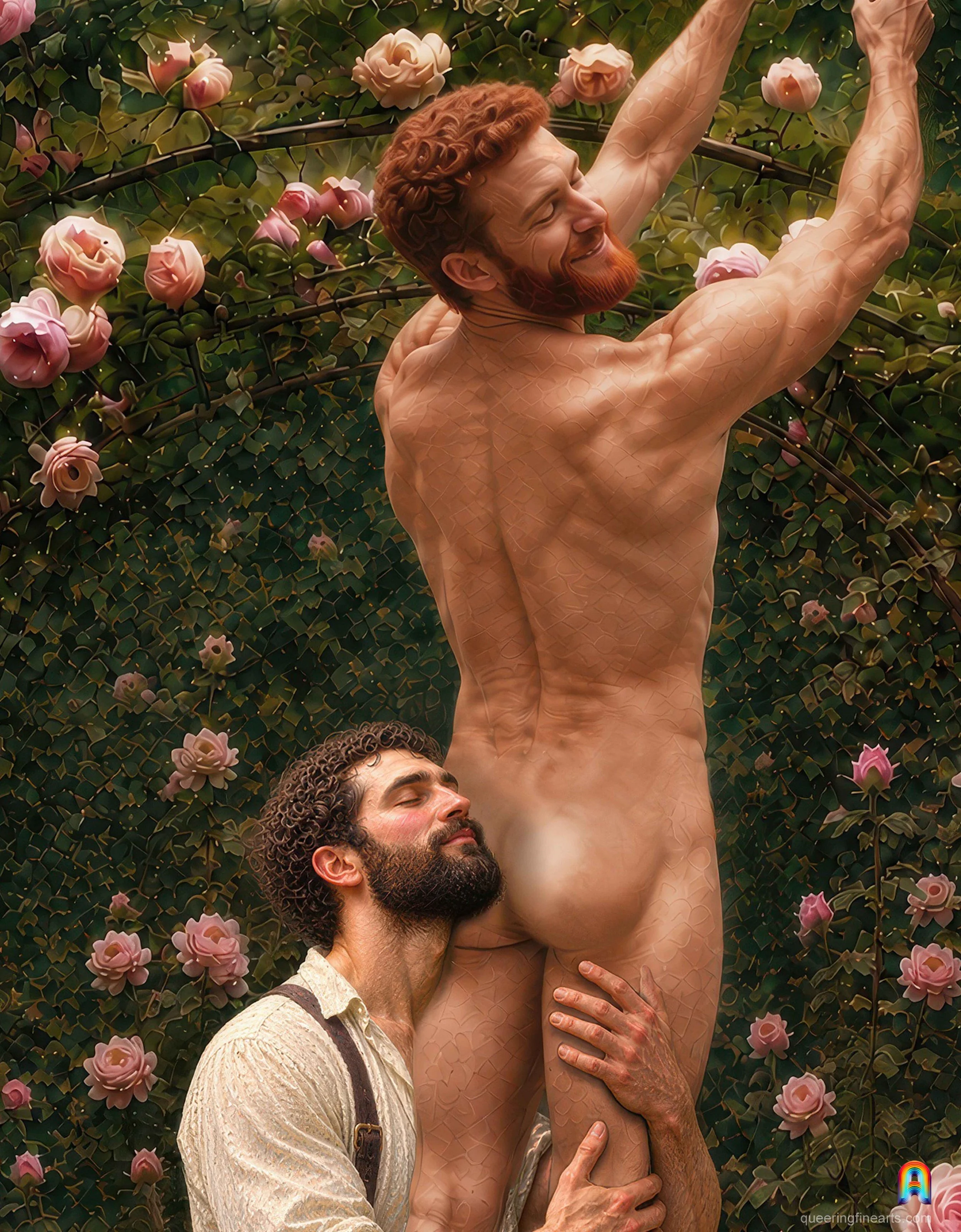
A Delightfully Gay Rose Garden
Roses have been given the names of almost everyone imaginable: monarchs, artists, writers, musicians, actors and assorted celebrities. So we went looking among them for men from the past whose lives also belong, in one way or another, to queer history.
The result is a rather irresistible little gathering: two great artists of the Renaissance, a king surrounded by centuries of gossip, a Romantic poet who made scandal almost an art form, a Danish storyteller whose longing found its way into some of the most enduring tales ever written and a Russian composer whose private desires could become gloriously expansive in music.
Their roses could hardly be more different. There is brilliant gold and deep old rose, purplish crimson and warm apricot, scarlet and ivory. Some are lush and voluptuous, one has something much wilder about it and another wants an arch or wall to conquer.
Together, they make a surprisingly beautiful garden.
And because six historically queer gentlemen apparently weren’t quite enough, we slipped in one last rose. It bears no famous man’s name and, as far as we can determine, its creators had nothing particularly gay in mind. But some names are simply asking to be claimed.

Michelangelo®
A man who spent a lifetime celebrating the beauty of the male body seems a perfectly suitable choice for our first planting. Michelangelo’s attraction to men is hardly a modern invention imposed upon the Renaissance. His passionate attachment to the young Roman nobleman Tommaso de’ Cavalieri inspired love poems, letters and some of his most intimate drawings.¹ Whether that love was ever physically consummated remains unknown, but the desire expressed by Michelangelo himself is rather less mysterious. Tommaso was not the only young man to stir him either: Febo di Poggio was among several others who found their way into his poetry.
So what grows when you plant Michelangelo? Something suitably magnificent. Michelangelo® (MEItelov) was bred in France by Alain Meilland and introduced in the 1990s as part of Meilland’s ROMANTICA® family.² It produces enormous, very full flowers, around 12 to 13 cm across, packed with roughly fifty golden-yellow petals. Their cupped, almost old-fashioned form softens the brilliance of the colour, while the fragrance brings fruity notes of peach and plum. Dark, dense foliage makes all that yellow look even richer.
It is a vigorous, repeat-flowering shrub with excellent disease resistance, blooming from spring until frost and reaching roughly a metre in height. It also makes a splendid cut flower, should you feel Michelangelo belongs as much in the bedroom as in the garden. Better still, this is no extinct horticultural curiosity: Michelangelo® remains commercially available today, particularly in Europe through rose nurseries and specialist growers.
Leonardo da Vinci®
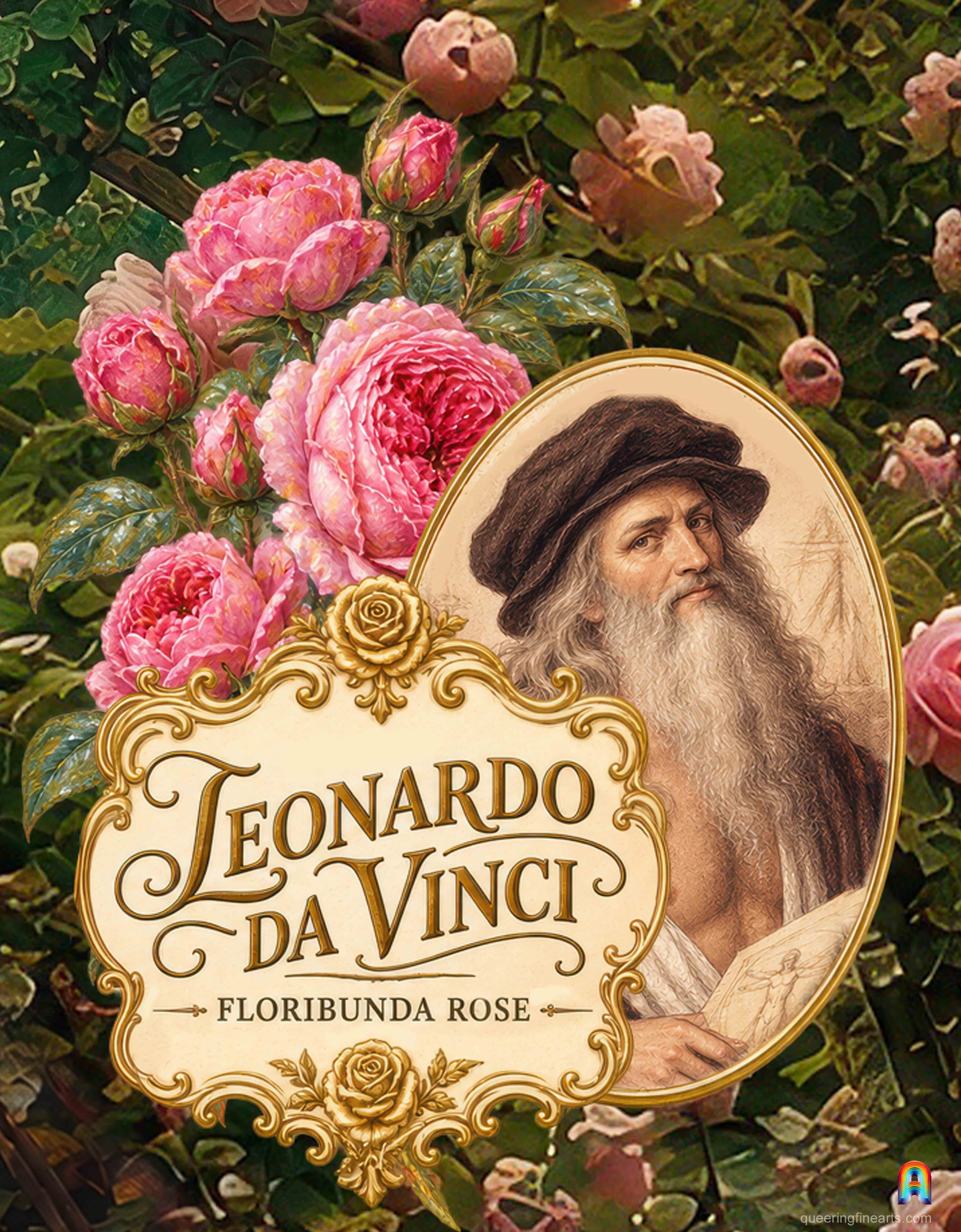
Our second Renaissance artist brings an entirely different sort of extravagance to the garden. Leonardo da Vinci® (MEIdeauri) is a mass of deep, old-fashioned pink, with extraordinarily full flowers packed with 75 to 80 petals and opening in voluptuous quarters that give them all the romance of an old garden rose.
Yet Leonardo da Vinci is thoroughly modern. Bred in France by Meilland and introduced in 1994, this floribunda blooms generously in clusters from early summer until frost. Its perfume is discreet, its foliage dense and, despite the almost decadent appearance of those flowers, they stand up remarkably well to rain. The bush reaches roughly 70 cm to 1.10 m, flowers abundantly and has excellent disease resistance. It was already winning admirers before reaching the market, taking a Gold Medal at Monza in 1993.³
The rose may be straightforward enough, but the sexuality of the man whose name it bears requires rather more care. At twenty-four, Leonardo was anonymously accused of sodomy in Florence alongside several other young men. The charge was eventually dismissed, but the episode is only one part of a life in which close attachments to men repeatedly appear.⁴
The most famous was Gian Giacomo Caprotti, better known as Salaì, who entered Leonardo’s household as a boy and remained with him for decades. Leonardo could describe him as troublesome, vain and thieving, yet kept him remarkably close, and their relationship has long prompted speculation that the affection extended beyond that of master and pupil. Later came Francesco Melzi, the handsome young Milanese nobleman who became Leonardo’s pupil, companion and one of the closest figures of his final years. Melzi followed him to France and ultimately inherited his papers.⁵
Five centuries later, we cannot reconstruct the precise nature of every intimacy in Leonardo’s life. What we can say is that relationships with men occupied an unusually important place in his personal world and have long formed a serious part of the historical discussion surrounding his sexuality. Leonardo da Vinci therefore has every reason to bloom here.
William III
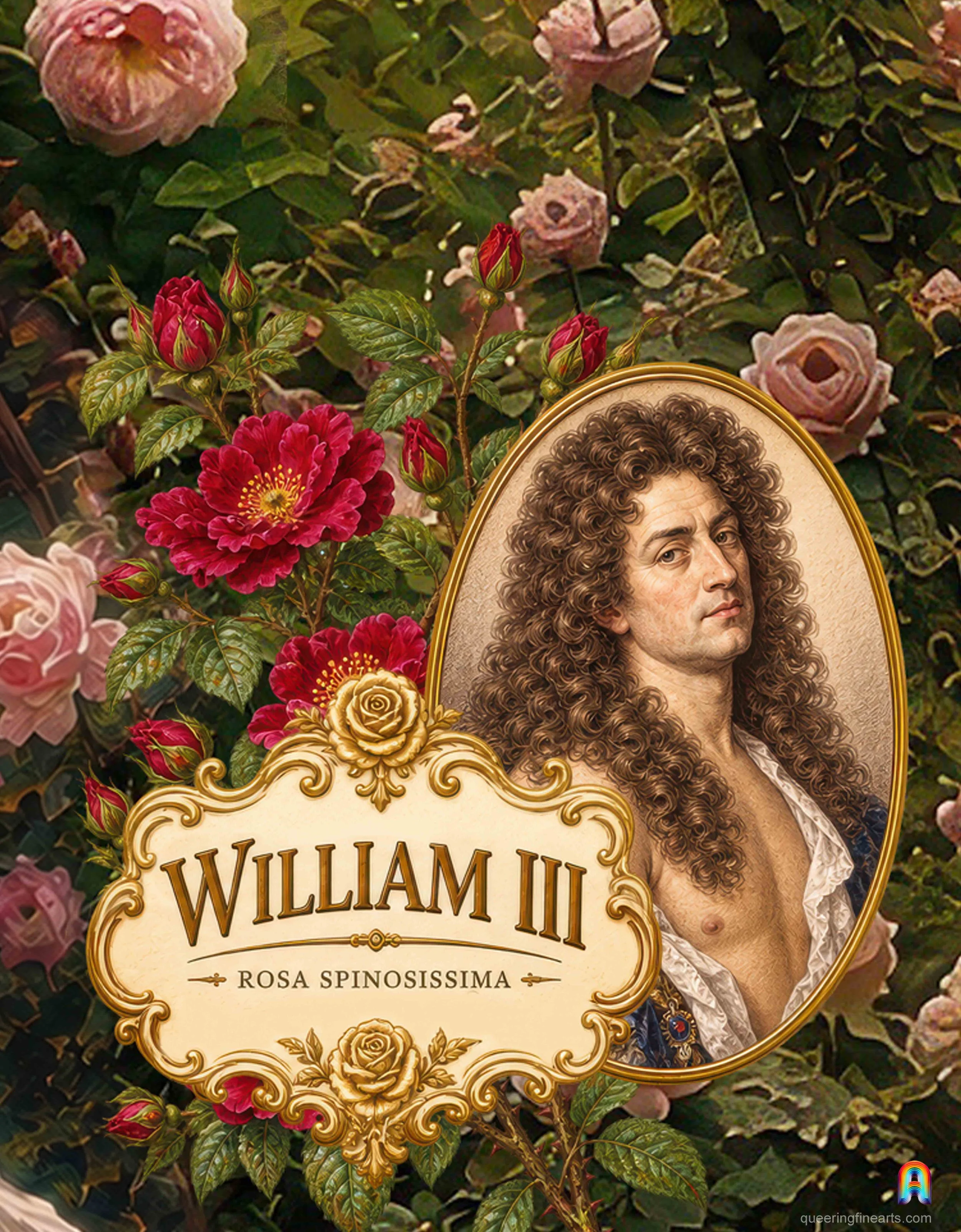
After the sumptuous modern roses of Michelangelo and Leonardo, William III changes the character of the garden completely. This old Rosa spinosissima produces small semi-double flowers of deep purplish crimson opening around a bright centre of golden stamens. Dense, thorny and relatively low, around 90 to 120 cm, it has something much wilder about it than the carefully sculpted blooms surrounding it, which seems rather appropriate for a king whose private life has been pricking historians for centuries.
William III became king of England and Ireland and William II of Scotland after the Glorious Revolution of 1688. He ruled jointly for a time with his wife, Mary II, but his intense relationships with male favourites attracted attention even during his lifetime. Most famous among them was the handsome Arnold Joost van Keppel, later Earl of Albemarle, whose extraordinary intimacy with William provoked jealousy, gossip andaccusations that went considerably beyond friendship.⁶
Before Keppel there had been another exceptionally close favourite: Hans Willem Bentinck, William’s lifelong Dutch companion, confidant and servant. When William contracted smallpox, Bentinck famously nursed him with extraordinary devotion and even shared his bed during the illness. Years later, when the much younger Keppel captured William’s affection, Bentinck’s jealousy became painfully apparent in their correspondence. Contemporary enemies of the king were considerably less discreet, openly portraying his attachments to male favourites as sexual.⁷
We cannot turn court gossip into a bedroom inventory more than three centuries later, but William’s intense emotional attachments to men, the jealousy surrounding them and the sexual accusations made by contemporaries have ensured that his relationships with Bentinck and Keppel remain part of the historical discussion of his sexuality.
William III the rose asks for considerably less drama. Unlike our repeat-flowering modern roses, this old spinosissima puts on its principal show in spring. Its flowers are smaller and looser, its growth dense and thorny and its whole appearance closer to a wild rose. It is also exceptionally hardy, a particularly attractive quality in colder climates: as a cultivar of the famously tough Scots rose, it is far better equipped for severe winters than many of the more pampered beauties in our garden. A gay royal favourite, a thorny old rose and no fear of winter? William III may have found exactly the right bed.

Lord Byron / Polka®
“Rose, Wine, and Beauty, all my own.”
Lord Byron wrote those words in 1805, long before anyone thought of putting his name on a rose, but they provide a remarkably good invitation to bring him into our garden.⁸ Roses were very much in fashion during his lifetime: the early 19th century saw a growing European passion for collecting and cultivating them, as Joséphine assembled her celebrated collection at Malmaison, Pierre-Joseph Redouté immortalised roses in print and dedicated rose gardens became increasingly fashionable. Byron therefore lived in a world becoming rather infatuated with roses, and two centuries later he finally acquired one of his own.
Lord Byron (MEItosier) is a magnificent French climbing rose bred by Jacques Mouchotte for Meilland and introduced in 1991, although today it is much more commonly encountered under another of its names, Polka®.⁹ This is not a rose given to discretion. Its large, ruffled double flowers can reach around 12 cm across, opening in delicious shades of apricot, peach and salmon before softening toward cream as they age. Their colour changes with weather and temperature, so that the same plant can seem to be wearing several shades at once. Very fragrant, repeat-flowering and capable of climbing roughly 2.5 to 4 metres, it is the first rose in our garden that requires an arch, pillar or wall to conquer: rather a lot of beauty, appetite and excess for one plant, which brings us rather neatly back to Byron himself.
Poet, aristocrat, celebrity, exile, scandal magnet and one of the great embodiments of Romanticism, George Gordon, Lord Byron was never particularly gifted at moderation. Women certainly occupied a spectacular place in his life, but so did men. His relationships and sexual encounters with men are unusually well documented for his period, from his intense attachment to John Edleston at Cambridge to the male lovers he pursued during his travels in the Mediterranean.¹⁰ The danger was real, since sexual relations between men remained a capital offence in Britain during Byron’s lifetime.
That mixture of beauty, desire, danger and flamboyance makes Lord Byron / Polka feel almost suspiciously well named. A restrained little shrub simply wouldn’t have done: Byron gets the climber, throwing apricot and salmon flowers several metres into the air and blooming again and again until autumn. Perhaps the most appropriate conclusion belongs to Byron himself, in another passage from the same youthful poem:
“Rose by far the fairest birth,
Which Spring and Nature cull from Earth -
Rose whose sweetest perfume given,
Breathes our thoughts from Earth to Heaven.”

Hans Christian Andersen
Roses can be surprisingly particular about where they live. Cold winters can destroy the more delicate varieties, but excessive heat can be just as unforgiving. They are sensitive creatures, and Hans Christian Andersen would no doubt have understood. The Danish writer who gave the world The Little Mermaid, The Ugly Duckling, The Snow Queen and some of the most enduring fairy tales ever written spent much of his own life observing creatures who were fragile, misplaced, transformed or longing to belong somewhere else.
His rose, however, could hardly be less timid. H.C. Andersen™ (Poulander) is a floribunda bred by the Danish house Poulsen and introduced in 1986.¹¹ Its flowers are vivid scarlet to cherry red, semi-double to double and carried generously in clusters. They are less voluptuous than some of the enormous roses already growing here, but what they surrender in extravagance they make up for in abundance. The bush is compact, generally around 70 to 90 cm, with dark foliage setting off those brilliant red flowers. It blooms repeatedly through the season and makes an excellent choice for beds and borders where a strong mass of colour is wanted. A Danish rose for Denmark’s great storyteller seems almost inevitable, although Andersen’s own story of love was considerably less like a fairy tale.
Desiring men in a world that had taught them to make such desire invisible was another difficulty Andersen had to contend with. Andersen formed intense emotional attachments to both women and men, but some of his most revealing expressions of longing were for male companions. Among them was Edvard Collin, to whom Andersen became deeply attached. “I languish for you as for a pretty Calabrian wench... my sentiments for you are those of a woman,” Andersen wrote to him.¹² His surviving letters reveal an intimacy and emotional hunger that make his attraction to men difficult to separate from his biography.
Andersen had another difficulty to contend with: he was not considered a handsome man. Very tall and awkward, with a long face and unusually prominent features, he was painfully conscious of his appearance, and for a man who longed intensely to be loved, that mattered. Desire between men, meanwhile, had largely been forced into invisibility. Silence made recognition itself uncertain: friendship might conceal desire or simply be friendship. To reveal too much carried risks, yet without revealing something, how could one know whether another man might feel the same?
Andersen did something extraordinary with all that longing: he turned it into stories. Again and again, his tales return to outsiders longing to belong, creatures whose true nature cannot be seen, transformations, impossible loves and the hope that what appears strange or unwanted might one day be recognised as beautiful. Some scholars have read works such as The Little Mermaid in the light of Andersen's unrequited attachment to Edvard Collin, seeing in the tale a reflection of his longing for a love that could not be openly reciprocated.¹³ It would be simplistic to reduce those stories to Andersen's sexuality, but equally misleading to imagine that the emotional life of their author existed entirely apart from them. His private disappointments became part of the immense reservoir from which his imagination drew.
Perhaps his rose deserves to be bright red after all. Hans Christian Andersen blooms openly, abundantly and repeatedly, its flowers gathered together in brilliant clusters with absolutely no inclination to hide.

Tchaikovski®
Tchaikovski® (MEIchibon) brings a quieter palette into the garden, producing large, very double flowers that open in soft cream and ivory, warmed at the centre by pale butter yellow that gradually fades as the bloom expands. Their densely layered petals give them the romantic form of an old rose, although this is another thoroughly modern creation. Bred in France by Meilland and introduced in 2000, Tchaikovski grows into a vigorous, rounded shrub of roughly 1 to 1.2 metres and flowers repeatedly in generous waves throughout the season. Its dark foliage makes those luminous flowers appear even softer.¹⁴
The man whose name it bears hardly needs an introduction. Pyotr Ilyich Tchaikovsky gave the world Swan Lake, The Sleeping Beauty, The Nutcracker, six symphonies, operas, concertos and some of the most unabashedly emotional music of the 19th century. Yet behind music capable of expressing such enormous passion was a private life in which love between men could not safely be lived in the open.
Tchaikovsky’s attraction to men is unusually well documented in his own correspondence. His letters reveal desires, attachments and relationships that leave remarkably little doubt about this part of his life. Among the men who mattered was Iosif Kotek, the young violinist and former student for whom Tchaikovsky developed an intense attachment in the 1870s. “When he caresses me with his hand, when he lies with his head on my chest and I play with his hair and secretly kiss it [...] passion rages in me with unimaginable force,” he wrote to his brother Modest in 1877.¹⁵ Imperial Russia offered little room for such desires to be lived openly and the composer remained acutely conscious of what exposure might cost him. His disastrous marriage to Antonina Miliukova in 1877 lasted only weeks before he fled, emotionally shattered.
Yet what had to remain guarded in life could become gloriously expansive in music. Desire, tenderness, melancholy, ecstasy and heartbreak were allowed to become enormous once they entered the orchestra. There is something rather lovely, then, about giving Tchaikovsky a place in our garden: Tchaikovski, all ivory petals and warm yellow at its heart, flowering again and again through the summer.

The Pride®
At this point, our garden contains six roses, each bearing the name of a man whose life has a place in queer history. Our final rose does not. The Pride® is an intensely fragrant hybrid tea introduced in 2017, with enormous flowers reaching around 14 cm across and opening in shades of lavender, mauve and lilac. Upright and elegant, it reaches around 80 cm to 1 metre and produces those great lavender blooms with all the confidence one might reasonably expect from something called The Pride.
The name does not appear to have been chosen specifically in reference to LGBTQ+ Pride, at least as far as we have been able to determine. But really... The Pride? There are moments when a name simply offers itself up for adoption, so we’re claiming it anyway.
There is something particularly appropriate about ending here. Pride has always involved taking something that society expected to remain private, concealed or unspoken and allowing it to become visible. The six men growing elsewhere in this garden lived in worlds where desire between men had to negotiate silence, danger, discretion, coded language or historical erasure. Michelangelo put desire into poetry and drawings; Leonardo surrounded himself with men whose place in his emotional world continues to fascinate historians; William III inspired gossip fierce enough to survive for centuries; Byron pursued men and women with characteristic disregard for moderation; Andersen transformed longing and otherness into stories; Tchaikovsky allowed emotions that had to remain guarded in life to become enormous in music.
Now they are all blooming together: seven roses, six men from queer history and one irresistible little act of horticultural appropriation. Our delightfully gay rose garden is complete.

A Better Breed
There is, however, something curious about the dates attached to our garden. With the exception of William III, almost all its roses are comparatively recent. That does not mean that earlier rose breeders were reluctant to name their creations after celebrated men. Quite the opposite. The 19th and early 20th centuries produced an extraordinary succession of roses named after monarchs, writers, artists, politicians and other public figures.
What has changed is the horticultural world in which those roses must survive. Modern gardeners generally expect repeat flowering, reliable growth, good disease resistance and plants capable of performing without excessive attention. Many older cultivars could not compete with successive generations of improved roses. Some survive only in historic collections, some are propagated by a handful of specialist nurseries and countless others have simply disappeared from cultivation. The catalogues available to us today are therefore records of horticultural survival rather than complete inventories of the roses that once existed.
Our own search offered a particularly tantalising glimpse of what has been lost. A rose called Antinous was already being cultivated before 1845, its name recalling the young Bithynian beloved of the emperor Hadrian.¹⁶ Once sufficiently established to find its way into 19th-century rose literature, it has now virtually disappeared from ordinary commerce. There may have been other roses bearing names that would have fitted our garden equally well, flourishing for a few decades before disappearing along with the catalogues and nurseries that once offered them.
For the modern gay gardener, however, there is something to be said for progress. The roses that have survived or replaced those more temperamental ancestors are generally healthier, more reliable and considerably less demanding. That means less time spent battling disease, coaxing reluctant plants into flower and worrying over delicate specimens, and rather more time available for other pursuits in the garden. Preferably with another gentleman.
QFA

Curiosity piqued?
1. James M. Saslow, The Poetry of Michelangelo: An Annotated Translation, New Haven et Londres, Yale University Press, 1991, notamment les poèmes adressés à Tommaso de’ Cavalieri.
2. HelpMeFind Roses, « Michelangelo », fiche horticole de Michelangelo® (MEItelov), rose obtenue par Alain Meilland, série ROMANTICA®, en ligne, https://www.helpmefind.com/rose/, consulté le 23 août 2026.
3. Charles et Brigid Quest-Ritson, Encyclopedia of Roses, Londres, Dorling Kindersley, 2011, entrée « Leonardo da Vinci ».
4. Walter Isaacson, Leonardo da Vinci, New York, Simon & Schuster, 2017, chap. 5, «Personal Life ».
5. Martin Kemp, Leonardo da Vinci: The Marvellous Works of Nature and Man, Oxford, Oxford University Press, 2006, notamment les passages consacrés à Salaì et Francesco Melzi.
6. Wout Troost, William III, the Stadholder-King: A Political Biography, Aldershot, Ashgate, 2005, notamment les passages consacrés à Arnold Joost van Keppel.
7. David Onnekink, The Anglo-Dutch Favourite: The Career of Hans Willem Bentinck, 1st Earl of Portland (1649-1709), Aldershot, Ashgate, 2007.
8. George Gordon, Lord Byron, « Translation from Anacreon, Ode 5 », 1805, dans Ernest Hartley Coleridge (dir.), The Works of Lord Byron: Poetry, vol. 1, Londres, John Murray, 1898, p. 106-107.
9. Charles et Brigid Quest-Ritson, Encyclopedia of Roses, Londres, Dorling Kindersley, 2011, entrée « Polka ».
10. Fiona MacCarthy, Byron: Life and Legend, Londres, John Murray, 2002, notamment les chapitres consacrés à Cambridge et aux voyages méditerranéens.
11. Poulsen Roser, « H.C. Andersen™ (Poulander) », fiche horticole, Fredensborg, Poulsen Roser, en ligne, https://www.poulsenroser.dk/, consulté le 23 août 2026.
12. Hans Christian Andersen, lettre à Edvard Collin, citée dans Rictor Norton (dir.), My Dear Boy: Gay Love Letters through the Centuries, San Francisco, Leyland Publications, 1998, section « Hans Christian Andersen ».
13. Heinrich Detering, Das offene Geheimnis: Zur literarischen Produktivität eines Tabus von Winckelmann bis zu Thomas Mann, Göttingen, Wallstein Verlag, 1994, p. 175-232.
14. Charles et Brigid Quest-Ritson, Encyclopedia of Roses, Londres, Dorling Kindersley, 2011, entrée « Tchaikovski ».
15. Piotr Ilitch Tchaïkovski, lettre à Modest Tchaïkovski, 19/31 janvier 1877, citée dans Roland John Wiley, Tchaikovsky, New York, Oxford University Press, 2009, p. 94-95.
16. William Paul, The Rose Garden: In Two Divisions, Londres, Sherwood, Gilbert, and Piper, 1848, p. 110, entré
