

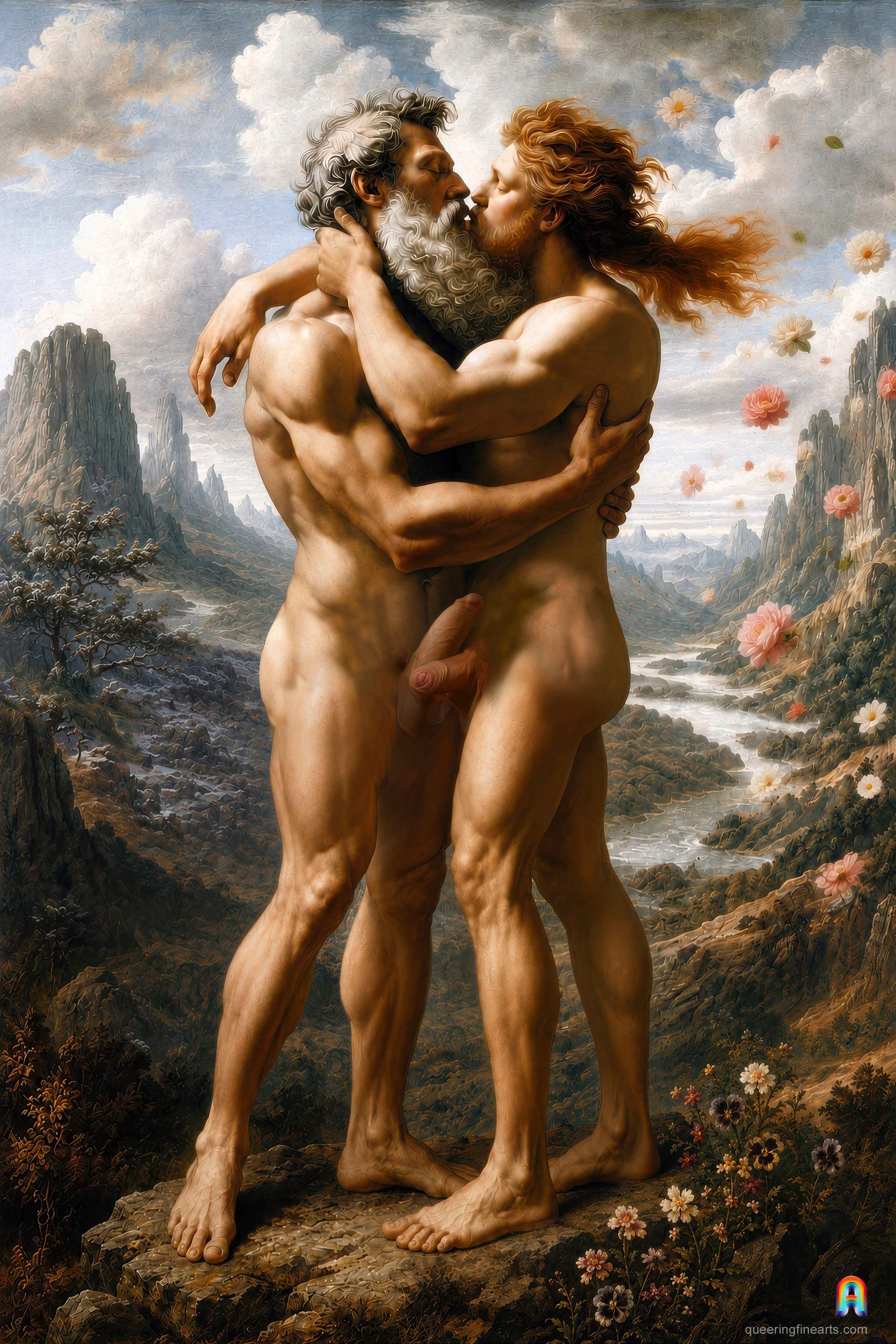
Il bacio che fa primavera (The Kiss That Brings Spring)
Attributed to a Florentine painter
Oil on canvas, c. 1540–1560
Private collection
The Changing of the Winds
This monumental composition imagines the meeting of Boreas and Zephyrus, two of the Anemoi, the divine winds of Greek mythology.¹ While Boreas rules over the icy winds of the North, Zephyrus brings the gentle breezes that herald the return of spring. The artist depicts them at the precise moment when winter yields to spring, not as rival forces but as two lovers united by an affection older even than the turning of the seasons.
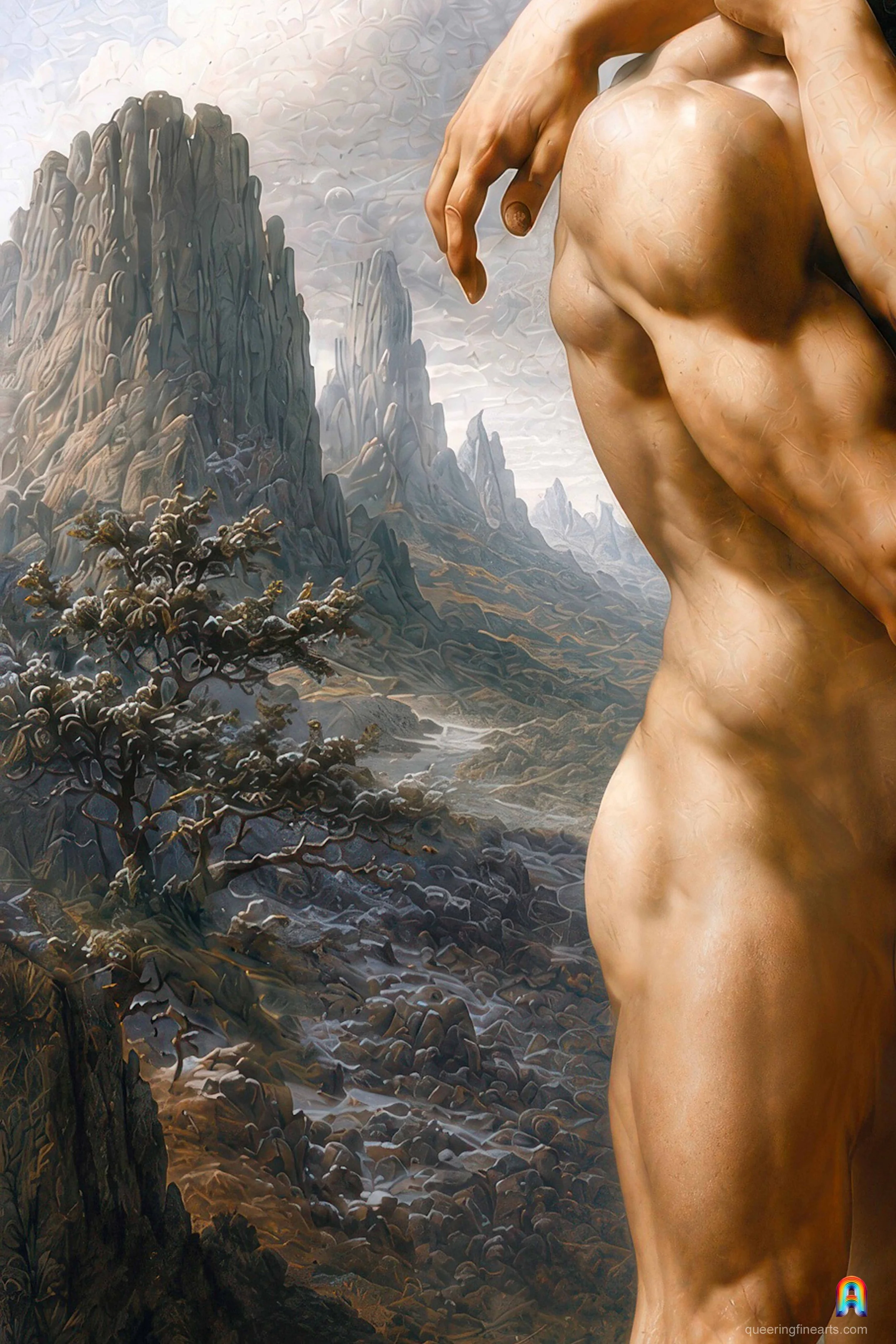
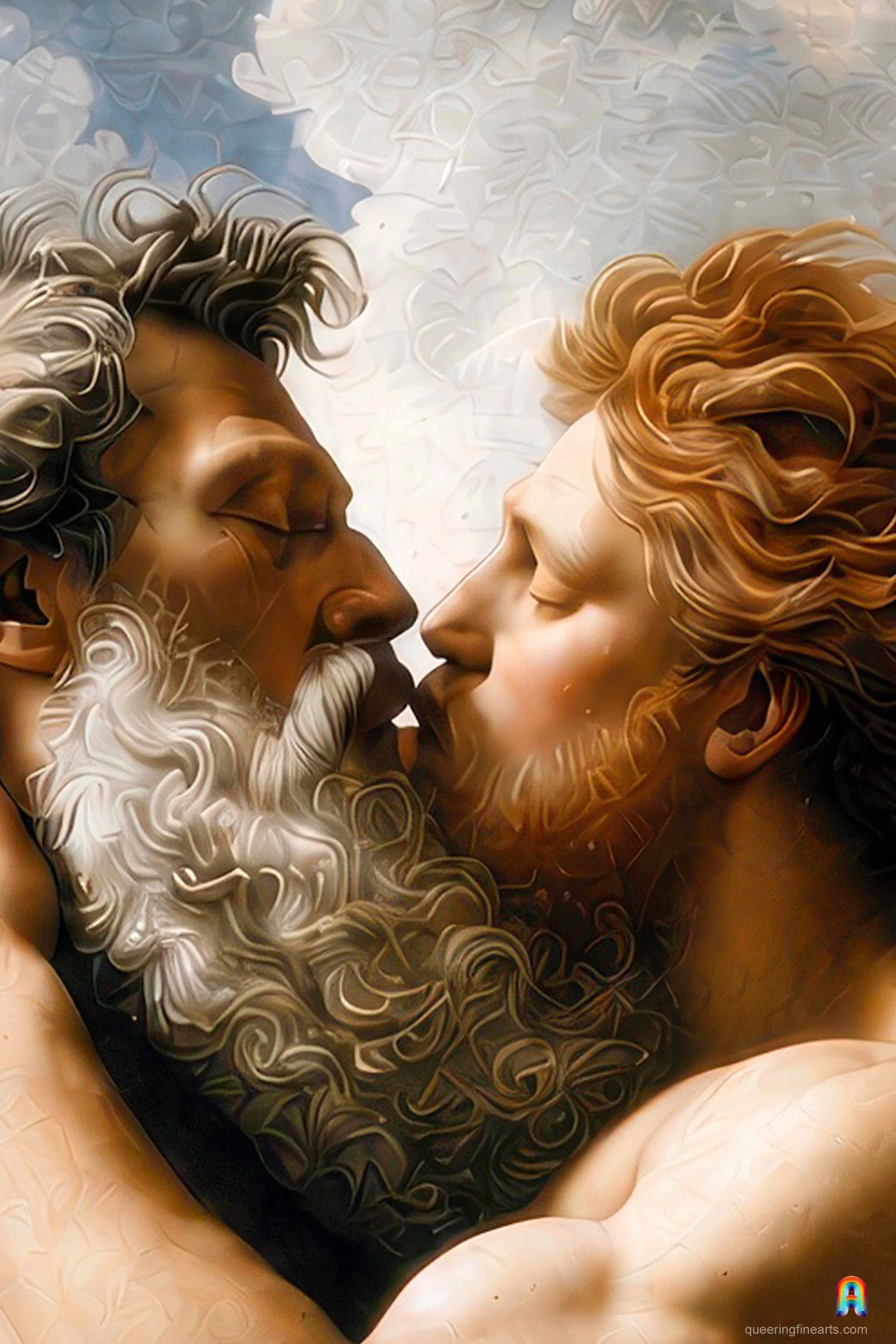
Boreas appears in the guise of a mature man. His whitening beard, silver hair and the cooler tones enveloping the landscape to his left evoke the final days of the Mediterranean mountain winter. The mountains remain austere, a few trees still await their foliage and the last patches of snow linger upon the peaks. Winter is not driven away; it graciously accepts the time has come to yield its place.
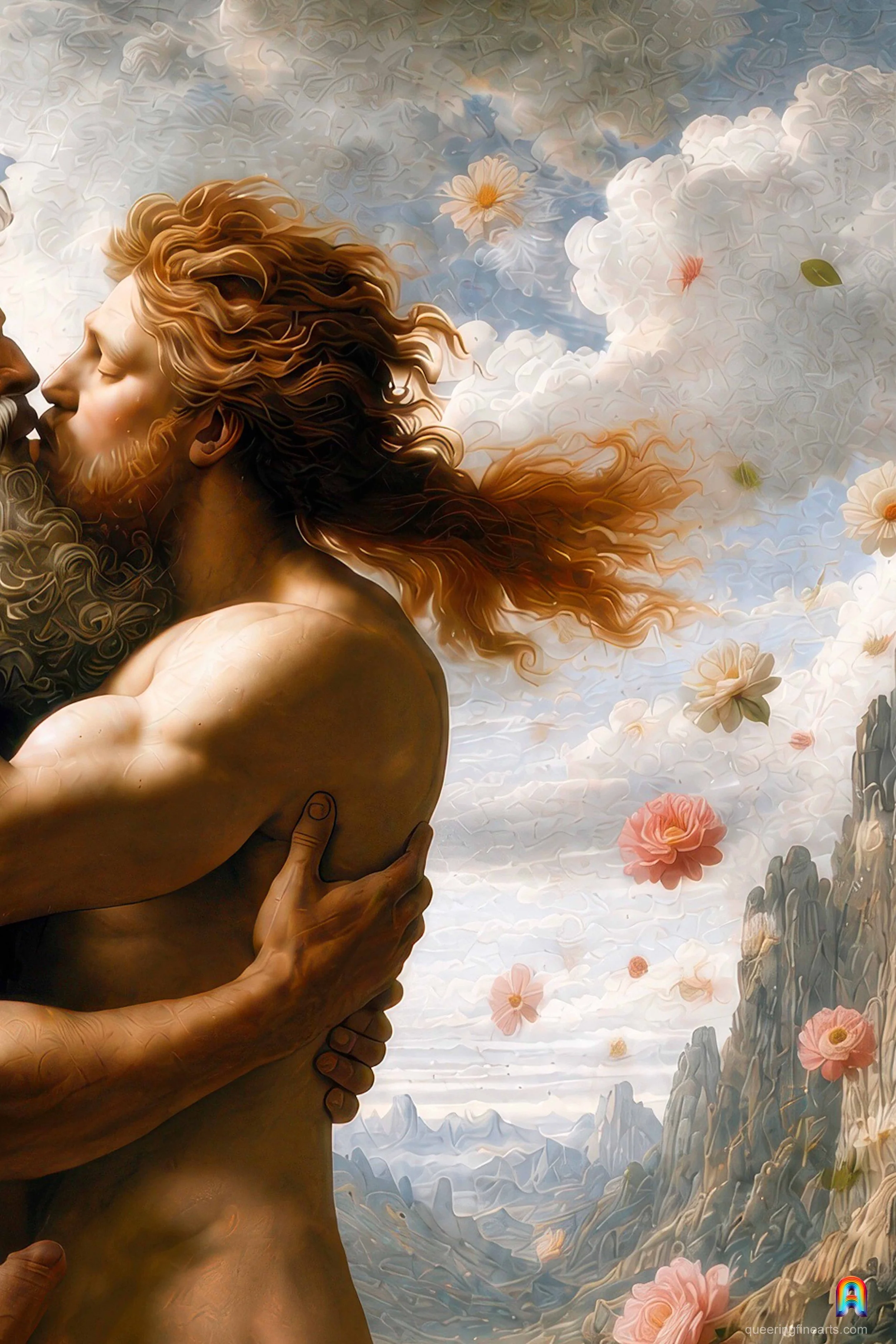
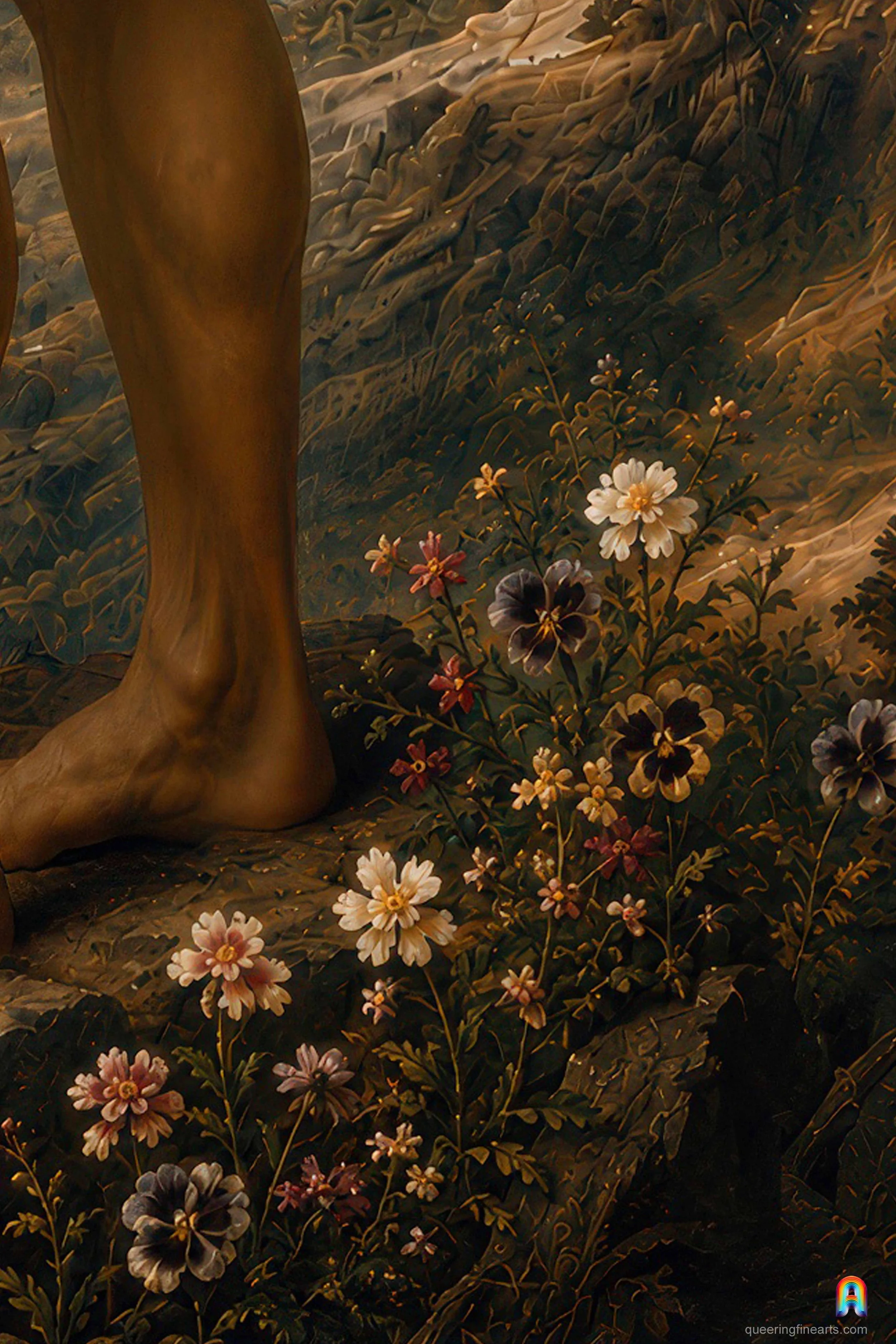
Facing him, Zephyrus embodies youth, gentleness and renewal. His long hair is already stirred by a softer breeze as blossoms drift down from the sky to scatter across the valley. At his feet, the earth is already covered with fresh blooms, as though awakened by his very presence. Their descent and blossoming accompany the passing of Zephyrus: nature slowly returns to life.
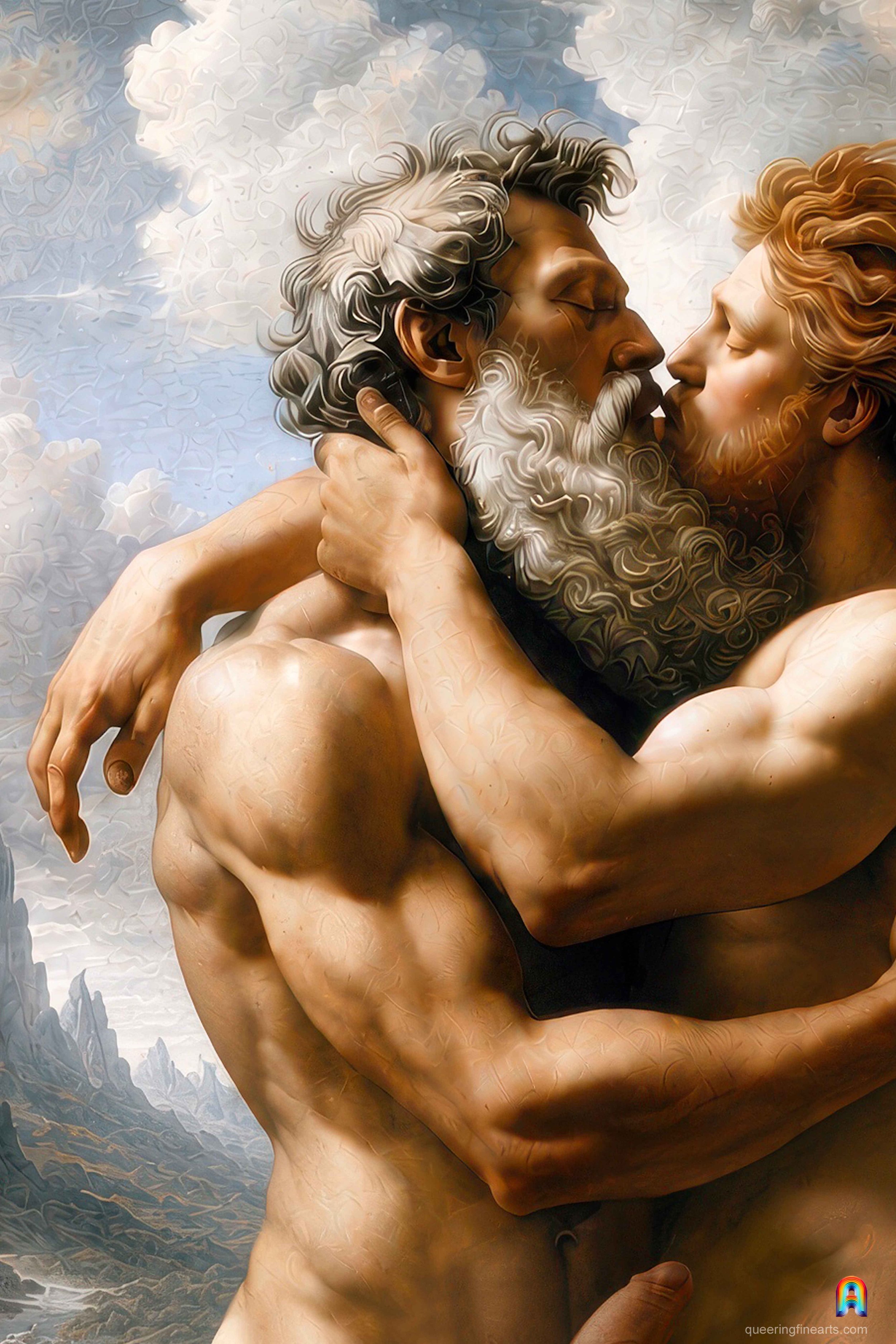
The kiss forms the true centre of the composition. The two gods embrace with a tenderness that seems to suspend time itself. Their embrace celebrates a passing of the torch. Boreas entrusts the world to the one who will now continue his work until the first cold winds return. The changing of the seasons thus becomes the fruit of a silent fidelity rather than an eternal struggle.
This interpretation belongs to a long tradition that personifies the forces of nature in order to express human passions. Without drawing upon any specific ancient narrative, the painting imagines an episode that might easily have found its place among the fables of the Greek poets or the allegorical inventions of the Renaissance.² Through its palette poised between silvery coolness and warmer touches of spring, its elongated figures and its theatrical space, it recalls the explorations of the Florentine Mannerists of the mid-sixteenth century, for whom myth often served as a vehicle for reflections on beauty and desire.³ The passage of the seasons ceases to be a simple natural phenomenon and instead becomes the enduring testimony of a love that returns unfailingly each year, as ancient as the winds themselves and as constant as their eternal cycle.
Another Florence
Florence immediately evokes the great artists of the Renaissance—Leonardo da Vinci, Michelangelo and Botticelli—as well as the Medici, the dynasty that shaped the destiny of the city. It remains the quintessential symbol of the period when Europe rediscovered Antiquity, transformed the arts and placed the human being at the centre of its intellectual life. Yet, however accurate, this image tells only part of the city's story.
From the Middle Ages onward, Florence also acquired a far less familiar yet remarkably enduring reputation: that of being the European city where sexual relationships between men were especially widespread. This reputation extended far beyond the borders of Tuscany. In German, the word Florentiner long served as a synonym for sodomite, an extraordinary linguistic testimony to Florence's place in the European imagination.⁴ Other contemporary writers, both in Italy and elsewhere, likewise described the city as a place where love between men appeared more visible than elsewhere.
Throughout the fourteenth and fifteenth centuries, Florence developed an urban life of unprecedented intensity. Its workshops, guilds, merchant households, academies and networks of apprenticeship brought together thousands of men and young men every day. In a society where men generally married relatively late, relationships between men occupied an important place in social life and could take many different forms, ranging from friendship and mentorship to emotional attachment and sexual relationships.⁵
The scale of this phenomenon emerges with exceptional clarity through the archives of the Ufficiali di Notte, the magistracy established in 1432 to prosecute sodomy. Between 1432 and 1502, nearly 17,000 men were denounced or became involved in its proceedings, making Florence by far the best-documented homosexual culture in pre-modern Europe.⁶ The existence of such an institution reflects less an exceptionally severe system of repression than the remarkable level of administrative organisation achieved by the Florentine Republic, which had already established numerous specialised magistracies to govern civic life.⁷ When considered in relation to the city's population, the period covered by the records and the penalties actually imposed, the resulting punishments often appear less severe than those found in several other European states.
Love between men was already deeply rooted in medieval Florence long before the artistic flowering of the Renaissance. The Renaissance did not invent it. By rediscovering Plato, Homer, Ovid and the great Greek myths, humanists encountered once again an Antiquity in which such relationships occupied a familiar place. The stories of Zeus and Ganymede, Apollo and Hyacinthus, Heracles and Hylas, or Achilles and Patroclus once again became living references for artists, scholars and collectors.⁸ The Renaissance thus provided this culture with a prestigious language, a recovered memory and the immense symbolic reservoir of classical civilisation. Only in the closing decades of the century, as the Italian Wars destabilised the peninsula and preachers proclaimed God's wrath against corrupt cities, did this latent tension develop into a movement of moral purification.
The Price of Brilliance
The very energy that made Florence the great laboratory of the Renaissance also carried within itself its own contradictions. As the city grew wealthier, artists pushed the limits of their art, humanists breathed new life into the ancient authors and worldly pleasures assumed an ever greater place in urban life, part of Florentine society began to see in this prosperity the signs of a dangerous moral decline.
Refinement, sensuality, wealth, festivals and freedom of manners gradually came to be denounced as threats to the salvation of the city. It was in this climate of mounting tension that the Dominican friar Girolamo Savonarola emerged at the end of the fifteenth century, his fanaticism bordering on what might reasonably be regarded as madness.⁹ A preacher of extraordinary talent, he proclaimed that Florence had been chosen by God to become an exemplary city, but that it first had to renounce the luxury, vanities and pleasures that, in his eyes, were leading it toward ruin.
His influence proved as spectacular as it was brief. Within only a few years, part of the city embraced this sweeping movement of moral reform, which culminated in the famous Bonfires of the Vanities.¹⁰ Crowds consigned paintings, books, musical instruments, precious garments, jewellery, mirrors and works of art to the flames in the hope of purifying Florence of everything that might nourish luxury, pleasure or earthly beauty. The world undoubtedly lost countless masterpieces, sacrificed to Savonarola's fanatical delirium, yet this blaze of fanaticism fortunately remained only a brief interlude in the history of Florence.
Florentine Splendours and Loves
Florence remained one of the most extraordinary laboratories of Western civilisation. Nowhere else did wealth, beauty, intellectual audacity and desire converge with such intensity. It was here that Antiquity found a new voice and that love between men could, for a time, flourish within a world where the gods, heroes and poets continued to embody its noblest ideals. That freedom was never absolute and indeed provoked violent reactions, yet it is precisely this tension that today makes Florence such an exceptional witness to the complexity of the period.
It was the place where the Renaissance attained one of its most luminous expressions, but also where two profoundly human aspirations confronted one another with exceptional intensity: the desire endlessly to expand the horizons of beauty, knowledge and love, and the desire to restore the world to an absolute moral order. The bonfires died out. The masterpieces endured. And within the marbles, frescoes, poems and myths survived the memory of the love between men that had also helped shape one of the greatest cultural adventures in history.
QFA
Curiosity Piqued?
1. Simon Hornblower, Antony Spawforth et Esther Eidinow (dir.), The Oxford Classical Dictionary, 4e éd., Oxford, Oxford University Press, 2012.
2. Jean Seznec, The Survival of the Pagan Gods: The Mythological Tradition and Its Place in Renaissance Humanism and Art, Princeton, Princeton University Press, 1953.
3. John Shearman, Mannerism, Harmondsworth, Penguin Books, 1967.
4. Michael Rocke, Forbidden Friendships: Homosexuality and Male Culture in Renaissance Florence, New York, Oxford University Press, 1996.
5. Christiane Klapisch-Zuber, Women, Family, and Ritual in Renaissance Italy, Chicago, University of Chicago Press, 1985.
6. Nicholas Terpstra, « Sex in Florence in the Fifteenth Century », dans Merry E. Wiesner-Hanks et Mathew Kuefler (dir.), The Cambridge World History of Sexualities, Cambridge, Cambridge University Press, 2024.
7. John M. Najemy, A History of Florence, 1200–1575, Malden, Blackwell Publishing, 2006.
8. James M. Saslow, Ganymede in the Renaissance: Homosexuality in Art and Society, New Haven, Yale University Press, 1986.
9. Donald Weinstein, Savonarola: The Rise and Fall of a Renaissance Prophet, New Haven, Yale University Press, 2011.
10. Lauro Martines, Fire in the City: Savonarola and the Struggle for the Soul of Renaissance Florence, Oxford, Oxford University Press, 2006.