Telemachus and Peisistratus
Attributed to an Attic Vase Painter
Terracotta, red-figure technique, c. 470-450 BC
Private collection
Two Princes at Night
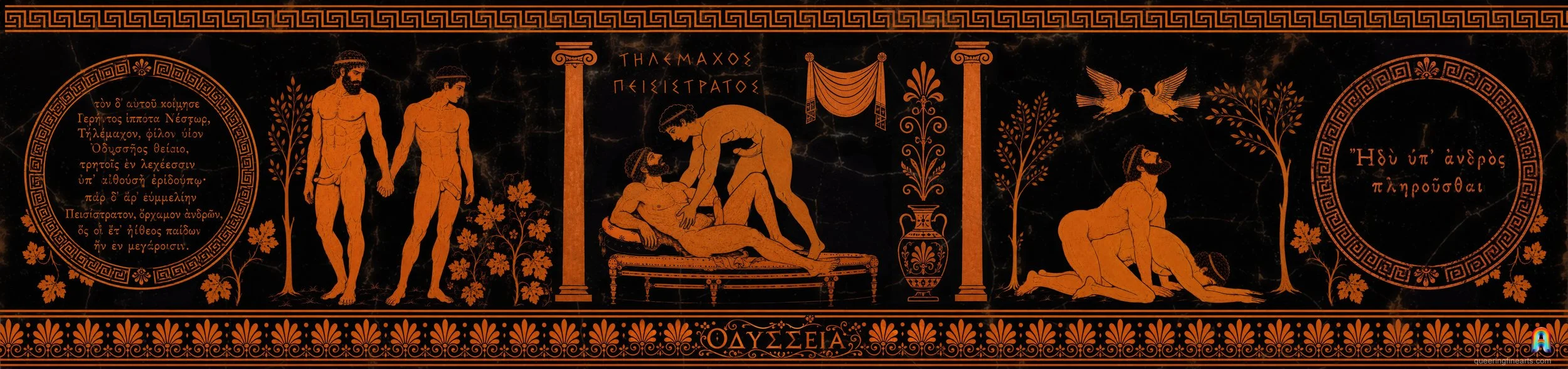
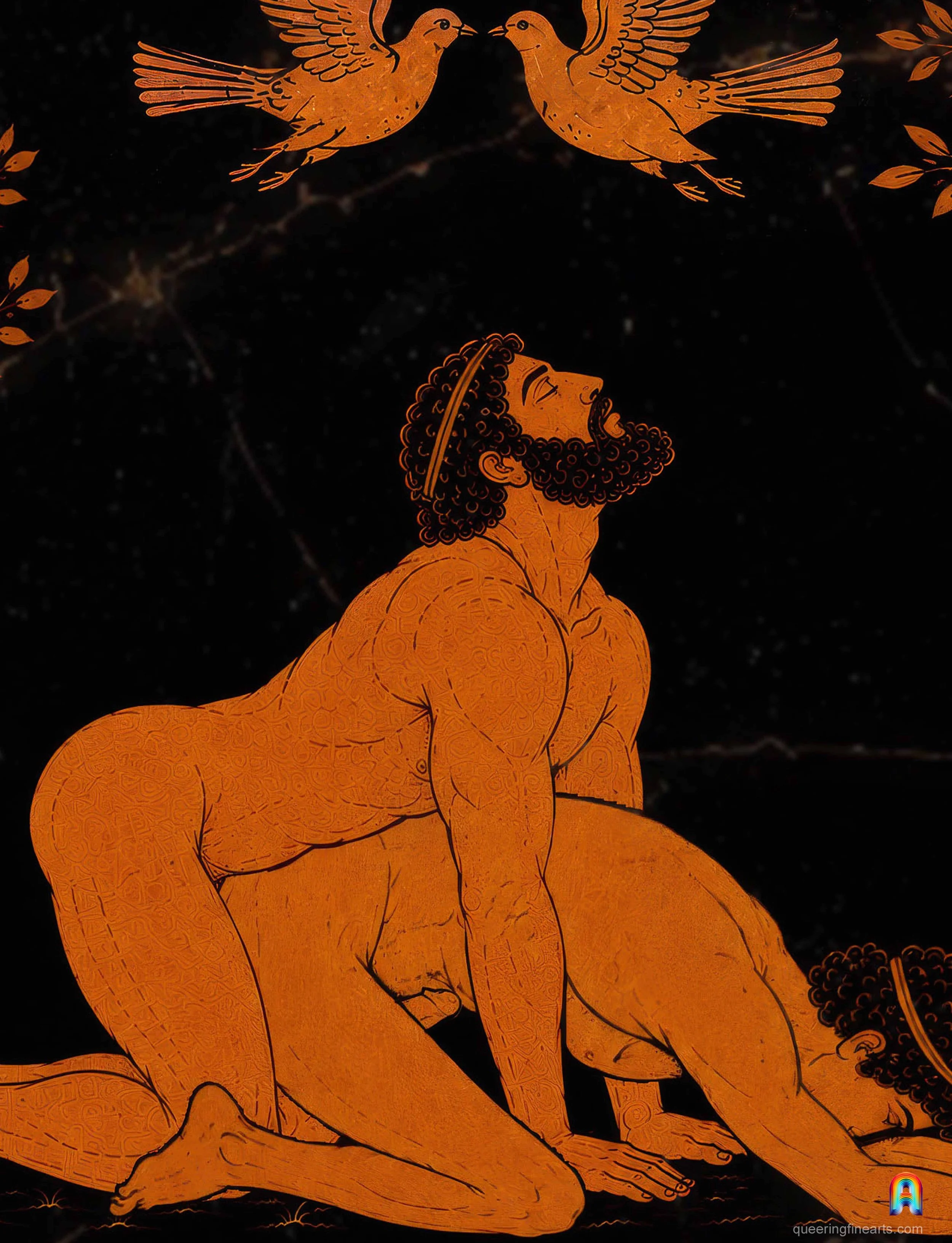
Telemachus and Peisistratus presents itself as a vast composition inspired by Attic red-figure pottery of the early 5th century BC.¹ Conceived as a continuous frieze, the work combines text, narrative and iconography in a visual language borrowed from the great monumental vases devoted to Homeric narratives. The decoration is punctuated by meanders, palmettes, stylized trees, Doric columns and confronted birds, all motifs drawn directly from the ornamental repertoire of ancient Greece.
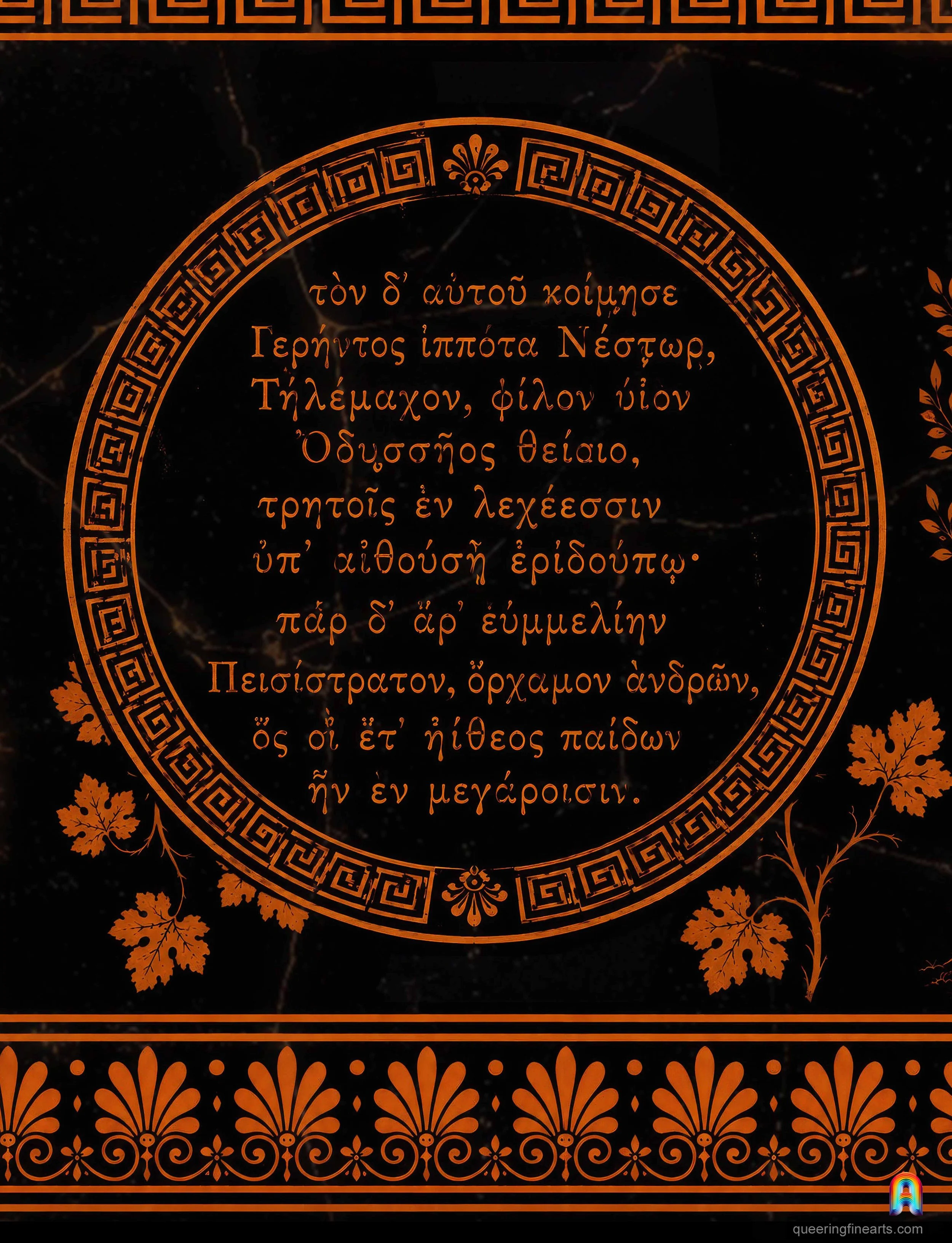
The first section, on the left, reproduces in Ancient Greek the passage from the Odyssey (Book III) in which Nestor has Telemachus sleep beside Peisistratus beneath the portico of his palace.
The inscription reads:
"Nestor, the old horseman of Gerenia, made Telemachus, the beloved son of noble Odysseus, sleep there upon a corded bed beneath the echoing portico. Beside him he placed Peisistratus, master of the good ash spear, the only one of his sons who was still a hēítheos, an unmarried young man, within the palace."
The text forms the literary foundation of the entire composition. It reminds us that Peisistratus is the only son still a hēítheos, that is, an unmarried young man, and that he spends this night with the son of Odysseus.
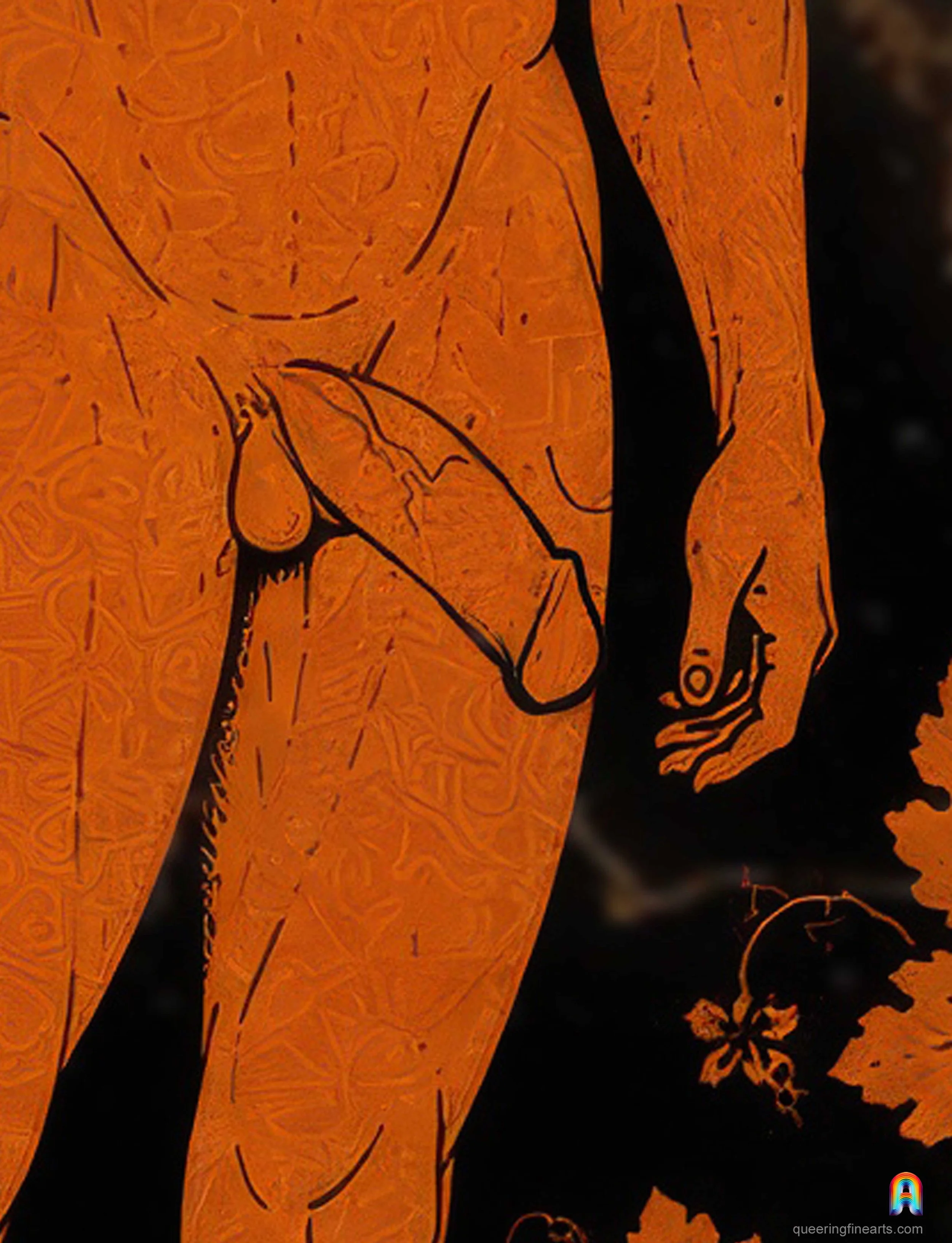
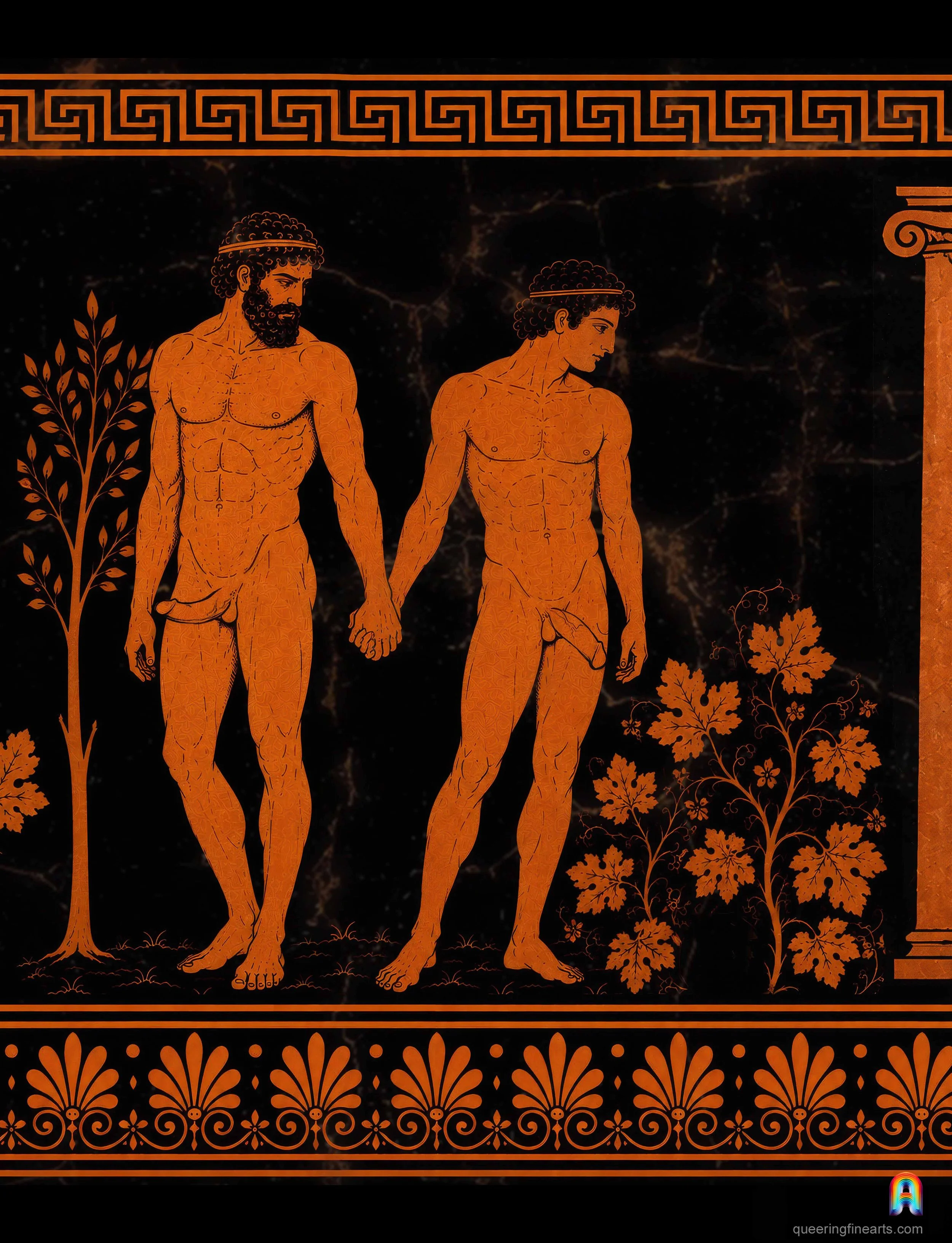
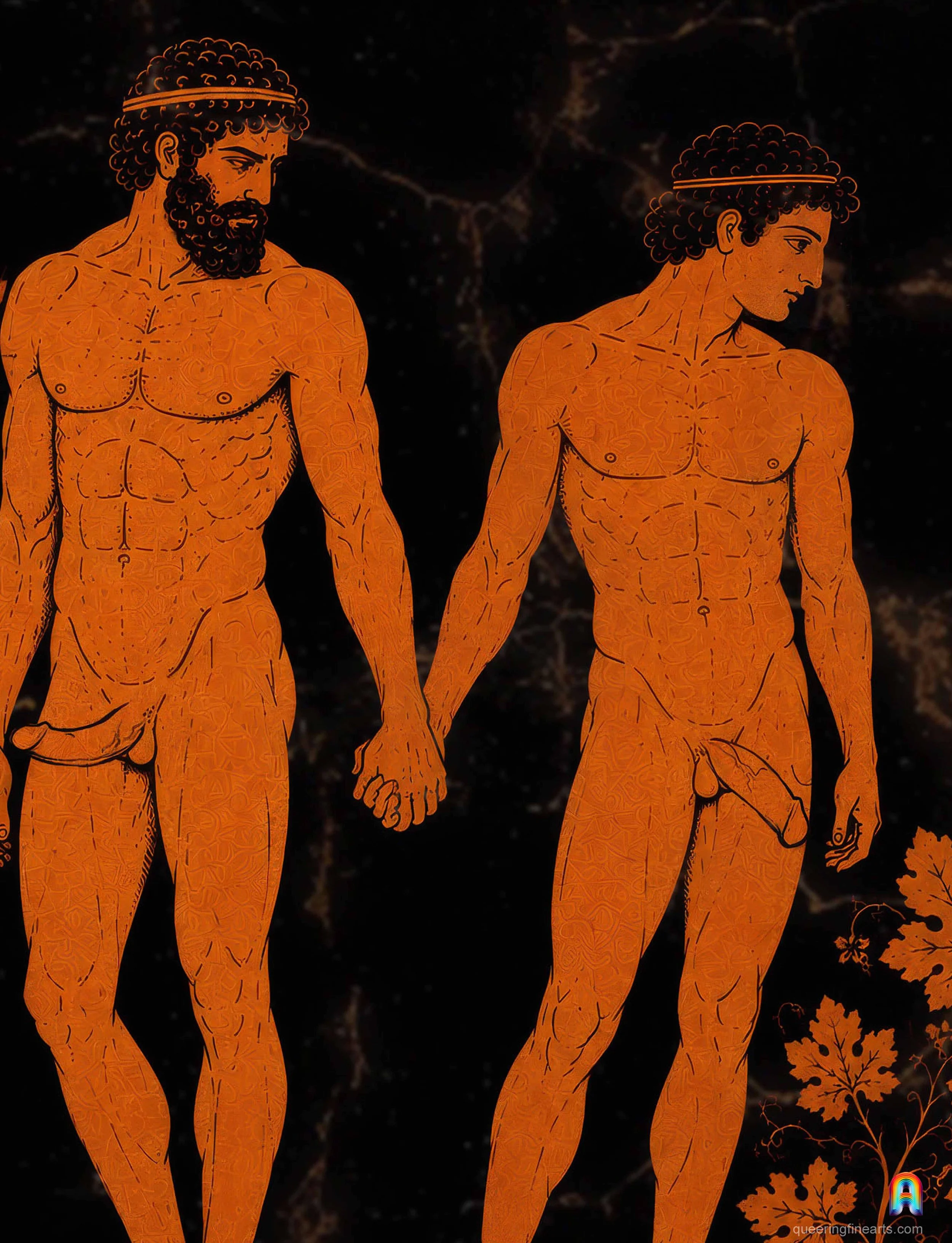
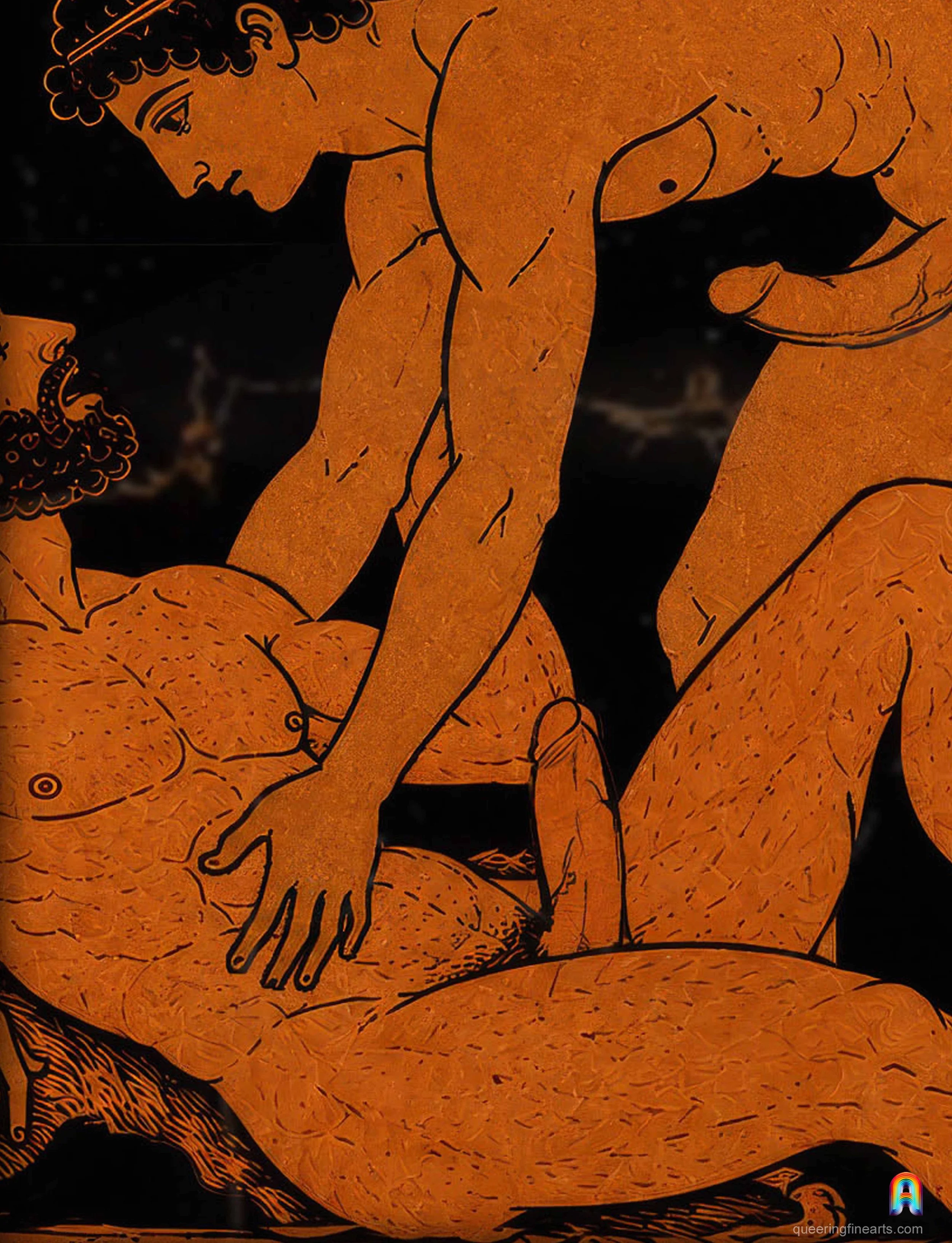
The second section depicts the two young men standing hand in hand. Telemachus and Peisistratus appear as two companions of equal rank, most likely in their early twenties. Their naked bodies, their gazes and their erections reveal a mutual desire. Each possesses his own distinct physiognomy, expressed as much through build, musculature and facial features as through the way desire swells his member. The scene transposes the language of courtly love into a vocabulary drawn from Greek sculpture and vase painting, where the simple joining of hands becomes the sign of an emotional commitment.²
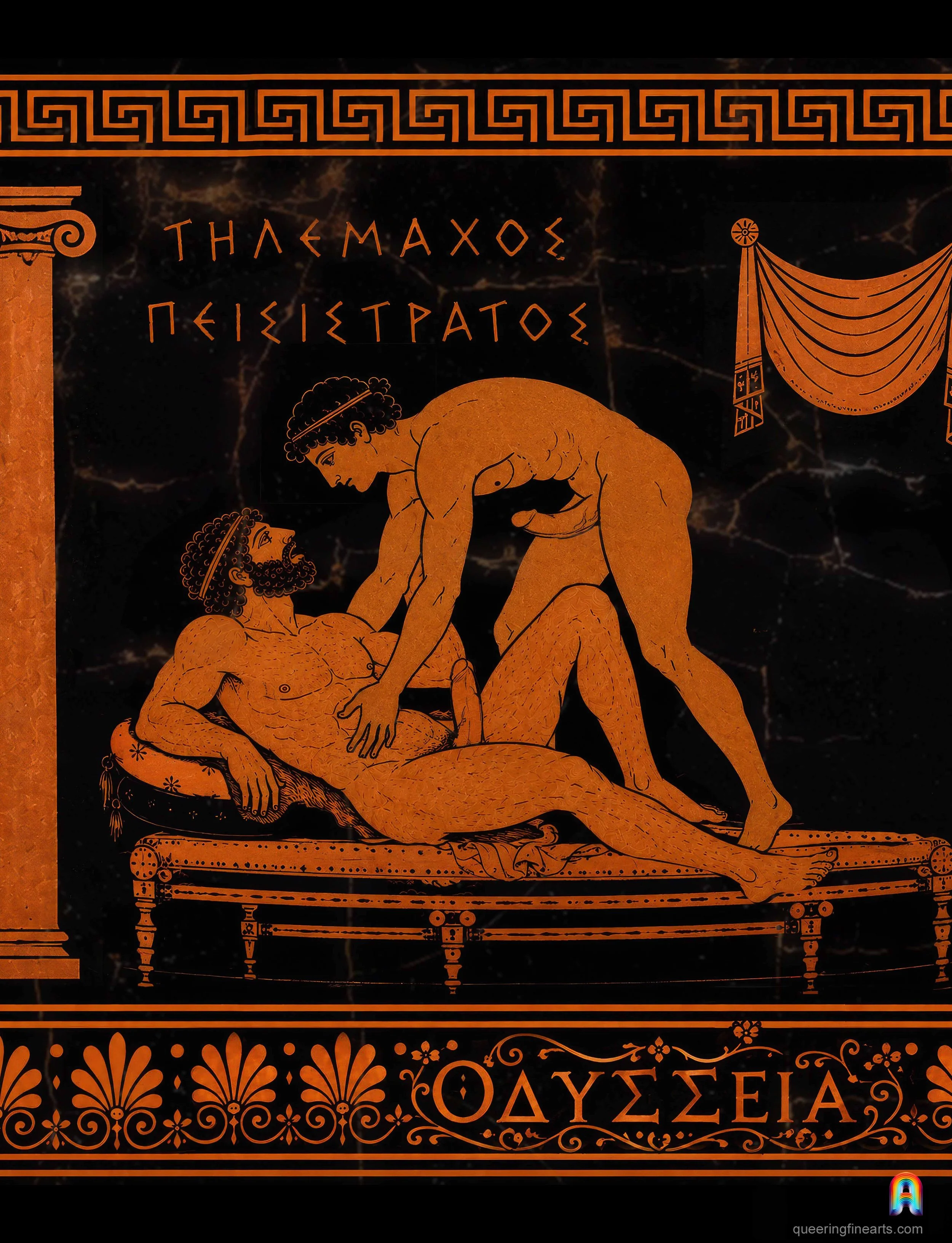
At the centre of the composition, beneath a portico directly recalling the Homeric narrative, the two heroes are portrayed during their shared night. The architecture, the couch, the draperies and the columns isolate this space as a place of intimacy. Their eyes are locked upon one another while their penises, powerfully swollen with desire, proclaim without restraint the intensity of their reciprocal carnal appetite. The artist freely interprets the ancient text by imagining the foreplay of a love affair that the work chooses to explore as a legitimate narrative possibility.
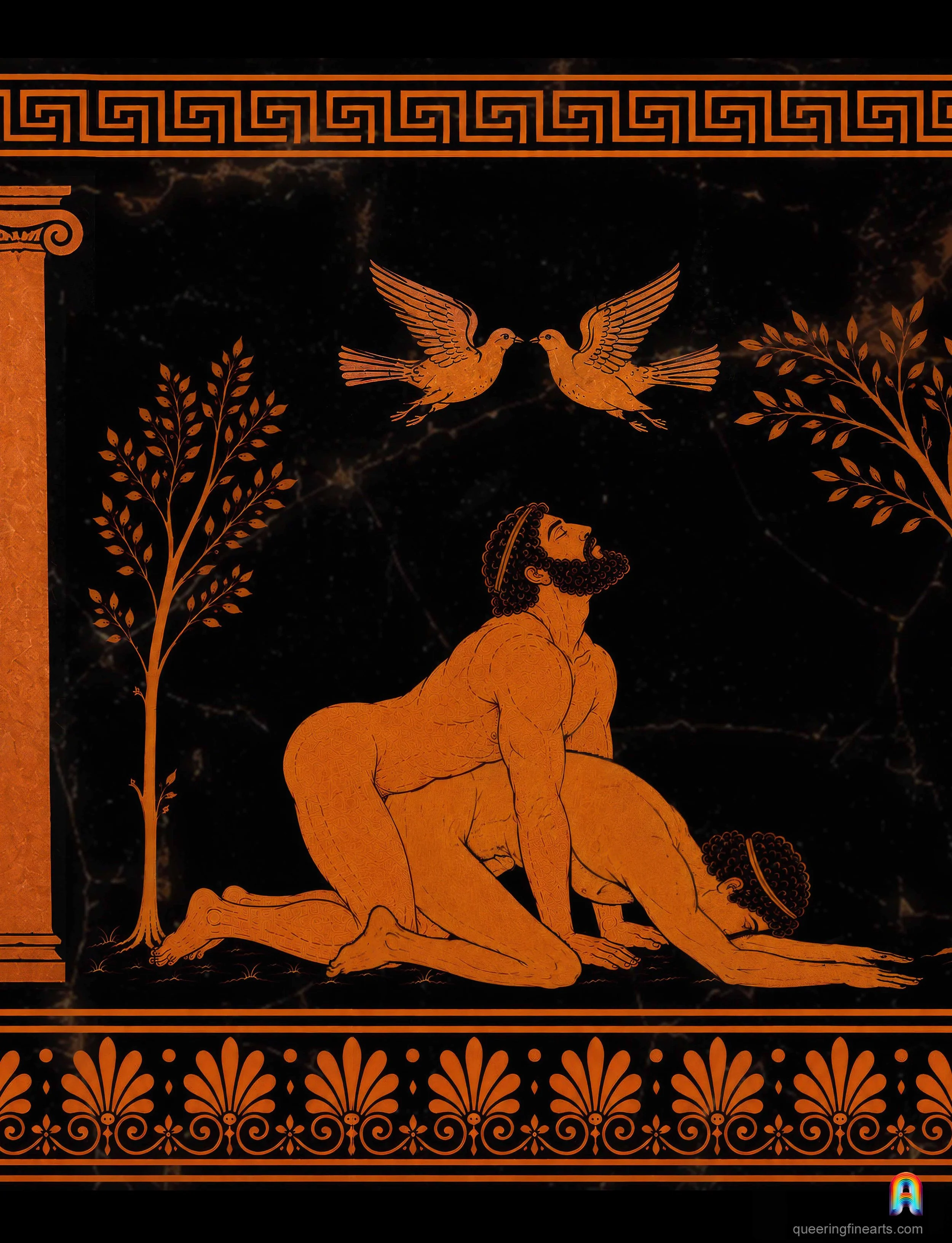
The fourth section depicts the two young men engaged in sexual intercourse, presented as the natural culmination of their growing intimacy. Telemachus penetrates Peisistratus from behind, while the latter completely surrenders himself to this virile intrusion. The relaxed attitude of their bodies and the serene expression of their faces celebrate both the erotic dimension of the scene and the idea of a harmonious and fully embraced union.
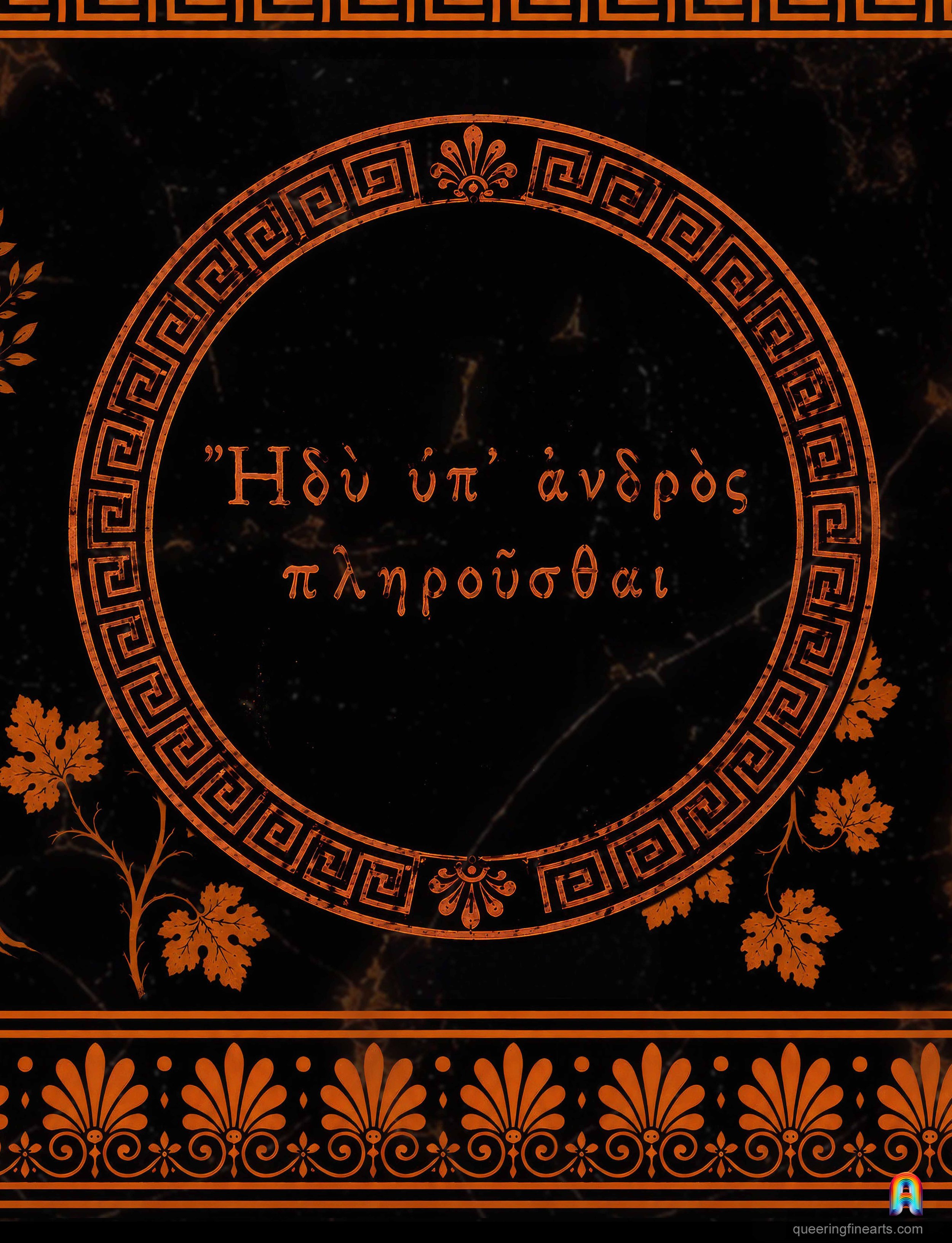
Finally, the medallion on the right brings the narrative to its conclusion with an inscription in Ancient Greek: Ἡδὺ ὑπ᾽ ἀνδρὸς πληροῦσθαι, translated by the English phrase: "Sweet is it to be filled by a man." Placed in deliberate counterpoint to the Homeric passage that opens the composition, this sentence functions as a fictional gloss. The work offers a fully embraced queer reading of this episode by making the two princes' intimacy the true subject of the narrative.
The Origins of an Intimacy
The work draws its inspiration from the Odyssey, traditionally attributed to Homer and composed toward the end of the 8th or the beginning of the 7th century BC.³ The poem recounts Odysseus' long return to Ithaca after the Trojan War. While the hero endures the trials of his journey, his son Telemachus embarks upon a quest of his own to discover his father's fate and become the rightful heir to the kingdom. The scene depicted here belongs to the Telemachy (Books I-IV), more specifically to Book III, when the young prince is received at Pylos by the aged King Nestor.
At the close of the banquet, Nestor has a bed prepared beneath the portico of his palace for his guest and chooses his youngest son, Peisistratus, to sleep beside him. Homer emphasizes that Peisistratus is still a hēítheos, that is, an unmarried young man, and explicitly states that he spends the night beside Telemachus. This mention of the young prince's unmarried status, unusual within the narrative, naturally draws attention to the youth whom Nestor appoints as Telemachus' companion for the night.⁴ These are the very verses reproduced in Ancient Greek in the left medallion of the composition. They provide the literary foundation upon which the entire visual narrative is built.
Homer's wording almost seems to wink at the reader. As Nestor settles the two young men side by side, Peisistratus is introduced as the only unmarried son still living in the palace... and as the youth "of the good ashen spear." Philologists will rightly tell us that the spear is a conventional heroic epithet. Fair enough. But once those details are placed side by side, it becomes delightfully tempting to wonder whether Homer might have enjoyed leaving us with just a little more to think about. In this work, the ash spear remains a weapon, yet it also blossoms into an unmistakable emblem of youthful virility.
The chronology of the story places Telemachus on the threshold of adulthood, most likely around twenty years of age. Odysseus departed for Troy shortly after his son's birth; the war lasted ten years, followed by another decade of wandering. The narrative therefore situates the young prince at the threshold of adulthood, an estimate that has also been adopted by recent scholarship. Homer gives no precise age for Peisistratus, yet everything suggests that he belongs to the same generation. Capable of driving a chariot, representing his father on a diplomatic mission, and consistently described as an unmarried young man, he too most likely appears to be in his early twenties.
Their closeness does not end with this first night. The following day, the two princes travel together in Peisistratus' chariot to Sparta, where they are welcomed by Menelaus and Helen. In Book XV, Athena once again finds them lying side by side beneath the portico of Menelaus' palace. They therefore spend several days together, sharing their journeys, their halts and their nights, forming a pair of youthful companions whose association remains constant throughout the Telemachy.
Their relationship also belongs to the well-established theme of the "heroic pair," long studied in Greek literature.⁵ Rooted in masculine intimacy, companionship and the shared passage into adulthood, this narrative structure provides especially fertile ground for a homoerotic reading. The two princes are young, unmarried, inseparable and repeatedly portrayed in situations of physical closeness. It is precisely this combination of elements that has made their relationship one of the episodes most frequently discussed in queer scholarship devoted to the Odyssey.⁶
It is within this space left open by Homer that the present work takes shape. Without altering the course of the narrative, it extends the silences of the ancient text by developing the relationship between Telemachus and Peisistratus into a fully realized story of physical and emotional love, transforming a suggested intimacy into a genuine love story.
The Freedom of Myths
Since the late 18th century, Attic pottery has inspired artists throughout Europe. Their refined silhouettes, linear contours and frieze-like compositions have nourished a revival of Hellenism in which ancient myth became a space of freedom for the celebration of male beauty and desire between men.⁷ By adopting the visual language of Greek vase painters, Telemachus and Peisistratus continues this tradition through a confidently queer reading of the Odyssey.
For centuries, the history of art has chiefly represented the loves of Odysseus, Penelope or Helen. Telemachus and Peisistratus instead turns its gaze toward two young men whose shared nights Homer briefly records. If the poet leaves the door ajar, nothing prevents us from opening it wider. The work unfolds within a space where one may finally imagine, without equivocation, that the heroes of ancient Greece also had the right to fall in love with another man, like so many other figures of classical literature.⁸
QFA
Curiosity piqued?
1. John Boardman, Athenian Red Figure Vases: The Archaic Period. A Handbook, London, Thames & Hudson, 1975.
2. Andrew Lear and Eva Cantarella, Images of Ancient Greek Pederasty: Boys Were Their Gods, London, Routledge, 2008.
3. Martin L. West, The Making of the Odyssey, Oxford, Oxford University Press, 2014.
4. Alfred Heubeck, Stephanie West and J. B. Hainsworth, A Commentary on Homer's Odyssey, Vol. 1, Introduction and Books I-VIII, Oxford, Clarendon Press, 1988.
5. David Konstan, Friendship in the Classical World, Cambridge, Cambridge University Press, 1997.
6. Thomas K. Hubbard (ed.), A Companion to Greek and Roman Sexualities, Malden, MA, Wiley Blackwell, 2014.
7. James M. Saslow, Pictures and Passions: A History of Homosexuality in the Visual Arts, New York, Viking, 1999.
8. Stefano Evangelista, Queer Classicism: Greece and Rome in Victorian Sexualities, Oxford, Oxford University Press, 2009.