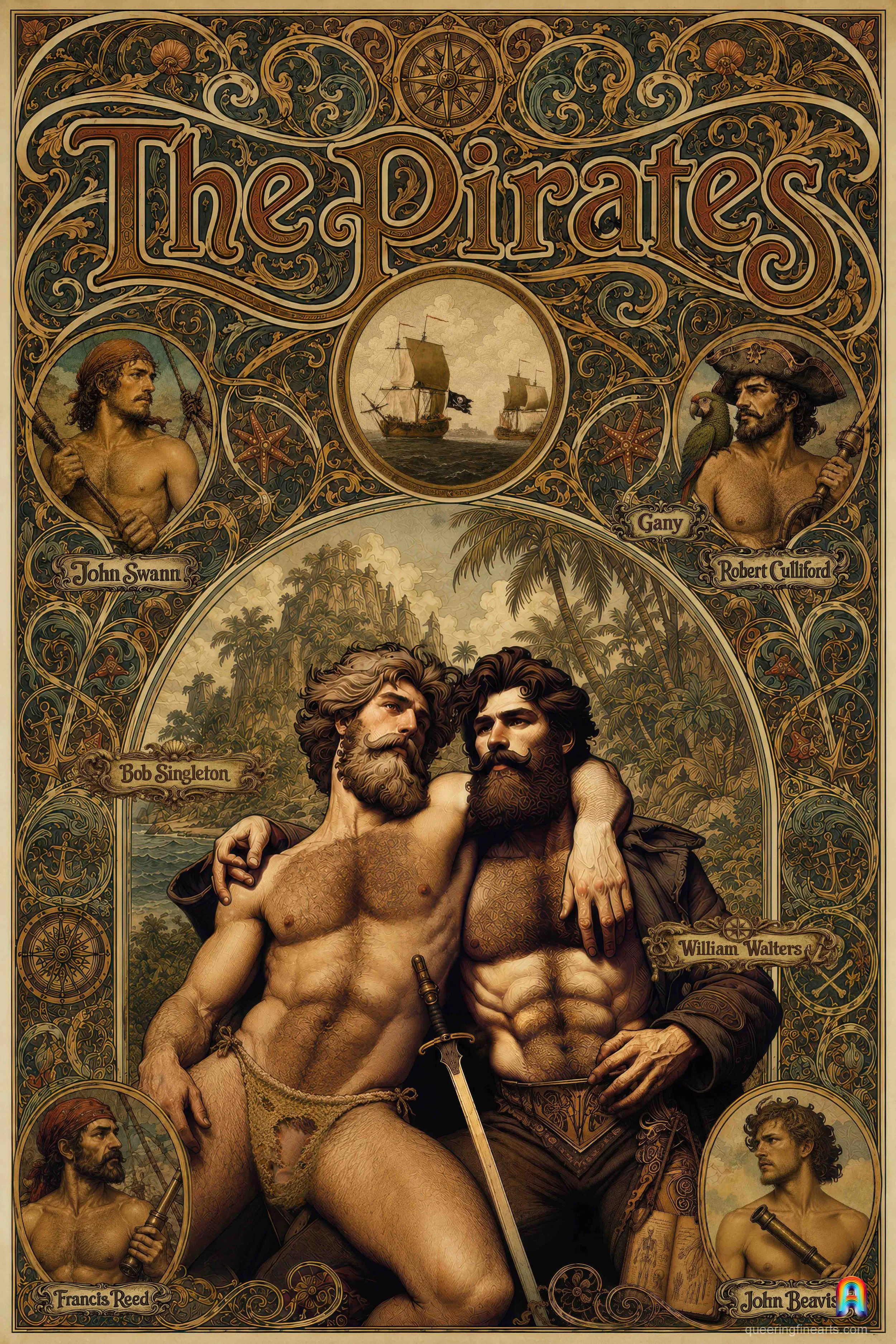
The Pirates
Attributed to a British illustrator of the Art Nouveau period
Inspired by the British adventure novels of Daniel Defoe
Gouache, watercolour and ink on illustration board, c. 1900
Cover illustration for an imaginary adventure novel
Private collection
Three Perspectives on Queer Piracy
A Lost Treasure from the Great Age of Adventure Books
The attribution of this cover illustration to an illustrator of the Art Nouveau period remains deliberately imprecise. Its luxuriant ornamentation, elaborate typography and richly framed portraits recall the flourishing culture of British illustrated book design around 1900¹, when adventure classics enjoyed a new life through richly illustrated editions². Advances in colour printing, decorative design and commercial publishing transformed familiar tales of shipwrecks, hidden islands, buried treasure and heroic exploits into objects of beauty as well as adventure.
The Pirates appears to belong naturally to that publishing tradition. This imaginary edition, however, offers a very different kind of adventure. Beneath the familiar appearance of a classic pirate novel lies an exploration of queer history, literature and maritime culture, seen through the visual language of the fin de siècle.
Three Ways of Reading the Same Voyage
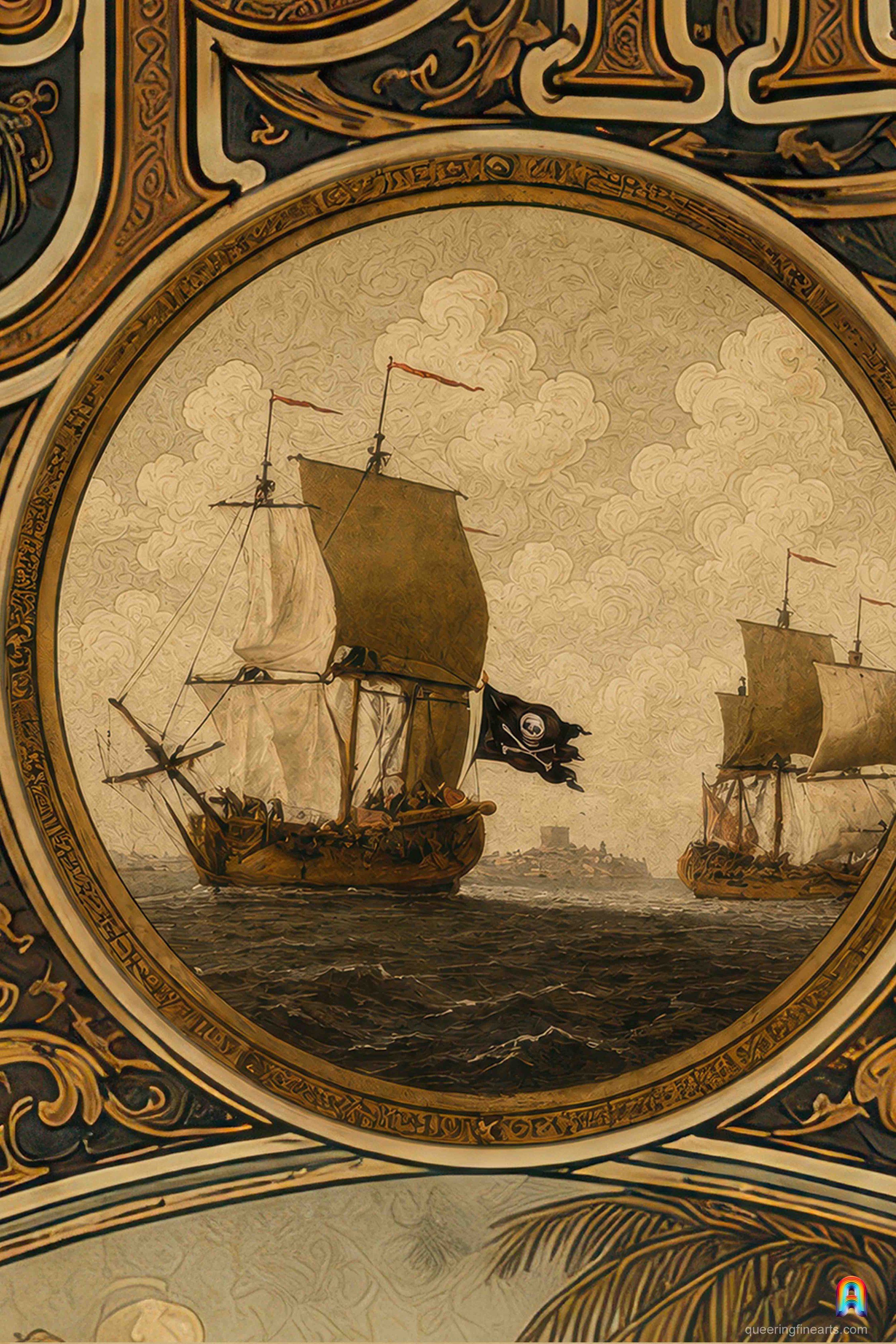
At first glance, The Pirates presents itself as the lavish cover of an illustrated British adventure novel published around 1900. Organised around a monumental central scene framed by four circular portrait medallions and surmounted by a fifth vignette depicting a pirate sloop under black colours, the composition recreates the visual splendour of those prestigious re-editions. A luxuriant Art Nouveau framework of scrolling foliage, anchors, compass roses, ropework and richly ornamented cartouches unifies the design, transforming the imaginary book into an object of beauty in its own right.
The Central Pair
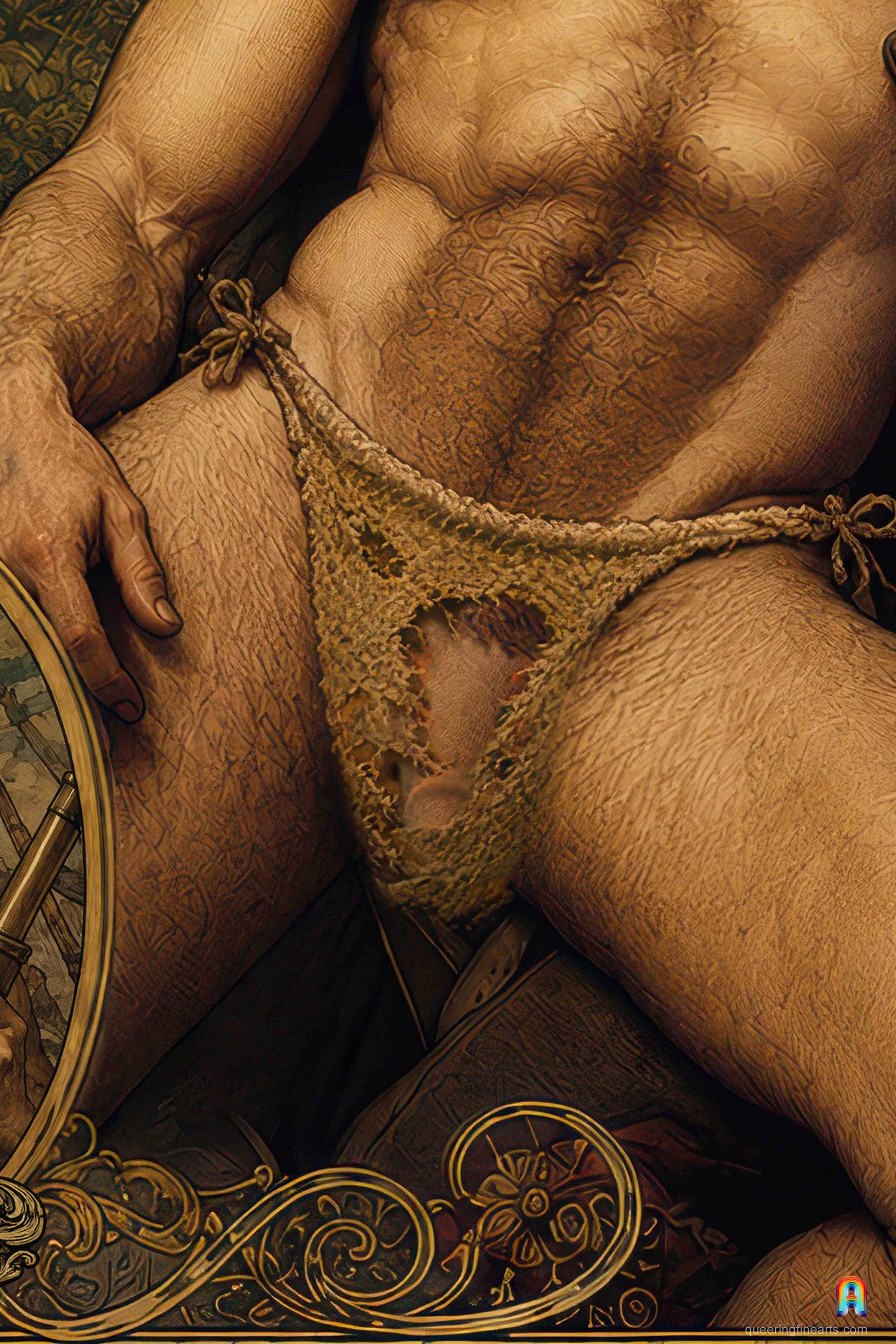
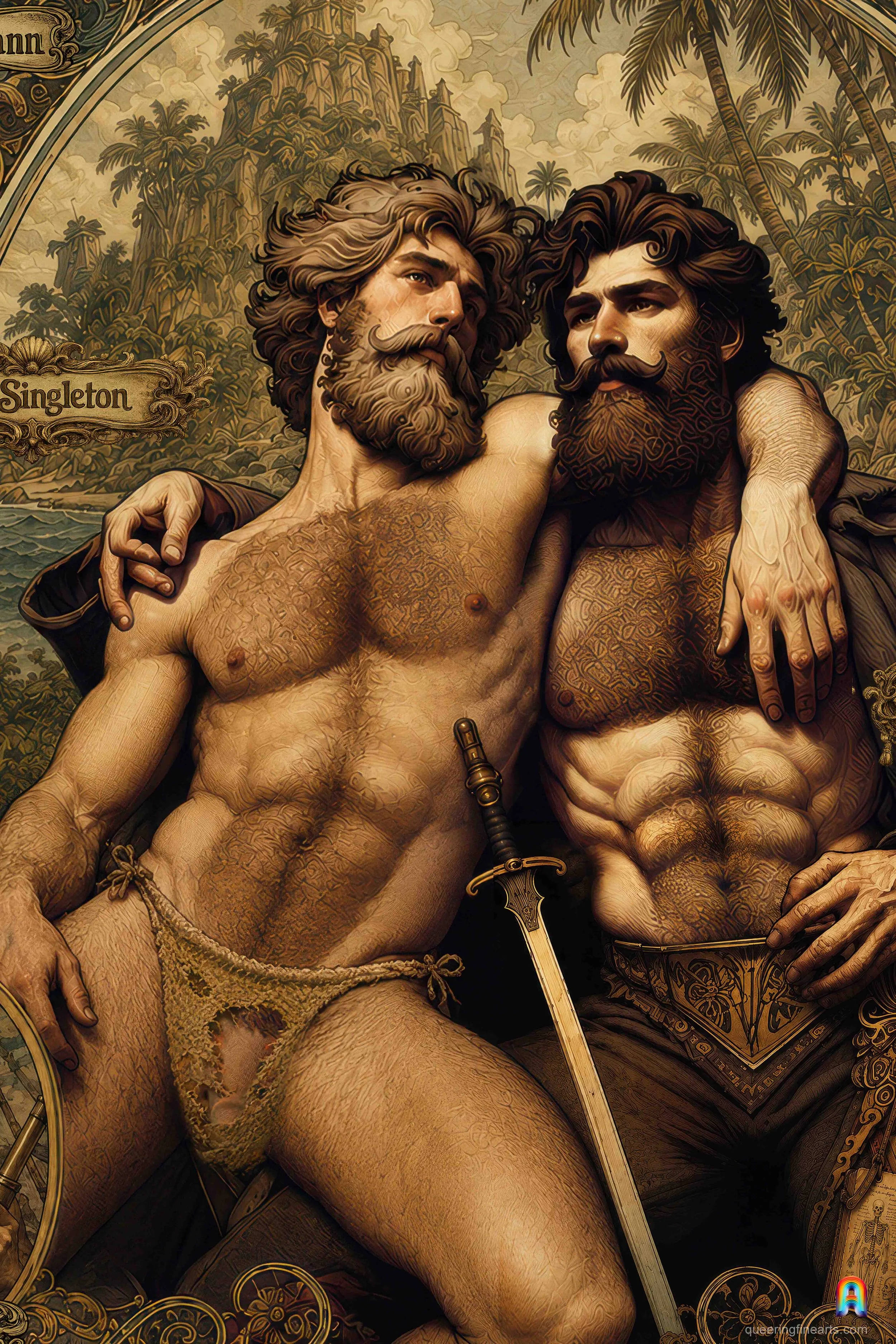
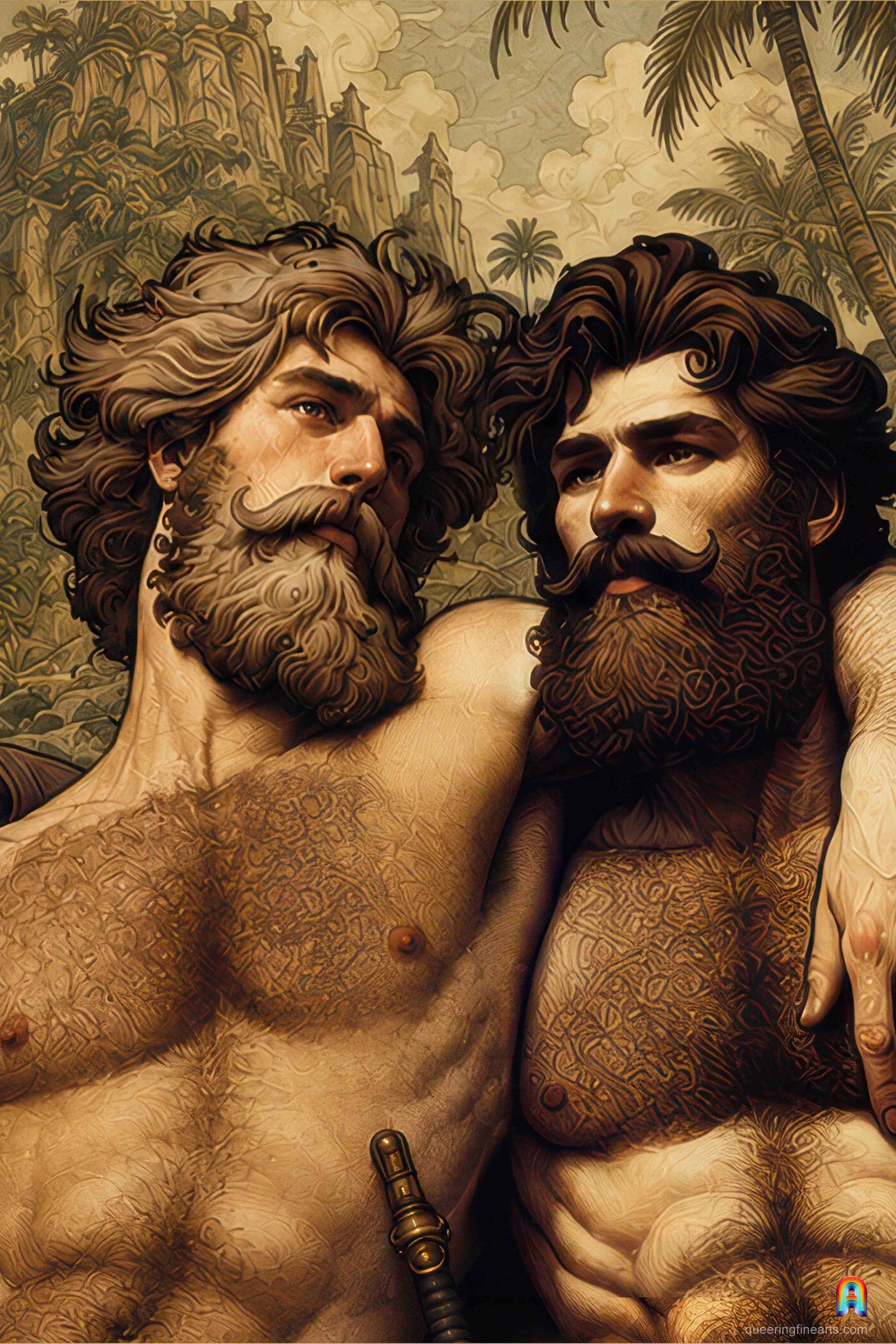
The eye is naturally drawn to the monumental figures of Bob Singleton and William Walters, whose scale immediately establishes them as the principal protagonists of the imagined volume. Seated side by side before a lush tropical island, the two pirates dominate nearly half the composition. Their bare torsos and intertwined arms establish the emotional centre of the image, while the tear in Singleton's breeches, revealing a discreet glimpse of his sex, introduces an additional note of playful homoeroticism entirely at odds with the conventions of traditional adventure publishing. Walters's anatomical notebook, suspended from his belt, immediately identifies the Quaker as the ship's surgeon.
The Four Medallions
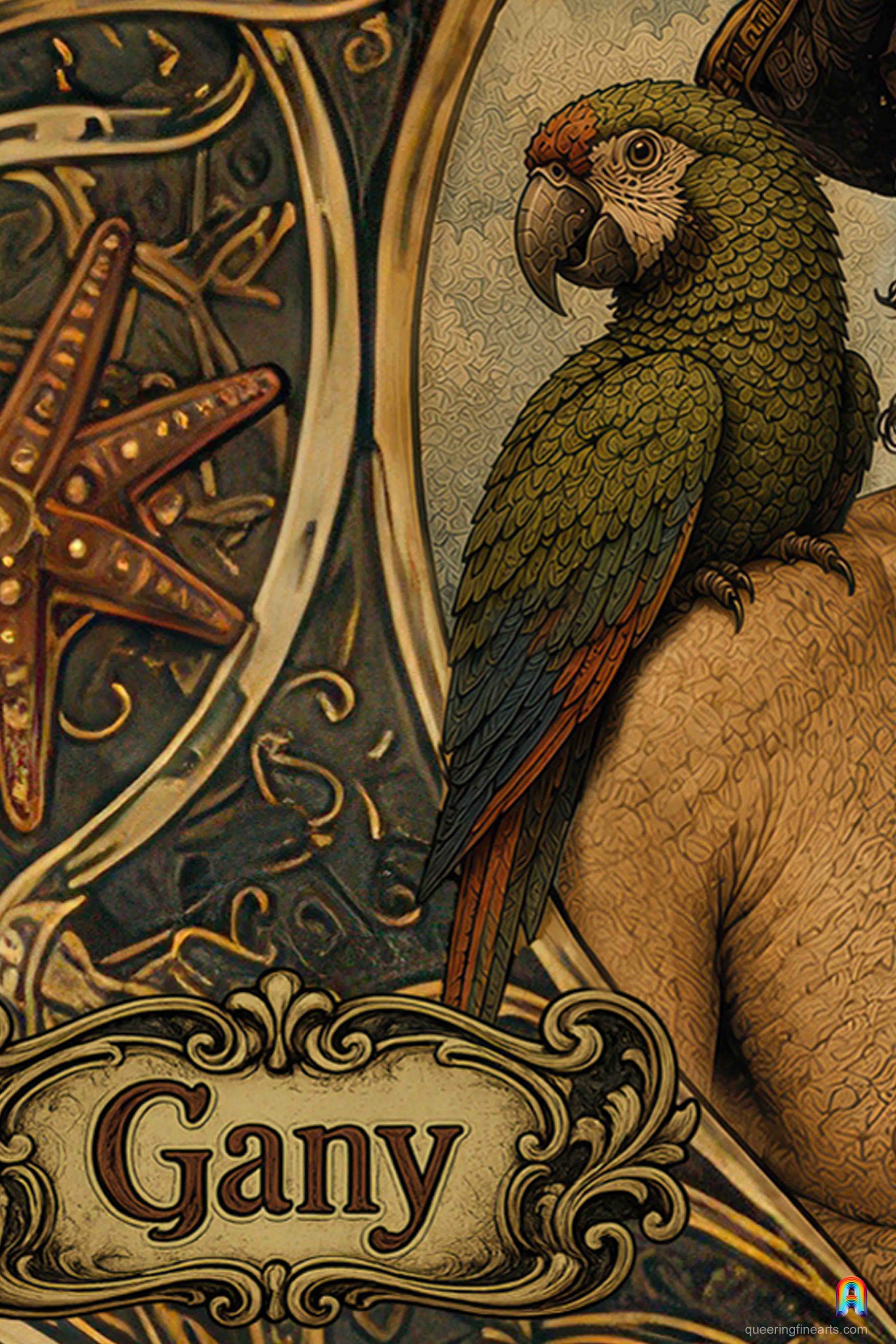
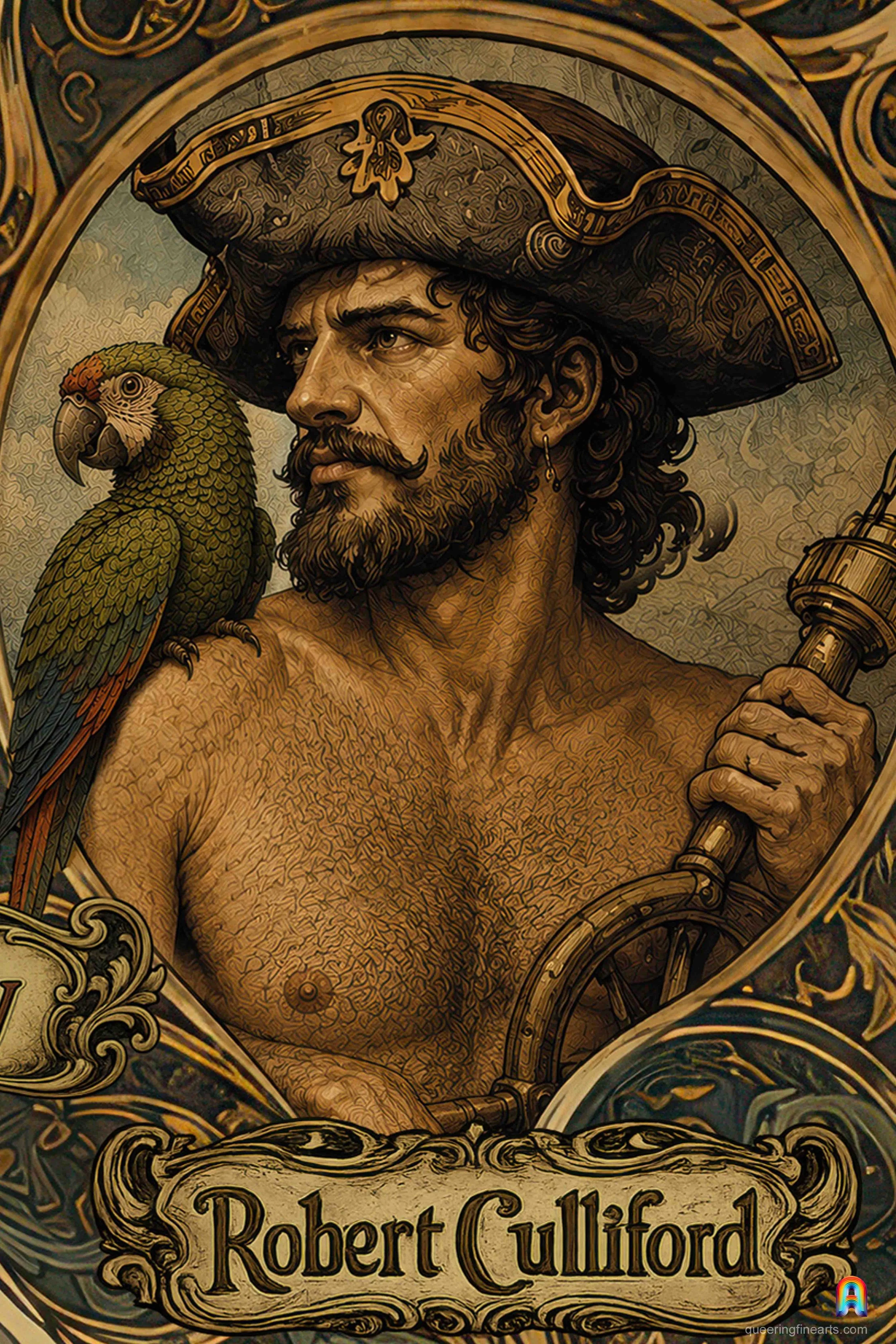
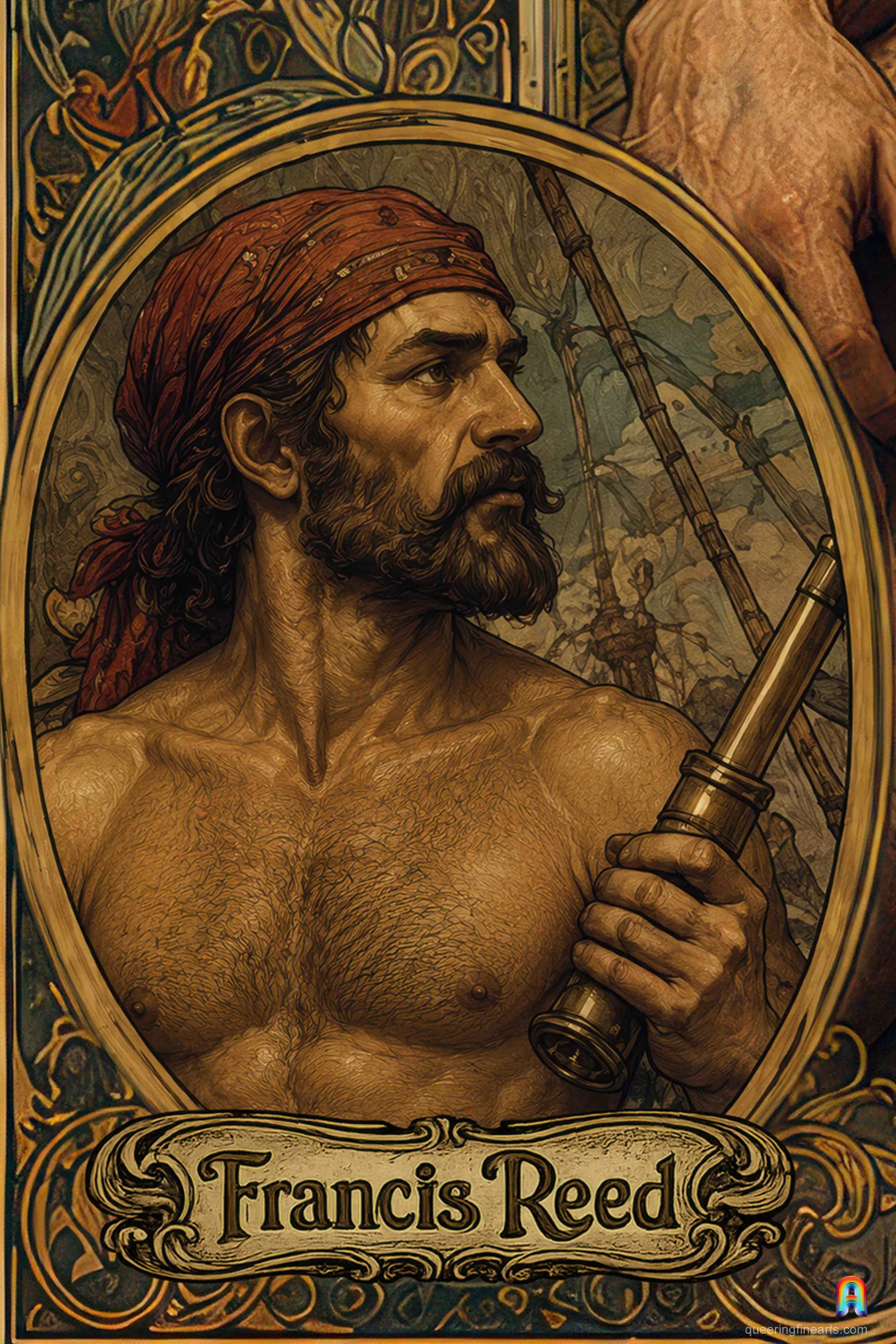
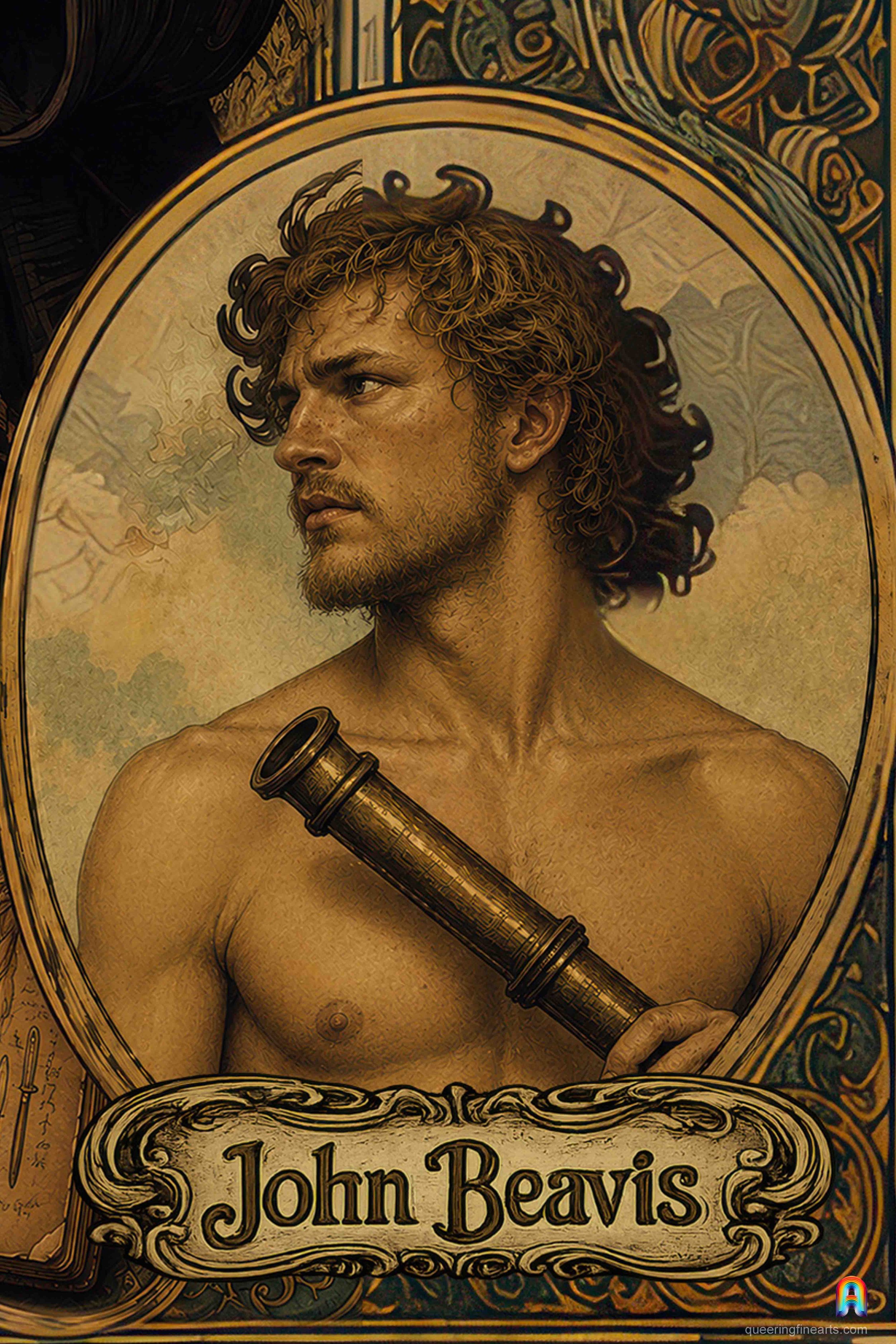
The four portrait medallions introduce the remaining protagonists of the imaginary volume, each representing a different facet of queer piracy. Carefully individualised through physiognomy, hairstyle, facial hair and expression, they reveal contrasting personalities and backgrounds. Robert Culliford alone is enriched with a more explicit iconographic attribute: a Grand Vasa Parrot, a species selected for its plausible association with Madagascar, where the historical pirate spent part of his career. Named Gany, the bird discreetly alludes to Ganymede, extending the work's queer iconography.
A Composition in Three Distinct Movements
At the centre stands fiction. Inspired by Daniel Defoe's The Life, Adventures and Piracies of the Famous Captain Singleton, Bob Singleton and William Walters embody a queer reading of one of English literature's most remarkable male partnerships. Their embrace, the prominence of their bodies and Walters's surgeon's notebook immediately distinguish their relationship from every other figure on the cover
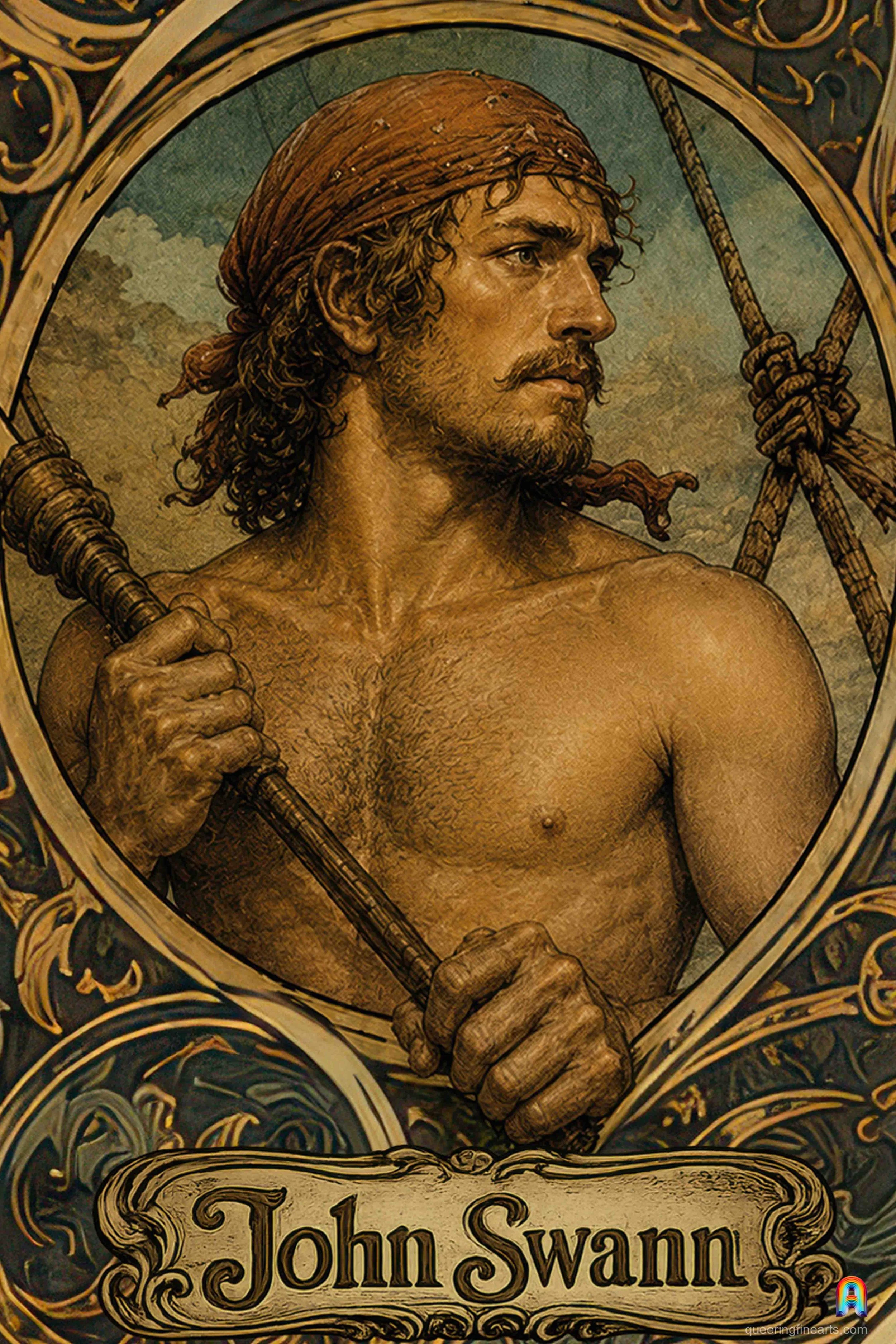
The upper medallions belong to history. John Swann and Robert Culliford introduce what is probably the best documented homosexual relationship in the history of piracy, carrying the reader from literary interpretation to historical evidence.
The lower medallions celebrate maritime partnerships. Francis Reed and John Beavis evoke the institution known by the French term matelotage, reminding us that pirate society also fostered enduring partnerships built upon mutual support, shared property and, according to many historians, romantic or sexual intimacy.
Three stories. Three perspectives. The voyage begins here.
An Imaginary Book with Real Questions
Like every good adventure novel, The Pirates promises exotic landscapes, dangerous voyages and memorable characters. Yet its greatest treasure lies elsewhere.
By adopting the familiar language of Victorian adventure publishing, the work asks a simple question: what might the history of piracy look like if homosexuality between men were no longer treated as a marginal curiosity but as an integral part of the story
Rather than inventing a hidden past, The Pirates invites us to rediscover one that has too often remained beneath the surface, waiting, like buried treasure, to be found.
What Defoe Left Unspoken
An Adventure Built Around an Extraordinary Partnership
Published in 1720, Daniel Defoe’s The Life, Adventures and Piracies of the Famous Captain Singleton³ follows the adventures of Bob Singleton from his youth to his years as a pirate. Beneath its familiar tale of exploration, plunder and survival, however, the novel gradually develops another story: the remarkable relationship between Singleton and the Quaker surgeon William Walters. More than captain and companion, the two men become inseparable, their partnership gradually emerging as the emotional centre of the narrative.
More Than Ordinary Companions
William Walters enters the novel not simply as another member of the crew but as the one man who progressively becomes indispensable to Singleton. Again and again, Defoe sets him apart from the other pirates. Singleton seeks his company in preference to that of his officers, consults him before making important decisions and increasingly entrusts him with matters that extend far beyond navigation or medicine. Walters becomes his closest confidant, his moral compass and the companion whose judgement consistently carries the greatest weight.
Yet Walters does more than advise. Throughout the novel, he steadily transforms Singleton himself. He tempers his impulsiveness, moderates his appetite for violence and risk, encourages prudence over bravado and gradually redirects the pirate's ambitions toward stability rather than conquest. Singleton's authority increasingly gives way to Walters's quiet influence. By the end of the novel, the fearless pirate captain has become a man guided, restrained and ultimately managed by the companion whose presence has quietly reshaped his entire existence.
Defoe eventually marries Singleton to Walters’s sister, restoring the appearance of a conventional heterosexual ending. Yet such resolutions were common both in fiction and in life, allowing an exceptionally close relationship between two men to continue under the reassuring appearance of family ties⁴. The arrangement comes at a price. The sister is drawn into a social compromise not of her own making, while the two men remain obliged to conceal the true nature of their attachment behind the respectability of marriage.
A Queer Reading Faithful to the Book's Spirit
This artwork does not impose homosexuality upon Defoe's novel from the outside. Rather, it begins with the relationship he himself chose to portray. As a Puritan moralist, Defoe could depict extraordinary trust, devotion and worldly fulfilment between two men, yet he could not openly acknowledge such a relationship as a legitimate source of happiness. His solution was not to erase the attachment but to redirect it toward an acceptable social conclusion. What remains unspoken is therefore not the relationship itself but its emotional and erotic implications.
Like many great works of literature, Captain Singleton exceeds the limits of its author's own moral framework. Bob Singleton and William Walters remain exactly the characters Defoe created. What changes is our understanding of the dynamics between them. Read in the light of what we now know about intimacy, emotional attachment and same-sex relationships, their partnership may equally be recognised as the portrait of a homosexual couple. The cover of this imaginary book simply gives visual form to a reading that the novel itself makes possible while simultaneously striving to repress.
Robert Culliford and John Swann
Pirate ships were overwhelmingly male worlds. Crews lived, fought, slept, drank, gambled and divided plunder in conditions of extreme proximity. There must have been countless intimate relationships between men in such environments. What is rare is not the relationships themselves, but the chance survival of documents that allow us to glimpse them.
Robert Culliford was one of the most successful pirates of the Indian Ocean at the close of the 17th century⁶. Born in Cornwall around 1666, he first crossed paths with the future Captain William Kidd aboard the French privateer Sainte Rose in 1689. After participating in the mutiny that placed Kidd in command, Culliford soon led a second mutiny that removed him. Over the following decade he built an extraordinary career: privateer, mutineer, pirate captain, prisoner in Gujarat for four years after his capture near Mangalore, escapee, commander of the Mocha, rival of Kidd at Île Sainte-Marie and finally one of the captains responsible for the capture of the fabulously wealthy Great Mohammed in the Red Sea in 1698, one of the richest prizes in pirate history⁷.
John Swann remains a far more elusive figure, yet the surviving evidence suggests that his life became closely intertwined with Culliford's. The two men appear to have shared imprisonment in India after their capture, escaped together in 1696, returned to piracy in the Indian Ocean and eventually settled together at Edward Welch's pirate community on Île Sainte-Marie off Madagascar. Their association therefore extended over many years and through some of the defining episodes of Culliford's career.
Everything changes with the deposition of Theophilus Turner in June 1699. Reporting on the pirate settlement at Sainte-Marie, Turner wrote: “There is one John Swann, a great consort of Culliford’s, who lives with him.”⁸ In a document otherwise concerned with pirate captains, settlements and intelligence for the Crown, this brief sentence stands out immediately. Swann is identified not through his own exploits but through his association with Culliford. More striking still, Turner does not merely say that the two men sailed together. He records that Swann “lives with him.”
The expression "great consort" has generated more discussion than perhaps any other phrase relating to homosexuality in pirate history. In maritime language, consort could refer to allied ships or companions sailing together. Yet Turner's wording goes beyond a professional association by adding that the two men shared a household at Sainte-Marie. Whether he intended the phrase to imply a sexual relationship can never be known. What can be said is that the unusual combination of "great consort" and "lives with him" has no close parallel elsewhere in the surviving pirate archive. It is precisely this rare conjunction that has attracted the sustained attention of historians.
A Sentence Queer Historians Could Not Ignore
The modern reassessment of Swann and Culliford owes much to the emergence of queer history during the late 20th century. In Sodomy and the Pirate Tradition, B. R. Burg argued that piracy should be understood not only as a form of maritime crime but also as a social world in which relationships between men could develop beyond the constraints of conventional society⁹. Hans Turley expanded that perspective in Rum, Sodomy, and the Lash, placing pirates within broader questions of masculinity, sexuality and literary imagination¹⁰.
Neither historian claims that Turner accidentally recorded a confession of homosexuality. Their contribution lies elsewhere. They showed that expressions long dismissed as incidental deserve to be read within the social realities of overwhelmingly male communities. Swann and Culliford therefore occupy an important place not because they were necessarily unique among pirates, but because their relationship is one of the very few for which the archive preserves language suggestive enough to invite a serious queer reading.
Maritime Partnerships, or The Institution of Matelotage
Francis Reed and John Beavis
Unlike the relationship between Robert Culliford and John Swann, the partnership of Francis Reed and John Beavis is documented not through an observer’s description but through an agreement the two men themselves entered into. Drawn up at Port Dolphin, Madagascar, in 1699, it is the only surviving contract establishing a formal lifelong partnership between two pirates¹¹. Such partnerships, known among French buccaneers as matelotage, regulated shared property, inheritance and mutual obligations between two men.
The agreement opens with a striking declaration:
"Be it knowen ... that Francis Reed and John Beavis are entered in Consortship together..."
The document continues by providing that, should either man die unexpectedly, his gold, silver and every other possession should pass to the survivor. Far from a casual understanding between shipmates, this was a formal contract governing inheritance, mutual obligation and shared property. In an occupation where violent death was an everyday possibility, matelotage offered security, continuity and trust.
More Than Mutual Insurance
The French word matelotage derives from matelot, meaning sailor. Seventeenth-century buccaneers used it to describe a recognised partnership between two men¹². Matelots agreed to live, work, fight and often accumulate wealth together. They cared for one another when sick or wounded and inherited each other’s property upon death. Contemporary observers frequently compared the institution to marriage, even if its legal status differed entirely from that of Christian matrimony.
Whether every matelotage relationship was sexual is another question. Almost certainly not. Like marriage itself, the institution embraced many different human realities. Some partnerships were probably practical, others economic, others deeply affectionate and some almost certainly erotic. The surviving documents rarely permit us to distinguish between these possibilities. Their value lies precisely in demonstrating that pirate society recognised durable partnerships between two men as legitimate social arrangements.
Queer Historians and the Meaning of Matelotage
Few historians have done more to place matelotage at the centre of queer pirate history than B. R. Burg. In Sodomy and the Pirate Tradition, he described it as an institutionalised bond between two men that could include distinctly homosexual characteristics. Hans Turley approached the question more cautiously, emphasising the poverty of the surviving evidence while nevertheless arguing that piracy created a social world in which homoerotic attachments became historically conceivable in ways rarely acknowledged by earlier scholarship. Their conclusions differ in degree, but together they transformed the discussion. Pirate history was no longer simply about ships and plunder; it had become a history of intimacy as well.
More recently, historians of pirate law and pirate settlements have drawn renewed attention to the Reed-Beavis agreement itself, treating it not merely as a legal curiosity but as evidence that pirates developed their own institutions of care, inheritance and domestic solidarity outside the conventions of European society¹³. Rather than forcing the document into modern categories, they invite us to recognise how remarkably original the institution already was on its own terms.
From Contract to Portrait
On the cover of The Pirates, Francis Reed and John Beavis introduce the reader to the world of matelotage, the little-known institution that forms the third thread of the book. Their portraits promise that the voyage ahead will not be limited to famous pirates and buried treasure, but will also explore the customs, relationships and everyday lives that made pirate society unlike any other.

Men of the Cannons
Perhaps the most remarkable aspect of queer piracy is not that traces of it survive, but that anyone should be surprised they exist. Pirate crews were human communities, and every human community has included men attracted to men. Ships were no exception.
What history has preserved is only a tiny fraction of those lives. A novel here, a deposition there, a legal contract elsewhere: these are not isolated curiosities but rare windows onto a reality that must once have been commonplace. The silence of the archive should never be mistaken for the silence of the past.
The Pirates invites us to look through those windows. Not to claim certainty where none exists, but to recognise that homosexuality did not arrive after the age of sail. It sailed with it.
QFA
Curiosity piqued?
1. Simon Houfe, The Dictionary of British Book Illustrators and Caricaturists, 1800-1914, Woodbridge, Antique Collectors' Club, 1981.
2. Brian Maidment, Reading Popular Prints, 1790-1870, Manchester, Manchester University Press, 1996.
3. Daniel Defoe, The Life, Adventures and Piracies of the Famous Captain Singleton, London, J. Brotherton et al., 1720.
4. Robert Clark, « The Ambiguities of Captain Singleton, Defoe's Piratical Novel », XVII-XVIII, vol. 76, 2019.
5. Marcus Rediker, Villains of All Nations: Atlantic Pirates in the Golden Age, Boston, Beacon Press, 2004.
6. David Cordingly, Under the Black Flag: The Romance and the Reality of Life Among the Pirates, London, Random House, 1995.
7. Arne Bialuschewski, « Pirates, Slavers and the Indigenous Population in Madagascar, c. 1690-1715 », The International Journal of African Historical Studies, vol. 38, no 3, 2005, p. 401-425.
8. Calendar of State Papers, Colonial Series, America and West Indies, 1699, London, His Majesty's Stationery Office, 1908, p. 283-291.
9. B. R. Burg, Sodomy and the Pirate Tradition: English Sea Rovers in the Seventeenth-Century Caribbean, New York, New York University Press, 1995.
10. Hans Turley, Rum, Sodomy, and the Lash: Piracy, Sexuality, and Masculine Identity, New York, New York University Press, 1999.
11. Edward Theophilus Fox, « "Piratical Schemes and Contracts": Pirate Articles and their Society, 1660-1730 », thèse de doctorat, University of Exeter, 2013.
12. Alexandre-Olivier Exquemelin, The Buccaneers of America, trad. Alexis Brown, Mineola, Dover Publications, 2000.
13. Agnese Palumbo, « Bound to a Mast: Matelotage and the Queer Contract in Shakespeare's Maritime Plays », Law and Humanities, vol. 19, no 2, 2025, DOI: 10.1080/17521483.2025.2467551.