Two Lovers by a River, Xu Ziyun and Chen Weisong
Shanghai School
Anonymous artist
Ink and colour on silk
China, second half of the nineteenth century
Present whereabouts unknown
Seventeen Years of Love
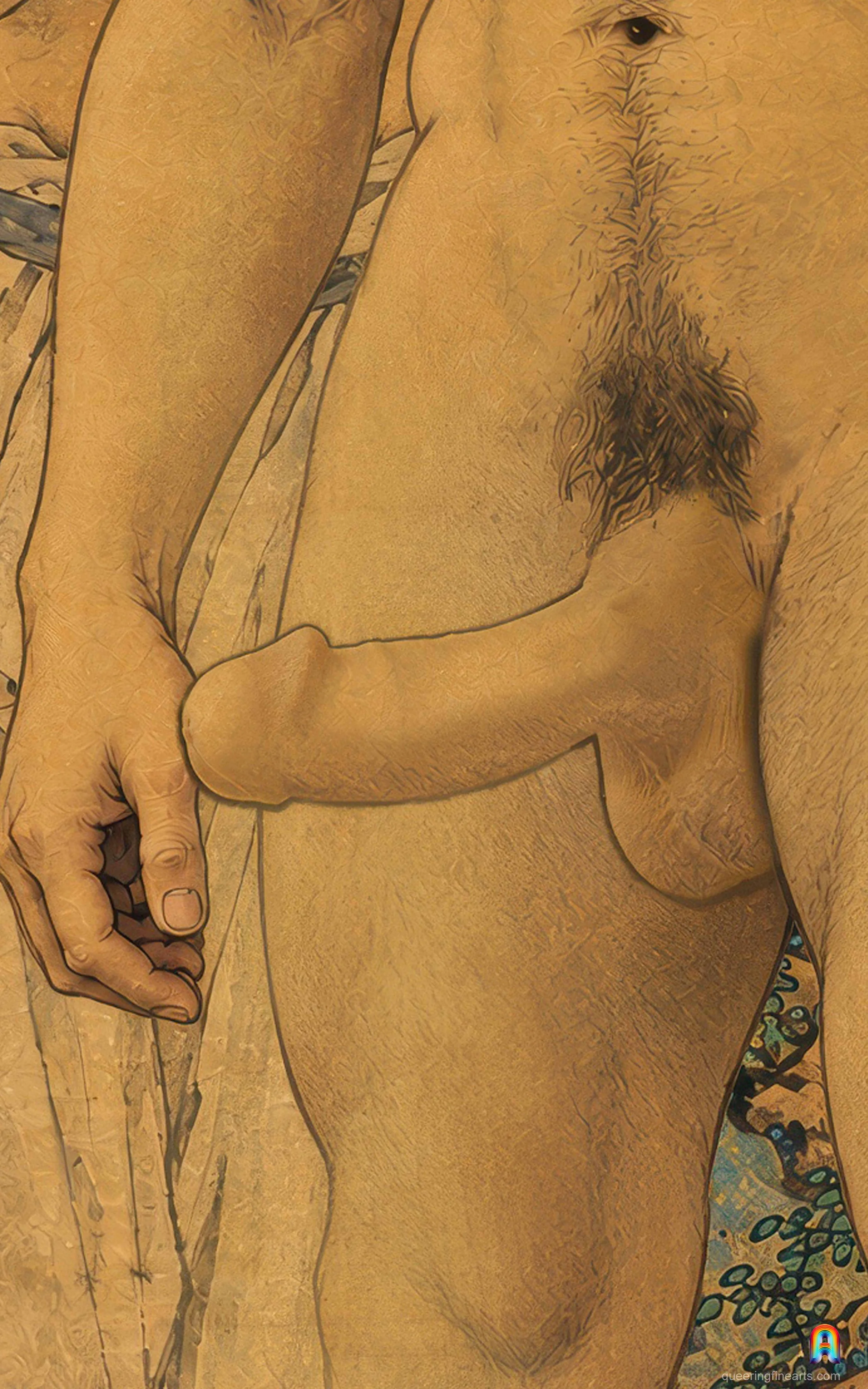
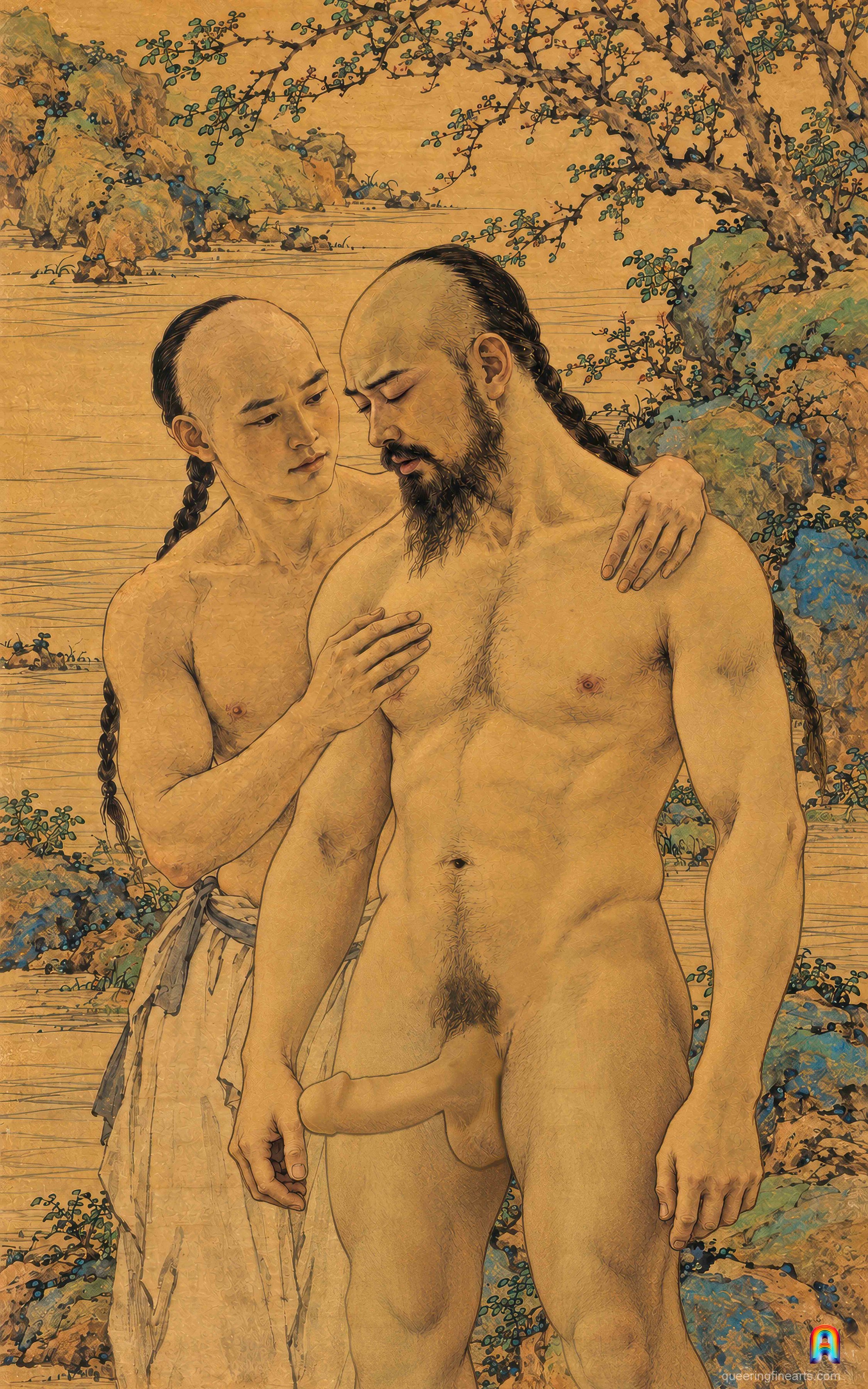
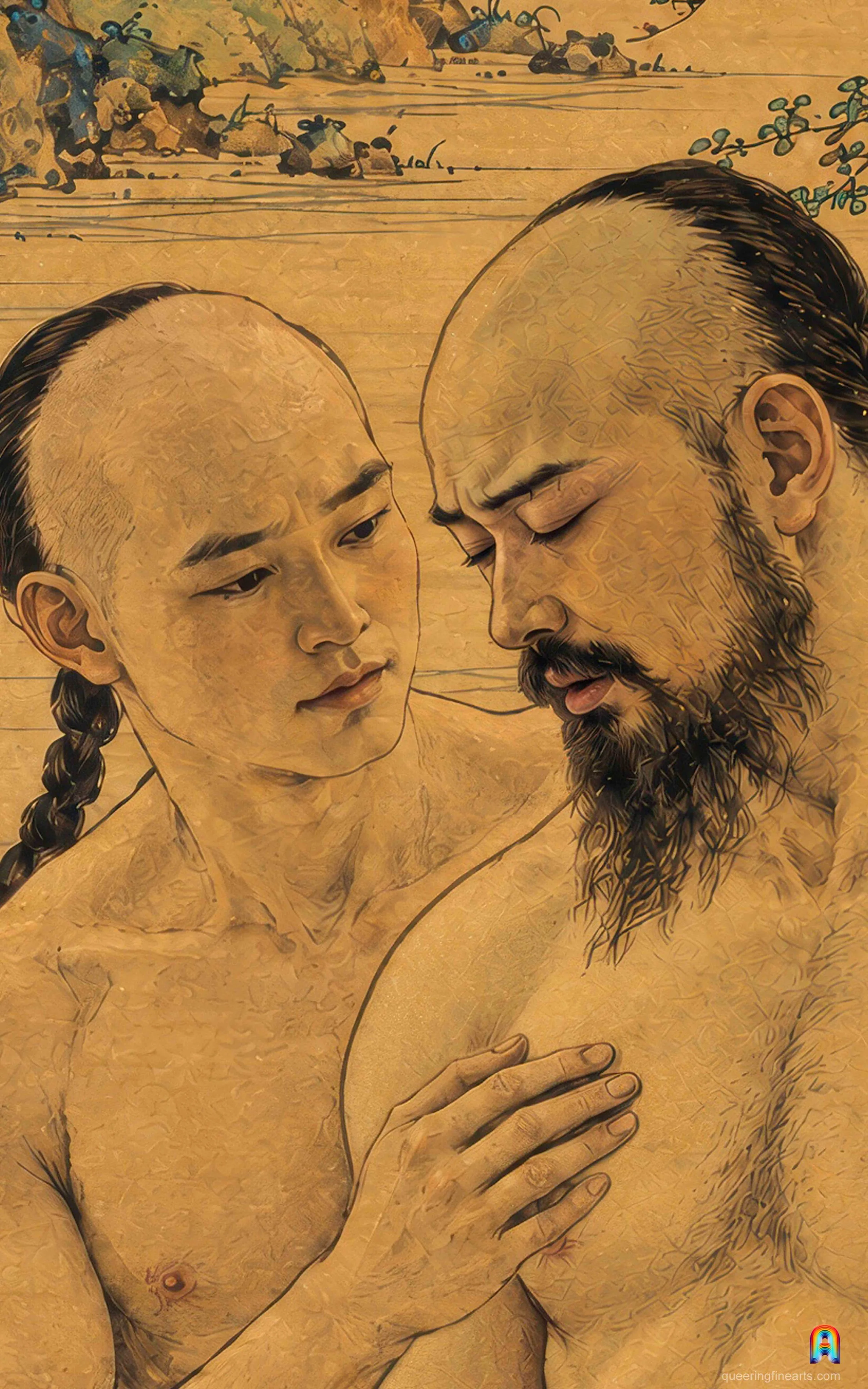
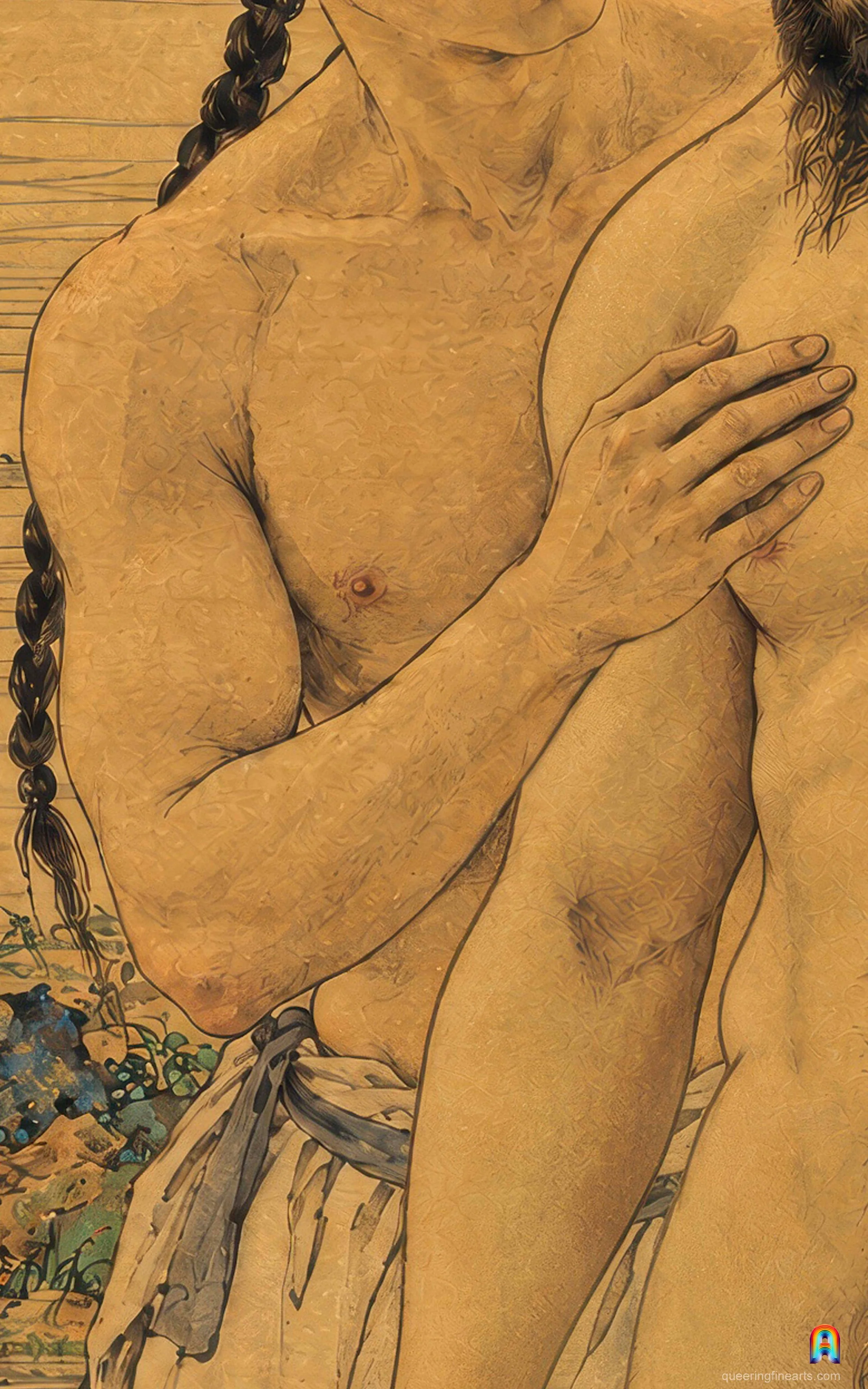
On a secluded riverbank, two lovers appear to be preparing to bathe. The younger man at the left still wears his loosely tied trousers; his companion has already undressed. He slips an arm around the older man’s shoulders and rests a hand against his chest, watching his face as he closes his eyes and parts his lips. Their contrasting expressions bring the embrace to life: the younger man’s attentive gaze meets his companion’s absorption in the moment, while the naked man’s visible arousal makes their attraction unmistakable. The open water gives the encounter a sense of possibility.
The younger lover is Xu Ziyun, a singer, dancer and actor; the man beside him is Chen Weisong, a celebrated writer. Their love belongs to the Jiangnan region of China in the second half of the seventeenth century. They met in the household of Mao Xiang, a literary patron who maintained the troupe in which Ziyun performed and welcomed Chen as a guest. Their attachment left its mark in poems and portraits. Here, that remembered love takes on the ease of a private encounter: two artists enjoying each other’s company beside a river, with the freedom to let the moment unfold.
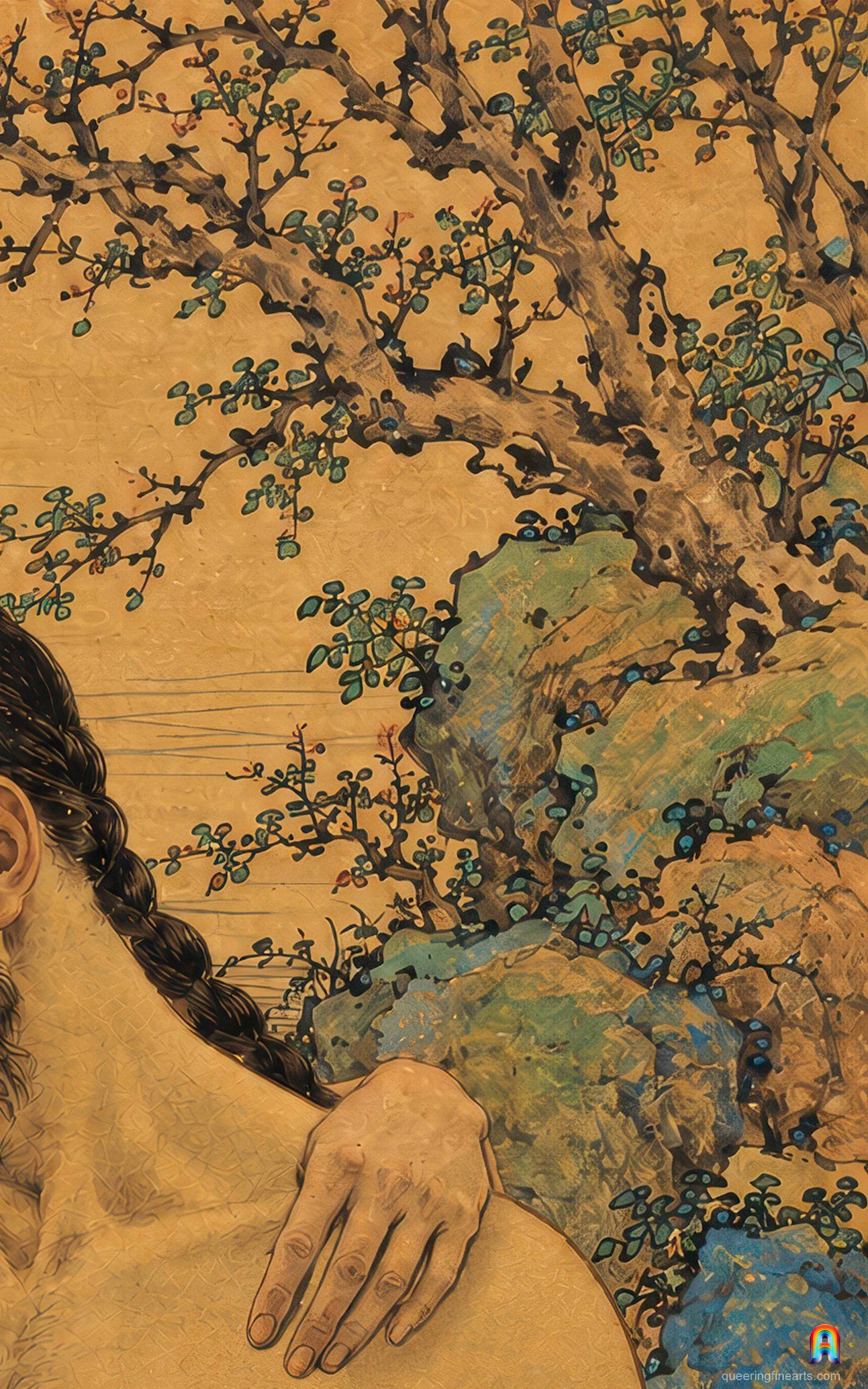
Imagined as a nineteenth-century work, the painting brings an older love into renewed presence. Its branching trees, blue-green rocks and tranquil water recall landscapes such as those of Lan Ying. This meeting of inherited forms and more closely modelled figures finds a parallel in nineteenth-century Shanghai painting, where artists such as Ren Bonian combined a study of earlier masters with new approaches to shading and portraiture.² Here, that dialogue between past and present serves an intimate purpose. Xu Ziyun and Chen Weisong emerge from the poems and portraits that preserve their attachment, reunited beside the river in the pleasure of an embrace.
Curiosity Piqued?
1. Sophie Volpp, The Literary Circulation of Actors in Seventeenth-Century China, The Journal of Asian Studies, vol. 61, no. 3, Association for Asian Studies, August 2002, pp. 949–984.
Through poems concerning Xu Ziyun and his relationship with Chen Weisong, Volpp explores male homoerotic attachment within a circle of seventeenth-century Chinese literati. Her study places their relationship within the artistic exchanges and social hierarchies connecting actors and their patrons.
2. Maxwell K. Hearn, Modern Chinese Painting, 1860–1980: Selections from the Robert H. Ellsworth Collection in The Metropolitan Museum of Art, The Metropolitan Museum of Art Bulletin, vol. 58, no. 3, New York, The Metropolitan Museum of Art, Winter 2001, pp. 10–13, especially p. 12.
Hearn examines how nineteenth-century Shanghai painters renewed earlier pictorial traditions. His discussion of Ren Bonian describes the combination of facial chiaroscuro with calligraphic treatments of clothing and setting, providing a historical parallel for the meeting of styles imagined here.
An Actor and a Scholar in Early Qing China
The love between Xu Ziyun and Chen Weisong grew within a literary circle whose members could make another man’s beauty a subject of poetry. Around them, men wrote about Ziyun and celebrated the attachment he inspired in Chen.¹ Their relationship belonged to a recognisable part of this cultivated world, where the appreciation of a performer’s art could mingle with attraction to the man himself. It was within that setting that two very different lives came together.
Xu Ziyun (1644–1675) was a singer, dancer and actor in the private troupe of Mao Xiang, a writer and patron based in Rugao. His accomplishments placed him before an audience capable of appreciating both the refinement of his performances and his personal charm. The distinction matters: the young man who attracted Chen’s attention was an artist whose talent formed part of his appeal. His position in Mao’s household also brought him into the company of writers who would give his name a life beyond the stage.
Chen Weisong (1626–1682) came from a scholarly family in Yixing. Educated in the literary traditions that conferred prestige on a cultivated man, he won recognition for his poetry and prose while repeatedly failing the civil service examinations. His reputation opened doors that his examination results could not. Scholars and officials welcomed him and Mao Xiang, a close friend of his father, received him for extended stays devoted to study and writing. His appointment to the Hanlin Academy came only in 1679,² after decades in which literature and friendship had sustained his standing.
Chen’s poems preserve the pleasure of looking at the man he loved. In a sequence addressed to Yunlang, another name for Ziyun,³ he remembers him during the Dragon Boat Festival:
I remember the fifth-month festival:
You leaned against the open lattice, a little drunk.
A whole landscape of the Xiao and Xiang rivers,
With strands of rosy evening cloud slanting across it.
The grand language of landscape painting serves a tender recollection. What catches Chen’s attention is Ziyun at ease, warmed by wine and beautiful enough to call an entire painted world to mind. The performer admired before an audience becomes the companion observed in an unguarded moment.
Elsewhere in the same sequence, Chen turns to a pair of mandarin ducks:
The pond’s autumn water shimmers green;
Fine grass along the bank lies soft as a cushion.
Tell those in the high pavilion to put their slingshots aside:
Mandarin ducks, after all, are lovers of one heart.
The birds carry a declaration of constancy and a playful appeal to let the lovers be. Water, soft grass and the closeness of a devoted pair give affection a welcoming landscape. Beside our painted river, that image finds a natural echo: two men enjoying the happiness of being together.
Curiosity Piqued?
1. Sophie Volpp, The Literary Circulation of Actors in Seventeenth-Century China, The Journal of Asian Studies, vol. 61, no. 3, Association for Asian Studies, August 2002, pp. 949–984.
Through the poems surrounding Xu Ziyun and Chen Weisong, Volpp examines male homoerotic attachment within a literary circle. Her study connects their relationship with the artistic exchanges and structures of patronage that brought actors and writers together.
2. Tu Lien-chê, Ch’ên Wei-sung, in Arthur W. Hummel, editor, Eminent Chinese of the Ch’ing Period (1644–1912), vol. 1, Washington, D.C., United States Government Printing Office, 1943.
This biographical entry documents Chen’s family background, literary reputation, examination failures and residence with Mao Xiang. It explains how his recognition as a writer preceded his eventual official appointment.
3. Chen Weisong, Chaochang ci ershi shou bie Yunlang (怊悵詞二十首別雲郎, “Twenty Poems of Sorrow on Parting from Yunlang”), in Huhai lou quanji, section “Seven-Character Quatrains,” Chinese text reproduced by Shidian Guji. English translations prepared for this essay.
Written around a separation, this sequence also preserves affectionate memories and declarations of fidelity. The two complete quatrains quoted here evoke Ziyun during the Dragon Boat Festival and a pair of mandarin ducks sharing “one heart.” The reference to the Xiao and Xiang rivers draws on a celebrated landscape tradition to describe the beloved.
A Love Story That Left Its Traces
Their story begins in 1658 at Mao Xiang’s household in Rugao. Chen Weisong was in his early thirties; Xu Ziyun was still a teenager. Assigned to attend Chen during his stays, Ziyun became his companion in a relationship lasting approximately seventeen years, until his death in 1675.¹ Chen’s poems preserve the changing rhythms of their attachment: shared lodgings, journeys together and the impatience of waiting to be reunited.
In his verses to Ziyun, Chen remembers a decorated flute and books sharing their bed. Elsewhere, his lover’s absence makes a night away from home seem longer. These details give substance to their intimacy. The celebrated performer was also the companion whose presence Chen had come to count on, through uncertain prospects and repeated departures.
In 1668, the two men left Rugao for Beijing without informing Mao. Their friend Gong Dingzi intervened with the patron on their behalf. Gong’s letter reports that “Xu Ziyun followed Chen, and they are very happy together.”² Here, a voice other than Chen’s confirms their happiness. Their wish to travel together had challenged Mao’s authority over Ziyun; a friend’s intervention helped negotiate their freedom.
Marriage was part of both men’s lives. Chen had married and, following his wife’s death, took a concubine while Ziyun remained his companion. Ziyun also married a woman and continued his relationship with Chen. Their love existed alongside commitments to women and the expectations surrounding family life.
In imperial China, marriage served purposes that extended beyond the couple: continuing the lineage, sustaining ancestral rites and establishing ties between households.³ Loving another man could coexist with the expectation of becoming a husband and father. This provides a context for both men’s marriages, although the surviving accounts leave Ziyun’s personal reasons for marrying uncertain. They also offer little information about his wife or their domestic arrangements.
For Ziyun’s wedding, Chen composed a lyric addressed to the bridegroom as Yunlang, another name for Ziyun. Chen opens with the pleasures of the celebration while his attention keeps returning to his male lover:
I sip a little rose wine,
Delighted today by the gleam of hairpins and ornaments
Shimmering before the lamps.
Beyond the screen rise laughter and chatter:
They announce that the bridal headdress is in place.
Then, quietly, I steal another look at my darling.⁴
Later in the same poem, Chen addresses Ziyun directly: “For six years, in lonely lodgings, we leaned upon each other.” He encourages his lover to fulfil his role as a husband while anticipating the loneliness of his own bed. The wedding brings another commitment into an established intimacy. Chen’s response combines affection for the bridegroom with apprehension about what might change between them. Their continuing attachment shows that the marriage accommodated a relationship already central to their lives.
It was the younger lover who died first. Ziyun was only around thirty when he died at Yixing, Chen’s ancestral home, in 1675. Chen was about forty-nine and would survive him by seven years, dying in 1682. After so many departures followed by reunions, he now faced an absence that would endure for the rest of his life. Friends contributed poems mourning Ziyun and Chen preserved their responses alongside his own grief. Their words carry the memory of the young performer into the years he never lived to see.
Curiosity Piqued?
1. Sophie Volpp, Worldly Stage: Theatricality in Seventeenth-Century China, Cambridge, Massachusetts, Harvard University Asia Center, 2011, chapter 5, especially pp. 174 and 184–186.
Volpp reconstructs their seventeen-year relationship and documents both men’s connections with women. Page 186 discusses Ziyun’s marriage, Chen’s deceased wife and subsequent concubine, Ziyun’s death in 1675 and Chen’s death in 1682.
2. Gong Dingzi, Letter to Mao Xiang concerning Chen Weisong and Xu Ziyun’s departure for Beijing, 1668, translated and discussed in Sophie Volpp, Worldly Stage: Theatricality in Seventeenth-Century China, Cambridge, Massachusetts, Harvard University Asia Center, 2011, pp. 185–186.
Written by their friend Gong, this letter describes the two men’s happiness together and asks Mao to forgive their departure.
3. Patricia Buckley Ebrey, Introduction, in Rubie S. Watson and Patricia Buckley Ebrey, editors, Marriage and Inequality in Chinese Society, Berkeley, University of California Press, 1991, especially p. 17.
Ebrey explains the familial purposes of marriage, including the continuation of the patrilineal descent line and alliances between families. These expectations provide historical context rather than evidence of Ziyun’s individual motives.
4. Chen Weisong, He xinlang: Yunlang hejin wei fu ci ci (賀新郎·雲郎合巹為賦此詞, “To the Tune ‘He xinlang’: Written for Yunlang’s Wedding”), Chinese text reproduced by Chinese Wikisource. English translations prepared for this essay.
Chen wrote this lyric for Ziyun’s marriage. The speaker is Chen and the male beloved he addresses is Ziyun. “My darling” translates the affectionate expression 檀奴.
Love Between Men in Their China
In the Jiangnan literary circle surrounding Xu Ziyun and Chen Weisong, male beauty could inspire poetry and a performer could become a writer’s celebrated beloved. Wu Cuncun’s research places male homoeroticism within the cultural life of late imperial Chinese literary elites,¹ where it could express refinement and a capacity for deep feeling. Around Ziyun’s portrait, this appreciation took a remarkable collective form: more than 150 poems by some seventy poets,² including prominent writers and officials. Chen’s love found recognition among men who answered it with verses of their own.
That welcome depended partly on who was offering it. Wealth, reputation and influential friendships gave members of Mao Xiang’s circle considerable freedom. Honouring an actor could display their confidence and cultivated taste. Ziyun benefited from their admiration while remaining dependent on a patron’s authority. His talents could cross social boundaries more readily than he could.
Family obligations also shaped that freedom. Marriage, descent and ancestral rites remained central expectations,³ allowing attachments between men to coexist with households organised around marriage to women. Acceptance nevertheless varied even among those closest to the lovers. Sophie Volpp notes that Chen’s brother removed a handwritten reference to Ziyun’s death when editing Chen’s work.⁴ She suggests that his family may have been less accepting of the relationship than his literary friends.
Their experience reveals a tolerance sustained by friendship, patronage and shared artistic values, with freedoms distributed unevenly. Within those limits, something generous happened. Men recognised another man’s love and helped give it a lasting place in cultural memory. Their poems carried Chen and Ziyun’s attachment beyond the circle that first welcomed it.
Celebrated in their lifetime, their love has continued to find readers through the poems and portrait inscriptions that preserve its memory. Their story has crossed languages and centuries, reaching people whose lives they could scarcely have imagined. There is something quietly magnificent in that endurance: an attachment that moved their contemporaries still able to stir recognition so many generations later. Beside the river, the painting gives this enduring memory the tenderness of an embrace, evoking the happiness of two men who had found each other.
QFA
Curiosity Piqued?
1. Wu Cuncun, Homoerotic Sensibilities in Late Imperial China, London and New York, RoutledgeCurzon, 2004.
Drawing on poetry, fiction and other historical writings, Wu examines male love as a significant part of elite cultural life. Her study connects homoerotic appreciation with distinctions of taste, status and power.
2. Sophie Volpp, Worldly Stage: Theatricality in Seventeenth-Century China, Cambridge, Massachusetts, Harvard University Asia Center, 2011, pp. 174 and 188–191.
Volpp documents the poems associated with Ziyun’s portrait and examines how Chen’s circle celebrated their attachment. She also explains the privileges that made such recognition possible and the inequalities it continued to accommodate.
3. Patricia Buckley Ebrey, Introduction, in Rubie S. Watson and Patricia Buckley Ebrey, editors, Marriage and Inequality in Chinese Society, Berkeley, University of California Press, 1991, especially p. 17.
Ebrey explains the familial purposes of marriage, including the perpetuation of the patrilineal descent line. This framework helps clarify how male attachments could coexist with expectations of marriage and fatherhood.
4. Sophie Volpp, Worldly Stage: Theatricality in Seventeenth-Century China, Cambridge, Massachusetts, Harvard University Asia Center, 2011, p. 186.
Volpp records the removal of Chen’s handwritten reference to Ziyun’s death from the printed edition. Her suggestion of differing family attitudes remains an interpretation of that editorial decision.