The Bewitched Canvas
German Symbolist School
Circle of Sascha Schneider (1870-1927)
Oil on canvas
Germany, c. 1900
Location kept secret by the brotherhood that acquired it.
A Portrait of Love and Horror
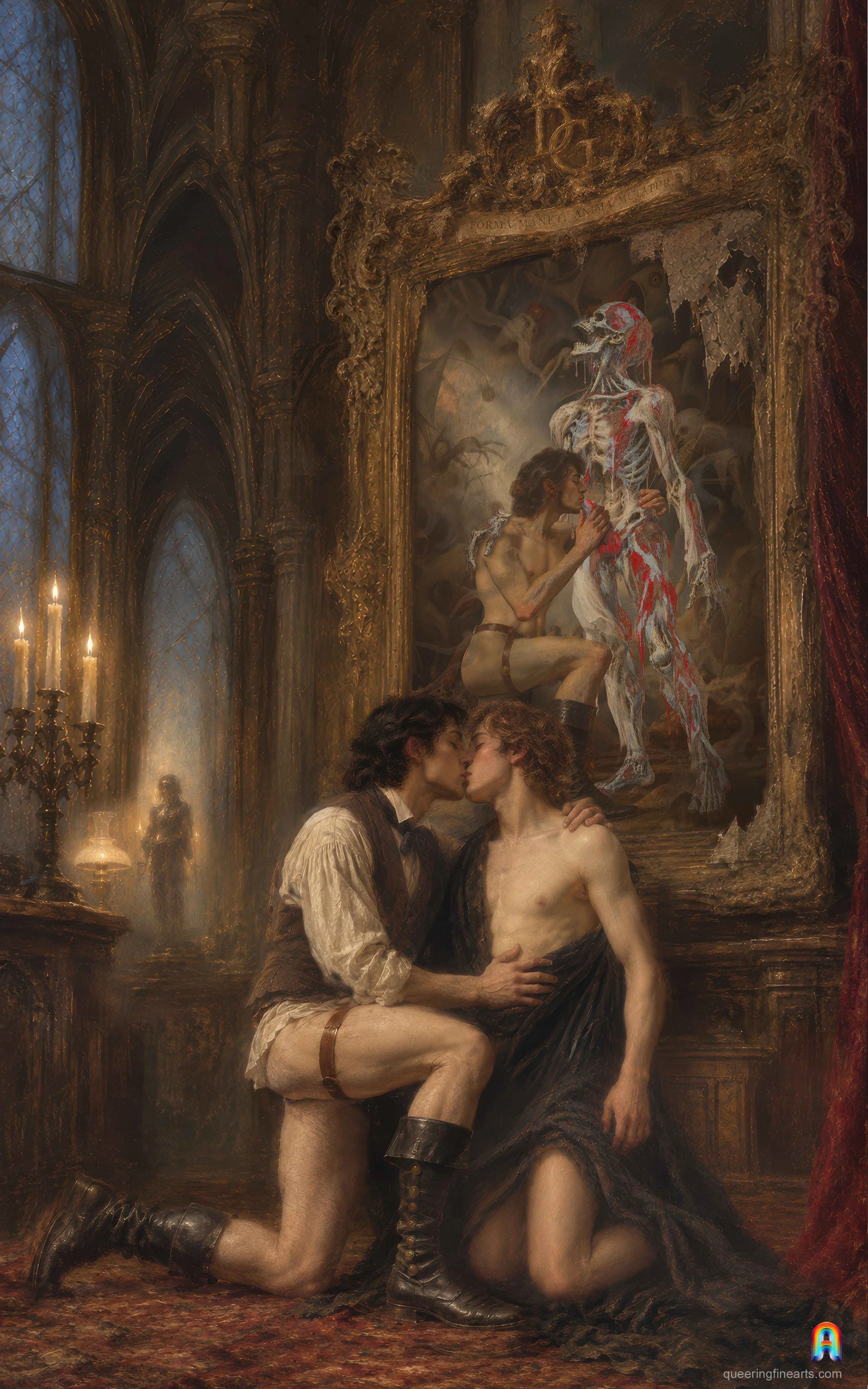
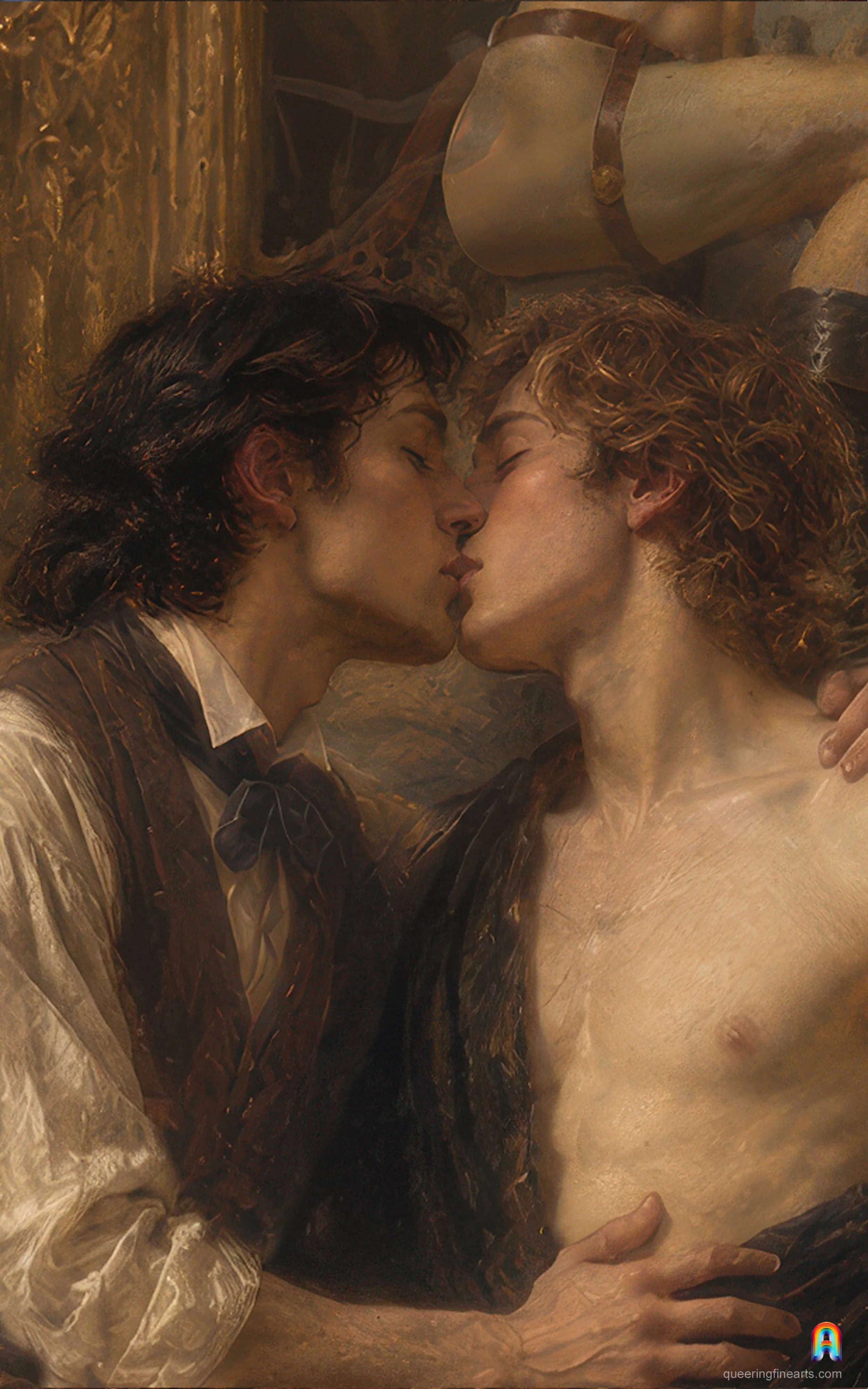
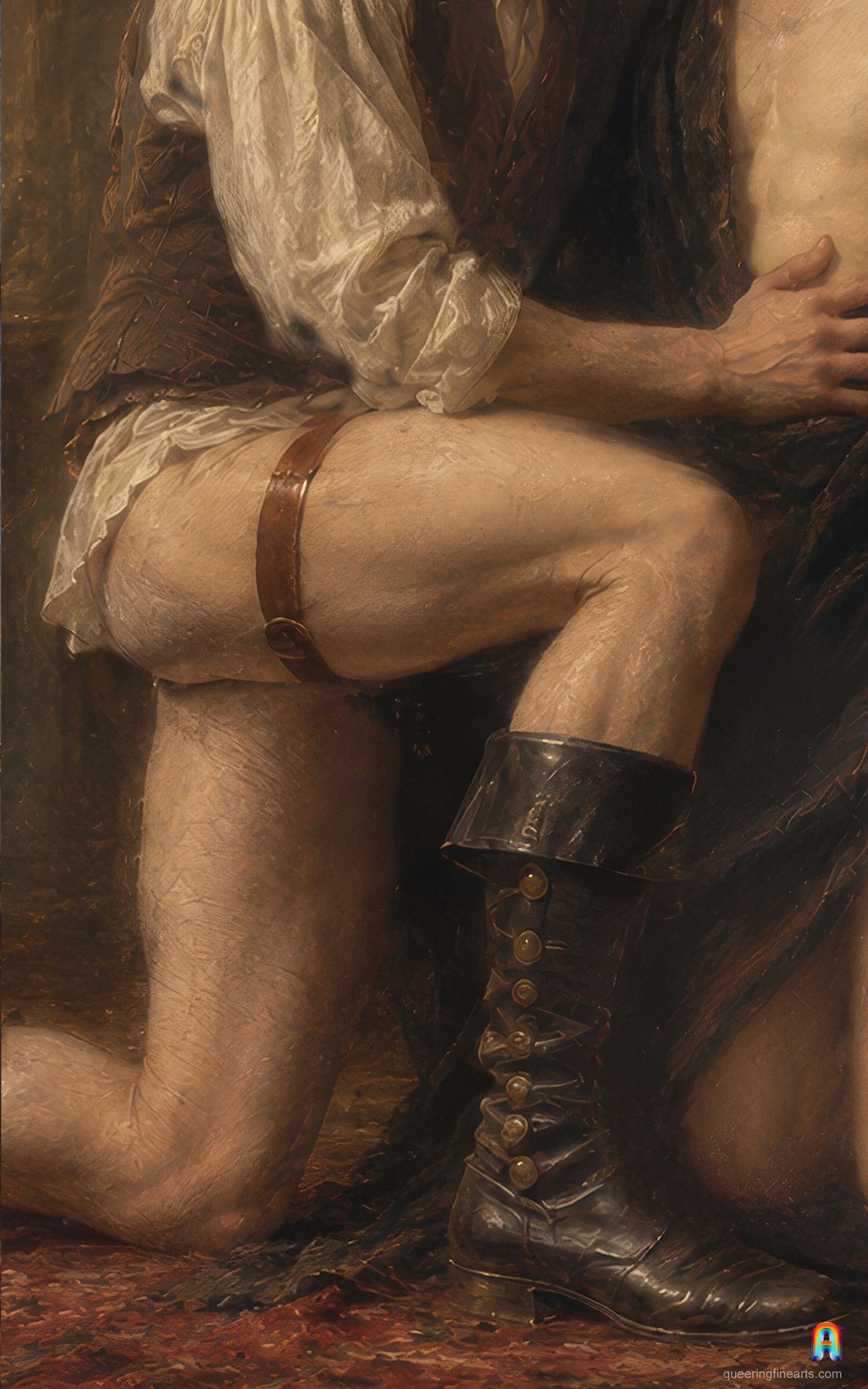
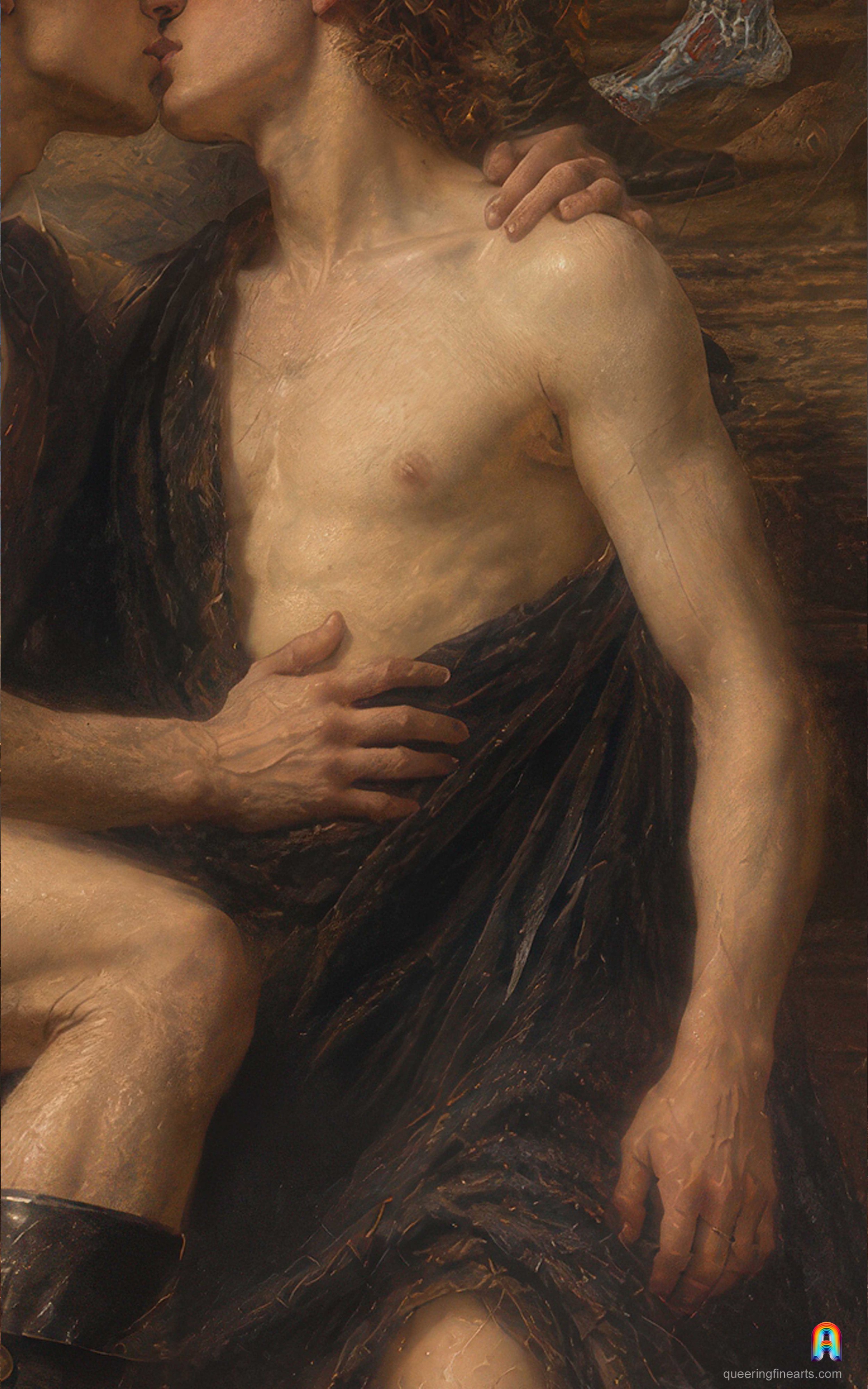
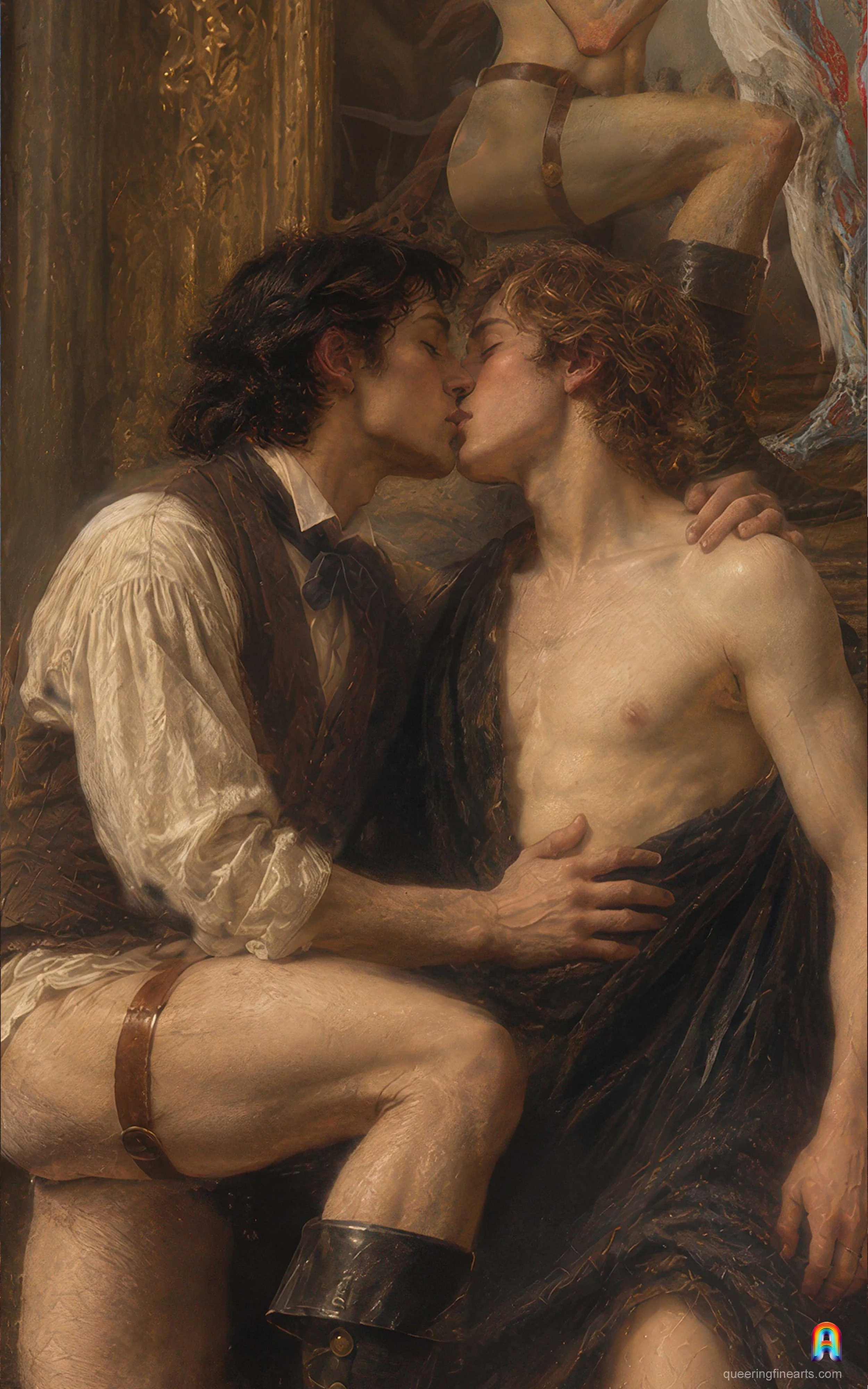
Inspired by Oscar Wilde's The Picture of Dorian Gray, this haunting composition reimagines one of the novel's most dramatic encounters. In a dim Gothic chamber, Basil Hallward and Dorian Gray share a passionate kiss beneath an enormous gilded portrait. Basil, his dark hair falling loosely around his face, wears a white shirt with billowing sleeves and a fitted waistcoat. His daringly abbreviated breeches reveal his shapely thighs and the enticing curves of his bare buttocks, while tall leather boots complete his deliciously provocative appearance. Kneeling before Dorian, he draws him passionately close, one hand caressing the seductive curve of his bare waist, the other wrapping firmly around his shoulder. Dorian, whose striking handsomeness has been miraculously preserved by a supernatural spell, returns the kiss with his eyes closed, a dark drapery loosely covering his hips and thighs.
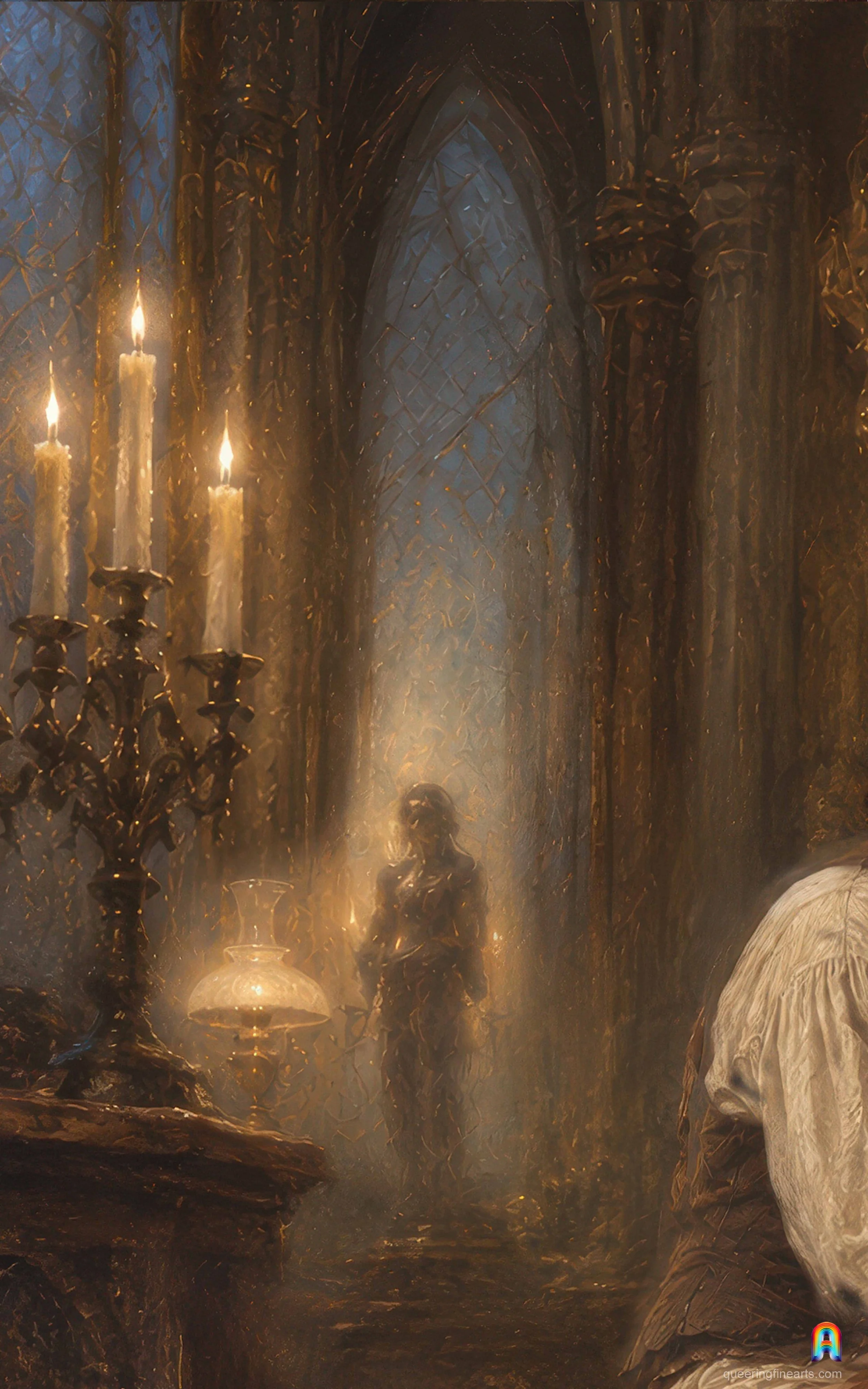
Cold bluish light filters through tall Gothic windows, mingling with the warm glow of candles. Columns and vaulted arches fade into shadow, while softened contours and atmospheric illumination evoke the dreamlike sensibility of late 19th-century Symbolism.
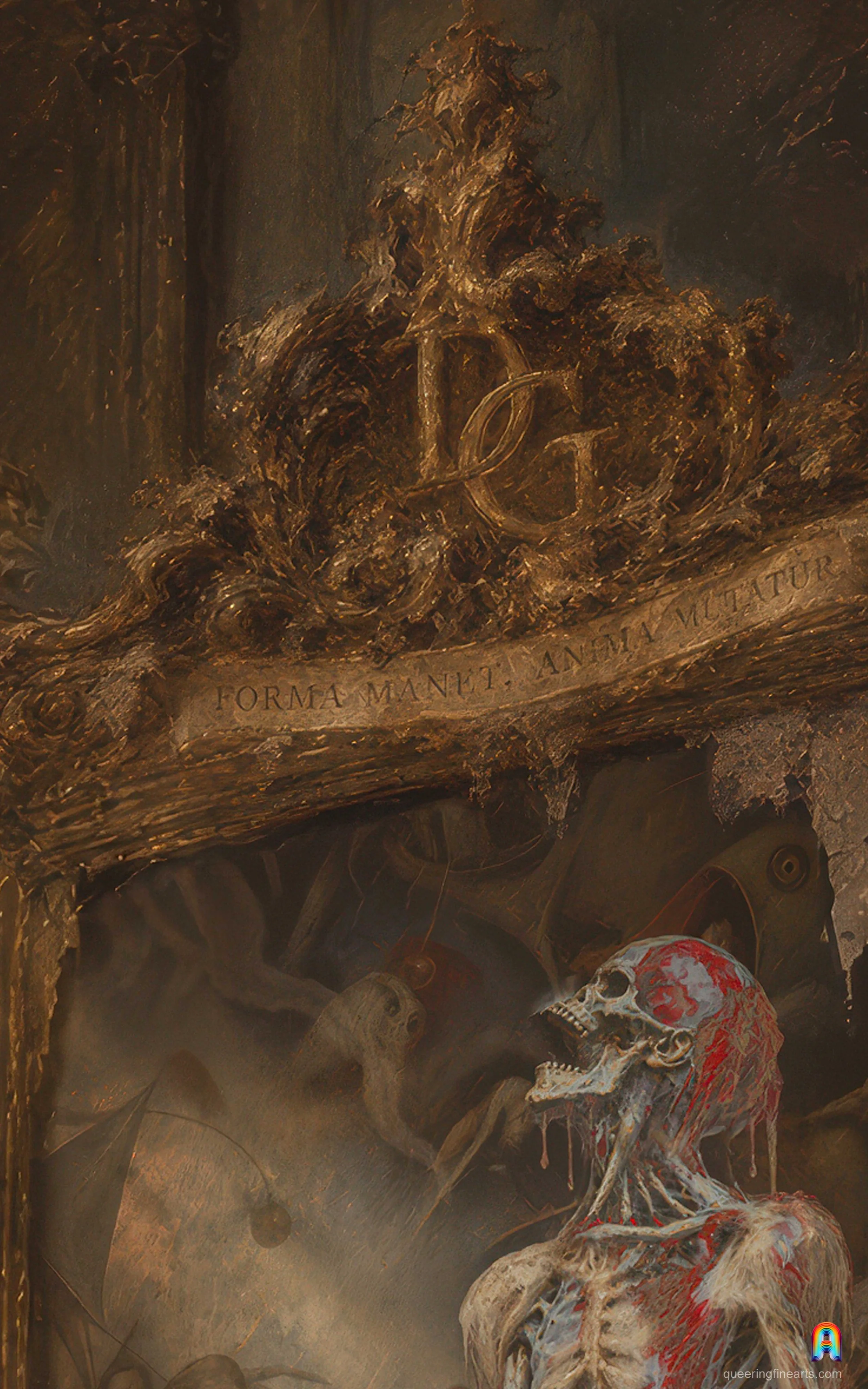
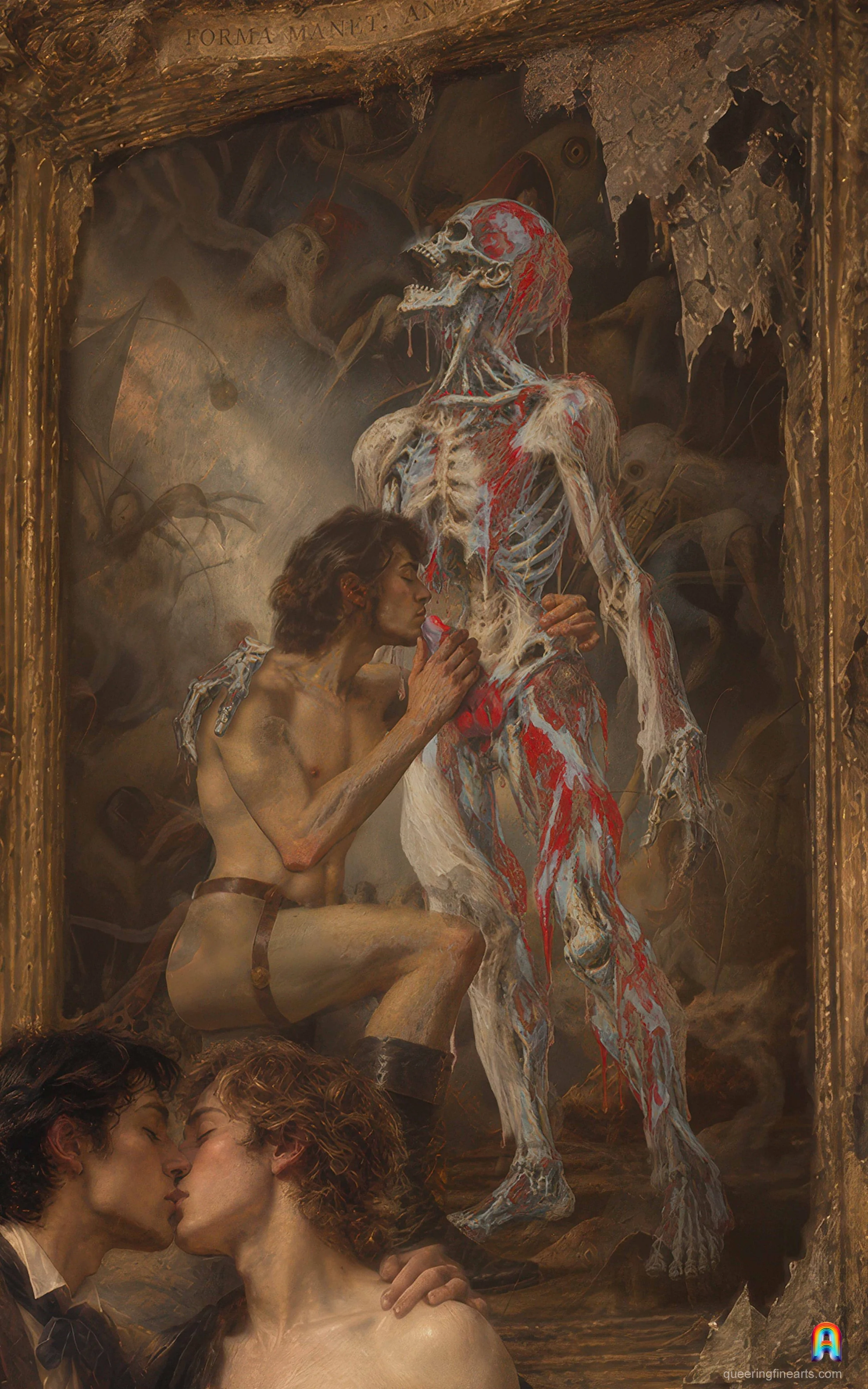
Behind the lovers looms a disturbing spectacle. The monumental portrait, enclosed in a deteriorating gilded frame, bears crumbling ornaments and a torn, fraying canvas. Above it, an elaborate monogram intertwining the initials of Dorian Gray crowns the gilded structure, accompanied by the Latin inscription Forma manet, anima mutatur, meaning "The form remains, the soul changes."¹
Within the portrait, Dorian's once-handsome body has become a skeletal, partially flayed figure, its decaying flesh mottled with livid bluish hues and streaked with the deep crimson of blood and exposed tissue. His skull tilts backwards, jaws open in sexual ecstasy as he receives oral pleasure from Basil, whose painted likeness closely resembles the living man. Nearly naked except for his brief garment and leather boots, Basil kneels before the cadaverous Dorian, performing fellatio, one hand firmly gripping his pelvis while the other holds his penis
Around them, grotesque birds, hybrid beasts and spectral creatures emerge from swirling darkness, recalling the infernal imagination of Hieronymus Bosch. Their monstrous presence heightens the contrast between the tender, passionate embrace in the chamber and its macabre erotic counterpart within the portrait.
The extraordinary portrait within the painting, with its unsettling eroticism, infernal creatures and elaborate symbolism, will receive a detailed examination in a forthcoming second part devoted entirely to Basil's bewitched masterpiece.
Curiosity Piqued
1. Oscar Wilde, The Picture of Dorian Gray, London, Ward, Lock & Co., 1891, chapters XIII and XX. Read the complete novel.
The Latin inscription Forma manet, anima mutatur, meaning "The form remains, the soul changes," was created specifically for the present artwork and does not appear in Wilde's novel. It encapsulates the supernatural paradox at the heart of the story: Dorian's outward appearance remains unchanged while his portrait absorbs the effects of time and the consequences of his actions. Chapters XIII and XX reveal the mysterious exchange between the living man and his painted double, culminating in its fatal reversal.
Sascha Schneider: Giving Homosexuality a Visible Form
The imagined attribution of The Bewitched Canvas to the circle of Sascha Schneider (1870–1927) connects our composition with a German Symbolist artist whose homosexuality found confident expression in his work. His male nudes invite admiration and attraction, giving men a place as objects of desire. Classical ideals and the contemporary enthusiasm for physical culture offered a publicly acceptable setting for this homoerotic imagery.¹
Schneider’s openness nevertheless existed within a society that could punish sexual relationships between men. In Weimar, he lived with the painter Hellmuth Jahn, who later became his blackmailer. Following their separation, the threat of exposure and prosecution drove Schneider to relinquish his teaching position and leave Germany for Italy in 1908.² His experience brings the pressures surrounding homosexual life into painful focus: artistic success could coexist with profound personal insecurity.
His Symbolism also provides an evocative setting for our supernatural invention. In The Triumph of Darkness (1896), an imposing winged Lucifer stands above the reclining body of Christ. Both figures retain a striking physical beauty, bringing attraction into an unsettling encounter with death and religious imagery.² This conjunction helps explain our choice of Schneider’s circle for a composition in which erotic intimacy persists before a horrifying transformation.
Within QFA’s imagined collection, that attribution establishes an artistic affinity. Our lovers inhabit a world where the male body carries emotional meaning and homosexual passion becomes fully visible. Schneider’s legacy gives this fantasy a fitting ancestry while recalling the risks borne by an artist who made his attraction to men part of his public work.
Curiosity Piqued?
1. Schwules Museum, “‘I go my own way…’ Sascha Schneider: Art and Homoeroticism ca 1900”,presentation of the exhibition curated by Jonathan David Katz, Berlin, Schwules Museum, 28 March–30 June 2014. Explore the exhibition presentation. Consulted 25 October 2026.
This specialist exhibition situated Schneider within the emergence of a self-conscious homosexual artistic expression around 1900. Its presentation explains how physical culture created opportunities for the public display of male bodies charged with homoerotic attraction.
2. Christiane Starck, Sascha Schneider: Ein Künstler des deutschen Symbolismus, Wissenschaftliche Beiträge aus dem Tectum Verlag, Kunstgeschichte, vol. 5, Marburg, Tectum Verlag, 2016, pp. 32–43 and 121–123. Read the scholarly preview. Consulted 25 October 2026.
Developed from doctoral research, this monograph draws on correspondence and archival material. The accessible pages reconstruct Schneider’s relationship with Jahn and his departure from Weimar, correcting the exhibition summary’s less precise account of the blackmailer as his current partner. Starck’s analysis of The Triumph of Darkness also provides a concrete basis for connecting his Symbolism with our composition’s disturbing eroticism.
Oscar, Dorian and Basil
Published in 1890 and expanded into a novel the following year, Oscar Wilde's The Picture of Dorian Gray tells the extraordinary story of a handsome young aristocrat whose beauty becomes the source of a supernatural tragedy. The novel combines Gothic fantasy, aesthetic philosophy and an unmistakable undercurrent of homosexual desire, expressed most poignantly through the painter Basil Hallward's passionate attachment to Dorian.
Basil is captivated by his model's extraordinary beauty. Dorian has transformed his understanding of art and become the central inspiration of his work. His feelings extend far beyond artistic admiration, approaching a romantic obsession that he struggles to conceal. Indeed, Basil initially refuses to exhibit the portrait because he fears it reveals too much of himself. As he confesses to Lord Henry Wotton, "I have put too much of myself into it.
It is Lord Henry, however, who awakens Dorian to the fleeting nature of physical beauty. Confronted with the prospect of growing old while his painted likeness remains forever handsome, Dorian passionately wishes that their destinies could be reversed. His wish is mysteriously granted. As the years pass, his face and body retain their youthful perfection while the portrait registers the effects of ageing and the increasingly destructive consequences of his actions.
Dorian's existence becomes a succession of pleasures, scandals and shattered relationships. His cruelty drives the actress Sibyl Vane to suicide, while his growing fascination with sensation and forbidden experiences gradually poisons his reputation. Yet his beauty remains irresistible, concealing the passage of time and the increasingly disturbing history of his private life.
A Portrait of Devotion
At the emotional heart of the novel lies Basil's love for Dorian. Wilde gives this attachment a distinctly homosexual character, particularly in the original 1890 version, where the painter's declarations are unusually revealing.¹
Before its publication in Lippincott's Monthly Magazine in 1890, Joseph Marshall Stoddart had removed passages from Wilde's manuscript without the author's knowledge or consent. When preparing the expanded 1891 edition, Wilde himself made further cuts to passages expressing homosexual attachment, amid hostile press criticism and fears of legal repercussions. Nevertheless, the portrait remains the material expression of Basil's passion, an artistic creation into which he has poured his most intimate feelings.²
The novel's homoeroticism extends beyond Basil's declarations. Dorian's extraordinary attractiveness exerts a powerful fascination over other men, while the rumours surrounding his private life suggest relationships and experiences that Victorian conventions prevented Wilde from describing openly. The language of beauty, admiration and artistic devotion provides a literary means of expressing desires that could scarcely be acknowledged publicly.
Basil's devotion ultimately leads him to a horrifying discovery. Troubled by the scandals surrounding Dorian, he confronts his former model, who reveals the grotesquely transformed portrait. Faced with the evidence of Dorian's secret existence, Basil urges him to seek forgiveness. Dorian responds by murdering the man whose love and artistic genius had first immortalized his beauty.
The novel ends with Dorian attempting to destroy the portrait. Instead, he dies, his body suddenly assuming the hideous appearance accumulated by his painted double, while the canvas recovers its original beauty. The supernatural exchange has finally been reversed.
Basil's devotion and tragic fate make his relationship with Dorian one of the most poignant portrayals of homosexual love in late Victorian fiction.
Curiosity Piqued?
1. Oscar Wilde, The Picture of Dorian Gray, Lippincott's Monthly Magazine, vol. 46, Philadelphia, J. B. Lippincott Company, July 1890, chapter VII. Read the original text.
The original published version contains Basil Hallward's remarkably candid confession of his romantic attachment to Dorian, including the declaration: "I have worshipped you with far more romance of feeling than a man usually gives to a friend." This passage was removed from the expanded 1891 edition, illustrating how Wilde's portrayal of homosexual love was modified between the two publications.
2. Oscar Wilde, The Picture of Dorian Gray, London, Ward, Lock & Co., 1891. Read the revised edition.
The revised novel preserves Basil's profound emotional attachment to Dorian while omitting some of his most revealing declarations. Comparing the two editions makes it possible to trace the changes in Wilde's presentation of male desire and artistic devotion.
Horror and Queer Imagination
Oscar Wilde's magnificent novel inspires two daring departures in The Bewitched Canvas. The painting reimagines the relationship between Basil and Dorian while transforming the supernatural portrait into an erotic nightmare.
Desire Beyond Beauty
Basil has painted himself beside the man he loves. Yet the supernatural transformation of Dorian's portrait has turned this intimate fantasy into a confrontation with bodily decay. The painter's likeness continues to desire Dorian even as his flesh decomposes, challenging the assumption that erotic attraction depends upon physical beauty.
In Erotism: Death and Sensuality, Georges Bataille explores the intimate relationship between sexuality, mortality and transgression. Erotic experience, in his understanding, can bring us into contact with the very boundaries that ordinarily govern human existence.¹
Julia Kristeva offers another perspective in Powers of Horror, where the corpse becomes one of the most powerful manifestations of abjection. The decomposing body disturbs us because it exposes the fragility of our physical boundaries and confronts us with our own mortality.²
Basil's sexual attention to Dorian's cadaverous likeness gives Kristeva's notion of abjection an unexpected dimension: the confrontation with bodily decay becomes an intimate encounter rather than an occasion for withdraw
The Fantastic and the Monstrous
In Au cœur du fantastique, Roger Caillois examines the fantastic as an intrusion of the impossible into an otherwise familiar world.³ Wilde's supernatural portrait exemplifies this disturbance of reality. The Bosch-inspired creatures, however, belong to a different imaginative tradition, one that freely invents monstrous beings beyond the ordinary laws of nature.
The creatures also raise questions about the cultural meaning of monstrosity. In Skin Shows: Gothic Horror and the Technology of Monsters, Jack Halberstam examines how Gothic literature has invested monstrous bodies with anxieties surrounding identity and sexual difference, including in Wilde's fiction.⁴
The historical association of homosexuality with the unnatural and the monstrous gives this imagery a particular resonance. By appropriating such imagery, the painting turns a longstanding instrument of stigmatization into a source of queer artistic expression.
The scene also loosens the moral framework of Wilde's portrait. Its grotesque eroticism need not signify sexual corruption. The fantasy can disturb without becoming a condemnation of the desire it depicts.
Reclaiming the Freedom to Imagine
The affectionate embrace outside the portrait is equally significant. Wilde's Basil meets a terrible death at the hands of the man he loves. Our reinvention gives him the happiness denied in the original story, a deliberate act of queer empowerment inspired by our admiration for Wilde
Yet such freedom extends beyond the representation of tenderness. Richard Meyer, in Outlaw Representation, examines how homosexual imagery has challenged censorship and the boundaries of artistic acceptability.⁵ His research reminds us that the history of queer art also includes works whose sexual explicitness or unsettling imagery have provoked controversy.
Even societies that pride themselves on civility and restraint preserve occasions for exploring their darker fascinations. Halloween is one such moment, when death, monstrosity and forbidden fantasies are welcomed into the collective imagination. Yet this appetite for the macabre extends far beyond a single celebration. The enduring success of Stephen King and the extraordinary popularity of horror cinema, from Nosferatu to Sinners, testify to a fascination that survives every passing fashion. Eroticism has long been central to this tradition, often accompanied by a powerful homoerotic undercurrent, from the suggestive tensions of Bram Stoker's Dracula to the passionate male vampires of Anne Rice and the disturbing sexual fantasies of Clive Barker's Hellraiser.⁶ The Bewitched Canvas embraces this enduring tradition through the language of Gothic horror and homosexual desire.
The Freedom to Disturb
For Queering Fine Arts, the right to create disturbing queer imagery is essential to the breadth of its artistic legitimacy. That freedom must be exercised regularly and without fear of unsettling expectations. Homosexual love deserves its tender representations, but queer imagination must also be free to venture into horror, transgression and the most troubling reaches of fantasy. Only by embracing that full spectrum can its artistic possibilities truly flourish.
QFA
Curiosity Piqued?
1. Georges Bataille, L'Érotisme, Paris, Les Éditions de Minuit, 1957. English translation: Erotism: Death and Sensuality, translated by Mary Dalwood, San Francisco, City Lights Books, 1986.
For Bataille, eroticism involves the crossing of boundaries established by social prohibitions. His analysis of transgression helps explain why the confrontation of sexuality and death can produce an experience that is simultaneously disturbing and compelling.
2. Julia Kristeva, Pouvoirs de l'horreur. Essai sur l'abjection, Paris, Éditions du Seuil, 1980. English translation: Powers of Horror: An Essay on Abjection, translated by Leon S. Roudiez, New York, Columbia University Press, 1982. Explore the English edition.
Kristeva describes abjection as the unsettling experience of encountering what threatens the boundaries of the self. The corpse occupies a particularly significant place in her analysis because it confronts the living with the dissolution of the body and the certainty of death.
3. Roger Caillois, Au cœur du fantastique, Paris, Gallimard, 1965.
Caillois explores the fantastic as an intrusion of the impossible into familiar reality. In this study, he explicitly distinguishes such disturbances from deliberately invented imaginary worlds, including those of Hieronymus Bosch. This distinction helps clarify the contrasting imaginative traditions brought together in The Bewitched Canvas.
4. Jack Halberstam, Skin Shows: Gothic Horror and the Technology of Monsters, Durham, Duke University Press, 1995, particularly Gothic Surface, Gothic Depth: The Subject of Secrecy in Stevenson and Wilde. Explore the book.
Halberstam explores how Gothic fiction gives physical form to cultural anxieties about identity and difference. His discussion of secrecy in Wilde's fiction is particularly relevant to the relationship between Dorian's outward appearance and the disturbing truths concealed within his portrait.
5. Richard Meyer, Outlaw Representation: Censorship and Homosexuality in Twentieth-Century American Art, Oxford and New York, Oxford University Press, 2002.
Through historical examples of censorship and controversy, Meyer demonstrates how representations of homosexuality have challenged the limits imposed upon public artistic expression. His study provides a useful context for understanding why the freedom to depict explicit or unsettling queer subjects remains significant.
6. Christopher Craft, “‘Kiss Me with Those Red Lips’: Gender and Inversion in Bram Stoker's Dracula”, Representations, no. 8, autumn 1984, pp. 107–133. Read the study.
George E. Haggerty, Queer Gothic, Urbana and Chicago, University of Illinois Press, 2006, particularly chapter 9, “Anne Rice and the Queering of Culture.” Explore the book.
Giorgio Paolo Campi, “S/M, Splatter, and Body Modifications in the Early Clive Barker: Birth of a Political Aesthetics”, Whatever: A Transdisciplinary Journal of Queer Theories and Studies, vol. 5, no. 1, 2022, pp. 73–96. Read the study.
These three studies approach queer Gothic literature from complementary perspectives. Craft investigates the sexual ambiguities of Stoker's Dracula, Haggerty examines the importance of male intimacy and queer desire in the Gothic tradition, while Campi considers the relationship between bodily transformation and sadomasochistic imagery in Barker's early fiction. Together, they provide a critical framework for interpreting the erotic possibilities of supernatural horror.