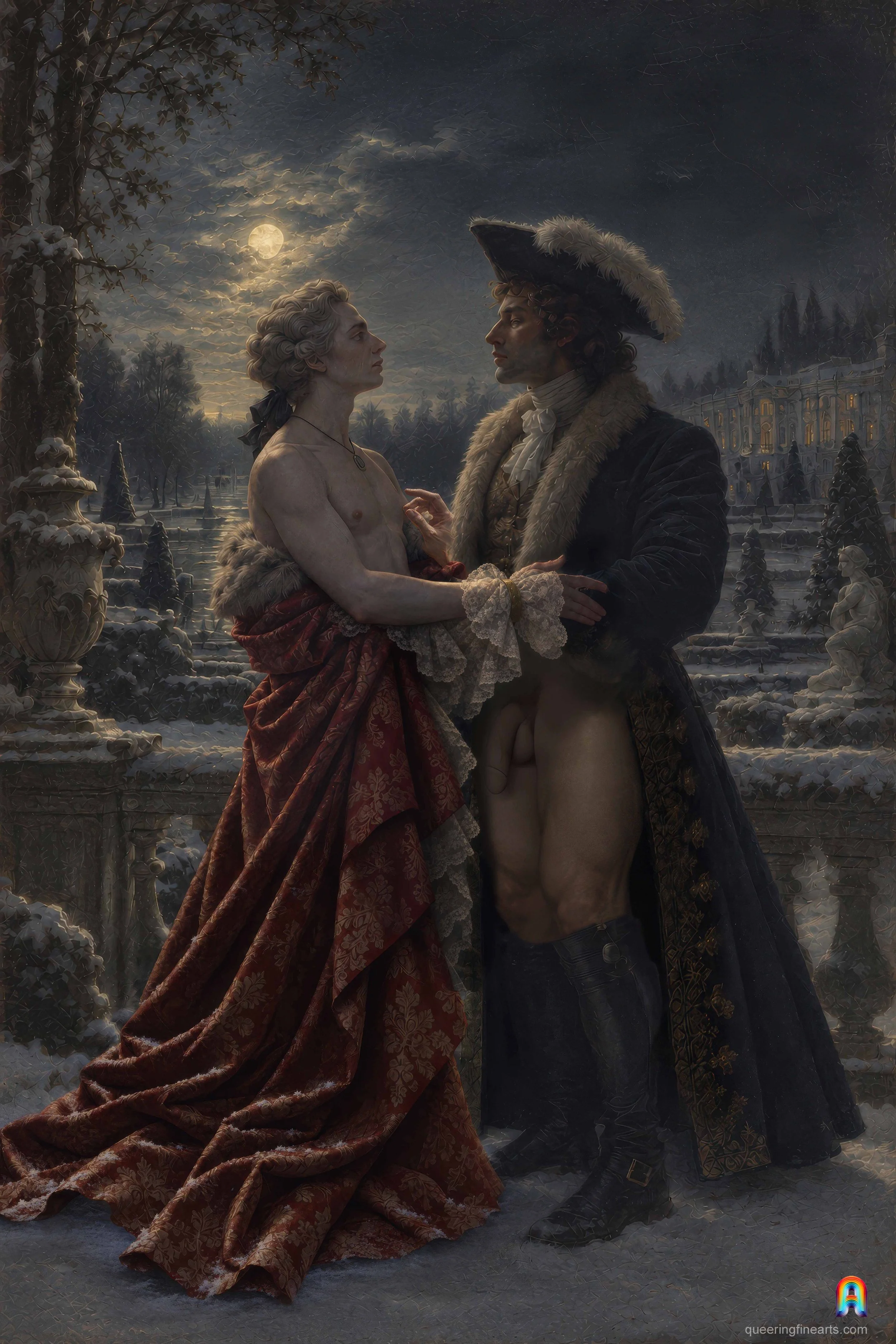
The Chevalier d'Eon: A Winter Encounter at Tsarskoye Selo
French School, circle of Charles Meynier
(Presumed commission for Count Giovanni Battista Sommariva)
Oil on canvas
France, c. 1810-1825
The Sommariva Collection, Villa Carlotta, Lake Como, Italy
An Extraordinary Life Between History and Legend
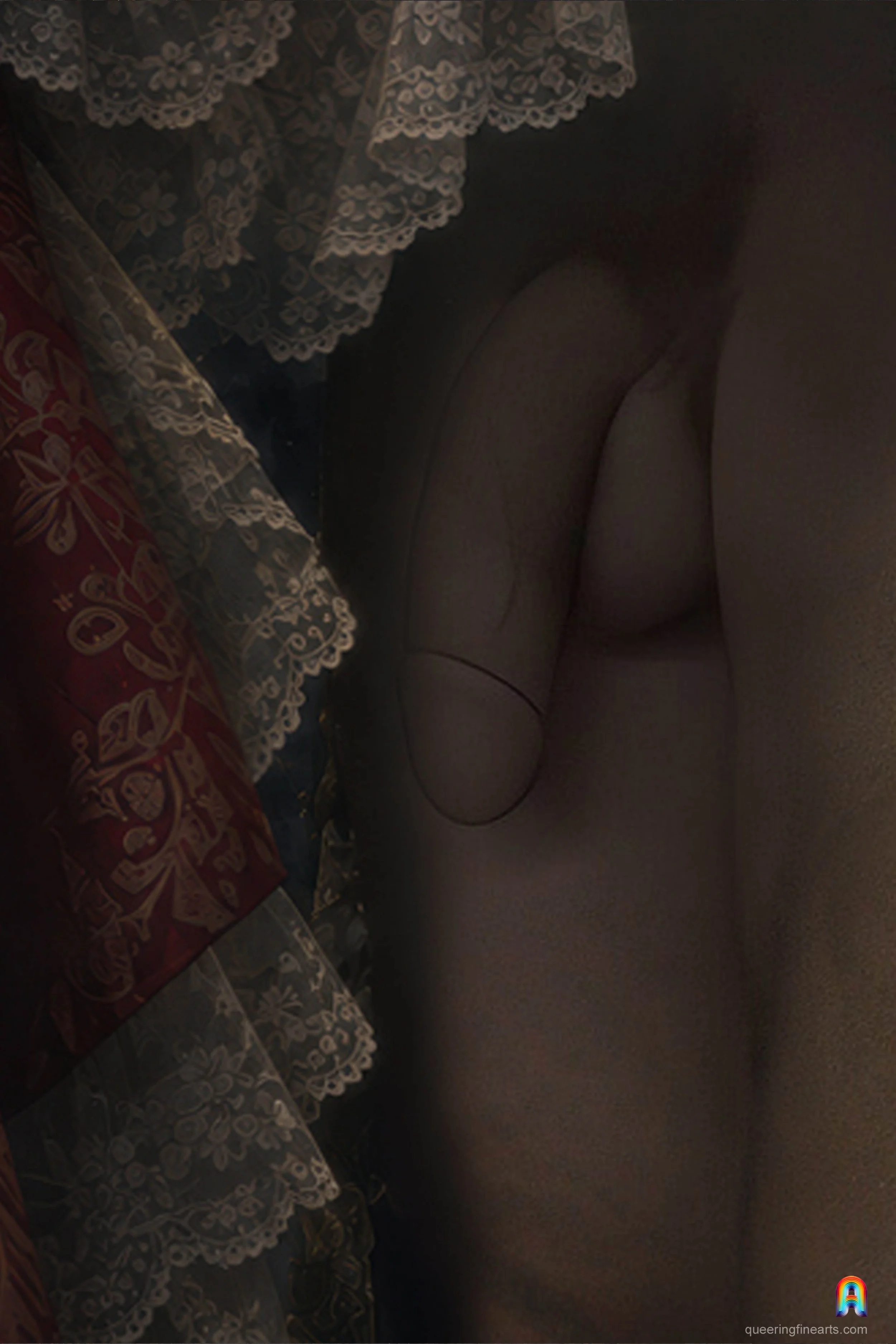
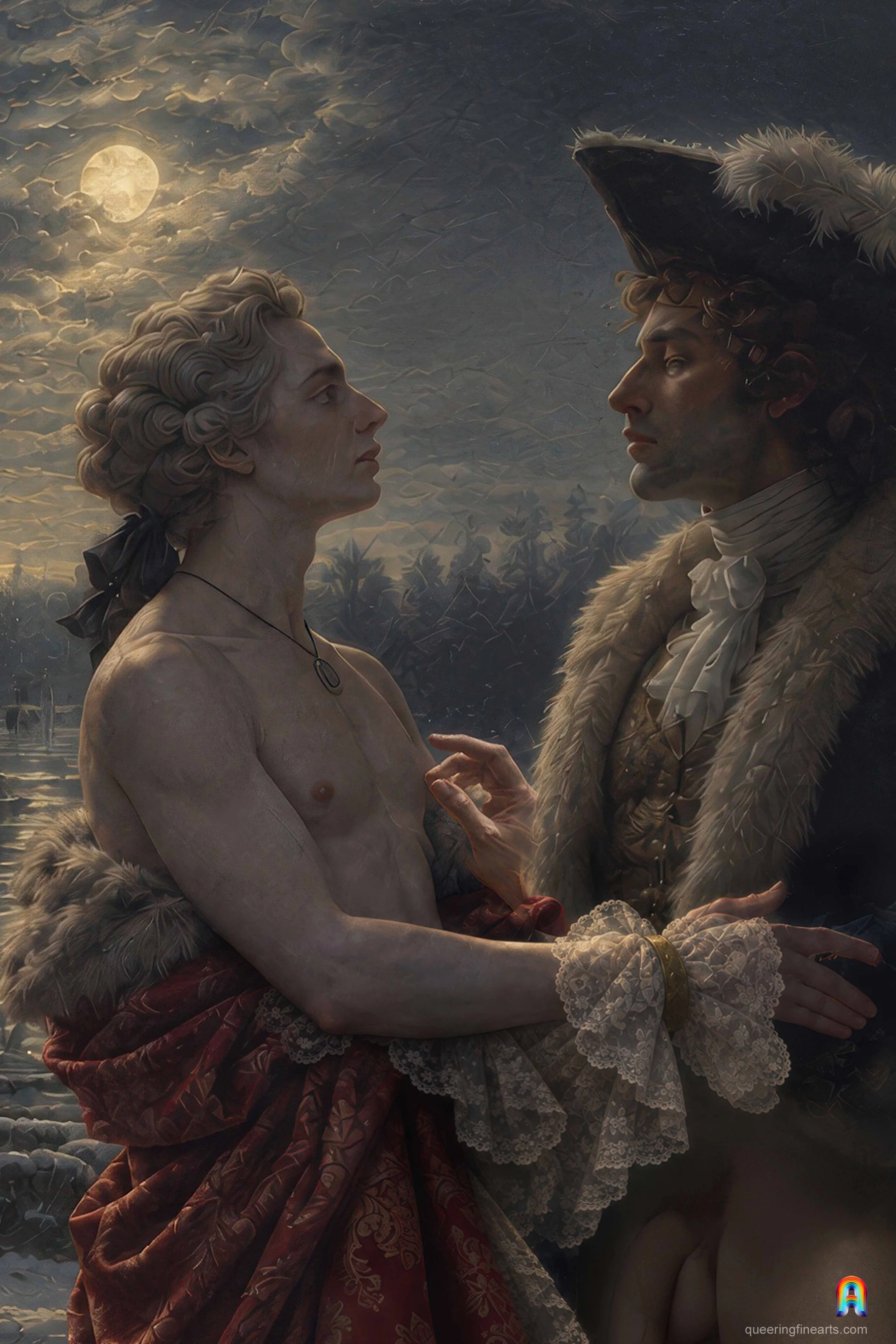
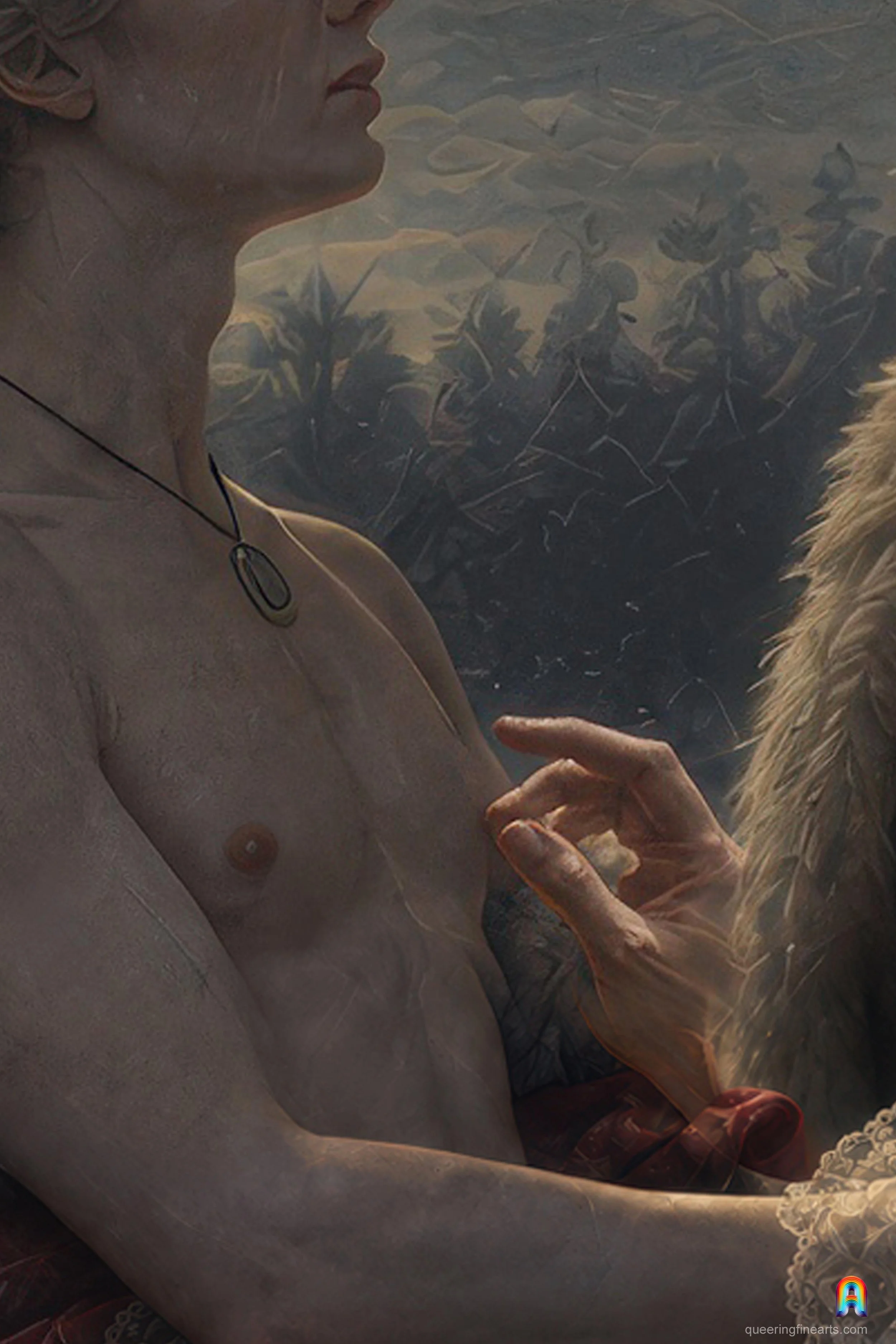
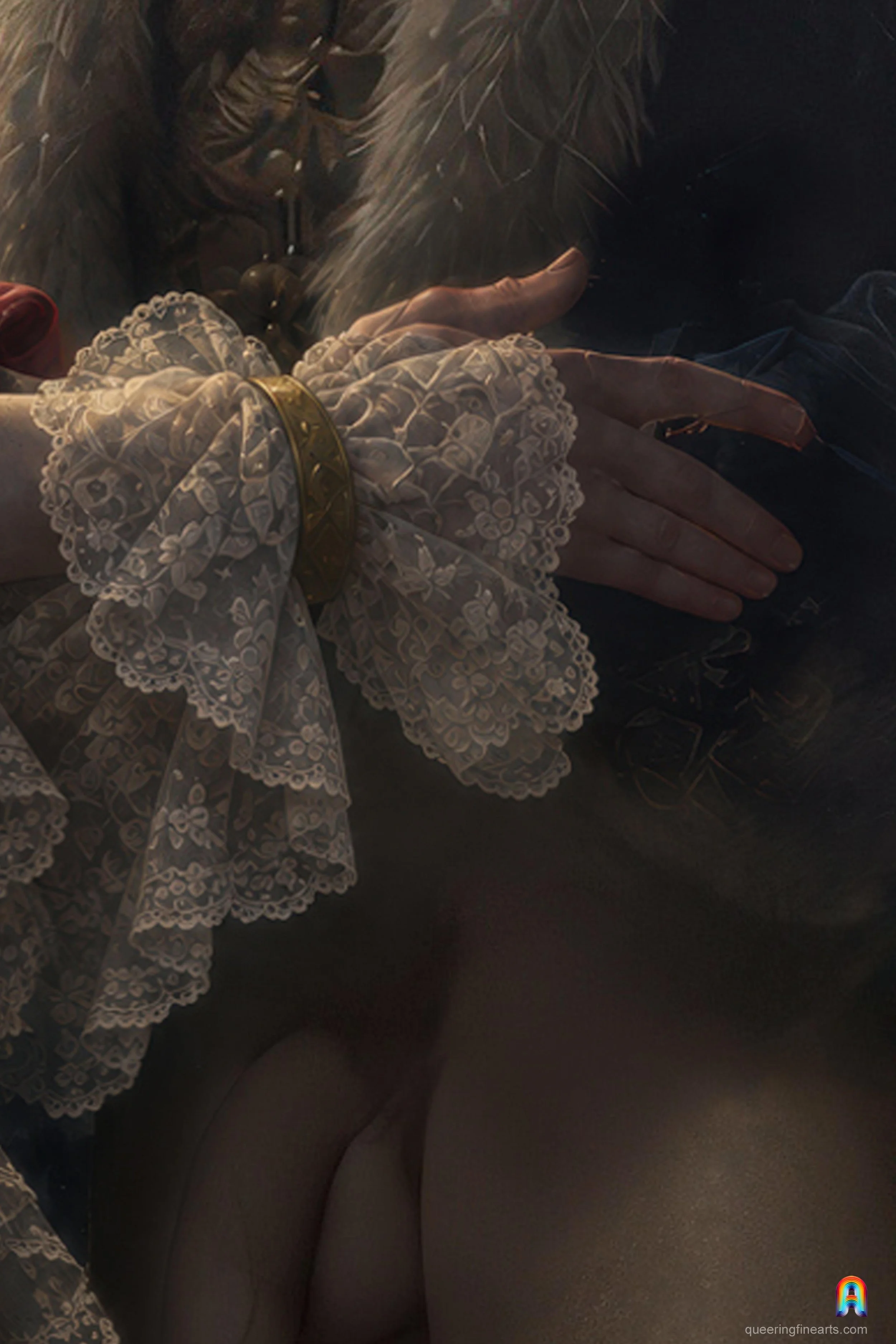
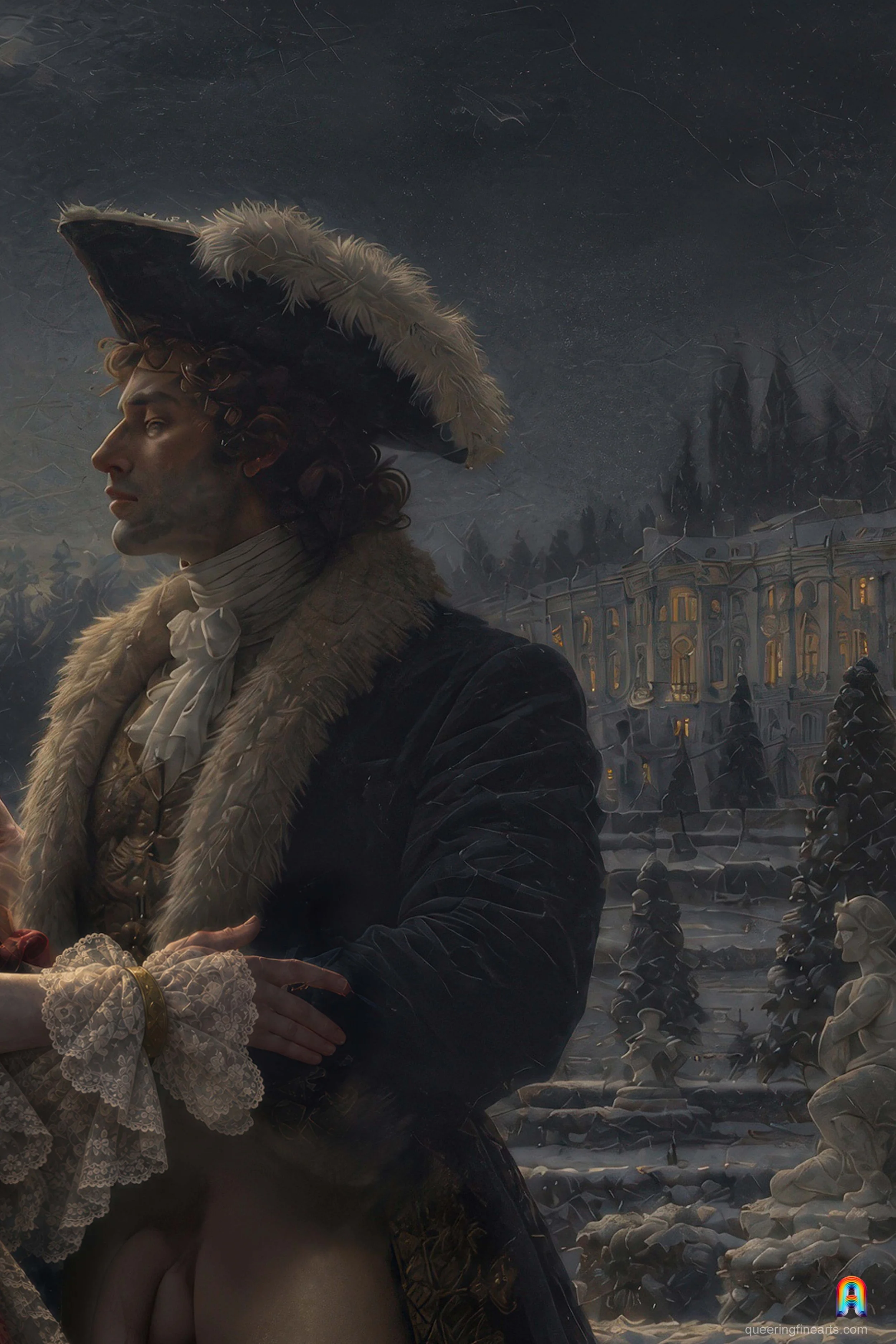
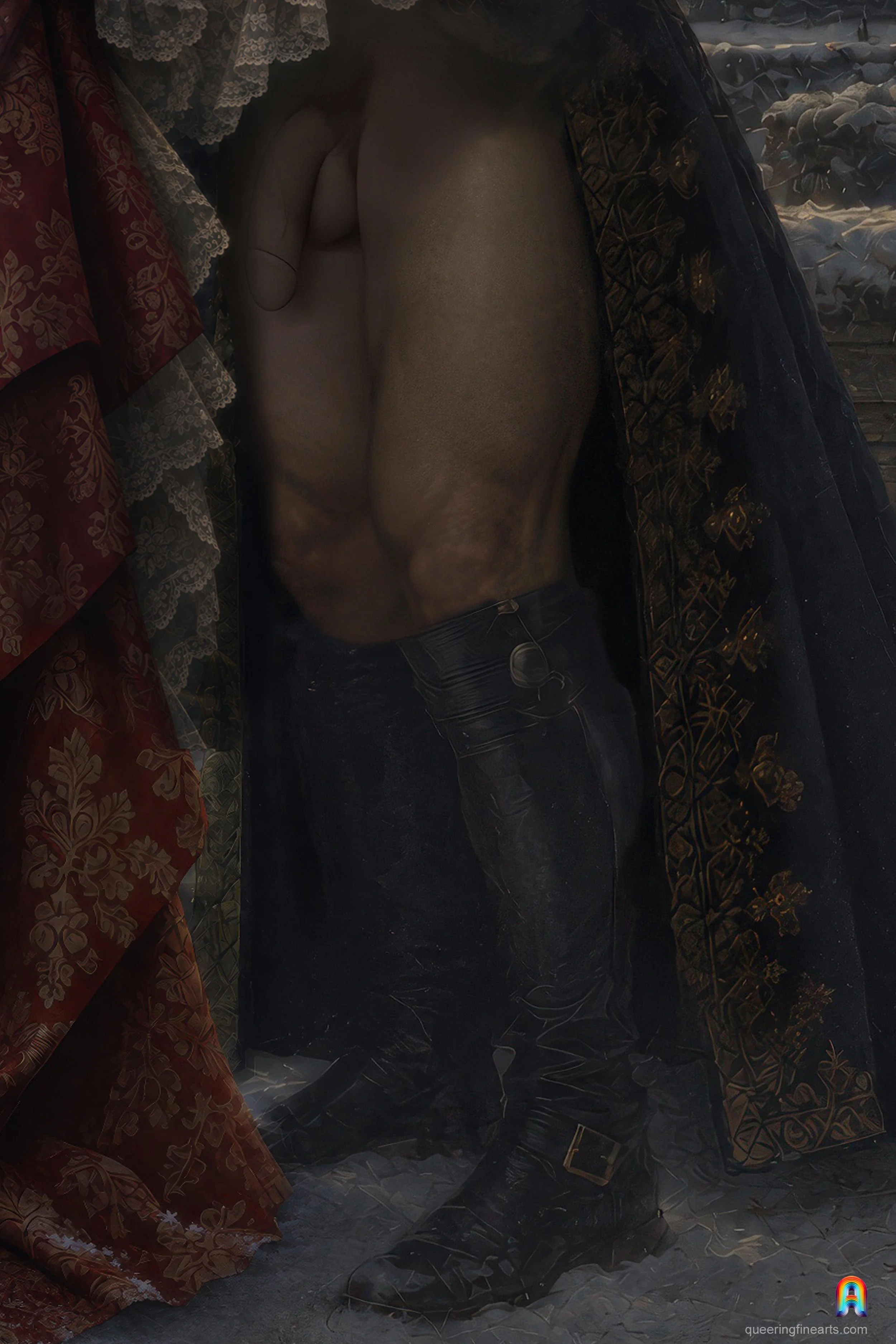
Beneath the winter moon, in the snow-covered gardens of the imperial residence at Tsarskoye Selo, two young men share a moment of extraordinary intimacy. One wears the sumptuous garments of an eighteenth-century courtier, his upper body richly dressed in an embroidered waistcoat beneath an elegant coat, while his lower body remains provocatively naked. The other, draped in crimson silk and delicate French lace, has allowed his elaborate feminine attire to slip from his shoulders. The courtier gently pinches his companion's nipple, while their eyes remain locked in a gaze charged with anticipation. The scene captures that exquisite instant when courtly ceremony gives way to something far more personal.
The partially undressed figure is Charles-Geneviève-Louis-Auguste-André-Timothée d'Éon de Beaumont, better known as the Chevalier d'Eon, whose remarkable career as a diplomat, soldier and secret agent unfolded across the courts of Europe. Sent to Russia in the 1750s, d'Eon would later become the subject of extraordinary speculation concerning his sex and identity. His Russian missions would later inspire stories of disguise and intrigue that transformed his diplomatic career into one of the eighteenth century’s most extraordinary personal legends.
In The Chevalier d'Eon: A Winter Encounter at Tsarskoye Selo, one of the most persistent stories surrounding d'Eon into an intimate episode of courtly seduction. The young courtier facing him responds to the encounter with unmistakable excitement. His open coat leaves little doubt about the nature of his intentions. The ambiguity belongs to the encounter itself, where disguise may serve as an invitation and the discovery of another man's body becomes part of the pleasure.
The painting is attributed to the circle of Charles Meynier (1768-1832), whose patron, Count Giovanni Battista Sommariva (1760-1826), cultivated a remarkable taste for erotic art. His commissions repeatedly favoured sensual beauty over heroic grandeur, with the male body occupying a conspicuous place in his collection. In 1810, he commissioned Meynier's Wisdom Defending Youth from the Arrows of Love, with its beautiful adolescent male figure caught between virtue and sensual temptation, alongside Pierre-Narcisse Guérin's Aurora and Cephalus, in which the goddess embraces a reclining young man. Sommariva also commissioned Antonio Canova's Palamedes, an imposing male nude whose physical beauty was so important to its patron that he eventually arranged mirrors to allow the sculpture to be admired from every angle. These repeated celebrations of masculine beauty invite an unmistakably homoerotic reading of aspects of his collection. Within such a setting, a painting depicting the Chevalier d'Eon's intimate encounter with another man would find a particularly fitting home.
At the Russian Court: The Mission and the Legend
In 1756, d’Éon left France for Russia. At twenty-seven, he was entering a career in which the king’s confidence could matter more than any official title. In Saint Petersburg, Empress Elizabeth Petrovna, daughter of Peter the Great, ruled over a court of considerable political influence. France was seeking to restore relations with her government as European alliances were being reshaped and the Seven Years’ War was beginning.
D’Éon joined the Chevalier Alexander Douglas, a Scotsman in French service who had been entrusted with negotiations at the Russian court. He became Douglas’s secretary. The biographers Octave Homberg and Fernand Jousselin date his departure to early June 1756, drawing on letters preserved among his papers¹. This chronology is significant, since it contradicts accounts claiming that he had already undertaken a secret infiltration in 1755.
His mission included a confidential dimension. The Prince de Conti, a prince of the blood and one of d’Éon’s patrons, then directed the Secret du Roi. This network allowed Louis XV to pursue a diplomatic policy parallel to that of his own ministers. Conti hoped to secure the Polish crown and sought Russian support for his ambitions¹. D’Éon was therefore expected to assist the rapprochement between the two courts while advancing objectives that remained partly concealed from official French diplomacy. The secrecy lay primarily in his instructions and channels of correspondence.
One surviving document brings us particularly close to his work: his Mémoire sur la Russie en 1759, published with annotations by Francine-Dominique Liechtenhan, a historian specialising in Imperial Russia². In it, d’Éon examines the country’s institutions and economic organisation. The text reveals an observant diplomat seeking to make a foreign power intelligible to those governing France.
Yet another story came to dominate the popular imagination. According to this account, d’Éon gained Elizabeth’s confidence by appearing as a woman and became her reader or intimate companion. Feminine dress supposedly granted him access to the sovereign that men could never have obtained.
The historian Gary Kates considers this story an invention developed by d’Éon around 1775 or shortly afterward. He observes that the secret correspondence concerning the Russian mission contains no mention of an infiltration in feminine clothing³. In Kates’s interpretation, the narrative subsequently allowed d’Éon to present his career as that of a woman who had already served the king in affairs of state. His public transformation could thus be understood as a continuation of his earlier service.
Elizabeth’s court, however, provided a genuine setting for experiments with clothing and gender. In her memoirs, Catherine II, then Grand Duchess and wife of the heir to the Russian throne, describes court balls at which Elizabeth required men to wear women’s dresses and women to appear in masculine attire. The participants attended without masks⁴. Catherine recalls the displeasure of many men confronted with this obligation, while expressing admiration for the empress’s appearance in masculine costume.
Kates considers the possibility that d’Éon attended such gatherings³. His participation remains hypothetical. These documented festivities nevertheless help explain why the story of d’Éon dressed as a woman at the Russian court could appear credible to his contemporaries. Within the imperial palace, the boundaries of masculine and feminine appearance could be deliberately overturned under the authority of the sovereign herself.
Russia consequently occupies two distinct places in d’Éon’s life. It was the setting of a diplomatic mission that helped establish his career. The Russian episode would follow d’Éon throughout his life, acquiring new meanings as his public identity changed.
Curiosity Piqued?
1. Octave Homberg and Fernand Jousselin, Le Chevalier d’Éon (1728-1810): d’après des documents inédits. Paris, Plon-Nourrit et Cie, 1904, chapter 1.
Drawing on d’Éon’s personal papers, the authors reconstruct the beginnings of his diplomatic career. They examine the chronology of his arrival in Russia and explain the Polish ambitions of the Prince de Conti. Their study provides an account of the negotiations behind the later adventure stories.
2. Charles de Beaumont, chevalier d’Éon, En Russie au temps d’Élisabeth: Mémoire sur la Russie en 1759, edited and annotated by Francine-Dominique Liechtenhan. Paris, L’Inventaire, “Valise diplomatique” collection, 2006.
This memorandum presents Russia as d’Éon studied it for the purposes of his mission. Liechtenhan’s scholarly annotations place his observations in their historical context. It offers a direct introduction to his diplomatic work through a text written by d’Éon himself.
3. Gary Kates, Monsieur d’Eon Is a Woman: A Tale of Political Intrigue and Sexual Masquerade. Baltimore and London, Johns Hopkins University Press, 2001 [1995], particularly pp. 72-76.
Kates examines the origins of the story of d’Éon’s infiltration in feminine dress and its role in his autobiographical reconstruction. He also connects the legend with the costume balls of the Russian court, while treating d’Éon’s possible participation as a hypothesis.
4. Catherine II, Memoirs of the Empress Catherine II: Written by Herself, preface by Alexander Herzen, translated from French. New York, D. Appleton and Company, 1859, part II.
The future empress describes the balls at which Elizabeth required men and women to exchange their customary clothing. Her testimony illuminates a courtly practice that may have contributed to the legend surrounding d’Éon.
A Reputation at the Mercy of Rumours
In London, d’Éon discovered that fame could come at the price of losing control over what others said about him. His diplomatic quarrels had brought him public attention. Before long, his body and his friendships became subjects of curiosity in their own right.
Having arrived in England in 1762, he came into conflict with the Comte de Guerchy, the new French ambassador. Refusing orders from his superiors to return to France, he published part of his diplomatic correspondence in 1764. The affair attracted the attention of John Wilkes, an English parliamentarian and journalist opposed to the government. The two men became friends, and Wilkes’s supporters helped protect d’Éon¹. To this audience, the Frenchman represented a man standing up to the arbitrary authority of Versailles. His popularity brought him valuable support, but also exposed him to the attacks provoked by his political alliances.
In 1771, wagers on his sex transformed this curiosity into financial speculation². Bets were placed on the possibility that this former captain of dragoons was actually a woman. The question circulated through London coffeehouses and inspired satirical prints whose creators claimed to reveal what d’Éon kept concealed. His intimate life became a public spectacle in which everyone seemed entitled to participate.
Some images went beyond questions of anatomy. In a 1771 engraving entitled Enlèvement de Mlle d’Éon (The Abduction of Mlle d’Éon), the figure, still dressed as a man, is carried across the English Channel on the back of Time. The inscription describes him as a “new Ganymede”². In classical mythology, Ganymede was the beautiful young man abducted by Zeus, a story long associated with male homoerotic desire. The art historian Valerie Mainz identifies this connotation in her analysis of the print³. The comparison thus places d’Éon within an erotic imagination centred on men, without referring to any particular episode in his life.
The attacks became more explicit in 1776. Charles Théveneau de Morande, a French pamphleteer living in London and an adversary of d’Éon, associated him with the “mollies”, an English term applied to effeminate men suspected of sodomy⁴. D’Éon and several of his associates challenged Morande to a duel. Among them was his friend Captain Charles Horneck, who also became the target of press attacks referring to his pleasures with a male companion. The historian Anna Clark demonstrates how these publications drew d’Éon into a controversy in which his friendships were used to suggest sexual relationships between men⁴.
These accusations deserve a place in his history. The possibility of d’Éon’s attraction to men is not simply an interpretation proposed after his death: his contemporaries were already making insinuations of this kind. These allegations reveal how readily d’Éon’s contemporaries associated his friendships with sexual relationships between men. Their circulation tells us much about his reputation, though considerably less about his private life
His enemies were eager to speak on his behalf. To pursue the inquiry, we must now return to how d’Éon himself presented his identity and shaped his life as a woman.
Curiosity Piqued?
1. Gary Kates, Monsieur d’Eon Is a Woman: A Tale of Political Intrigue and Sexual Masquerade. Baltimore and London, Johns Hopkins University Press, 2001 [1995].
This biography examines d’Éon’s connections with John Wilkes and the English political opposition. It explains how his diplomatic disputes became public controversies and how his alliances provided him with protection in London.
2. British Museum, Catalogue of Prints and Drawings in the British Museum: Political and Personal Satires, vol. V, revised by M. Dorothy George. London, British Museum, 1935, catalogue no. 4870.
The catalogue describes the 1771 engraving and reproduces its inscription, including the reference to Ganymede. It also places the print within the context of the wagers on d’Éon’s sex, providing a valuable contemporary visual source for the controversy.
3. Valerie Mainz, “The Chevalier d’Eon and his Several Identities”, in Simon Burrows, Jonathan Conlin, Russell Goulbourne and Valerie Mainz, eds., The Chevalier d’Eon and His Worlds: Gender, Espionage and Politics in the Eighteenth Century. London, Continuum, 2010.
Mainz examines the visual representations of d’Éon. Her analysis explores how the reference to Ganymede introduces a homoerotic allusion into a satire concerned with uncertainty about his sex.
4. Anna Clark, “The Chevalier d’Eon, Rousseau and New Ideas of Gender, Sex and the Self in the Late Eighteenth Century”, in Simon Burrows, Jonathan Conlin, Russell Goulbourne and Valerie Mainz, eds., The Chevalier d’Eon and His Worlds: Gender, Espionage and Politics in the Eighteenth Century. London, Continuum, 2010.
Clark examines Morande’s attacks and the newspaper articles targeting Horneck in 1776. She demonstrates that suspicions of sodomy formed part of contemporary discussions about d’Éon, while also showing how his life challenged the categories imposed upon him by his detractors.
The Chevalière Takes Her Place
After negotiating with ministers and confronting an ambassador, d’Éon found that even his wardrobe had become a matter of state. In 1777, the French monarchy demanded that he abandon his uniform and henceforth appear as a woman. Yet this decision marked the beginning of a period in his life whose duration and personal writings would extend far beyond the circumstances that had brought it about.
The agreement signed with Beaumarchais on 4 November 1775¹ prepared the way for this transformation. The playwright was acting as Louis XVI’s negotiator to recover the secret documents retained by d’Éon. In exchange for their return, d’Éon secured financial guarantees and permission to return to France. The monarchy officially recognised him as a woman, in accordance with his own claims, but required him to adopt feminine clothing. In the eyes of the authorities, it was therefore the masculine uniform that constituted the disguise to be discarded.
D’Éon nevertheless resisted giving up his military attire. When he returned to France in August 1777, he was still wearing his captain’s uniform of the dragoons. Rose Bertin, Marie-Antoinette’s celebrated dressmaker, subsequently prepared the clothes for his presentation at Versailles². Her involvement gave his new appearance the endorsement of the royal court. The dress historian Kimberly Chrisman-Campbell, however, identifies purchases in d’Éon’s accounts suggesting that he had privately worn feminine clothing before this obligation was imposed. The royal decree thus intervened in a history of feminine dress that had already begun. D’Éon would continue living as a woman after the Revolution and the disappearance of the monarchy that had imposed the requirement.
The chevalière also retained a conspicuous part of her former existence. Returning to England in 1785, d’Éon achieved renewed celebrity through fencing exhibitions performed in feminine attire³. Audiences came to admire a person recognised as a woman who handled weapons with the expertise of a former military officer. The dress now accompanied skills acquired in uniform. It allowed d’Éon to fashion a distinctive public identity while continuing to practise an art to which she remained deeply attached.
D’Éon’s own writings give this feminine existence a more intimate significance. The historian Jonathan Conlin examines manuscripts in which d’Éon describes her transformation through the Christian language of conversion and rebirth⁴. Femininity becomes a means of reimagining her life, accompanied by the desire to free herself from the compromises of the political world. Conlin situates these writings within transgender history and emphasises the variety of ways in which d’Éon represented herself.
Curiosity Piqued?
1. Gary Kates, Monsieur d’Eon Is a Woman: A Tale of Political Intrigue and Sexual Masquerade. Baltimore and London, Johns Hopkins University Press, 2001 [1995], chapter “The Transaction”, pp. 226-229.
Kates reconstructs the negotiations with Beaumarchais and the terms of their agreement. His account demonstrates that d’Éon’s official recognition as a woman resulted from a negotiation in which d’Éon herself played an active part.
2. Kimberly Chrisman-Campbell, “Dressing d’Eon”, in Simon Burrows, Jonathan Conlin, Russell Goulbourne and Valerie Mainz, eds., The Chevalier d’Eon and His Worlds: Gender, Espionage and Politics in the Eighteenth Century. London, Continuum, 2010, chapter 7.
Chrisman-Campbell examines d’Éon’s clothing and financial records. She distinguishes evidence of feminine dress before 1777 from the garments prepared for the royal court and considers the continuation of d’Éon’s feminine life after the disappearance of the royal obligation.
3. National Portrait Gallery, “Chevalier d’Eon”, biographical entry in the collections catalogue. London, National Portrait Gallery, undated. Online catalogue entry, accessed 10 October 2026.
This catalogue entry documents d’Éon’s renewed British celebrity as a female fencer from 1785. It illustrates how her public exhibitions extended her military accomplishments into a new phase of her life.
4. Jonathan Conlin, “Adventurer, Saint, Celebrity: The Chevalière Deon’s Transgender Selves”, Australian Feminist Studies. Taylor & Francis, published online 25 August 2025. Article, accessed 10 October 2026.
Conlin explores d’Éon’s autobiographical writings and their religious dimensions. His study interprets the different ways she represented herself within transgender history, paying particular attention to the meanings she attributed to her transformation.
What History Leaves Untold
In the snow-covered garden, d’Éon appears to be seducing a courtier who may have no idea who is beneath the dress. Perhaps he knows. This imagined encounter gives shape to a possibility left open by the historical record.
We know about d’Éon’s conflicts with the authorities because they generated letters, official decisions and public controversies. A romantic encounter might have left far fewer traces, especially when secrecy was essential. This distinction matters: what occupies the most space in the archives was not necessarily what mattered most in a person’s life.
The absence of romantic testimony therefore leaves us with a question. It gives us no reason to presume that d’Éon loved women while demanding proof whenever the possibility of his loving men is raised. Both possibilities deserve the same scrutiny. The evidence examined here gives the possibility of his loving men a legitimate place in his history.
The painting gives this possibility a human presence, inviting us to imagine a moment of intimacy in a life so relentlessly exposed to public scrutiny.
D’Éon’s celebrity sometimes gives us the impression that we know him well. Above all, it tells us how much was said about him. What he experienced away from the public gaze remains another story
QFA