Beneath the Ottoman Crescent
Şeb-i Visâl – The Night of Union draws on a ghazal by the Ottoman poet Enderûnlu Fâzıl (c. 1756/57–1810), whose poetry repeatedly gives male beauty and male love an unusually vivid presence. Born in Acre (present-day Akko, Israel), then part of Ottoman Palestine, and brought to the Ottoman court as a young man, Fâzıl wrote within the sophisticated literary culture of the late eighteenth-century Empire. His Dîvân preserves the ghazal that provides both the title and the intimate subject of this image.
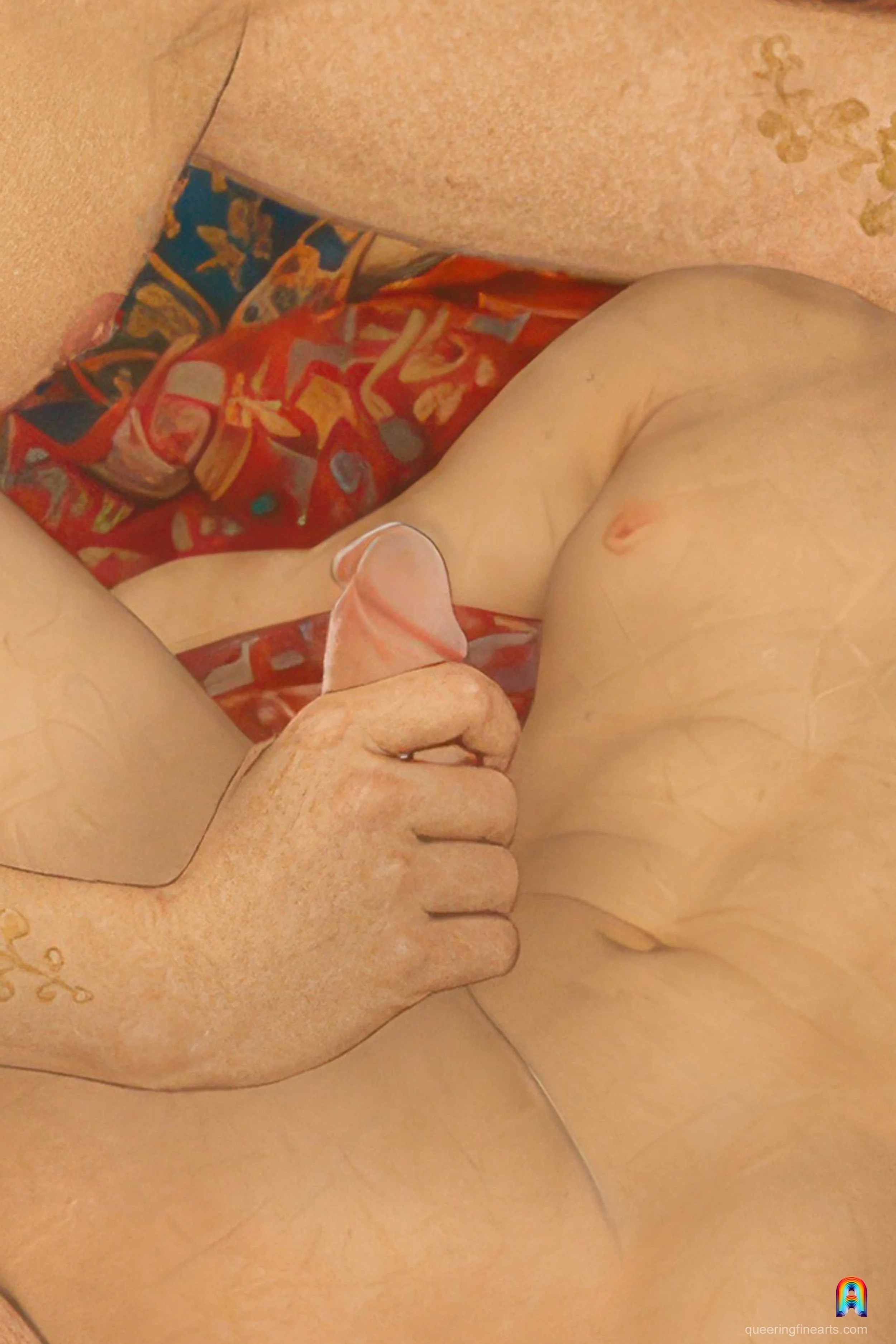
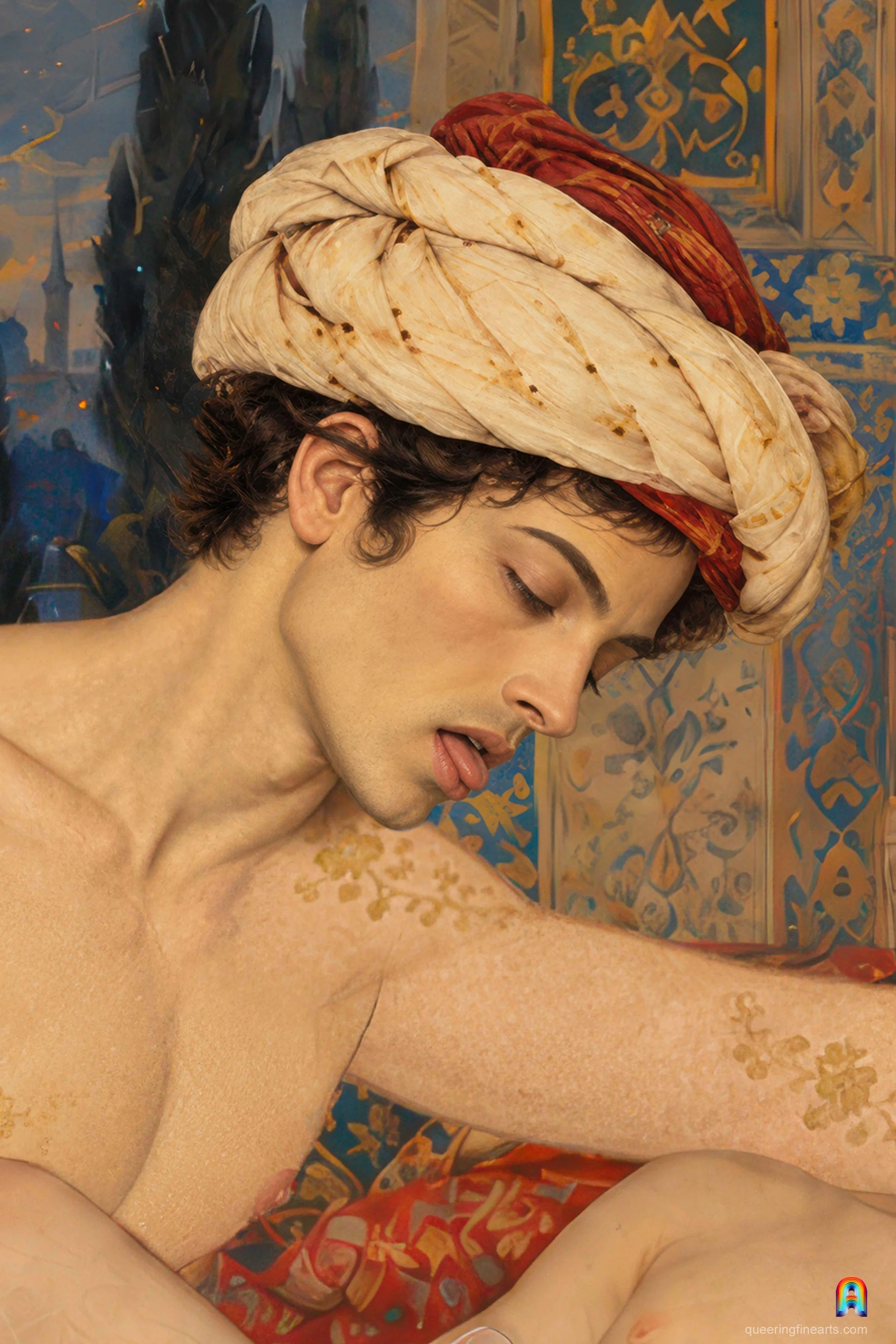
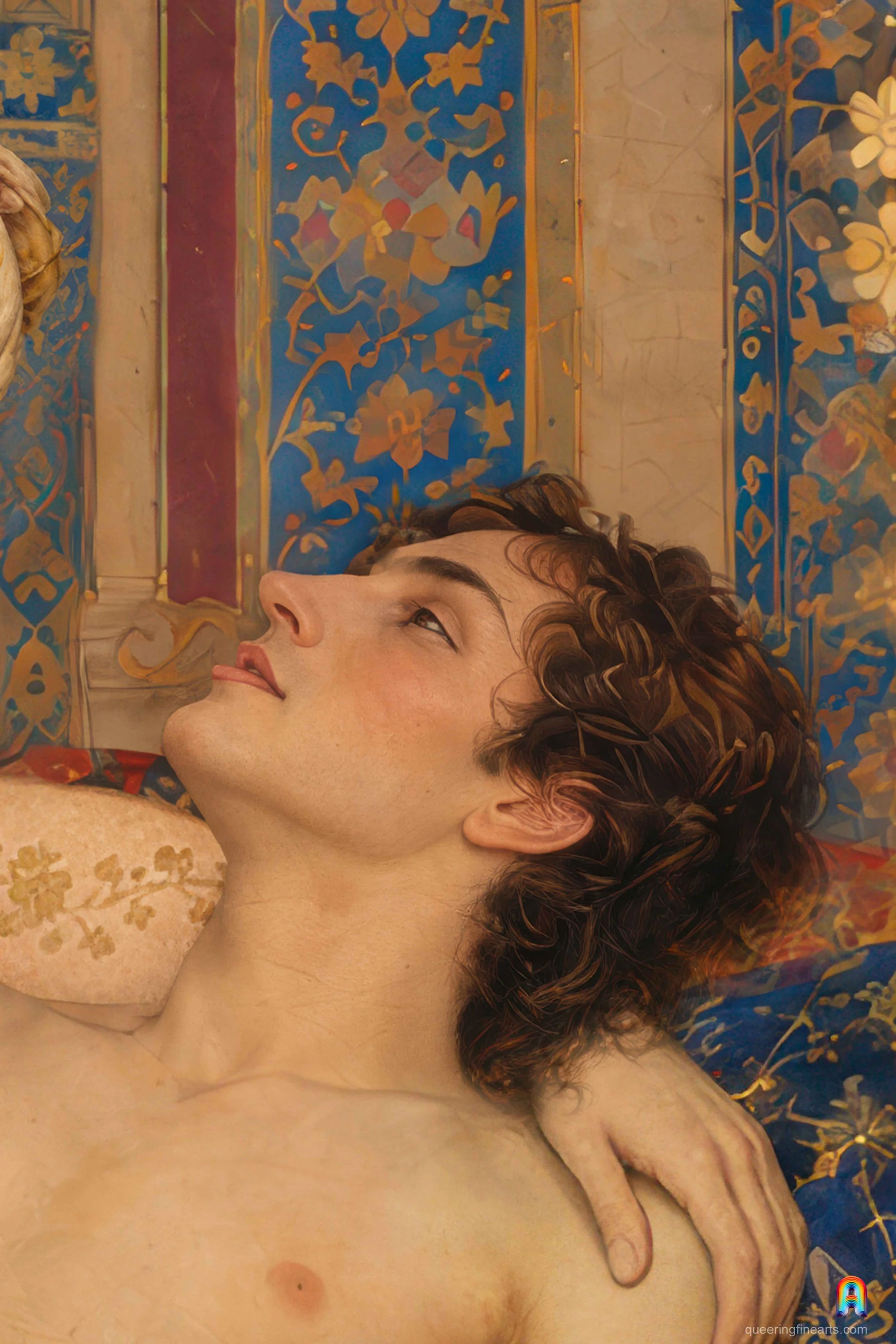
Fâzıl appears at left with the unnamed young man celebrated in the poem reclining beside him in an attitude of languid, sensual abandon. Their arms and legs cross and entwine in an intricate erotic choreography, the two bodies almost woven together in a pose of remarkable sophistication. His hand firmly grasps his lover’s erect member, while the prominently displayed calves give visual form to the “silver calf” Fâzıl claims as his share. The lover’s half-closed eyes, languid nudity and complete physical surrender heighten the sense of intimacy, while the complexity of their interlocking bodies gives that surrender an extraordinary refinement. Fâzıl’s gaze, meanwhile, remains fixed upon his lover’s arousal, the tip of his tongue showing as though in anticipation of soon drinking from that fountain. Together, these details give tangible form to the poem’s şeb-i visâl, the “night of union.”
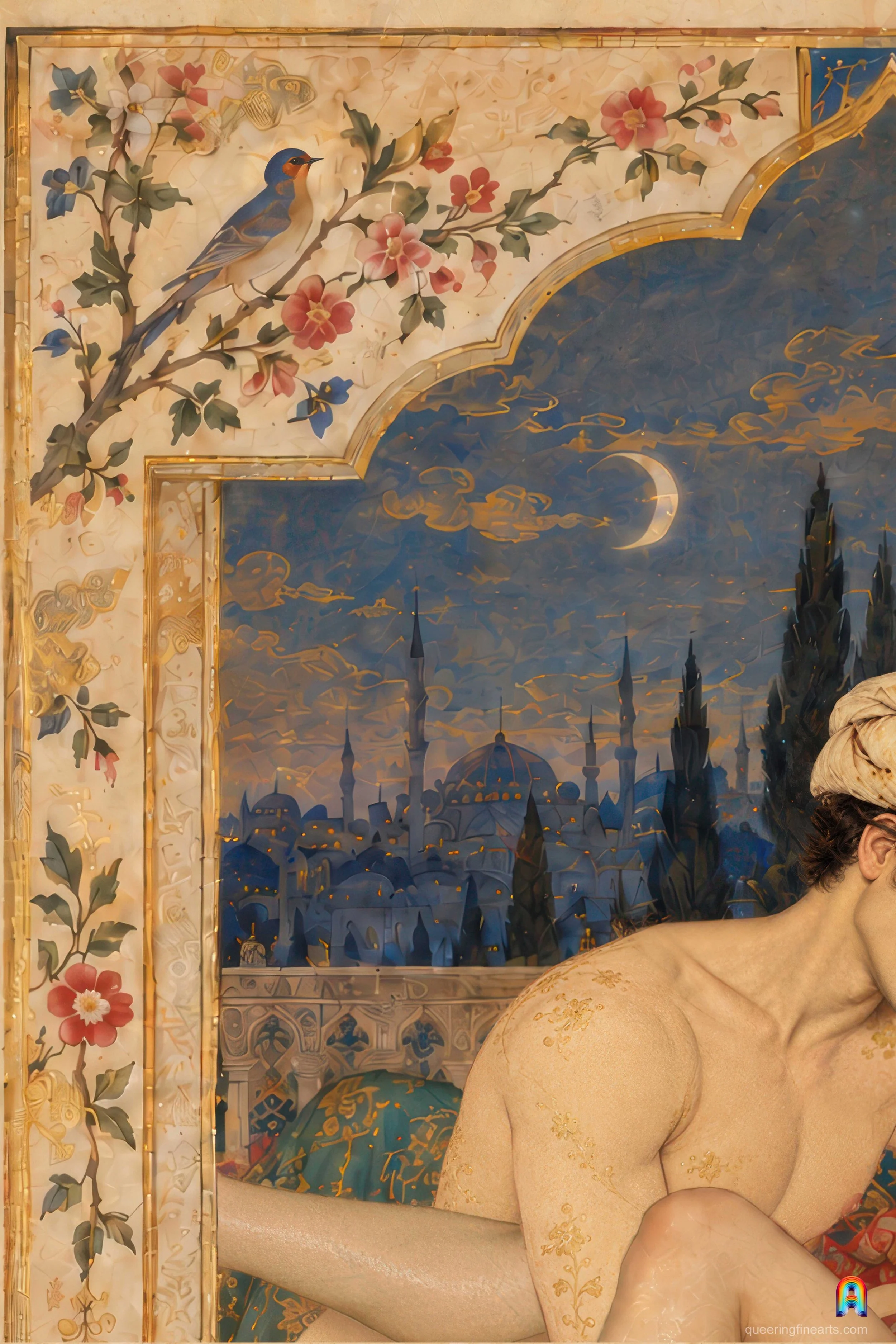
Other details quietly draw upon the same poem. The young man is introduced in its opening verse as a mehpâre-i hüsn, a moon-like beauty or, more literally, a “piece of the moon,” while his glance wounds those who look upon him and his long curls bind the poet’s burning heart. The crescent suspended above the Ottoman city therefore belongs not simply to the nocturnal setting but to Fâzıl’s own poetic vocabulary. The luxurious textiles, gilded ornament and enclosed chamber place that imagined encounter within the refined visual world of the late Ottoman Empire. The image turns Fâzıl’s metaphors into flesh and allows the poet and his beautiful young man to inhabit together the şeb-i visâl, The Night of Union he wrote.
Seb-i Visâl - The Night of Union
Illustration of a ghazal by Enderûnlu Fâzıl (c. 1756/57–1810), from his Dîvân-ı Fâzıl Bey Enderûnî, c. 1790
Ink, opaque watercolors and gold on paper.
Ottoman, Istanbul, c. 1790
From the library of an Ottoman notable, Bursa

The Poet Among Beautiful Men
Şeb-i Visâl – The Night of Union belongs to a literary world in which love between men could be expressed with a directness that may surprise readers encountering late Ottoman poetry for the first time. Its author, Enderûnlu Fâzıl, was born around 1756–57 in Acre, in Ottoman Palestine, into the Arab Zaydān family. Brought to Istanbul after the violent collapse of his family’s power, he entered the Enderûn palace school in 1775 at about eighteen or nineteen and received the education that would make him an Ottoman court poet.¹
Fâzıl did not merely employ the beautiful male beloved as an occasional poetic convention. Men occupy an extraordinary amount of space in his writing. His Defter-i Aşk (Book of Love), a 438-couplet autobiographical poem, recounts his own love affairs. His Hûbânnâme (Book of Beautiful Men) devotes 796 couplets to the beautiful men of different peoples and regions. In Çengînâme, he turns his attention to the celebrated male dancers, or köçeks, of Istanbul, describing them individually.²
This matters for understanding the ghazal behind The Night of Union. The beautiful young man lying naked before Fâzıl belongs to a poetry in which the male body, male beauty and the poet’s attraction to men recur again and again. Fâzıl could praise a man’s face, eyes, hair and body, recount his own attachments to men and devote an entire work to cataloguing male beauty. His poetry makes the beautiful man not a marginal presence but a persistent object of fascination.
The cultural setting was larger than Fâzıl himself. Ottoman poetry possessed a long-established vocabulary of the beloved’s eyes, brows, hair, mouth and body, while literary genres such as the şehrengiz celebrated the beauties of particular cities. By Fâzıl’s period, some examples had become markedly sexual, and the tradition could accommodate descriptions of beautiful young men with remarkable physical specificity.³
Fâzıl nevertheless pushes this inheritance somewhere intensely personal. In the ghazal illustrated here, the beloved is a mehpâre, a “piece of the moon”; his glance shoots arrows, his long hair binds the poet’s burning heart and finally his body enters the imagined şeb-i visâl, the night when separation ends and the lovers are united. Fâzıl asks for his beloved’s ankles and “silver calf” as his share. The language of poetic beauty has become unmistakably physical.
That continuity between literary convention, lived attraction and the male body will be essential to what follows. Fâzıl gives us something particularly precious: the voice of an eighteenth-century Ottoman man who repeatedly wrote about beautiful men and his love for them, within a culture that possessed its own sophisticated language through which such attraction could be imagined and expressed.
Curiosity Piqued?
1. Sabahattin Küçük, “Enderunlu Fâzıl,” TDV İslâm Ansiklopedisi, vol. 11 (Istanbul: Türkiye Diyanet Vakfı, 1995).
A concise scholarly biography tracing Fâzıl from Acre and the Zaydān family through his education at the Enderûn and his literary career.
2. “Fâzıl, Enderunlu Fâzıl (Hüseyin) Bey,” Türk Edebiyatı İsimler Sözlüğü.
Particularly useful for the range of Fâzıl’s writing: Defter-i Aşk and his own love affairs, the 796-couplet Hûbânnâme on beautiful men of different nations and his works devoted to Istanbul’s male dancers.
3. “Şehrengiz,” TDV İslâm Ansiklopedisi.
An introduction to the Ottoman literary tradition devoted to cities and their beauties, including its increasingly sexual forms and Fâzıl’s place within that development.
A Life Written in Love
Fâzıl’s poetry becomes still more remarkable when The Night of Union is placed beside his Defter-i Aşk, the Book of Love. Written in 1795, this substantial poem recounts the poet’s own history of love with men. The modern Turkish literary reference Türk Edebiyatı Eserler Sözlüğü describes it with striking simplicity as “the work in which the poet recounts his loves with persons of his own sex.”¹
Defter-i Aşk nevertheless looks back upon these loves through a language of regret and repentance. Fâzıl’s attraction to men coexisted with a genuine religious anxiety about sexual transgression, a tension that surfaces elsewhere in his writing as well. Yet he preserved the men he loved in remarkable detail and continued to make male beauty one of the great subjects of his work.
Those men emerge individually from the poem. The first is a young man Fâzıl loved while studying at the Enderûn palace school, a relationship he describes as lasting approximately a year. Then came Bostancıbaşızâde Süleyman Bey, whom he loved for about a year and a half, followed by Şehlevendim Hâfız Abdullah Ağa, a singer associated with the sophisticated musical culture of the Ottoman court, whose relationship with Fâzıl lasted some three years. Finally there is Köçek Kıbtî İsmail, a professional male dancer. With names, professions and even the duration of these attachments, Defter-i Aşk preserves successive chapters of Fâzıl’s emotional life: a man remembering the men he loved.² ³
İsmail also opens a window onto Ottoman entertainment culture. As a köçek, he belonged to the world of professional male dancers that fascinated Fâzıl enough to inspire another work, the Çengînâme. The passage devoted to İsmail in Defter-i Aşk has consequently been valued as historical evidence for the köçeks who performed in Istanbul taverns.²
That fascination with men expands still further in the extraordinary Hûbânnâme. Composed at the request of a male beloved, its 796 couplets survey male beauty across peoples and regions, considering complexions, bodies, manners and particular physical attractions. The result is almost an atlas of beautiful men. Together with Defter-i Aşk, Çengînâme and the ghazals of his Dîvân, it makes Fâzıl’s writing unusually rich evidence for sexuality and gender in eighteenth-century Ottoman poetry.³
Within this body of work, the erotic immediacy of Şeb-i Visâl feels entirely at home. The moon-like young man, the captivating hair, the piercing glance, the silver calf and the anticipated night of physical union belong to the poetic imagination of a man whose writing repeatedly joins male beauty to personal attraction. Fâzıl wrote men into his poetry because men occupied his erotic and emotional world.
Curiosity Piqued?
1. Hicran Yücel, “Defter-i Aşk (Fâzıl),” Türk Edebiyatı Eserler Sözlüğü (2022).
A particularly useful scholarly entry devoted specifically to Defter-i Aşk, identifying it as Fâzıl’s account of his loves with men and providing its date, form and literary context.
2. Reşad Ekrem Koçu, “Defteri Aşk,” İstanbul Ansiklopedisi.
Especially valuable for the individual men in Fâzıl’s love history and the internal structure of the poem, including Süleyman Bey, Abdullah Ağa and Köçek İsmail.
3. Esra Egüz, “Enderunlu Fâzıl: Perspectives on Sexuality and Gender in Eighteenth-Century Ottoman Poetry,” Anthropology of the Middle East 20, no. 1 (2025): 75–91.
A recent scholarly study bringing together Defter-i Aşk, Hûbânnâme, Çengînâme and Fâzıl’s other writings to examine his attraction to men and his representation of sexuality and gender.
A Culture That Knew the Male Beloved
Fâzıl’s celebration of men belonged to a much larger Ottoman culture of male beauty and male love. For centuries, Ottoman lyric poetry had placed the beloved at the centre of an elaborate language of longing: eyes became arrows, eyebrows bows, curls chains and the face a moon. Very often, that beloved was male. Walter G. Andrews and Mehmet Kalpaklı have described the early modern Ottoman world as an “age of beloveds,” in which beautiful young men could become the focus of desire for poets, artists and powerful men.¹
Poetry gave this attraction an extraordinarily rich vocabulary. The male beloved appears across the gazel, the şehrengizand other literary forms, praised for his face, hair, eyes, waist, complexion and physical grace. The şehrengiz, devoted to the attractions of particular cities, could catalogue their beautiful young men one after another. Fâzıl inherited this tradition and carried its fascination with male beauty into the late 18th century with unusual abundance and specificity.
The culture extended beyond the written page. Male dancers, musicians, entertainers and beautiful youths occupied highly visible places within Ottoman urban life. The köçeks celebrated by Fâzıl belonged to a professional performance culture in which young men danced in elaborate costumes before predominantly male audiences. Poetry, music, performance and erotic admiration could therefore meet within the same social world. Fâzıl’s singer Abdullah Ağa and dancer İsmail connect his literary loves directly to that living culture.
Male-male desire was consequently intelligible within Ottoman society through its own cultural language. This language distinguished roles, ages, beauty and sexual acts in ways that do not correspond neatly to modern categories of sexual orientation. A man attracted to another man did not need to understand himself through the modern identity category “homosexual” for that attraction to be recognisable, expressible and culturally legible. Ottoman literature could speak extensively about men desiring men centuries before the modern vocabulary of homosexuality appeared.²
That openness existed alongside Islamic moral and legal restrictions on particular sexual acts. Ottoman society contained religious prohibition, erotic poetry, sexual humour, admiration of beautiful youths and actual relationships between men at the same time. Dror Ze’evi’s study of Ottoman sexual culture demonstrates precisely this multiplicity: discussions of sexuality circulated through poetry, medicine, religious writing, dream interpretation, popular theatre and other forms of knowledge.³
This is the world that makes Fâzıl possible. When he describes the men he loved, surveys male beauty across nations or imagines receiving his beloved’s silver calf on the şeb-i visâl, his words participate in a cultural tradition his Ottoman readers could understand. His exceptional value lies in the richness with which he allows that world to survive on the page.
The history also makes what happened later especially significant. During the 19th century, the Ottoman language of sexuality began to change dramatically as the Empire encountered increasingly powerful European ideas about morality, respectability and sexual identity. A culture that had spoken abundantly about male beauty and male-male desire would gradually learn to speak about them very differently.
Curiosity Piqued?
1. Walter G. Andrews and Mehmet Kalpaklı, The Age of Beloveds: Love and the Beloved in Early-Modern Ottoman and European Culture and Society (Durham: Duke University Press, 2005).
A major study of Ottoman love poetry and the social world surrounding it, particularly valuable for understanding the prominence of beautiful young men as beloveds and objects of desire
2. Abdulhamit Arvas, “From the Pervert, Back to the Beloved: Homosexuality and Ottoman Literary History, 1453–1923,” in E. L. McCallum and Mikko Tuhkanen, eds., The Cambridge History of Gay and Lesbian Literature(Cambridge: Cambridge University Press, 2014), pp. 145–163.
Arvas traces male homoeroticism through Ottoman literary history and examines the profound transformation of its interpretation during the 19th century.
3. Dror Ze’evi, Producing Desire: Changing Sexual Discourse in the Ottoman Middle East, 1500–1900 (Berkeley: University of California Press, 2006).
A wide-ranging study reconstructing Ottoman ways of thinking and speaking about sexuality through literature, law, medicine, religion, dream interpretation, popular theatre and travel writing.

When Europe influenced the Language of Desire
During the 19th century, the Ottoman world entered a period of intense political, legal and cultural transformation. European powers exercised growing influence over the Empire while Ottoman reformers increasingly looked to France and other Western European states for models of administration, education, law and social organisation. Sexuality became part of this encounter. The older Ottoman vocabulary of beloveds, beautiful youths and male-male desire increasingly met a European culture developing its own powerful ideas about sexual morality, respectability and identity.¹
The Ottoman Penal Code of 1858, heavily influenced by the French Code pénal of 1810, reorganised the legal treatment of sexual conduct. It contained no offence specifically targeting consensual same-sex intimacy, while Article 202 punished acts contrary to public decency when committed openly. These provisions operated within a broader Ottoman legal and moral landscape in which Islamic norms concerning sexual acts continued to carry authority. The reform therefore placed same-sex relations within overlapping legal, religious and social frameworks rather than establishing a single new legal status for them.²
European influence was also reaching far beyond legislation. During the later 19th century, new ideals of bourgeois respectability, companionate heterosexual marriage and sharply differentiated gender roles acquired increasing prestige among Ottoman elites. European observers had long portrayed Ottoman sexual customs as evidence of an exotic and morally suspect East. Ottoman intellectuals encountered those judgements while negotiating their own place within a world increasingly dominated by European political and cultural power. The emerging Western concept of homosexuality as a distinct category of person also differed profoundly from earlier Islamic ways of understanding male-male desire through particular acts, roles and forms of attraction.³
The effects became visible in literature itself. Earlier poetry had spoken freely of the beautiful male beloved through conventions immediately intelligible to its readers. During the 19th century, editors and literary historians increasingly reinterpreted, softened or obscured the male gender of beloveds. Abdulhamit Arvas has traced this extraordinary shift from the beloved to the modern category of the pervert: male-male desire moved from an established literary language into a new sexual taxonomy shaped by modern concepts of homosexuality and heterosexuality.⁴
Westernisation therefore transformed Ottoman sexuality along several paths at once. The Penal Code reorganised the legal treatment of sexual conduct while European-derived ideas of sexual normality were making male-male desire increasingly difficult to accommodate within respectable public culture. Law, morality, literature and social convention interacted in new ways. The language through which sexual acts, desires and eventually identities were understood was itself changing.
Fâzıl stands just before this transformation. His works preserve an Ottoman erotic vocabulary still capable of speaking expansively about beautiful men, male lovers and physical attraction. Reading him from the 21st century therefore reveals more than an individual poet’s sexuality. It reveals how much a culture can forget about its own past.
Curiosity Piqued?
1. Dror Ze’evi, Producing Desire: Changing Sexual Discourse in the Ottoman Middle East, 1500–1900 (Berkeley: University of California Press, 2006).
Particularly useful for following the transformation of Ottoman sexual discourse during the 19th century and the growing importance of European-derived categories and ideas.
2. Elif Ceylan Özsoy, “Decolonizing Decriminalization Analyses: Did the Ottomans Decriminalize Homosexuality in 1858?,” Journal of Homosexuality 68, no. 12 (2021): 1979–2002.
A detailed examination of the 1858 Penal Code within the Ottoman legal system, particularly valuable for understanding Article 202, the treatment of same-sex sexual acts and the limits of applying modern Western categories of criminalisation and decriminalisation to Ottoman law.
3. Khaled El-Rouayheb, Before Homosexuality in the Arab-Islamic World, 1500–1800 (Chicago: University of Chicago Press, 2005).
Essential background for understanding the conceptual distance between early modern Islamic approaches to male-male desire and the modern Western category of homosexuality.
4. Abdulhamit Arvas, “From the Pervert, Back to the Beloved: Homosexuality and Ottoman Literary History, 1453–1923,” in E. L. McCallum and Mikko Tuhkanen, eds., The Cambridge History of Gay and Lesbian Literature (Cambridge: Cambridge University Press, 2014), pp. 145–163.
Especially important here: Arvas follows the changing interpretation of the male beloved as Ottoman literary culture encountered modern sexual categories and new regimes of respectability.

Living Echoes of Ottoman Love
Fâzıl belongs unequivocally to the cultural history from which modern Turkey emerged. His poetry was written within the Ottoman Empire, in Ottoman Turkish and within literary traditions cultivated for centuries across its cities, courts and learned circles. Today his manuscripts are preserved, catalogued and studied as part of Turkish literary heritage. The men he loved belong to that heritage as well.
This matters particularly in contemporary Turkey. During the past decade, LGBTQ+ Pride marches have repeatedly been banned or dispersed, activists have been detained and political rhetoric has increasingly presented homosexuality as a threat to the family, morality and national values.¹ In 2025 and 2026, proposed and enacted measures targeting LGBTQ+ expression intensified this direction, placing sexuality and gender at the centre of an increasingly restrictive politics.²
Fâzıl makes one recurrent implication of that rhetoric historically untenable: that homosexuality somehow arrived from elsewhere. More than two centuries ago, an Ottoman poet educated inside the imperial palace was recording his love affairs with men, describing beautiful male bodies, celebrating male dancers and imagining the şeb-i visâl with a male beloved. His readers possessed a literary vocabulary through which such desire could be recognised and expressed.
The contrast reaches beyond Fâzıl. Ottoman poetry preserves centuries of male beloveds. Istanbul’s entertainment culture celebrated köçeks. Literary works catalogued the beautiful young men of cities and regions. Manuscripts transformed these worlds into images. This history was produced within Ottoman society itself and transmitted in its own languages, artistic forms and cultural institutions.
Recovering it consequently changes the historical perspective. LGBTQ+ Turks looking into the Ottoman past encounter a culture far more complicated than contemporary rhetoric might suggest. They can also encounter men whose desires speak across the centuries with startling familiarity. Fâzıl is especially powerful because his voice is so personal: he remembers whom he loved.
Şeb-i Visâl returns that memory to view. The naked beloved beneath the moon and the poet anticipating their union belong to the history of the lands, literature and culture inherited by modern Turkey. Homosexual love has a Turkish history. Fâzıl wrote part of it himself.
Curiosity Piqued?
1. Human Rights Watch, World Report 2026: Turkey (New York: Human Rights Watch, 2026).
Documents the growing pressure on LGBTQ+ people in contemporary Turkey, including restrictions on public expression, assembly and advocacy.
2. ILGA-Europe, Annual Review of the Human Rights Situation of Lesbian, Gay, Bisexual, Trans and Intersex People in Türkiye (2026).
Provides a detailed account of recent legal, political and social developments affecting LGBTQ+ people in Turkey and allows Fâzıl’s Ottoman world to be considered against the sharply different rhetoric of the present.
QFA