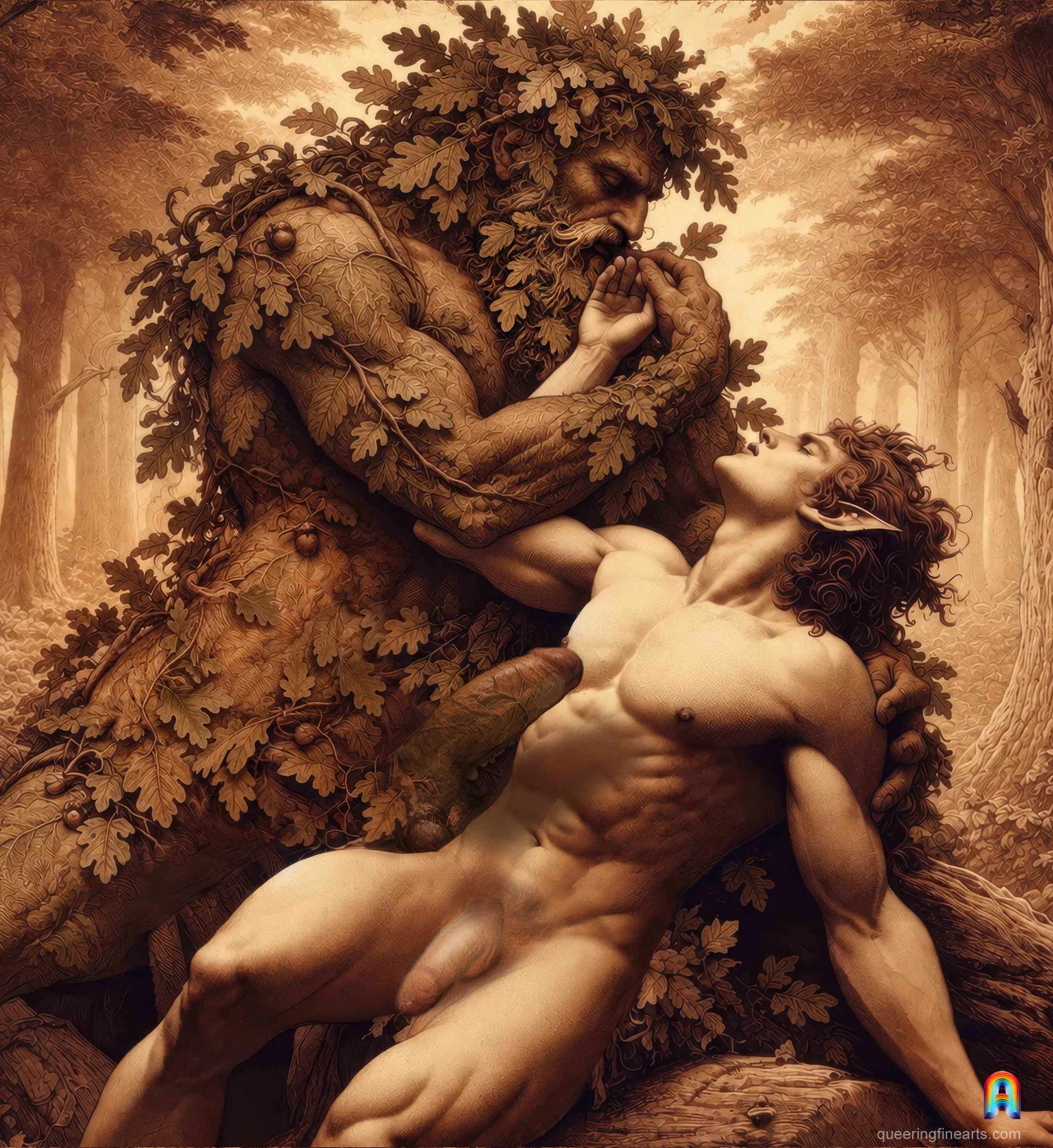
The Green Man’s Abundance
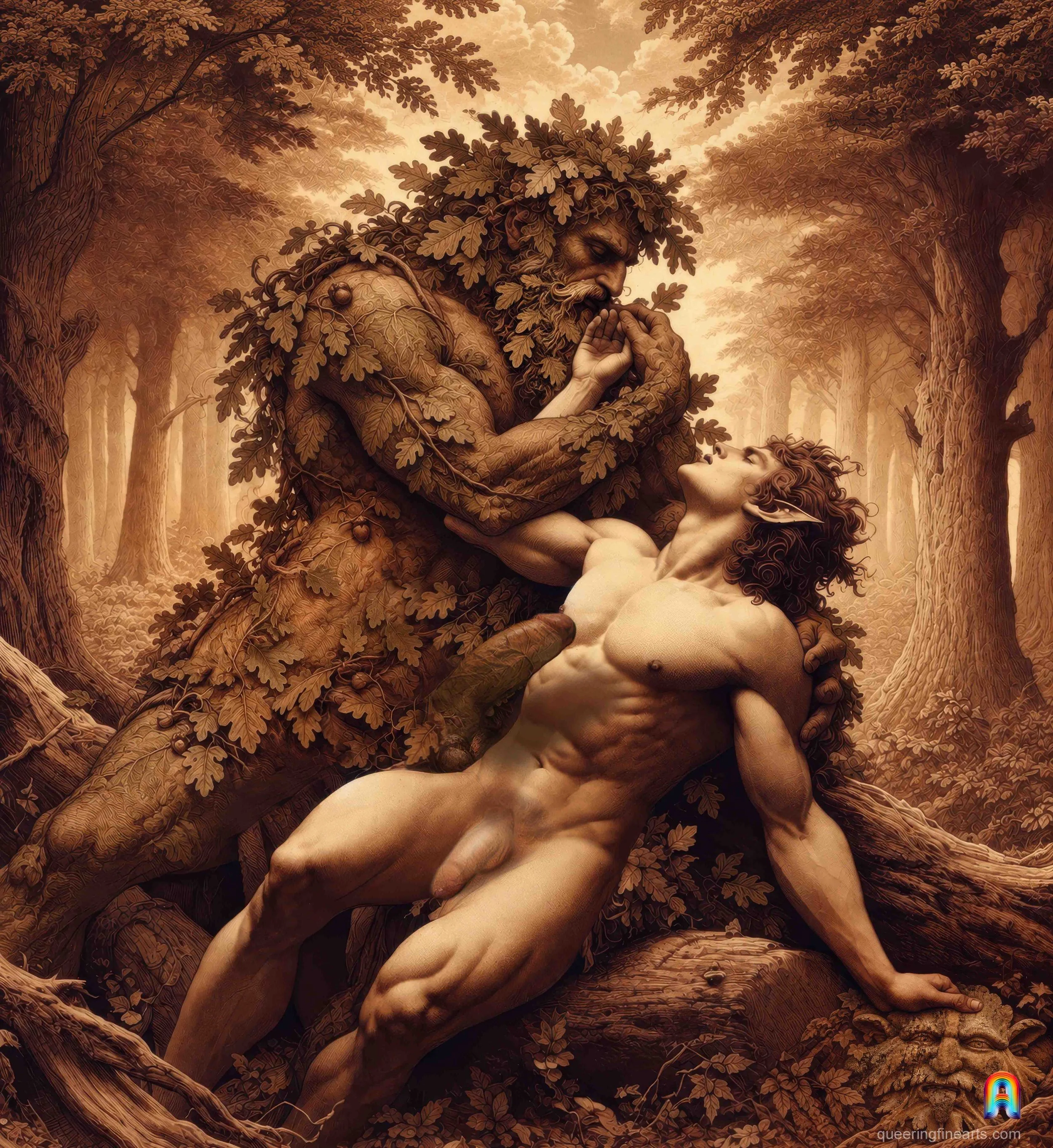
Illustration from The Generative Spirit of the Greenwood: Its Forms in Myth and Legend, 1878
Engraving
British, 1878
Private collection
Virile Nature
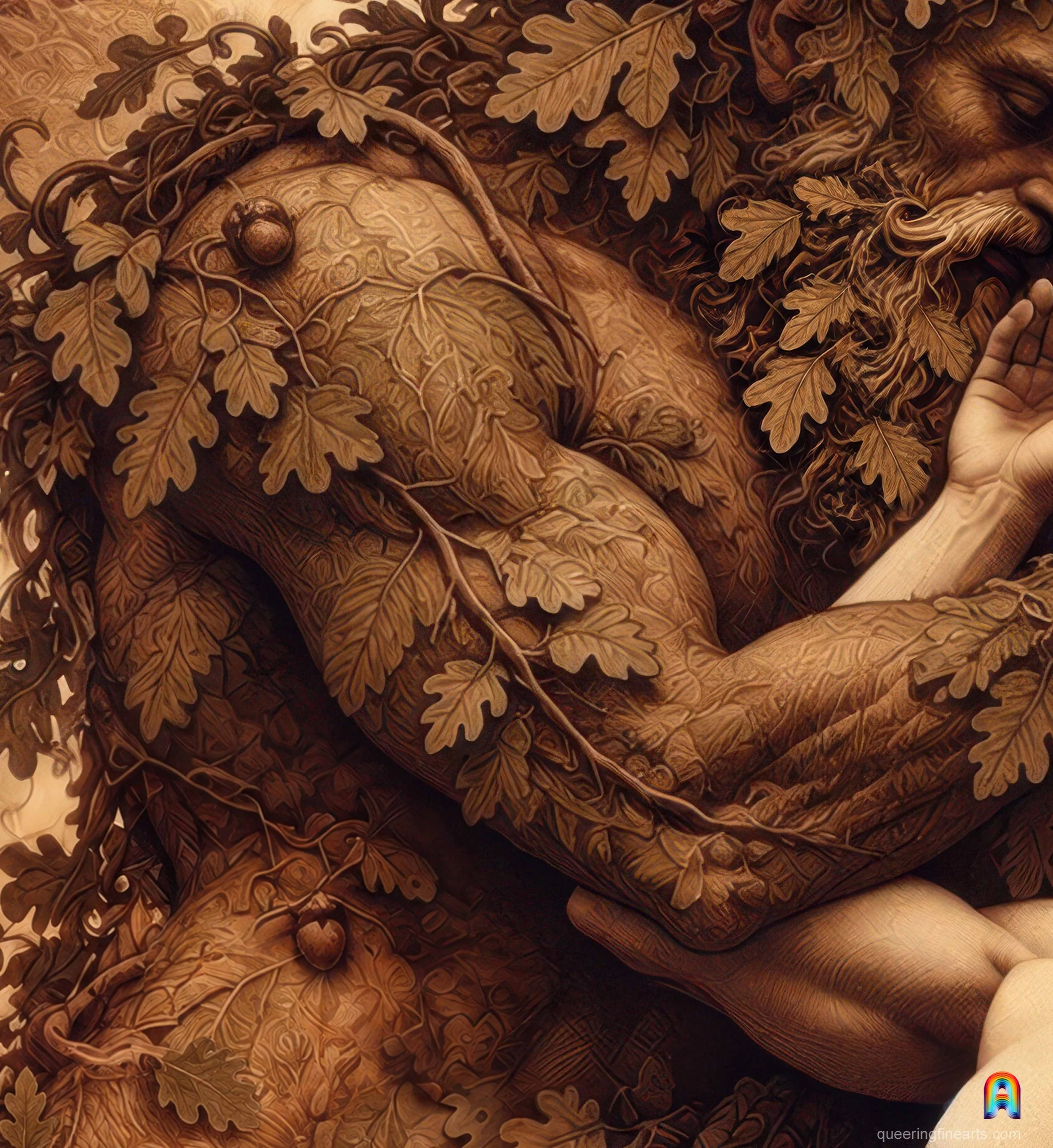
If its supposed 1878 source is to be believed, this exuberant engraving appeared in the wonderfully titled The Generative Spirit of the Greenwood: Its Forms in Myth and Legend, an antiquarian exploration of the male generative spirit of nature and its many manifestations across myth and legend. Its central figure belongs to an ancient imaginative tradition in which the abundance of the living world acquires a masculine body, linking distant mythological ancestors with the foliate figures later known as Green Men.
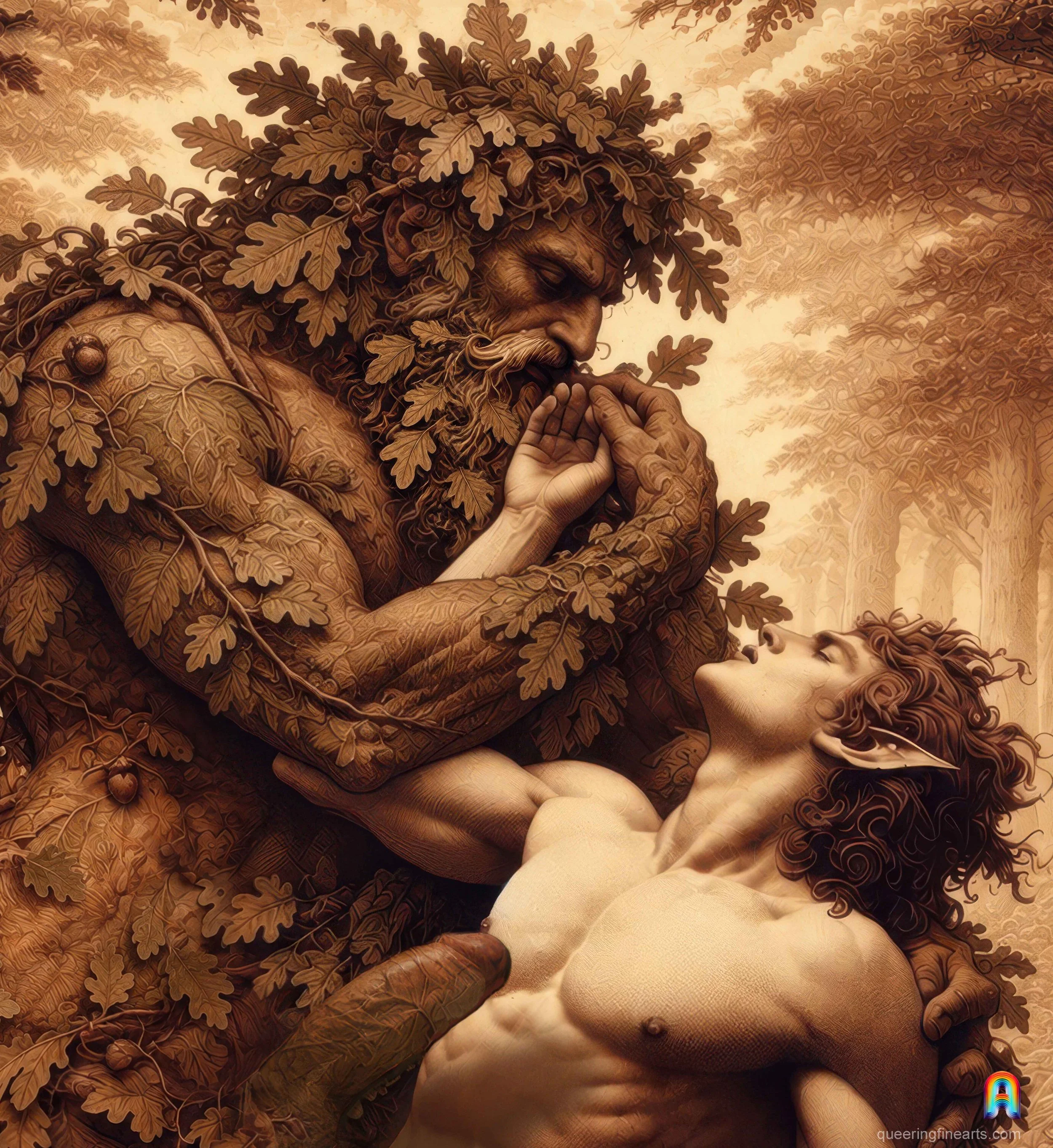
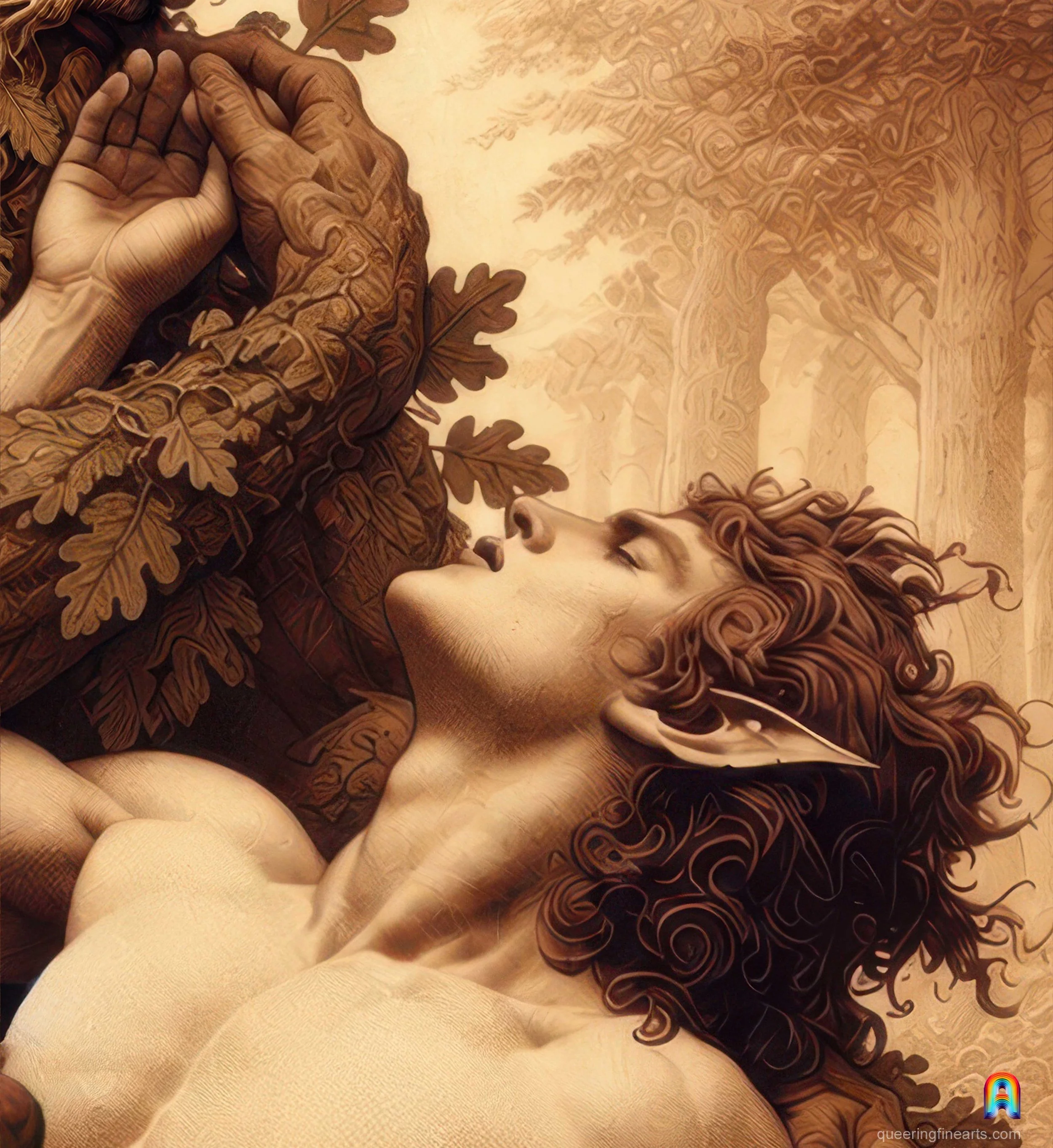
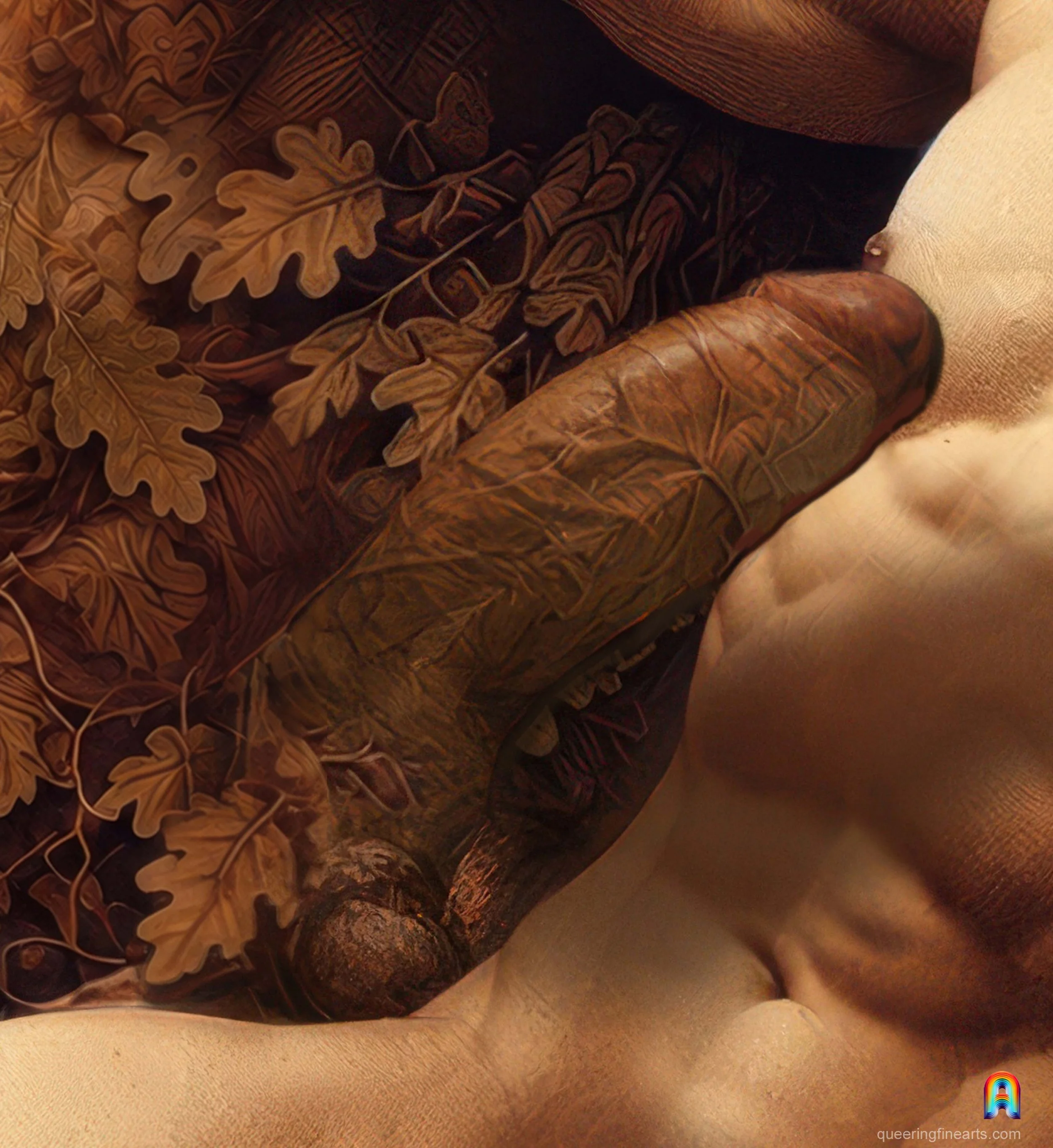
Here that presence is monumental, mature and powerfully male. The great bearded being seems completely at home within the dense woodland. Oak leaves spread through his hair and beard and across his body while his rugged flesh echoes the bark of the surrounding trees. His immense anthropomorphic erection makes his sexual power spectacularly explicit. Scale, physical strength and luxuriant vegetation combine to make him an embodiment of masculine abundance.
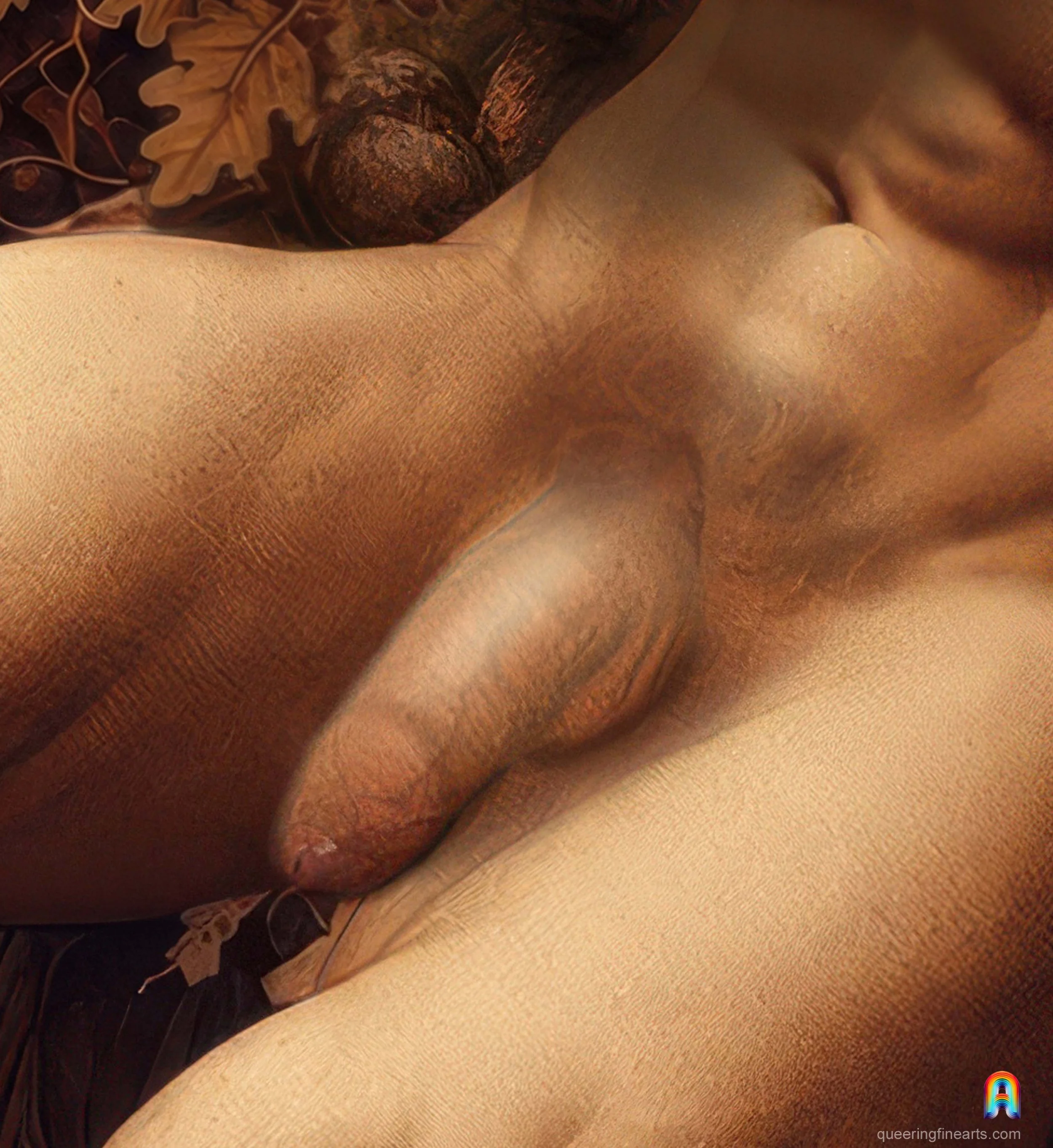
A beautiful naked male creature reclines intimately against him. His pointed ears identify him as another supernatural inhabitant of the woods. His smooth body contrasts sensually with the older being’s massive vegetal presence. His penis is not yet erect, but his languid abandon and visible pleasure suggest that arousal will soon follow. The older sylvan being gathers him close and tenderly raises his hand to his lips. Their intimacy has an almost initiatory quality: the older creature’s prodigious virility seems capable of being communicated through their sexual union, with penetration and the gift of his seed carrying a symbolic power of transmission. Masculine abundance can thus pass from one male body to another and multiply within the enchanted life of the forest.
The scene recalls the mythological universe of Ovid’s Metamorphoses, where beautiful males encounter gods within an animated supernatural landscape. The affinity lies in a conception of nature as sensual, embodied and alive with myth. The homosexuality of the two creatures belongs easily within such a world.
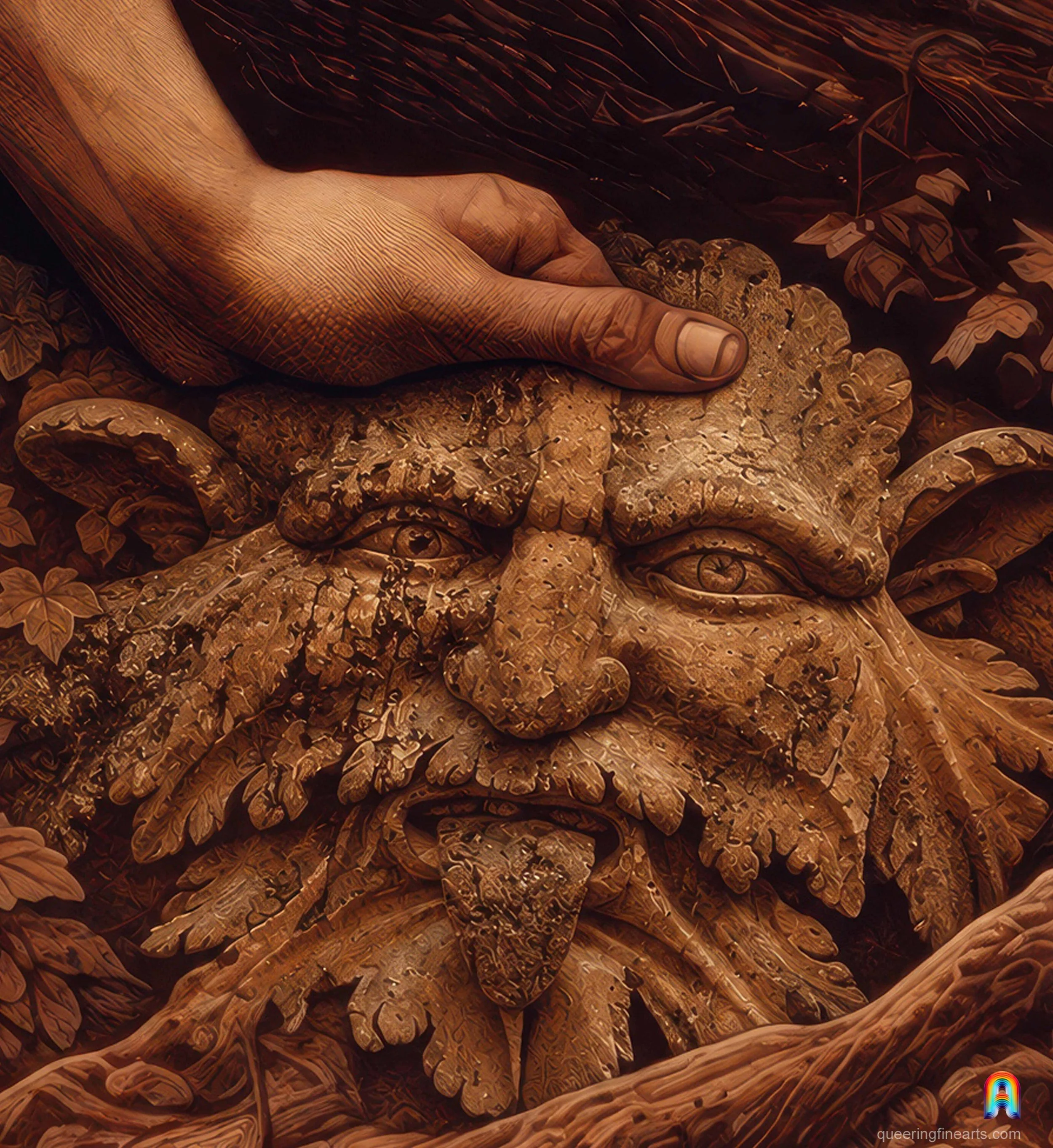
Beneath the younger male’s outstretched hand lies the weathered sculpted head of another sylvan being. He braces himself against the ancient carving, bringing living myth into physical contact with its material ancestry. Half absorbed into the forest floor, the sculpture gives the woodland its own archaeology, as though generations of these creatures had inhabited the landscape long before the present encounter.
The medieval Green Man is recalled in the fusion of masculine body and foliage, but here the familiar foliate head acquires an entire body and returns to the forest.
The Green Man’s Abundance makes nature’s abundance emphatically masculine and its erotic expression emphatically homosexual. The younger male belongs fully within the older being’s generative world and their tenderness gives that abundance an intimate human dimension. Nature teems with life, pleasure and growth, and homosexuality flourishes within it.
Before the Green Man: The Male Spirit of Fertile Nature
Long before the Green Man acquired his familiar leafy face in medieval European art, human beings had imagined the forces of the natural world in bodily form. The Green Man’s Abundance belongs deliberately to one particularly ancient possibility: nature imagined as a virile masculine presence whose physical potency expresses the abundance of the living world.
Its roots reach deep into the past. Prehistoric art already includes enigmatic beings combining human and animal characteristics, such as the celebrated figure from the Trois-Frères cave in Ariège.¹ Their meanings remain beyond recovery, yet they reveal the great antiquity of giving hybrid bodily presence to powers extending beyond ordinary human existence. In ancient Egypt, the idea becomes strikingly explicit in Min, a god of male fertility conventionally represented with an erect penis.²
The Greco-Roman world developed this masculine embodiment of nature with extraordinary richness. Pan, part man and part goat, intensely sexual and inseparable from the wild landscape, offers perhaps its most recognisable expression. Faunus and Silvanus inhabited related worlds, alongside satyrs and other male beings whose sexuality belonged naturally to their supernatural identities.³ The erect phallus could consequently become an emphatic sign of masculine potency, placing the generative force of nature quite literally upon the male body.
Homosexuality belonged naturally within this exuberantly sexual world. Gods desired beautiful young men: Zeus loved Ganymede and Apollo loved Hyacinthus. Athenian herms combined the head of a mature bearded male with an erect phallus, and vase painters could place these sacred images beside desirable young men, sometimes exploiting the visual language of male courtship itself.⁴ Virile supernatural masculinity and attraction between males could therefore coexist within the same visual and mythological imagination.
The Roman poet Ovid, writing at the beginning of the 1st century CE, gave this mythological world one of its richest literary expressions in the Metamorphoses. Ganymede and Hyacinthus appear in Book X amid a universe where landscapes are alive with supernatural presences and the boundaries between human beings, gods, animals and vegetation are wonderfully unstable.⁵ Nature can possess a body and a sexuality, and a beautiful male body can become the object of another male’s love.
The Green Man’s Abundance draws these ancient possibilities together. Its immense sylvan male belongs to the long history of nature imagined as virile, bodily and exuberantly sexual. His beautiful male companion belongs to an equally ancient homosexual history. Their intimacy therefore requires no invention of homosexuality for an otherwise heterosexual mythological past. Men loving men were already there.
There is no need for a single uninterrupted lineage from a prehistoric hybrid, Min or Pan to a foliate head carved in a medieval church. By the time leafy male faces began flourishing in medieval European art, nature imagined as masculine, virile and capable of homosexual expression already possessed histories reaching far into the past.
Curiosity Piqued?
1. Jean Clottes, “Composite Creatures in European Palaeolithic Art,” in Geoffrey Blundell, Christopher Chippindale and Benjamin Smith, eds., Seeing and Knowing: Understanding Rock Art With and Without Ethnography (Johannesburg: Wits University Press, 2010), pp. 188–197.
Clottes examines the enigmatic human-animal beings of European Palaeolithic art and the limits of what we can recover about their meanings.
2. Ann McFarlane, The God Min to the End of the Old Kingdom, Australian Centre for Egyptology Studies 3 (Sydney: Australian Centre for Egyptology, 1995).
A detailed study of the Egyptian god whose conspicuous erection made male generative power physically explicit.
3. Philippe Borgeaud, The Cult of Pan in Ancient Greece, trans. Kathleen Atlass and James Redfield (Chicago: University of Chicago Press, 1988).
Borgeaud explores Pan’s place within Greek ideas of wilderness, pastoral life and sexuality, providing an important background for the masculine sylvan world evoked in The Green Man’s Abundance.
4. Jorge J. Bravo III, “Boys, Herms, and the Objectification of Desire on Athenian Sympotic Vases,” EuGeStA: Journal on Gender Studies in Antiquity 7 (2017), pp. 32–66.
Bravo examines a particularly compelling intersection of phallic sacred masculinity and male-male erotic imagery: herms represented alongside beautiful young males within the visual language of Athenian courtship.
5. Ovid, Metamorphoses, Book X, especially lines 143–219.
The stories of Ganymede and Hyacinthus place male divine love within Ovid’s extraordinary universe of supernatural nature and bodily transformation.
The Ancient World in Plain Sight
The ancient world did not disappear when Antiquity ended. Throughout the Middle Ages, its physical remains continued to occupy cities and landscapes. Temples became ruins, statues lost their original settings and great buildings acquired new functions, yet enormous quantities of ancient material remained visible. Medieval life could quite literally unfold among the remnants of an older civilisation.
Rome offers the most spectacular example. Its medieval population inhabited a city whose ancient scale vastly exceeded its own. Temples, baths, arches, columns and fragments of sculpture remained scattered through inhabited quarters and open land. Houses and workshops occupied ancient structures while monumental ruins rose above a city that had developed around and within them.¹ Around the turn of the 13ᵉ century, Master Gregory recorded his fascination with these surviving monuments and sculptures, preserving the experience of a medieval viewer actually looking at ancient art centuries after the world that produced it had disappeared.²
Yet Rome was the spectacular centre of a much wider phenomenon. Across the former Empire, medieval communities inherited landscapes still marked by Roman construction. Arles and Nîmes retained imposing monuments in southern Gaul, while Trier preserved an extraordinary concentration of imperial architecture far to the north. Roman walls, roads, bridges, tombs and sculptural remains survived along the Rhine and across northern Gaul, and in Britain the remains of Roman towns, fortifications and roads continued to structure parts of the medieval landscape. York, built upon Roman Eboracum, is only one particularly important example.³ Antiquity was therefore physically present even in the northern regions where medieval European art would develop some of its most distinctive forms.
This geographical reach matters. Contact with Antiquity did not depend entirely upon books or upon travelling to Italy. A medieval person in northern Europe needed neither Latin poetry nor knowledge of an ancient god’s identity to encounter something Roman. Bodies, faces, vegetation and fantastic creatures remained carved upon buildings, sarcophagi and sculptural fragments. Their names and stories might become obscure while their forms remained available to the eye.³
This is particularly important for the Green Man. Medieval artists did not work in a world visually sealed from the ancient imagery explored in the previous section. Older ways of joining the human body to animals or vegetation could still be encountered within the territories of the former Empire. An image can remain visible after its name has been forgotten.
That simple fact is crucial. Ancient forms did not have to travel exclusively through texts or learned memory. They could survive as things: visible, tangible and available to later eyes.
The ancient mythological world had become distant, but some of its physical forms remained present from the Mediterranean deep into northern Europe. Medieval people did more than encounter them. They sometimes incorporated ancient material into their own buildings and objects, giving it new lives in a very different world.
Curiosity Piqued?
1. Richard Krautheimer, Rome: Profile of a City, 312–1308 (Princeton: Princeton University Press, 1980).
Krautheimer reconstructs medieval Rome as a living city still permeated by its ancient fabric. His study makes it possible to imagine Antiquity as part of the environment medieval Romans actually inhabited.
2. Master Gregory, The Marvels of Rome, trans. John Osborne (Toronto: Pontifical Institute of Mediaeval Studies, 1987).
Written around the turn of the 13ᵉ century, Master Gregory’s account gives us something wonderfully immediate: a medieval visitor encountering ancient monuments and sculptures with fascination and wonder.
3. Michael Greenhalgh, The Survival of Roman Antiquities in the Middle Ages (London: Duckworth, 1989).
Greenhalgh broadens the picture beyond Rome, following the survival and changing fortunes of Roman architecture and sculpture across the medieval world. Particularly important here is the sheer geographical reach of the material evidence: Antiquity remained available in regions far removed from its most spectacular concentrations in Italy.
When Old Forms Entered New Worlds
The physical presence of Antiquity in the medieval landscape had an important consequence: its remains could become part of the new world growing around them. Columns, capitals, carved stones, sarcophagi, reliefs and other fragments were removed from older structures and incorporated into new ones. Modern scholarship commonly describes such reused material as spolia.
The reasons varied considerably. Ancient buildings contained enormous quantities of stone that had already been quarried, transported and cut, making their materials valuable resources for new construction. Beauty, craftsmanship, prestige, religious reinterpretation and political symbolism could also influence what was preserved and how it was used.¹ An antique column might support the arcade of a Christian church, a sarcophagus receive a new occupant and a carved fragment find a place in a medieval wall.
Images could experience even more surprising afterlives. Engraved gems depicting pagan gods and mythological figures were mounted in medieval precious objects, carrying recognisably antique imagery into settings created centuries later.² A figure originally created within a pagan religious or mythological world could therefore remain visible in a culture that understood and valued it differently.
Much of Antiquity had remained visible throughout the Middle Ages, while other monuments and works lay buried and would be brought to light by Renaissance excavation, when both old and new discoveries became the objects of increasingly systematic study. The Renaissance thus enlarged and transformed the encounter with the ancient world without erasing the centuries of physical contact that had preceded it.
This long material afterlife has an important consequence for our story. An object could survive even when everything once known about it did not. A sculpted figure might remain intact while its name, story or religious significance changed or faded. Reuse could actually favour its preservation by giving it a new function and a new place within the living world.
For the Green Man, the significance lies in what reuse made possible. Ancient forms could enter medieval settings without carrying intact explanations of what they had once represented. Their new surroundings changed how they were seen while preserving them for new generations of viewers.
The weathered sculpted head beneath the male creature’s hand in The Green Man’s Abundance gives this history a wonderfully tangible presence. The younger creature braces himself against an image belonging to an older world. Worn by time and partly absorbed into the forest floor, the carving remains there to be encountered and touched. Living myth comes into physical contact with its material ancestry.
What medieval artists made of inherited forms belongs to another part of the story. Their visual culture could accommodate hybrid creatures, grotesque bodies, sexual imagery, humour and fantasy, sometimes within the most sacred of settings. It is within this remarkably inventive world that the familiar medieval Green Man begins to flourish.
Curiosity Piqued?
1. Arnold Esch, Wiederverwendung von Antike im Mittelalter: Die Sicht des Archäologen und die Sicht des Historikers, Hans-Lietzmann-Vorlesungen 7 (Berlin and New York: Walter de Gruyter, 2005).
Esch follows columns, capitals, statues, sarcophagi, reliefs and inscriptions through their medieval afterlives. Particularly fascinating is the range of circumstances he uncovers, from practical economy to admiration, Christian reinterpretation and political meaning. His study shows how giving ancient material a new purpose could also contribute to its physical preservation.
2. Dale Kinney, “Ancient Gems in the Middle Ages: Riches and Ready-mades,” in Richard Brilliant and Dale Kinney, eds., Reuse Value: Spolia and Appropriation in Art and Architecture from Constantine to Sherrie Levine (Farnham and Burlington: Ashgate, 2011), pp. 97–120.
Ancient engraved gems provide an especially vivid example of images crossing cultural boundaries. Small, precious and portable, they could carry pagan gods and mythological figures into medieval objects centuries after their creation. They allow us to see on an intimate scale how an ancient image could remain physically present while its surroundings and associations changed.
Sacred, Sexual and Strange: The Freedom of Medieval Imagery
Medieval artists inherited old forms within a visual culture already capable of extraordinary invention. Churches and manuscripts contain creatures in which familiar categories seem wonderfully unstable: the human body can merge with an animal or a plant, acquire impossible anatomy or become the starting point for visual jokes and fantasies. Such images could appear remarkably close to sacred subjects, sometimes sharing the same page or architectural space.¹
Sexuality and bodily obscenity belonged comfortably within this imaginative range. Medieval sculpture and illumination could display penises, bare buttocks and exposed anuses with remarkable directness. Romanesque churches themselves preserve male exhibitionists, ithyphallic figures and even spectacularly enlarged phalluses, sometimes carved on corbels or around doorways.² Figures expose themselves, display their genitals or turn the body into a visual joke, placing an unmistakably male sexuality within the very fabric of Christian architecture. Such images could carry moral, comic or other meanings, yet their physical presence matters in itself: medieval sacred space could accommodate the naked male body and the penis with a frankness that modern assumptions about Christian art can easily obscure.
Manuscript margins offer some of the richest evidence for this freedom. Around sacred texts, artists created an exuberant parallel world in which decorum could be overturned and ordinary categories abandoned. Michael Camille famously explored this visual territory at the “edge,” where the marginal position of an image could provide exceptional scope for invention and play.¹
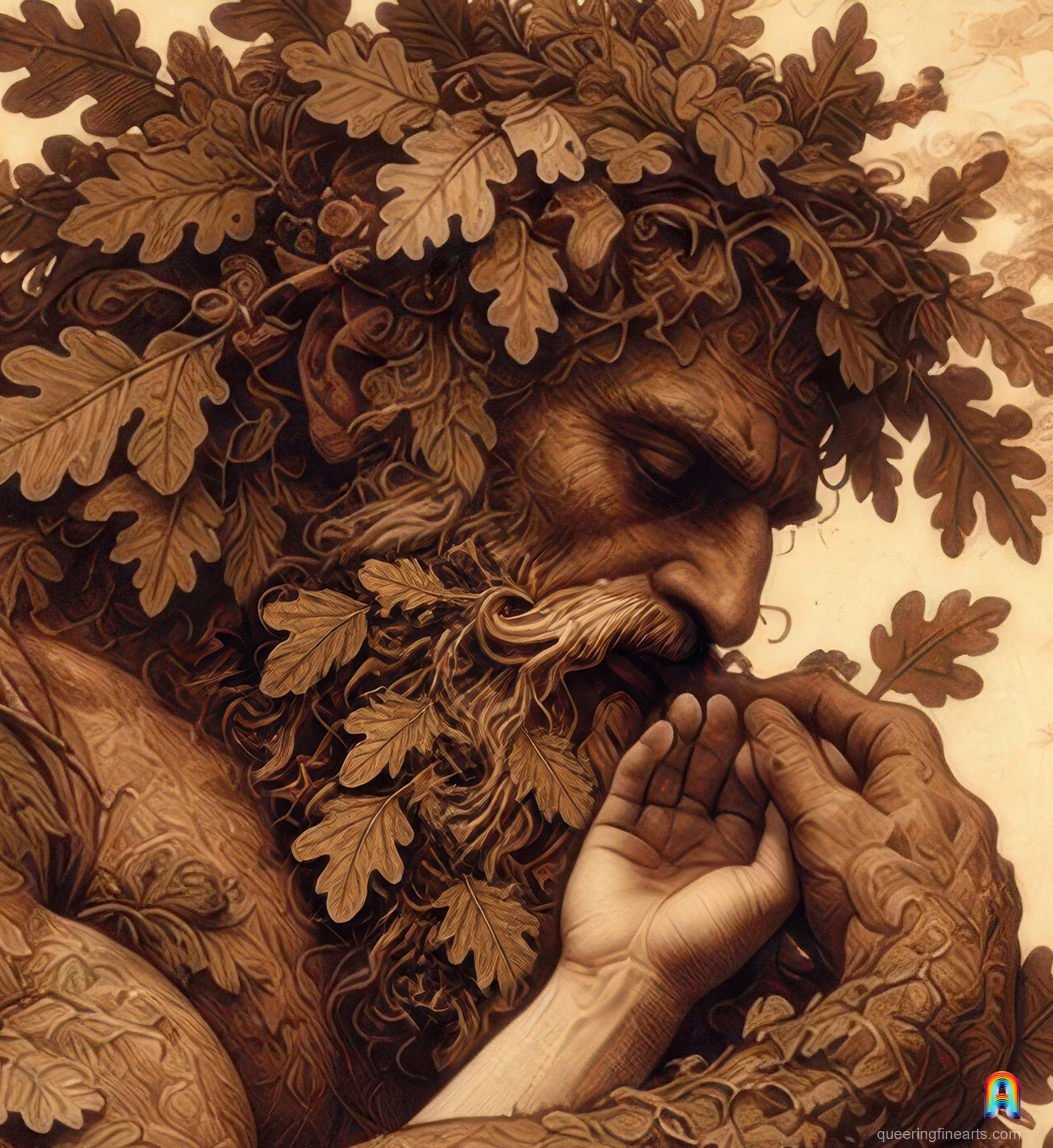
The Green Man becomes considerably less mysterious when placed within this world. A human face invaded by leaves or apparently becoming continuous with vegetation participates in the same freedom to cross the boundaries of the body. His strangeness belongs to a visual culture already comfortable imagining bodies that exceeded ordinary nature.
This context also helps explain the imaginative logic of The Green Man’s Abundance. The engraving takes the familiar foliate male beyond the face and gives vegetal masculinity an entire body. Its monumental erection and homosexual intimacy push the image in directions specific to the work, while remaining entirely at home within a much older visual tradition willing to make the body strange, sexual and marvellous.
The important point is simple: the medieval Green Man did not emerge within a visually austere world. He belonged to one of remarkable imaginative freedom. That freedom also made room for images whose meanings were never necessarily exhausted by a single explanation.
Curiosity Piqued?
1. Michael Camille, Image on the Edge: The Margins of Medieval Art (Cambridge, MA: Harvard University Press, 1992).
Camille opens the extraordinary world surrounding the central subjects of medieval art, particularly in manuscript margins. His monsters, sexual imagery, visual jokes and bodily inversions reveal how experimentation could flourish remarkably close to sacred texts and images. It is one of the most engaging introductions to the freedom of medieval visual imagination.
2. Anthony Weir and James Jerman, Images of Lust: Sexual Carvings on Medieval Churches (London: B. T. Batsford, 1986; later ed., London and New York: Routledge, 2013).
Weir and Jerman document the startling sexual imagery carved on medieval churches across Western Europe, including male exhibitionists, ithyphallic and megaphallic figures and explicitly displayed genitalia. Particularly valuable for our purposes is the prominence of the male body within this material: the penis could appear with extraordinary directness on Christian architecture itself. Their study also explores the varied moral and cultural meanings such imagery may have carried.
A Homosexual Green Man?
No medieval text provides a universal explanation for the foliate heads we now call Green Men. Their meanings varied with place, context and viewer, leaving the figure wonderfully open to renewed attention.¹ The Green Man is emphatically male, his imagery rooted in the vitality of nature and his deeper history reaching towards a mythological world in which masculine sexuality could include other males. What happens when we look at him homosexually
The question brings the Green Man remarkably close to the gay world of today. Gay culture has given particular erotic visibility to the mature masculine figure celebrated as the “daddy.” The word is modern; the attraction is surely much older. Men who loved men existed throughout the ancient and medieval worlds, and their attractions can hardly have been more uniform than our own. Mature masculine beauty, experience and virility were already there to be admired.
The Green Man’s Abundance makes the connection wonderfully tangible. Its immense older sylvan male is mature, bearded, powerful, tender and prodigiously sexual. He gathers a beautiful younger male against his body while embodying an almost inexhaustible masculine abundance. He is, in a wonderfully recognisable sense, an ancient daddy. The term belongs to modern gay culture; the masculine archetype it recognises is vastly older.
The resemblance extends beyond appearance. The daddy can embody experience and protection as well as sexual attraction, and relationships between older and younger adult gay men can include guidance and transmission.² In the engraving, this acquires an almost mythological dimension. The older creature’s prodigious virility appears capable of passing to his companion, making their intimacy sexual, tender and initiatory.
This is why reading the Green Man homosexually can be so rewarding. It opens onto the much larger history of what men may have found beautiful and sexually compelling in other men. His maturity, physical abundance and supernatural masculinity can speak powerfully to a homosexual imagination today.
And that leaves us with a tantalising question. If homosexual desire is ancient, if some of the masculine archetypes that still attract gay men are ancient and if the visual forms through which those archetypes were expressed survived across centuries, what exactly does it mean for a homosexual possibility to have been “lost”?
Curiosity Piqued?
1. Joana Filipa Fonseca Antunes, “Metamorphosis of the Green Man and the Wild Man in Portuguese Medieval Art,” in Flocel Sabaté, ed., Ideology in the Middle Ages (Leeds: Arc Humanities Press, 2019), pp. 281–300.
Antunes follows the Green Man and Wild Man through specific medieval contexts, showing how related figures could acquire different associations as their settings and uses changed. Her study is particularly valuable here because it resists reducing the Green Man to a single universal meaning and instead reveals the flexibility of a figure whose significance could be continually reshaped.
2. Tony Silva, Daddies of a Different Kind: Sex and Romance Between Older and Younger Adult Gay Men (New York: New York University Press, 2023).
Silva turns the gay “daddy” into a serious subject of study by listening to older gay and bisexual men and the younger adult men who desire them. Particularly relevant here is the importance his subjects give to masculine maturity, physical attraction, experience, care and mentorship. The book reveals the daddy as something considerably richer than a sexual stereotype: a distinctly gay erotic and relational figure in which age itself can enhance masculine desirability.
When Form Outlives Meaning
The Green Man has survived more successfully than any certainty about what he once meant. Across centuries, the form endured while interpretations changed, multiplied or disappeared. Aby Warburg later described this remarkable persistence of imagery as Nachleben, the “afterlife” of forms.¹ An image can outlive the world that first gave it meaning and remain available to other times, other cultures and other eyes.
That freedom matters enormously here. We cannot know everything a foliate male face meant to the people who carved or encountered it in the Middle Ages, and there is no reason to imprison it within the meanings we can document today. Its long history has already been one of reinterpretation.
A queer reading of the Green Man can therefore be historically informed without claiming to recover a lost homosexual meaning. The histories explored here enrich what we see, but they do not determine what we are allowed to see.
We are entitled to bring our own homosexual gaze to the image. A mature, bearded male face emerging from luxuriant vegetation can evoke masculinity, physical abundance, sexual vitality or the erotic appeal of the older male body to a gay viewer today. Those associations belong to the encounter between image and viewer, just as generations before us encountered the same form through the concerns and imaginations of their own time.
The Green Man’s Abundance embraces that freedom. It gives the foliate male a body, makes his virility spectacularly visible and places another male lovingly against him. It does not need to prove that the medieval Green Man was homosexual. It asks what the Green Man can become when homosexual men look at him through their own history, culture and attractions.
That freedom can itself be empowering. Queer people have spent centuries encountering histories in which their presence was condemned, obscured or simply left unrecorded. We can recover homosexual histories wherever the evidence allows it and acknowledge uncertainty where meanings have been lost. We do not need to ask permission to look at the images that have come down to us, to recognise ourselves within them or to interpret them through our own experience. The past belongs to us too, and we are free to look at it with our own eyes.
Curiosity Piqued?
1. Aby Warburg, The Renewal of Pagan Antiquity: Contributions to the Cultural History of the European Renaissance, trans. David Britt (Los Angeles: Getty Research Institute, 1999).
Warburg’s concept of Nachleben, the afterlife of forms, offers a useful way of understanding how images remain culturally alive after the circumstances and meanings that first surrounded them have changed.
QFA