Never Did Love Have a More Faithful Beloved
The Farewell of a Monk and His Crusader Lover
Oil on canvas, c. 1880
Private collection, Paris
The Farewell
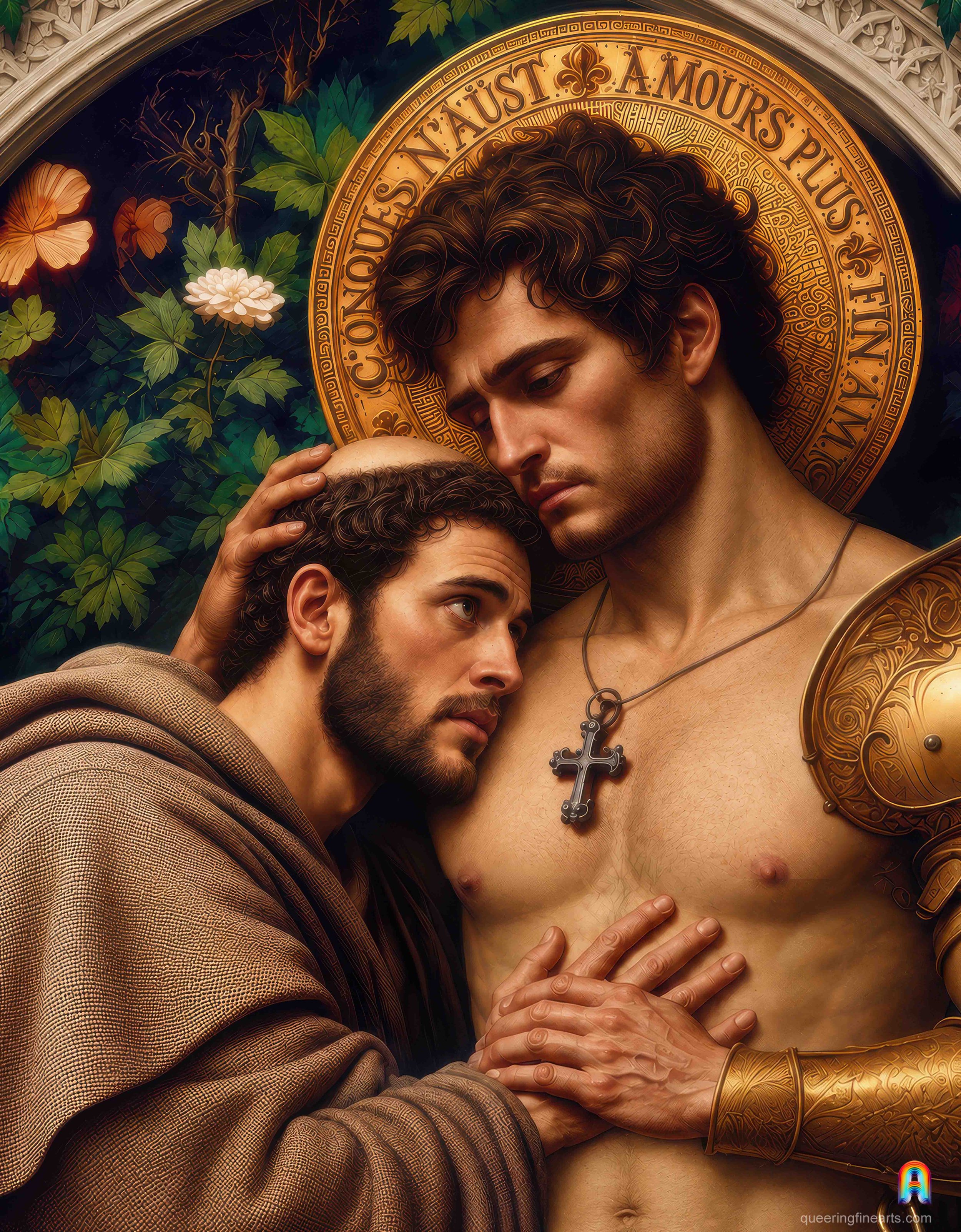
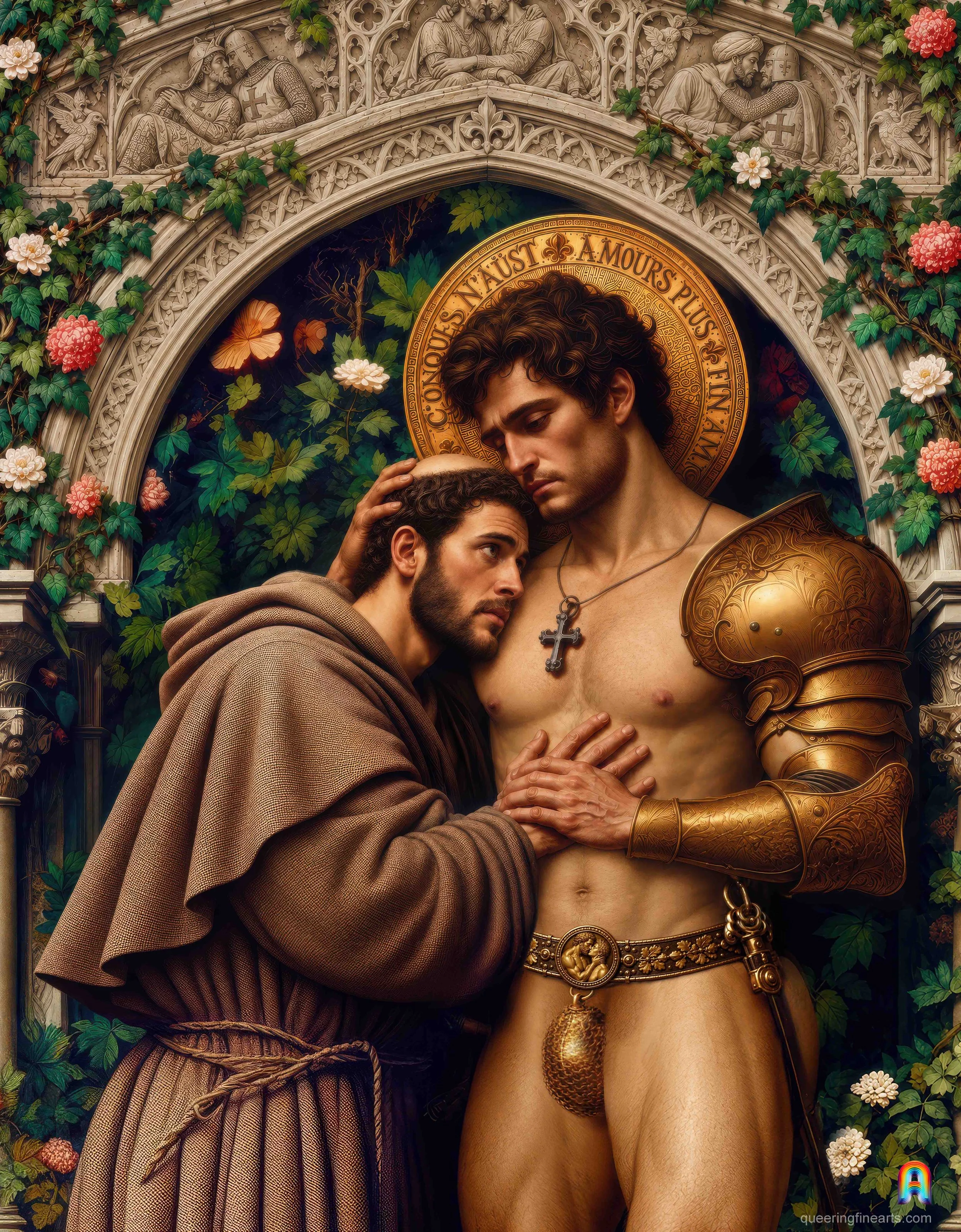
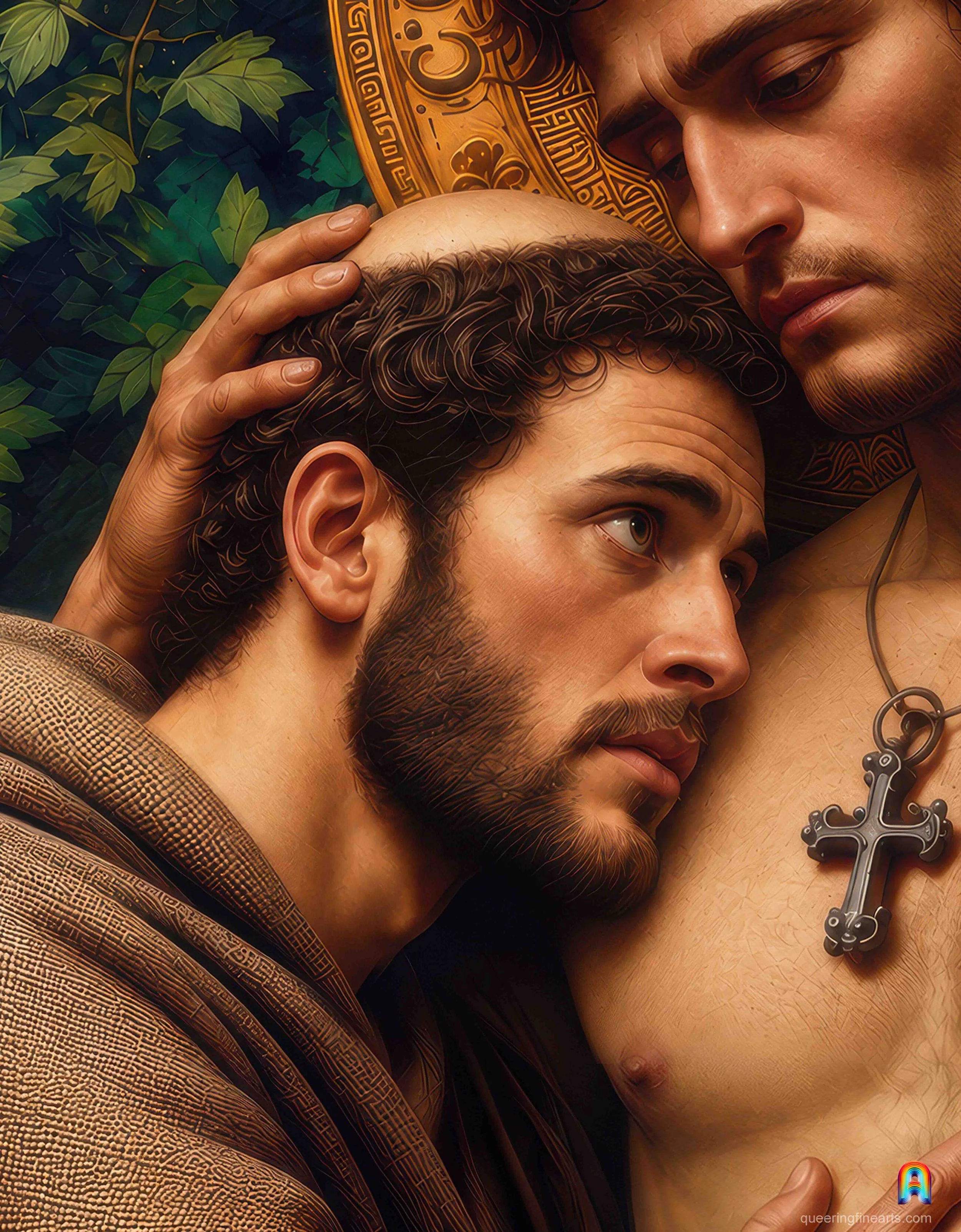
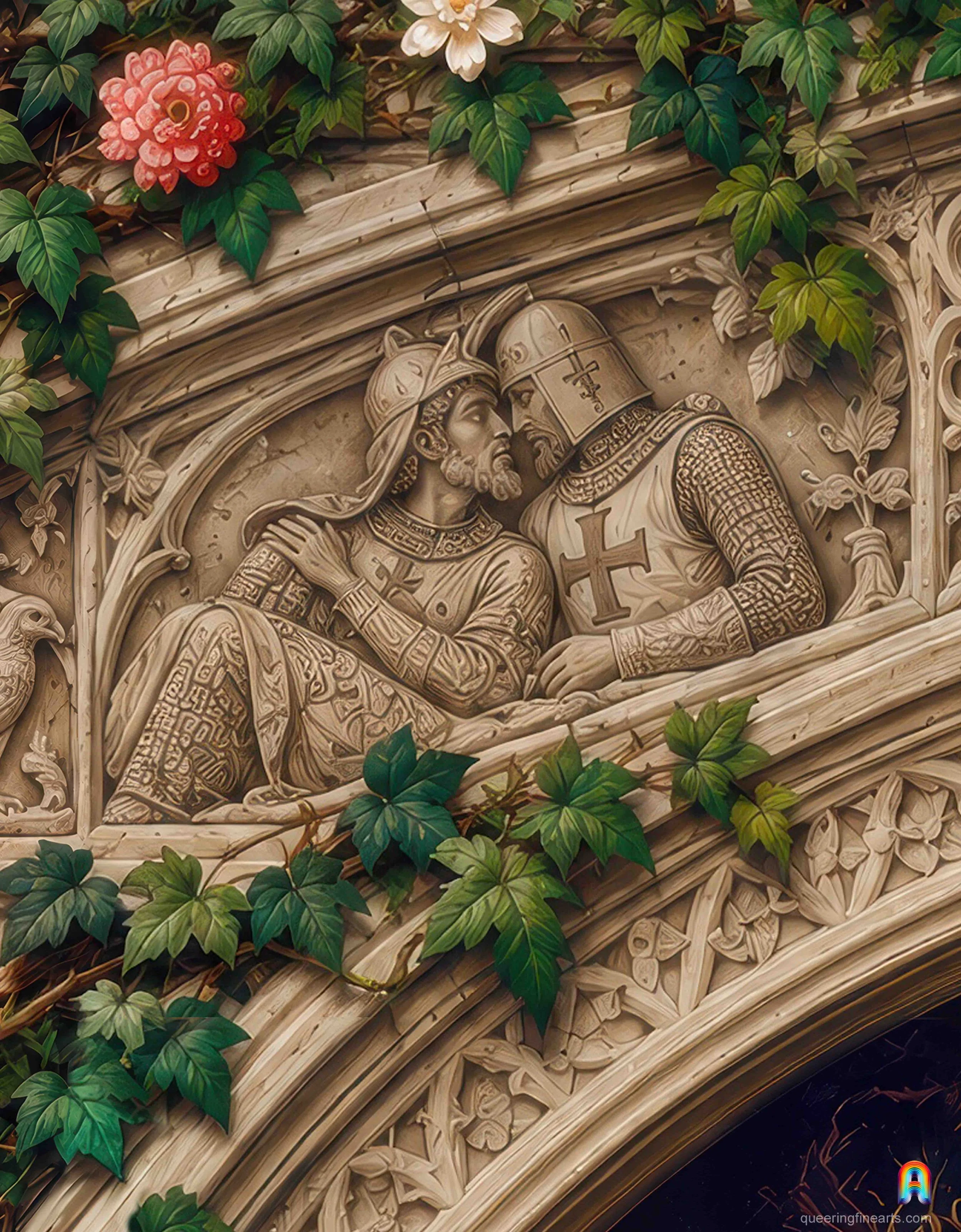
Beneath a stone arch thick with leaves and flowers, the monk has drawn close to his knight. He tilts his face towards him, searching his eyes, while both hands rest upon the knight’s bare chest. The gesture has the ease of intimacy: he knows this body, has touched it before and now seems reluctant to surrender it to the armour and the journey ahead.
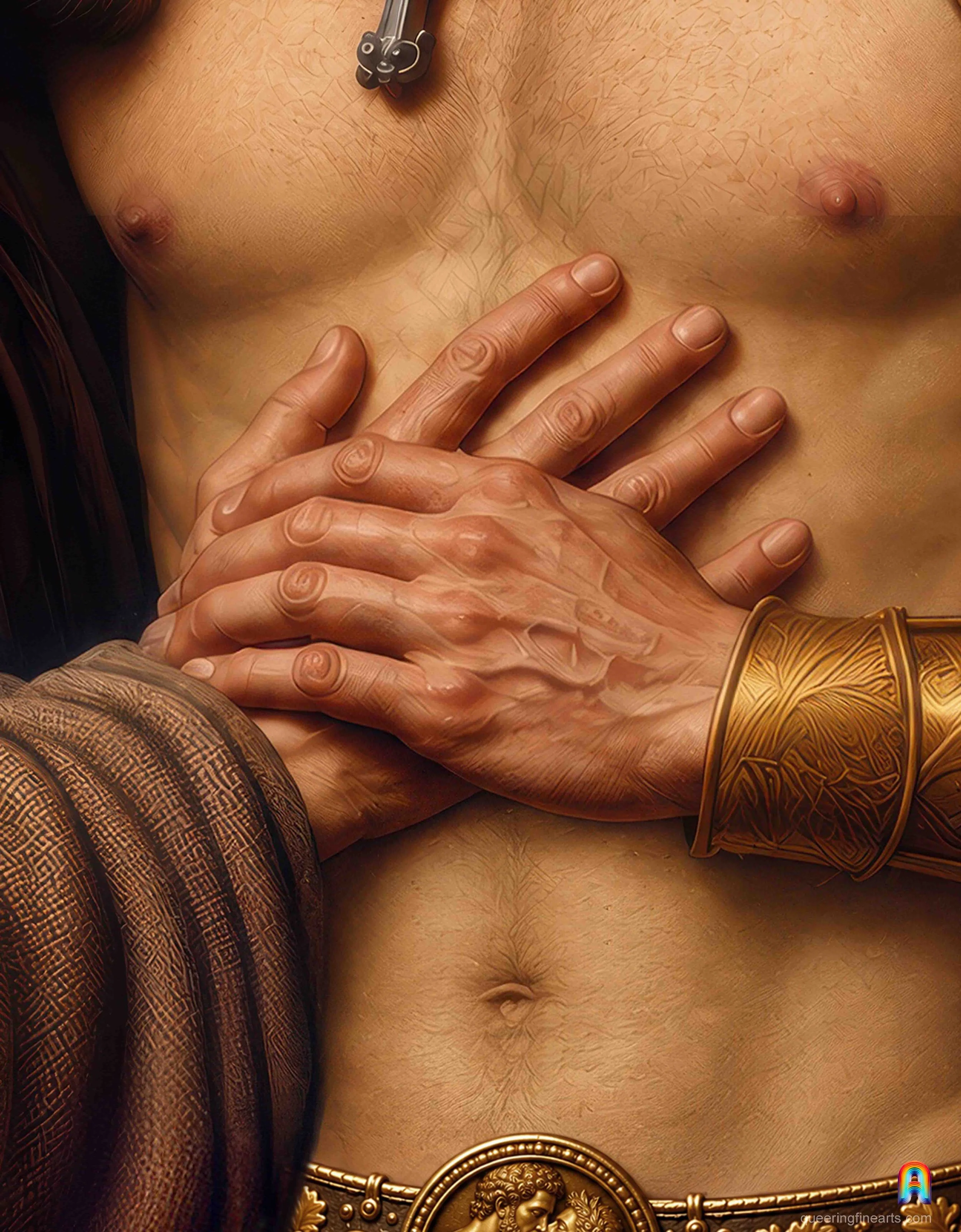
The knight looks down at him. One arm is encased in magnificent golden armour while the other remains bare and bends around the monk, his hand resting softly in his dark curls. Is he putting on his armour, preparing to leave, or taking it off for one last night with his lover? The painting leaves both possibilities open. Departure and desire occupy the same suspended moment. For now, the great warrior simply holds the head of the man he loves.
Everything around them seems to close in upon this moment. Flowers climb the columns and spill across the arch. White, orange and coral blossoms emerge from deep green foliage. Behind the men, the garden has become almost black, throwing their faces, their hands and the knight’s bare body into the light. Gold is everywhere: on his armour, at his waist and most brilliantly in the enormous halo surrounding his head. Against his skin hangs a simple cross.
The contradiction is deliberate. He appears almost as a saint and yet what is being sanctified here is unmistakably the love between two men.
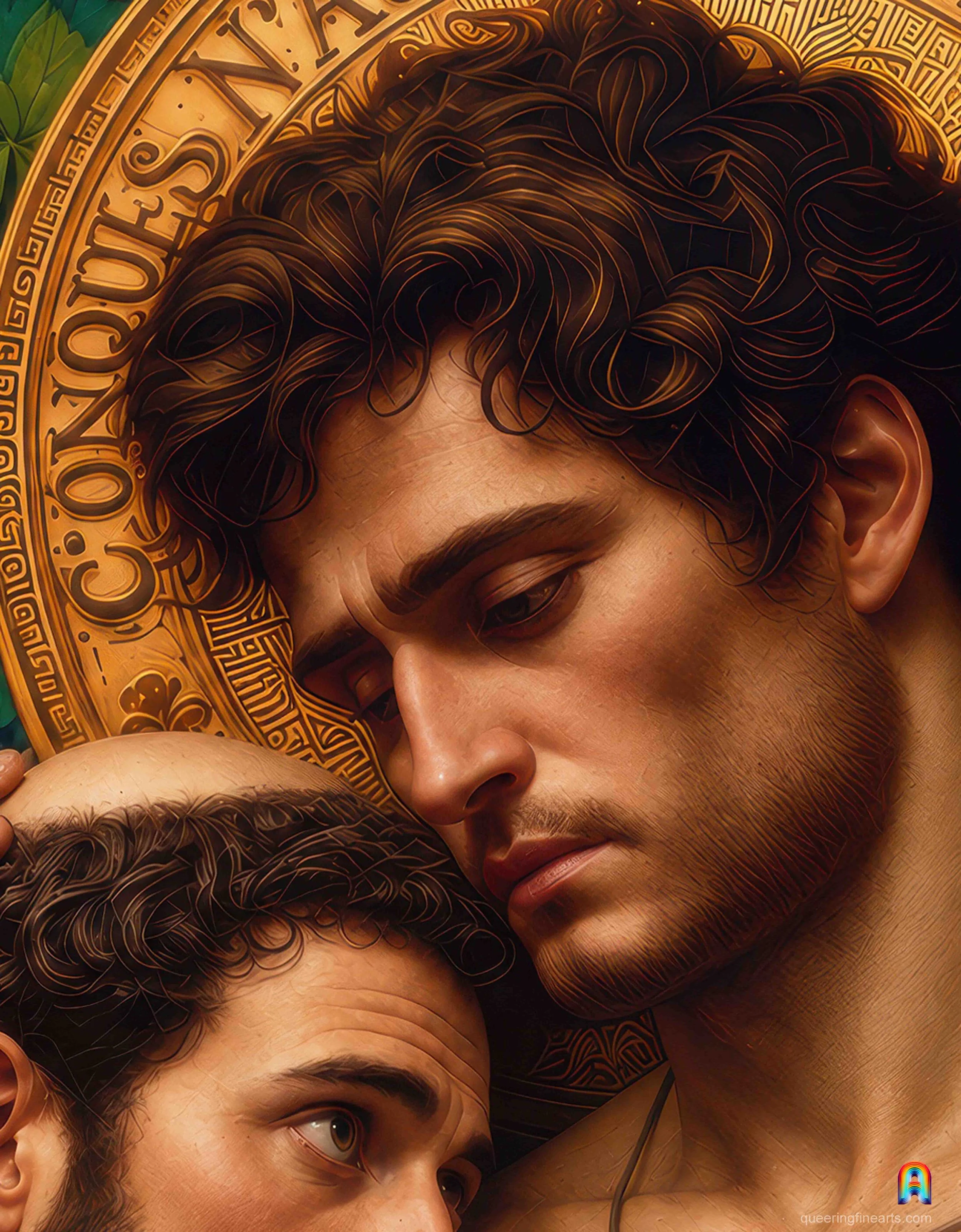
Even the halo speaks of their love. Around the knight’s head runs a line reconstructed from the crusading poetry of Conon de Béthune:¹
C’onques n’aüst Amours plus fin ami. Never did Love have a more faithful beloved.
The choice is more provocative than it first appears. The line survives only in damaged form. In an additional stanza preserved in one manuscript, its crucial second verse reads C’onques aüst … amin, with several words missing. The complete line used in the painting, C’onques n’aüst Amours plus fin ami, is a modern reconstruction of this fragment. What makes it particularly tantalising is that the masculine ami is rooted in the surviving end of the medieval verse rather than simply supplied by the reconstruction. The fragment cannot establish that Conon was writing a homosexual love poem, but the painting deliberately embraces its possibility, turning an unstable medieval line into a declaration of love between men.
Here there is no ambiguity about the lovers. Amours crowns the knight while ami names the man beneath the halo. A disputed fragment of medieval crusading lyric becomes, in the painting, an unequivocal declaration of homosexual love.
And the monk does not shrink from him. His body presses close. His face is raised openly towards the knight’s. His hand rests on bare skin with the familiarity of someone for whom this body is neither strange nor forbidden. The knight answers him just as plainly: hand over hand, hand in his hair, eyes lowered towards him.
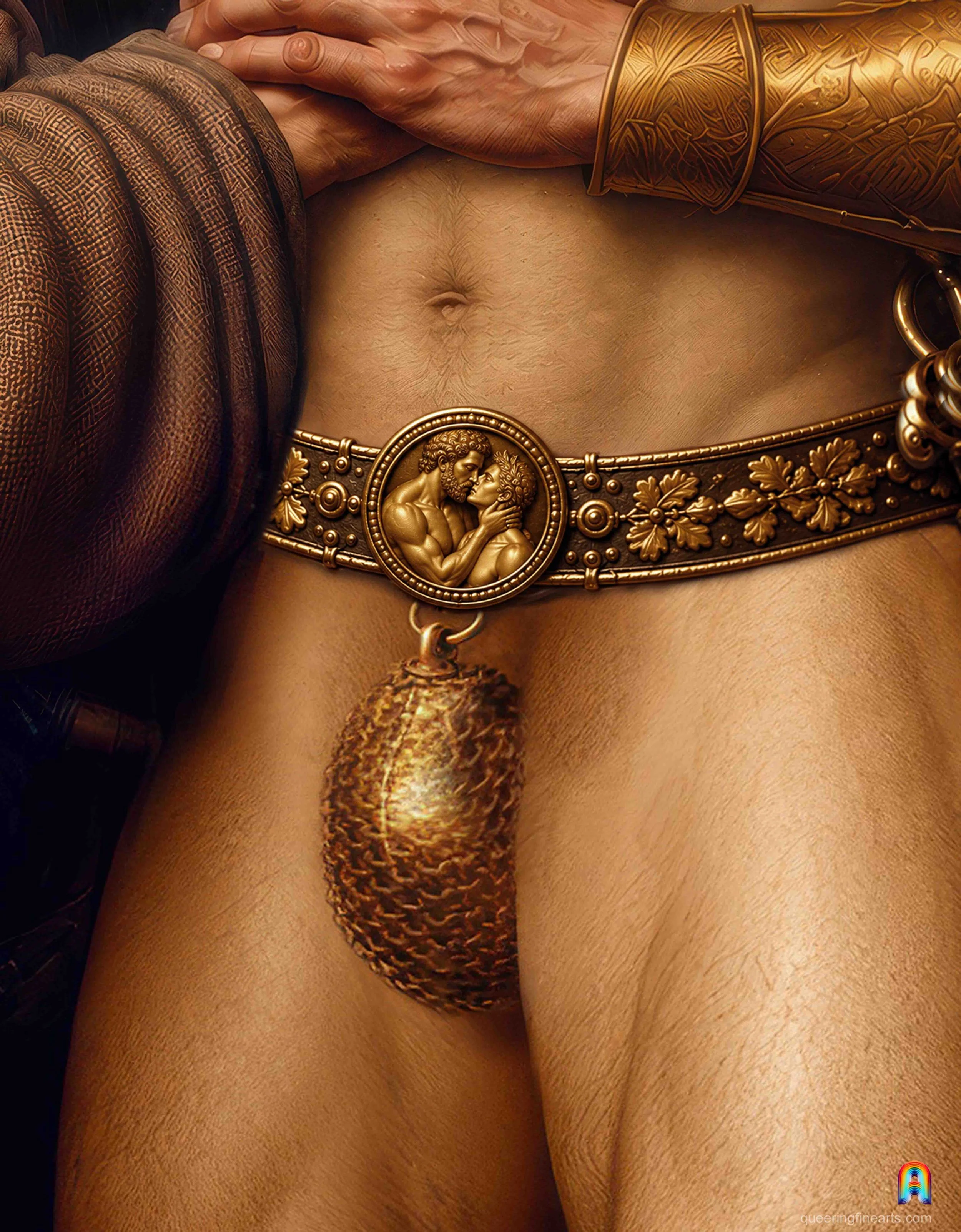
The armour itself belongs to a world of fantasy. Gold covers the great sculpted pauldron and the richly worked protection of his arm, every surface treated as something precious and ceremonial. The same imaginative language continues at his waist. From an ornamented golden belt hangs a penile sheath enclosed in fine golden chain mail, as though the knight’s most intimate anatomy had been granted its own exquisite piece of armour. Its oval form is deliberately ambiguous: it both encloses and exalts the Crusader’s sex, suggesting at once an elaborate work of goldsmithing devoted to chastity and a precious emblem of virility and fertility. What might conceal instead draws the eye, making the homoeroticism of the image wonderfully explicit. The monk’s hands rest upon the body of his lover while this elaborate, sensual armour celebrates the body itself, from shoulder to sex. Cross, halo, gold and desire all participate in the same vision of the knight.
There is no battle here. No enemy. No Jerusalem on the horizon. The Crusade has not yet swallowed the picture.
For this last instant, there are only two men beneath an arch of flowers.
A monk. A knight. And the knowledge that one of them is going away.
Curiosity Piqued?
1. Conon de Béthune, “Bien me deüsse targier” (RS 1314). Text edited in Axel Wallensköld, Les chansons de Conon de Béthune (Paris: Honoré Champion, 1921). Conon de Béthune was both a trouvère and a crusader, an unusual conjunction that makes his poetry especially pertinent to this painting. For a modern examination of Bien me deüsse targier and its difficult manuscript transmission, see Luca Barbieri’s 2016 edition for the University of Warwick project Troubadours, Trouvères and the Crusades. Comparing the witnesses and editorial reconstructions is particularly useful here, since the final stanza is textually problematic and the reading adopted in the painting is one proposed reconstruction rather than an uncontested medieval text. The Warwick project also places the song within the broader corpus of Old French crusade lyric and provides an excellent starting point for exploring how love, loyalty, separation and crusading intersect in this literature.
Men Who Loved Men Went on Crusade
Our knight and his monk are imaginary. The homosexual men who inhabited the world of the Crusades were not.
Thousands of men left western Europe for the eastern Mediterranean between the end of the 11th century and the fall of the last Crusader strongholds. Knights, princes, kings, clerics, servants, sailors and pilgrims travelled together for months or years through an overwhelmingly masculine world of armies, camps, ships, castles and religious houses. Most disappeared without leaving the slightest record of whom they desired or with whom they slept. Yet occasionally the sources allow us to see more.
And one of the men they reveal is perhaps the most famous Crusader of them all.
Richard the Lionheart
Richard I of England has become almost the archetype of the Crusader king. He took the cross in 1187, became king in 1189 and departed for the Third Crusade the following year. He conquered Cyprus, fought Saladin, captured Acre and won the great battle of Arsuf. Medieval chroniclers and later legend transformed him into the warrior king par excellence.
They also left behind a remarkably complicated record of his sexuality
The most famous episode occurred before Richard became king. In 1187 he allied himself with Philip II of France against his own father, Henry II. Roger of Howden describes the relationship between the two young princes in language whose intensity has fascinated historians ever since. Richard remained with Philip, they ate every day at the same table and from the same dish and at night, Roger tells us, “the bed did not separate them.” Philip loved Richard “as his own soul.” Their mutual attachment became so intense that Henry II was astonished by the vehemens amor between them and wondered what it meant.¹
Two medieval men sharing a bed were not necessarily lovers. Bed-sharing could express hospitality, friendship, hierarchy or political intimacy and the episode cannot by itself establish a sexual relationship between Richard and Philip. Nor can the extraordinarily affectionate language simply be translated into modern categories. Klaus van Eickels has drawn attention to the biblical model of David and Jonathan behind Roger’s description, a language capable of expressing an exceptionally intense bond between men.¹ Yet neither should the shared bed be isolated from everything else Roger tells us. The two men love one another, Philip loves Richard as his own soul and their vehemens amor is sufficiently conspicuous to disturb Richard’s father. The historical question lies precisely in determining what kind of love Roger believed he was describing.
Richard’s later life makes that question considerably more difficult to dismiss.
In 1190, while travelling towards the Holy Land, Richard stopped with his Crusading army at Messina in Sicily. There he underwent an extraordinary public act of sexual repentance. Roger of Howden says that the king remembered the turpitudo, the shame or foulness, of his previous life. Richard assembled the bishops and archbishops travelling with him, fell naked at their feet and confessed his sexual sins. Roger describes the king as having been overwhelmed by the “thorns” of his lusts. Richard received penance and, according to the chronicler, emerged from the episode a changed man.²
Five years later the problem returned. A hermit appeared before Richard and delivered an ominous warning: “Remember the destruction of Sodom and abstain from what is unlawful.” Richard initially ignored him. After becoming seriously ill, however, he confessed again, received absolution, returned to his wife Berengaria, whom he had long neglected, and, Roger tells us, abandoned his illicit sexual relations.²
None of these episodes provides the equivalent of a modern declaration of sexual identity. Richard also had sexual relations with women and fathered an illegitimate son. The medieval evidence therefore does not require us to choose between the modern categories homosexual and heterosexual. It does something more interesting: it preserves a king whose intense relationship with another man was remarked upon by contemporaries and whose sexual conduct repeatedly became the subject of penitence in the eyes of his chroniclers.
Historians have disagreed sharply about what to make of this evidence. John Gillingham, Richard’s great modern biographer, has repeatedly rejected homosexual interpretations of it. He emphasises that gestures such as kissing, bed-sharing and intensely affectionate language belonged to a medieval grammar of political alliance and male friendship whose meanings cannot simply be equated with modern sexual intimacy. William Burgwinkle has challenged that scepticism, questioning the very different standards of evidence historians have traditionally applied to heterosexual and homosexual desire. More recently, Hilary M. Rhodes has reassembled the medieval evidence and argued much more forcefully that Richard’s queerness should be taken seriously rather than continually explained away.³
The argument matters because Richard is not a marginal figure whom queer history has rescued from an obscure chronicle. He is Richard the Lionheart. The man whose sexuality has produced this debate is simultaneously one of the most celebrated military heroes in the entire history of the Crusades.
Men who desired men went on Crusade.
The queer court behind the First Crusade
Richard belonged to the Third Crusade, almost a century after the first armies marched towards Jerusalem. Yet if we return to the very beginning of the Crusading movement, we encounter another remarkable concentration of evidence much closer to home.
William II of England, better known as William Rufus, never went on Crusade. His brother Robert Curthose did. When Robert took the cross and needed an enormous sum to finance his expedition, he mortgaged Normandy to William for 10,000 silver marks. Rufus raised the money in England and took control of the duchy while Robert departed with the First Crusade. The court of a king repeatedly associated by medieval writers with sex between men therefore stood directly beside the financial and political machinery that sent one of the great Norman contingents towards Jerusalem.⁴
William himself never married and produced no recognised children. That alone proves nothing about his sexuality. What makes his reign exceptional is what contemporary and near-contemporary monastic writers say about the men surrounding him.
Eadmer, William of Malmesbury and Orderic Vitalis all describe a royal court in which conventional distinctions of masculine appearance and behaviour seemed, to their horrified eyes, to be collapsing. The young men around Rufus wore extravagant clothes, cultivated long hair and adopted fashions that clerical critics condemned as effeminate. More importantly, some of those writers associated the court explicitly with sexual activity between men.
The historian Tom Licence has recently returned to this evidence and made an important distinction. Medieval accusations of effeminacy cannot simply be translated into homosexuality. Long hair, luxurious clothing and elaborate shoes tell us about contested masculinity, fashion and clerical disapproval. Licence argues, however, that the sources go further: Rufus’s critics describe a court characterised by men who liked to have sex with men. He considers their testimony significant because it is early, consistent and specific, despite coming from hostile churchmen. His interpretation has itself been challenged on methodological grounds, particularly for the weight it places upon hostile clerical testimony and for the modern conceptual framework through which that testimony is read.⁵ The evidence therefore remains contested, but the controversy itself is revealing: several near-contemporary writers associated Rufus’s court not merely with effeminacy but with sexual behaviour between men.
Whether William himself had sex with men remains impossible to establish. The sources curiously stop short of accusing the king directly while describing the sexual world surrounding him. That silence has produced something of the same historiographical problem encountered with Richard. Heterosexuality can disappear into the background as an assumption while homosexuality is required to produce an impossible abundance of evidence before it is admitted even as a historical possibility.
The importance of Rufus for our story therefore extends beyond the sexuality of one king. His court existed at precisely the moment when the First Crusade began. The men who marched east did not leave a sexually uniform Christian West and suddenly encounter homosexuality in the Muslim world. Sex between men already existed in their own societies, their courts, their monasteries and undoubtedly their armies. Christian moralists knew it existed because they were already preaching and writing against it.
The Crusaders carried that world with them.
From the Lionheart to Jerusalem
The surviving evidence will never allow us to count the homosexual men who went on Crusade, but absence of documentation should not be confused with absence of homosexual men. Crusading mobilised tens of thousands of men over several centuries. Among any human population on that scale, a substantial number of men will experience sexual desire for other men, and it is scarcely conceivable that such desires remained universally unacted upon. Men desired other men in medieval Europe, as contemporary prohibitions, penitentials, accusations and occasional individual cases make abundantly clear. Some of those men inevitably took the cross, marched with armies, sailed on Crusading ships and lived for months or years in the overwhelmingly masculine societies created by warfare and migration. Some of them also had sex with other men. What has disappeared is not the homosexual behaviour but overwhelmingly the evidence that would allow us to attach names and stories to the men who engaged in it. Medieval chroniclers preserved the lives of kings, princes and aristocrats far more readily than those of ordinary soldiers, servants, sailors and pilgrims. Richard and the men surrounding William Rufus are visible because power made them visible. Their visibility should never be mistaken for uniqueness.
Richard the Lionheart nevertheless gives us something extraordinary. One of the most famous Crusaders who ever lived was remembered by medieval writers through an intense love for another man, repeated episodes of sexual repentance and a warning invoking Sodom. Around the time of the First Crusade, meanwhile, the court of William Rufus was being denounced by churchmen for sexual relations between men while Rufus himself financed his brother’s journey to the Holy Land.
Homosexual desire did not wait for the Crusaders in the East. Some of the men who went East carried it with them.
And in Jerusalem itself, at the very beginning of the Crusader kingdoms, we encounter an even more tantalising figure.
The first crowned King of Jerusalem. Baldwin I.
Curiosity Piqued?
1. Roger of Howden, Chronica Magistri Rogeri de Houedene, ed. William Stubbs, vol. II, Rolls Series 51 (London: Longmans, Green, Reader and Dyer, 1869), 318; English translation in Roger of Hoveden, The Annals of Roger de Hoveden, trans. Henry T. Riley, vol. II (London: H. G. Bohn, 1853), 63-64; Klaus van Eickels, “Homosexuality, Male Bonding and Male Friendship in Medieval Europe,” in Albrecht Classen and Marilyn Sandidge, eds., Friendship in the Middle Ages and Early Modern Age: Explorations of a Fundamental Ethical Discourse (Berlin and New York: De Gruyter, 2010), 267-297. Roger provides the indispensable contemporary account of Richard’s extraordinary intimacy with Philip II in 1187. The importance of the passage lies not simply in the famous shared bed. Roger describes the princes eating daily from the same dish, says that Philip loved Richard “as his own soul” and characterises the attachment between them as vehemens amor, intense or passionate love, strong enough to astonish Henry II. Van Eickels places this language within medieval traditions of male friendship and draws particular attention to the biblical model of David and Jonathan, whose love furnished medieval writers with a powerful vocabulary for intense bonds between men. The comparison is especially useful because it complicates rather than resolves the sexual question: the language is demonstrably capable of expressing political and emotional intimacy without allowing us simply to decide what happened in the bed Roger so conspicuously mentions.
2. Roger of Howden, Chronica Magistri Rogeri de Houedene, ed. William Stubbs, vol. III, Rolls Series 51 (London: Longmans, Green, Reader and Dyer, 1870), especially 74 and the account for 1195; Roger of Hoveden, The Annals of Roger de Hoveden, trans. Henry T. Riley, vol. II (London: H. G. Bohn, 1853). These passages contain two of the most intriguing episodes in Richard’s sexual history. At Messina in 1190, while actually travelling on Crusade, Richard assembles his bishops, falls naked at their feet and confesses the turpitudo of his previous life after being tormented by what Roger calls the thorns of lust. In 1195 a hermit warns him to remember the destruction of Sodom and abandon illicit behaviour. Richard later repents again and returns to his neglected wife. Neither passage names a male sexual partner and both must therefore be interpreted rather than treated as straightforward confessions of homosexuality. Their value lies in showing that Richard’s sexuality repeatedly became a subject of unusually dramatic penitential concern in a chronicle otherwise deeply invested in his kingship and Crusading career.
3. Hilary M. Rhodes, “Richard the Lionheart, Contested Queerness, and Crusading Memory,” Open Library of Humanities 9, no. 1 (2023), https://doi.org/10.16995/olh.9349; William E. Burgwinkle, Sodomy, Masculinity, and Law in Medieval Literature: France and England, 1050-1230 (Cambridge: Cambridge University Press, 2004), especially 72-86; John Gillingham, Richard I (New Haven and London: Yale University Press, 1999). These works allow the reader to enter the historiographical battle rather than simply accepting one interpretation of Richard. Gillingham represents the influential sceptical position, interpreting Richard’s relationship with Philip within medieval conventions of political alliance and male friendship and resisting attempts to convert references to intimacy or Sodom into proof of homosexual behaviour. Burgwinkle approaches the problem through the history of medieval sexuality and questions the unequal evidentiary standards by which heterosexual desire has frequently been assumed while homosexual desire must be demonstrated. Rhodes offers the most sustained recent queer reassessment, bringing together Richard’s relationship with Philip, his penitential episodes, medieval ideas of sodomy and the later construction of the Lionheart as a national and Crusading hero. Her article is particularly useful for understanding why the argument over Richard’s sexuality is also an argument over who has been allowed to inhabit the heroic memory of the Crusades.
4. Charles Wendell David, Robert Curthose, Duke of Normandy (Cambridge, MA: Harvard University Press, 1920), 89-119, especially 91-96; The Anglo-Saxon Chronicle, s.a. 1096; The Chronicle of John of Worcester, ed. and trans. P. McGurk, vol. III (Oxford: Clarendon Press, 1998), 84-85. Robert Curthose, duke of Normandy and elder brother of William Rufus, was one of the principal aristocratic leaders of the First Crusade. To finance the expedition he pledged Normandy to William for 10,000 marks. Rufus raised the enormous sum in England and assumed control of the duchy while Robert went east. These sources establish the concrete connection between Rufus and the First Crusade without pretending that William himself was a Crusader: the king whose court became notorious in contemporary clerical accounts for its sexual culture was directly involved in financing and facilitating his brother’s participation in the expedition that captured Jerusalem.
5. Tom Licence, “Sex at the Court of William Rufus,” in Laura L. Gathagan, Laura Wangerin and William North, eds., The Haskins Society Journal 33: Studies in Medieval History (Woodbridge: Boydell & Brewer, 2023), 13-34, https://doi.org/10.1017/9781800109483.002; see also T. J. H. McCarthy’s critical review of The Haskins Society Journal 33. Licence provides the most substantial recent reassessment of the evidence concerning sex between men at the court of William II. Returning principally to Eadmer, William of Malmesbury and Orderic Vitalis, he distinguishes conventional clerical attacks upon fashion and effeminacy from what he interprets as more specific testimony concerning sexual activity between men. His argument is deliberately strong: he regards the evidence as early, consistent and sufficiently specific to take seriously as testimony about the sexual culture of Rufus’s court. That interpretation has not gone unchallenged. McCarthy criticises Licence’s methodology and argues that some of his readings depend too heavily upon the conceptual framework he brings to hostile clerical sources. Reading the two together is therefore especially valuable: Licence demonstrates how much sexual information may be contained in sources too easily dismissed as moralising invective, while the criticism of his method reminds us how difficult it is to separate observation, polemic and modern interpretation when reconstructing homosexual life at a medieval court.
Baldwin I: A King in a Chainmail Closet?
Our knight and his monk belong to an imagined story. Yet the world into which we have placed them was inhabited by men whose homosexual desires and relationships have left tantalising traces in the historical record. We need not travel very far from our lovers to meet one of them. We need only follow the Crusaders to Jerusalem.
Baldwin I was no obscure knight whose private life vanished with him. He was one of the great figures of the First Crusade and, from 1100 until his death in 1118, the first crowned King of Jerusalem. He helped transform conquest into a kingdom, fought almost continuously, expanded Frankish territory and established the monarchy that would rule the Latin Kingdom of Jerusalem after him. His sexuality has puzzled historians for a very long time.
The secret pleasures of a king
Our most important narrative source is William of Tyre, the great historian of the Latin Kingdom, born in Jerusalem around 1130, little more than a decade after Baldwin’s death. William therefore did not know the king personally. He nevertheless grew up in the society Baldwin had helped create and later became archbishop of Tyre and chancellor of the kingdom. His Chronicon, written later in the 12th century, is one of the fundamental narrative sources for the history of the Crusader states.
When William describes Baldwin, he gives us a remarkably physical portrait: tall, dark-haired and dark-complexioned, with a prominent nose and upper lip, a somewhat receding chin and a dignified bearing. He praises his intelligence, his determination and his abilities as a ruler. Then he turns to sex and his language changes. William says that Baldwin was subject to carnis illecebris, the enticements or pleasures of the flesh. He adds that the king indulged these desires with extraordinary discretion. His sexual conduct was known, William tells us, only to a very small number of his intimate servants.¹
That secrecy has attracted the attention of historians precisely because William of Tyre was perfectly capable of being explicit about heterosexual misconduct. Hans Eberhard Mayer drew attention to the contrast. When William had women to talk about, he could talk about women. Yet when describing Baldwin’s sexual life he retreats into an unusually guarded formulation and places knowledge of it within the tiny masculine world of the king’s personal household. Mayer therefore suggested that William’s reticence may itself be significant: the desires he was declining to name may have been homosexual.²
Other historians have followed that trail. Malcolm Barber has described Baldwin’s homosexuality as probable. Christopher Tyerman has taken the possibility seriously. Ruth Mazo Karras places Baldwin at the centre of her investigation into sex between men and its punishment in the Latin East. Jay Rubenstein found an irresistible phrase for the possibility: Baldwin may have lived in a “chainmail closet.”³ The expression is witty, but the historical problem behind it is quite serious.
Baldwin married three times, as rulers did, for dynasty, alliance, wealth and politics. None of these marriages produced children, so far as the surviving sources tell us. His marital history therefore tells us that he fulfilled, or attempted to fulfil, the political and dynastic expectations of kingship. It tells us much less about whom he sexually desired.
A man in the king’s chamber
One man in Baldwin’s household makes the question considerably more intriguing. He was a Muslim who had converted to Christianity and at baptism took the king’s own name: Baldwin.
William of Tyre places this man extraordinarily close to the king. He calls him quasi cubicularius. A cubiculariusbelonged to the ruler’s chamber and personal household, the intimate domestic sphere surrounding his body, his clothing, his sleep and his privacy. William’s quasi makes the exact office difficult to define, but the social geography is unmistakable: this man lived close to the king.
How close becomes apparent in 1110, during Baldwin’s siege of Sidon. Men inside the Muslim city sought a way to assassinate the king and, according to William, approached the converted Muslim Baldwin. They promised that if he killed the king they would reward him richly and restore his family property. Their choice depended upon his extraordinary access to the king.
William explains that the convert accompanied Baldwin even when the king went apart to relieve himself. The proposed assassination was to exploit precisely this physical proximity. The plot was discovered and the converted Baldwin was executed.⁴
This episode has inevitably become part of the debate over Baldwin’s sexuality. William has already told us that the king possessed a secret sexual life known only to a few intimate servants. He then introduces a converted Muslim man occupying precisely that intimate household and enjoying exceptional access to Baldwin’s person. Ruth Mazo Karras consequently discusses the possibility that Baldwin had Muslim or formerly Muslim male lovers.⁵ The evidence cannot identify this particular man as Baldwin’s lover, but it does reveal an unusually intimate male household surrounding a king whose sexual behaviour William himself chooses not to name.
Desire in Outremer
That possibility becomes still more suggestive in the world of Outremer. The Latin Kingdom was born through conquest and terrible violence, but conquest also created proximity. Muslims, eastern Christians, Armenians and Latins encountered one another as subjects, servants, prisoners, soldiers, diplomats, physicians, merchants and members of aristocratic households. Baldwin himself had married an Armenian Christian. A converted Muslim man could inhabit the innermost circle of the Latin king, and sex and desire could cross those boundaries too
There is disagreement among historians about Baldwin and it deserves to remain visible. Susan B. Edgington, his modern biographer, is sceptical that William’s guarded language is sufficient to identify him as homosexual. Yet she makes an observation that is in some ways just as intriguing: Baldwin’s contemporaries apparently neither commented publicly on his sexuality nor condemned him for it.⁶ William could describe his secret sexual life and still praise his intelligence, determination and kingship.
We are therefore left with a remarkable historical possibility. The first crowned King of Jerusalem may have had sex with men, and several important historians think William’s language points in that direction. One of the men with exceptional access to his body was a Muslim convert. None of this prevented Baldwin from becoming one of the most powerful rulers of the early Crusader states. Our fictional knight, standing beneath his halo while his monk touches his naked chest, inhabits a world considerably more sexually complicated than the conventional image of the Crusader might suggest.
From Baldwin to Nablus
Baldwin’s story becomes still more provocative because of what happened almost immediately after his death. He died in 1118. Two years later, the rulers of the kingdom he had created assembled at Nablus. There, in 1120, they wrote sex between men into law and attached to it a punishment of extraordinary violence.
That extraordinary proximity takes us directly into the next chapter of our story.
Curiosity Piqued?
1. William of Tyre, Willelmi Tyrensis Archiepiscopi Chronicon, Book X, chap. 2, ed. R. B. C. Huygens, Corpus Christianorum Continuatio Mediaevalis 63–63A (Turnhout: Brepols, 1986). English translation: William of Tyre, A History of Deeds Done Beyond the Sea, trans. Emily Atwater Babcock and A. C. Krey, vol. I (New York: Columbia University Press, 1943). William is the indispensable medieval witness for Baldwin’s appearance, character and carefully veiled sexual life. The passage is worth reading in context because the sexual remark occurs within an otherwise admiring portrait of the king. William acknowledges Baldwin’s susceptibility to carnis illecebris and emphasises the extraordinary discretion with which he pursued these pleasures: knowledge of them remained confined to a very small number of intimate servants. William was born only after Baldwin’s death, so this is not eyewitness testimony, but he grew up in the Latin Kingdom Baldwin had founded and later occupied its highest ecclesiastical and political circles. His choice of words is the starting point for virtually every subsequent discussion of Baldwin’s sexuality.
2. Hans Eberhard Mayer, Mélanges sur l’histoire du royaume latin de Jérusalem, Mémoires de l’Académie des Inscriptions et Belles-Lettres, new series, 5 (Paris: Académie des Inscriptions et Belles-Lettres, 1984), 70–72. Mayer provides one of the most important arguments for reading William’s reticence as evidence of homosexual activity. His method is comparative: William can be quite direct when describing the sexual relationships of other rulers with women, yet becomes conspicuously vague when he reaches Baldwin. Mayer asks what might account for that change in vocabulary and suggests that sex with men offers a plausible explanation. This is particularly useful because the argument does not depend upon extracting a hidden confession from a single Latin phrase. It depends upon examining how the same chronicler writes about different kinds of sexual behaviour.
3. Malcolm Barber, The Crusader States (New Haven and London: Yale University Press, 2012); Christopher Tyerman, God’s War: A New History of the Crusades (Cambridge, MA: Belknap Press of Harvard University Press, 2006); Ruth Mazo Karras, “The Regulation of ‘Sodomy’ in the Latin East and West,” Speculum 95, no. 4 (2020): 969–986; Jay Rubenstein, Nebuchadnezzar’s Dream: The Crusades, Apocalyptic Prophecy, and the End of History (Oxford: Oxford University Press, 2019), 90–91. These historians show that the homosexual interpretation of Baldwin is not an eccentric modern invention attached to an ambiguous medieval sentence. Barber regards homosexuality as a probable explanation, Tyerman takes the evidence seriously and Karras incorporates Baldwin into a much broader investigation of male same-sex relations and their regulation in the Crusader states. Rubenstein gives the problem its memorable shorthand, the “chainmail closet.” Read together, these works are especially useful because they reveal historians reasoning from the same small body of evidence while differing in how confidently they interpret it. Karras’s article is the most important bridge to the later part of our story: Baldwin’s possible homosexual life becomes part of her investigation into why the Latin Kingdom produced exceptionally severe legislation against sex between men only two years after his death
4. William of Tyre, Chronicon, Book XI, chap. 14, ed. R. B. C. Huygens (Turnhout: Brepols, 1986), vol. I, 518; William of Tyre, A History of Deeds Done Beyond the Sea, trans. Emily Atwater Babcock and A. C. Krey, vol. I (New York: Columbia University Press, 1943), 487–488. This is William’s account of the converted Muslim Baldwin and the assassination plot during the siege of Sidon in 1110. Its importance lies less in what William says about sex, which is nothing explicit, than in what he reveals about access. The convert occupied a position close to the king’s chamber and could accompany him at exceptionally private moments. That intimacy made him useful to the conspirators. The episode therefore gives us a rare glimpse into the physical and domestic world surrounding Baldwin, the very world in which William elsewhere tells us that knowledge of the king’s sexual life was confined
5. Ruth Mazo Karras, “The Regulation of ‘Sodomy’ in the Latin East and West,” Speculum 95, no. 4 (2020): 969–986. Karras is the central modern study connecting Baldwin’s possible homosexuality with the wider history of sex between men in the Latin East. She brings William’s guarded description of Baldwin together with the evidence of his intimate household and discusses the possibility of Muslim or formerly Muslim male lovers. More importantly for what follows, she places this material beside the extraordinary legislation enacted at Nablus in 1120. Her article asks a larger historical question that will become crucial in the next sections of this essay: why did one of medieval Western Christianity’s earliest and most violent secular interventions against sex between men appear in the Crusader East?
6. Susan B. Edgington, Baldwin I of Jerusalem, 1100–1118 (Abingdon: Routledge, 2019), 181. Edgington provides the essential sceptical counterpoint. She considers the evidence insufficient to establish Baldwin’s homosexuality and therefore prevents William’s euphemistic language from being treated as certainty. Yet her discussion contains another historically important observation: Baldwin’s contemporaries apparently did not comment upon or condemn his sexuality. That point complicates any simple picture of an invariably persecuted homosexual Crusader. Whatever lay behind William’s guarded description, it coexisted with Baldwin’s successful kingship and with a later chronicler’s fundamentally admiring assessment of him.
When the Franks Looked East
To understand what happened next, we must cross the line that Crusader histories have so often drawn for us and look back from the other side. When the Franks arrived in Syria and Palestine at the end of the 11th century, they entered a Muslim world with its own ancient, sophisticated and remarkably visible culture of male homosexual desire.
For the men who inhabited Damascus, Aleppo, Baghdad, Cairo and the other great centres of Arabic culture, the possibility that one man might desire another was hardly an unimaginable secret. Men had been writing for centuries about the beauty of men and boys, about looking at them, falling in love with them, longing for them, drinking with them and wanting them sexually. One of the most celebrated examples is Abū Nuwās, who died around 814, nearly three centuries before the First Crusade. His poetry could celebrate wine and beautiful young men with startling directness, and his importance lies precisely in the fact that he was no obscure figure writing from the margins. He became one of the canonical poets of Arabic literature. Homosexual desire possessed a vocabulary, imagery and cultural memory long before a Frankish army appeared before Jerusalem.
The Crusaders therefore entered a society in which homosexual desire could become poetry. This did not mean that medieval Islamic societies simply approved of every sexual act between men. Islamic jurists discussed liwāṭ, generally referring to anal intercourse between males, and regarded it as sinful while disagreeing considerably about its legal classification, standards of proof and punishment. Religious prohibition existed alongside a much broader cultural world in which male beauty and homosexual desire could be contemplated, described and celebrated. Khaled El-Rouayheb has shown how sophisticated the distinctions could become between committing a sexual act, falling in love with a man, admiring male beauty and expressing that desire in poetry. His principal study concerns the later period from 1500 to 1800, but many of the literary and intellectual traditions he examines were already centuries old.¹
For our purposes, the essential historical point is wonderfully simple: male homosexual desire could be culturally visible even where particular homosexual acts were religiously forbidden.
Homosexual desire in the world of Saladin
The same coexistence can be found much closer to the actual period of the Crusades. The great 12th-century literary anthology Kharīdat al-qaṣr wa-jarīdat ahl al-ʿaṣr was compiled by ʿImād al-Dīn al-Iṣfahānī, born in 1125 and later secretary to Saladin. He was hardly detached from the Muslim struggle against the Franks. He served Nūr al-Dīn and Saladin and witnessed some of the central events of the period. Yet the enormous literary culture preserved in his anthology contains drinking poetry, erotic poetry and poems concerning beautiful young men alongside the martial and religious subjects that modern histories of the Crusades have traditionally preferred to emphasise.
Matthew L. Keegan has examined precisely this material and challenges the temptation to imagine Muslim culture during the Crusades as an austere society suddenly mobilised in its entirety around jihad. The poetry collected by ʿImād al-Dīn circulated through networks of educated elites and patrons, where pleasure, wine, desire and the appreciation of male beauty remained part of cultural life while Muslim rulers were simultaneously fighting the Franks.² The battlefield therefore separated two religions and two armies, but it did not separate a supposedly sexual West from an erotically silent East. On the other side were men whose own culture could speak openly and elaborately about the beauty of men.
The Muslim gaze turns upon the Franks
The Franks themselves quickly became objects of observation. One of our most fascinating witnesses is the Syrian prince Usāma ibn Munqidh, born at Shayzar in 1095, the year of Urban II’s call for the First Crusade. Soldier, diplomat, hunter, poet and aristocrat, Usāma spent much of his long life encountering Franks. He fought them, negotiated with them, befriended some of them and visited the Frankish Kingdom of Jerusalem. His Kitāb al-Iʿtibār, usually translated as The Book of Contemplation, gives us something precious: the Crusaders seen through the eyes of a Muslim contemporary.³
One of his most memorable stories concerns a Muslim bath attendant named Sālim at Maʿarrat al-Nuʿmān. A Frankish knight enters the bath and pulls away Sālim’s towel. Seeing that the attendant has shaved his pubic hair, the knight comes closer and touches his groin. Intrigued by what he sees and feels, he asks Sālim to do the same for him. The Frank lies on his back while Sālim shaves his pubic hair, then passes his hand over his newly smooth groin and approves of the result. Finally he summons his wife and asks Sālim to shave her as well.³
Usāma tells the story to illustrate what he considers the Franks’ astonishing attitudes towards bodily modesty, so the episode cannot simply be transformed into evidence that the knight and Sālim were lovers. Yet its physicality deserves to remain physical. A Christian knight removes another man’s covering, looks at his shaved pubis, approaches him and touches his groin. He then exposes his own body and lies before the Muslim attendant while the man shaves his pubic hair. This is not a modern erotic fantasy projected onto the Crusades. It is a story preserved by a Syrian Muslim aristocrat who actually lived among the Franks, and it gives us an extraordinarily intimate glimpse of male bodies crossing the cultural frontier.
Usāma also preserves a very different kind of intimacy. He tells of a Frankish knight who had spent enough time among Muslims to become familiar with local customs and who became his friend. The knight addressed Usāma as his brother and, when preparing to return to Europe, offered to take Usāma’s young son with him so that the boy could live among the knights and receive a Frankish education. Usāma politely refused, but the offer itself reveals considerable affection and trust between the two men.³ Their relationship is documented as friendship, and that friendship matters in its own right. Warfare did not prevent Frankish and Muslim men from forming personal attachments across the religious frontier.
The hammam was a world of male bodies
The setting of Sālim’s encounter is equally important. The bathhouse belonged to the ordinary physical culture of the Islamic city. Men undressed, washed, shaved and received bodily care there. Attendants worked directly upon other men’s bodies, while rules concerning coverings, looking and modesty attempted to regulate precisely the intimacy such spaces created. The hammam placed male bodies together in circumstances very different from those of the battlefield.
Some Franks entered that world too. Documentary and archaeological evidence shows that bathhouses continued to form part of urban life under Frankish rule. Acre possessed baths associated with Italian communities and the Hospitallers, while documents from Tyre record several more. Archaeologists have also excavated a substantial Crusader-period bathhouse at Acre.⁴ Usāma’s story therefore belongs to a broader physical history in which Franks encountered and adopted aspects of an eastern culture of bathing and bodily care.
Our knight has crossed the Mediterranean carrying armour, Christianity and the culture of the Frankish warrior. In the hammam, the armour comes off and the Muslim gaze encounters the Frankish body.
And sometimes the gaze was frankly sexual
Arabic and Persian literary traditions had long been capable of making Christians objects of erotic imagination. The beautiful Christian youth appears in poetry, while monasteries could become literary settings associated with wine, beautiful cupbearers and erotic encounters. Religious difference could itself participate in the beloved’s attraction. A Christian man could therefore occupy the erotic imagination of a Muslim poet, and a literary language already existed in which Christian male beauty could be desired.⁵
The Crusades brought an enormous new Christian presence into that imaginative landscape. The Syrian poet Ibn al-Qaysarānī, who died in 1154, travelled into the Frankish Principality of Antioch and composed a remarkable group of poems concerning the Franks, his Ifranjiyyāt. Nizar F. Hermes has described this corpus in terms of “Frankish enchantment” because Ibn al-Qaysarānī’s response to the invaders is considerably more complicated than simple hostility. His poems preserve curiosity, fascination and erotic interest in the Frankish world.⁵
Here the evidence requires an important distinction. The explicitly sexual objects in the surviving poems discussed by Hermes are principally Frankish women, so Ibn al-Qaysarānī cannot be recruited as evidence that Muslim poets were sexually desiring Frankish knights. What his poetry demonstrates is nevertheless important: Muslim observers could eroticise the people who had invaded their lands. Set beside a much older literary tradition capable of eroticising Christian men, it reveals the cultural possibility into which the Frankish male body had suddenly arrived. The Frank could be enemy, stranger and object of fascination, while the language for desiring beautiful men already existed.
The Crusaders had entered a different erotic landscape
The First Crusade is conventionally narrated as a movement from West to East: European men march towards Jerusalem and impose themselves upon the lands they conquer. Yet those men were also entering somebody else’s world, and in that world they were being watched. Muslim observers noticed their clothes, religious practices, customs, hygiene, women and bodies. The gaze did not travel in only one direction.
For a homosexual Frank, whether knight, servant, pilgrim or cleric, such encounters could have opened possibilities that our surviving sources only occasionally allow us to glimpse. We cannot reconstruct private experiences that disappeared without documentation, but we can reconstruct the cultural world in which those experiences might occur. Muslim poets had spent centuries writing about men who desired men. The Christian youth could become the beautiful beloved of a Muslim poet. Male bodies encountered one another within the intimate physical culture of the hammam. Frankish and Muslim men formed friendships, entered one another’s households and sometimes crossed religious boundaries altogether. The converted Muslim Baldwin had entered the intimate household of a king whose homosexuality several modern historians consider probable.
The Crusaders had gone East expecting to encounter the infidel. They also encountered a culture with a remarkably rich language for homosexual desire. Then, in 1120, at Nablus, the rulers of the new Christian kingdom made sex between men punishable by death.
Curiosity Piqued?
1. Philip F. Kennedy, The Wine Song in Classical Arabic Poetry: Abū Nuwās and the Literary Tradition (Oxford: Clarendon Press, 1997); Philip F. Kennedy, Abu Nuwas: A Genius of Poetry (Oxford: Oneworld, 2005); Khaled El-Rouayheb, Before Homosexuality in the Arab-Islamic World, 1500–1800 (Chicago: University of Chicago Press, 2005). Kennedy provides an excellent route into Abū Nuwās and the classical literary tradition in which wine, male beauty and sexual desire could be treated with extraordinary sophistication. His work makes particularly clear that poems about beautiful young men belonged to an established literary culture rather than an obscure sexual subculture. El-Rouayheb approaches the subject from another direction, drawing on poetry, biographical dictionaries, medicine, theology, mysticism, dream interpretation and legal writing to reconstruct the distinctions through which later Arab-Islamic societies understood male love, beauty and sexual acts. His study covers 1500–1800 and therefore cannot simply be projected backwards onto the Crusades, but it illuminates intellectual and literary traditions with much older histories. Together these works offer an unusually rich introduction to the coexistence of legal prohibition, male beauty and culturally articulated homosexual desire.
2. Matthew L. Keegan, “Rethinking Poetry as (Anti-Crusader) Propaganda: Licentiousness and Cross-Confessional Patronage in the Kharīdat al-qaṣr,” Intellectual History of the Islamicate World 11 (2023): 24–58.Keegan takes us directly into the literary culture of the Crusading period through ʿImād al-Dīn al-Iṣfahānī’s vast 12th-century anthology. His study is particularly valuable because it challenges the habit of reading poetry produced during the Crusades principally through jihad and anti-Frankish propaganda. The same elite literary networks preserved wine poetry, erotic verse and celebrations of pleasure. For our purposes, this places the cultural visibility of desire inside the political world of Nūr al-Dīn and Saladin rather than treating it as a distant feature of an earlier Islamic golden age.
3. Usāma ibn Munqidh, The Book of Contemplation: Islam and the Crusades, trans. Paul M. Cobb (London: Penguin Classics, 2008), especially 149–150 for the bathhouse episode. Few sources reward curiosity about everyday Frankish-Muslim encounters as richly as Usāma. A Syrian prince, soldier, diplomat and man of letters who personally knew Franks, he records everything from warfare and diplomacy to medicine, friendship, religion and bodily customs. The encounter between Sālim and the Frankish knight is especially remarkable for the physical detail with which male bodies are described, while Usāma’s friendship with the Frank who called him “brother” and offered to educate his son in Europe reveals another form of intimacy across the frontier. Neither story documents a homosexual relationship. Together, however, they open a window onto a world of physical contact, familiarity, friendship and cultural exchange largely invisible in narratives concerned only with armies and battles.
4. Benjamin Z. Kedar, “Frankish Bathhouses: Balneum and furnus - A Functional Dyad?,” in Iris Shagrir, Benjamin Z. Kedar and Michel Balard, eds., Communicating the Middle Ages: Essays in Honour of Sophia Menache (Abingdon and New York: Routledge, 2018), 121–140; Howard Smithline and Edna J. Stern, “A Crusader-Period Bathhouse in ‘Akko (Acre),” ‘Atiqot 73 (2013): 71–108. These studies move us from Usāma’s memorable anecdote to the material landscape of the Crusader cities themselves. Kedar assembles documentary evidence for baths used under Frankish rule, while Smithline and Stern examine the archaeological remains of a Crusader-period bathhouse at Acre, including its heating and water systems and decorative remains. Together they show that the hammam was not merely an exotic setting encountered by one wandering knight. Bathing became part of the urban environment inhabited by Franks in the Latin East.
5. Nizar F. Hermes, “The Poet(ry) of Frankish Enchantment: The Ifranjiyyāt of Ibn Qaysarānī,” Middle Eastern Literatures 20, no. 3 (2017): 267–287; see also Franklin Lewis, “Sexual Occidentation: The Politics of Conversion, Christian-love and Boy-love in ʿAṭṭār,” Iranian Studies, and Annemarie Schimmel, “Christianity vii. Christian Influences in Persian Poetry,” Encyclopaedia Iranica. These studies allow the reader to pursue two related but distinct phenomena. Hermes examines a Muslim poet of the Crusading period responding to the Franks with a mixture of hostility, fascination and erotic interest. The explicitly sexual figures in the surviving poems he discusses are principally Frankish women, an evidentiary limit worth preserving. Lewis and Schimmel open onto the wider literary tradition in which Christians, including beautiful Christian youths, could themselves become objects of male erotic imagination. Read together, these sources help recover something easily lost when the Crusades are viewed entirely from the Latin side: the invading Christians were also bodies being observed, imagined and sometimes eroticised by the societies into which they had arrived.QFA
Nablus, 1120: When Desire Became a Capital Crime
On 16 January 1120, the rulers of the Latin Kingdom of Jerusalem assembled at Nablus. Only twenty years had passed since the Crusaders captured Jerusalem and Baldwin I had been dead for less than two years. His cousin Baldwin II now occupied the throne. With Warmund, Patriarch of Jerusalem, the king gathered ecclesiastical and secular leaders of the kingdom for what William of Tyre would later describe as a conventus publicus et curia generalis, a public assembly and general court. The resulting canons are among the earliest laws produced by the new Frankish kingdom.
Sex occupies a remarkable place in them. Adultery, prostitution, sex between Christians and Muslims, rape and sexual relations between men all become matters for regulation. Even clothing capable of blurring the visible distinction between Frank and Muslim attracts the attention of the lawmakers. The new Christian kingdom was drawing boundaries around bodies.
Two men could now be sentenced to the flames
Canon 8 concerns homosexual sex. Its language is brutally concise. If an adult man is proven willingly to have engaged in what the text calls sodomitica nequicia, sodomitical acts, both the active and the passive participant are to be burned. The distinction is important: the law explicitly envisages two consenting male participants and condemns both. The following canons elaborate the offence, distinguishing consensual sex from coercion and establishing provisions concerning repentance and recurrence. Whether men were actually burned under these provisions is unknown: no surviving evidence allows us to determine how frequently, or even whether, the death penalty was enforced. What changed at Nablus was nevertheless momentous: consensual sex between men had become, in secular law, a capital crime.¹
Ruth Mazo Karras identifies Nablus as a remarkable turning point in the Western history of the prosecution of homosexual sex. Christian condemnation of sex between men was already centuries old, but the legislation of 1120 introduced something strikingly different: secular authorities prescribing extreme physical punishment, including death, for sexual acts between men. Karras places Nablus at the beginning of a legal transformation: during the following centuries, secular laws prescribing severe punishment for sex between men would appear more widely across medieval Europe.²
The location makes this innovation particularly intriguing. It emerged neither in the old heartlands of Latin Christianity nor in a secluded Western monastery. It appeared in the Crusader Kingdom of Jerusalem, among Franks living in the Muslim East.
Sex, religion and clothing
The homosexual canons do not stand alone. Canons 8 to 11 regulate sex between men and are followed immediately by canons regulating sexual relations between Christians and Muslims. A Frankish man who knowingly has sex with a Muslim woman is to have his penis cut off while the woman is to have her nose cut off. Other provisions address sexual violence involving Muslim women and a Christian woman who willingly has sex with a Muslim man. Canon 16 then turns from bodies to appearance: a Muslim who dresses in the Frankish manner is subject to confiscation of property.¹
Sexual, religious and visual boundaries consequently appear together within the same legislative programme. The laws regulate who may have sex with whom and who may visibly resemble whom. They belong to a society in which Christians and Muslims lived in proximity, worked and traded together, entered one another’s households and inevitably crossed boundaries that conquest had attempted to establish. The authorities at Nablus responded by defining those boundaries with unusual precision and violence.
This context does not establish that homosexual men were condemned to death because Muslim society possessed a visible culture of male homosexual desire. The historical argument is subtler and considerably more interesting. Karras asks why an exceptionally severe secular response to homosexual sex should emerge here, in the Latin East, and now, during the first generation of the Crusader kingdom.²
When the sexuality of the enemy comes home
Western Christians had long associated Muslims with sexual excess. Medieval Christian polemic could represent Islam through polygamy, sensuality and sexual practices Christians classified as sodomitical. The Muslim enemy was therefore imagined not only through religious difference but through sexual difference. The Crusades transformed that imagined East into a lived environment as thousands of Western men settled among Muslim and eastern Christian populations whose customs and sexual cultures differed from their own.²
As we have already seen, the Muslim societies they encountered possessed a long and culturally visible tradition of male homosexual desire. Poetry could celebrate male beauty and longing even while Islamic law prohibited particular sexual acts. Karras proposes that this encounter may have contributed to the unprecedented severity of the legislation enacted at Nablus. The significance of her argument lies in the mechanism she identifies: homosexual sex could become associated in the Frankish imagination with the sexual otherness of the Muslim world.²
The overwhelmingly masculine character of the First Crusade and of the early Frankish presence in the East makes this possibility still more suggestive. Western men were precisely those most exposed to daily encounters with Muslims and eastern Christians. The sexual difference attributed to the enemy could therefore become a danger imagined within the Frankish community itself. Contact made the frontier permeable and the law attempted to make it solid again.
Seen in this context, the sequence of the Nablus canons acquires a remarkable coherence. One group of laws regulates homosexual sex. Another regulates sexual relations across the Christian-Muslim divide. Another prevents Muslims from assuming Frankish appearance. Bodies, sex, religion and identity become different aspects of the same problem: how could a conquering Christian minority preserve its boundaries while living inside a much larger eastern world?
The possibility is disturbing. Christian hostility towards Islam may have helped intensify Christian hostility towards homosexual men.
From Jerusalem back to Europe?
Karras raises an even larger question: whether the legal innovation produced in the Crusader East may subsequently have travelled westward. Before Nablus, Western Christianity possessed abundant theological condemnation of homosexual sex, but death was not a general secular punishment for it. During the 13th century, laws prescribing severe criminal penalties for sex between men, including death, began to appear in parts of Western Europe. Their existence does not mean that such penalties were systematically enforced: medieval legislation tells us what authorities sought to punish much more readily than how often they actually did so. Nablus therefore appears extraordinarily early in the chronology.²
The evidence does not establish a direct line of transmission from the council chamber at Nablus to later European sodomy laws, and Karras does not claim one. Her argument instead changes the geography from which we view the history. One of the earliest and most severe medieval Western secular laws against consensual sex between men appears on the frontier of Latin Christianity, among Crusaders governing a population in which Muslims, eastern Christians and Franks lived in close proximity. It appears within legislation deeply concerned with regulating sexual and cultural crossings between those populations.
The Latin East can consequently be considered as a possible laboratory of legal change. Practices developed there could travel, just as people, texts, objects and ideas travelled continually between the Crusader states and Western Europe. Whether this particular innovation did so remains an open historical question. Its chronological precedence is nevertheless striking.
The Crusade turns inward
The legislation of Nablus gives the history of the Crusades another dimension. A movement directed outward against an enemy defined by religion also transformed the society of the conquerors themselves. Boundaries erected against Muslims could become boundaries regulating Christians. Anxiety about foreign sexual practices could become surveillance of Christian sexual behaviour. The sexual otherness attributed to the enemy could help determine which desires became intolerable at home.
This is what makes the chronology surrounding Baldwin I so haunting. Baldwin died in 1118. Several modern historians consider homosexual relationships a plausible explanation for William of Tyre’s guarded description of his sexual life, and Karras entertains the possibility that some of his male lovers may have been Muslim or formerly Muslim. Only two years later, the kingdom Baldwin had helped create decreed that two men who willingly had sex with one another could be sentenced to death by burning.
Our sources cannot establish a direct connection between Baldwin’s sexual life and the legislation of Nablus, but their proximity captures an extraordinary historical transformation. Within a single generation of the First Crusade, our surviving evidence takes us from the secret sexual life of a king who may have loved men to a law prescribing flames for men who had sex with one another. Between them stands the encounter of Franks and Muslims, two worlds whose histories of homosexuality had begun to become profoundly entangled.
Curiosity Piqued?
1. Benjamin Z. Kedar, “On the Origins of the Earliest Laws of Frankish Jerusalem: The Canons of the Council of Nablus, 1120,” Speculum 74, no. 2 (1999): 310–335, especially 331–334. Kedar provides the fundamental modern study of the Nablus legislation together with the critical text of the surviving canons. The sole surviving medieval manuscript was copied in the 12th century for the church of Sidon, making these laws unusually tangible evidence from the first generation of the Latin Kingdom. Reading the canons together is particularly revealing: regulations concerning homosexual acts appear beside provisions governing adultery, Christian-Muslim sexual relations, sexual violence and Muslim adoption of Frankish dress. The sequence allows the reader to see directly why Nablus can be approached not merely as a collection of sexual prohibitions but as legislation concerned with maintaining boundaries within a culturally mixed conquering society.
2. Ruth Mazo Karras, “The Regulation of ‘Sodomy’ in the Latin East and West,” Speculum 95, no. 4 (2020): 969–986. This is the central historical study behind our interpretation of Nablus. Karras begins from a striking chronological problem: widespread criminalisation of same-sex activity in medieval Western Europe is generally associated with the 13th century, yet the Nablus assembly had already prescribed exile, mutilation and death for sexual offences in 1120. She places this precocious legislation within the encounter between Western Christians and the Muslim East, examining Christian associations of Muslims with sodomy, the overwhelmingly male character of the Crusading movement and the possibility that anxieties generated on this frontier contributed to new forms of legal persecution. She also asks whether developments in the Latin East might help illuminate the later emergence of severe secular penalties in Western Europe. Her argument is deliberately exploratory rather than a claim of proven transmission, which is precisely what makes the article so useful: it shows how an unusual law can be used to ask a much larger question about the movement of sexual ideas between East and West
3. David M. Freidenreich, “Muslims in Western Canon Law, 1000–1500,” in Christian-Muslim Relations: A Bibliographical History, vol. 3, ed. David Thomas and Alex Mallett (Leiden: Brill, 2011), 41–68. Freidenreich places Nablus within the broader history of Christian attempts to regulate contact with Muslims. This is particularly valuable for understanding why the sexual provisions concerning Muslims should be read alongside the homosexual canons rather than treated as unrelated curiosities. Christian legal authorities increasingly sought to determine where contact between the two religious communities became unacceptable, with sex representing an especially charged form of boundary crossing. His study allows the curious reader to follow that concern beyond the Crusader states and into the developing Western canonical tradition.
Surviving Every Empire
The flames prescribed at Nablus were not the end of the story. For centuries afterwards, male homosexual desire continued to possess a remarkable visibility across much of the Muslim world. Arabic, Persian and Ottoman literature preserved poems addressed by men to beautiful men and boys. Love, admiration, physical attraction and sexual desire circulated through literary cultures perfectly capable of recognising what one man might feel for another.
Khaled El-Rouayheb has reconstructed this world in extraordinary detail for the Arabic-speaking Ottoman lands between 1500 and 1800. His sources include poetry, biographies, medicine, religious texts and dream interpretation and together they reveal the persistence of a rich culture of male same-sex eroticism many centuries after the Crusades. Religious prohibitions remained part of that world, as did moralists, jurists and periods of greater severity. Yet homosexual desire retained a cultural visibility that would become increasingly difficult to sustain as the Muslim world entered the modern period.¹
A long tradition begins to close
The transformation was gradual and uneven. It occurred differently in Istanbul, Cairo, Damascus, Beirut, Tunis, Algiers and the many other societies that cannot simply be collapsed into a single “Muslim world.” Yet from the 19th century onward, historians can observe an increasingly powerful movement towards new forms of sexual regulation, embarrassment and silence.
Dror Ze’evi has traced this transformation across four centuries of Ottoman sexual discourse. Medical treatises, legal records, religious writings, popular theatre and other sources reveal an earlier world in which sexuality could be discussed through multiple intellectual traditions. During the 19th century, many of those older ways of speaking about sex began to recede. New languages of sexuality emerged alongside modern medicine, administrative reform, changing religious thought and increasingly intense contact with Europe.
Male homosexual desire became caught within that transformation. The poetry remained, as did the manuscripts, Abū Nuwās and centuries of men writing about the beauty of other men. What increasingly changed was the cultural ease with which that inheritance could be acknowledged. During the 19th and 20th centuries, reforming intellectuals and political authorities sought new forms of modernity and respectability, religious reform movements developed new approaches to morality and modern states acquired more powerful mechanisms for regulating their populations. European medical and sexual classifications circulated internationally while nationalism promoted changing ideals of family, masculinity and social order.
European imperial power entered this already changing landscape
The West arrives with its own sexual morality
By the 19th century, the balance of power between Europe and much of the Muslim world had changed dramatically. Europeans arrived as diplomats, travellers, missionaries, scholars, soldiers, administrators and colonial rulers. They brought technologies and institutions, but they also brought moral assumptions about sex, gender, family and civilisation.
European travellers had long been fascinated by what they perceived as the sexual freedoms of Muslim societies. Male homosexuality became one of the recurring subjects through which Europeans imagined the East. What medieval Christians had described through the language of Muslim sensuality could now be reframed through ideas of civilisation, degeneration, morality and sexual respectability. The irony is striking: the West that had once imagined the Muslim East as dangerously tolerant of sex between men was now powerful enough to participate in reshaping that East according to European standards of sexual order.
Ze’evi identifies the encounter with European modernity as an important component of the transformation of Ottoman sexual discourse. Older languages of desire did not disappear overnight, but they became increasingly difficult to reconcile with emerging forms of modern respectability.² Western influence was one force among several. Muslim intellectuals, jurists, religious reformers, governments and communities remained active participants in their own transformations and no single explanation can account for developments extending across numerous societies over two centuries.
Colonialism nevertheless changed something fundamental. European sexual ideas no longer travelled only in books, sermons, medical theories and the observations of travellers. They could now travel with police forces, judges, bureaucracies and penal codes.
But Europe did not export one single legal model.
Britain and France deserve particular attention here not because they were the only European colonial powers to reshape the societies of the Muslim world, but because together they governed an exceptionally large share of Muslim-majority territories subjected to European rule and embodied two strikingly different legal relationships to homosexuality. Other European empires also mattered, but these two cases reveal particularly clearly how different colonial mechanisms could be
Britain exports its laws against homosexuality
The British Empire provides the clearest example. The Indian Penal Code of 1860 made “carnal intercourse against the order of nature” a criminal offence under Section 377. Versions of this prohibition, sometimes through the Indian model and sometimes through distinct colonial codes, travelled through British administrations across Asia, Africa and parts of the Middle East. The process was extensive rather than universal and the precise legislation varied between territories, but in many places the resulting prohibitions survived independence.³
Here the relationship between colonialism and modern anti-homosexual legislation is unusually direct. British rule did not merely bring European attitudes towards sexuality. It provided police, courts and penal codes capable of transforming those attitudes into an enduring machinery of state repression.
The reversal is extraordinary. Homosexuality is now sometimes denounced in former colonies as a foreign Western import. Yet in a considerable number of those countries, important parts of the modern penal machinery used to persecute homosexual acts were themselves imported by Europeans.
But Britain was not Europe
The French paradox
France presents a revealingly different case. Revolutionary France removed consensual sodomy from its criminal law in 1791 and the Penal Code of 1810 did not restore it. This should not be mistaken for an early French acceptance of homosexuality. The revolutionary reform belonged to a much broader transformation of criminal law in which certain offences understood primarily as matters of religion, sin or private morality ceased to be crimes punished by the state. Legal decriminalisation did not mean social acceptance of homosexual men. Police surveillance and repression could continue even in the absence of a specific crime of sodomy.⁴
It nevertheless produced an important legal difference. France entered the great age of European imperial expansion without an equivalent of Section 377 to reproduce systematically across its empire.
Yet French colonialism was hardly neutral in matters of sexuality. It carried European ideas about civilisation, race, masculinity, family and sexual respectability and embedded them within colonial administration, education and social regulation. French imperial influence could therefore transform sexual cultures without simply copying a metropolitan sodomy statute that no longer existed.
Sometimes the contradiction went further.
Under the French protectorate, Tunisia’s Penal Code of 1913 introduced Article 230, punishing sodomy with three years in prison even though no equivalent offence existed in metropolitan France.⁵ The contrast is remarkable. More than a century after revolutionary France had removed sodomy from its own criminal law, a penal code created under French colonial rule could criminalise it in Tunisia.
This apparent contradiction makes sense only if colonialism is understood as more than the geographical extension of metropolitan law. Colonial administrators governed populations through assumptions about civilisation, race, religion and the supposedly distinctive sexuality of colonised peoples. Colonial law could therefore become more sexually restrictive than the law operating in the colonising country itself.
Article 230 survived Tunisian independence in 1956. A provision created within a colonial legal order acquired a long postcolonial life of its own.
Colonial influence without a colonial copy
Elsewhere the genealogy was different again.
Algeria’s present prohibition of homosexual acts belongs to its Penal Code of 1966, four years after independence. Morocco’s current Article 489 likewise belongs formally to its post-independence Penal Code of 1962, although the extent to which its criminalisation of homosexual acts developed from legal structures and provisions established under the French protectorate remains a matter of historical interpretation. The Lebanese prohibition of sex “contrary to the order of nature,” often described simply as a French colonial relic, has an equally complicated history involving local Christian legal and theological traditions as well as European influence.⁶
These cases matter precisely because they prevent colonialism from becoming an explanation so convenient that it obscures history. Not every modern anti-homosexual law in a former colony was written by the coloniser and handed unchanged to the independent state. Colonial governments transformed legal institutions, social categories and mechanisms of surveillance. Local Muslim and Christian traditions continued to operate within those transformations. Independent states then retained, discarded, modified or created laws of their own
Colonial genealogy and postcolonial responsibility can coexist.
The comparison between Britain and France therefore reveals two very different mechanisms. Britain frequently exported criminal prohibition directly, although never through one perfectly uniform imperial code. French influence operated less consistently, sometimes through colonial legislation and sometimes through administrative, religious and cultural transformations that cannot be reduced to the copying of French law.
Not simply East against West
The Ottoman case reminds us how carefully this history must be told. It is often claimed that the Ottoman Empire simply “decriminalised homosexuality” in 1858 when it adopted a new penal code influenced by European models. Elif Ceylan Özsoy has demonstrated why that formulation is misleading. Earlier Ottoman law did not organise homosexual behaviour according to the modern Western category of homosexuality, so the reform of 1858 cannot simply be inserted into a Western narrative moving neatly from criminalisation to decriminalisation.
The larger transformation is more revealing than any single law. Muslim societies possessed their own religious prohibitions and legal traditions long before European conquest. Colonialism did not invent sexual prohibition. Nor, however, can modern repression simply be projected backwards as the unchanged continuation of timeless Islamic morality.
Across the 19th and 20th centuries, older traditions encountered European legal concepts, colonial bureaucracies, modern medicine, nationalism and new ideas about sexuality. The resulting systems were neither purely Islamic nor simply European imports.
Colonialism was one of the forces that changed the language, institutions and power through which homosexuality could be regulated and punished.
History performs an extraordinary reversal
During the 20th century, the direction began to change again. Homosexual men in many Western societies organised politically, published, demonstrated, challenged psychiatry and medicine, contested criminal laws and demanded recognition of their relationships and eventually their families. Across much of Europe and North America, laws criminalising consensual homosexual relations were repealed, gay men became increasingly visible and legal recognition expanded until, in a growing number of countries, marriage itself became available to two men.
The transformation constitutes one of the most remarkable reversals in the history we have been following. Societies whose legal and religious traditions had once permitted men to be executed for sex with men became capable of legally recognising the love between them.
The West therefore occupies no simple moral position in this story. It persecuted homosexual men. It exported some of that persecution. It also became one of the places where homosexual men eventually organised successfully against it.
That reversal contains something profoundly hopeful because it demonstrates that cultures can change. Religious traditions can be reread, laws can be repealed, inherited prejudices can lose their authority and forgotten histories can be recovered. Societies can become more generous than their past.
The story can travel again
For Muslim societies today, greater acceptance of homosexuality need not mean abandoning their history in order to imitate the West. Their own history contains centuries of poetry about male beauty, men writing about their desire for men, sophisticated discussions of love and attraction and periods in which homosexual desire possessed a cultural visibility that later became much more difficult.
Recovering that history requires neither idealising the medieval or Ottoman Muslim world nor transforming it into a modern gay paradise. It means recognising that tolerance, accommodation and the cultural expression of homosexual desire also belong to its inheritance.
That recognition changes the direction of the story.
The West need not appear at its conclusion as a teacher arriving to instruct Muslim societies in tolerance. History gives it no such privileged position. Western Christianity contributed to centuries of persecution and European empires participated in transforming sexual regulation across the societies they controlled. British colonial governments exported criminal prohibitions with extraordinary efficiency. French colonialism followed a different and more contradictory course.
The freedoms achieved much later in Western societies were themselves the result of struggles against parts of that inheritance. What the modern West possesses is therefore not an ancient moral superiority but evidence that profound change is possible.
That evidence belongs to everyone.
Back beneath the flowers
After this long journey, we can return to the two men with whom we began. The knight is still standing beneath the flowering arch, his fantastic golden armour partly embracing his body. The monk remains pressed against him, his hands upon his lover’s naked chest while the knight’s hand rests in his hair. Perhaps the armour is being put on for departure. Perhaps it is coming off for one last night together. Their suspended moment still contains both possibilities.
They cannot know the history that will follow them: the Crusades, Nablus, the tightening and loosening of prohibitions, the movement of laws and prejudices across continents and the long survival of homosexual desire beneath them all. We do and that knowledge allows us to see their embrace differently. Their hands upon one another belong to a much longer human history in which desire survives armies, religions, laws and empires.
Ideas have always travelled between East and West. Poetry travelled, science travelled, religion travelled and laws travelled. Ways of loving travelled too. Prejudices travelled, sometimes with terrible consequences.
And now freedom can travel.
Perhaps what once travelled from West to East was sometimes intolerance. What can travel now is freedom.
If greater freedom for homosexual men continues to grow across Muslim societies, it need not arrive as something foreign brought from the West. It can also become a recovery of something contained within their own long and complicated history.
The poems are still there.
So are the lovers.
For centuries, ideas, beliefs and prejudices have passed between East and West. Poetry and science crossed borders. Laws followed empires, sometimes with terrible consequences.
Homosexual men survived every attempt to condemn, silence or erase them. The future can secure what history so often denied: dignity, equality and the freedom to live and love without fear.
Curiosity Piqued?
1. Khaled El-Rouayheb, Before Homosexuality in the Arab-Islamic World, 1500–1800 (Chicago: University of Chicago Press, 2005). El-Rouayheb reconstructs the extraordinarily rich sexual culture of the Arabic-speaking Ottoman world through poetry, biographical dictionaries, medicine, theology, mysticism, dream interpretation and legal literature. His sources reveal societies capable of distinguishing sexual acts between men from falling in love with a man, admiring male beauty and writing poetry about it. The book is fundamental to this section because it demonstrates the persistence of culturally articulated male homosexual desire alongside religious prohibitions. It also cautions against projecting modern categories of sexual identity and modern patterns of social intolerance unchanged into the past.
2. Dror Ze’evi, Producing Desire: Changing Sexual Discourse in the Ottoman Middle East, 1500–1900 (Berkeley: University of California Press, 2006). Ze’evi follows changing ways of understanding sexuality across four centuries of Ottoman history through medical texts, religious writing, legal records, popular theatre and other sources. Particularly important here is his treatment of the 19th century, when older Ottoman languages of sexuality increasingly encountered European medicine, administrative reform and new classifications of sexual behaviour. His work prevents the story from becoming a convenient morality tale in which a tolerant Muslim world suddenly becomes intolerant because Europeans arrive. Internal transformations were already taking place, but European modernity became an increasingly powerful force within them. It is an essential source for understanding how profound cultural change can occur without being reducible to either indigenous tradition or foreign imposition.
3. Enze Han and Joseph O’Mahoney, “British Colonialism and the Criminalization of Homosexuality,” Cambridge Review of International Affairs 27, no. 2 (2014): 268–288; Human Rights Watch, This Alien Legacy: The Origins of ‘Sodomy’ Laws in British Colonialism (New York: Human Rights Watch, 2008). Han and O’Mahoney provide comparative evidence for the unusually strong relationship between British colonial rule and the later existence of laws criminalising homosexual conduct. Human Rights Watch reconstructs the legal machinery behind that relationship, beginning with Section 377 of the Indian Penal Code of 1860 and following related provisions through different parts of the British Empire. Together the studies also make an important qualification possible: there was no single statute mechanically imposed upon every British possession. Some territories received legislation derived closely from the Indian model while others were governed by differently worded colonial codes. The pattern was therefore extensive rather than universal. What connects these histories is the repeated use of imperial criminal law to regulate sex between men and the remarkable survival of many such provisions after independence.
4. Michael David Sibalis, “The Regulation of Male Homosexuality in Revolutionary and Napoleonic France, 1789–1815,” in Jeffrey Merrick and Bryant T. Ragan Jr., eds., Homosexuality in Modern France (New York: Oxford University Press, 1996), 80–101; Thierry Pastorello, “L’abolition du crime de sodomie en 1791 : un long processus social, répressif et pénal,” Cahiers d’histoire. Revue d’histoire critique, nos. 112–113 (2010): 197–208; Andrew Delatolla, “The French Empire and Its Legacies: Sexual and Gender Histories Exemplified in the Middle East and Africa,” in Colonialisms and Queer Politics: Sexualities, Genders, and Unsettling Colonialities (Oxford: Oxford University Press, 2026). Sibalis provides the essential legal and social background to the French paradox. The disappearance of consensual sodomy from revolutionary criminal law in 1791 did not amount to an early acceptance of homosexuality. Although “crimes against nature” ceased to be criminal offences, revolutionary and Napoleonic authorities continued to regard male homosexual behaviour as morally and socially troubling and men suspected of it could remain subject to police repression and surveillance. Pastorello places the abolition within a longer 18th-century transformation: prosecutions for sodomy as a capital crime had already become extremely rare while policing increasingly displaced prosecution and the “sodomite” was becoming a socially stigmatised type. Delatolla then follows the problem into the colonial period, examining how a France without a general metropolitan sodomy offence could nevertheless reshape sexuality, gender, family and respectability through imperial administration and colonial power. Together these studies connect the legal rupture of 1791 to the central paradox of French colonialism without confusing decriminalisation with tolerance
5. Ramy Khouili and Daniel Levine-Spound, Article 230: A History of the Criminalization of Homosexuality in Tunisia (Tunis: Avocats Sans Frontières, 2019). This archival and legal investigation makes Tunisia an unusually revealing test case for the French colonial paradox. Article 230 entered the Tunisian Penal Code in 1913 under the French protectorate and punished sodomy with three years in prison even though metropolitan French law had contained no equivalent offence since 1791. Particularly fascinating is the discrepancy between the French and Arabic formulations associated with the provision: the French text speaks specifically of “sodomie” while the Arabic terminology has been interpreted more broadly in relation to homosexuality. Khouili and Levine-Spound investigate how such a prohibition could emerge within a French colonial legal order without pretending that it was simply copied from France. Their research brings colonial administrators, Tunisian institutions, assumptions about indigenous sexuality and interpretations of Islamic law into the same history. Article 230 survived independence in 1956, demonstrating how a provision created within a colonial legal environment could acquire a postcolonial life extending far beyond the regime that produced it.
6. Andrew Delatolla, “The French Empire and Its Legacies”; Ivan Strenski, “On the Jesuit-Maronite Provenance of Lebanon’s Criminalization of Homosexuality,” Journal of Law and Religion 35, no. 3 (2020): 380–406; Morocco, Code pénal, Dahir no. 1-59-413 of 26 November 1962, art. 489; Algeria, Ordonnance no. 66-156 du 8 juin 1966 portant Code pénal, art. 338. Reading these cases together reveals why the phrase “colonial law” must be used carefully. Algeria’s current prohibition was enacted in 1966 after independence. Morocco’s Article 489 appears formally in the post-independence Penal Code of 1962, although sources differ over how much of its genealogy should be traced to legal structures and provisions developed during the French protectorate. Lebanon presents a different complication. Strenski challenges the familiar description of Article 534 as simply a French colonial import and traces its language of acts “against nature” through Maronite moral and legal traditions shaped partly by Thomistic and post-Tridentine Catholic theology transmitted through Jesuit institutions. These examples do not diminish colonial influence. They reveal how colonial institutions, European ideas, local religious traditions and postcolonial legislation could interact rather than forming a single chain of legal copying.
7. Elif Ceylan Özsoy, “Decolonizing Decriminalization Analyses: Did the Ottomans Decriminalize Homosexuality in 1858?,” Journal of Homosexuality 68, no. 12 (2021): 1979–2002. Özsoy dismantles one of the most attractive simplifications in popular queer history: the assertion that the Ottoman Empire straightforwardly “decriminalised homosexuality” in 1858. Earlier Ottoman law regulated particular sexual acts through categories that do not correspond neatly to the modern concept of homosexuality. The disappearance or alteration of particular offences in the 1858 Penal Code therefore cannot automatically be understood as the Ottoman equivalent of modern gay decriminalisation. This article is especially valuable at the end of our colonial discussion because it prevents the argument from simply reversing an older Eurocentric narrative. Neither “Islam persecuted homosexuals until the West liberated them” nor “Islam tolerated homosexuality until the West criminalised it” adequately describes the historical record. The transformations occurred through interactions among indigenous legal and religious traditions, Ottoman reform, European influence, colonial government and eventually the choices of independent states.
QFA