

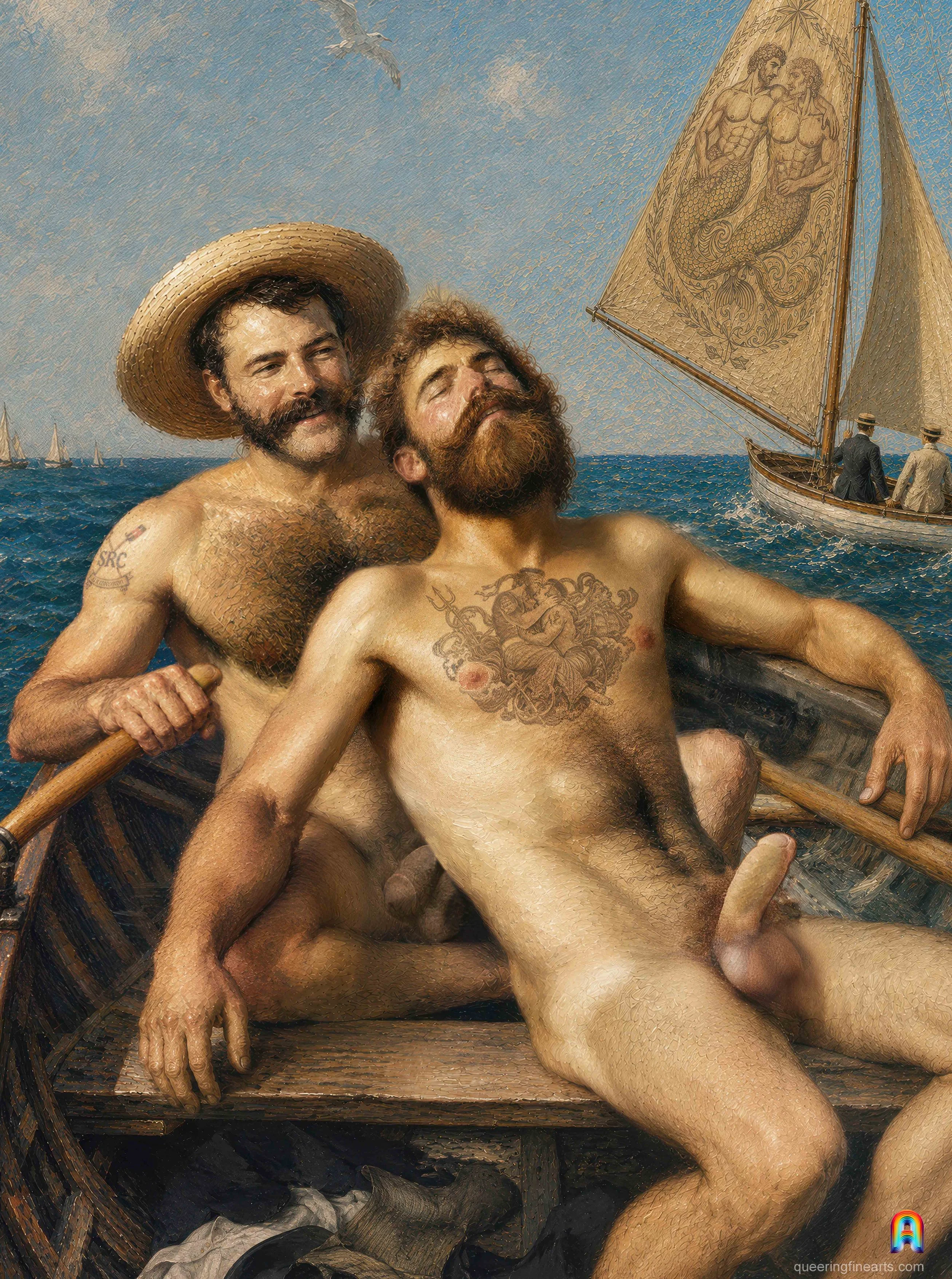
Cox at Sea
Attributed to Rupert Bunny (1864-1947)
Oil on canvas, c. 1890
The Museum of Gentlemen’s Rowing
Against the Current: Queer Lives and Victorian Rowing
An Intimate Portrait of a Rower in the Victorian Age
distance, several sailboats punctuate the horizon, while another passes much closer on the right.
In the foreground, John Lempriere Irvine (1847-?) and his lover occupy almost the entire space of a wooden rowing boat. Irvine, an Australian rowing champion and captain of the Sandhurst Rowing Club, is shown here with the man who shares his intimacy.
The title Cox at Sea plays lightly with rowing terminology. The cox, or coxswain, steers the boat and directs the rowers rather than rowing himself. Irvine was no cox, of course, but the irresistible echo between cox and cocks gives the title a second meaning particularly well suited to the scene.
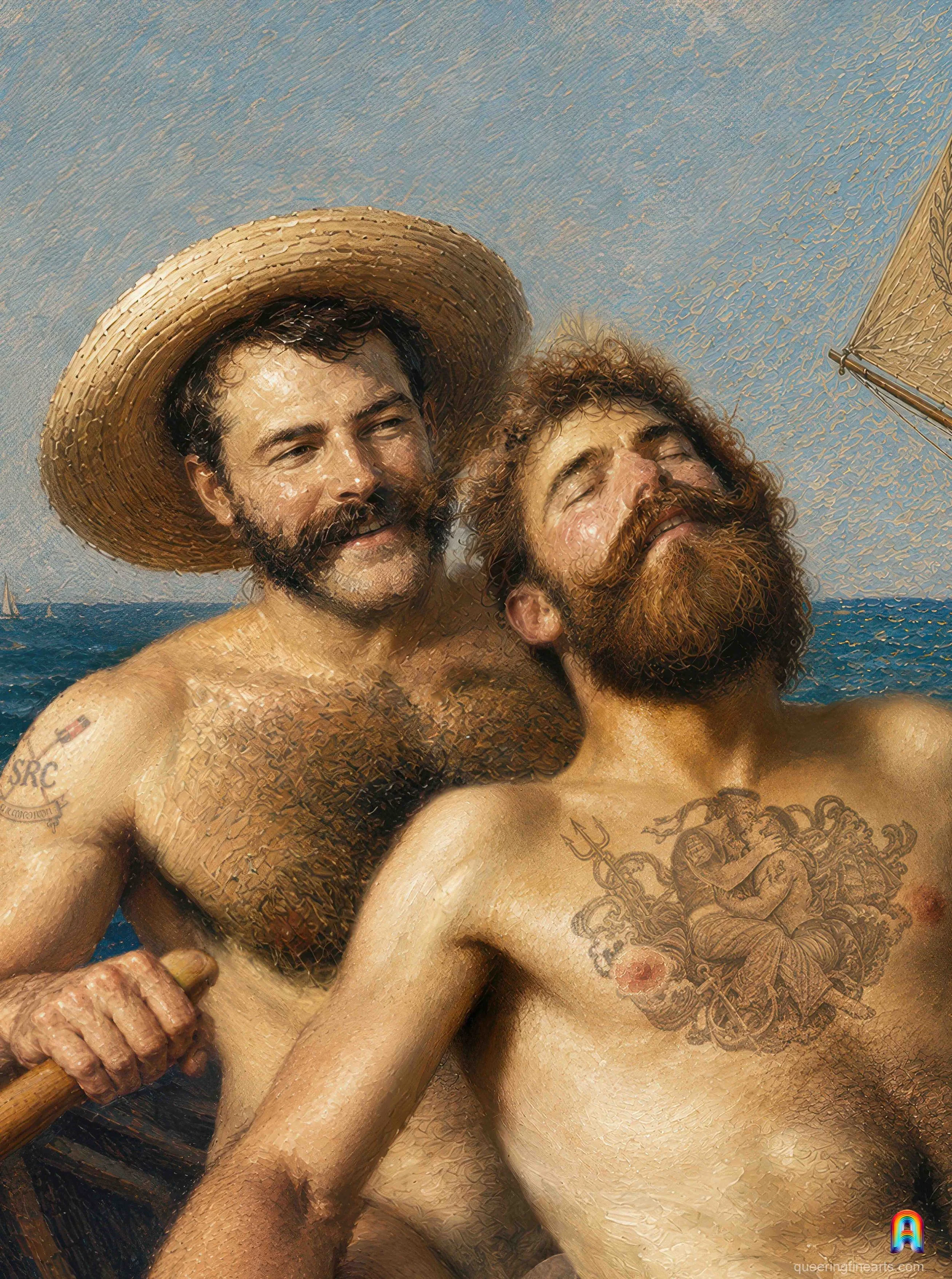
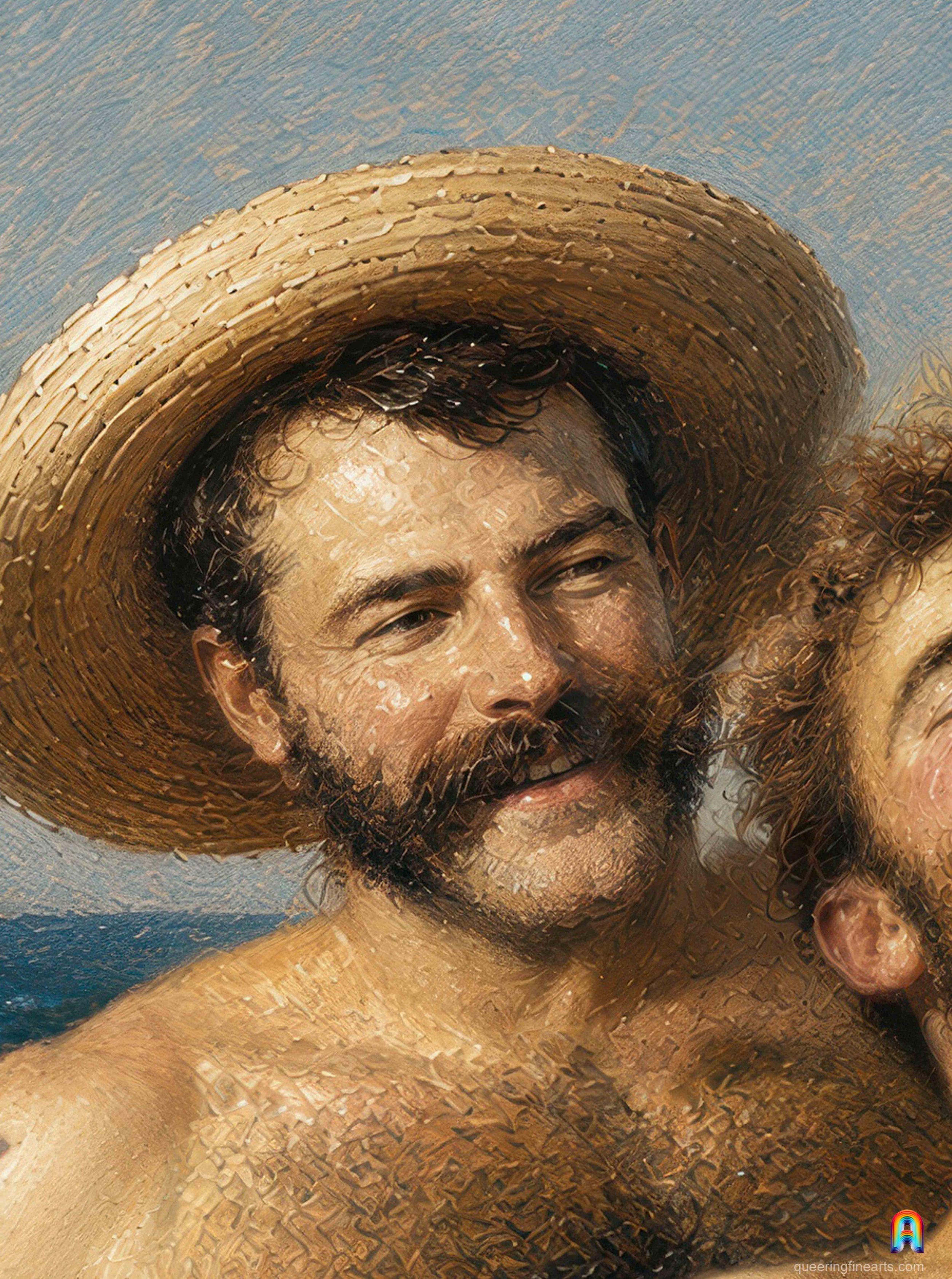
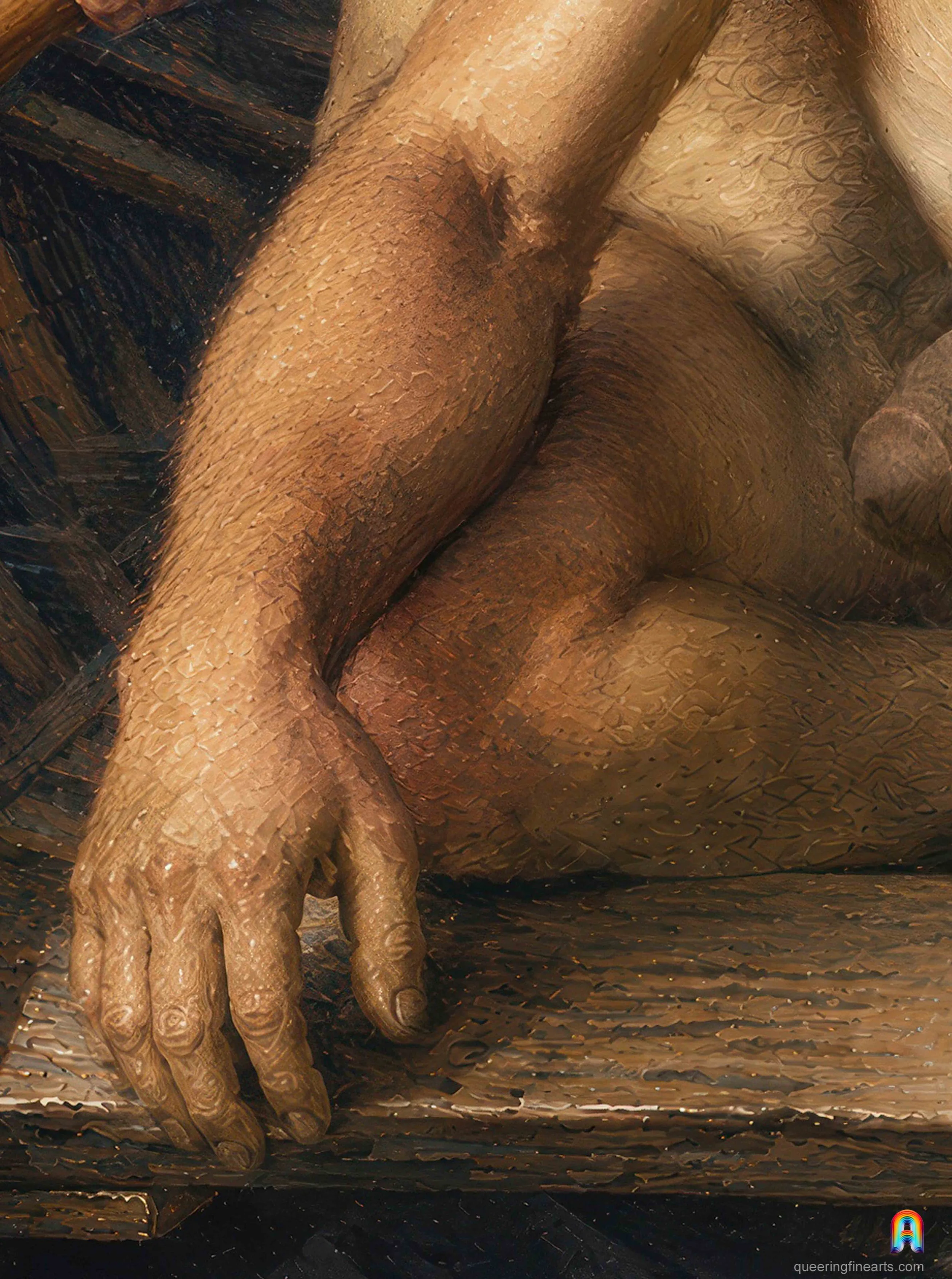
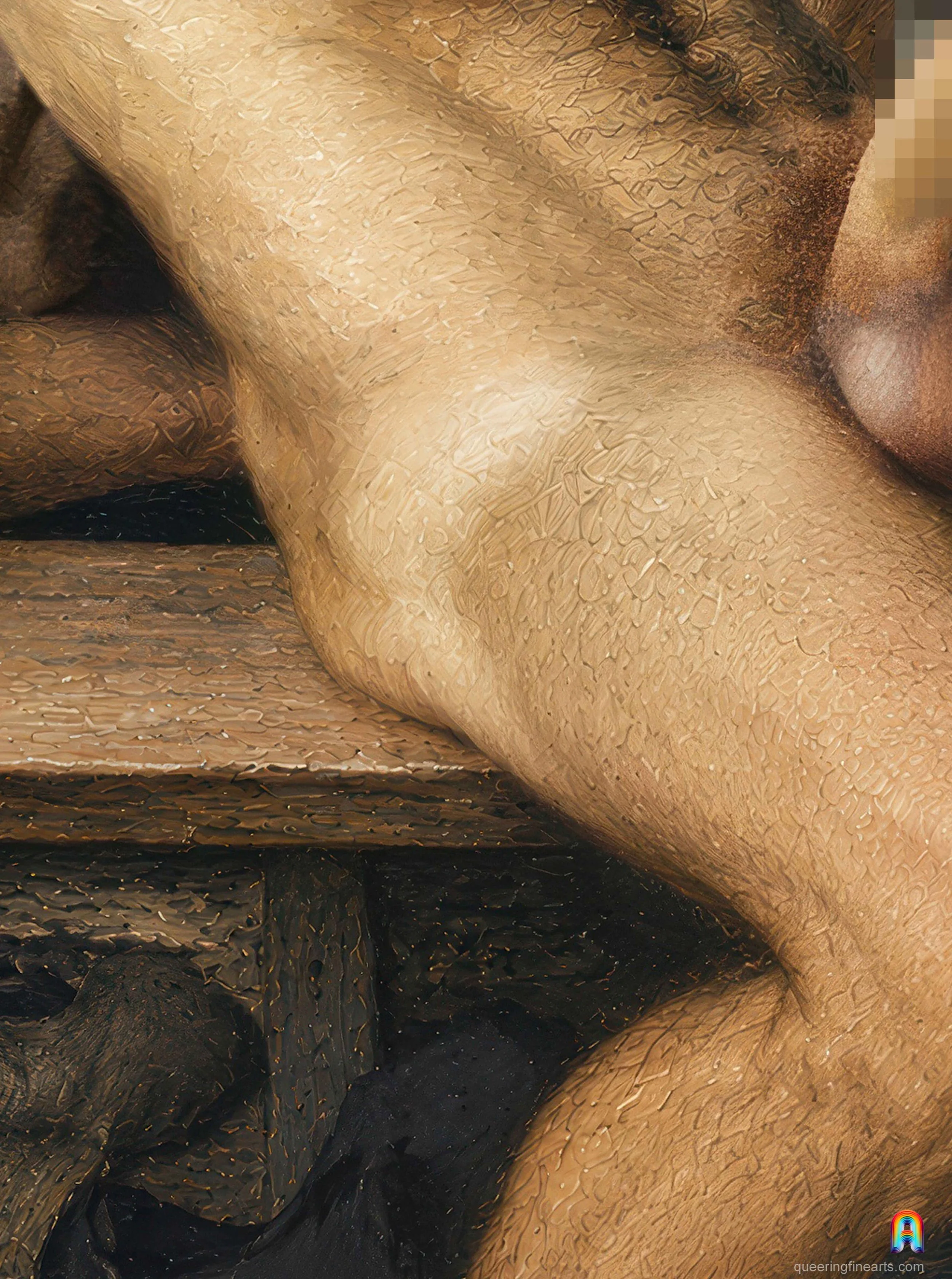
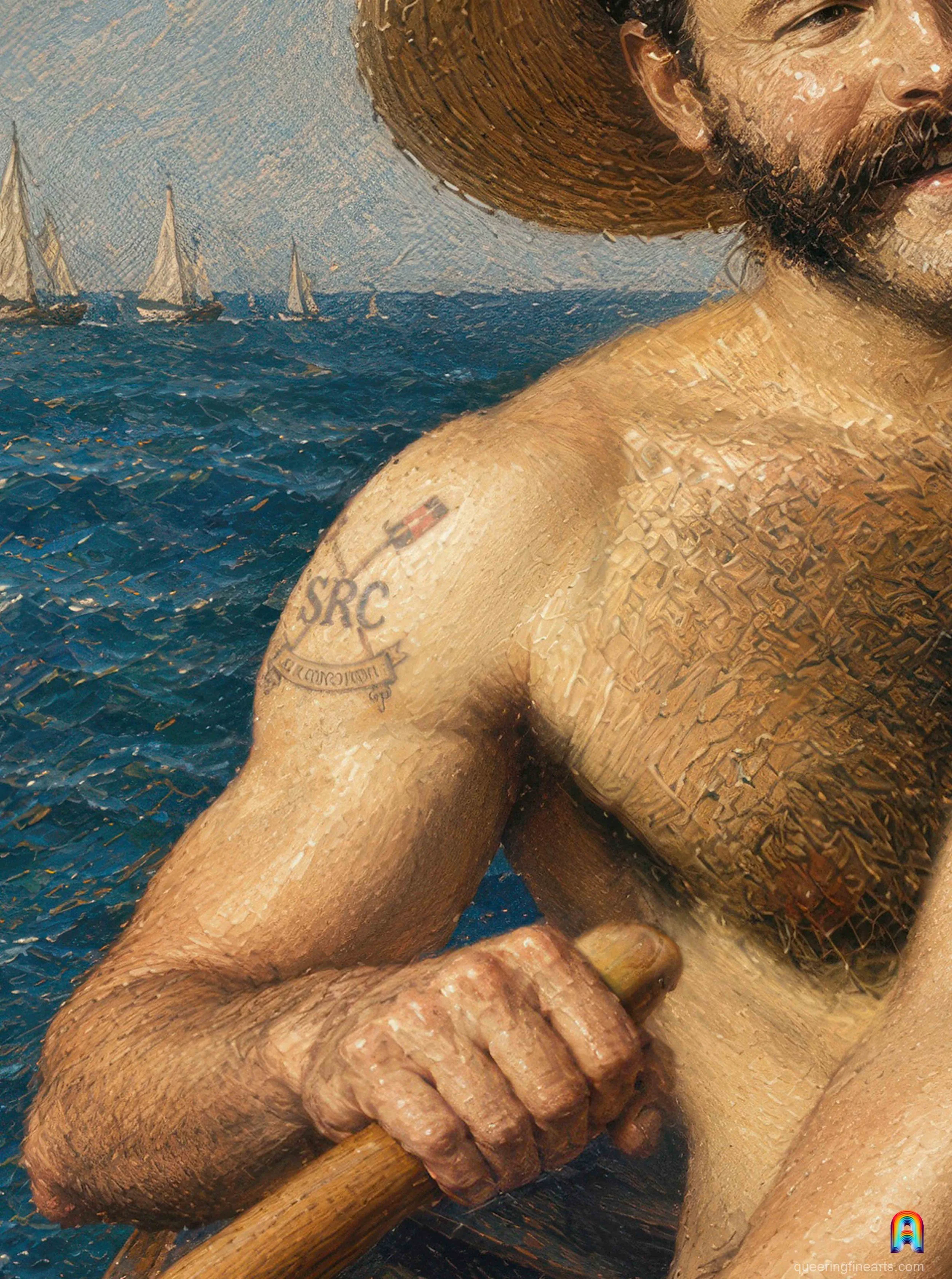
Both men are naked, their ease heightened by the sea and by their obvious attraction to one another, their clothes tossed carelessly into the bottom of the boat. Irvine, on the left and seated behind his companion, wears a broad straw hat. Dark-haired, moustached and bearded, with a hairy chest, he holds an oar in his right hand. On his arm is a small tattoo accompanied by the letters “SRC”, the initials of the Bendigo rowing club of which he was captain. His penis is clearly visible, generous and at rest.
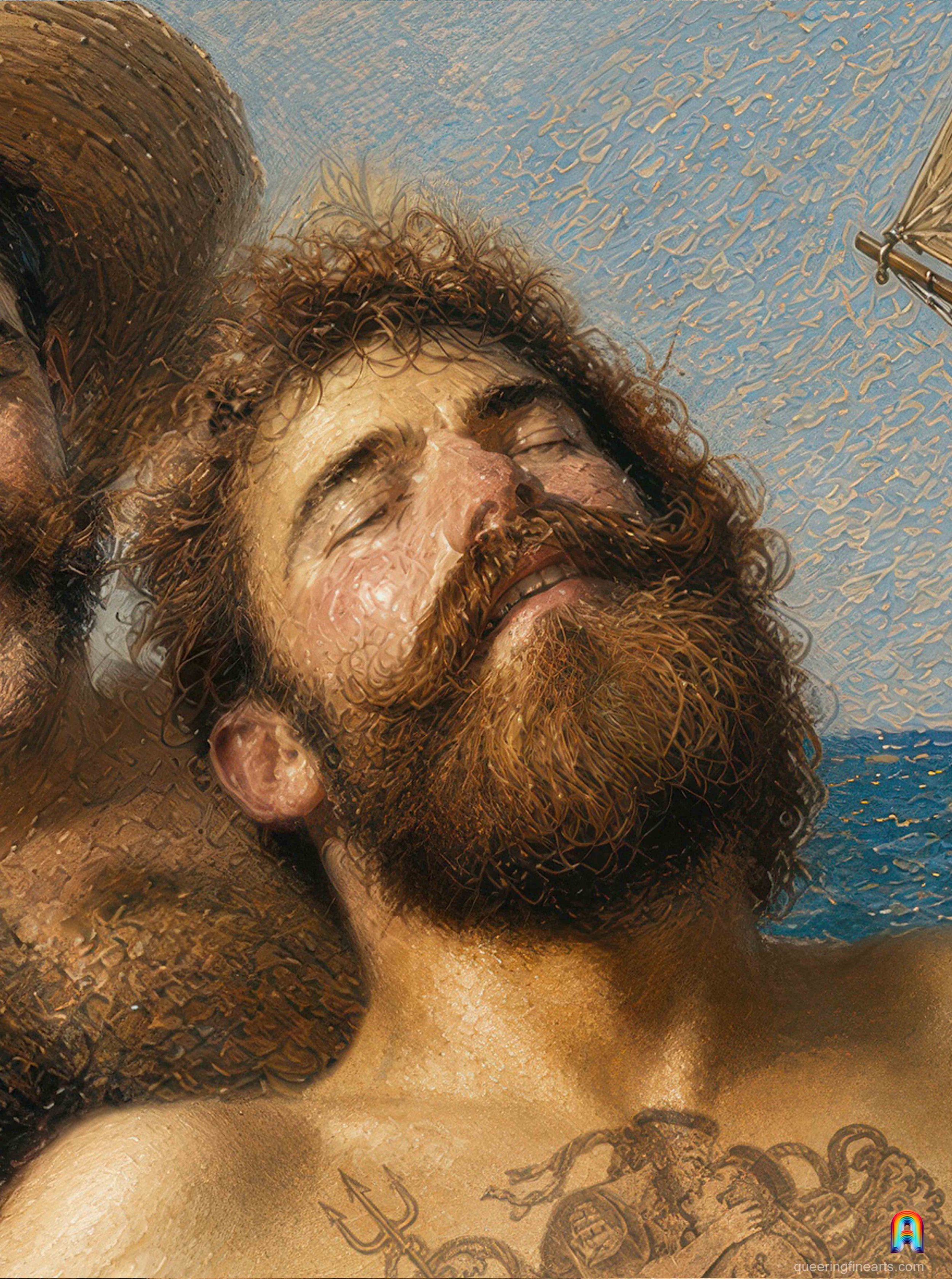
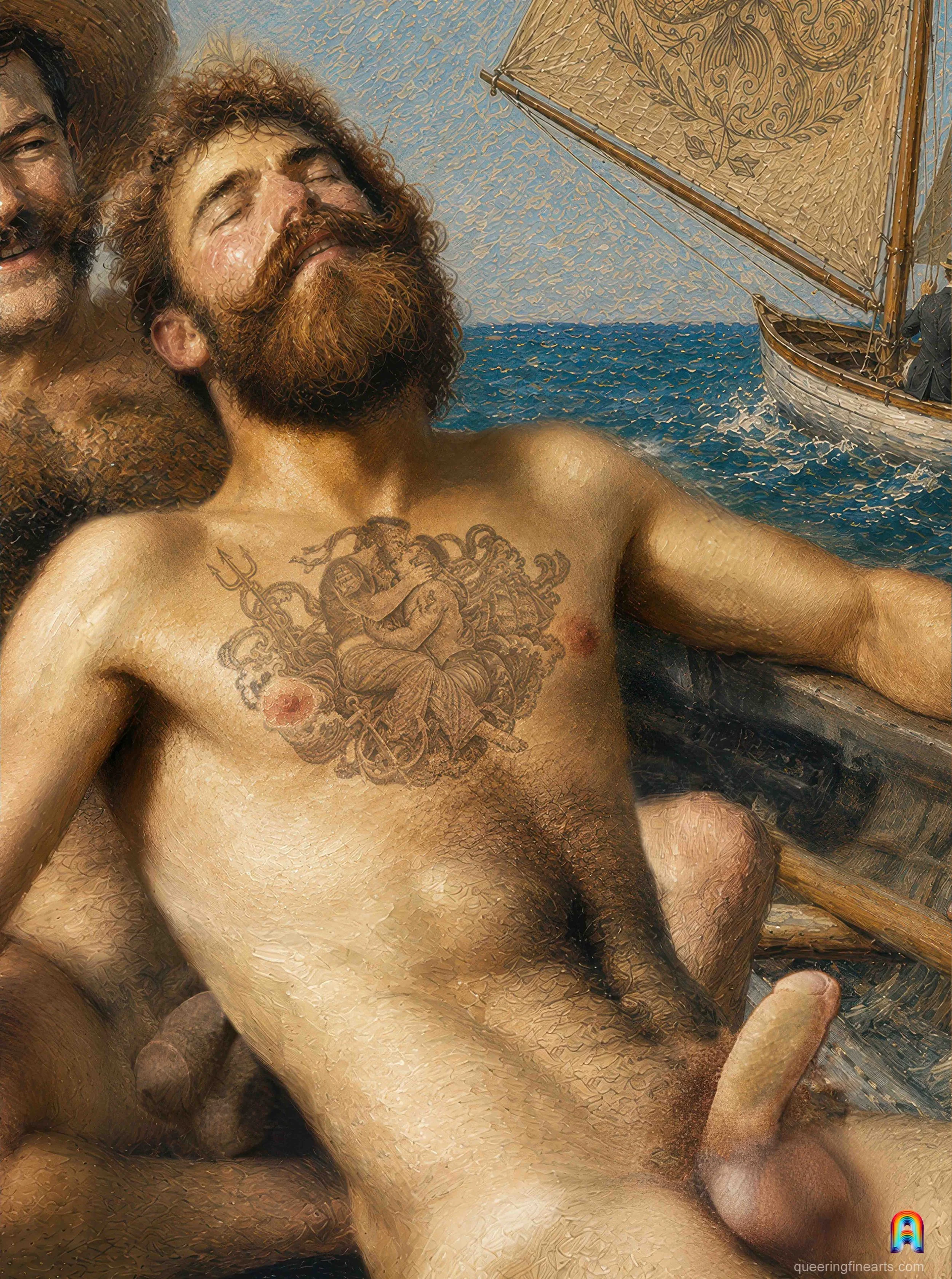
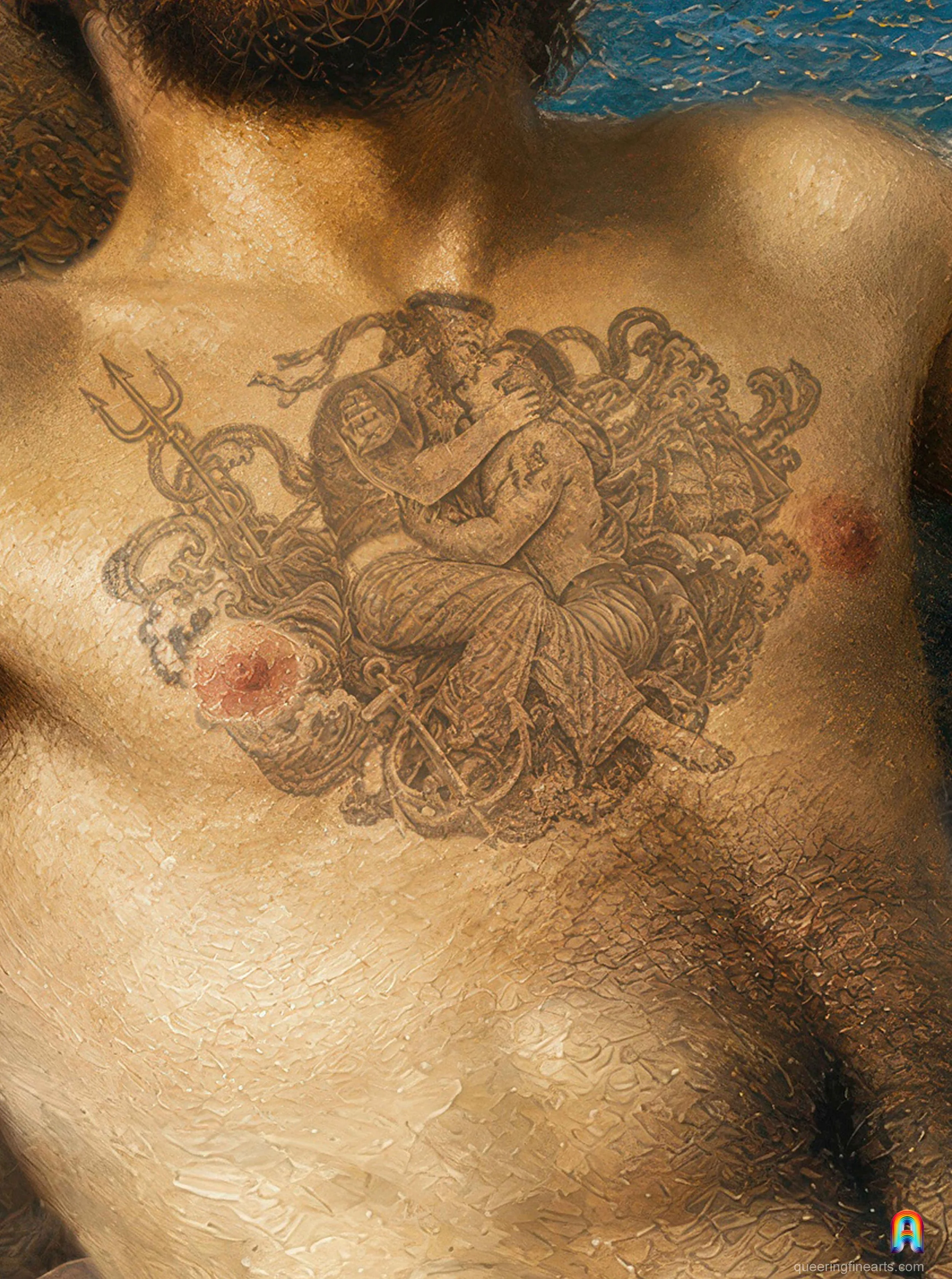
The second man sits at the bow, his torso leaning backwards against his companion’s hairy chest. His posture is far more abandoned: head thrown back and eyes closed, his right arm rests broadly along the gunwale while his left hand lies on Irvine’s leg. A luxuriant red beard frames a face flushed by the sun. His erect penis, a further sign of his desire for the rowing club captain, seems to beat the air in time with the boat’s movement on the sea. A large tattoo fills the centre of his chest: a maritime composition dominated by two sailors exchanging a passionate kiss, surrounded by aquatic creatures and motifs. The bodies of Irvine and his lover visually overlap and fill almost the entire foreground.
Sea, Sails and Lusty Tritons
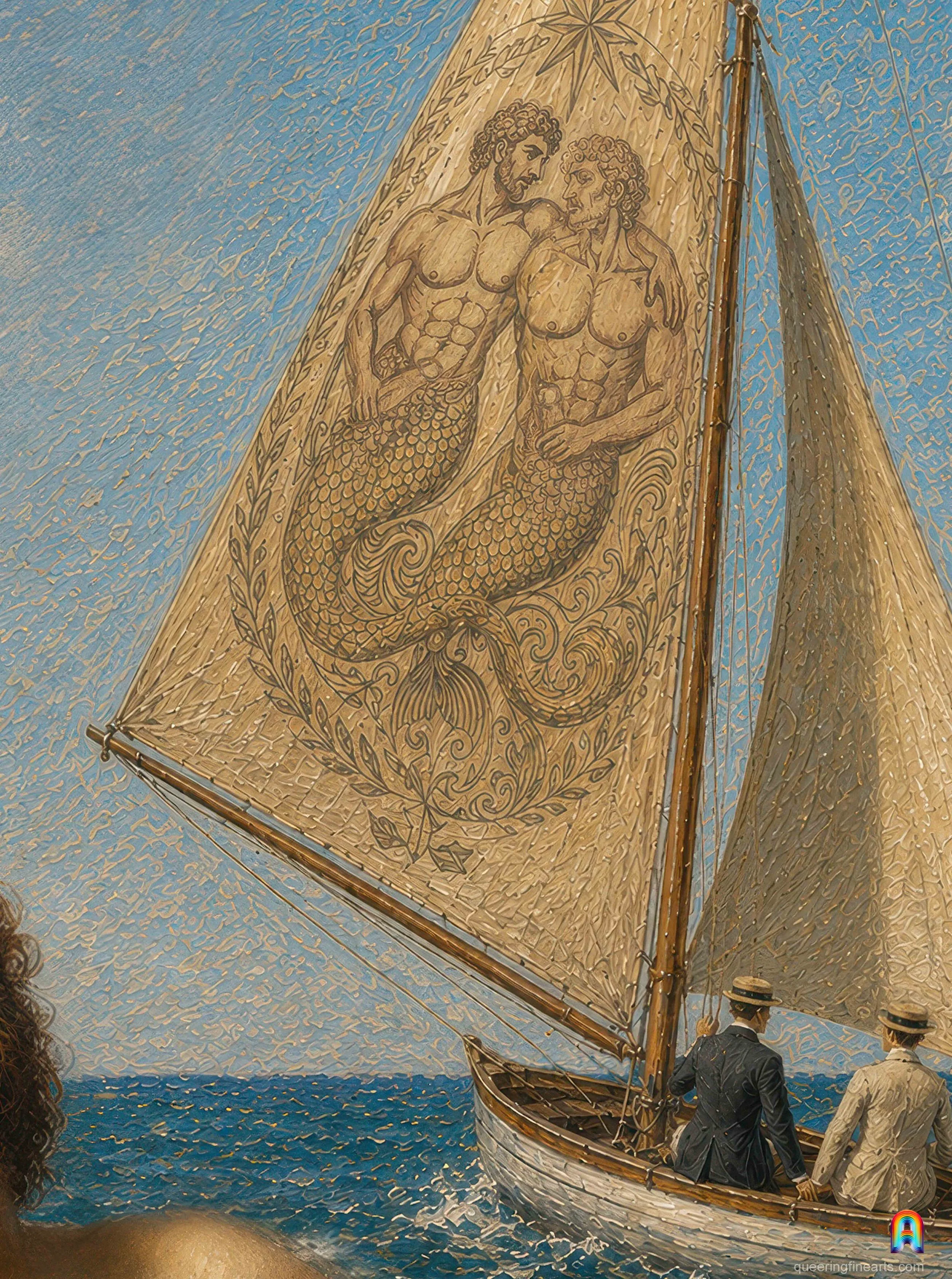
The background introduces a striking contrast with this intimacy. The sea opens behind them, with several small white sails appearing to the left. On the right, a sailboat passes close by. Two elegantly dressed figures in straw boaters sit aboard it, facing the sea, seen from behind and holding hands. The large beige sail carries an elaborate drawn decoration: two bearded, bare-chested male figures firmly grasping their penises, entwined and ending in fish tails, surrounded by vegetal ornaments and scrolling forms, an unmistakable echo of the tritons that recur in Bunny’s own maritime imagery.
Attributed to Rupert Bunny, the work places this uninhibited scene within the sensual maritime world the Australian painter was exploring at the same period, particularly in compositions populated by bodies and mythological figures.¹ The entire composition evokes the exhilaration of the sea and an almost insolent freedom, embodied by the two men’s naked bodies, the movement of the boat and the sails animating the horizon.
Rupert Bunny: An Australian Artist in Queer Paris
Rupert Bunny (1864-1947) was born in St Kilda, near Melbourne. After receiving his early training at the National Gallery School in Melbourne, he left Australia for Europe in 1884 and soon settled in Paris, where he studied under Jean-Paul Laurens, a major figure in French history painting. There he achieved remarkable success for an Australian artist of his generation: exhibiting at the Salon from 1888, he became the first Australian painter to receive an honourable mention there, precisely for The Tritons, a mythological composition populated by marine figures.² In his works of the 1890s, particularly A Sea Idyll, he repeatedly imagined a sensual golden age inhabited by bodies, fauns, mermaids and tritons, far removed from the more austere world of contemporary Australian painting.³
But Bunny also belongs to Australian queer history. Deborah Edwards’s research into the painter’s early years in Paris has considerably reshaped his biography. The diary of his Hungarian friend Zsigmond Justh provides particularly revealing evidence that the young Bunny was then involved in a homosexual relationship with the British art student Alastair Cary-Elwes.⁴ The historian regards Bunny as homosexual, without seeing his later marriage to the French artist Jeanne Morel as necessarily contradicting his sexuality.⁵
This context lends particular resonance to his early fascination with male bodies, tritons and hybrid creatures. Living in Paris, far from the social conventions and closely connected circles of his native Australia, Bunny found himself in a vast metropolis where artistic life offered possibilities that would have been far more difficult to find in Melbourne. His homosexuality, too, could find greater room for expression, as other men who loved men could be encountered within artistic and cosmopolitan circles. In Cox at Sea, he would thus have turned his gaze towards his homeland and towards one of the most singular queer figures in its sporting world: John Lempriere Irvine, intercolonial rowing champion, captain of Bendigo’s Sandhurst Rowing Club and a man whose relationships with other men are abundantly documented in contemporary archives.
Distance from Australia allowed Bunny to reinvent it rather than simply depict it: an Australia of sea, sunlight, male bodies and freedom. The attribution of Cox at Sea to Bunny thus takes on its full significance: an Australian vision imagined from Paris by a painter who was himself homosexual and one that gives visible form to desires his own time left largely beyond the reach of art.
John Lempriere Irvine: A Champion with Another Life
John Lempriere Irvine was born in Tasmania in 1847 into an affluent colonial family. He became a banker and settled in Victoria, in the south-eastern corner of mainland Australia, with Melbourne as its capital. There he led the active life of a gentleman of his time, dividing his existence between his professional career, clubs, committees and, above all, a passion at which he would quickly excel: rowing.
During the 1870s, Irvine established himself as one of Victoria’s finest rowers. With the Melbourne Rowing Club, he notably won three consecutive Senior Eights at the Melbourne Regatta from 1876 to 1878. In 1878, he was part of the Victorian crew that won Australia’s first intercolonial eight-oared championship against New South Wales. He competed in the first four editions and was again among the winners in 1880 and 1881.⁶ That year, the race on the Yarra attracted some 15,000 spectators, a measure of rowing’s immense popularity in the Australian colonies.⁷
Irvine, then, was no mere sporting amateur. He was a recognised champion and a prominent figure in the rowing world. After settling in Sandhurst, now Bendigo, he became captain of the Sandhurst Rowing Club, a position mischievously recalled by the “SRC” tattoo painted on his arm in Cox at Sea. His standing within rowing endured beyond his great competitive years: as late as 1891, he was selected as starter for the Head of the River, an important school rowing competition in Victoria.⁸
His sporting success formed part of an exceptionally active social life. Irvine served on committees, moved within respectable society and maintained connections in both Victoria and Tasmania. He plainly enjoyed company, collective activities and the pleasures of life.
And Irvine Loved Having Sex with Men
This other dimension of his life has been brought back to light by Wayne Murdoch, an Australian historian specialising in the history of male homosexuality in Melbourne and Victoria. After years of research through scattered sources, Murdoch devoted an entire biography to Irvine, published in 2020 under the revealing title The Mystery of the Handsome Man: The Double Life of John Lempriere Irvine.⁹
That “handsome man” is more than a pretty turn of phrase. Irvine emerges from the sources as a robust, elegant and physically striking man. Add to this his status as an accomplished sportsman, his sociable temperament and his taste for pleasure, which earns him the description bon vivant in Murdoch’s account. The man who sought the company of other men was therefore no solitary figure living on the fringes of society. On the contrary, his life was filled with clubs, sport, evenings out, travel and a wide circle of acquaintances.
Murdoch’s research also shows that Irvine’s attraction to men endured over time. The documents do not allow us to draw up a list of his lovers or identify the companion given to him in Cox at Sea, but they do reveal a man who actively sought encounters with other men. His homosexuality does not enter his story through some isolated episode. It was part of his life.¹⁰
Nor can that life be reduced to secrecy. The few episodes preserved by the archives belonged to a much larger existence, most of which naturally left no trace: mutual attractions, successful encounters, friendships, pleasures and perhaps love affairs.
It is precisely this space that Cox at Sea inhabits. The fictional painting does not claim to portray a historically identified lover or a documented episode from Irvine’s life. It gives an image to something the archives rarely preserve: a happy moment in the life of a gay man of the 19th century. Irvine remains the champion and captain of the Sandhurst Rowing Club, but he is also a man who desires and is desired, free with his lover beneath the sun and upon the sea.
In Close Company
The almost exclusively male world in which Irvine moved could offer a homosexual man unusual opportunities for encounters and intimacy. This phenomenon was by no means unique to Australia. Across the 19th-century Anglo-Saxon world, schools, universities, clubs and sporting teams created spaces in which extraordinary closeness between men remained socially acceptable.
At Yale, for example, student diaries show that male friends could regularly sleep together and share intensely physical and emotional relationships without those around them necessarily finding anything unusual in it. In 1858, Edward Sheffield frequently spent the night with his friend Asher Wilcox. Historian George Chauncey reminds us that this freedom could also allow some men to express genuinely erotic desires beneath the cover of an entirely accepted form of male intimacy.¹¹
Sport intensified that closeness still further. Photographs of the Rugby Club in London, founded in 1884, show men embracing, leaning against one another or resting a hand on a companion’s shoulder. Its activities included sport, boxing, swimming and, above all, annual camps where the men lived together for several days away from their families. Historian Lucinda Matthews-Jones shows how such sporting spaces fostered genuine male intimacy based on physical contact, camaraderie and a collective life almost entirely devoid of women.¹²
The boundary between male friendship and desire could be particularly porous. In Sheffield, Edward Carpenter’s archives reveal men for whom affection between friends could encompass a sexual dimension without thereby constituting an identity separate from the rest of their lives. Historian Helen Smith emphasises that, in certain male circles of Victorian England, erotic expression between men could simply exist as an extension of friendship. One of Carpenter’s correspondents dreamed of being able to sleep with two men he loved without feeling that he was doing anything wrong.¹³
Irvine belonged to this same Anglo-Victorian culture. Rowing brought together many of the conditions encountered elsewhere: physical closeness, shared travel, evenings out and crews bound by intense camaraderie. For a man like Irvine, the sport could therefore be more than a passion. It gave him access to a world in which intimacy with other men required no explanation and where desire could sometimes find roomwithin the very conventions meant to contain it.
When Society Became the Crime
This relative freedom had a terrible limit: Victorian conventions accepted male intimacy only so long as it did not become openly homosexual. Once desire between men emerged from the private realm, it was not Irvine who changed, but the way society looked at him. What had until then been a life of sport, friendships, encounters and pleasure could suddenly be redefined by the law as transgression.
The events of 1888 offer a particularly revealing example. After an evening with members of the rowing world at Young and Jackson’s Hotel, Irvine met nineteen-year-old John Reardon. The two men walked together towards South Melbourne before several of Reardon’s companions joined them. Irvine was then beaten and robbed. He managed to summon a policeman, but in a reversal that speaks volumes about the period, the victim himself came under suspicion because of the presumed nature of the encounter. The investigation ultimately revealed that Reardon and his companions belonged to a group that lured men into encounters, assaulted them and then exploited the threat of a homosexual accusation to silence them. Irvine was cleared while his attackers were convicted.¹⁴
The case demonstrates with almost brutal perfection what the criminalisation of homosexuality made possible: one man’s desire for another could be turned into a weapon against him. The law did more than fail to protect homosexual men. It created the conditions in which they could be intimidated, robbed or beaten in the knowledge that the threat of public shame might prevent them from defending themselves.
In 1897, this social machinery closed around Irvine once again. Twenty-one-year-old Ernest Smith accused him of making a sexual proposition and touching him. Irvine denied the allegation. The inconsistencies in Smith’s testimony were such that the magistrates ultimately dismissed the case. Irvine was not convicted.
But Society Did Not Need a Conviction
The press reported the case and revived the events of 1888. Two episodes nearly a decade apart were now enough to manufacture a public identity: that of a man suspected of homosexuality. What was destroyed was not merely some abstract notion of reputation. Irvine lost precisely the things that had structured his entire existence: his professional respectability, his standing among his peers and his place within the circles to which he had long belonged.¹⁵
The relatively small and closely connected world of colonial Australia made such a fall particularly difficult to escape. Victoria’s professional, sporting and social circles overlapped, and for a man as prominent as Irvine, reputation travelled easily between them. In a larger and more anonymous society, disgrace in one circle might sometimes be escaped by disappearing into another. Irvine had far less room in which to do so. The very networks that had sustained his success as a banker, sportsman and clubman could now carry the scandal with them. His visibility, once an asset, had become a trap.
Here lies the true violence of his story. Irvine had assaulted no one and robbed no one. He had simply loved and sought other men in a society that considered such desire shameful enough to ruin a life. The scandal therefore reveals not Irvine’s criminality, but that of a system capable of turning homosexual desire into an instrument of blackmail, exclusion and social destruction.
For a man whose life had depended so much on reputation and public standing, this punishment could be even heavier than imprisonment. A prison sentence would have ended. Social exclusion attacked his name, his livelihood, his friendships and his place in the world. After 1897, his trajectory breaks off and his presence in the historical record almost completely disappears.
A Radiant Reclamation
Irvine’s fate thus measures less the gravity of his actions than the gravity his age assigned to them. A society that had admired him as a champion and welcomed him as a gentleman could suddenly cease to see anything in him except that part of his life which escaped the conventions, roles and narrow limits imposed by Victorian respectability.
Cox at Sea then becomes something of a reclamation: beneath the sun, in the open air and upon a glittering sea, Irvine recovers the freedom his age denied him. But the painting goes further. It breathes happiness, a joyous thumb of the nose at constraints and conventions. It celebrates the beauty of the male body and the homosexual intimacy of two men, their pleasure in being together and their complete ease with one another. Everything is bathed in radiant sunlight: their naked bodies, the boat, the sails and the immense expanse of water around them.
QFA


Curiosity Piqued?
1. National Gallery of Australia, “Rupert Bunny: Australian in Paris,” essay accompanying the exhibition Rupert Bunny: An Australian in Paris, Canberra, Australian National Gallery, 1991. The essay notably places A Sea Idylland Pastoral within the mythological and sensual “golden age” developed by Bunny in the late 19th century.
2. David Thomas, “Bunny, Rupert Charles (1864-1947),” Australian Dictionary of Biography, vol. 7, Melbourne University Press, 1979, National Centre of Biography, Australian National University, online edition published 2006. The entry traces Bunny’s training in Melbourne, London and Paris, his studies under Jean-Paul Laurens and the honourable mention he received at the Salon for The Tritons.
3. National Gallery of Victoria, “Rupert Bunny, Sea idyll, c. 1891,” NGV Collection Online, Melbourne. Oil on canvas, 100.5 × 161.5 cm, painted in Paris and presented to the NGV by Alfred Felton in 1892. The catalogue entry identifies mermaids, tritons, legendary figures, the sea and leisure among Bunny’s subjects.
4. Deborah Edwards, ed., Rupert Bunny: Artist in Paris, Sydney, Art Gallery of New South Wales, 2009, 224 pp.; see also John McDonald, “Rupert Bunny,” 2009. McDonald emphasises the importance of newly accessible extracts from Zsigmond Justh’s diary, which provide particularly strong evidence concerning Bunny’s relationship with Alastair Cary-Elwes.
5. National Gallery of Victoria, QUEER: Stories from the NGV Collection, Melbourne, 2022, entries on Rupert Bunny and Alastair Cary-Elwes. The catalogue notably brings together the portrait of Bunny painted by Cary-Elwes around 1887 and Bunny’s portrait drawing of Cary-Elwes from the same year, particularly suggestive documents concerning their closeness in the Paris of the 1880s.
6. Andrew Guerin, “J L Irvine,” Guerin-Foster History of Australian Rowing, Australian Rowing History, updated January 2023. The entry provides Irvine’s known competitive record from 1876 to 1881, including his victories at the Melbourne Regattas and the intercolonial championships.
7. Andrew Guerin and Margot Foster, “1880-1885 Intercolonial Championships,” Guerin-Foster History of Australian Rowing, Australian Rowing History. The race held on the Yarra on 10 April 1880 is recorded as attracting 15,000 spectators; the page also provides crew lists and results from the first major intercolonial competitions.
8. Andrew Guerin and Margot Foster, “1891 VIC APS Head of the River,” Guerin-Foster History of Australian Rowing, Australian Rowing History. Irvine is listed as starter for the race held on the Lower Yarra on 15 May 1891.
9. Australian Lesbian and Gay Archives, Beyond the Culture Wars: Australian Homosexual Histories Conference 2016, Keynotes, Abstracts and Biographies, Melbourne, 2016, biographical entry on Wayne Murdoch and abstract for his paper “Mr Irvine and the South Melbourne Push: A Lost Nineteenth Century Life.” This source also places Murdoch’s work on Irvine within his broader research into the history of male homosexuality in Victoria.
10. Wayne Murdoch, The Mystery of the Handsome Man: The Double Life of John Lempriere Irvine, Melbourne, Interventions Inc, 2020, 248 pp. See also Queer Oz Folk’s presentation of the book, which describes Irvine as a “banker, champion sportsman and bon vivant” and traces Murdoch’s research into his homosexual life and his disappearance from the historical record.
11. Matthew Busick, “Becoming a Yale Man: Intimacy among Yale Students in the Nineteenth Century,” Kaplan Senior Essay Prize for Use of Library Special Collections, Yale University Library, 2007; George Chauncey, “Gay at Yale,” Yale Alumni Magazine, July-August 2009. These studies offer a broader exploration of physical and emotional intimacy among male students in the 19th century and its sometimes ambiguous relationship to erotic desire.
12. Lucinda Matthews-Jones, “Capturing Homosocial Worlds in the Photographs of the Rugby Club, 1885-1920,” Gender & History, vol. 36, no. 2, July 2024, pp. 430-453, first published online 21 December 2022, DOI 10.1111/1468-0424.12676. The study notably examines touch, male intimacy, boxing, swimming and the Rugby Club’s annual camps as components of a homosocial world.
13. Helen Smith, “What a forgotten gay activist tells us about LGBTQ life in 19th century Sheffield,” Sheffield Hallam University, 2018. See more broadly Helen Smith, Masculinity, Class and Same-Sex Desire in Industrial England, 1895-1957, Palgrave Macmillan, 2015, on the porous boundaries between male friendship, camaraderie and homosexual desire in different English social environments.
14. Public Record Office Victoria, “Bendigo’s queer history,” Melbourne, 2021, based on Wayne Murdoch’s research and criminal records held by PROV. The article notably reconstructs Irvine’s assault in March 1888 following an evening with members of the rowing club at Young and Jackson’s Hotel and shows how the threat of a homosexual accusation could be used against victims.
15. Sian Gard and Fiona Parker, “Research paints grim picture of how a gay man was shunned by Victorian-era Bendigo,” ABC News, ABC Central Victoria, 22 March 2021. Drawing on Wayne Murdoch’s research, the article places the cases surrounding Irvine within their social context and emphasises the consequences that the public disclosure of his homosexuality had for his reputation and his place within Victorian society.