Love's Revolution
Cleomachus of Pharsalus and His Beloved
French School
In the manner of Alexandre Cabanel (1823-1889)
Oil on canvas, c. 1880
Private collection, Boston
The Love That Changed a City
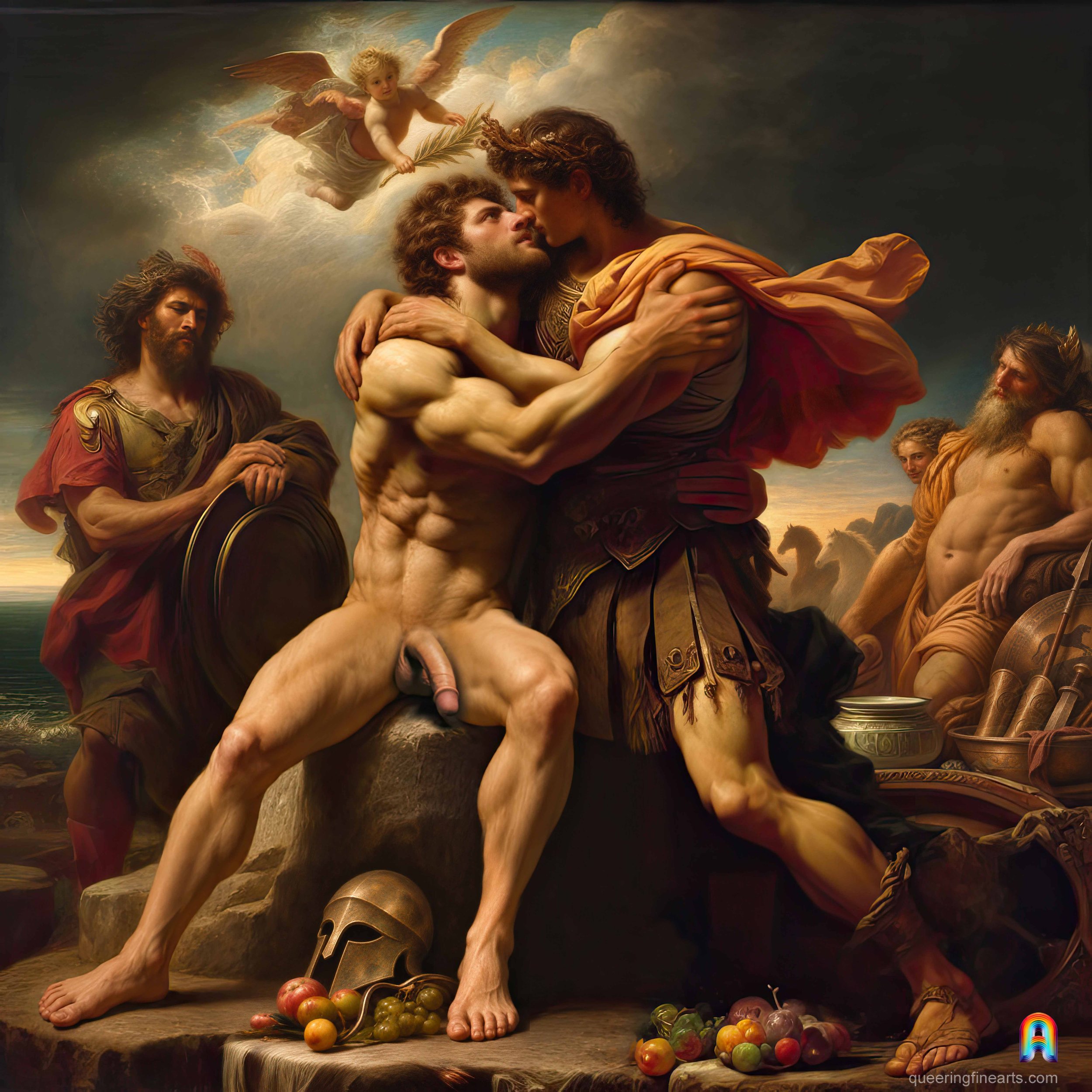
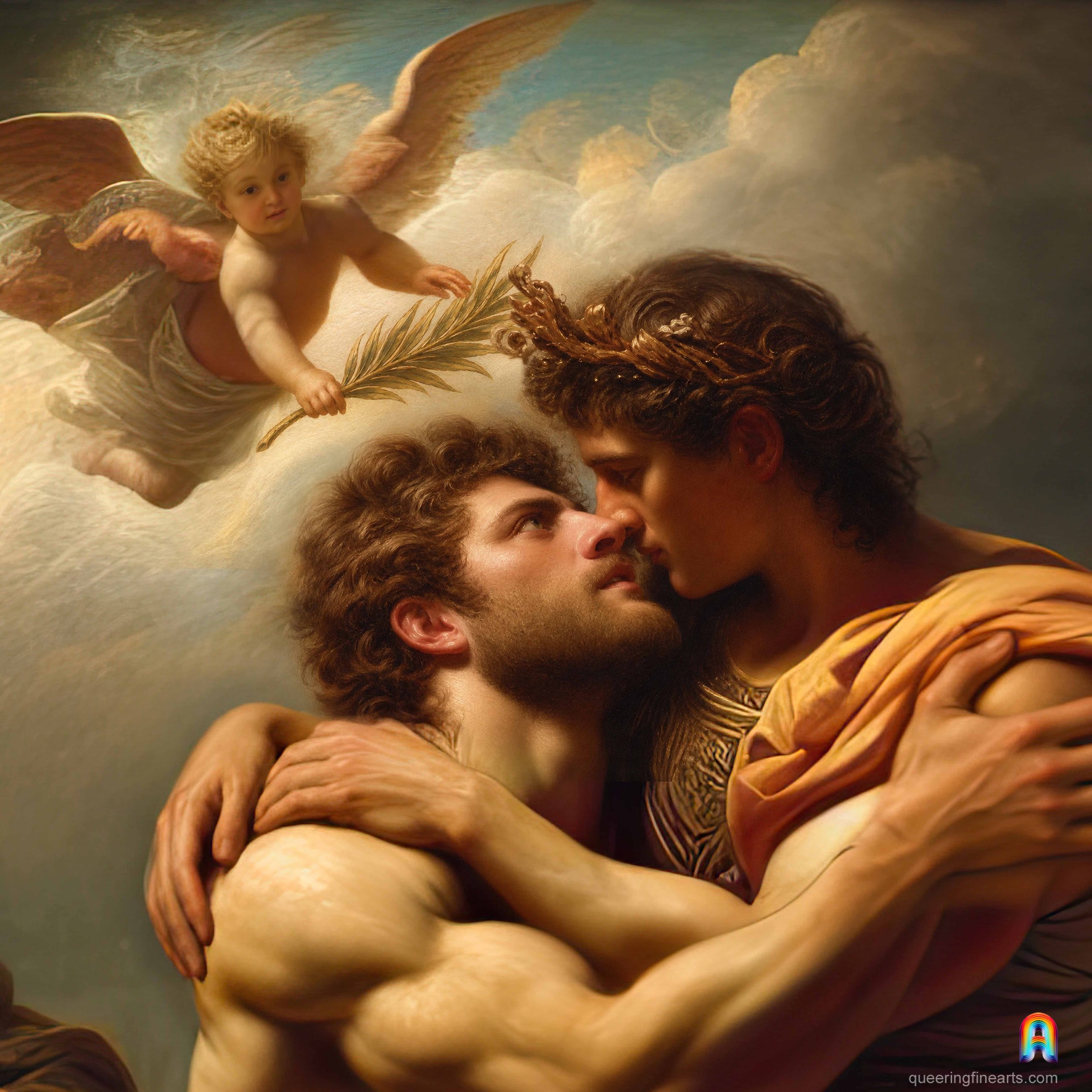
Love's Revolution takes us to the shores of Euboea around 700 BC, where the Thessalian warrior Cleomachus of Pharsalus embraces his beloved before entering battle. Their lips are about to meet, their arms drawing their bodies into a tender union. According to Plutarch, Cleomachus asked his beloved whether he would watch him fight. The young man answered affirmatively, kissed and embraced him before placing the helmet upon his head.¹ This intimate gesture would become part of the founding legend of a remarkable transformation in Greek society: the people of Chalcis came to honour the very form of male love they had previously condemned.
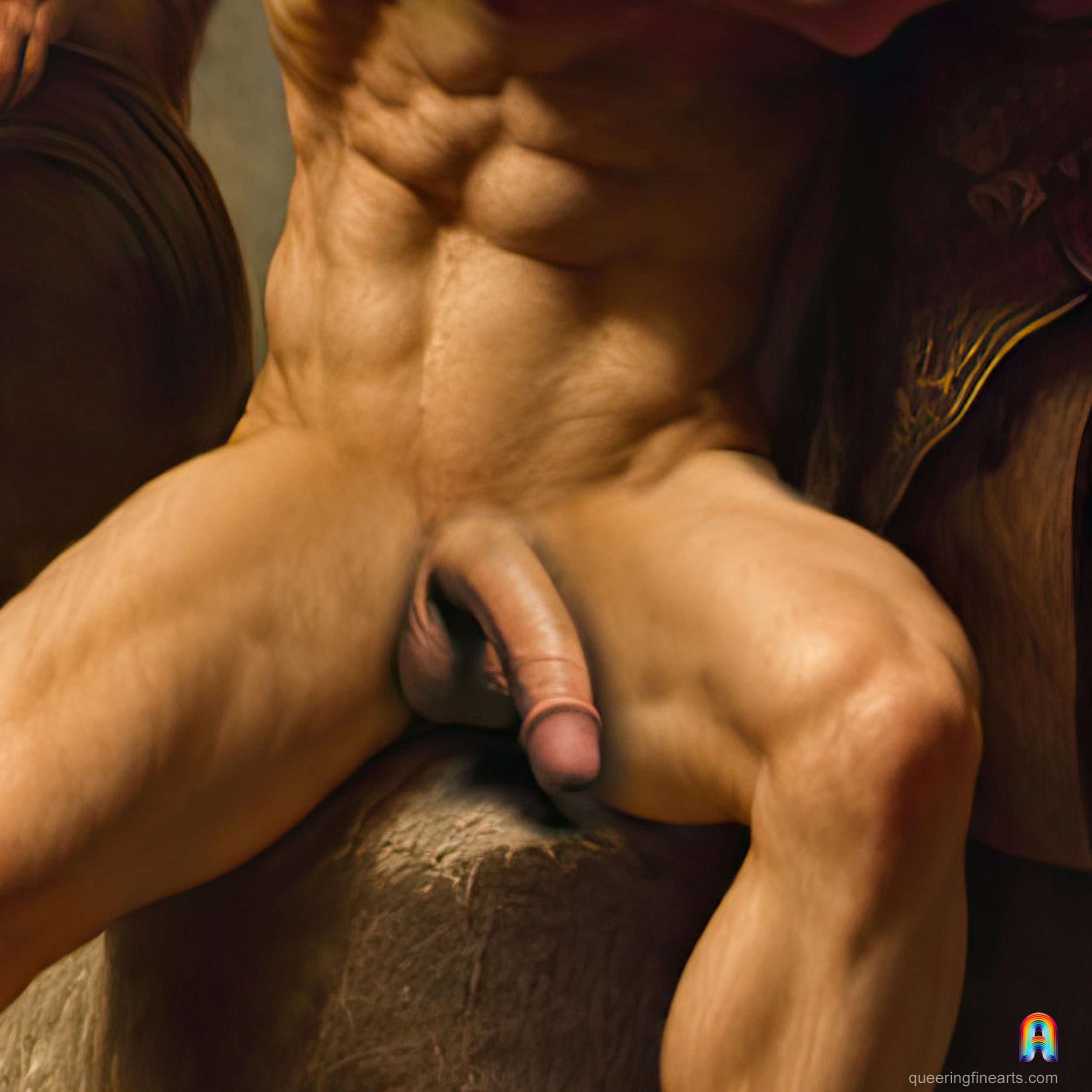
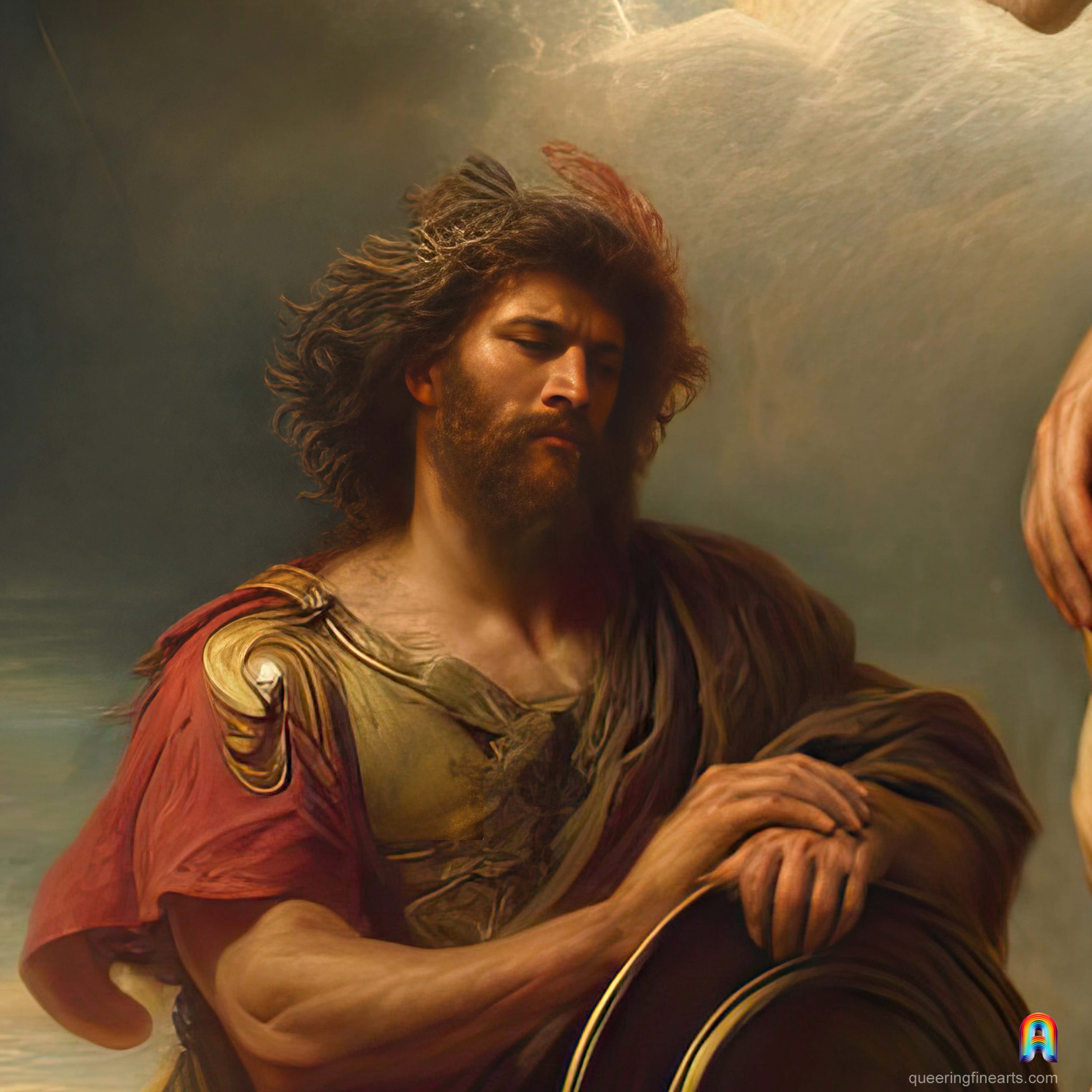
The beloved sits naked upon a rock, his powerful thighs framing the bronze helmet that he will shortly place upon his lover's head. His muscular torso twists towards Cleomachus, whose richly ornamented armour contrasts with the warmth of his exposed flesh. Their bodies meet in a sensual interplay of strength and tenderness. The warrior's sweeping crimson mantle lends theatrical grandeur to an embrace in which masculine beauty, desire and courage become inseparable.
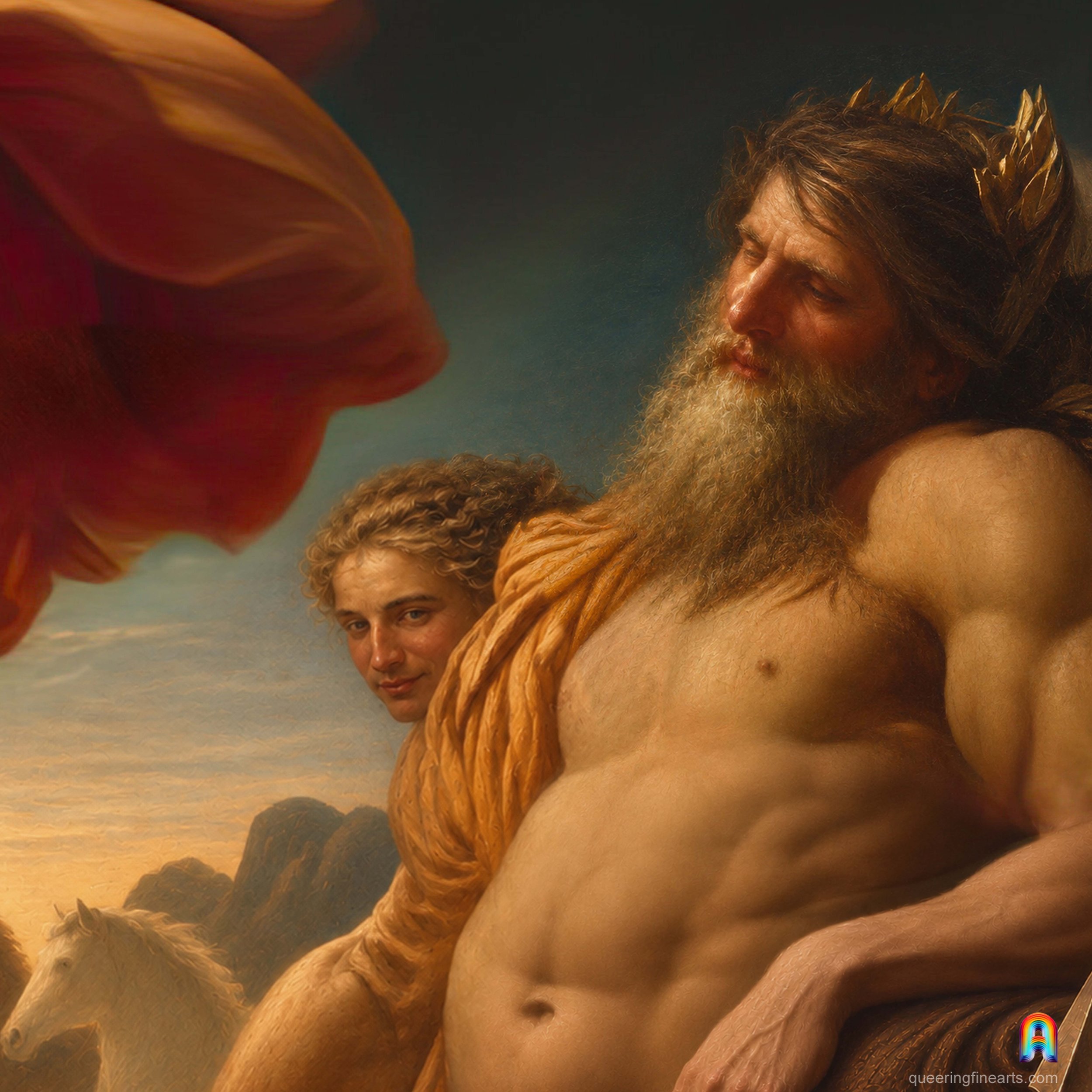
Around the lovers, the assembled men lend the encounter a public dimension. A bearded warrior rests upon his shield, while an older man watches the couple with quiet attentiveness. Behind him, a younger companion observes the scene with a discreet smile. Horses emerge from the golden haze, evoking the Thessalian cavalry. Above them, Eros descends through luminous clouds, presiding over this gathering of masculine beauty and affection.
Cleomachus would lead his fellow Thessalians to victory against the cavalry of Eretria at the cost of his own life. The grateful Chalcidians buried him in their agora and erected a great column above his tomb. According to Plutarch, his heroism inspired a profound reversal in their attitudes towards love between males.² The affection shared by two men thus entered the collective memory of an entire city, becoming a celebrated source of courage and civic virtue. This tradition offers a particularly compelling example of how ancient Greek communities could understand male erotic bonds as a force capable of shaping their social institutions.³
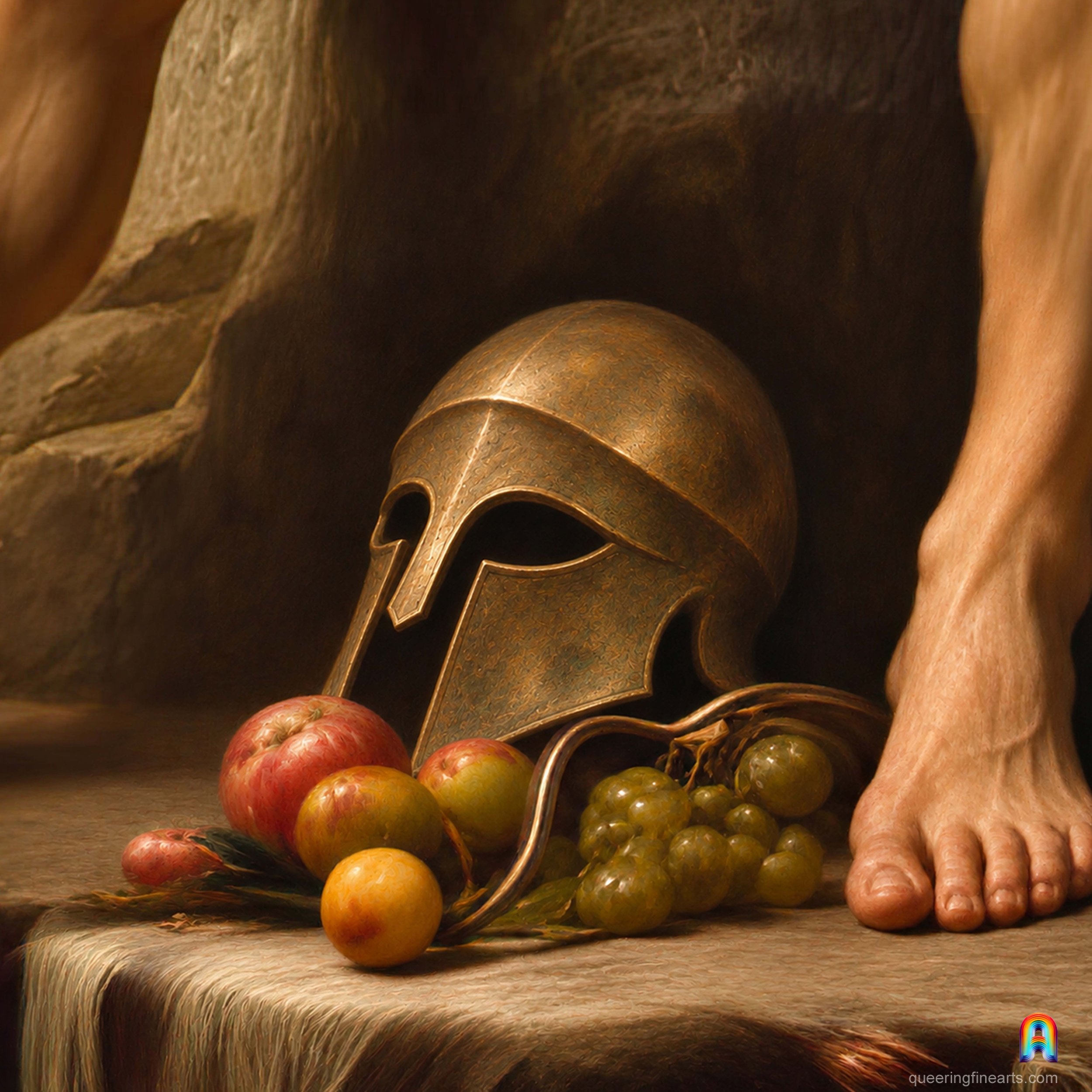
Conceived in the manner of Alexandre Cabanel, the composition brings together the sensuality of French academic painting, the grandeur of classical history and the expressive power of mythological allegory. The golden light caresses bare flesh, bronze and sumptuous drapery, while the gathering darkness foreshadows the warrior's fate. The fruits scattered at the lovers' feet evoke the sweetness and fleeting abundance of earthly pleasures. Here, the heroic male nude becomes the embodiment of an extraordinary social legacy: the love of two men whose embrace would resonate far beyond the battlefield.
Curiosity Piqued?
1. Plutarch, “Dialogue on Love” (Amatorius), Moralia, section 17, 760d-761b, translated by Philemon Holland, London, 1603.
Plutarch explores the extraordinary courage that Eros inspires in those united by love. The encounter between Cleomachus and his beloved, with its affectionate embraces and the gesture of placing the helmet upon the warrior's head, provides the principal narrative inspiration for the painting. Read the text.
2. Plutarch, “Dialogue on Love” (Amatorius), Essays and Miscellanies, vol. IV, edited by William W. Goodwin, Boston, Little, Brown and Company, 1911, pp. 284-285.
Plutarch recounts the public honours bestowed upon Cleomachus and the reversal of Chalcidian attitudes towards male same-sex relationships, specifically within the ancient Greek tradition of pederasty. He also preserves a traditional Chalcidian song associating masculine beauty, noble birth, erotic affection and military valour. Read the text.
3. Natasha Bershadsky, “Impossible Memories of the Lelantine War”, Mètis, new series, no. 16, Paris and Athens, Éditions de l'EHESS and Daedalus, 2018, pp. 205-206.
Bershadsky examines the story of Cleomachus as an aetiological myth explaining the origins of a Chalcidian social custom. Her analysis places particular emphasis on the gaze of the beloved, the warrior's heroic performance and the transformation of their intimate relationship into a narrative of collective significance. Read the article.
Gay Valour
Traditionally dated to around 700 BC, the Lelantine War opposed the neighbouring cities of Chalcis and Eretria over the fertile Lelantine Plain on the island of Euboea. The conflict drew other Greek communities into their rivalry, including the Thessalians, whose aristocracy derived much of its military prestige from horsemanship. Among the warriors who came to the assistance of Chalcis was Cleomachus of Pharsalus.
Plutarch recounts that the Chalcidians were superior in infantry but struggled against the Eretrian cavalry. Asked to lead the attack, Cleomachus turned to his beloved and asked whether he would watch him fight. The young man embraced and kissed him before placing his helmet upon his head. Cleomachus then gathered the bravest of the Thessalian horsemen, routed the enemy cavalry and secured victory for Chalcis, losing his life in the encounter.¹
The presence of the beloved was fundamental to Greek conceptions of erotic courage. In Plato's Symposium, Phaedrus imagines an army composed entirely of lovers and their beloveds, each inspired to excel in the eyes of the other.² The desire to earn the admiration of another man, to appear beautiful, courageous and worthy of his affection, becomes a powerful moral and military incentive.
Plutarch preserves a Chalcidian song celebrating handsome young men of noble birth and proclaiming that Eros flourishes alongside courage.³ Masculine beauty and homosexual desire thus belong to the same ideal of excellence as physical strength and military prowess. The tenderness of an embrace, the pleasure of a kiss and the admiration exchanged between lovers acquire the dignity of heroic virtues.
The story circulated in several forms. Plutarch also records an alternative tradition attributed to Aristotle, in which the warrior who received his beloved's kiss came from Chalcis in Thrace. The poet Dionysius gives the lovers in this tradition the names Anton and Philistus.⁴ The existence of these variants reveals how deeply the association between male love and military heroism had entered Chalcidian cultural memory.
Curiosity Piqued?
1. Plutarch, “Dialogue on Love” (Amatorius), Essays and Miscellanies, vol. IV, edited by William W. Goodwin, Boston, Little, Brown and Company, 1878, pp. 284-285.
Plutarch describes the military difficulties of the Chalcidians and the decisive intervention of the Thessalian cavalry. His account places the emotional bond between Cleomachus and his beloved at the centre of the victory.
2. Plato, Symposium, 178c-179b, translated by W. R. M. Lamb, in Lysis, Symposium, Gorgias, Cambridge, Massachusetts, Harvard University Press and London, William Heinemann, Loeb Classical Library, no. 166, 1925.
In his speech in praise of Eros, Phaedrus presents the admiration exchanged between male lovers as a source of honour, courage and moral excellence. His ideal army of lovers extends this intimate relationship into the sphere of civic responsibility.
3. Plutarch, “Dialogue on Love” (Amatorius), Moralia, 761b, in Essays and Miscellanies, vol. IV, edited by William W. Goodwin, Boston, Little, Brown and Company, 1911, p. 285.
The traditional Chalcidian song preserved by Plutarch associates the physical attractions of youth with erotic pleasure and martial courage. It offers a glimpse into a culture in which masculine beauty and desire could be celebrated collectively.
4. Natasha Bershadsky, “Impossible Memories of the Lelantine War”, Mètis, new series, no. 16, Paris and Athens, Éditions de l'EHESS and Daedalus, 2018, pp. 205-206.
Bershadsky analyses the alternative accounts preserved by Plutarch and Aristotle, emphasising the significance of the beloved's gaze and the transformation of the warrior's performance into heroic legend. Her study also illuminates the difficulties of separating historical events from the traditions subsequently associated with the Lelantine War.
A Double Victory
The most extraordinary consequence of Cleomachus's victory occurred within the society of Chalcis itself. Plutarch explicitly states that the Chalcidians had previously disapproved of pederasty, an institutionalised form of male erotic relationships in ancient Greece, and came to honour it following the Thessalian warrior's heroic death.¹ The love of two men thus became the foundation of a tradition explaining a remarkable reversal of collective values.
The location of Cleomachus's tomb is particularly significant. By burying him in the agora and erecting a great column above his grave, the Chalcidians incorporated his memory into the very heart of civic life. In the Greek world, burial in the agora was an exceptional distinction associated with founders, benefactors and heroes.² Cleomachus's monument gave enduring public visibility to a heroic achievement inseparable from his love for another man.
This transformation also belongs to the broader history of Greek erotic customs. Chalcis acquired a reputation for male same-sex relationships, and its name even entered the vocabulary of ancient Greek sexuality. Hesychius of Alexandria records the verb chalkidizein, associated with sexual relations between males.³ The city's connection with male eroticism thus extended beyond the legend of Cleomachus and entered the cultural imagination of the Greek-speaking world.
The ancient categories of lover and beloved belonged to a social structure distinct from modern gay relationships, with conventions governing age, courtship and civic status. Yet the emotional and erotic substance of these relationships remains recognisable across the centuries: the pleasure of masculine beauty, the longing for another man's embrace and the desire to be worthy of his love.
Writing some eight centuries after the presumed events, Plutarch preserves a tradition whose historical details remain difficult to establish. Its significance lies equally in what the Chalcidians were remembered as having embraced: the conviction that desire between men could enrich the moral and social life of a community.
The revolution celebrated in the painting is therefore one of collective recognition. An intimate expression of homosexual affection acquires the dignity of a public virtue. The embrace of two men becomes the symbolic beginning of a new social order in which their love has earned a place of honour.
QFA
Curiosity Piqued?
1. Plutarch, “Dialogue on Love” (Amatorius), Moralia, 761a, in Plutarch's Dialogue on Love: An Intermediate Greek Reader, Greek text with running vocabulary and commentary by Evan Hayes and Stephen Nimis, Oxford, Ohio, Faenum Publishing, 2011, p. 107.
The Greek text is particularly revealing through its choice of verbs. Plutarch uses ēgapēsan (ἠγάπησαν) and etimēsan (ἐτίμησαν), expressing affection, esteem and honour. His account describes a community moving beyond acceptance towards the active celebration of a formerly disapproved erotic custom. Read the text.
2. Natasha Bershadsky, “Impossible Memories of the Lelantine War”, Mètis, new series, no. 16, Paris and Athens, Éditions de l'EHESS and Daedalus, 2018, pp. 205-206.
Bershadsky examines Cleomachus's burial in the agora, his commemorative monument and the acceptance of male erotic relationships as interconnected elements of an origin myth. Her research illuminates the role of heroic narratives in shaping the customs and collective identity of ancient Greek communities. Read the article.
3. Paul Cartledge and Paul Christesen (eds.), The Oxford History of the Archaic Greek World, vol. I: Argos to Corcyra, Oxford, Oxford University Press, 2024, “Chalcis and Eretria”, section 2.10.2, p. 199.
This collective scholarly work examines the city's erotic traditions and their possible origins in aristocratic educational practices, comparable to those of Sparta and Crete. It also discusses the linguistic association between Chalcis and male sexuality preserved in ancient lexicography.