The Black Queen
William Dorsey Swann and His Circle
Anonymous artist, pupil of Henry Ossawa Tanner (1859–1937)
Oil on canvas
1890
Private collection, Washington, D.C.
Holding Court
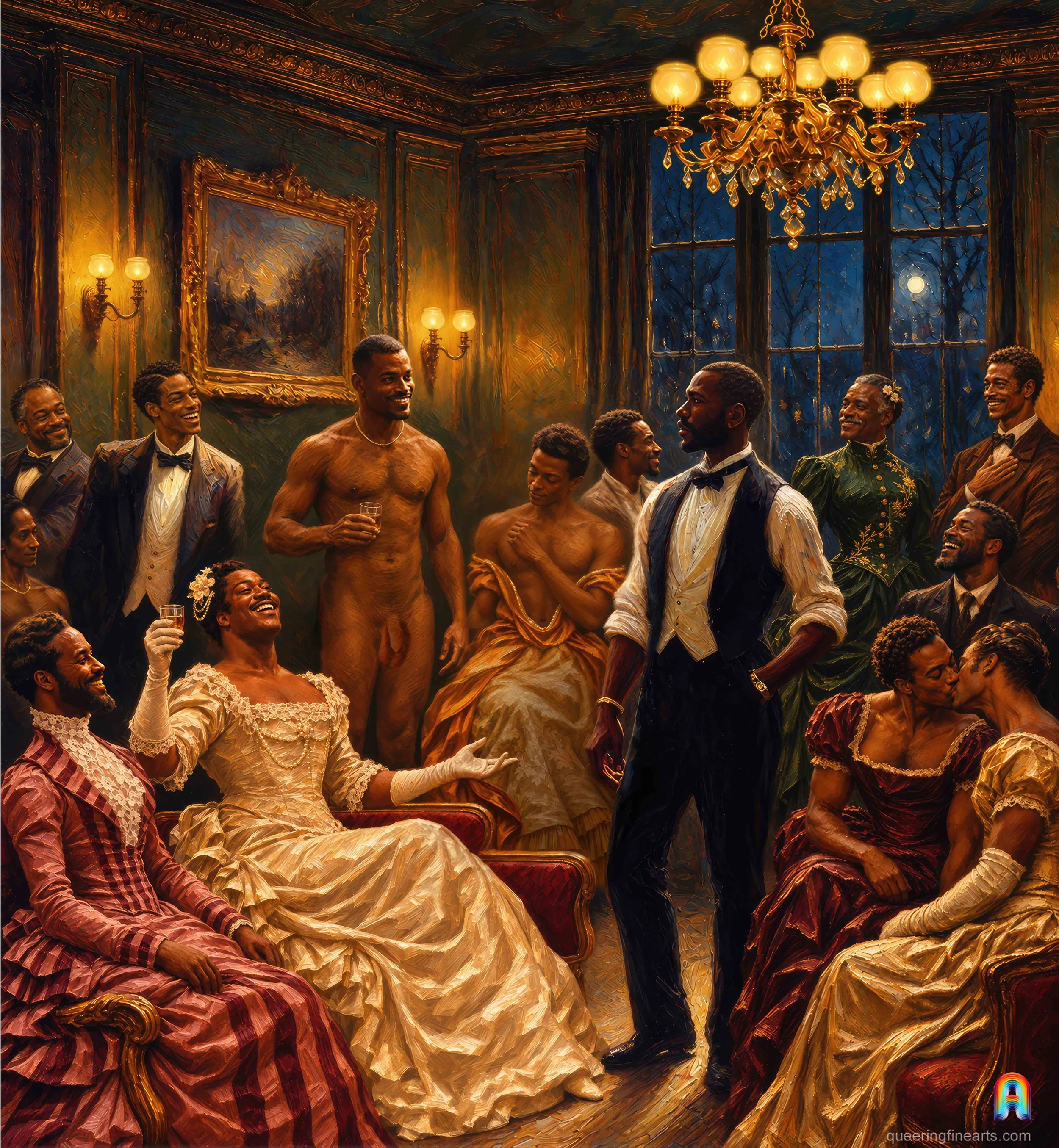
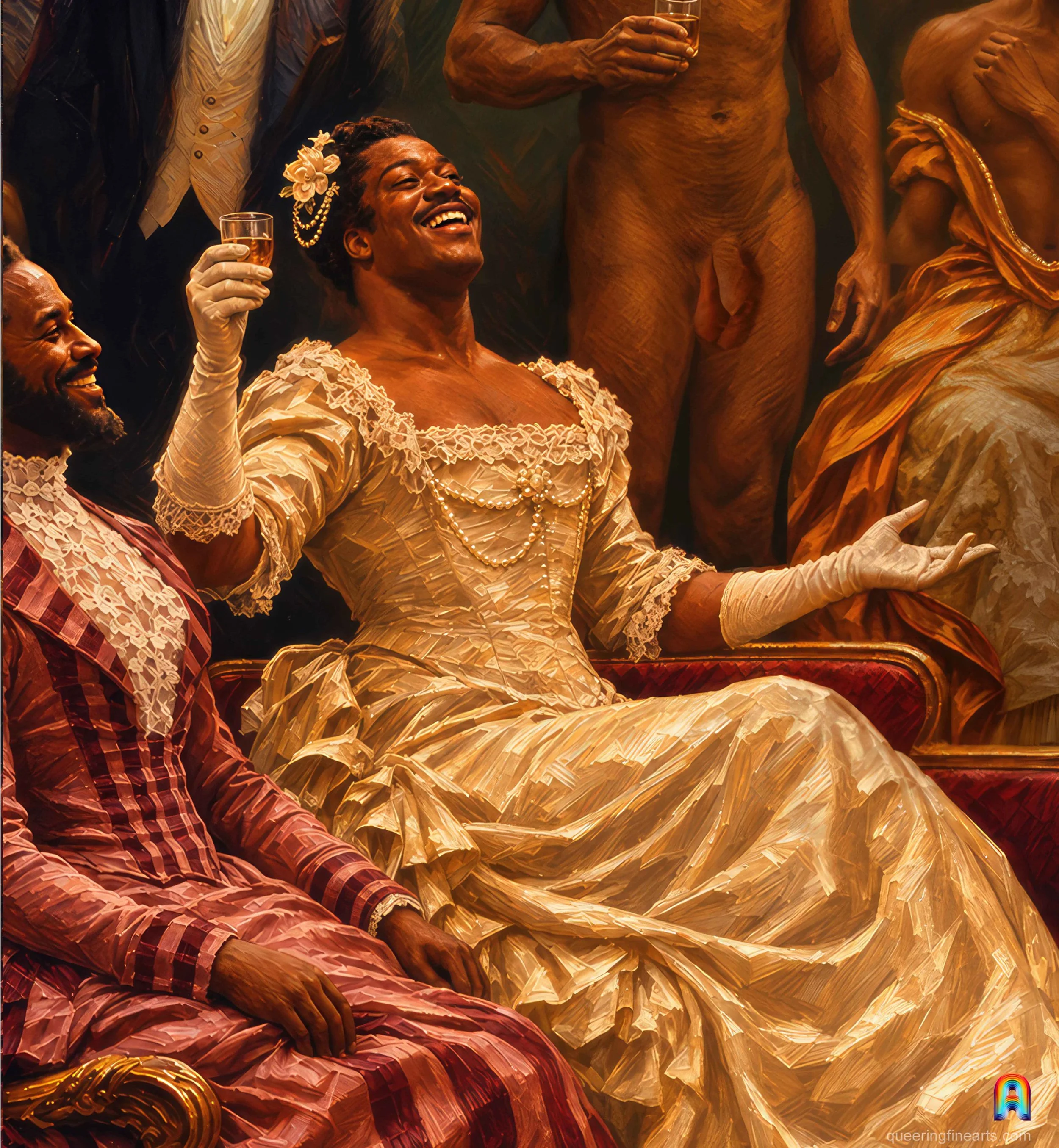
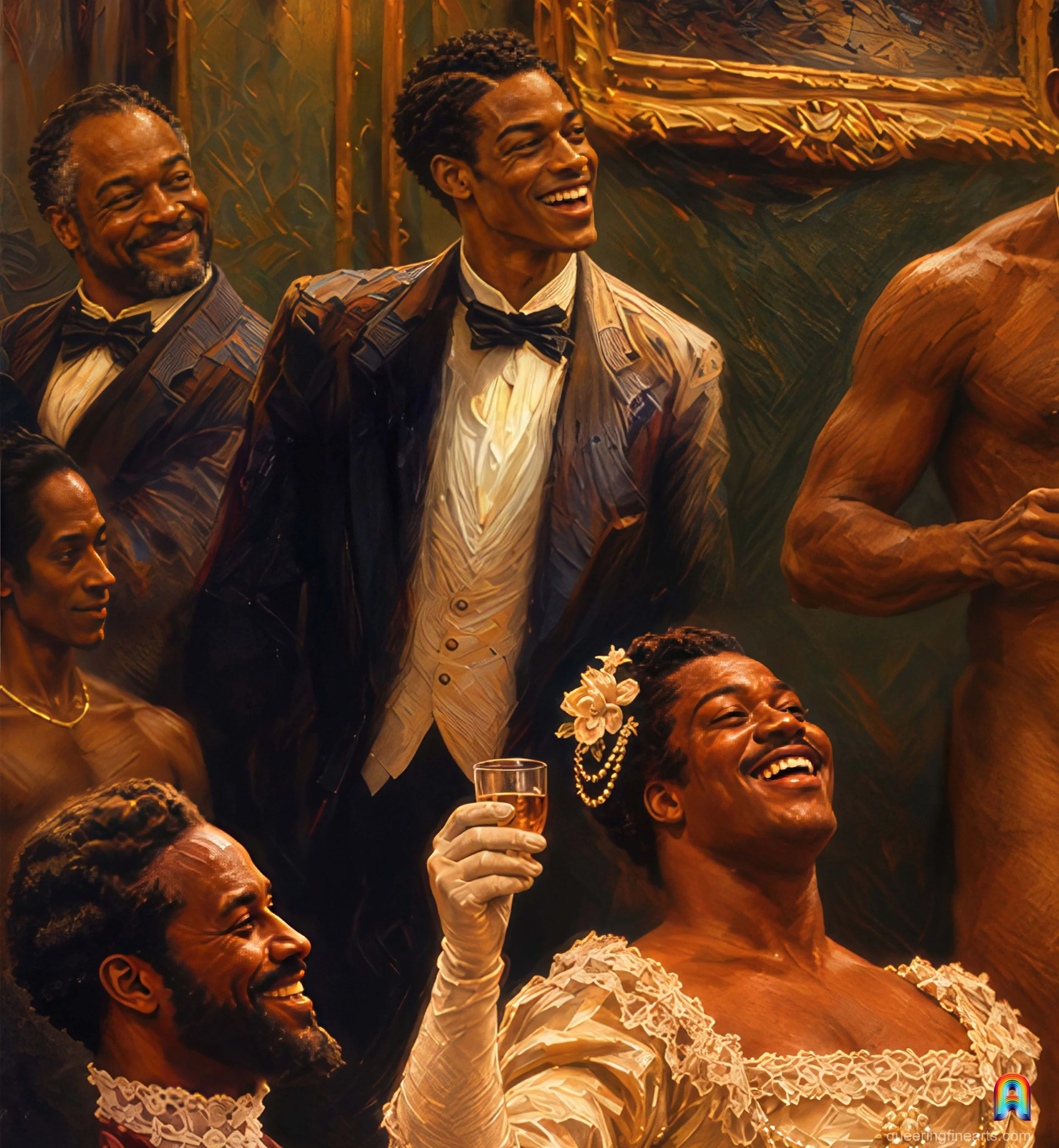
The Black Queen invites us into the pleasures of William Dorsey Swann’s circle in Washington around 1890. Swann presides in a cream gown, long ivory gloves and a floral hair ornament strung with pearls. Head tilted back in laughter, he raises his drink and stretches his other hand towards his guests with exuberant theatrical flair. Born into slavery in Maryland, he became the organiser of private balls where men danced together and some wore women’s clothing. His companions knew him as “the Queen”.¹ These festivities also nurtured a spirit of defiance: nearly a century before Stonewall, Swann and his companions were already claiming the freedom to dress, dance and gather on their own terms.²
His satin gown catches the gaslight in sumptuous folds, spilling across the red settee. It echoes the cream satin described when police raided one of his Washington gatherings on 12 April 1888 and arrested him alongside his guests.
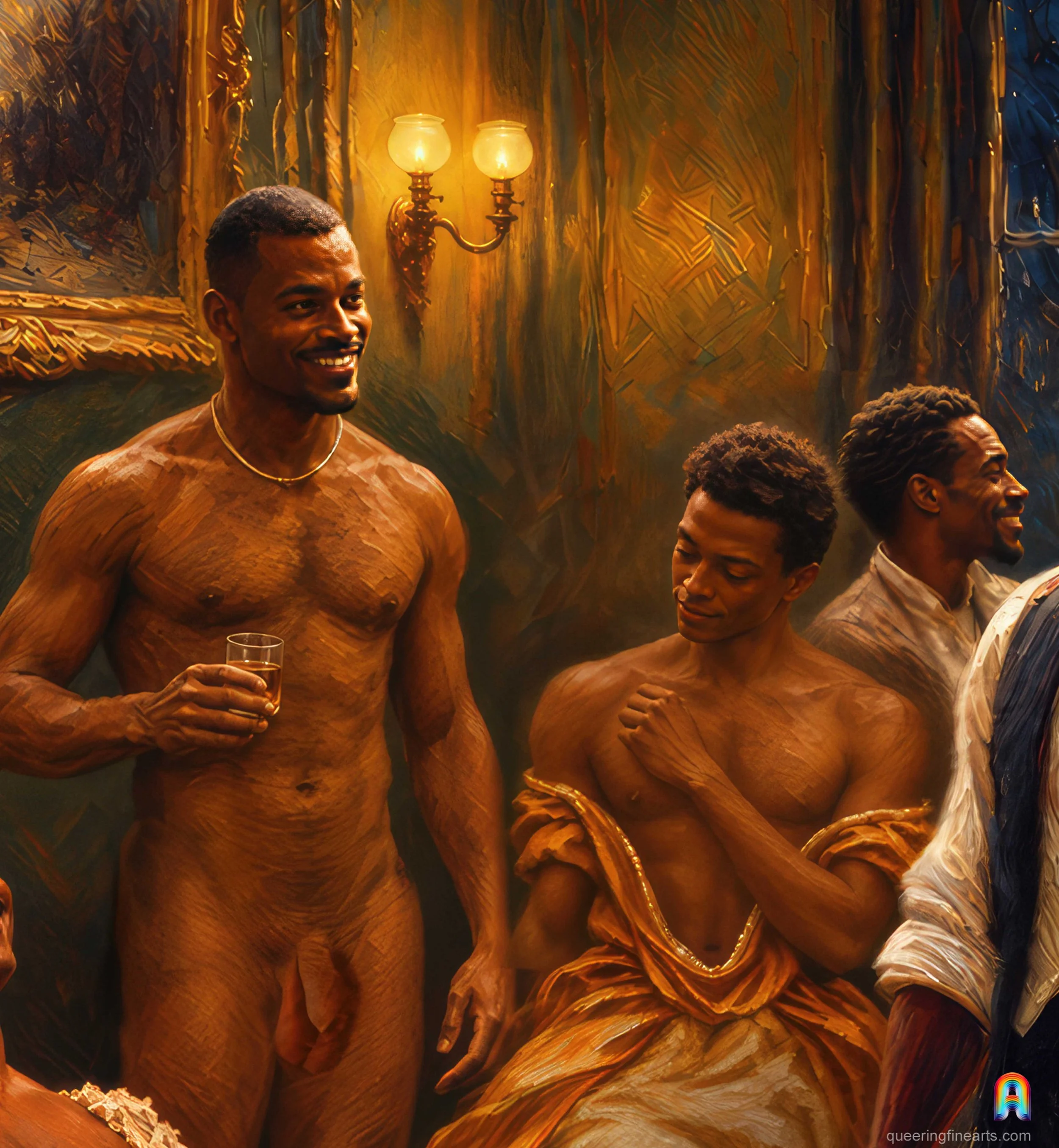
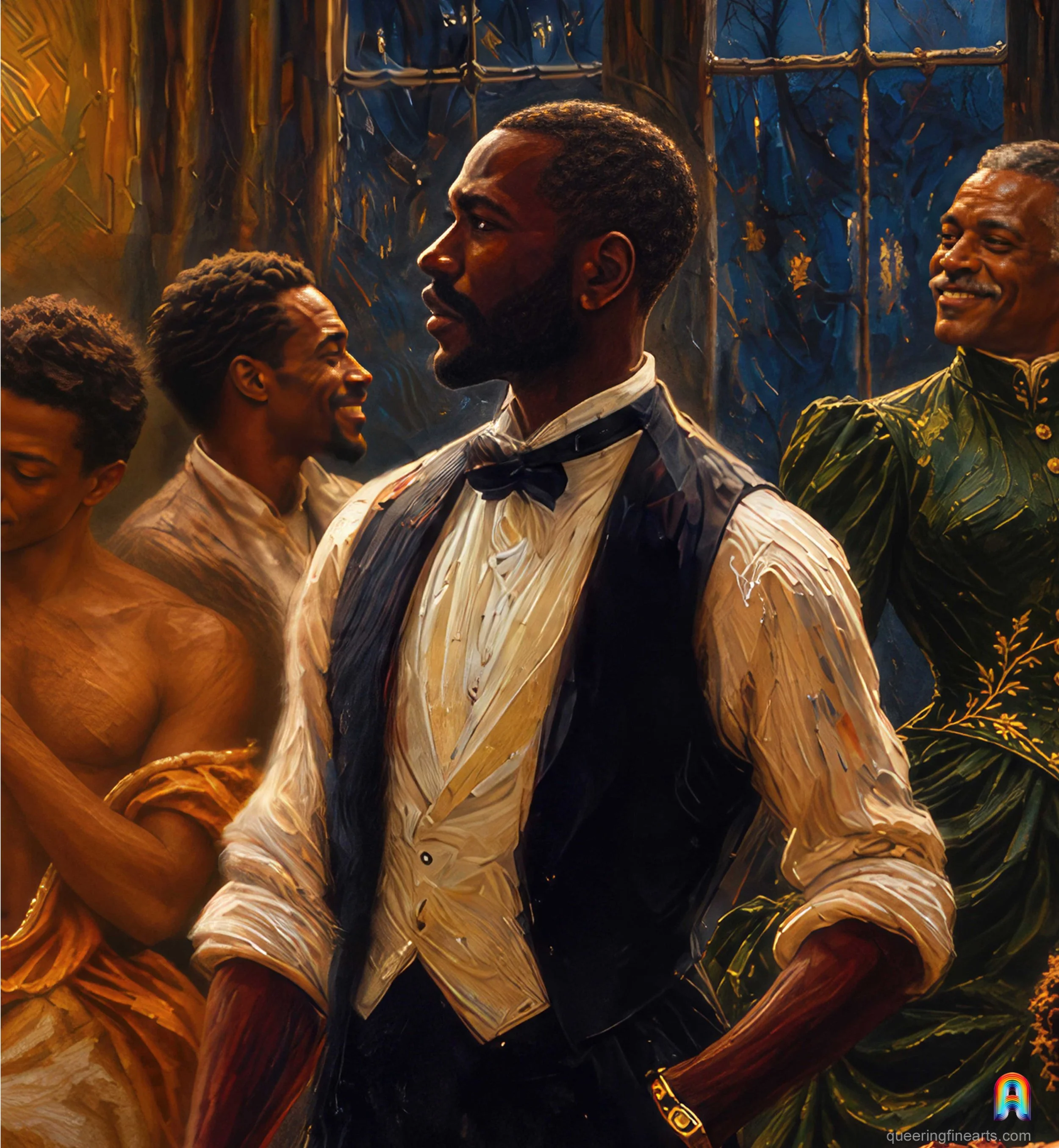
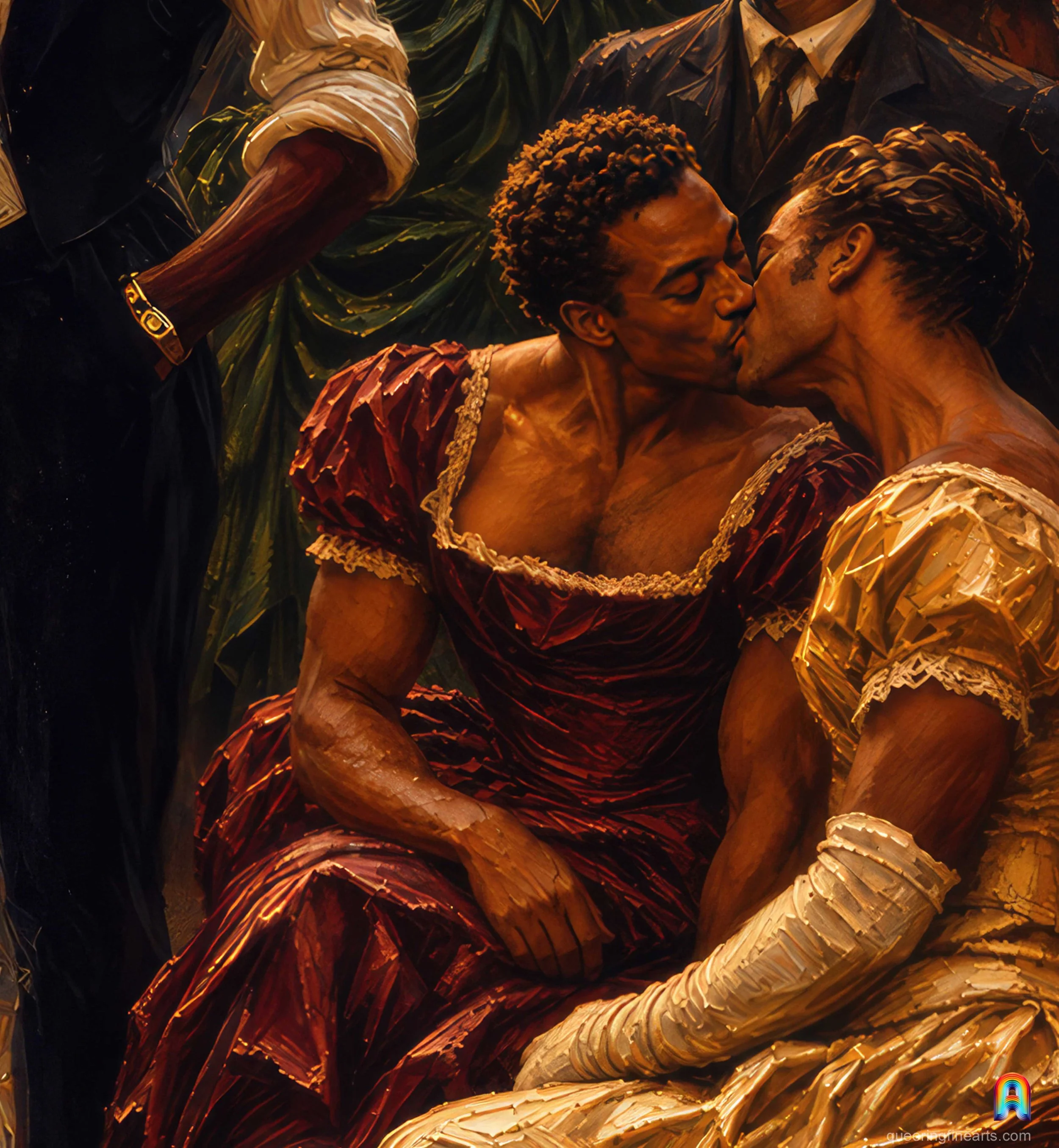
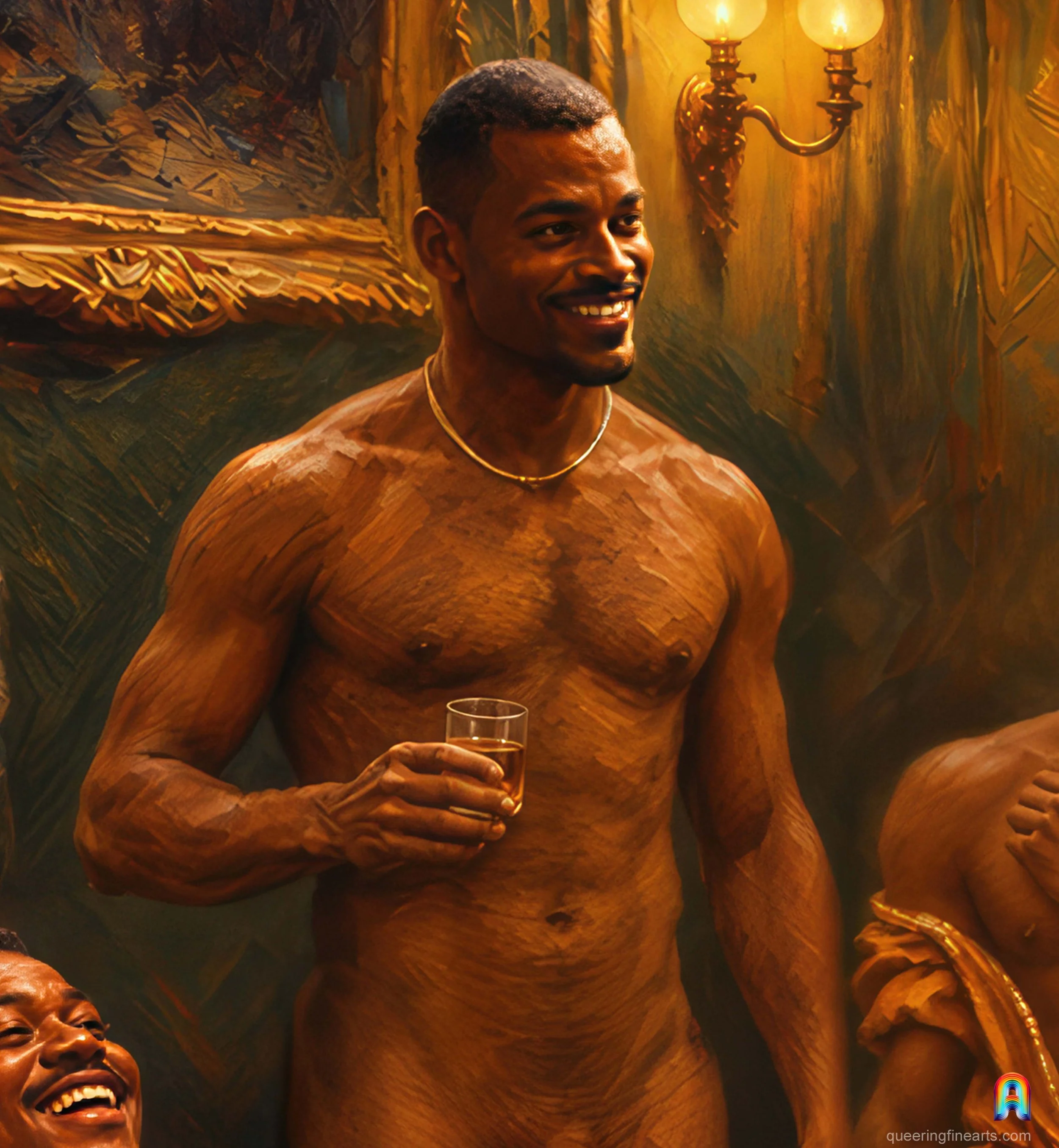
Around him, masculine beauty takes many forms. Dark evening suits mingle with bare chests, embroidered bodices and shoulders released from silk sleeves. A standing nude holds his drink with easy confidence. Beside him, a young man lets his saffron gown fall low across his torso, his lowered gaze and gentle smile suggesting delicious distraction. At the right, two men in burgundy and gold lean into a kiss. Their intimacy belongs naturally to the evening’s pleasures.
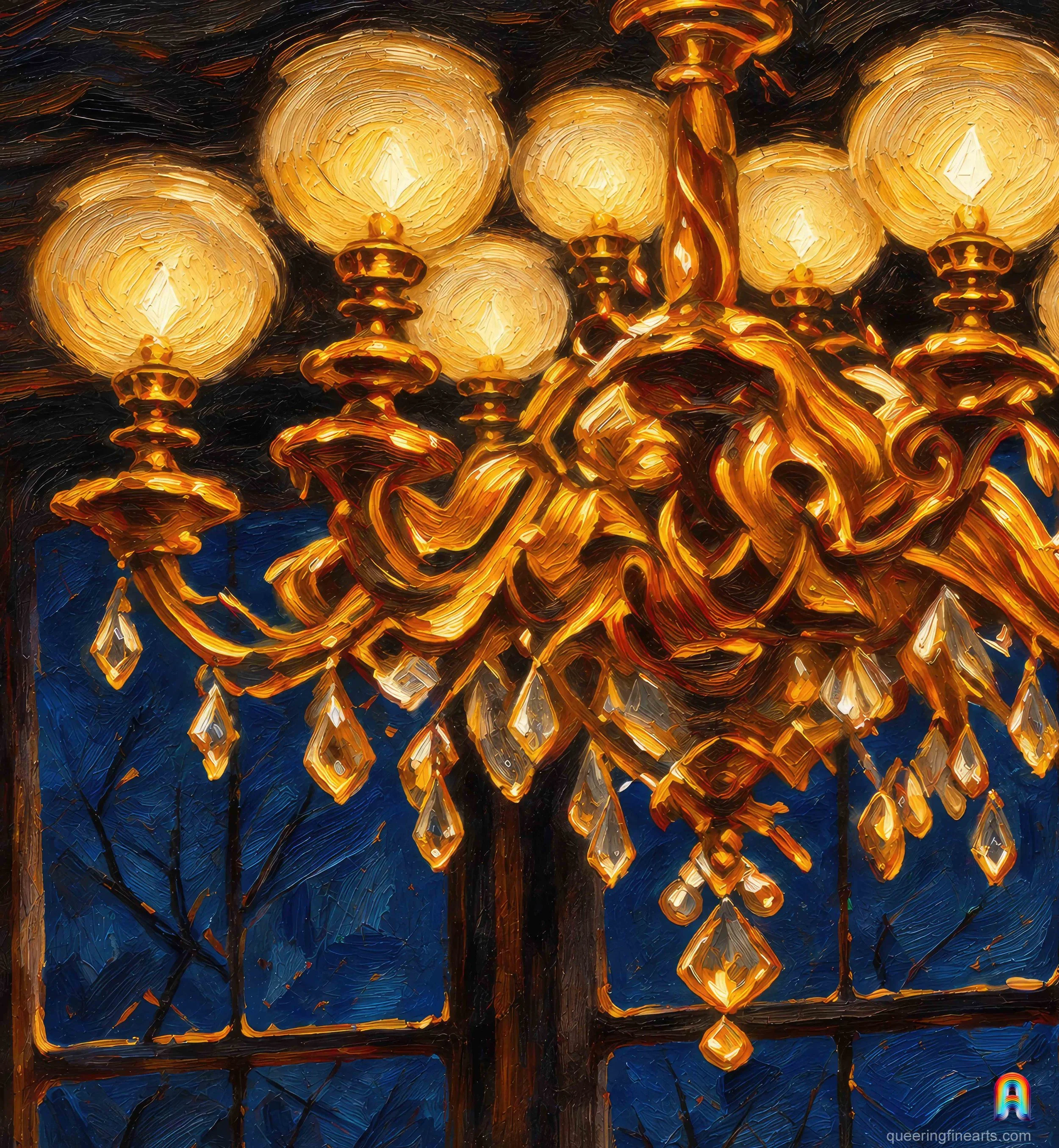
The room glows with amber light. Gold travels from the chandelier to jewellery, skin and satin, while the blue night deepens beyond the windows. Lively brushstrokes give the fabrics their rustle and the bodies their warmth. Swann’s radiant gown anchors this gathering of lovers, friends and dazzling personalities.
The anonymous painter is identified as a pupil of Henry Ossawa Tanner, a Black American artist who began teaching drawing at Clark College in Atlanta in autumn 1888.³ The warm tonal harmonies, expressive handling of light and attention to Black subjects connect the painting to Tanner’s artistic world. Here, these qualities serve a sumptuous celebration of male beauty and homosexual affection, granting Swann and his circle the grandeur of a society portrait.
Curiosity Piqued?
1. Channing Gerard Joseph, “Who was the first person to call themselves a ‘drag queen’?”, HistoryExtra, Bristol, Immediate Media, 22 June 2021. Read Joseph’s introduction to Swann’s place in drag history.
Joseph introduces Swann’s Washington gatherings and explains how his role as their organiser earned him the designation “Queen”. He places these festivities within the lives of Black men who created opportunities for companionship and self-expression in the late 19th century.
2. Channing G. Joseph, “The Black Drag Queens Who Fought Before Stonewall, 1880–1900”, particularly “A ‘Drag Party’ Raided”, OutHistory, adapted from an article published in Truthdig, 24 September 2015. Explore the archival evidence behind Swann’s circle.
Drawing on contemporary newspapers and archival documents, Joseph examines the gatherings, police raids and resistance associated with Swann and his companions. Accounts of the April 1888 raid describe Swann’s imposing build and cream satin gown, providing essential details for his representation.
3. Smithsonian American Art Museum, “Henry Ossawa Tanner”, biographical entry, Washington, D.C., Smithsonian Institution, undated. Discover Tanner’s life and artistic development.
This biography follows Tanner’s education, his teaching at Clark College from autumn 1888 and his subsequent career. It introduces his paintings of African American life and his religious subjects, offering context for the artistic training attributed to the anonymous painter.
From Slavery to the Capital
Nothing could have foretold the extraordinary destiny awaiting a little boy born into slavery in Washington County, Maryland, around 1860. His name was William Dorsey Swann, and his childhood began in Hancock, a town on the banks of the Potomac River, where the slaveholding South met the free North. His mother, Mary Jane Younker, worked as an enslaved housekeeper, while Andrew Jackson “Jack” Swann, who raised him, was an agricultural worker and musician. William was the fifth of thirteen children, growing up in a large family whose story would soon take a remarkable turn.¹
On 1 November 1864, Maryland abolished slavery. William was still a small child, and a new chapter was opening for his family.² His parents went on to purchase land and establish their own farm, an achievement that brought new possibilities and the satisfaction of building something of their own. Everyone contributed to the household’s livelihood, and William found work as a hotel waiter. By the second half of 1880, he was ready for a new adventure. He set off for Washington, determined to earn better wages, discover new opportunities and continue supporting his family.
In the capital, Swann found employment as a janitor at the Spencerian Business College, an educational institution run by Henry and Sara Spencer. Surrounded by an atmosphere of learning, he seized the opportunity to pursue an education of his own. In his spare time, he practised reading and writing, while continuing to send money home whenever possible. His employers remembered him as hardworking, gentle and courteous. Here was a young man with determination, curiosity and a generous sense of responsibility, steadily making his way in a city full of possibilities. In time, his friends would come to know him by a far more extraordinary title: queen.
Swann’s first years in Washington were not without complications. In 1882, he pleaded guilty to stealing books from the Washington Library Company and objects from the Spencers’ home. Yet the story took an unexpected turn. Rather than abandon him, Henry and Sara Spencer supported his application for a presidential pardon. They spoke of his efforts to educate himself, his devotion to his family and the qualities they had come to appreciate in him. They even offered to employ him permanently as the college janitor.³ Their intervention reveals something striking about the impression Swann had made on those who knew him. Even after a serious breach of trust, they believed he deserved another opportunity.
And Washington had something else to offer him, something that would prove just as important as employment or education: the possibility of finding men who shared his attraction to other men. Among the acquaintances gathering around him were Black workers whose lives, like his own, had begun in slavery. They found pleasure in one another’s company, formed friendships and romantic attachments, and began creating a world in which they could express parts of themselves that wider society rarely welcomed. For Swann, this circle would become a source of companionship, affection and celebration. Within it, he would gradually acquire the standing that made his invitations matter, laying the foundations for a remarkable chapter in the history of queer life in America.
Curiosity Piqued?
1. Channing Gerard Joseph, “Swann, William Dorsey,” in African American National Biography, edited by Henry Louis Gates Jr. and Evelyn Brooks Higginbotham, Oxford, Oxford University Press, 20 May 2021. DOI: 10.1093/acref/9780195301731.013.79001.
Joseph brings Swann’s early world vividly into focus, following his childhood in Maryland, his family’s emancipation and his move to Washington in 1880. Through biographical and archival evidence, he traces the emergence of a resourceful young man who pursued education, supported his family and found his place among other Black men whose friendships and relationships challenged the conventions of their time. Joseph dates Swann’s birth to March 1860, although other accounts suggest approximately 1858.
2. Maryland State Archives, “Slave Statistics,” Guide to Government Records, Annapolis, Maryland State Archives, undated.
These records offer a window onto a transformative moment in Maryland’s history. Compiled following the abolition of slavery on 1 November 1864, they preserve information about formerly enslaved individuals and the circumstances of their enslavement. They help illuminate the world into which Swann was born and the extraordinary changes his family experienced during his earliest years.
3. Netisha Currie, “William Dorsey Swann, the Queen of Drag,” Rediscovering Black History, College Park, National Archives and Records Administration, 29 June 2020. Drawing on Pardon Case File J-202, “Dorsey Swan,” 1882, Record Group 204, National Archives, NAID 165128485.
Currie opens a fascinating archival window onto Swann’s early years in Washington. The documents surrounding his 1882 conviction and pardon petition include personal statements from Henry and Sara Spencer, who described his character, his determination to educate himself and his commitment to supporting his family. Their willingness to offer him permanent employment reveals an unexpected dimension of his story. The article also explores his later 1896 pardon petition, connecting these personal experiences to a broader history of queer resistance in the United States.
Where Love Found Its Freedom
For William Dorsey Swann, Washington was becoming a city of wonderful possibilities. During the 1880s, he discovered a circle of men with whom he could share something far more personal than the routines of everyday life: friendship, desire and the excitement of falling in love. Many worked as domestic servants, cooks, coachmen or messengers, and some, like Swann himself, had been born into slavery. After spending their days attending to other people’s households, these men could finally devote time to their own affections and pleasures. They were discovering one another, forming attachments and creating a social world in which love between men could flourish. Channing Gerard Joseph’s research reveals how romance and sexual attraction helped bring this remarkable circle together.¹
Among these men, one stands out: Pierce Lafayette, born enslaved in Georgia and formerly held by Alexander H. Stephens, who would become vice president of the Confederacy. By January 1887, Lafayette was living in an elegantly furnished, two-storey house in Washington, a home he willingly opened to Swann and his friends. But his connection with Swann went well beyond hospitality. Joseph describes Lafayette as Swann’s intimate friend, while the American public television network PBS, in its documentary series American Masters, identifies him more explicitly as Swann’s lover.² Their closeness brings warmth and humanity to a history too often reconstructed from police reports and court proceedings. Although the surviving evidence does not establish precisely how their relationship began or how long it lasted, it offers a precious glimpse into the intimate lives of these men.
And Lafayette had already known love with another man long before meeting Swann. While still enslaved, he had been involved with Felix Hall, another enslaved man. A contemporary source described Hall, in the peculiar language of the period, as Lafayette’s “negro Mistress.”³ Behind those words lies an extraordinary fragment of queer history: two men who found affection and intimacy with one another even under slavery. Their relationship reminds us that love between men did not suddenly appear when circumstances became more favourable. It had always existed, including among people whose personal lives were subject to the most severe restrictions. Years later, Lafayette’s place in Swann’s circle carried that history of same-sex affection into a new generation.
Washington itself offered opportunities for encounters. Lafayette Square, immediately beside the White House, was already known as a place where men sought sexual contact with other men. The city’s social divisions were certainly present: Black and white homosexual networks often developed separately, although gatherings involving drag could bring men from both communities together.⁴ In this setting, Swann and his acquaintances were doing something especially meaningful. They were creating occasions to meet, recognise familiar faces, discover new attractions and enjoy the company of people who understood their desires.
There was something wonderfully human about these gatherings. An invitation might lead to a new friendship, a flirtation or the beginning of a lasting romance. A familiar face could become someone to look forward to seeing again. Swann’s circle offered its members the pleasure of belonging, the freedom to express affection and the reassurance of finding others who shared their feelings. Joseph interprets these gatherings as places of mutual recognition and acceptance.⁵ And at their heart was a simple, enduring possibility: a man could love another man and find a place where that love belonged.
Curiosity Piqued?
1. Channing Gerard Joseph, “Swann, William Dorsey,” in African American National Biography, edited by Henry Louis Gates Jr. and Evelyn Brooks Higginbotham, Oxford, Oxford University Press, 20 May 2021. DOI: 10.1093/acref/9780195301731.013.79001.
Joseph reconstructs the personal and social world surrounding Swann in Washington, identifying the friendships, romantic attachments and shared experiences that brought these men together. His research reveals how formerly enslaved Black men, many employed in domestic service, developed relationships and social networks that allowed them to explore their sexuality and establish a sense of belonging.
2. PBS, “William Dorsey Swann: From Enslaved to Queen,” American Masters, New York, The WNET Group, 2021.
This documentary introduces Swann’s extraordinary life and the community he helped create in Washington. It identifies Pierce Lafayette as Swann’s lover and places their relationship within the broader emergence of Black queer social life after emancipation. Through historical research and storytelling, it brings a personal dimension to a history often known primarily through official records.
3. Channing Gerard Joseph, “The First Drag Queen,” The Berlin Journal, no. 35, Berlin, American Academy in Berlin, 18 October 2021. Originally published in The Nation, 17 February 2020.
Joseph explores the lives of Swann and the men who gathered around him, including Pierce Lafayette and his earlier relationship with Felix Hall. The account preserves the remarkable contemporary description of Hall as Lafayette’s “negro Mistress,” offering rare evidence of affection between enslaved men. It also situates Swann’s gatherings within a longer history of same-sex relationships, showing how queer intimacy endured across the transition from slavery to freedom.
4. Cari Shane, “The First Self-Proclaimed Drag Queen Was a Formerly Enslaved Man,” Smithsonian Magazine, Washington, Smithsonian Institution, 9 June 2023.
Shane examines Swann’s pioneering role in Washington’s queer history and the social environment in which his gatherings took place. Drawing on historical research, including Washington’s 2019 LGBTQ historic context study, the article discusses meeting places such as Lafayette Square, the racial divisions within homosexual networks and the occasions when Black and white men participated in shared social activities.
5. Channing Gerard Joseph, “Historical Research and Discoveries,” author’s research website, undated.
Joseph presents discoveries arising from his investigation into Swann and his circle, emphasising the importance of their gatherings as spaces of companionship, recognition and mutual acceptance. His research helps illuminate the emotional and social significance of these occasions, showing how friendship, romantic attraction and a shared sense of identity contributed to the formation of an early Black queer community.
An Evening with the Queen
Imagine receiving an invitation to an evening unlike any other in Washington. Perhaps it began with a few discreet words exchanged at the YMCA, where a young man might discover that others shared his attraction to men. Soon, he could find himself approaching the door of a private residence, anticipating an evening of music, dancing, flirtation and delightful company. Among the homes that welcomed William Dorsey Swann’s circle was the elegant two-storey residence of Pierce Lafayette, where a ball took place in January 1887.¹ Inside, the guests could leave their everyday occupations behind and enter a world of feminine elegance, male affection and joyful celebration.
And what a spectacle these gatherings must have presented! The guests devoted considerable attention to their appearance, choosing outfits inspired by contemporary fashion. Silk dresses, tightly fitted corsets, elaborate bustles, long stockings and delicate slippers transformed the room into a parade of fashionable silhouettes. Some gowns featured low necklines, short sleeves and sweeping trains, while other guests preferred men's suits.² Imagine the pleasure of arriving in satin, admiring a friend's new dress or attracting the attention of a handsome partner across the room. Men who spent their working days as servants, cooks, coachmen or messengers could now become the most dazzling figures at the ball. Here, elegance was something to enjoy, display and celebrate together.
Naturally, no splendid evening would be complete without refreshments, singing and dancing! Among the entertainments was the cakewalk, a lively competition in which the winning dancers received a cake. Originating among enslaved African Americans, the dance featured exaggerated movements that playfully mocked the formal manners of white plantation society.³ In Swann’s circle, it offered a wonderful opportunity for theatrical display, humour and friendly rivalry. One can readily imagine the excitement as dancers took their turns, the amusement of the spectators and the satisfaction of winning the coveted prize. Meanwhile, the evening offered plenty of opportunities for flirtation, admiration and the pleasures of dancing with another man.
And presiding over this extraordinary company was William Dorsey Swann himself, the Queen. The Washington Critic used the title “queen” in its account of an April 1888 gathering. Joseph has suggested a possible connection with the “queens of liberty” who appeared on decorated floats during Washington’s Emancipation Day celebrations. Within his own circle, Swann had acquired a title that expressed both affection and authority. The man who earned his living serving others could now welcome his guests, set the tone of the festivities and enjoy the distinction of presiding over a celebration created by and for his community.
One particular evening has left us an especially vivid glimpse of this world. On 12 April 1888, Swann appeared in a cream satin gown, a striking choice that must have caught the light beautifully. Some of his guests wore ribbons and wigs of long, wavy hair, adding to the elegance and theatricality of the occasion. Supper had been prepared, and the gathering was sufficiently well attended that numerous men managed to escape when the police unexpectedly entered the house.⁴ Yet before that unwelcome interruption, the evening had belonged entirely to its guests. Every detail, from the carefully chosen garments to the music, dancing and refreshments, reflected the pleasure they took in creating these occasions.
There is something irresistible about imagining these men preparing for a ball, adjusting a ribbon, arranging a gown, exchanging compliments or waiting for a favourite partner to ask them to dance. Their gatherings were occasions for beauty, laughter, attraction and companionship, organised by men who understood how precious such pleasures could be. And at the centre of it all stood Swann, welcoming his guests in satin and presiding over a world in which the freedom to love could also become the freedom to celebrate.
Curiosity Piqued?
1. Channing Gerard Joseph, “The First Drag Queen,” The Berlin Journal, no. 35, Berlin, American Academy in Berlin, 18 October 2021. Originally published in The Nation, 17 February 2020.
Joseph introduces the remarkable social world surrounding Swann, describing the private gatherings organised by his circle and the importance of homes such as Pierce Lafayette’s residence. His research explores how invitations circulated, how these men found one another and how their celebrations created opportunities for companionship, romantic encounters and expressions of identity that were rarely possible in public.
2. Channing Gerard Joseph, “Swann, William Dorsey,” in African American National Biography, edited by Henry Louis Gates Jr. and Evelyn Brooks Higginbotham, Oxford, Oxford University Press, 20 May 2021. DOI: 10.1093/acref/9780195301731.013.79001.
Joseph provides a detailed account of Swann’s life and the elaborate festivities associated with his circle. Particularly fascinating are the descriptions of fashionable clothing, including silk gowns, corsets, bustles, stockings and slippers. The entry helps reconstruct the visual splendour of these occasions and the ways in which clothing, dancing and sociability contributed to a distinctive culture of celebration.
3. Cari Shane, “The First Self-Proclaimed Drag Queen Was a Formerly Enslaved Man,” Smithsonian Magazine, Washington, Smithsonian Institution, 9 June 2023.
Shane places Swann’s celebrations within the broader history of African American performance and queer culture. The article discusses the cakewalk, its origins among enslaved African Americans and its playful imitation of white plantation manners. It also examines Swann’s extraordinary adoption of the title “queen” and the importance of his gatherings as expressions of community and self-determination.
4. “A Negro Dive Raided,” The Washington Post, Washington, 13 April 1888, p. 3. Reproduced and discussed in Channing Gerard Joseph, “A ‘Drag Party’ Raided,” The Black Drag Queens Who Fought Before Stonewall, 1880–1900, OutHistory, 2016.
This contemporary newspaper report offers one of the most vivid surviving descriptions of a gathering attended by Swann and his companions. It records his cream satin gown, the ribbons and long-haired wigs worn by guests and the circumstances of the police raid on 12 April 1888. Although written through the prejudices of its time, the account preserves invaluable details about the clothing, atmosphere and organisation of these early drag celebrations.
A Queen Who Refused to Bow
On the evening of 12 April 1888, William Dorsey Swann was about to demonstrate that being a queen meant considerably more than wearing a beautiful gown. When police officers burst into the ball, he stepped forward to confront them, determined to protect his guests. As his friends hurried towards doors and windows, Swann stood his ground, giving some of them precious moments to escape. The National Republican captured the extraordinary scene, describing him in “an attitude of royal defiance.” During the struggle, his magnificent cream satin gown was torn.¹ The image is unforgettable: a Black man born into slavery, dressed in satin, standing up to the police in defence of his friends and their freedom to celebrate together.
Thirteen Black men were arrested that night. The newspapers published their names, turning a private evening among friends into a public spectacle. A crowd followed the prisoners to the police station, while reporters described the gathering through the racial and sexual prejudices of their time.² Ironically, these hostile accounts would become invaluable records of a community they sought to ridicule. For men employed as servants, cooks, coachmen or messengers, such exposure could have serious consequences. Their employers, neighbours and relatives might now learn about a part of their lives they had carefully kept private. Yet behind the sensational headlines lay a very different story: a group of men whose principal desire had been to enjoy an evening of companionship, music, dancing and affection.
And Swann was not about to surrender the world he had helped create. He continued organising gatherings, maintaining the friendships and celebrations that had become so important to his circle. In January 1896, another prosecution resulted in a sentence of 300 days in prison for “keeping a disorderly house,” an accusation commonly associated with prostitution. Swann pleaded not guilty. Three months into his imprisonment, he took an extraordinary step: he petitioned President Grover Cleveland for a pardon. He presented his employment record, challenged the severity of his punishment and gathered the support of thirty friends and acquaintances who signed his application.³ Their signatures tell a story of solidarity. Even under circumstances that might have encouraged silence, these people were prepared to put their names behind him.
The authorities, however, regarded Swann’s relationships with other men as the real source of scandal. U.S. Attorney A. A. Birney opposed the petition, invoking conduct he considered too disgusting even to describe and condemning Swann’s influence on the community. The judge was even more revealing in his hostility, reportedly declaring that he wished he could send Swann somewhere he would “never again see a man’s face.”⁴ Such words leave little doubt about the prejudices shaping the prosecution. The objection extended beyond the festivities themselves to the very possibility of men forming intimate relationships with other men. Swann’s determination to continue gathering with his companions challenged those attitudes in the most practical way imaginable: by refusing to abandon the people and pleasures that mattered to him.
As the petition made its way through the authorities, Swann’s supporters continued their efforts. Concerned about his declining health, they contacted officials and drew attention to the dangers of his imprisonment. A physician reported that Swann suffered from heart disease and warned that prison conditions threatened his life. Nevertheless, on 29 July 1896, President Cleveland refused the pardon. The campaign had not achieved its immediate objective, but it had produced something remarkable: a formal appeal to the highest political authority in the United States on behalf of a man persecuted for the social and sexual world he inhabited.
Channing Gerard Joseph identifies Swann’s petition as the earliest documented instance in American history of someone taking specific legal and political action to defend a queer community’s right to assemble. It is an extraordinary distinction for a man whose life had begun in slavery. Swann had not set out to become a political theorist or the leader of a national movement. He wanted to gather his friends, welcome the men he loved, wear beautiful clothes and enjoy evenings filled with music and dancing. Yet when those pleasures were threatened, he stood up for them, first in a ballroom and then through an appeal to the president himself.
The courage of William Dorsey Swann gives his story a significance that reaches far beyond the history of drag. Long before the modern LGBTQ+ rights movement, he had already demonstrated something fundamental: the freedom to love, to gather and to celebrate one's identity was worth standing up for. His cream satin gown may have been torn that April evening, but the determination of the queen who wore it has endured.
Curiosity Piqued?
1. Channing Gerard Joseph, “The First Drag Queen,” The Berlin Journal, no. 35, Berlin, American Academy in Berlin, 18 October 2021. Originally published in The Nation, 17 February 2020.
Joseph reconstructs Swann’s remarkable confrontation with the police during the raid of April 1888, including the contemporary description of his “royal defiance.” He also examines the broader significance of Swann’s later petition to President Cleveland, identifying it as an exceptionally early example of political resistance in defence of queer assembly. His account places these events within the history of Black emancipation, sexuality and the emergence of organised queer social life in the United States.
2. Channing Gerard Joseph, “A ‘Drag Party’ Raided,” in The Black Drag Queens Who Fought Before Stonewall, 1880–1900, OutHistory, 2016. Drawing on contemporary reports in The Washington Post, Evening Star and The Washington Critic, Washington, 13 April 1888.
This collection brings together contemporary newspaper accounts of the police raid on Swann’s gathering. The reports describe the arrests, the publication of the participants’ names and the public attention surrounding the incident. Although written through the prejudices and sensationalism of the period, they preserve valuable evidence of the men who attended these celebrations and the circumstances in which their private lives became public knowledge.
3. Netisha Currie, “William Dorsey Swann, the Queen of Drag,” Rediscovering Black History, College Park, National Archives and Records Administration, 29 June 2020. Drawing on Pardon Case File P-532, William D. Swan, 1896, Record Group 204, National Archives, NAID 165128484.
Currie examines the surviving archival documentation of Swann’s 1896 pardon petition, including his prison sentence, the support of thirty signatories and the medical concerns raised during his imprisonment. The documents reveal the determination of Swann and his supporters to seek relief through official channels, while the eventual refusal by President Cleveland illustrates the institutional hostility confronting homosexual men at the end of the 19th century.
4. Channing Gerard Joseph, “Swann, William Dorsey,” in African American National Biography, edited by Henry Louis Gates Jr. and Evelyn Brooks Higginbotham, Oxford, Oxford University Press, 20 May 2021. DOI: 10.1093/acref/9780195301731.013.79001. Quoting Evening Star, Washington, 13 January 1896.
Joseph provides further details of the prosecution against Swann, including the hostile statements attributed to the judge and the prosecutor’s objections to clemency. These accounts reveal how directly the authorities associated Swann’s gatherings with male homosexuality and how their condemnation extended beyond public behaviour to the intimate relationships between men.
Beyond Oblivion
A queen may leave the ballroom, but her story does not end when the music stops. By 1900, William Dorsey Swann had returned to Hancock, Maryland, where his extraordinary journey had begun. He died shortly before Christmas in 1925. According to historian Channing Gerard Joseph, local officials subsequently burned Swann’s home, potentially destroying personal belongings and documents that might have illuminated his private life.¹ What memories, keepsakes or intimate traces of the men he had loved might have disappeared in those flames? We may never know. But the destruction of a house could not erase the life of the man who had once stood before the police in a cream satin gown.
And the world Swann had helped create was far from disappearing. His younger brother, Daniel J. Swann, a tailor, continued providing feminine clothing and costumes to Washington’s drag community until his death in 1954. Among the figures associated with this later generation were Alden Garrison and the wonderfully named “Mother” Louis Diggs.² Imagine the fabrics passing through Daniel’s hands, the gowns taking shape and the delight of a performer discovering how splendid he looked! Through his brother’s work, the Swann family remained connected to a culture of creativity, companionship and queer self-expression for decades.
The gatherings organised by Swann, with their elaborate costumes, competitions and celebrated queens, also recall aspects of the ballroom culture that would flourish in American cities generations later. Joseph has drawn parallels between these early communities and the houses of contemporary ballroom culture, particularly their chosen families and figures of authority known as queens and mothers. Although the precise historical connections remain to be established, Daniel’s long career provides a fascinating thread linking different generations of queer celebration.
For decades, however, William Dorsey Swann himself remained almost invisible in the historical record. Then, in 2005, Channing Gerard Joseph, a journalism student at Columbia University, discovered a newspaper account of the April 1888 police raid. Who was this extraordinary man described as a queen? And how had his remarkable story escaped wider attention? Joseph followed the clues through newspapers, census records, medical publications and other scattered documents.³ Piece by piece, a forgotten life began to emerge. The sensational headlines that had once exposed Swann and his friends to ridicule were becoming the very evidence through which their courage could be recognised.
The discoveries continued. In early 2020, National Archives specialist Netisha Currie, inspired by Joseph’s research, searched for and located two presidential pardon files associated with Swann. Suddenly, the surviving record offered much more than accounts of parties and arrests. Here was a man who had worked to educate himself, supported his family, inspired the confidence of employers and gathered friends willing to defend him. Here, too, was his extraordinary appeal to the president of the United States.⁴ Documents created by institutions that had punished him were now helping to restore his humanity and his place in American history.
Some mysteries remain. No authenticated photograph of William Dorsey Swann is currently known.⁵ His private correspondence has not emerged, and his relationship with Pierce Lafayette survives only in fragments. Yet those fragments tell us something essential: men loved other men, dressed for special occasions, danced together and formed communities that brought joy and meaning to their lives. Swann was admired, his invitations mattered and his friends returned to the gatherings he organised. Above all, he understood that affection, beauty and celebration were worth defending.
And this is where Queering Fine Arts enters the story. Historical research has recovered the names, places, costumes and events. Art can bring these fragments together and give them visual presence. The cream satin gown, the elegance of a private Washington home and the affection between men become the foundations of an imagined scene rooted in historical evidence. Where the archives preserve only glimpses, painting can evoke the warmth, pleasure and dignity of the world these men created for themselves.
What an extraordinary destiny for a little boy born into slavery in Maryland! William Dorsey Swann became a queen, gathered a community around him, celebrated love between men and challenged the authorities who tried to suppress their freedom. More than a century later, historians are recovering his story, artists are bringing his world back to life and new generations are discovering the significance of his courage.
The queen has returned to the ballroom. And this time, the whole world is invited to celebrate with her.
Curiosity Piqued?
1. Channing Gerard Joseph, “Swann, William Dorsey,” in African American National Biography, edited by Henry Louis Gates Jr. and Evelyn Brooks Higginbotham, Oxford, Oxford University Press, 20 May 2021. DOI: 10.1093/acref/9780195301731.013.79001.
Joseph reconstructs Swann’s life from his childhood in slavery to his later years in Maryland. His research addresses Swann’s withdrawal from Washington’s drag community, his death in 1925 and the reported destruction of his home. The biography brings together scattered historical evidence to restore the life of a man whose significance had long remained unrecognised.
2. Channing Gerard Joseph, “The First Drag Queen,” The Berlin Journal, no. 35, Berlin, American Academy in Berlin, 18 October 2021. Originally published in The Nation, 17 February 2020.
Joseph follows Swann’s circle beyond the 1880s, highlighting the continuing involvement of his younger brother Daniel and later performers such as Alden Garrison and “Mother” Louis Diggs. He also explores parallels between these early drag communities and the houses, competitions and chosen families of contemporary ballroom culture.
3. Channing Gerard Joseph, “Historical Research and Discoveries,” author’s research website, undated.
Joseph recounts the discoveries that began with a newspaper report of the 1888 raid while studying at Columbia University in 2005. He follows his investigation through newspapers, census records, medical publications and other archival sources, revealing how a nearly forgotten historical figure gradually re-emerged.
4. Netisha Currie, “William Dorsey Swann, the Queen of Drag,” Rediscovering Black History, College Park, National Archives and Records Administration, 29 June 2020. Drawing on Pardon Case File J-202, “Dorsey Swan,” 1882, NAID 165128485, and Pardon Case File P-532, William D. Swan, 1896, NAID 165128484, Record Group 204, National Archives.
Currie presents two presidential pardon files associated with Swann. These documents illuminate his employment, education, family responsibilities, supporters and determination to challenge his imprisonment. They demonstrate how official records can unexpectedly preserve intimate details of lives otherwise largely absent from historical narratives.
5. Cari Shane, “The First Self-Proclaimed Drag Queen Was a Formerly Enslaved Man,” Smithsonian Magazine, Washington, Smithsonian Institution, 9 June 2023.
Shane examines Swann’s historical significance and the challenges of reconstructing his life, including the absence of an authenticated photograph. Drawing on Joseph’s research, the article explores how his rediscovery is transforming our understanding of early drag culture, Black queer communities and LGBTQ+ history in the United States.