

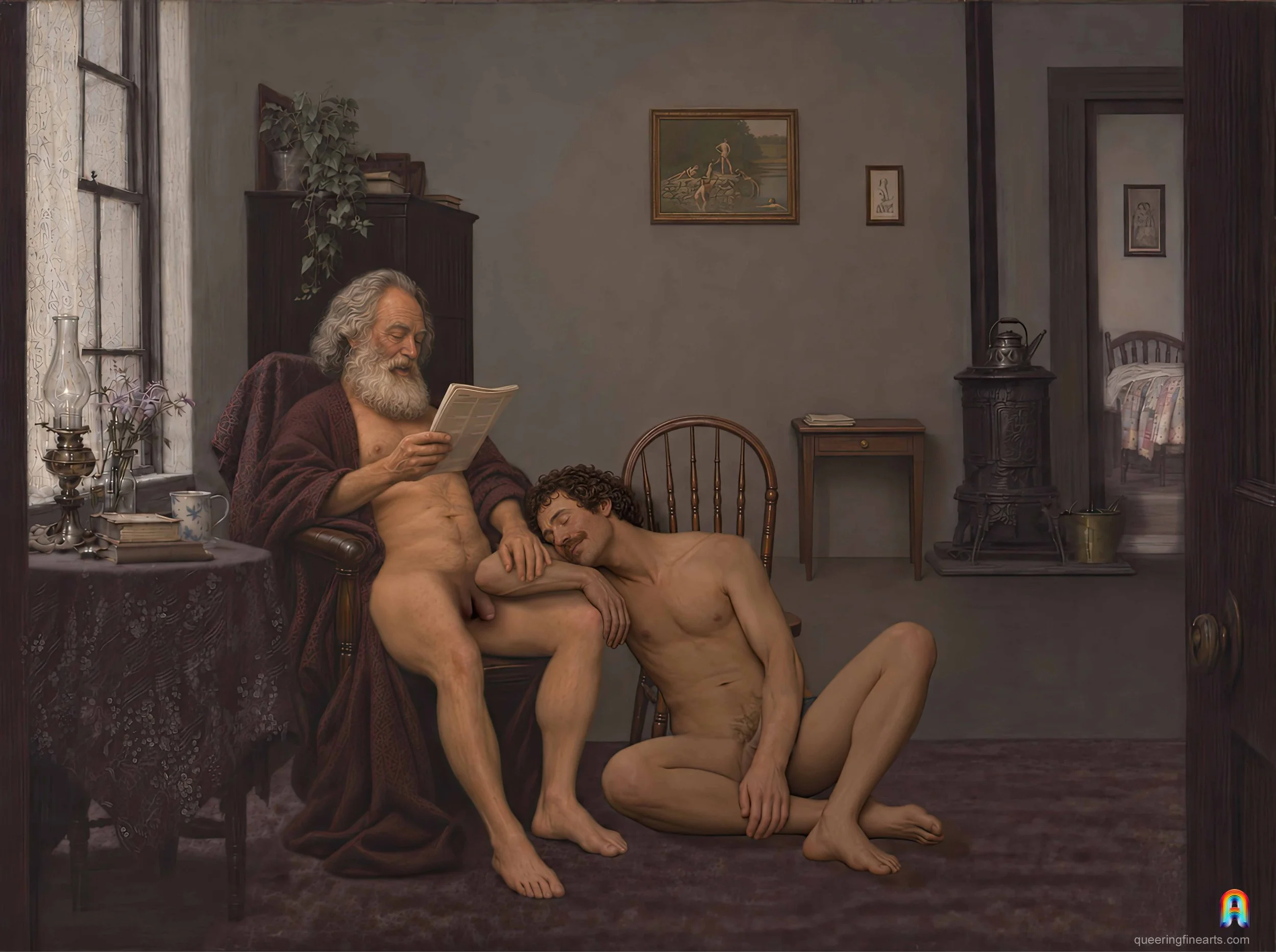
For the One I Love Most Lay Sleeping by Me
Walt Whitman and Peter Doyle at Whitman’s home in Camden, New Jersey, c. 1888
American School
In the manner of Eastman Johnson (1824–1906)
Oil on canvas
Late 19ᵗʰ century
Private collection, Philadelphia
The Poetry of Loving Men
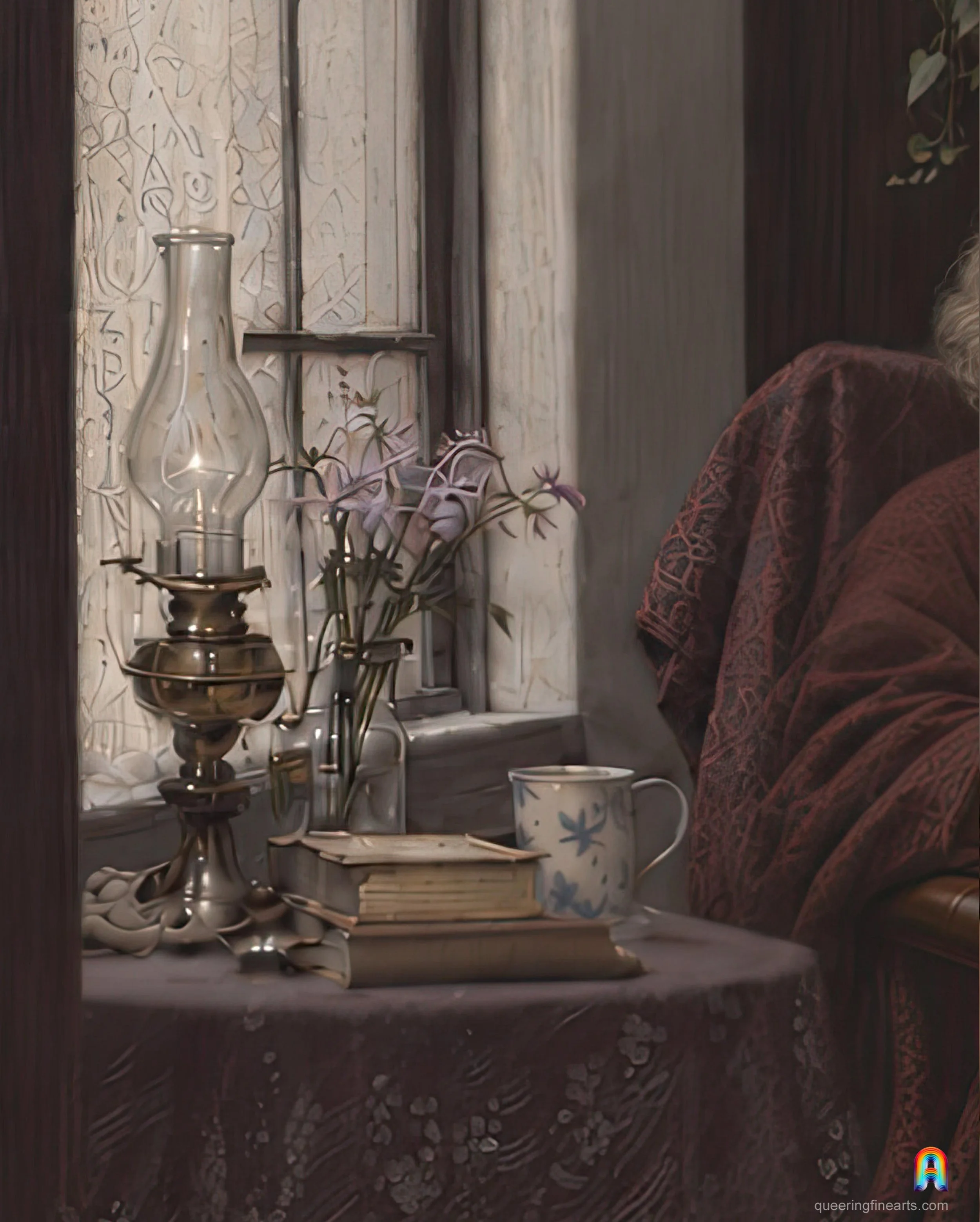
The light from the window falls across the page Walt Whitman holds in his right hand. He sits in his armchair, his robe loose around his bare body. Peter Doyle has settled on the rug beside him. His forearm rests across Whitman’s thigh and his cheek has come to rest on his own arm. Whitman’s eyes are on the page. His free hand lies gently on Doyle’s arm. There is a trace of a smile on the sleeping man’s face.
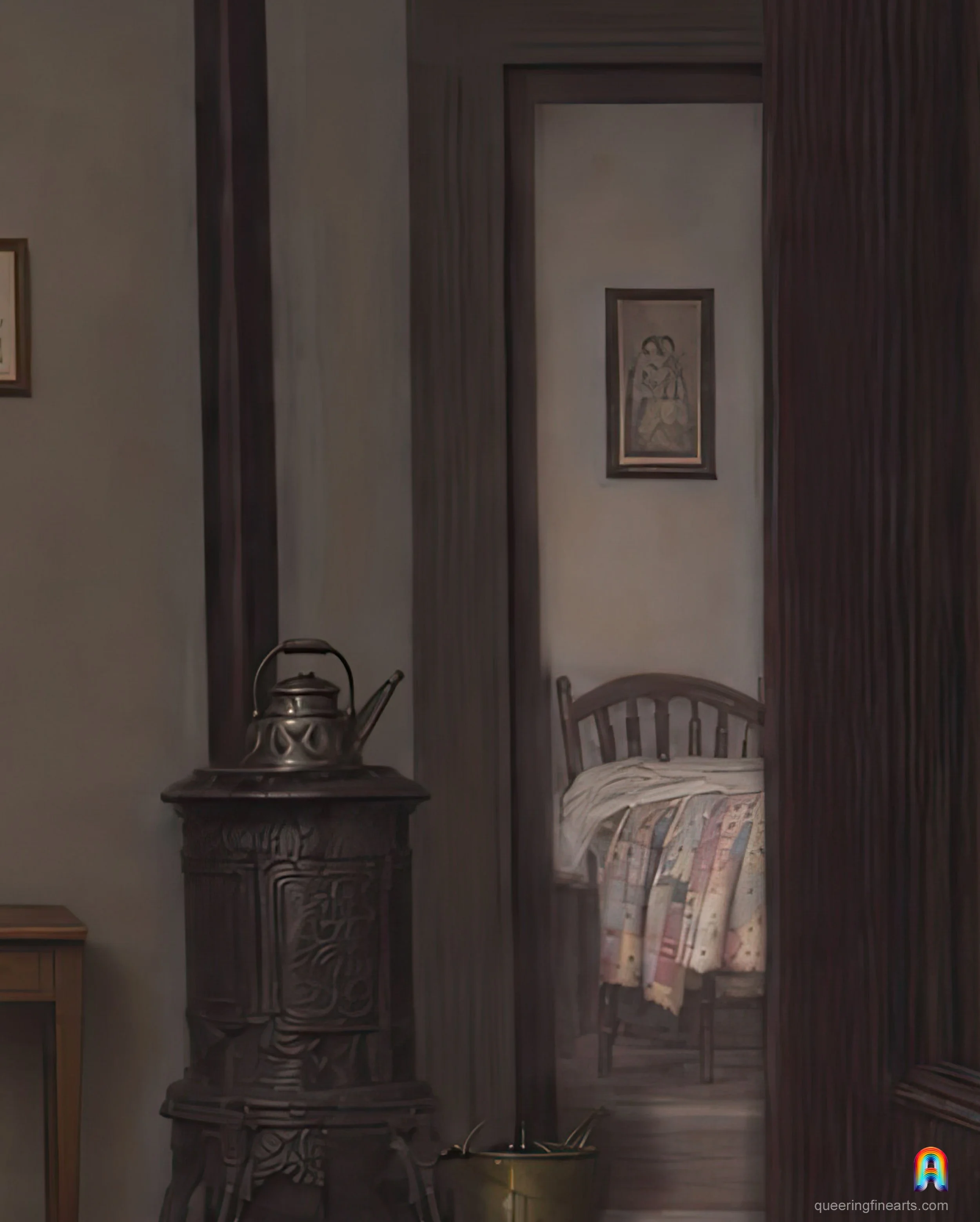
At the far right, an open doorway lets us glimpse the bedroom. Light catches the rumpled covers of an unmade bed. That small patch of brightness balances the tall window on the left, drawing the eye across the room from the page in Whitman’s hand to the bed beyond. The covers have been left as they fell, with the same ease that marks the two men’s closeness.
The scene imagines a visit at Whitman’s home in Camden, New Jersey, around 1888. By then, the author of Leaves of Grass had known Doyle for more than twenty years. They first met in Washington, where Doyle worked as a streetcar conductor. Years later, after settling in Philadelphia, he resumed his visits to Whitman across the Delaware.¹ The title comes from Calamus, the cycle in which Whitman writes about love between men. In “When I Heard at the Close of the Day,” the speaker finds his happiness in a man sleeping beside him.² The line finds its echo here in the weight of Doyle’s arm on Whitman’s thigh and the ease with which Whitman rests his hand on it.
The painting is conceived in the manner of Eastman Johnson. In The Lord Is My Shepherd,³ Johnson gives a man absorbed in reading the full attention of a painting. That quiet concentration is also part of Whitman’s bearing here. The colour owes something to James McNeill Whistler’s Arrangement in Grey and Black No. 1.⁴ The breadth of the grey wall and the deep plum-browns of the fabrics make room for smaller notes of colour. There is blue on the cup, old gold in the frame and warmth in the faces and bare limbs.
The swimmers in the frame are a nod to Thomas Eakins’s Swimming.⁵ Eakins painted Whitman in this same period, at the poet’s house in Camden. The likeness became Whitman’s favourite portrait of himself.⁶ In the imagined room, the bathers are out in the open air. Below them, two men share the ease of being undressed together at home.
Curiosity Piqued?
1. Martin G. Murray, “Doyle, Peter (1843–1907)”, in Walt Whitman: An Encyclopedia, edited by J. R. LeMaster and Donald D. Kummings, New York, Garland Publishing, 1998. Read Murray’s account of Doyle’s life.
Murray follows Doyle from his years as a streetcar conductor in Washington to his later visits to Whitman in Camden. Their relationship spanned nearly thirty years and left a record in the letters Whitman wrote to him.
2. Walt Whitman, “When I Heard at the Close of the Day”, in Leaves of Grass, “Calamus,” Washington, D.C., 1871–1872, pp. 131–132. Read the poem that gives the painting its title.
The poem opens with news of public acclaim and closes with the man Whitman loves asleep beside him. In the autumn moonlight, his lover’s arm rests lightly across his chest.
3. Eastman Johnson, The Lord Is My Shepherd, 1863, oil on fiberboard, Washington, D.C., Smithsonian American Art Museum. See Johnson’s painting.
Johnson gives the act of reading a quiet gravity. The sitter’s lowered gaze and the way he holds the open Bible make his concentration visible.
4. James McNeill Whistler, Arrangement in Grey and Black No. 1, 1871, oil on canvas, Paris, Musée d’Orsay. See Whistler’s portrait of his mother.
Look at the warm colour in Anna Whistler’s face and hands against the broad grey wall. The brown-violet darks and touches of ivory give the palette much of its character.
5. Thomas Eakins, Swimming, 1885, oil on canvas, Fort Worth, Amon Carter Museum of American Art, inv. 1990.19.1. See the painting echoed in the frame on Whitman’s wall.
Eakins places his bathers on a rocky ledge and in the water below. In the Camden interior, that outdoor scene echoes the ease with which Whitman and Doyle share a room.
6. Thomas Eakins, Walt Whitman, 1887–1888, oil on canvas, Philadelphia, Pennsylvania Academy of the Fine Arts, inv. 1917.1. See the portrait Eakins painted at Whitman’s home.
Whitman preferred this likeness to the other portraits artists had made of him. He told Horace Traubel that it came closest to the way he saw himself.
The Making of an American Voice
In 1855, a former printer and newspaper editor published twelve poems in Brooklyn under the title Leaves of Grass.¹ The longest would later become “Song of Myself.” In one passage, a contralto sings in an organ loft. In the very next line, a carpenter runs a plane along a plank and the tool whistles.² Whitman puts the two sounds side by side, giving each a line of its own. We hear the trained voice and then the music a worker makes in the course of his day. That small transition tells us a great deal about Whitman’s long, unrhymed lines. Their rhythm comes from the way one image or sound leads into the next. Each line can bring another person into the poem and give that person a moment of our full attention.
Whitman became one of the central figures of American poetry. Ralph Waldo Emerson recognised the ambition of Leaves of Grass almost at once. After reading the first edition, he wrote to Whitman in July 1855 to greet him “at the beginning of a great career.”³ A century later, Allen Ginsberg imagined meeting Whitman in a California supermarket. He borrows Whitman’s habit of taking stock of the world around him, aisle by aisle, and addresses him as a father and a teacher of courage.⁴ The tribute tells us something about what later poets found in Whitman. His verse gave them room to write about the America they lived in and to speak openly about whom they loved.
Whitman’s love for men is part of that legacy. In 1860, he added forty-five poems to Leaves of Grass under the title Calamus.⁵ In “In Paths Untrodden,” a man walks away from the clamour of the world to the edge of a pond. There, he finds the words for what he calls “the secret of my nights and days.”⁶ He wants other men to hear what he has to say. In another poem in the cycle, the happiness he describes is as simple as falling asleep beside the man he loves. There is joy in recognising one’s own life in these poems, especially in the small gestures Whitman gives such care to.
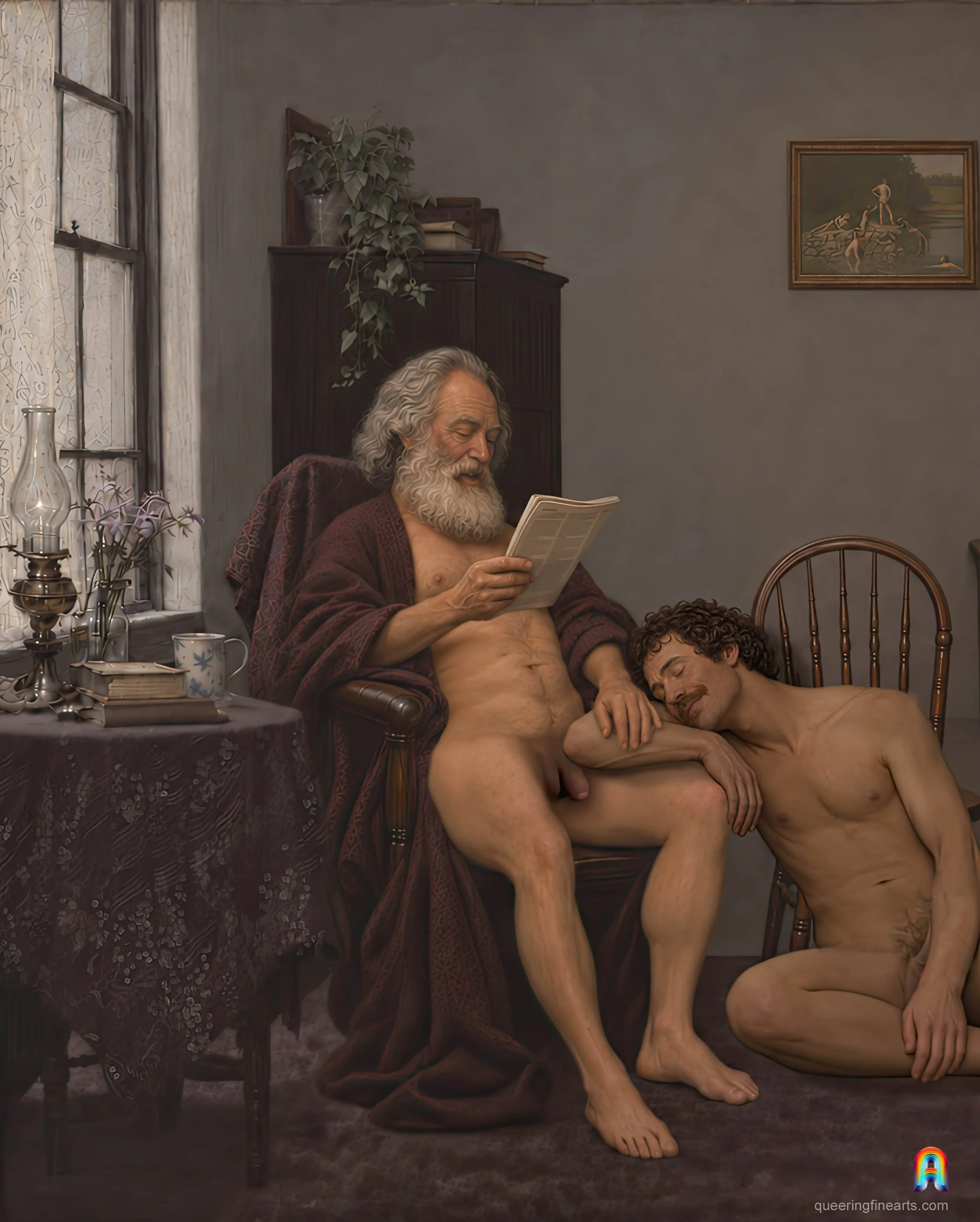
That tenderness has a different rhythm in his letters to Peter Doyle. Writing from Brooklyn on September 3, 1869, Whitman tells Pete that he has read his letter several times and thinks of him “every day and every night.”⁷ He wants to know how Pete is feeling and whether he is back at work. The declaration and the everyday questions belong together. When you love someone, the smallest particulars of his day can be what you most want to hear about. In the painting, that same attentiveness takes the form of Whitman’s hand resting on Doyle’s arm while he sleeps.
Curiosity Piqued?
1. Ivan Marki, “Leaves of Grass, 1855 Edition”, in Walt Whitman: An Encyclopedia, edited by J. R. LeMaster and Donald D. Kummings, New York, Garland Publishing, 1998. Read about the first edition.
The original Leaves of Grass contained twelve poems. Marki traces the making of the book and explains why that first edition holds such a place in American literary history.
2. Walt Whitman, “Song of Myself,” section 15, in Leaves of Grass, Philadelphia, David McKay, 1891–1892. Read the passage with the contralto and the carpenter.
Read the two lines aloud. The first ends in the organ loft. The next carries on past the carpenter himself to the whistle of his plane. The line follows the sound wherever it leads.
3. Ralph Waldo Emerson, Letter to Walt Whitman, July 21, 1855, Concord, Massachusetts, reprinted in Walt Whitman, Leaves of Grass, Brooklyn, 1856. Read Emerson’s letter.
Emerson’s praise came in a private letter. Whitman thought enough of it to print it in the second edition of Leaves of Grass the following year.
4. Allen Ginsberg, “A Supermarket in California”, written in Berkeley in 1955, in Selected Poems 1947–1995, New York, HarperCollins, 2001. Read Ginsberg’s poem.
Ginsberg gives the peaches, the shoppers and the grocery boys the attention Whitman gave to the people and things he passed in the street. He imagines Whitman there beside him, curious about it all.
5. James E. Miller, Jr., “‘Calamus’ [1860]”, in Walt Whitman: An Encyclopedia, edited by J. R. LeMaster and Donald D. Kummings, New York, Garland Publishing, 1998. Read about the origins of the cycle.
At the heart of Calamus was an earlier manuscript sequence of twelve poems, Live Oak with Moss. Miller follows the passage from that smaller sequence to the forty-five poems Whitman published in 1860.
6. Walt Whitman, “In Paths Untrodden”, in Leaves of Grass, “Calamus,” Boston, James R. Osgood and Company, 1881–1882. Read the opening poem of the cycle.
The speaker begins alone beside the water. By the end, he is speaking to all who are or have been young men. In a few lines, a private confession becomes an invitation to recognise a shared experience.
7. Walt Whitman, Letter to Peter Doyle, September 3, 1869, in Calamus: A Series of Letters Written During the Years 1868–1880 by Walt Whitman to a Young Friend (Peter Doyle), edited by Richard Maurice Bucke, Boston, Laurens Maynard, 1897, pp. 55–56. Read the letter in the facsimile.
Doyle’s letter had been a comfort to Whitman. His reply gives us a sense of how the two men stayed close while they were apart, by asking after each other and reading each other’s words more than once.
All the Way Back
On a stormy night in Washington, around 1865, Walt Whitman was the only passenger in a horse-drawn streetcar. Peter Doyle, the conductor, remembered him with a blanket thrown around his shoulders, looking like an old sea captain. Doyle went inside to talk to him. What he remembered most vividly was how quickly they took to one another. “I put my hand on his knee,” he recalled. “We understood.”¹ When the car reached the end of the line, Whitman stayed aboard and rode all the way back with him.
Doyle was in his early twenties and Whitman in his mid-forties. Born in Limerick, Ireland, Doyle had come to the United States as a child and served in the Confederate artillery during the Civil War.² In Washington, he and Whitman found a way to spend time together around Doyle’s working hours. Whitman often joined him on the last run of the night. On days when they could get away, they took long walks out of the city. Whitman remembered that Doyle was as fond of those walks as he was.³
After a stroke in 1873, Whitman moved to Camden and the two men had to get used to seeing less of each other. In a postcard the following spring, Whitman tells Doyle where to get off the train in Philadelphia, how to reach the ferry and how short the walk is from the landing. He offers to meet him at the station if Doyle sends word a day ahead. Then comes the reason for all those directions. He wishes Pete were there that very day. It would feel like old times.⁴
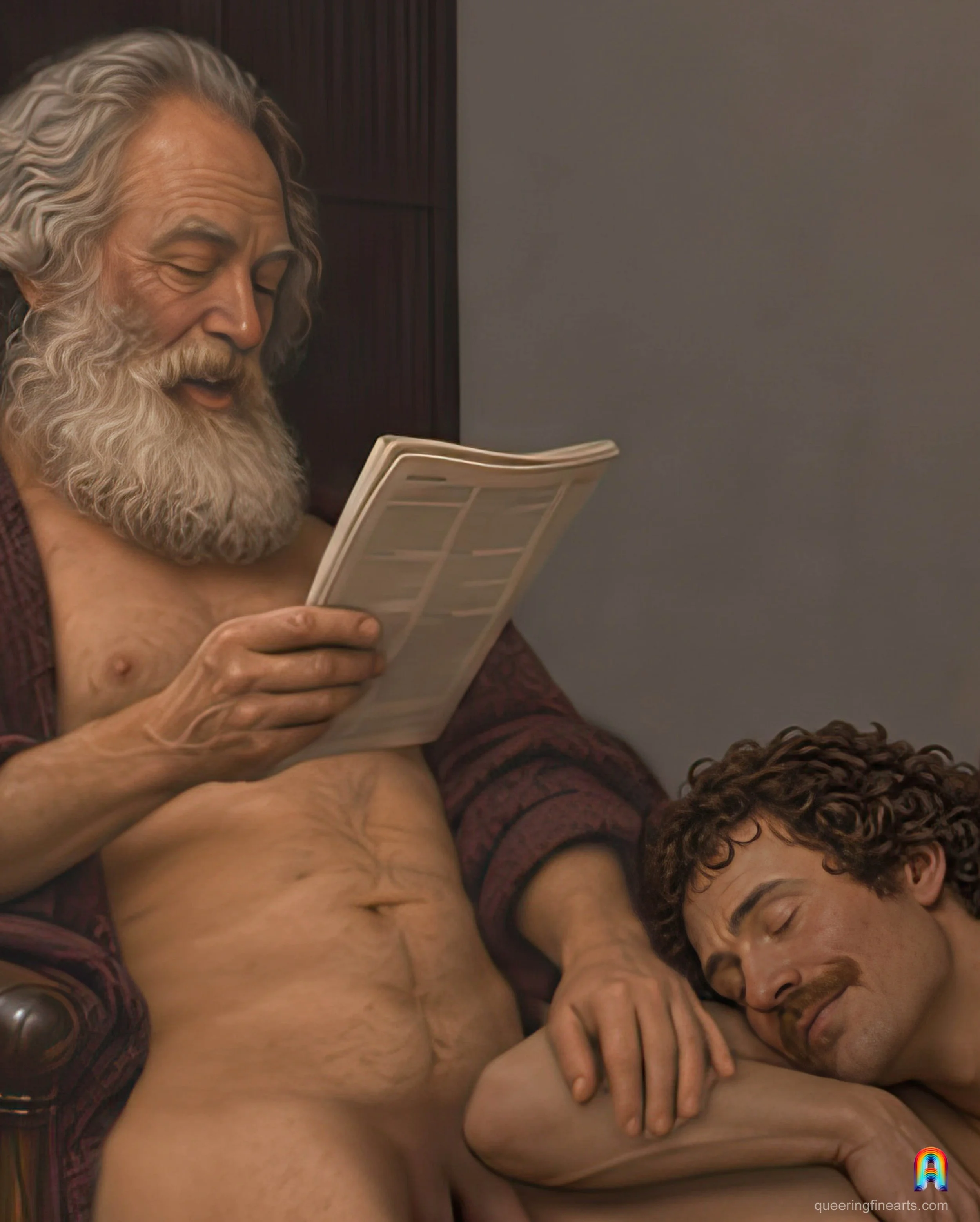
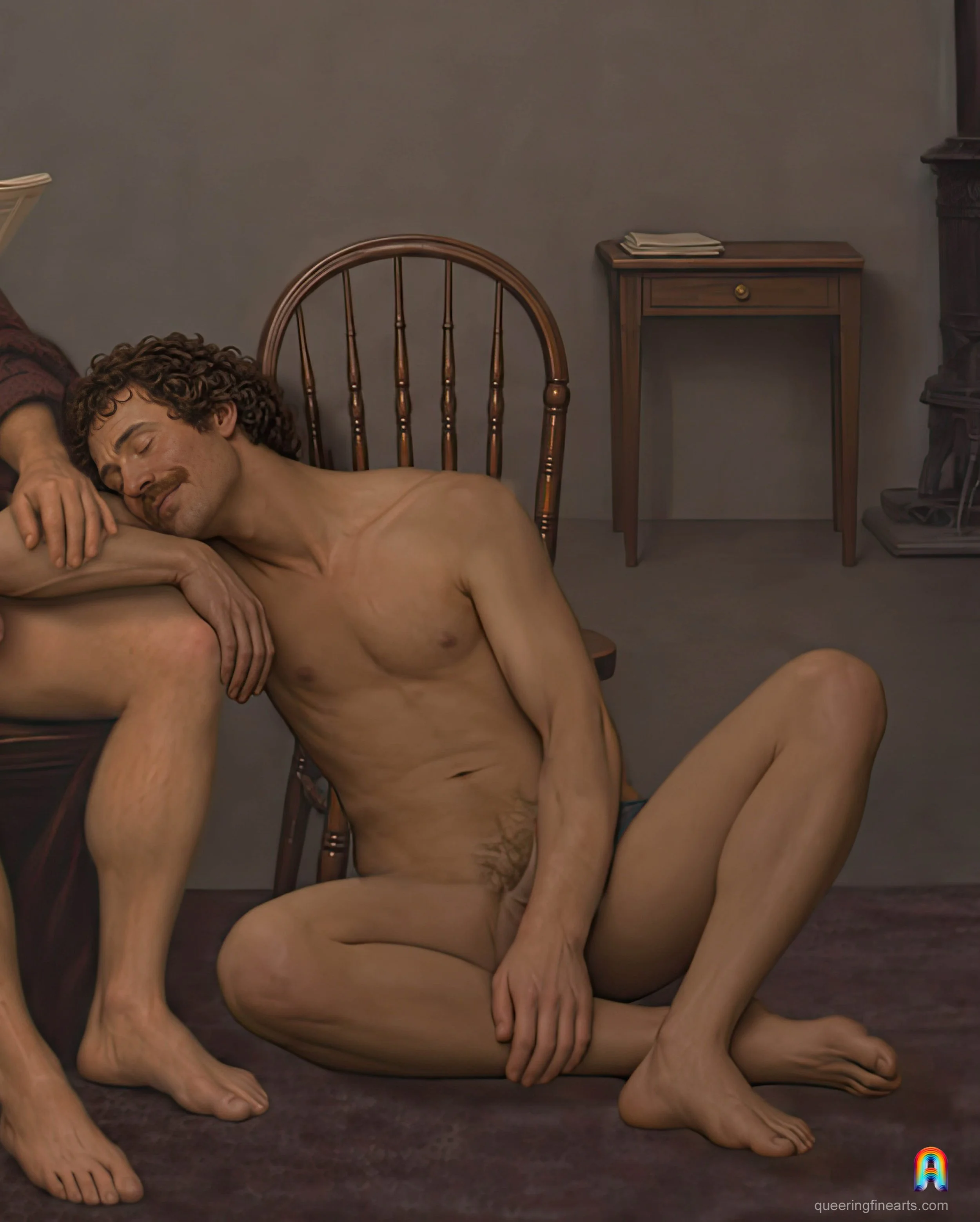
By the mid-1880s, Doyle had settled in Philadelphia and could visit Whitman regularly again.⁵ That is the period imagined in the painting. I keep coming back to the way Doyle told the story of their first meeting. He remembered what he had done with his own hand and how readily Whitman had understood him. Years later, in the Camden room we imagine, Doyle can fall asleep with his arm across Whitman’s thigh. This time it is Whitman who reaches out and rests his hand on him.
Curiosity Piqued?
1. Peter Doyle, “Interview with Peter Doyle”, in Walt Whitman, Calamus: A Series of Letters Written During the Years 1868–1880 by Walt Whitman to a Young Friend (Peter Doyle), edited by Richard Maurice Bucke, Boston, Laurens Maynard, 1897, pp. 23–24. Read Doyle’s account in the facsimile.
Doyle tells the story in his own voice. He remembers the blanket, the storm and what drew him to the only passenger on his car. He also recalls how often Whitman rode with him afterwards, sometimes staying aboard for several runs.
2. Martin G. Murray, “Doyle, Peter (1843–1907)”, in Walt Whitman: An Encyclopedia, edited by J. R. LeMaster and Donald D. Kummings, New York, Garland Publishing, 1998. Read about Doyle’s life.
Doyle had already crossed an ocean and lived through a war by the time Whitman stepped aboard his streetcar. Murray gives us a sense of the life he brought to that encounter.
3. Martin G. Murray, “Pete the Great: A Biography of Peter Doyle”, Walt Whitman Quarterly Review, University of Iowa, Iowa City, 1993. Read the biography.
Murray quotes Whitman’s recollection of their walks out of Washington. The poet remembers outings of five, seven or perhaps ten miles and back, usually with Doyle.
4. Walt Whitman, Postcard to Peter Doyle, March 23, 1874, Camden, New Jersey, in The Correspondence, edited by Edwin Haviland Miller, New York, New York University Press, 1961–1977, p. 290. Read the postcard.
Whitman gets down to the practical details of a visit. From West Philadelphia, Doyle is to take the Market Street horsecar down to the ferry and cross the Delaware. Whitman’s directions end with the assurance that there is plenty of room.
5. Walt Whitman, Postcard to Peter Doyle, March 17, 1874, Camden, New Jersey, Amherst College Archives and Special Collections, with an editorial note on Doyle in The Walt Whitman Archive. Read the note on their later years.
The editors trace how the move to Camden changed the time the two men could spend together. Doyle’s move to nearby Philadelphia brought regular visits back into their lives.
Comrades in Public
Around 1869, Walt Whitman and Peter Doyle went to a photographer’s studio in Washington. In one of the surviving portraits, they sit facing each other. Whitman turns towards Doyle, who meets his gaze.¹ It is a photograph two men could sit for as friends. For us, knowing how they met and reading the letters they exchanged, it also records something of the pleasure they took in each other’s company.
In Whitman’s America, affection between men had a familiar public language. Men could speak warmly of their friends and comrades, and those words could carry a great deal of feeling. Whitman called passionate attachment between men adhesiveness, a word he borrowed from phrenology and made his own.² In Calamus, the affection of comrades can hold a country together. It can also be the happiness of lying beside a particular man at night. Some readers heard both meanings in the same word.
One of them was the English writer John Addington Symonds. In 1890, after years of correspondence, he asked Whitman whether the comradeship in Calamus could include sexual intimacy between men.³ Whitman rejected that reading in emphatic terms.⁴ The exchange gives us a sense of the distance between what a poem could express and what its author was prepared to name in a letter. For Symonds, the poems had made the question possible in the first place.
Doyle’s account of their meeting gives us a different way to understand how that love could be lived. A young conductor sat down beside his last passenger. They found reasons to see each other again, on the streetcar, on long walks and later across the Delaware. That is the part of their life together the painting imagines. For an hour in Camden, the man beside Whitman can close his eyes and rest his weight against him.
Curiosity Piqued?
1. M. P. Rice, Walt Whitman and Peter Doyle, photograph, Washington, D.C., c. 1869. See the portrait in The Walt Whitman Archive.
This is the earliest surviving photograph of Whitman with another person. The two men sit turned towards one another, giving the portrait much of its character through the direction of their gaze.
2. Betsy Erkkila, “Walt Whitman’s Songs of Male Intimacy and Love: ‘Live Oak, with Moss’ and ‘Calamus’”, Huntington Library Quarterly, vol. 73, no. 1, 2010, p. 116. Read about Whitman’s language for love between men.
Erkkila explains how Whitman took adhesiveness, a term used for same-sex friendship, and gave it the force of passionate attachment.
3. John Addington Symonds, Letter to Walt Whitman, August 3, 1890, Walt Whitman Papers, Library of Congress, Washington, D.C. Read Symonds’s question.
Symonds asks whether the ideal of comradeship he found in Whitman’s poetry could take a physical form. The care with which he poses the question gives a sense of what it cost to ask it plainly.
4. John Addington Symonds, Letter to Walt Whitman, September 5, 1890, Walt Whitman Papers, Library of Congress, Washington, D.C., with an editorial transcription from Whitman’s draft reply of August 19, 1890. Read the letter and the note on Whitman’s reply.
Read the two voices together. Whitman’s draft is emphatic. Symonds answers courteously, thanking him for making his position clear.
The Secret of My Nights and Days
In 1855, Walt Whitman opened Leaves of Grass with a long poem that would eventually take the title “Song of Myself.” It begins with a poet celebrating himself. As it unfolds, that same voice takes in the lives of people around him, including the woman singing in the organ loft and the carpenter at his bench. Near the end of the poem, Whitman gives us a line that helps explain how a song of himself can have room for so many other people.
I am large, I contain multitudes,¹
Among the lives Whitman makes room for in Leaves of Grass is one he takes particular care to name. It is the life a man shares with the men he loves. In Calamus, he gives that love a sequence of poems of its own. The title is the name of the sweet flag, a plant that grows at the water’s edge. Whitman makes it an emblem of the bond between men. Its upright flower spike also lends the emblem a sensual suggestion.²
The opening poem, “In Paths Untrodden,” takes us to the very place where the plant grows. A man goes alone to the edge of a pond, away from the noise and expectations of the world. In that quiet, he finds the freedom to speak of the love that sustains him. By the end of the poem, he knows whom he wants to tell.
I proceed for all who are or have been young men,
To tell the secret of my nights and days,
To celebrate the need of comrades.³
The secret is something he wants to celebrate. It takes a wonderfully ordinary form in “A Glimpse.” In a crowded barroom, with men drinking and joking around them, one man comes to sit beside another and hold his hand.
There we two, content, happy in being together, speaking little, perhaps not a word.⁴
In “Whoever You Are Holding Me Now in Hand,” Whitman brings that intimacy right up to the reader. The voice belongs to the book you are holding. It invites you to put your lips to its own and tells you what kind of kiss it has in mind.
With the comrade’s long-dwelling kiss or the new husband’s kiss,
For I am the new husband and I am the comrade.⁵
The word husband does something extraordinary here. Whitman gives the kiss of a man to his companion the tenderness and standing of a kiss exchanged between spouses. In “I Hear It Was Charged Against Me,” he imagines what might happen if that love had a place in the life of the country. He pictures it in cities and fields and aboard boats as they pass over the water. He calls it
The institution of the dear love of comrades.⁶
By the close of “When I Heard at the Close of the Day,” the world has narrowed to two men under the same cover. One is asleep. The other is awake long enough to feel the weight of his lover’s arm. The poem gives us the words that drew me back to Whitman and Doyle in the Camden room.
For the one I love most lay sleeping by me
[…]
And his arm lay lightly around my breast⁷
Curiosity Piqued?
1. Walt Whitman, “Song of Myself,” section 51, in Leaves of Grass, Philadelphia, David McKay, 1891–1892. Read the poem in Whitman’s final edition.
The poem opened the 1855 edition of Leaves of Grass and acquired its familiar title in 1881. Whitman kept revising it as the book grew. Read Ivan Marki on the first edition.
2. Betsy Erkkila, “Walt Whitman’s Songs of Male Intimacy and Love: ‘Live Oak, with Moss’ and ‘Calamus’”, Huntington Library Quarterly, vol. 73, no. 1, 2010, p. 116. Read about the plant and its significance in the cycle.
Erkkila describes the sweet flag’s phallic flower spike and connects the plant to Whitman’s language of passionate attachment between men.
3. Walt Whitman, “In Paths Untrodden”, in Leaves of Grass, “Calamus,” Boston, James R. Osgood and Company, 1881–1882. Read the opening poem of the cycle.
Pay attention to the place where the speaker chooses to begin. The margin of a pond gives him the privacy to find the words he will offer to other men.
4. Walt Whitman, “A Glimpse”, in Leaves of Grass, “Calamus,” Washington, D.C., 1872. Read the poem.
Whitman gives the reader just enough of the barroom to hear the talk around the two men. Amid that noise, the handclasp holds our attention.
5. Walt Whitman, “Whoever You Are Holding Me Now in Hand”, in Leaves of Grass, “Calamus,” Boston, James R. Osgood and Company, 1881–1882. Read the poem.
The kiss is one of several ways the poem imagines a reader getting close to the poet. Later, Whitman asks to be carried beneath the reader’s clothing, close to the heart or the hip.
6. Walt Whitman, “I Hear It Was Charged Against Me”, in Leaves of Grass, “Calamus,” Boston, James R. Osgood and Company, 1881–1882. Read the poem.
The poem begins with an accusation and ends with a declaration. Between the two, Whitman imagines an institution whose life depends on the affection people bear one another.
7. Walt Whitman, “When I Heard at the Close of the Day”, in Leaves of Grass, “Calamus,” Boston, James R. Osgood and Company, 1881–1882. Read the poem that gives the painting its title.
The poem lets us feel the lover’s approach before he arrives. Even food tastes better in anticipation. At night, Whitman hears the sound of the water on the shore as if it were whispering its congratulations.