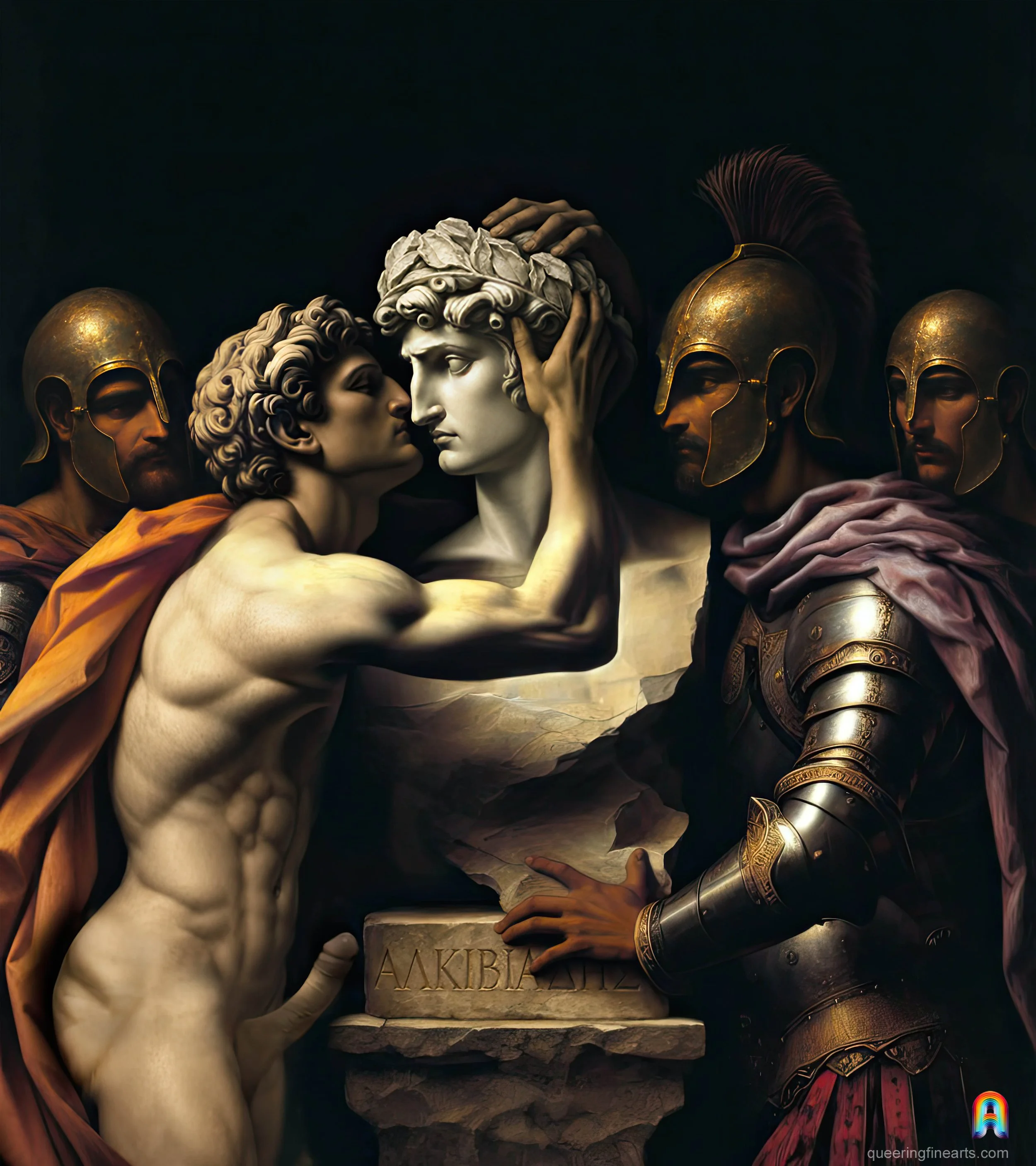
Anytus Kissing the Bust of Victorious Alcibiades
British Academic School
Circle of Lawrence Alma-Tadema (1836–1912)
Oil on wood panel
England, c. 1875
Private collection, St John’s Wood, London.
The Joy of Victory
In 410 BC, during the Peloponnesian War, the Athenians defeated a Spartan-led fleet at Cyzicus, a city on the southern shore of the Sea of Marmara in what is now Turkey. Alcibiades was one of the Athenian commanders and remained with the fleet after the battle.¹ The painting imagines three soldiers who fought under him bringing news of the victory to the house of Anytus, an Athenian whom Plutarch describes as being in love with Alcibiades.² With Alcibiades still far from Athens, it is his likeness that stands before them in marble, a wreath of laurel carved into the stone.
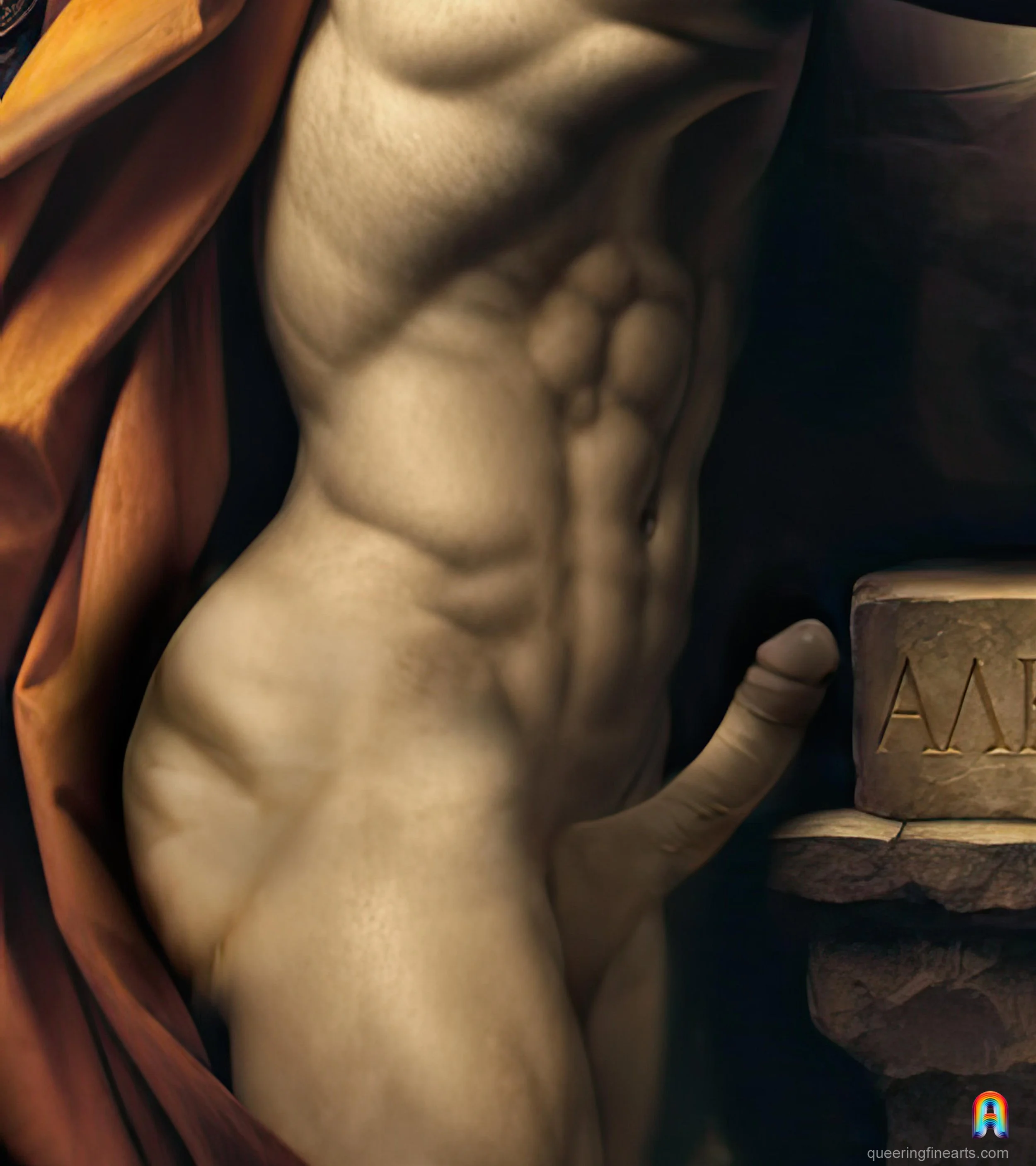
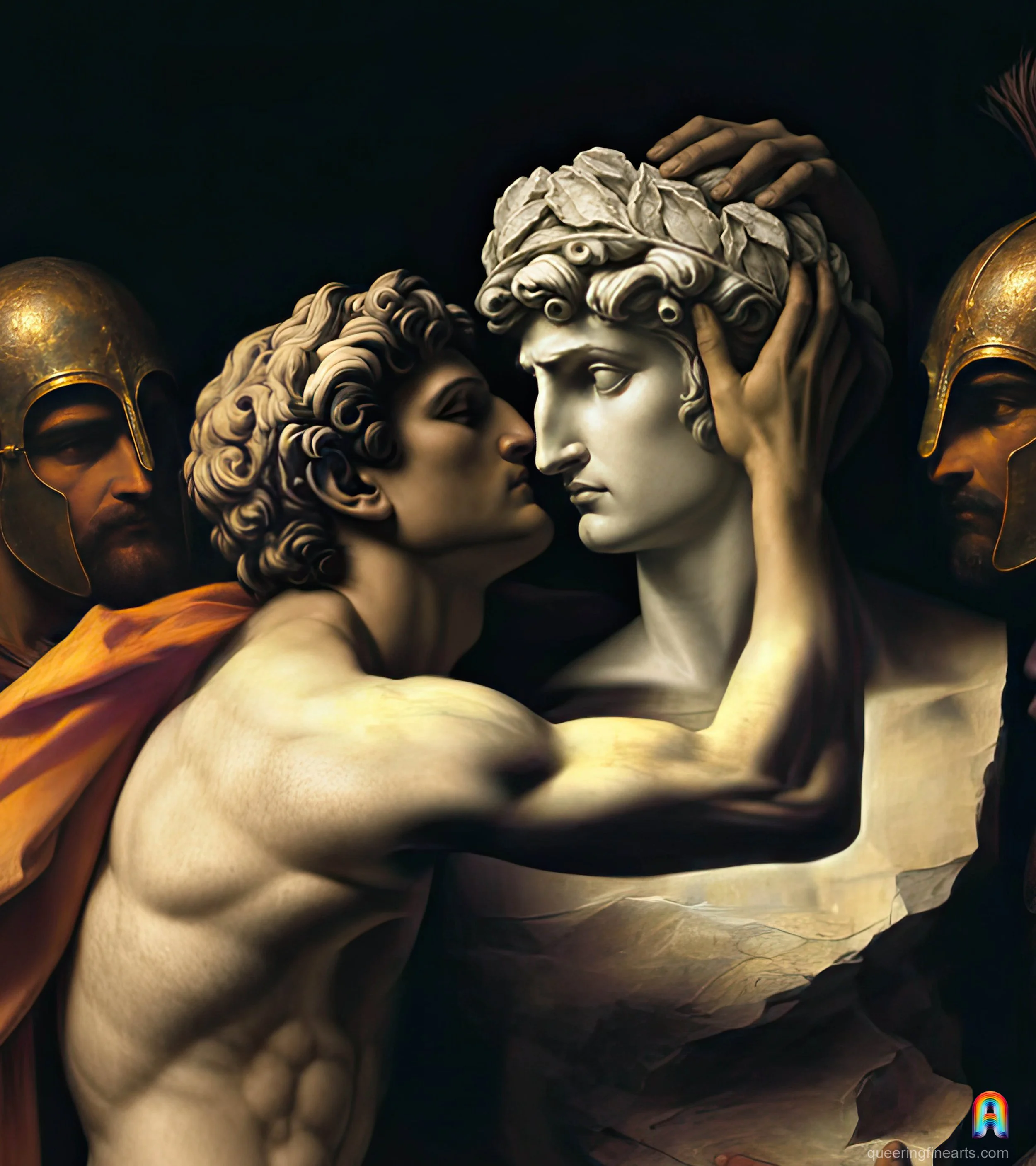
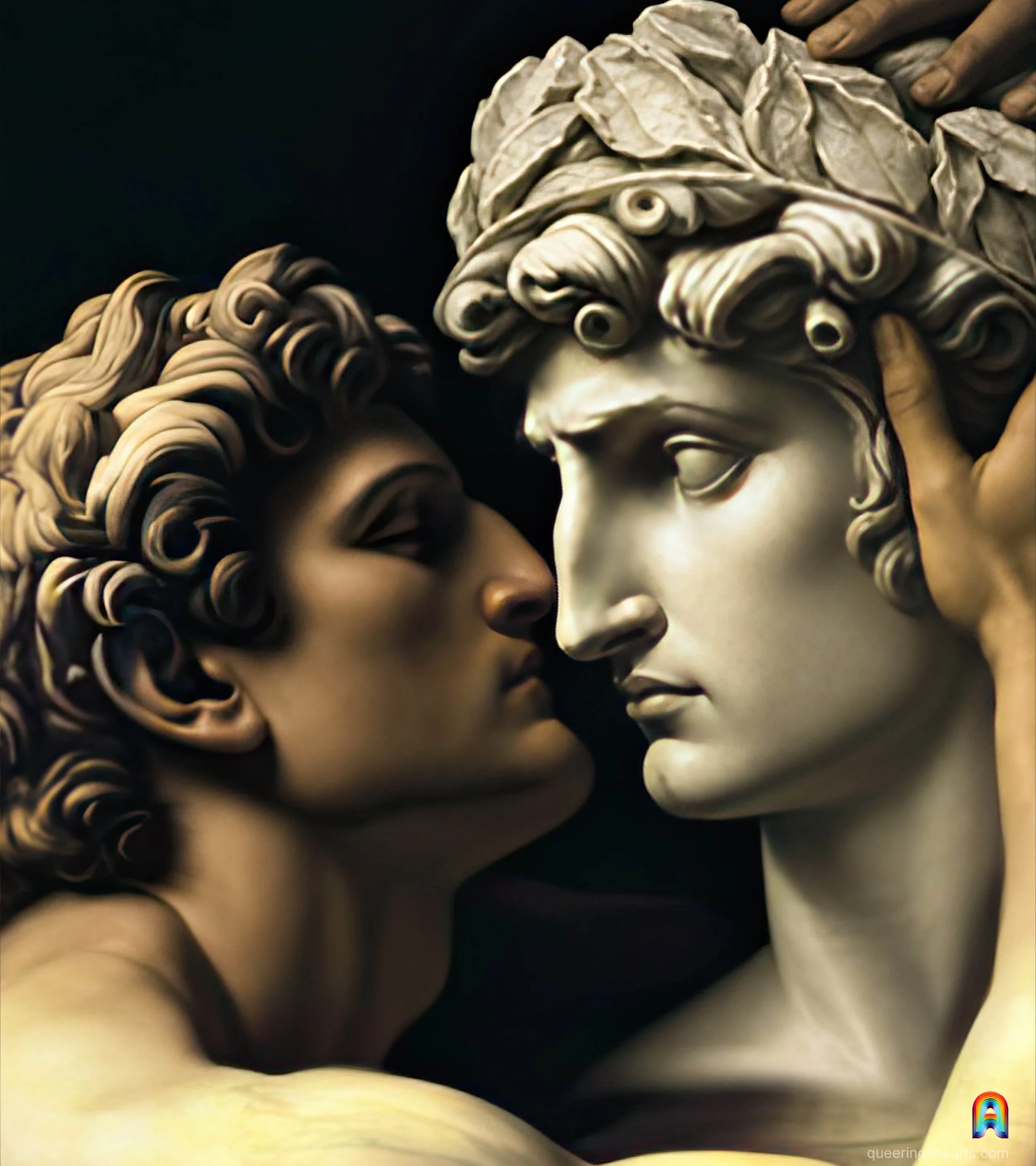
Anytus leans in to kiss the bust. His orange cloak falls behind him, leaving his muscular torso and erect penis exposed. He cups the sculpted head in both hands, one against the temple and the other over the carved leaves. His lips hover just short of the marble mouth. In the light, his fingers are nearly as pale as the stone they touch.
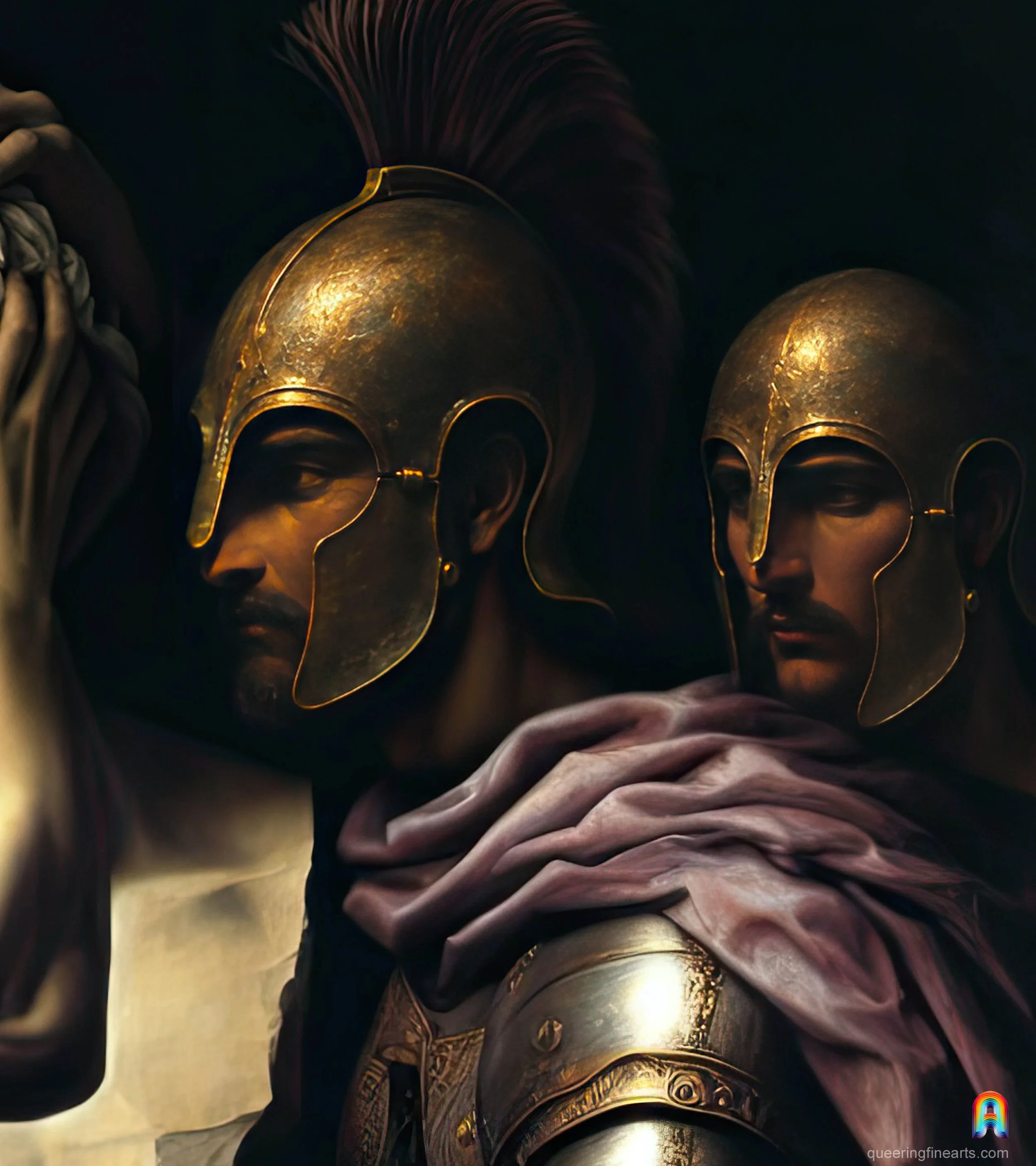
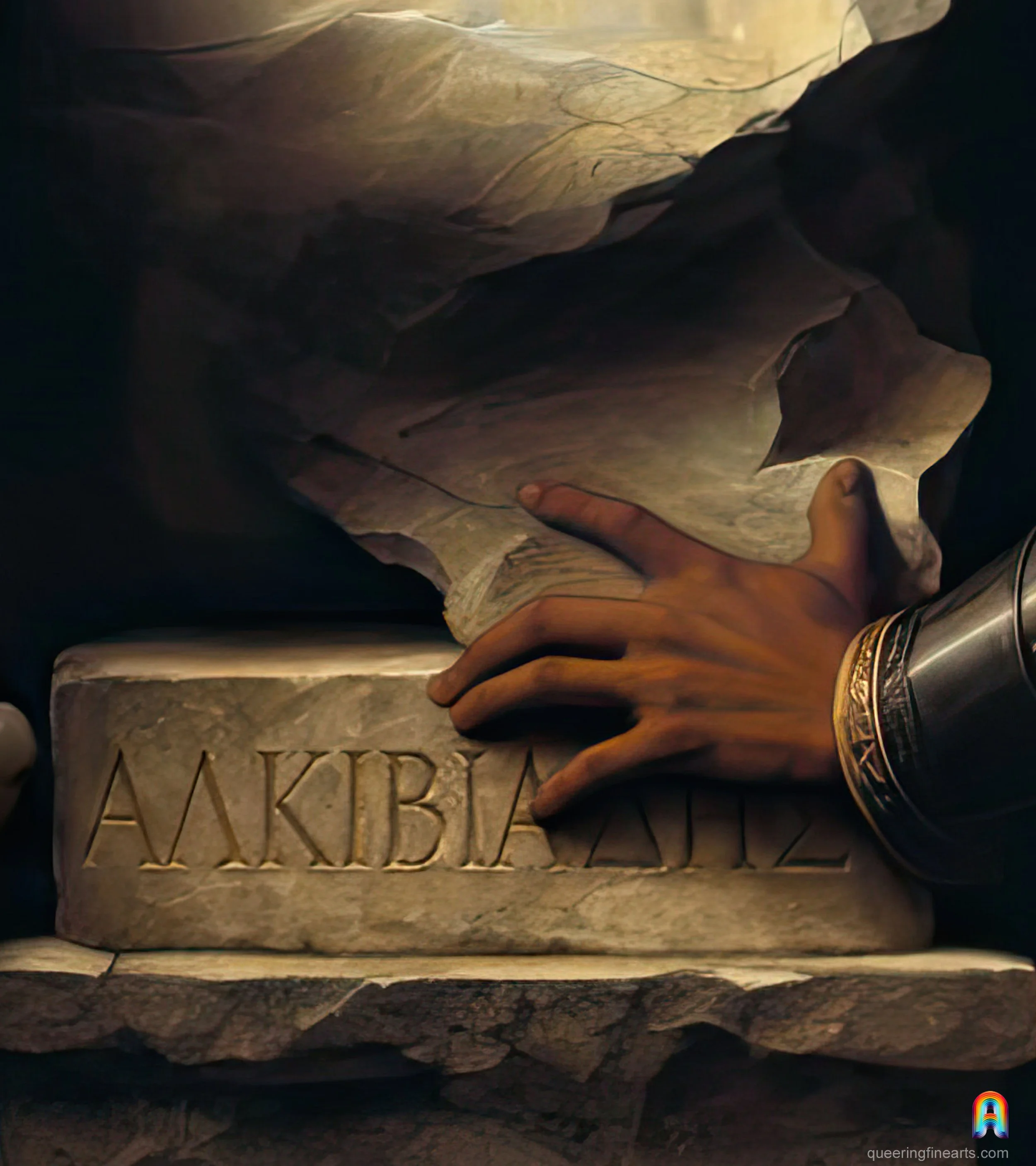
The soldiers stand within arm’s reach, their faces half hidden beneath their helmets. The nearest rests a hand on the pedestal, partly covering the name of Alcibiades carved in Greek.
The attribution to a painter in Lawrence Alma-Tadema’s circle rests as much on the choice of subject as on the finish. Alma-Tadema often pictured antiquity through scenes of everyday life, taking care over the rooms people inhabited and the objects they handled.³ Here, the painter brings news of an Athenian victory into a private house and gives the scene to the man who has been waiting for word of Alcibiades. The careful modelling of Anytus’s flesh and the distinct way light falls on marble and metal reinforce that kinship.
Curiosity Piqued?
1. Xenophon, Hellenica, Book I, 1.16–22, translated by Carleton L. Brownson, Loeb Classical Library, Cambridge, MA, Harvard University Press, 1918. Read Xenophon’s account of the battle.
Xenophon follows Alcibiades from the fighting at sea to the landing near Cyzicus, where the Spartan commander Mindarus was killed. He also records what Alcibiades did after the victory. He stayed at Cyzicus for twenty days and then sailed back to Proconnesus, an island in the Sea of Marmara. That continued campaign provides the setting for the painting’s imagined arrival of the soldiers in Athens while Alcibiades is still away.
2. Plutarch, Life of Alcibiades, 4.4–5, in Lives, vol. IV, translated by Bernadotte Perrin, Loeb Classical Library, London, William Heinemann, and New York, G. P. Putnam’s Sons, 1916. Read Plutarch’s account of Anytus.
Plutarch describes Anytus, son of Anthemion, as a man who loved Alcibiades. In his account, Anytus invites Alcibiades to dinner and later defends him when the guests are offended by his behaviour. The anecdote gives us Anytus’s side of the attachment. The painting imagines what that attachment might have felt like on hearing of the victory at Cyzicus.
3. National Portrait Gallery, “Sir Lawrence Alma-Tadema (1836–1912)”, Later Victorian Portraits Catalogue, London, National Portrait Gallery, n.d. Read the artist’s biography.
The National Portrait Gallery traces Alma-Tadema’s interest in classical life to his visit to Pompeii in 1863. Archaeological detail gave substance to the scenes he imagined.
Bronze for Gold
Alcibiades was an Athenian general whose beauty was part of his public reputation. Plutarch says it stayed with him from boyhood into manhood. He describes men competing for his attention and singles out Anytus as one of those who sought his company.¹ By the time of the victory at Cyzicus, the man Anytus desired was also a commander Athens had reason to celebrate.
In Plato’s Symposium, Alcibiades tells a room full of men how he tried to seduce Socrates. He was sure the philosopher desired him and hoped that, by granting him his favours, he could learn from him. Socrates replies that if his wisdom is really as valuable as Alcibiades thinks, the young man is offering bronze for gold. Alcibiades would give him the beauty of his body and receive something he prized far more. Socrates then tells Alcibiades to look more closely. He may be offering his body in exchange for wisdom that Socrates has no power to give him.²
The exchange shows how confidently Alcibiades expected his beauty to move another man. It also lets him speak candidly about what it felt like to desire a man whose response he could neither predict nor command.
Curiosity Piqued?
1. Plutarch, Life of Alcibiades, 1.3 and 4.1–5, in Lives, vol. IV, translated by Bernadotte Perrin, Loeb Classical Library, London, William Heinemann, and New York, G. P. Putnam’s Sons, 1916. Read Plutarch’s portrait of Alcibiades.
Plutarch first describes Alcibiades’ beauty at different ages, then shows how men responded to it. For the painting, the first detail is especially important. The beauty that draws Anytus to the bust belongs to the same man the soldiers know as a commander.
2. Plato, Symposium, 217a–219d, in Lysis, Symposium, Gorgias, translated by W. R. M. Lamb, Loeb Classical Library, London, William Heinemann, and New York, G. P. Putnam’s Sons, 1925. Read Alcibiades’ account of the exchange.
Plato puts the story in Alcibiades’ own mouth. He remembers engineering occasions to be alone with Socrates, then lying beside him under his cloak. The speech makes room for both his confidence in his own appeal and the embarrassment of telling his friends that Socrates resisted him.
The Victory at Cyzicus
In 410 BC, the Athenians caught a Spartan fleet off Cyzicus, on the southern shore of the Sea of Marmara in what is now Turkey. Diodorus tells how Alcibiades drew the Spartan admiral Mindarus into pursuit with a small squadron while the other Athenian commanders, Thrasybulus and Theramenes, cut off his return to the harbour. Mindarus fled to shore, where Persian troops came to his aid. Alcibiades went ashore after him. With reinforcements from both fellow commanders, the Athenians won the fight for the beached ships. Mindarus was killed among them.¹ Athens took the city and captured most of the enemy fleet. Alcibiades stayed in the region to continue the campaign.²
What might it mean to fight with the man you love beside you? In Plato’s Symposium, Phaedrus imagines an army of male lovers. He thinks a man would sooner die than let his beloved see him throw down his weapons or abandon him in danger.³ Xenophon records a moment of that kind near Abydos, in the same region some twenty years after Cyzicus. The Spartan commander Anaxibius, caught in an ambush, told his men to save themselves and took up his shield for a last stand. His beloved stayed beside him.⁴
Curiosity Piqued?
1. Diodorus Siculus, Library of History, Book XIII, 49.5–51.8, vol. V, translated by C. H. Oldfather, Loeb Classical Library, Cambridge, MA, Harvard University Press, and London, William Heinemann, 1950. Read Diodorus’s account of the battle.
Diodorus describes Alcibiades’ men throwing grappling irons onto the beached ships to drag them away. The vessels that Mindarus had hoped to save became the ground over which the two armies fought.
2. Xenophon, Hellenica, Book I, 1.18–23, translated by Carleton L. Brownson, Loeb Classical Library, Cambridge, MA, Harvard University Press, 1918. Read Xenophon on the aftermath of Cyzicus. Consulted 8 November 2026. beta.perseus.tufts.edu
Xenophon records that Alcibiades remained at Cyzicus for twenty days before sailing on. He also preserves a Spartan dispatch intercepted on its way home. It reports the loss of the ships, the death of Mindarus and the hunger of the surviving men.
3. Plato, Symposium, 178d–179b, in Lysis, Symposium, Gorgias, translated by W. R. M. Lamb, Loeb Classical Library, London, William Heinemann, and New York, G. P. Putnam’s Sons, 1925. Read Phaedrus’s speech on love and courage.
Phaedrus imagines that the regard of a beloved man could matter more to a soldier than the judgement of his comrades. His speech gives love between men a place in a Greek argument about what makes someone brave.
4. Xenophon, Hellenica, Book IV, 4.8.35–39, translated by Carleton L. Brownson, Loeb Classical Library, Cambridge, MA, Harvard University Press, 1918. Read the account of Anaxibius’s last stand.
Xenophon leaves the beloved unnamed. He identifies him through the Greek term paidika, which designates a younger male beloved. In an account otherwise concerned with an ambush and the men who fell in it, Xenophon singles out the fact that he stayed.
He Could Have Taken It All
Anytus is one of the few men the ancient sources name as having loved Alcibiades. He was a wealthy Athenian who commanded troops the year after Cyzicus and later helped lead the restored democracy.¹ We catch a glimpse of him in love in Plutarch’s account of a dinner he gave for friends.
Anytus invited Alcibiades. An evening among friends might give him a chance to have Alcibiades beside him, to feel his arm against his own or to lean close enough to say something for his ear alone. Alcibiades declined. He turned up drunk after the guests had gathered and stopped at the doorway, where he could see the gold and silver cups on the tables. He told his servants to take half of them and went away without coming in. Anytus’s friends protested at the insult. Anytus answered that Alcibiades had been kind to him. He could have taken everything.²
Athenaeus tells a different version of the dinner. Alcibiades comes in and gives the cups to a poorer guest, but Anytus defends him all the same.³ In both versions, it is Anytus who is in love. His friends see an affront, and he finds a kindness in the fact that Alcibiades left him half. Alcibiades, for his part, gives him little reason in either account to think that his affection is returned.
QFA imagines a separate occasion. The painting catches Anytus a breath away from the kiss. A moment later, his lips meet the cold marble. His hands hold the face as gently as if Alcibiades were about to turn his head into the kiss. He imagines the warmth of the other man’s breath on his cheek. Across the sea, the man he loves has come through the battle alive, and there may yet be an evening when Anytus can kiss him in the flesh.
Curiosity Piqued?
1. Michael Gagarin, “Anytus”, Oxford Classical Dictionary, Oxford, Oxford University Press, 22 December 2015. Read the biographical entry.
Anytus held an Athenian command in 409 BC, when the city lost Pylos. His military service places him in the same war as Alcibiades and gives us a sense of the standing he held in Athens.
2. Plutarch, Life of Alcibiades, 4.4–5, in Lives, vol. IV, translated by Bernadotte Perrin, Loeb Classical Library, London, William Heinemann, and New York, G. P. Putnam’s Sons, 1916. Read the story of Anytus’s dinner.
Plutarch tells the story to show how Alcibiades treated the men who courted him. Anytus’s reply lets us read the episode from the host’s side. Even in front of friends who think he has been humiliated, he speaks with affection of the man who has just walked away.
3. Robert J. Littman, “The Loves of Alcibiades”, Transactions and Proceedings of the American Philological Association, vol. 101, American Philological Association, 1970, pp. 263–276, especially pp. 263–264 and 268. Read the comparison of the ancient accounts.
Littman compares Plutarch’s account with the version Athenaeus attributes to Satyrus. The versions differ over what Alcibiades did with the cups, yet both preserve Anytus’s defence of him. Littman suggests that the dinner story may have been told at Anytus’s expense.